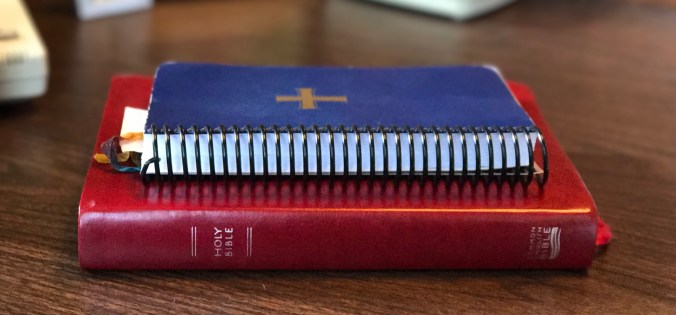
Let us Ramble: Diving Inside

It has been no secret that I have been attending the Academy for Spiritual Formation through Upper Room Ministries over the past 9 months. Once a season, I have travelled to Malvern, Pennsylvania to meet with holy conversation partners and teachers about a variety of spiritual traditions and how they can affect the way we approach spirituality. As much as there is an academic side to the studies, I have found the program to be highly practical and personal.

For our upcoming session, we are looking at both the (w)holiness of the relationship between our physical bodies and our spiritual selves as well as Orthodox spirituality. By Orthodox I mean literally Orthodox Church spirituality—there has not been a ton of lectures teaching heretical matters or anything of that nature.

On a side note, the Academy has actually been a great place to have open discussions on spirituality from a great range of Christian (and Jewish!) traditions without a need for those kinds of arguments, which has been really refreshing after a long traditional education where argument and counter-argument sometimes seemed to be at the heart of the formative process. To put it simply, the Academy is more about discipleship than conversion, which is why I adore my time at the Academy and recommend it highly for people who are tired of argument and long for personal formation. Yes, by the way, it is open to clergy and laity—both are welcome and appreciated in my experience.

While I will admit that a lot of the Academy preparation for the next session makes me nervous as my back has been acting up and I understand that things like yoga might challenge it during the next session, I find myself coming back again and again to the readings for the Orthodox spirituality section of the Academy. In particular, I am working my way through “The Art of Prayer: An Orthodox Anthology” as compiled by Igumen Chariton of Valamo, edited by Timothy Ware, and translated by E. Kadloubovsky and F. M. Palmer.
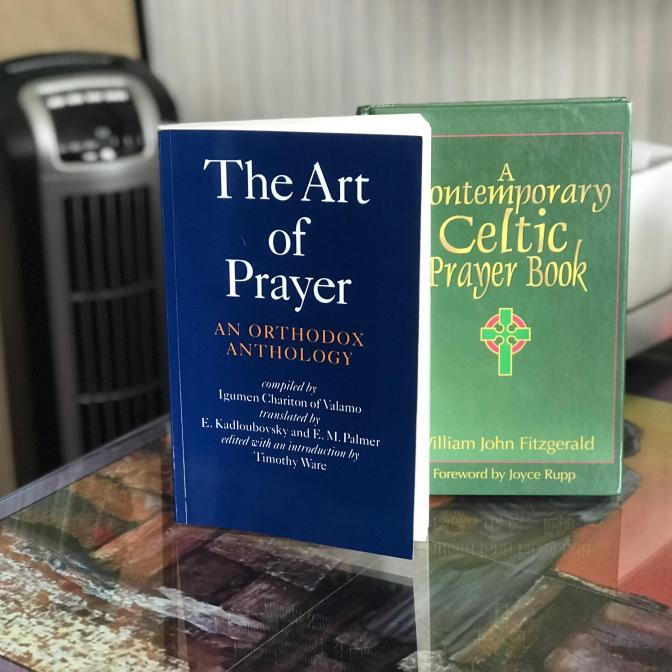
My copy of “The Art of Prayer” along with a subtle suggestion of another cool book filled with very cool resources for next month for all of my Irish loving friends.

A quote has stuck out to me in the introduction by Timothy Ware. Ware quotes Theophan the Recluse as saying “The principal things is to stand with the mind in the heart before God, and to go on standing before [God] unceasingly day and night, until the end of life.” Related to the depth of this idea, on the sixty third page of the anthology (which is where the quote Ware was citing in the introduction resides in the anthology) Theophan writes: “Every prayer must come from the heart, and any other prayer is no prayer at all. Prayer-book prayers, your own prayers, and very short prayers, all must issue forth from the heart to God, seen before you.”

In our church we have been in a lot of deep conversations lately. I personally have been in several conversations where we have had deep debate over leadership from the heart and leadership from the head. Does compassion rule the day when making decisions? Does regulation designed to protect us have the final word in conversation? Does the advice of wise denominational officials have weight equal to the advice of our hearts?

The conversations have been deep, thoughtful, and often stressful in nature. To some extent, some of these conversations have had a depth and thoughtfulness I have not seen since some of those deep lunch table debates in seminary which took place between impassioned people with differing knowledge, tradition, and convictions.

I continue to find myself drawn back to these Orthodox Spirituality concepts in these conversations. Ware connects all parts of the self (identified in his worldview as body, soul, and spirit) through the combining connector known as the heart. The heart is intertwined with the body, the soul, and the spirit in a way that is uniting. On the eighteenth page, Ware says:

“The term ‘heart’ is of particular significance in the Orthodox doctrine of man. When people in the west today speak of the heart, they usually mean the emotions and affections. But in the Bible, as in most ascetic texts of the Orthodox Church, the heart has a far wider connotation. It is the primary organ of [a human’s] being, whether physical or spiritual; it is the centre of life, the determining principle of all of our activities and aspirations…it embraces in effect everything that goes to comprise what we call a ‘person.’”

Today’s post is called “diving inside.” I titled the post this way due to the fact that I have been spending much of the past week diving inside of myself in the midst of these deep conversations and asking questions of myself. If I led (or lived) only from the head, could I stand before God with a soul and spirit that has gone ignored? If I led (or lived) only from the heart, could I stand before God with soul and a body that had been ignored? How could a soul even survive before God without that spirit of courage tended by Jesus or that head full of knowledge that has formed me into who I am today? In short, diving into my life’s conversations lately, I wondered if in any circumstance or path I chose, could I possibly stand before God in my heart without my conviction shattering me into a thousand little pieces?

I do not find it coincidental that the Jesus prayer rests deeply within Orthodox spirituality. “Lord Jesus Christ, Son of God, have mercy on me.” Pondering these matters, I have regularly found myself praying this prayer over the past few weeks, but not solely this prayer.

For me, this prayer is held in contrast with the Lord’s prayer. I am making an audacious or possibly even a (forgive me, but this is literally the right word for the situation) bodacious request when I ask God to lead me besides still waters (Psalm 23 runs through my mind when I see God’s reign and God’s will being done in heaven—I am aware it is technically not in the prayer), when I ask God’s will to be done on earth despite the fact that I need forgiveness for my trespasses, or even when I ask God for daily bread. There’s a sense of an almost arrogant familiarity and assurance in the Lord’s prayer that stands at odds with the pure humility found in the Jesus prayer. The two prayers speak from two very different places.

As I have been diving into these deep conversations and into my own spirit, soul, mind, and especially my heart, I found myself grateful for both prayers. There have been times during these conversations when I have felt the only thing I could reasonably ask of God for myself was the mercy that comes from a place of pure and utter prostration before God’s throne. There have also been times when I have had the assurance to know that the daily bread I needed was the ability to extend compassion from a place of confidence, eyes wise enough to look past fear towards the brightest possible outcome while others struggled with fear and anxiety, and even at time to find hope in Christ’s provision even as the conversation needed insight far beyond the wisdom held by mere mortals like me.

I am reminded of the words our ordination class responded with at Annual Conference when asked “Wesley’s Historic Questions” (which are asked of every United Methodist minister). Every time we were asked a “Will you…” question, we responded “With God’s help, I will.”

In many cases, daily life is like answering those questions. Do I know the answer to every difficult question I face in ministry? Heavens, no. Do I make mistakes? Most assuredly I have made mistakes and will likely continue to make mistakes in the future. Do I have faith in Jesus Christ? Yes. Will I continue to seek after Christ? With God’s help, I will. Will I do my best to live my life from a place of peace where all parts of me can coexist? With God’s help, I will. With all this in mind, will I live my life in such a way that I can stand before God in my heart in prayer? With God’s help, I will.

In the end, I believe that Theophan the Recluse was correct. Every prayer must come from the heart. Since that is true, I must not only guard my heart. I must tend my heart like a garden, After all, in Matthew 15:10-20, the gospels record that Jesus taught that it is not what we eat that defiles us, but what comes comes out of the heart. If I am to stand before God, I must tend my heart zealously. To quote the New International Version of Proverbs 4:23: “Above all else, guard your heart, for everything you do flows from it.” If the Orthodox spirituality of Ware is correct, that guarding and tending of my heart means caring for what exists within me, in my body, in my spirit, and in my soul. With God’s help, I will.

Let us Ramble: An Arresting Quote on Charity

Recently, a college classmate of mine from years ago asked a question on Facebook. If I could write a paper on any female spiritual figure in history, which person would I choose? I love open-ended questions and spent a couple of days perusing the answers until late Thursday morning. I had been working on collecting reports for our Annual Meeting and had just completed a report for a member who is in need of a bit of a hiatus. In other words, I was out of coffee, had been up worrying about my infant with a fever most of the night, and was a bit bleary eyed. I took a few moments to look at my bookshelf for something that I could peruse for a few minutes while my wits came back around to meet me and the next item on my agenda.

My eyes fell on one of my favorite books from a few years back. I came across “The Mirror of Simple Souls” by Marguerite Porete. My edition is from “The Classics of Western Spirituality” of Paulist Press in 1993 and was translated by Ellen L. Babinsky with a preface by Robert E. Lerner. I immediately thought of the post, remembered that nobody seemed to have mentioned this wonderful author, and jumped to share with my old college friend.

IMG_1344.JPG

My copy of Marguerite Porete’s “The Mirror of Simple Souls.” I recommend it highly!

I picked up my copy, began to peruse, and then began to laugh. Did you ever wonder what would get a woman killed by the inquisition in France in 1310? Well, writing in vernacular French didn’t help. What made me laugh was the translation of a part of the trial where the inquisitor is shocked that not only did Marguerite not burn her copy of her book after a former bishop ruled it heretical, she kept thinking it was a good book, and dared to send it to another bishop as well as other simple folks “as if it were good!”

I do love a woman who believes in herself and her God! She spoke the language of the people, cared about the people, and kept on believing in God’s call on her life despite the challenges! Authority should be respected, but let’s be clear—Marguerite Porete saw authority abused and relied on her faith in the highest authority of all! Here was a woman who makes me smile!

I began to spend a few minutes browsing over the pages while working up the courage to go across the way to heat up a cup of coffee. I was reading along when something caught my eye worthy of a blog post and inspirational enough to get me to hold off on grabbing that cup of joe. Here’s what is translated from the fourth chapter of Marguerite Porete’s Mirror of Simple Souls:

“Charity is such a wise merchant that she earns profits everywhere where others lose, and she escapes the bonds that bind others and thus has great multiplicity of what pleases Love.”

I love this concept. As I pen this blog post for Monday morning, I am drawn to think about charity. Charity has many roots and I do not pretend to be an etymologist, but I noted with enthusiasm that the Online Etymology Dictionary stated that around the time of Marguerite Porete’s life, charity became connected with the concept of the affections we ought to feel for other people. In my own imaginary world, there is a distinct correlation between these facts!

I think about the ways we ought to feel for other people and how that inspires us a lot on Mondays. Recently, my primary visitation day for going to visit people in their homes or in care-facilities is on Mondays. As this is posted online (unless something goes askew) I am likely riding in my car down to visit one of our saints in the Triple Cities. Some of these visits are easy to accomplish as the saints in question are lively, ask deep questions, and appreciate a good visit. Some of these visits are heartbreaking at times when the saints are struggling.

When we consider how we ought to feel for others and then when we let those feelings affect who we are as people, we are entering into the purest form of charity. Charity is not meant as something begrudgingly given, something scowlingly given, or something unfortunate that has to happen in order for the charitable person to to be one of the good people. Charity is our opportunity to live into the same gracious love as our Lord and Savior first showed us. Charity is our opportunity to become the hands and feet of God and to enter into the dance of God’s love. Charity is an amazing thing!

Marguerite’s concept arrested my eyes because of the simple beauty of the idea. Charity finds profits where others lose. Charity finds freedom where others find fettering chains. Charity abounds in what pleases Love. These ideas are so simple and beautiful.

How can charity find profit where others lose? Perhaps it is because charity, when birthed by love, sees things through different eyes. The world says that you will never get rich by taking weekends off from work and volunteering to play basketball at the YMCA with kids. You will never get rich volunteering with the Boys and Girls Club or with your church. You also cannot buy the love those kids may come to have for you as a person. You cannot buy their affection, their love, their admiration, their imitation, or any of the other blessings that come being involved in a ministry of charity. You will never get rich with money—you may become rich with love.

How can charity find profit where others lose? Sometimes it is because love follows love. In the spring of 2013 I witnessed the worst community fire of my career in Boonville, NY. The church I was serving became a hub to help provide food, shelter, space for the American Red Cross, and information for the people who were displaced. Do you know what happened when we tried to buy lunch for the people who were displaced? We were matched by others and nobody went hungry. Do you know what happened when we started to collect clothes? The fellowship hall was filled with blessings. Every time we tried to give what we could, others joined in with us in charity. Perhaps you may find no personal profit in engaging in charity, but sometimes the love of God seen in you inspires others to bless those around us.

How does any of this promote freedom? I believe charity breaks the bonds that hold us in place. Often we get trapped within our own prisons by tradition, by circumstances, by our own limitations, and by our own imagination. There can be freedom when charity invites us to feel for others like we ought to feel, when charity motivates us to move past feeling to action, and when charity finally overwhelms our prisons.

The week of the fire in Boonville wasn’t just a holy week. The fire took place during THE Holy Week. We had to cancel our extra services on Thursday and Friday to care for people in need. We worshipped across church lines with Presbyterians and Baptists that week on Maundy Thursday and Good Friday respectively.

They welcomed us as guests and opened their hearts and church homes to us. What kept us from worshipping together before? Pride? Maybe. Tradition? Probably. Silliness? Definitely. I never enjoyed worship services so much as when we came into those churches, sat exhaustedly down, and we were welcomed and loved despite our tiredness and our Methodist personhoods. We United Methodists made space for others and through charity we found the freedom to look beyond our doors. We had the freedom to find our family and spend time with them. The family of Christ worshipped in a holy way that week.

When we engage in charity, we find ourselves in places where we can build up an abundance of love. I will likely be thinking of Marguerite’s call to charity was I walk through the doors of Bridgewater Rehabilitation or one of the United Methodist Homes this morning. I pray that you would find places to fall in love with God, to love your neighbor, and to connect with who you ought to be—someone filled with holy charity, freed by grace, and abounding in love.

Let us Ramble: Solitude, Faith, and Community

A noise tickles my ears as a buzz begins at 5:59 AM. My phone buzzes and begins to flash. I wake up early to check if the paths need to be cleared of snow before the teachers and staff of the church community arrive. After a cold time clearing up the snow with my snowblower and a headlamp, a hot shower to warm up chilled bones, and a hot mug of coffee, I settle at the table with my notebook. Soon, as the eggs bake for breakfast sandwiches for my wife and children, I will find myself digging through the Revised Common Lectionary.

This day I am flicking through the story of Saul being chastised by Samuel for caring more about what his people want than what the Lord required. I write a poem about Saul’s predicament while thinking and praying about what God’s message for Saul says to me as a Christian, as a husband, as a father, and as a pastor. The words are deep this morning as my heart struggles to make sense of the story of God’s chosen one being rejected for his actions. I weigh the passage carefully with others that have been dwelling in my heart.

I find these moments of devotion while the room fills with the smells of cooking breakfast to be sacred. They are not always perfectly isolated. Sometimes I finish my poem while my kids are making cocoa across the room. Occasionally a crying baby will interrupt this time with her needs. It is a time that actually gets interrupted regularly towards the end, but it is also one of the most sacred moments of the day. Even with interruptions, the ground I walk upon in those moments is holy.

In these moments of personal devotion, I sort through my dreams and prayers from the recently passed night. In these moments of personal devotion, I find inspiration that often affects the way I live out my faith life. In these moments of personal devotion, I often find the fuel that feeds quiet prayers for the community which follow. Have I read about love? Standing in the window, cleaning up dishes, I pray with love for the people in my church and community who are in need. Have I read about sacrificing for others wellbeing? I find inspiration to pray for the bus drivers who pass by the window. The personal devotions of my morning feed my time in prayer and help me to do a better job at being a part of a vibrant church community.

Henri Nouwen, in his book “Discernment” wrote (on the tenth page of his book):

“Communion with God alone in prayer leads inevitably to community with God’s people, and then to ministry in the world. But it is good to begin this spiritual movement in solitude…When we are alone with God, the Spirit prays in us. The challenge is to develop a simple discipline of spiritual practice to embrace some empty time and empty space every day.”

For myself, the moments in my day that are emptiest and have space for the Holy Spirit are between checking the paths to see if they are clear and when my children get out of bed. The time that I spend alone with God in those quiet places strengthens my relationship with God. That strength then leads towards others.

Invariably, my time with God tends to lead towards other people. Sometimes my prayers are led towards my family, but more often than not, I find myself drawn to pray for situations around me in the community and in the church. I want to be clear about this fact. My personal devotions do more than inform my prayer. My personal devotions empower my ability to pray. If the spiritual life of a Christian is a river, my time in personal devotion is one of the springs where that spiritual life finds the living water.

When the Spirit prays in us, our lives change. If you look back at a number of the great figures of Christian history, a lot of them speak about powerful moments of connection with God. Some of the descriptions of these moments can induce a blush! These moments of intimacy with God generally did not come out of a place of constant action. If you look, most of these moments come in lives marked by time spent with God. Like any relationship, a relationship with God that is healthy requires time spent together.

So, how do you begin to discern the right time for spending time with God? The first thing I suggest to people who ask me in person is that they chart out their day in blocks. What regular patterns emerge in your daily life? I found myself needing to wake up early to take care of sidewalks for the winter. As such, for this literal season, a period between that daily chore and when the rest of the day began emerged. For some people, there is a lull in the late morning, especially if you are retired or work a second or third shift position. Each person is different and taking a look at your regular patterns can help you notice places that are empty.

Second, if a person cannot find those moments of free time I suggest that there be moments in your day that might be better used doing something else. Back when I tried to engage in evening devotions despite my tiredness, I used to spend my mornings before the girls woke up listening to the news. The news often made me anxious, led to me feeling inordinately stressed at the beginning of my day, and often served more as empty noise than something of substance. I was better served by spending that time with God than spending it listening to the news. I still check the news later in the day, but I first ground my heart and my soul in God before facing what the world will throw at me.

Third, I often suggest that you begin with a simple devotion. There are wonderful resources available through many fine publishers. A trip to a local bookstore will often provide a lot of helpful options. Our church provides copies of the Upper Room Daily Devotional and we would work with anyone who wanted to explore one of the other options available. There are also a number of reading plans available through places like Bible Gateway that can help you to explore your Bible over a set number of days. Even the United Methodist Hymnal has a pattern for daily worship and prayer in the rear of the hymnal. There are many options available.

Fourth, try new things on occasion. If you, like me, enjoy the Guide to Prayer for Ministers and Other Servants, consider using the Book of Common Prayer for a season. If you enjoy using Our Daily Bread, ponder trying out the Upper Room for a time. If you are going through a dry season, it might not help if that season is supposed to be teaching you something, but if your situation is simply fatigue—a change of pace might help.

What suggestions do you have for starting a time of personal devotions? Have any practices been particularly helpful?

Let Us Ramble: Hobbit Holes and Worship

So, I decided that I would spend a day doing a light-hearted blog post. The blog has been pretty dense since I returned from paternity leave, which reflects some challenges behind the scenes of ministry. In the midst of everything, I found myself needing to read to my infant the other day. She would not calm down without hearing my voice while rocking back and forth. I decided to read to her, looked through my Kindle purchases, and began to read her “The Hobbit” by J.R.R. Tolkien.

In the very first chapter, Bilbo encounters Gandalf. Gandalf is seeking aid in an adventure. When Gandalf expresses difficulty with finding someone to join him, Bilbo replies: “We are plain quiet folk and have no use for adventures. Nasty disturbing uncomfortable things! Make you late for dinner! I can’t think what anybody sees in them!”

I started to laugh when I read this passage. I found humor in the fact that Bilbo will definitely go on an adventure, but also because I am aware that the hobbit acts a lot like me! Over the years I have truly enjoyed several versions of “Bag End.” In the apartment that we first shared when I was in seminary, I took over the walk-in closet in our living room and turned it into my office. I spent many hours under a single incandescent light bulb with books of theology, an aging computer, and a cup of coffee. It was definitely my own little hole in the ground. To be honest, it was absolute bliss…

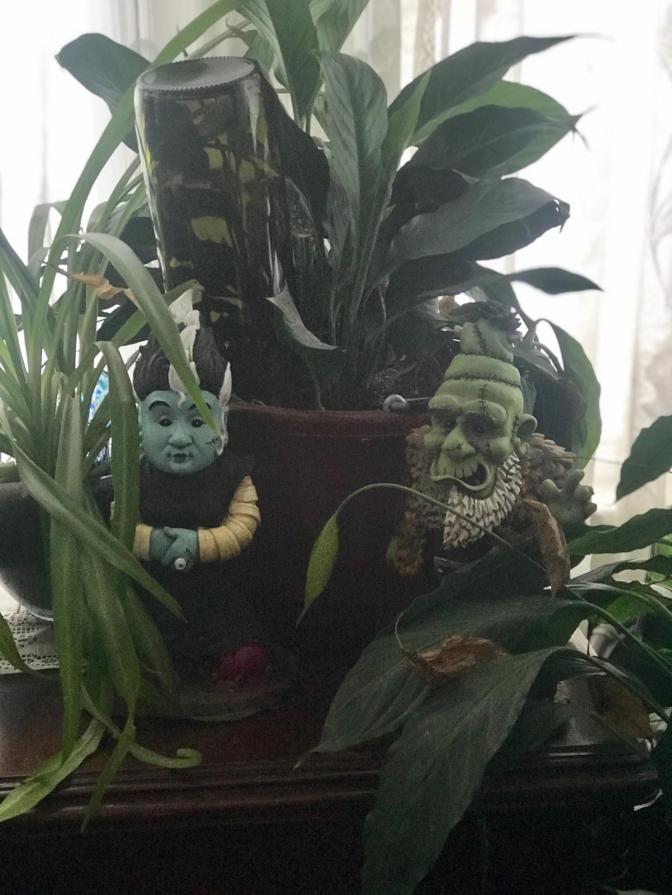
Since we left that apartment, I have not really had a hole to hide in of quite the same caliber, but I have enjoyed several offices over the year. The closest I have come is my current home office which is filled with plants, garden gnomes, and within sight of several rather tookish children that enjoy their own adventures.

Two of my favorite garden gnomes sit right next to the computer desk in our “library.”

I can understand the enjoyment of a space. There is something safe and secure about being in a familiar place with reminders of pleasant days and happy nights. If you invest a space with a lot of happy cups of coffee, hours of research, or even just time spent happily interacting with friends, a space can become pretty comfortable. In fact, it can be hard to walk away from such spaces sometimes…

There is a challenge that comes with living in a land where adventure can come from simply stepping outside of one’s door! Winter is here in the United States. With winter in this particular location comes things like snow, ice, and slush. This area is by no means the snowiest place that I have ever lived. To be entirely honest, it is actually the least snowy location where I have ever resided, but less snow is not the same as no snow.

Some Sundays, freezing temperatures strike and nobody is at the church. Some nights we would have a committee meeting but there’s a forecast that keeps us from having anywhere near quorum.It can be really frustrating to deal with winter adventures, and sometimes we seem to embody the spirit of Bilbo Baggins. “Go to church? In this weather? We are plain quiet folk and have no use for adventures. Nasty disturbing uncomfortable things! Make you late for dinner! I can’t think what anybody sees in them!”

So, here is some advice for people in church leadership during winter:

  1. Love other people. I have been quoting Hebrews 13:1 a lot lately. In that verse we are reminded to “let mutual love continue.” Sometimes people will let us down and not make it to a meeting. Love them. Love them. When you are done, love them some more. Yes, they might take advantage of your love and continue to engage in the behavior that bothers you, but extend love first. All mutual love comes from someplace and we must be willing to love first. I am reminded of the passage I read the other day in “Ways of Imperfection” by Simon Tugwell. In that passage, on page 18, Tugwell points out a story where abba Poemen was in a conversation where several monks were discussing how to deal with a monk who kept falling asleep in church. After several rather strict ideas are suggested, abba Poemen is reported by Tugwell as saying: “If I see that my brother has gone to sleep, I cradle his head in my lap.” If ancient monastic Egyptians can understand the idea of compassionate loving in such circumstances, certainly we can as well.
  2. Consider the circumstances. If you have a meeting with a saint who cannot drive after dark or on roads that might be challenging after peak maintenance hours, do not plan that meeting when things might be iffy. Roads (in our area) are often sketchy after dark and first thing in the morning. A little prior planning never hurt an administrator or worship planner. Late night services might fit the mood of an occasion like a “New Year’s Eve Prayer Vigil,” but be aware your worship time and the weather that surrounds it might affect some people in ways beyond their control.
  3. Consider situational problems. If someone no longer comes because they slipped in your parking lot, consider ways you can make your parking lot safer. Alternatively, ask someone (or go yourself if you are able) to walk with them from their car into the church meeting. Again, a little prior planning is an integral part to good leadership.
  4. Let things go. Nobody is helped when you dwell on things you cannot control. The weather turned sideways and your one absolutely perfect sermon of the year was heard by five people? Well, that happens sometimes. It is better to let go of your frustrations than to let them take root in your soul. You are a walking temple of God. Do not track dirt into your heart.

Those are four pieces of advice for leaders of churches during the slippery months. Do you have any other suggestions? What has worked for you?

Let Us Ramble: Nineveh and Change

I would like to begin this entry by pointing out that I sometimes struggle with the work of the Council of Bishops. I find that they often equivocate on challenging issues and I long for firm statements marked by honest reflection on scripture, tradition, reason, and experience. I long for deep statements based on the discernment that comes from the Holy Spirit. I sometimes feel disappointed, but that’s what happens when imperfect people gather together. Disappointment happens and that disappointment is inevitable. I still respect that body of leaders and consider their words carefully.

So, when I see statements like the one made last week by the Council of Bishops, I find myself doing more than simply paying close attention. I practically cheered when I read the Council of Bishops refer to racist behavior as racist, harmful behavior as being harmful, and urging on United Methodists to call for an apology from President Trump. These unequivocating and straightforward statements were startling coming from the voice of the bishops of the United Methodist Church. I would expect such words from an individual bishop, the General Board of Church and Society, or even individual conferences, clergy, or churches. As it would be almost impossible for the General Conference to gather globally to release a real-time call for repentance, this is probably as close as a statement can come to being a statement on behalf of the church. In the very least, such unity among so many of the leaders of the denomination is a powerful statement. My wife summed it up when she looked it up last night after we discussed how the statement had affected me. She simply said: “Wow!”

So, today I am honoring their request to call for an apology. To be honest though, I do not believe an apology will be enough. I want to call for repentance, but not just from Donald Trump. I believe we have an illness in our society that has allowed us to bring this kind of behavior to the highest levels of leadership. I believe we need to take a long, hard, and somber look at ourselves.

This past weekend the Revised Common Lectionary scripture included John 1:46. I did not preach out of the lectionary this past Sunday, but I know many of my colleagues did preach out of that prophetic moment in scripture. Jesus is beginning his ministry and calls Philip to follow. Philip comes across several of his friends and invites them on the journey with him. One of them, Nathanael, asks Philip if anything good could possibly come out of Nazareth…

Many of my colleagues point out that Nazareth was one of “those places.” Recent national news has focused conversation on several of “those places” in our own world. Could anything good come out of Haiti? Could anything good come out the heart of Africa? Could anything good come from one of “those places?” How are those places tied to the people who live in them? What does it say about the descendants of those places when we speak it such hateful terms?

As many of “those places” are filled with people created in the image of God, many of my colleagues had a field day, but I avoided the temptation to lash out. Today is a national holiday celebrating Rev. Dr. Martin Luther King, Jr., a man whose ancestry arose out of one of “those places.” I wanted to save my words for a more fitting day like today.

So today, I wanted to begin with a story. The story is an old story and was once passed from family to family and from community to community until it was written down.

Once upon a time, there was a kingdom in a far off land. The people of this kingdom were wicked, cruel, and hostile. The king was powerful, mighty, and by no means innocent. People affected by the people of this kingdom cried out to God on account of the kingdom and the great city within it. God heard the cries of the injured, saw the wickedness of the land, and sent a prophet to tell them that their end was coming. For three days the prophet walked across the city and stated their fate.

People burst into a panic. They stripped off their fine garments and covered themselves in sackcloth. They stopped eating—mighty and meek, all of the people joined in mourning. When the king of the kingdom heard the news, he joined in their grief, he sat down in ashes in garments made of sackcloth. He decreed with his nobles that all would join in the great mourning. Humans and animals together joined in the mourning.

God saw their repentance and changed their fate. Their humility and repentance saved them from their own destruction. The prophet was not exactly happy about the situation, but repentance came to that city.

Those of you who enjoy your Hebrew Scriptures probably realize that I was retelling the story found in the book of Jonah about the city of Nineveh. In my career I have preached several times about the story of Jonah being swallowed up and many more times about how Jonah needed to learn about compassion, but I am not certain that I have ever preached on the subject of what happens in Nineveh itself. Nineveh, the great city and all of her people, has sadly become a bit of a means for other lessons in most of my sermons, messages, and reflections.

Yet, I find myself drawn to Nineveh as I consider recent events. In the translation that goes by the name the New Revised Standard Version, Hebrews 13:1-3 says:

“Let mutual love continue. Do not neglect to show hospitality to strangers, for by doing that some have entertained angels without knowing it. Remember those who are in prison, as though you were in prison with them; those who are being tortured, as though you yourselves were being tortured.”

The author of Hebrews calls on the church to do many things in this chapter of scripture. We are called to things like mutual love, empathy, compassion, and even to simply remember what others are going through in different circumstances. We are warned not to forget our duty toward hospitality, for who knows when we might seek to entertain strangers and instead find ourselves in the company of angels?

As a Christian, when I hear words like those shared by the President of the United States last week, I find myself appalled. When the door is slammed shut in the face of people and places where there are serious problems, Is slamming the door in the face of those facing modern struggles really all that different than the people of the early church forgetting those struggling in prison or facing torture? If these conversations really do go hand in hand with conversations around harder standards for asylum seekers, then we need to realize that the words of Hebrews might apply directly to us without much interpretation.

it is my great fear that we are slamming the door in the face of not only angels, but in the face of people created in the image of God. We are slamming the door in the face of those who call out for justice to a God who listens. When we willingly forget our duty to Christ by neglecting love, compassion, empathy, and even memory, we are doing something incredibly wicked. Do we actually believe that we are so unique as a nation that we are above reproach? Where does that kind of blindness come from as a people? Do we forget that God is ruler above nations and not for nations?

Surprisingly enough, when I googled the phrase “sackcloth suit,” there were entries and sponsored ads. Unsurprisingly, the Brooks Brothers suit Google tried to sell me was not made up of sackcloth. In honesty, looking back into Catholic tradition, there has been a history of “hair shirts” made of irritating haircloth meant to inspire discomfort and thus inspire humility, which is quite fascinating. Looking at the history of the practice, the rarity of practice in modern times, and it seems unlikely that I could find any hairshirts at the local mall.

Of course, that’s probably a moot point. I have difficulty seeing sackcloth on many of the folks that I see when I walk past an interview on a television in a store, in restaurant, or on my Facebook feed. I will say that I did go out of my way to pick up a swatch of burlap while out after church yesterday and attempted to make a burlap necklace. I can tell you two things:

  • First, I’m not great at arts and crafts.
  • Second, wearing it for a couple of hours was a real irritating experience. My neck was itchy, irritated, and it made my shirt look terrible. I was considering wearing it for Lent, but it was so difficult to wear without being noticeable that I am going to have to consider alternatives if I am seeking to practice my piety before God and not before other people.

My terrible necklace, wound around my wrist, so you don’t need to see the hints of gray beginning to show up in my goatee…

The attempt did answer a really important question for me though. Is it comfortable to go out of one’s way to repent? Oh, heavens no. The King of Nineveh and the people of that place must have been really uncomfortable and very motivated. They went out of their way to not only refrain from food and drink, but went further to introduce a level of discomfort into their life that must have been incredibly frustrating.

The Council of Bishops is correct. President Trump’s words were racist, are offensive to all people of God who believe that the people of those nations are made in the image of God, and they caused a significant amount of harm both internationally and domestically. President Trump needs to repent. We need to repent also.

I say these things as someone who has needed to do a significant amount of repenting in his own life. I grew up on Grand Island, NY. I grew up believing the Seneca Nation was trying to take away our hometown and I had a lot of very strong opinions about the Seneca. I grew up among a people who looked at the native population of what was my hometown with a less than Christian light. Let’s be honest, at times I was downright racist. I thought of reservations in ways like our President speaks about other sovereign nations like those named last week.

I was wrong. The things I believed were wrong. The way I acted in my heart towards my human sisters and brothers in the Seneca nation was wrong.

My change in attitude started thanks to a band called Five Iron Frenzy singing about social justice and introducing me to a book. I read“Bury my Heart at Wounded Knee” by Dee Brown as a teenager and it confused me greatly. The stories I read were so unlike the stories people had shared throughout my life.

My convictions continued to change when I was invited to go on a Volunteer in Mission trip to Four-Corners Native American Ministries. I was broken down further in my heart while helping fix windows in the homes of widows, standing underneath the Window Rock in the heart of the country of the Wind Talkers, looking over American flags flying over the graves of brave patriots and warriors, and walking through the Navajo Nation Museum in Window Rock, AZ. My best friend Michael (rest in peace, my brother) stood with me under a blue sky as I began to confess my sin and my struggle underneath the eye of Window Rock. It was Michael who told me that I had a lifetime of amends to make and that I would have to keep working at things. I have sought to challenge and grow in my understanding since that day and since that conversation.

I was so ignorant and so foolish to accept as normal what I had swallowed hook, line, and sinker as a kid. I never had an issue with hanging around North Buffalo near my grandmother’s house, even as the neighborhood changed from a primarily European neighborhood to a more diverse neighborhood. I was happy to spend time within walking distance of a comic book store and a “Record Theatre.” (Thanks for the memories Mr. Silver…) I didn’t care who lived between Grandma’s house and my comics and my music. To this day, I still feel more nervous on a reservation than I do in a city, but I know this one thing to be true: If I believe that God’s image is in all people, then all people are worth treating as children of God, whether they live in a city, on a country road, in a Haitian village, on the coast of Africa, or anywhere in God’s beautiful creation.

I do not aim criticisms at the President of the United States lightly or from a place of superiority. I have been complicit in my own biases over the years. Still, truth must be held as truth. Evil is evil. Racism is racism. There is a severe need for not only an apology, but for true repentance when we engage in the acts of accepting and advocating for evil.

The old phrase of Rev. Charles F. Aked stands true as much today as it was in the fight against the abuses of alcohol: “It has been said that for evil men to accomplish their purpose it is only necessary that good men should do nothing.” As a people, we cannot in good conscience stand by in times like these without calling for repentance. What’s more, we cannot in good conscience stand by without examining our own behavior and seeing if we are also in need of repentance.

May God help us all in these challenging times. May we move towards repentance without hypocrisy.

Let us Ramble: Humility and Community

This year in my annual report to the church there’s a strong statement. I wrote in November and revised earlier this month the idea that “ We need to remember that we are a community unified and united in purpose.” I did not make this statement lightly as unity within the body of Christ is one of the most challenging and most important characteristics of a healthy church.

You will notice I did not write the phrase “uniformity” as the goal is one of connection and not utter conformity. Unity and unification around a concept is important for any community, but especially a religious community. To borrow from Henri Nouwen (on the ninth page in his book “Discernment”) we should be united around the idea of our “one true desire—to know God’s heart and do God’s will in all things.”

There is nothing as antithetical to unification around this desire than arrogance. Arrogance leads us to believe it is okay to ignore God’s call to simple concepts like talking to people instead of about people. Arrogance leads us to believe that we are better than each other or better than those called to particular ministries. Arrogance leads us to engage in a lot of the behaviors that hurt and harm churches.

I think Bernard of Clairvaux puts it well. The saint from the 1100s has been translated (by the Cisterian Order in their 1973 critical translation) as saying “If ignorance makes beasts of us, arrogance make us like demons. It is pride, the greatest of sins, to use gifts as if they were one’s by natural right and while receiving benefits to usurp the benefactor’s glory.”

Now, what’s interesting about this quote is that Bernard prefaces it by pointing out that everyone should know two facts: what they are and that they are not who they are by their own power. Bernard states clearly that everyone needs to know that they are who they are by the gift of God and to accept their role with humility.

Leaders in the church (both lay and clergy) are called by God to places of leadership. They are given gifts and graces to fulfill their role. It is great arrogance to both take these gifts for granted and to ignore the responsibilities that come with them. Bernard warns strongly against dulling one’s blessing by forgetting one’s call and forgetting the purpose for which one has been blessed. Bernard, holding a very strong opinion, writes (pardon the 1970s language of translation)

“When a man, promoted to a high dignity, does not appreciate the favor he received, because of his ignorance he is rightly compared to the animals with whom he shares his present state of corruption and mortality. It also happens when a man, not appreciating the gift of reason, starts mingling with the herds of dumb beasts to the extent that, ignoring his own interior glory, he models his conduct on the object of his sense. Led on by curiosity, he becomes like any other animal since he does not see he has receive more than they.”

Leaders are called to live up to the blessings they have received. One of the greatest challenges that faces me as a United Methodist Elder is the echoes of the words spoken by Bishop Marcus Matthews over me at my ordination. I was told to “Take thou authority…” The bestowed authority is an authority that comes with challenges that are well addressed by this article from Ministry Matters. Nonetheless, it is a promotion that comes from a place of high dignity within my tradition.

On my desk there’s a list of people with arrows. I was ordained by Bishop Marcus Matthews, who was ordained by Bishop James Kenneth Mathews, who was ordained by Bishop Benton Thoburn Badly, who was ordained by Bishop James Mills Thorburn, who was ordained by Bishop Edward Raymond Ames, who was ordained by Bishop Robert Richford Roberts, who was ordained by Bishop Francis Asbury, who was ordained by Bishop Thomas Coke, who was ordained by Archbishop Potter, who was the Archbishop of Canterbury or the Church of England, which was born out of direct apostolic succession from the beginning of the church.

There’s a high calling to the authority that was passed to me by Bishop Matthews. To ignore the weight and the responsibility of that calling would be a great sin. My authority as an Elder in apostolic succession comes with a great responsibility to not only maintain the standards of my office but to lead with integrity the people of God towards our one great and true desire.

Bernard’s words are not simply for leaders though. Believers in the church who are called to follow (both lay and clergy—especially if clergy serve in an episcopally based system or in a system where there is discernment of the body held over the discernment of the clergy) are called to know who they are, where they are, what is expected of them, and to accept the gifts granted to them by God with humility as well. Leaders are gifts from God often sent to teach us things that come unnaturally without help. Do leaders make mistakes? Yes, but they are often present to teach us things beyond ourselves.

As an Elder in that line of apostolic succession, I am also called to be a follower. I am asked to respect the bishop who has been discerned and sent to be the leader of my Annual Conference, am asked to respect my District Superintendent and the clergy who are called to assist in leadership through both the Order of Elders and the Board of Ordained Ministry. I am called to respect the Annual and General Conference, the Book of Discipline, the Book of Resolutions, and even to consider the non-binding words of the Council of Bishops with respect. I am called to participate in the life of the Conference and to use my voice, but I am also called to be a part of a system that is larger than myself. I am even called to consider the advice of the folks that I am called to lead, even if obedience is not required in that last situation due to the traditions surrounding both freedom of the pulpit and the role of the pastor within my church tradition. The calling to be a follower is as integral to my leadership as my call to be a leader.

In both these roles there’s a role both for knowledge and humility. Bernard writes:

“We should, therefore, fear that ignorance which gives us a too low opinion of our selves. But we should fear no less, but rather more, that which makes us think ourselves better than we are. This is what happens when we deceive ourselves thinking some good is in us of ourselves. But indeed you should detest and avoid even more than these two forms of ignorance that presumption by which you, knowingly and on purpose, seek your glory in goods that are not your own and that you certain are not in you by your own power.”

Bernard (in context) is talking about more than just physical goods. Bernard previously calls accepting praise for the spiritual blessings and spiritual roles that God has granted and gifted ability for to be no less than vainglory, which is excessive pride and vanity. Goods in Bernard’s view are more than just physical things. All that we have is given to us for the glory of God. When we claim anything as rightly ours by our own hand, whether it be a pair of jeans, a work of art, or a paycheck, then we are missing the point of why we have what we have in this life. To tie it back to Henri Nouwen, we have what we have for our “one true desire—to know God’s heart and do God’s will in all things.”

It is the greatest arrogance to take what we have been given for this one purpose and to use it to do the exact opposite. God is love and calls us to love. If we turn what God has given us to purposes of hate, isn’t that rightly named demonic? God calls us to care for the least of the children of God. If we hoard what we have from God to the detriment of those who need us to be the hands and feet of Christ, isn’t that the very heart of arrogance? Aren’t such acts drawing away or usurping the very glory of our one true benefactor?

When we are blessed by God we are called to live for that one true desire. When the Holy Spirit works and weaves within us, the tapestry is meant for God’s glory. When the Son grants us life and a place within the family of God, we are called to follow his teachings instead of our own.

Let us Ramble: Holy Movement

I have been working through some books lately on spiritual formation. One of them is “Discernment: Reading the Signs of Daily Life” by Henri Nouwen. I am finding it a rich feast of a book which is written to people of all sorts. I highly recommend it if you enjoy a good deep book!

I found myself pumping my fist to one particular passage on the ninth page. Henri Nouwen writes:

“Those who live lives worthy of their calling have been ‘reborn from above’ and are able to see with the eyes of faith and hear with spiritual ears. Their lives of discernment are characterized by single-mindedness: they have but one true desire—to know God’s heart and do God’s will in all things. In the words of Jesus to Nicodemus, they live the truth and seek to ‘come to the light, so that it may be clearly seen that their deeds have been done in God’ (John 3:21 NRSV). Such persons are so caught up in God’s love that everything else can only receive its meaning and purpose in the context of that love. They ask only what questions: ‘What is pleasing to the Spirit of God?’ And as soon as they have heard the sound of the Spirit in the silence and solitude of their hearts, they follow its promptings even if it upsets their friends, disrupts their environment, and confuses their admirers.

People reborn in the Holy Spirit with spiritual understanding come across as very independent, not because of psychological training or individuation but because of the fruit of the Spirit which ‘blows where it chooses, and you hear the sound of it, but you do not know where it comes from or where it goes’ (John 3:8). Spiritual rebirth is an evergreen openness to let the spirit of Jesus blow us where it pleases.”

At various times in my career I have been accused of being too quick to bolt out the door to situations beyond my understanding. There’s some truth to the accusation, but I have to admit that sometimes people love that I have this tendency. I will be praying and I will feel a need to call someone and I will call at just the right moment. I once felt the urge to pull into a hospital and went into the wrong entrance where I met a colleague whose wife had just been admitted in need of a prayer and a hug. The Spirit definitely blows where it pleases and I find nothing so exhilarating as coming across the Spirit at work! I have come to embrace that part of my spirit that loves hearing that quiet voice.

This sign is sitting in our church garage. I want to mount it over my desk!

Of course, this tendency to be always on the move is a very Methodist kind of tendency. Read the Book of Discipline of the UMC and you will eventually find the historic examination put before every Elder before full admittance into ministry. In ¶336 of 2016 Book of Discipline you will find the 19th examination to be in the hard-coding of ministry for United Methodist pastors. That examination asks

: “Will you observe the following instructions? Be diligent. Never be unemployed. Never be triflingly employed. Never trifle away time; neither spend any more time at any one place than is strictly necessary…do not mend our rules, but keep them; not for wrath, but for conscience’ sake.”

I believe Nouwen’s evergreen openness to the Spirit works very well with the historic nature of the Methodist circuit riders. When the road and the circuit used to be before you there was a world of possibility with infinite opportunities. Encouraging circuit riders to never idle away the time made sense. Again, this was not meant to be done in fear of God’s anger but instead to aid an easy conscience in the minds and souls of those called to ministry.

Nowadays, I think that these words are often lost in our culture. To believe that we should never trifle away time is something this is bucked against even within religious circles and the idea of never spending more time than necessary someplace is beyond most of us in the ministry world. Between office hours, worship slide creation, bulletins, and other things that tie us to a desk it can be easy to see why such thoughts of intentional movement are beyond most of us. We are often ensnared by the very things meant to help us accomplish ministry!

There is a part of me that misses the idea of intentionally seeking that disruptive still small voice of God. Let’s be honest—I long for that voice on a regular basis. Do you long for that voice? Do you thirst to know what pleases God and feel passionate about joining into that great ministry? If so, my friends, I invite you to listen, to seek, to discern, and then to follow.

Let us Ramble: The Will of God and Disappointment

So, I am coming up to the end of my paternity leave. I have been spending a lot of time caring for an infant, two older children, and their mother over the past two months. There has been time for bonding, time for cooking, time for laughing, time for crying, and a lot of time for reflection while changing diapers.

In the midst of this time of leave, I have been reading a number of books. One of those books is Simon Tugwell’s “Ways of Imperfection: An Exploration of Christian Spirituality.” Tugwell’s book begins rather strongly with some strong words of admonition. Tugwell speaks of the many moods that the church has held over the span of her life. In my own words, it seems that Tugwell believes that the church has been timid, self-assured, arrogant, humble, bold, and headstrong at different points in her life.

With all of these moods in her past, in times of crisis there are often a myriad of directions in which she can wander. I do not find this particularly shocking as I too have a myriad of directions that I can travel to when under stress. Sometimes I snap at the stressor, occasionally I shrink back, sometimes I have patience, and sometimes I will do something completely different. Tugwell, on the very first page of his work, makes the admonition that in “a time of confusion like our own, when people become disillusioned with the church and with christianity, should be a salutary, educative time, when we face the facts.”

Tugwell proceeds to point out that the church must struggle through questions and seasons of disappointment. I believe there are two reasons why Tugwell is correct in inviting us to confront our disappointment..

First, as Tugwell himself argues, the church is not about fulfilling our hopes, dreams, and ambitions. As a minister, at moments I daydream of coming into a packed church which is filled with parishioners on a Sunday morning. I know lay leaders who have dreamed of people begging to bake for coffee hour or for acolytes who will always light the candles perfectly without any need of guidance. Many people have hopes, dreams, and ambitions about life in the church, but Tugwell is correct. The church of Jesus Christ does not exist to fulfill our own will, but “is a mechanism for subjecting all things to the will of God.”

What does that mean? I do not believe that means forcing our views on others, but it may mean realizing the things we desire and the things that God desires are often very different. I might want to have a perfect acolyting moment every Sunday, but that child who cannot walk without assistance may be called by God to have a role in lighting the candles. Involving her might mean doing something different, like setting up a temporary ramp or assisting her up the stairs. Allowing her that role in the life of the church may cause us to end church five minutes late. Are those five minutes my time or God’s time? My view of what should be may have to go unfulfilled and that can be disappointing. My view of what should be might have to be discarded entirely, but the church of Jesus Christ does not exist to do my will but God’s will.

Second, hinted at by Tugwell, but not entirely fleshed out, is another reason why a church following Jesus might be frustrating and frustrated. Tugwell, while referring to the spirituality of St. Ignatius of Antioch, writes on the third page of “Ways of Imperfection:”

“[Jesus] is our true life, and apart from him we are only ghosts, masquerading as human beings but lacking substance. Faith is the beginning of life, but this has to be fulfilled in charity, and this is a practical matter, involving generosity to others, patient endurance of insults, gentleness, and above all else, belonging to the church, in communion with the bishop and his clergy.”

If Jesus is our true life then we are called into newness. I had professor in undergrad named Dr. Casey Davis who always spoke about the “already and not yet.” Christ is our true life and in Christ we have circumcised hearts! We are already living into that new life but to be entirely transformed has yet to take place. We will live into the fruits of the Spirit fully and completely. We have already begun but the complete fruition of that task has yet to be accomplished. We are already becoming more like Christ but that transformation is a process that can take a lifetime and usually longer.

Disappointment is necessary because we are living in an imperfect world as imperfect people. We should face that disappointment and imperfection with open eyes and courageous hearts. Despite our best efforts, we are but ghosts. Our righteousness is like a rag compared to that of Christ. The church is disappointing at times because it is full of people on their way towards Jesus. When the church is purified and enters into glory, she may lose everything about her that disappoints, but we are still on the journey. Tugwell is right to invite us to be aware of our situation.

So, what if we look at disappointment with the church as an opportunity? What if we find places in the midst of our disappointment to find the will of God? Where are we being led? What opportunities and adventures lie in our future when things are not perfect? Where is the voice of God leading us? What can these up and down moments on the journey teach us about the will of God and where we should be led?

One last quote from Tugwell this morning. On the seventh page, Tugwell quotes the writer of the didache as saying: “If you can carry the whole yoke of the Lord, you will be perfect. If you cannot, do what you can.” What if instead of focusing on our challenges, we do what we can?

Poems: Rev. 16:1-7, Psalm 123

I returned late yesterday from the most recent session of the Academy for Spiritual Formation. My wife had sent me a text and I completely misunderstood the urgency. I rushed into town expecting to head to the hospital. I was mistaken.

While at the Academy I began to explore writing poetry again. It has been several years since I have engaged in writing poetry on a regular basis. I brought a book of poetry to help me to pass the nights in silence. I fell asleep the first night of the Academy with a stanza of poetry ringing through my mind. I awoke after a night full of beautiful dreams remembering why I loved poetry.

When a particular time in reflective silence inspired me to attempt to write a poem the floodgates were flung wide open. I started scribbling, scribbling, and scribbling some more during my free time. I spent an hour reflecting in poems, prayers, and psalms before heading to bed that night. I felt as if a long dormant part of my personality was finally breathing after years of holding a breath.

For the next 18 months (at least), I have set poetry writing based on the daily readings from the Revised Common Lectionary to be a part of my ongoing covenant to grow closer to God. Why? First, you cannot write poetry on a passage without reflecting upon the passage first. Second, most of my poems are shaped around prayer language. Third, it allows me to keep that part of my soul breathing.

To be clear, I am not always going to be sharing poems that I write. As a matter of fact, I wrote three poems today and the first one that I wrote is not for public consumption. Sometimes the poems will just be bad. Occasionally, I am going to take time off. On rare occasions, the poems may not be appropriate, like the poem I wrote based on the Judges reading today. With that being said, I do not mind sharing poetry on occasion.

Today’s readings in the Revised Common Lectionary include Revelation 16:1-7 and Psalm 123. I will share the Revelation poem followed by the Psalm poem.

Pointless Bowl

A voice calls out from the temple:
“Pour out your bowl into the sea!”
So, I pour into brackish water.

A face watches from the shore.
Nothing moves, jumps, or tries to flee.
Eyes behold a sea of slaughter.

He wrote these things down at Patmos long ago.
He did not understand all of the things he did see.
This devastation came as humanity’s daughter.

Silenced Hope

My soul has had her fill.
Scriptural words make hope lie still.
Look at my heart and give dreams to me.
The only Source of light that I see,
Break apart contempt and pride.
Lead us to life–be our Guide.

Creative Commons License
This work by Robert Dean is licensed under a Creative Commons Attribution-ShareAlike 4.0 International License.

Let us Ramble: Bookmarks

I love to read and yesterday I had a few fleeting moments of free time in the middle of my day. A few weeks back my children helped me glue together fancy pieces of paper with old fashioned glue sticks so that I could cut them up and laminate bookmarks for the plethora of books I am currently juggling. I go through a lot of bookmarks between Academy books, science fiction anthologies, short stories, and the occasional need for several bookmarks in a given Bible during a given service. I prepared to make a lot of bookmarks.

The goal was that the glue would hold the paper together so I would not get any annoying slivers of the back of one piece of paper on another. I had nice pumpkins on the side of one of the bookmarks and a nice brick wall motif on the other side. It looked kind of nice as the earthtones of the bricks went nicely with the orange of the pumpkins. I was looking forward to lots and lots of earth tones.

I sliced, I diced, I julienned… Okay, I am kidding. I just used the paper cutter. I cut them all into perfect shapes so that I could put together the perfect set of bookmarks for the fall. I have a new kid on the way, so I know I will need a lot of bookmarks as I dive into the collection of books while rocking. I laminated with exactly a quarter inch of laminate around each bookmark. They were going to be perfect.

I looked down and saw a bunch of bricks peeking out from under the desk. I thought I might have an extra bookmark, but… no pumpkins on the other side. I whipped through the bookmarks. There was a pumpkin bookmark with a glaring-white back in the midst of my perfect bookmarks. Ugh… I was so close to getting everything right! Perfectionism demanded I throw it away!

So close to perfection…

So, realizing my heart was telling me something important, I stopped. Why did it need to be a perfect bookmark? Wasn’t it a laminated bookmark? Wouldn’t it hold the page just fine? Didn’t I love pumpkins? What is wrong with a white back anyway? Why was I so upset about a bookmark not matching the rest?

I slowed down and realized that I was getting carried away. Nothing in life is perfect. Nothing is absolutely, completely, 100% according to plan… What seems to truly matter is what we do with our imperfections. If God can work in my life and I am not perfect, couldn’t I give this poor bookmark a chance?

I still have the bookmark. It won’t be the first one I choose, but I still have it. The bookmark will be a reminder to me that I need to work with the imperfections even as I ask God to work with my imperfections. To put it another way, I can ask God to forgive me my trespasses, even as I forgive the trespass of this poor bookmark.

May you find room to live into the imperfections today. May that space bless you.

Let us Look: Jesus Meets His Mother

For the past few weeks I have been posting reflections on the work of the artist Timothy Schmaltz which is found outside the Malvern Retreat House. The Malvern Retreat House is where my cohort of the Academy for Spiritual Formation meets every three months.

The point of the reflections have been to go deeper into the passion narrative. I have been following a pattern through these contemplations. I seek to show up, slow down, stay still, and stay with each image. Each area of contemplation has led me deeper into each image, so I have been careful to attempt to do all four steps with every meditation.

As I show up with the image, I take the time to be aware of who I am as a person. My own perspective will change the way that I see the station, so I seek to find out where I am in relation to this image as I arrive in this place of contemplation.

The first thing I am aware of in my own life is my tendency to rush past these contemplations. I believe this is partially because I want to move forward quickly, but I am also aware of my own tendencies to always rush past these types of moments. As a self-identified Protestant, I have found myself willing to rush past the passion into the resurrection. I cannot say every Protestant rushes through the passion narrative, but I have the tendency to rush.

The time that I have personally spent with the cross has been time spent either pushing a theological agenda or marching through to Easter. In my earlier days, I would describe the cross as a bridge. I would stand on one side of a giant chasm, eternal life would stand on the other, and I would describe the gap as the place where sin leads to death. A cross would be placed between the two and there would be a bridge. Theologically, I still believe that there is a lot of truth in this illustration, but I would rush over the bridge both in my own description and in my own reality. I do not enjoy time thinking about Jesus’ suffering and I do not want to ruminate on thoughts of Jesus’ suffering, even if I know that such ruminations may bear fruit.

The cross is uncomfortable as it was the place where Jesus suffered. The cross continues as a symbol of a place of sorrow and a place of pain. In today’s contemplation I find myself drawn to an understanding that I am not the only one who sees the sorrow in this moment in time. The station today is entitled “Jesus Meets His Mother.”

“Jesus meets His Mother” by Timothy Schmaltz

“Jesus meets His Mother” by Timothy Schmaltz

As I slow down with this image, I find myself drawn into the imagery. There’s a real sorrow in this station. Jesus has been held for generations of Christians as being fully human and fully divine. Jesus had a mother and today’s image has her clinging to her son’s chest in sorrow. Jesus, as her son, reaches down to hold her as well. Although Jesus holds her, I wonder if he thought of the times she had held him in his infancy and childhood. I wonder if Mary thought of the times she kept Jesus safe by holding him in her arms.

Mary can no longer protect Jesus. Jesus cannot avoid the path that he must tread. There’s a profound sorrow in this image that strikes me deeply. As I stay still with this image I find myself thinking about my own children and my own mother. Could I honestly imagine what it would be like to hold my daughter as she went to her death? The sentence has been announced and Mary will lose her son at the end of his journey. He is going to die.

Even if she has a hope in his resurrection, nobody would want to watch their son go through this kind of pain. In my own contemplation I am drawn back to my younger daughter Joy at the hospital around a year ago. She went into surgery for a tonsillectomy without any real concept of what pain she would be going through in the next few days. She thought her immunization shots were awful. I remember her cries of pain after the surgery. I remember holding her close to my chest as she wept in pain. I remember the feeling of absolute helplessness that I felt while I held her tight and wished the pain away.

Was Mary having such memories of the first time Jesus stubbed his toe, got picked on by a neighbor, or had a rough day? Did she feel the hot bruises on his body? Did she see the blood pouring from her son’s forehead? Can you imagine the sorrow she must have felt? I could not wish this fate on any parent.

As I think about what will stay with me about this contemplation, I think it is a deep appreciation for what Mary went through as a parent. I will hug my kids extra tight tonight as they go to bed. I will think about what Mary went through and I will mourn the sorrow of her pain. Thank God that Easter happens, but can you imagine dwelling in that loss for three days?

Let us Seek: The Mourning Faithful

I decided to tackle a difficult subject in today’s blog post. One of the sets of readings for today in the Revised Common Lectionary includes Genesis 49:29-50:14. This passage is one of the more poignant moments in the relationship between Joseph and his father Jacob.

Jacob had loved Joseph dearly as a child. The coat which Jacob gave to Joseph is the inspiration behind one of the most popular musicals of the last century. The affection of Jacob for Joseph was pervasive and powerful enough that it inspired artistry from ancient times until the modern day. Their separation had been ended after a period of grief and mourning after circumstances led them together again as a family in the context of a famine in the land of Jacob and abundant stockpiling in the land of Joseph’s servitude in Egypt. The struggles between Joseph and his brothers led to Joseph being able to provide for his family in a time of need. God blessed Jacob and his family through even the rough circumstances endured by Joseph. Joseph’s faithfulness saved his family. Today’s story is about the next separation between Jacob and Joseph.

Joseph was faithful. Joseph’s father still died. Jacob did not live forever. The affection and love between the two moved from a daily reality into a matter of memory for Joseph. Joseph still experienced lost despite all of his faithfulness, all of his goodness, and all of his fidelity to God.

Even faithful people experience loss. Many people see the loss of a parent, a friend, or a child as a punishment from God. Sometimes loss can feel like a punch in the gut and I would never belittle or berate someone for feeling grief. Still, it must be said that for now death is a reality which all people must face in time.

Scripture is filled with the faithful of ages past and almost every single person in the stories of the scripture experienced death both in their immediate family and eventually in their own experience. Were it not for Enoch in Genesis 5 and Elijah in 2 Kings 2, every single person in the scriptures who have been described as dying or would have died by chronological inevitability, including Jesus Christ, the Son of God.

Yes, Jesus died. Yes, Jesus rose. Yes, Jesus will come again.

One of the promises in life which is clung to by many of the faithful is that death will eventually be no more. I look forward with anticipation to being with my mother and my grandparents again on the distant shore which I will reach when I have passed from this life or Christ comes again, but neither of those moments have yet to pass in my life. For now, death is a reality which we all must face, whether we are Jacob, Joseph, or even my own children.

I believe that Joseph’s journey can teach us some things about our own journeys of grief. First, I think there is something wise in the concept of leaving room for our own grief. Joseph not only goes about the task of preparing his father’s body—Joseph enters into grief. He takes time to go on a journey to the land of Jacob and he spends time there in mourning. He accepts his sorrow, laments what has happened, and spends seven days in grief. He does not simply rush through the motions—Joseph takes time to grieve.

Second, Joseph does not shun his loss or pretend it does not happen. Joseph goes to Pharaoh, explains his promise, and takes time away from his responsibilities. Joseph did not live in a time where he earned paid time off for his service to the Egyptian monarch. Joseph had to intentionally ask for space. His request could have serious consequences (like those experienced for rejecting another man’s wife earlier in his life), but Joseph is willing to risk the consequences because he has accepted the value of what must happen. His grief might have a cost but Joseph is willing to pay the cost, even if it causes him influence, pride, or even prestige.

Third, Joseph eventually returns to life. In time, after he has paid all due respect and has cared for his responsibilities, Joseph goes on with life. Joseph returns to Egypt and resumes the tasks which have been set before him by the Pharaoh.

In time, we all enter places of grief. In time, we all struggle. Even the most faithful of individuals eventually has to face the journey to the other shore, whether in the life of a loved one or on our own journey. As you inevitably face grief, I pray you find the tenacity, courage, and eventual ability to move forward that was modeled by Joseph.

Let us Seek: “If it had not been…”

One set of today’s readings from the Revised Common Lectionary includes Psalm 124. Psalm 124 is one of my favorite psalms from a rhetorical perspective. I adore the repetition of the phrase “If it had not been for the Lord who was on our side.” The phrase is used twice in the first two verses of the psalm. They are only separated by the phrase “Let Israel now say” in an attempt to compel the people of God to join in the chorus.

The psalm reminds me of countless worship services, concerts, and festivals where I have heard a singer invite the audience or congregation to join in the music. While this is not a call and response situation, the power of the phrasing brings to mind the same compulsion to join in the song of the faithful. Robert Altar notes that he shares this impression in his translation and commentary “The Book of Psalms: A Translation with Commentary” (New York: W. W. Norton & Company, 2007). Altar writes: (443)

“The second of these two versets is a formal exhortation, probably on the part of a choral leader, to the community of worshippers to chant the words of the liturgical text that begins in the first verset and continues in verse 2 through to the end of the psalm… The Hebrew, with its abundant use of incremental repetition, has a strong rhythmic character that would have lent itself to singing or chanting”

I am glad Altar agrees with my reflections and my tendencies with this psalm. One reason that I am glad is that I always appreciate being verified in my assumptions by a respected scholar like Robert Altar. The second reason that I am glad is that psalms like this psalm always strike me as invitations.

What if this psalm is an invitation to look at our own perspectives and experiences with a similar lens? The Psalmist claims the help of the Lord in the midst of challenges within this psalm. The Psalmist looks at the circumstances of challenge in life and notes God’s presence has made a difference in the life circumstances of the congregation. This invitation is especially powerful when we consider that the community as a whole is invited to join in the proclamation.

If I were a Hebrew man who was joining in this psalm, what might I think about as I talk about the powerful and salvific presence of God? Surely, I would consider the events of the Pentateuch and the salvation of the Jewish people, but I might also consider the times when I was sick and I felt God draw me out of the darkness. Surely, I would consider the events in the lives of the prophets, but I might also remember the times I stood by listening to my wife screaming as a child was brought safely into the world. There might be many thoughts on my mind as I joined in the psalm if I were a Hebrew man in the great congregation of the faithful.

So, what do I think of when I consider this psalm today? If it were not for the Lord, would my kids be healthy and safe? Surely, I am blessed by the world where my children live, but let us be clear. My children bear my genes and often my idiosyncrasies. I am surprised enough to have survived my own silliness and to have lived into the life I now lead. I am even more surprised it appears to be happening again! If it were not for the Lord, would I be here today? If it were not for the Lord, would my kids be safe and happy? I believe God has had a role in the lives of my family. If it were not for the Lord, my own silliness might swallow us up. Thanks be to God!

Where do you feel blessed by the Lord? What places in your life might have turned out differently if it were not for the Lord?

Let us Ramble: On Unity

Unity is currently an interesting word within United Methodist circles. The United Methodist Church is currently in prayer for “The Commission on a Way Forward” (hereinafter, “Commission”) The Commission was established by the 2016 General Conference of the United Methodist Church by the General Conference delegates at the request of the Council of Bishops. Conversation has revolved around concepts like unity as the Commission has continued to meet over the past year.

As a result, of this conversation, my eyes have been drawn to the word “unity” when I have come across it both in my reading and in my study. I was drawn to thought when I came across the collect “For the Unity of the Church” in “The Book of Common Prayer and Administration of the Sacraments and Other RItes and Ceremonies of the Church: Together with the Psalter or Psalms of David according to the use of The Episcopal Church” (hereinafter, “BCPASORCCTPPDAUEP” (just kidding)). The collect reads: (certified 2007)

“Almighty Father, whose blessed Son before his passion prayed for his disciples that they might be one, even as thou and he are one: Grant that thy Church, being bound together in love and obedience to thee, may be united in one body by the one Spirit, that the world may believe in him whom thou didst send, the same thy Son Jesus Christ our Lord; who liveth and reigneth with thee, in the unity of the same Spirit, one God, now and forever, Amen.”

In a similar manner, I was drawn into prayer and contemplation by the first full paragraph of the letter “From the colony of the Church of God to the colony of the Church of God at Corinth, called and sanctified by the will of God through our Lord Jesus Christ,” which is found in “Penguin Classics: Early Christian Writings” as translated by Maxwell Staniforth and revised by Andrew Louth (New York: Penguin Books, 1968). The paragraph which caught my eye reads:

“Because of our recent series of unexpected misfortunes and set-backs, my dear friends, we feel there has been some delay in turning our attention to the causes of dispute in your community. We refer particularly to the odious and unholy breach of unity among you, which is quite incompatible with God’s chosen people, and which a few hot-headed and unruly individuals have inflamed to such a pritch that your venerable and illustrious name, so richly deserving of everyone’s affection, has been brought into disrepute.”

The concept of unity caught my attention sharply in both of these readings. I was sharply caught by the ideas in the letter from Rome to Corinth, which is generally considered to have been authored by Clement of Lyons, the bishop of Rome at that time. Clement’s words were very strong. Disunity is described as having brought the name of the church in Corinth into disrepute. Indeed, of all of the struggles being faced by the church in Corinth, the disunity in the community is the very first thing that the church of Rome brings to the forefront for conversation.

Certainly, there is a brief statement of thanksgiving and blessing as per the custom of letter writing in that era. The church in Corinth is acknowledged to be called and sanctified. Indeed, before the letter writer enters into our quote, the writer also expresses the blessing, “All grace and peace to you from God Almighty, through Jesus Christ.” The combination of these statements is very brief and Clement is very clear that this is a situation that deserves to be addressed even as the church in Rome has her own situations to work through in her journey of faith.

Indeed, Clement was very concerned about the disunity of the church. The very next sentence Clement writes is, “There was a time when nobody could spend even a short while among you without noticing the excellence and constancy of your faith.” The connection that I make in this reading is that the disunity of the church in Corinth has led to others seeing their faith as being inconsistent and less than excellent. There’s a high opinion of unity in Clement’s writing.

Indeed, the high opinion of unity is seen in the collect. The collect asks God for unity within the church so that the world might believe in Jesus Christ. The church is called to unity in the collect through the binding together of the church by both love and obedience. Love and obedience are seen as reasons for unity within the life of the church even as that unity is seen as a converting witness.

Indeed, Jesus prays in John 17:11, “Holy Father, protect them in your name that you have given me, so that they may be one, as we are one.” Jesus prayed that we would have unity as a people. There is a strong emphasis on the importance of unity in Clement, in the prayers of the church, and in the scriptures themselves.

So, if unity is so important, why is it ignored so often? Why do we engage in behavior like gossip if we know that there is almost no quicker way to stab unity in the back than to engage in gossip? Why do people hop from community to community looking for people like us if we know that we are called to be in community across the spectrum? Why do we do the very things that we do?

In many ways, the struggle of the church over questions of unity throughout the centuries reminds me of the writings of Paul. Ironically, while writing to the church in Corinth, Paul describes a struggle that he has faced in 2 Corinthians 12. Paul describes how there is a thorn in his side which has forced Paul to his knees in prayer repeatedly. Paul uses that thorn as a reminder of his weakness, a reminder of his dependency on the grace of God, and as an invitation to contemplate the power of Christ.

I wonder if our ongoing struggle with these concepts is continual because we are in need of a reminder of our weakness. I also wonder if our ongoing struggle with gossip is a sign of our unwillingness to let go of this most basic of sinful behaviors. Indeed, the works of the flesh listen in Galatians 5 include such sinful vices as dissensions, factions, strife, enmities, and other behaviors which should be excised from the life of the faithful. As Paul states in Galatians 5:21, those who do these things will not inherit the kingdom of God.

Unity is a concept that I believe we all need to be in prayer around as a community. God’s call is for us to be one. It deserves to be noted that God does not call for uniformity among the church. God’s call is for us to be united in Christ and unity does not require absolute conformity.

Paul seems to agree with this assertion that unity is important. Clement seems to agree with the assertion that unity is important. The collects and prayers of many modern denominations seem to agree with this assertion that unity is important as well. With such a great cloud of witnesses inviting us to see the importance of unity, it is crucial that we be in prayer both on obtaining unity and understanding what unity might actually look like in our context.

Let us Look: Jesus falls for the first time

One of the blessings of the Academy for Spiritual Formation is that the session I am attending is located at the Malvern Retreat House. The Academy is located in some fairly beautiful scenery. For the past few weeks I have been journeying into the concept of contemplation by spending time with the Stations of the Cross located near the Retreat House. In particular, I have been trying to explore how the statues in that particular set of stations lead me to go deeper into the scriptural narratives of the passion narratives of the four gospels.

This week I am spending time with the third station on the journey. I have previously blogged about the first station which depicts the condemnation of Jesus. I have also blogged about Jesus taking up his cross for the first time. This third station on the journey was also created by the artist Timothy Schmaltz. I will admit that I think this particular statue is a bit…cartoony in the depiction of Jesus’ fall. I continue to be unable to see how it would be possible to fall in the particular method depicted. This week there are two angles we can use to ponder the image.

Statue by Timothy Schmaltz outside of Malvern Retreat House

Statue by Timothy Schmaltz outside of Malvern Retreat House

As previously stated, the four stages of contemplation that I am using for this particular exercise are as follows:

  1. Show up
  2. Slow down
  3. Stay still
  4. Stay with

As I show up with this meditation, I find myself drawn in memory to a conversation with a friend I made at the last session of the Academy. We had conversed about how the statue did seem a bit humorous. Jesus is flying through the air in this statue. The cross has struck him right in the gut.

I am struck by the power and influence of memory upon contemplation. There is absolutely no way that I could contemplate this image without acknowledging the laughter and joy that came out of the conversations revolving around this statue. There certainly is a point where laughing at a depiction of aa serious event like this seems sacriligeous, but the laughter comes from a place of joy and connection. Acknowledging the distraction is part of showing up in this moment. It is also important to realize that when you try to avoid thinking about something, it invariably is the only thing you can think of in the moment.

Distractions are a regular part of my devotional life in general. In my devotions I copy out the scripture of the day by hand into a journal to make sure I am being mindful of all of the words before returning to read the passage aloud. In copying scripture I often find myself thinking about other things, much like I am thinking about how it is possible to fall in the way Jesus is portrayed in this statue. I learned to acknowledge my distraction, make a note if needed, and then set it aside. Distractions come in a life of faith. What is important is how we deal with them when they arrive.

I am still drawn to the humor as I slow down into contemplation, but my focus changes. How could such a thin cross cause such an effect? How could it throw Jesus in such a manner? Perhaps Jesus is thrown so violently as this is the moment when the weight of what is coming to pass finally falls. There will be no avoiding the effect of this journey—Jesus’ strength will fail and Jesus will die at the end of this journey.

Perhaps the person who should be struck in the gut hardest by this moment is the person who views this statue. As light as the cross appears, to fly through the air and land on one’s back is a pain most of us have experienced. Most of us know how it feels to be absolutely out of control, flying through the air with no idea how we will land. These are the things that Jesus went through in those hours. Jesus had events go out of his control. The cross would force him to the earth three times.

I stay still with this idea of helplessness. As spectators, we can no more control what Christ went through than the Jesus who is flying through the air. The God of the Universe comes down to earth, enters into creation, lives into adulthood, and ultimately is brought to a place where the creation God loves looks on while loading Jesus with uncontrollable and ultimately uncarryable burdens.

This helplessness comes about at God’s own choice. God’s love for creation and for me was so great that Jesus underwent this helplessness to fulfill all righteousness. The great high priest of Hebrews brings the sacrifice and the sacrifice is personal, costly, and painful. Although Jesus will come to sit down with the job completed at the end of this journey, at this moment Jesus, who prayed for this cup to pass, is helpless as much before God’s love as the weight of this cross.

Perhaps the cross is so thin because it is not really the cross that is the heavy burden Jesus must carry. God’s love demands that Jesus give all in this moment. What heavier burden is there in this life than to lay down one’s life for the very people looking on with anger because you love them?

As I consider what will stay with me this day, I think the thing that will stay deeply and closely with me will be the very idea that God’s love is what bore Jesus to the ground. As much as I sometimes get caught up in the world around me, I find myself hoping that I am not the one who sits on the edges of the crowd. Are my frailities and faults part of what bear Jesus to the ground? What greater love is there than the fact that God loves me enough to not only forgive my weakness but to welcome me home?

Let us Ramble: Stilling hunger

I was not hungry as I began my devotions this morning. A parishioner had a bumper crop of hot peppers which she recently shared with me. I was not hungry for food at all as my stomach was filled with an omelette that was stuffed with spicy goodness.

I was not thirsty as I began my devotions this morning. I had an ethically-sourced cup of coffee which sated my thirst quite nicely. The cup of coffee was a good cup of coffee with strong flavor.

I was neither hungry nor thirsty as I began my devotions this morning, but that state of being changed as I spent time in reflection. I came across a quote from Henri Nouwen as I was working through my favorite devotional book “A Guide to Prayer for Ministers and Other Servants.” This quote from Henri Nouwen is sourced by the Guide as coming from “Reaching Out”:

“The Gospel doesn’t just contain ideas worth remembering. It is a message responding to our individual human condition. The Church is not an institution forcing us to follow its rules. It is a community of people inviting us to still our hunger and thirst at its tables.”

As I came out of the reverie, contemplation, and depths of my devotions, I found myself wanting to share this quote with others. There were deeper matters in my devotion this morning, but this was a word I felt needed to be shared for a simple reason. I am not certain the world sees the church in this light.

A Powerful Pair

My devotional and one of my Bibles


I grew up in a northern home in a house that was very Protestant. My mother had been Roman Catholic but had become United Methodist when she married my father. We went to a United Methodist Church every Sunday and were taught things like “God loves all people.” There were moments when my family struggled with racism, but I do not believe that is a unique situation. On the whole, we were taught that the church was open to people of all races and ethnicities. My general thought process was that if God welcomed people of every variety into the family, shouldn’t we? Even in the extremely European communities where my family lived, seeing someone of another race was not the kind of thing that made one exclude and hate, so much as just being the kind of thing that made you say “Oh, hey. That’s different. Whatever.” I was not the most enlightened of kids, but at least I was not malicious. I was more ignorant than anything else.

When the time came to be educated about the past of our nation I remember reading stories of the activities of the KKK with horror. I was not just horrified about the way that people treated the “other” in these stories. I was offended by someone burning a cross as a symbol of hatred. I was furious that they would try and use a symbol of love and inclusion to threaten people! The behavior I was learning about was simply unacceptable.

I saw the church as a place where God’s love leveled the playing field of life. I saw the church as the place where we could look beyond our differences and find community. I saw the church as a place where even ignorant kids like me could find a home as we grew. I was absolutely horrified by what I learned. I began to ask questions of youth leaders and my good friend Jim Patterson who was an elder in an urban Presbyterian Church invited me to think deeply about what united us with different people.

In college I studied with Dr. Middleton who brought a global perspective to my theology, although it was still very much a western perspective. When I went to seminary I studied African religious history and African American religious theology. I was enthralled because the words I was reading were far different than those in my own heart. I literally read “Stony the Road We Trod” to my daughter as an infant on the day she was born because I did not want to fall behind and because she liked the sound of my voice as she napped against my chest. I read, I pondered, I made friends, and I tried to know more and more about how the Bible looked to people who were not like me.

For me, the church had become a place where I could safely challenge my own assumptions, grow deeper in my faith, and help the world to become a better place. When I hungered for knowledge, there was almost always a wise colleague or friend who could help me go deeper. When I thirsted for righteousness, there was almost always some place I could go to work towards a better world. When I had a need to belong, to grow, to work, to live, and to be a part of something greater than myself, the church was there to push me forward.

I do not think the world sees the church in the same way, especially when sometimes the first exposure people have to Christianity is images of burning crosses, abortion protestors with horrifying pictures, or bullhorn wielding “prophets” telling everyone they are going to burn in hell. Not everyone is lucky enough to have been nudged into the path of knowledge, faith, and blessing which I was blessed enough to find in my own life.

I am hungry and thirsty. The coffee still takes care of my natural thirst and that omelette is doing remarkably well at holding off my hunger, but I am hungry and thirsty for other things. The world does not see what a blessing the church can be in the midst of life. I want people to see a world where the church can be a place more concerned with community than regulations. I want people to see a world where the church is more concerned with bringing good food to the table than in meeting the budget so we can have fancier napkins. I want people to know that the church exists to be a blessing. All of our lives are made better each time someone joins in at the table. I wish people understood the power of the church fully active and empowered. Indeed, Irenaeus, the glory of God is humanity fully alive in Christ.

Let us Ramble: Transients

I struggled to finish my sermon this weekend at the Maine Federated Church. The subject was challenging, but I was prepared. I struggled to finish my sermon because the cold of the previous week had beaten my voice to a pulp. We were preaching on baptism and how baptism was opened to people of all races. We shared that God loved all people. I publicly declared that God does not think of one race as superior to another. We spoke of deep things even as my voice started to crack.

Sunday night, I watched my Facebook feed explode with statements from pastors and committed Christians from across the spectrum. The vast majority of them were incredibly clear. “Racism is bad.” “God loves all people.” A few of the statements were provocative. A few statements seemed more concerned with politics than with what was actually happening. My public statement on Facebook was to reblog a “Litany against White Supremacy.” I will admit, I was still exhausted by my cold, so I was willing to let that stand for a day or two until I could get a good night’s rest.

Well, I am rested now. I have a cup of hot coffee to sooth my throat muscles, I have spent some time centering myself in my daily devotions, and I am prepared to enter into my pastoral role as one of the resident theologians in my community. So, let’s lay out the theological argument I wish to make. I will not be pulling punches today.

  1. It is a Christian’s duty to live with a sense of humility
  2. It is a Christian’s duty to love people like Jesus
  3. White Supremacy should be considered an abomination

I believe that it is a Christian’s duty to live with a sense of humility. I believe that is a belief that long predates Christianity, has been passed down from our Hebrew forebearers, and should be passed along from generation to generation. I believe that pride has been an issue for the church for nearly the entirety of our history and must be fought with all sincerity.

In my own studies I have been reading through “Penguin Classics: Early Christian Writings,” which is a translation by Maxwell Staniforth (revised by Andrew Louth) of some early letters of church leaders. One letter translated was from the church in Rome to the church in Corinth. It was written by one of the early church leaders in Rome named Clement and is generally considered to have been written during the last decade of the first century with a high probability of having been written around 96 CE. A passage from this letter from one church to another strikes me as fitting and applicable: (¶30)

“Since then we are the Holy One’s own special portion, let us omit no possible means of sanctification. We must bid farewell to all slandering, lewd and unclean coupling, drinking and rioting, vile lusting, odious fornicating, and the pride which is an abomination. God, it says, opposes the proud, but he gives grace to the humble; so let us attach ourselves firmly to men who have received this grace. Let us clothe ourselves in a mutual tolerance of one another’s views, cultivating humility and self-restraint, avoiding all gossiping and backbiting, and earning our justification by deeds and not by words… Self-assertion, self-assurance, and a bold manner are the marks of men accursed of God; it is those who show consideration for others, and are unassuming and quiet, who win His blessing.”

So, Clement was very opinionated. Clement uses several words and makes several claims that I am unwilling to make throughout his letter, especially on the role of women in their homes. I am very glad that this letter is not a part of our scriptures for several reasons, but there are some gems to be found in this old letter.

First, there seems to be a strong opposition to pride in Clement’s worldview. In some places, such as Clement’s insistence on quiet obedience of women, the adoption of humility as a driving force of church life is less than ideal in a modern context, In other places, such as the passage above, there’s a real sense of force behind Clement’s words. Looking through the list of sins Clement lists, the one which is singled out for being especially onerous is pride. Pride is the thing which Clement nails over and over again throughout his letter.

  • ¶16 “Christ belongs to the lowly of heart, and not to those who would exalt themselves over His flock. The coming of our Lord Jesus Christ, the Sceptre of God’s Majesty, was in no pomp of pride and haughtiness—as it could so well have been—but in self-abasement…
  • ¶35 “Wickedness and wrongdoing of every kind must be utterly renounced; all greed, quarreling, malice and fraud, scandal-mongering and back-biting, enmity towards God, glorification of self, presumption, conceit, and want of hospitality; for men who do these things—and not only men who do them, but men who consent to them—are held in detestation by God”
  • ¶39 “Men who have no intelligence or understanding, men who are without sense or instruction, make a mock of us and ridicule us, in their wish to raise themselves in their own esteem. But what is there that anyone who is mortal can really effect? What force is there in anyone born on this earth?”

Clement was very clear in his letter that pride was a serious issue. It can be inferred that Clement speaks out of the worldview of the early church. The conception of pride being an issue and the value of humility was nothing new to Clement or the church in which he lived. We can head back to the end of 1 Chronicles to see King David share similar sentiments. David says in 1 Chronicles 29:10-18: (NRSV)

“Blessed are you, O Lord, the God of our ancestor Israel, forever and ever. Yours, O Lord, are the greatness, the power, the glory, the victory, and the majesty; for all that is in the heavens and on the earth is yours’ yours is the kingdom, O Lord, and you are exalted as head above all. Riches and honor come from you, and you rule over all. In your hand are power and might; and it is in your hand to make great and to give strength to all. And now, our God, we give thanks to you and praise your glorious name.

But who am I, and what is my people, that we should be able to make this freewill offering? For all things come from you, and of your own have we given you. For we are aliens and transients before you, as were all our ancestors; our days on earth are like a shadow, and there is no hope. O Lord our God, all this abundance that we have provided for building you a house for your holy name comes from your hand and is all your own. I know, my God, that you search the heart, and take pleasure in uprightness; in the uprightness of my heart I have freely offered all these things, and now I have seen your people, who are present here, offering freely and joyously to you. O Lord, the God of Abraham, Isaac, and Israel, our ancestors, keep forever such purposes and thoughts in the hearts of your people, and direct their hearts towards you.”

At this moment in the story of scripture, David has prepared the way for his son Solomon to build a temple in Jerusalem. David has accomplished a great deal in his life and is approaching the end of his reign. David has led imperfectly but is completing his reign in peace, which is a blessing few of his descendents would know as the generations would pass. Here at the end David gives thanks to God through an honest lens that gives thanks to God and puts his life in perspective.

David sees himself as a transient in these words. He does not claim the right and power over all that he had done and all that he has gained. He seeks humility. He states that all of God’s blessings are from and ultimately are for God’s purposes. He lives out the humility that Clement claims we must seek. Clement is echoing David’s statement on human transience in this life when he asks what real effect the proud can have in this world. The people of God are here in this world for a moment. The people are being invited to live in humility by both Clement and David.

Going back further we see a real sense of a call to humility from the earlier tales of faith. When Abram was called in Genesis 12:2-3, the following words are shared (in the New Revised Standard Version) with the one who would become Abraham: “I will make of you a great nation, and I will bless you, and make your name great, so that you will be a blessing. I will bless those who bless you, and the one who curses you I will curse; and in you all the families of the earth shall be blessed”

From the very beginning, the call of God comes with an understanding that the blessing that will come to Abraham is for the very purpose of Abraham becoming a blessing to all the families of the earth. His call is to head out into the world as a transigent. His call, the call to create a nation, will begin with him being an immigrant in a strange land. The call of Abraham is not into a castle or highly advantaged place in society, but to live as a stranger in a strange land.

Throughout the scriptures, God calls the humble time and time again. Even figures like Jacob, who was not humble, had to go through humbling circumstances before they were fully ready to take their place in the story of God’s life-bringing and grace. Being a Christian is a call into a tradition which has been marked by a strong need for humility. Jesus told a parable in Matthew 26 about an employer who hired servants throughout the day and paid each the same amount to each. The ones who began earliest in the day believed they deserved more, but it was the employer’s choice to be generous. All who follow Christ are called to understand that by God’s choice the first may become last just as the last may become first.

I also believe it is a Christian’s duty to love people like Jesus. When Jesus came across the other, Jesus acted with compassion. It is true that Jesus called people to repentance and expressed extreme disappointment and occasionally foretold woe for cities that refused to repent like those in Matthew 11:30-34 and the Samaritan village in Luke 9:51-56. Jesus also expressed hope for those of other races than those of Jewish descent when we shared the parable of the Good Samaritan in Luke 10:25-37, shared a story of a faith-filled Roman Centurion in Matthew 8:5-12, and told the story of the Samaritan woman in John 4:1-42. Jesus seems less concerned with where people are from than how they react.

Jesus’ love was not bound to one race or one people. The very call of Acts 1:8 is to make disciples by witnessing to the ends of the earth. The very call of the Great Commission in Matthew 28:18-20 is to go out and make disciples of all nations. The call of God is to reach out to all people because God called for all people. Jesus’ compassion was for every people of earth—that is why are were sent out to share the good news in the first place.

This should go without saying, but this love informs us. If we want to live a life with Jesus, we will be remade through and like Jesus. Paul wrote to the church of Romans in 8:9-12:

“But you are not in the flesh; you are in the Spirit, since the Spirit of God dwells in you. Anyone who does not have the Spirit of Christ does not belong to him. But if Christ is in you, though the body is dead because of sin, the Spirit is life because of righteousness. If the Spirit of him who raised Jesus Christ from the dead will give life to your mortal bodies also through his Spirit that dwells in you.”

Later on the effect of God’s Spirit and Christ’s love is further laid out by Paul in Romans 10:10-13:

“For one believes with the heart and so is justified, and one confesses with the mouth and so is saved. The scripture says. ‘No one who believes in him will be put to shame.’ For there is no distinction between Jew and Greek—the same Lord is Lord of all and is generous to all who call on him, For, ‘Everyone who calls on the name of the Lord shall be saved.’”

So, let’s be clear on these points. Our life, our eternal life, comes from God. Jesus’ Spirit comes into us and gives us life. The Spirit of Christ who loved faithful people of different backgrounds has opened salvation to all who call on the name of the Lord. The God of the Jewish people is the same God as those who are Greek, Roman, African, Asian, or any other form of human.

With all these things in mind, I have to say that I firmly believe that white supremacy is an abomination which must be resisted with all of our strength, all of our willpower, and all of our heart. White supremacy claims that one race is superior to other races, but God has called us to humility. To claim an inherent greatness for people of one skin color is to walk in the exact opposite direction of where Jesus walked. To claim an inherent inferiority for people of other ethnicities is abominable for many reasons, but especially because it stands in direct contradiction to the teachings of Jesus.

In Luke 14:7-14, the following is shared by Jesus Christ, the author and perfecter of our faith:

“When he noticed how the guests chose the places of honor, he told them a parable. ‘When you are invited by someone to a wedding banquet, do not sit down at the place of honor, in case someone more distinguished than you has been invited by your host, and the host who invited both of you may come and say to you, ‘Give this person your place,’ and then in disgrace you would start to take the lowest place. But when you are invited, go and sit down at the lowest place, so that when your host comes, he may say to you, ‘Friend, move up higher’; then you will be honored in the presence of all who sit at the table with you. For all who exalt themselves will be humbled, and those who humble themselves will be exalted.’

He said also to the one who had invited him, ‘When you give a luncheon or dinner, do not invite your friends or your brothers or your relatives or rich neighbors, in case they may invite you in return, and you would be repaid. But when you give a banquet, invite the poor, the crippled, the lame, and the blind. And you will be blessed, because they cannot repay you; for you will be repaid at the resurrection of the righteous.’”

When teaching on humility, Jesus first told people to choose the worst places at the table. To be certain, there is a chance that this is a story about practically putting oneself in a place where someone could be honored by the host when they are asked to move up, but there’s also a real sense of Jesus noticing what is happening around him and inviting people to a place of honest humility. Jesus states that a person or people will be humbled when they seek to their own exaltation.

Is there any more clear description of self-exaltation than to say that your race is inherently superior to all of the others? Is there any more clear way of looking at this situation than as an invitation to being humbled for your actions? Is there really something so special about being white that leads people to believe that they alone are exempt from the call to humility? As a white male, I have to say that whites are no more exempt from this rule than men—any attempt, whether based on gender or race, to say that my people are superior to other people (either as men or as people of European descent) is foolhardy and an abomination.

Who should come to the banquet of celebration? The other is to be invited. We are called to humility and hospitality in life, Events like those in Charlottesville this past weekend are incompatible with Christian teaching. People who live out their faith through terrorism and violence do not exemplify the Christian life and they are certainly not acting on behalf of Christians who hear our call as a people to humility, repentance, and community.

Let us Look: Christ takes up His cross


As previously stated, one of the blessings of the Academy for Spiritual Formation is that it is located at the Malvern Retreat House. Our stay while at the Retreat House is at the Family Life Center. There are wonderful walking paths near the Retreat House for contemplative walks. One of the paths includes a set of fifteen Stations of the Cross. Yes, I said fifteen. It is a unique set of Stations.

We were invited to consider kataphatic contemplation while at the last session of the Academy. Kataphatic contemplation uses works of art or bits of nature as invitations to contemplate the divine. I was drawn to the fifteen (yes fifteen) stations of the cross which were created by the artist Timothy Schmaltz. They are quite beautiful and have been rather interesting to ponder.

Last week’s reflection was on the first station of the cross entitled “Jesus is Condemned.” The post ended up reflecting on how we all must choose how to react to Jesus.

“Christ takes up His cross” by Timothy Schmaltz

This week’s image is entitled “Christ takes up His cross” and was dedicated to a gentleman named Bob Ashman. As previously stated, the four stages of contemplation that I am using for this particular exercise are as follows:

  1. Show up
  2. Slow down
  3. Stay still
  4. Stay with

As I show up with this piece of art, I find myself drawn to the imagery of the Roman soldiers surrounding Jesus. The soldiers are strong and burly men. Jesus’ arms are being lifted up to hold the bottom of the beam which will eventually be attached to his wrists. They seem strong. Jesus seems to need help raising his hands to the beam. Jesus is looking up towards heaven. If I stood in front of the piece, Jesus would be staring right at me. When I was at Malvern, those eyes seemed a bit haunting to me. Here is the beginning of Jesus’ last journey before his death. It is an emotional image.

As I slow down I start to think about what I am seeing in this sculpture. I look to details like the strong muscles on the soldiers, the slighter appearance of Jesus, and it makes me begin to feel a bit perturbed. I notice a detail that tells me a great deal about the story which is untold in image, but familiar to those who have studied the stories.

Unlike last week’s representation of Jesus, this Christ has a crown of thorns. Last week’s sculpture was poignantly without a crown of thorns, which indicated a strong connection with the account from Luke, the only gospel without a mention of the crown of thorns. The crown shows up in Mark 15:17, John 19:2, and Matthew 27:29.

In fact, if a person were to isolate one scripture as the basis of this scene in this scenario, it would likely be the Matthew or Mark passages. Why? In the Matthew passage, Jesus receives the crown of thorns after Pilate’s judgment and before he goes on the journey to the cross. John has Jesus don the crown of thorn before Pilate concludes his questioning.

Mark and Matthew are both filled with events which take place between these two stations. In Mark, here’s how verses it reads in chapter 15, verses 16-20: (Common English Bible)

“The soldiers led Jesus away into the courtyard of the palace known as the governor’s headquarters, and they called together the whole company of soldiers. They dressed him up in a purple robe and twisted together a crown of thorns and put it on him. They saluted him, ‘Hey! King of the Jews!’ Again and again, they struck his head with a stick. They spit on him and knelt before him to honor him. When they finished mocking him, they stripped him of the purple robe and put his own clothes back on him. Then they led him out to crucify him.”

The detail of the crown tells me that Jesus has had a hard journey between stations. In all honesty, these actions are the kind of actions that make me want to do anything but watch a passion play. The taunting, the sorrow, the pain, and the brutality of it. To hit someone in the head with a crown made with thorns or even spiky leaves (there is a controversy here which I am not going to wade into), is to do something incredibly brutal. As I slow down and let my knowledge parse what I see, I am brought into a deep place in my heart.

As I stay still with this image, I remember the eyes. The hands may have become too heavy to lift, but the eyes are staring upward in pain. They faced me as I walked that path. They faced me as I walked away from that station. The stillness with those eyes has been deepened by a knowledge of what Jesus has already been through. There is a sense of frailty to Jesus.

As a Protestant, I have this strong idea in my head of Jesus as victor. When I think of Jesus I think of the teacher and the miraculous rabbi. I imagine Jesus calming a storm or confronting legion. I do not tend to focus on these moments. “Let’s rush to the resurrection! Let’s even rush to the tomb.” This place of pain in the life of Jesus is uncomfortable. Even as I write this blog I want to do anything but dwell in this place where Jesus arms, the arms of the Good Shepherd, are raised up to hold a cross that will soon cause him to stumble and fall.

As I sit with this image I think of all the places where I try to run past the difficult parts of my own journey. I think of the times places where I fall short but try to run on past. I think of these moments and I mourn what happened on that day.

As I decide what I will stay with as I go forward, my mind is drawn to a scripture that I read earlier in this week as a part of my personal devotions. 2 Peter 1:3-8 says: (CEB)

“By his divine power the Lord has given us everything we need for life and godliness through the knowledge of the one who called us by his own honor and glory. Through his honor and glory he has given us his precious and wonderful promises, that you may share the divine nature and escape from the world’s immorality that sinful craving produces.

This is why you must make every effort to add moral excellence to your faith; and to moral excellence, knowledge; and to knowledge, self-control; and to self-control, endurance; and to endurance, godliness; and to godliness, affection for others; and to affection for others, love. If all these are yours and they are growing in you, they’ll keep you from becoming inactive and unfruitful in the knowledge of our Lord Jesus Christ.”

There is a very large part of me what wants to dwell in this image and find a place of sorrow to dwell within forever. Peter’s letter invites me to see things differently though. Jesus has given us everything we need for life and godliness. We are invited to share in life through Jesus.

As Jesus looks upon me, even in weakness, there is still a question of how I will respond. Will I find a reason for shame or an invitation to faith? If I have that faith and put it into practice, might the eyes carry an invitation if I add to my faith this alternative conception of what Paul might call the“fruit of the Spirit?” What would the eyes say if I were to let these things grow in me? What would the eyes say if I were transformed by this act of love?

This journey of contemplation is just beginning. Next week the third station will be posted on Saturday. I invite you to journey and ponder along as we head through these fifteen opportunities for contemplation.

Let us Seek: Do not be alarmed!

I was out in the world this morning. Cold or no cold, there are some appointments that cannot be put off. I had an appointment with a specialist that I had scheduled weeks in advance. I went to my appointment on cold medicine, advised everyone I was in contact with to wash their hands, and we made the best of things.

My appointment today was for a simple non-invasive type of treatment which took a few minutes. The doctor and I sat alone talking while she was going about her work. We began to talk and things went to deep matters in a few moments. I was not surprised. People often open up to me–I do not advertise that I am a minister, but I always seek to be polite and courteous. It can be amazing how quickly people come to trust you when you always say “please,” “thank you,” and tell them that you are grateful for what they are doing for you. I also believe that most people just want someone to listen.

She started talking about what she had heard in the news. She was afraid of what was happening in the world. She talked about intercontinental ballistic missiles, nuclear warheads, and the idea that someplace as nearby as Washington could be struck, although she did not rule out New York City. As medicated as I was at the time, I wondered aloud about the fact that people feared nuclear attacks on the Hoover Dam and the dam at Niagara Falls during the Cold War. We talked about how frightening things are, how strange everything seemed, and she wondered what she would do if a war broke out. She was frightened. I commiserated, listened, spoke very little, and prayed for her fears in my heart.

The conversation reminded me of a passage in Matthew about the end times. Discussions of nuclear winter, nuclear fallout, and global conflict often remind me of the passage found in the twenty fourth chapter. Matthew’s gospel reads in verses three through fourteen: (Common English Bible)

“Now while Jesus was sitting on the Mount of Olives, the disciples came to him privately and said, ‘Tell us, when will these things happen? What will be the sign of your coming and the end of the age.’


Jesus replied, ‘Watch out that no one deceives you. Many will come in my name, saying, ‘I’m the Christ.’ They will deceive many people. You will hear about wars and reports of wars. Don’t be alarmed. These things must happen, but this isn’t the end yet. Nations and kingdoms will fight against each other, and there will be famines and earthquakes in all sorts of places. But all these things are just the beginning of the sufferings associated with the end. They will arrest you, abuse you, and they will kill you. All nations will hate you on account of my name. At that time many will fall away. They will betray each other and hate each other. Many false prophets will appear and deceive many people. Because disobedience will expand, the love of many will grow cold. But the one who endures to the end will be delivered. This gospel will be proclaimed throughout the world as a testimony to all nations. Then the end will come.’”

I first came to know this passage well through the New Revised Standard Version of the Bible. In that translation verse six says “…you will hear of wars and rumors of wars; see that you are not alarmed…” These verses have all taken a vital place in my lived theology within this world of global information and easily spread global panic, but verse six has always rung out the loudest in my mind. As I lay on the table, I could almost hear a palpable voice repeating in my heart “you will hear wars and rumors of wars…” alternating with “Peace I leave with you; my peace I give you… Do not let your hearts be troubled and do not be afraid.” 

My doctor was afraid this morning. I chose not to be fearful, but to be compassionate. What is the good news? In this context, I believe it can be best expressed earlier in the Gospel of Matthew. In verses twelve through fourteen in chapter eighteen, Jesus tells a parable: (CEB)

“What do you think? If someone had one hundred sheep and one of them wandered off, wouldn’t he leave the ninety-nine on the hillsides and go in search for the one who wandered off? If he finds it, I assure you that he is happier about having that one sheep than about the ninety-nine who didn’t wander off. In the same way, my Father who is in heaven doesn’t want to lose one of these little ones.”

I invite you to think about the promise which inherently sits within this parable. My doctor, like many individuals, has an uncertainty about the future. The world seems to be less than the ideal many of us were taught as children. Most of us lose a sense of the innocence of childhood as we grow into the world, and I personally believe that there’s a correlation between this loss of innocence and the traditional drop in church attendance that tends to happen at around the same time. Losing our innocence hurts.and events like those depicted in the news can send us back into our grief over our loss even if it has been decades since we first realized the world is broken. The world can seem to be a confusing place and our fear can isolate us.

Into those moments of fear, there is an ancient promise embodied in the person of Jesus. God does not want to lose one of those little ones. God cares about the lost sheep of the world. Even when it seems that the world does not care one bit for our fears, God does care and will walk through the valley of darkness to lead us all home. There is space for us at the table, there is space in the flock, and there is deep grace despite our fears for all people. God has come near, God has shown compassion, and eternal life will come to those who follow the Shepherd. As Matthew records in the twenty ninth verse of chapter nineteen, “…all who have left houses, brothers, sisters, father, mother, children, or farms because of my name will receive one hundred times more and will inherit eternal life.

Friends, be at peace. God does not give as the world gives. Know that the path of a Christian is not an easy path, but there is a place of peace that awaits the end of our journey. Go! Be a blessing in a world of fear! Fight for justice and grace! Share the Good News! Walk with the lost sheep! Please, be compassionate

Let us Look: Jesus is Condemned

One of the blessings of the Academy for Spiritual Formation is that it is located at the Malvern Retreat House. Our stay while at the Retreat House is at the Family Life Center. There are wonderful walking paths near the Retreat House for contemplative walks. One of the paths includes a set of fifteen Stations of the Cross. Yes, I said fifteen. It is a very unique set of Stations.

While we were at the Academy this past July, we were invited to consider the possibility of looking at beautiful works of art as invitations to contemplation. Kataphatic (sometimes spelled cataphatic despite the fact that the Greek root word began with a “kappa”) contemplation and prayer is not very common in most Protestant circles, but even the most pragmatic of Christians has probably felt an invitation to consider what Christ had done when they considered the image of Christ on the cross.

I am seeking to practice a bit more of what Spiritual Director and former Jesuit Wilkie Au called “crabgrass contemplation,” which is a term he admittedly borrowed from the book “Noisy Contemplation” by William Callahan. The four steps of this contemplation are as follows;

  1. Show up
  2. Slow down
  3. Stay still
  4. Stay with

Showing up is the first step which is recommended in this contemplation. Wilkie shared a joke with us while we were on retreat that illustrated this point beautifully. A person was praying to God and asking why God never answered their prayer. God decided that it was time to address the matter. A big booming voice from Heaven rang out over the person in prayer saying “Aren’t you the one who keeps asking me to help them win the lottery?” The praying person nods their head mutely in astonishment. The voice rang out again saying “Look. I can see you are scared, so I will meet you halfway on this one. Have you considered buying a lottery ticket?”

It is a mildly humorous joke, but it is an even better invitation. If you want to find God in contemplation, you must first show up. Nobody wakes up surprised that they have not learned to speak Spanish if they never study! The invitation is made clearly and it invites us to show up.

Slowing down is the second step to this form of contemplation. I have had struggles with eyesight over the past few years, especially as I have recovered from my corneal transplant since this past March. It can take me a moment or two to focus my eyesight and really see something well. I need to slow down and take the effort to focus if I want to see something. On occasion, I have even found that I need to get out a specialized instrument to help me see which I could never use on the run. You might be amazed at how much more beautiful that robin in the yard looks when I slow down, take out my spyglass (I had one functional eye for a while–binoculars were overkill), and look with purpose instead of rushing through the yard. Slowing down in our faith is one way to focus our minds for contemplation.

Staying still is the third step and one of my least favorite steps in this method of contemplation. I have a very precocious seven year old daughter who likes to run, jump, sing, talk, and make noise. My wife blames me for this part of her daughter’s personality because I used to be that child. My mass is what now uses all of that excess energy, but it can be very difficult for me to slow down in my mind. I want to sing, I want to hum, I want to monologue, and I want to be active. Staying still is the invitation which comes next in this process and it can be challenging, but useful.

Finally, the last step is staying with the thing that we are contemplating. For me this is a different than staying still. I often will find myself in contemplation having the same eureka moment time and time again. One reason this might be a part of my pattern of being is that I often take the first morsel and run off in joy. I never notice what I am missing. This pattern could be likened to being invited to a five-course meal and running off after the salad. We are invited to stay with the item we contemplate.

I wanted to publically practice this form of contemplation with the Stations of the Cross for several reasons. First, I want to model the idea of contemplation within a Protestant context. We tend to be afraid of what John Wesley would have called Romish things, but there is a beauty to considering what Christ has done for us and is doing within us. If a Station brings us to consider the actions of Jesus within the Passion narrative, then should we not consider that a blessing?

Second, I want to spend some time connecting these Stations within the Biblical narrative. Not every station is as firmly planted within the scriptures, but each station expresses a truth which I believe should be deeply embedded within our group consciousness as Christians.

So, without further ado, I invite you to consider the first Station of the Cross located outside of the Malvern Retreat House. The station is entitled “Jesus is Condemned to Death” and it was dedicated to the friends and relatives of the Santoleri family. The artist who created the sculptures was Timothy Schmaltz.

“Jesus is Condemned to Death” by Timothy Schmaltz

As I arrive at this place of contemplation, I consider the truth of contemplation which sits directly in front of me. As Herod sits in a contemplative posture in front of Jesus with crossed hands, so I sit considering the scene in front of me. Jesus stands upright at the base of the stairs upon which the judge sits in contemplation. Jesus waits, looking, and watching.

Biblically, I must admit that I think there’s a dissonance in the story. John 19 states that Jesus would have been flogged, beaten, and crowned with a crown of thorns by the point of his condemnation. Mark’s Gospel in chapter 15 does not have an explicit flogging before judgment is passed, but Jesus would have been bound. Also, where is the crowd? Likewise, Matthew 26 records the scribes and leaders beat Jesus, but there is no mention of a flogging; however, there is a place where Herod sitting on a seat is mentioned. Luke 22 and 23 have mockery, beating, and a fancy robe placed on Jesus, but this scene does not appear so readily. Indeed, Matthew has Jesus washing his hands while sitting on the judgment seat, which is probably as close as we can get to this particular image.

As I slow down and contemplate this scent of Jesus’ life, I am drawn to the inconsistencies with the story. Where is the crowd yelling for condemnation? Where is Barabbas? Why does Jesus appear so very calm? Who should I identify with in this image?

As I stay with the image, the question I ask myself is whether I am in image by intention. Consider for a moment that there is a crowd in this moment. The crowd is you and me. The crowd is everyone who walked this path and slowed down to look. The crowd stares at Jesus from thousands of Stations of the Cross around the world and throughout history. We are the crowd who sees Jesus standing in judgment. We are asked the question: “What would you have been yelling?” Would we be joining in the condemnation or would we have fled as the cock crowed that morning like Peter? Would we have had the courage of the women who would walk the road with Jesus, eventually even being with Jesus as he hung on the cross?

Herod’s hands are grasped together in a form that suggest to me a feeling of angst. I too feel the angst of Herod on considering what is ahead on the path towards Golgotha. The only person who doesn’t seem to feel angst in this interpretation is Jesus. Jesus has prayed in the Garden of Gethsemane that this cup would pass, but this is the moment when the prayer is ultimately answered. Jesus will begin his journey towards the cross.

How does this idea stay with me today? I think there’s a piece of my heart that needs to wrestle with questions of what I would have done as I watched this scene unfold in front of me. I think there’s a piece of my heart that needs to comprehend that Jesus would not have run away like I would have liked to run away. Ultimately, there needs to be a place of love in my heart for the willingness of Jesus alongside the pain of watching Christ suffer.

If we are called to be remade in the image of Jesus, then perhaps a good thing to contemplate is what it means to be willing to enter into love despite the pain it might cause for us. If such a contemplation brings me closer to the heart of Jesus, then such a contemplation is a blessing regardless of what name you claim as a Christian.

Let us Seek: Sovereign God, part deux

Sometimes, I argue with myself. My habit to write the next day’s blog post and schedule it for 9:00 AM the following morning. On occasion, I find inspiration to continue with a previous line of thought. Occasionally, I find myself arguing with both myself and my blog entry for the day.

This morning I posted about a reflection on the sovereignty of God. My post came about after reflection on scripture as seen through the light of a book I am reading for the Academy for Spiritual Formation. That book is “Psalms of the Jewish LIturgy: A Guide to Their Beauty, Power & Meaning” by Rabbi Miriyam Glazer. In the book, the argument is made that the sovereignty of God is a sacrosanct concept. Adonai reigns so our world is seen in a different light.

I made the “mistake” of spending time in my devotions this morning, which is always a risky affair. I was working through one of my favorite resources, which is Upper Room’s “A Guide to Prayer for Ministers and Other Servants” (henceforth, “Guide”) This resource is the very resource which led me to consider applying for the Academy in the first place. Before finding the Guide I had always seen Upper Room as that tiny little book which I took to individuals when I visited or handed out to folks when they wanted something to read to go deeper. The Guide was deep, methodical, and practical for me as someone who likes structure in their prayer life to balance out my lack of attention span–there is a reason my blog uses the phrase “Distracted Pastor.”

Quick aside, one of my colleagues at the Academy recommended that I take my new Worship Book to the artist formerly known as Kinkos to get it bound with a spiraling ring to make it easier to use. I took my Guide there and for less than nine dollars it is now far easier to use and has nice protective covers to keep it safe. Getting my devotional book bound with a ring was a great idea as I now don’t have to weigh the pages down while taking notes in my journal.

Look how easily it sits flat!

The plastic cover is a nice protective touch…

Anyway, back on subject, I made the mistake of working through the Guide and found myself reflecting on a passage that was the exact opposite of what our good Rabbi Miriyam Glazer stated. Mind you, the author whom the guide quoted is a Christian, so that is somewhat to be expected. Still, the cognitive dissonance has been bothering me as I attempt to stay with both readings.

The following excerpt is stated to be from “Prayer” by Simon Tugwell, a Dominican historian and author. The excerpt is found in the readings for reflection for this week.

“[God in Jesus] does not come in strength but in weakness, and he chooses the foolish and weak and unimportant things of the world, things that are nothing at all, to overthrow the strength and impressiveness of the world. As we saw earlier, he is like the judo expert who uses the strength of his opponent to bring him to the ground; it is the art of self-defense proper to the weak.

This is why, if we keep clamoring for things we want from God, we may often find ourselves disappointed, because we have forgotten the weakness of God and what we may call the poverty of God. We had thought of God as the dispense or all the good things we would possibly desire; but in a very real sense, God has nothing to give at all except himself.”

I imagine most people can see the dissonance between these two sets of conceptions. On the Rabbi’s side we have a God who reigns. Adonai reigns; therefore, we have hope that the future can be a place of blessing. On the Dominican’s side we have a God who has entered the form of Jesus. There is a sense of a self-imposed weakness. God has nothing to give except himself in the form of Jesus. God has nothing to give except himself; therefore, we should not see God as the dispenser of all the good things we would possibly desire.

I have to say that my knee-jerk reaction is to immediately side with Rabbi Glazer. My fear is that my reaction is very human. How could God do something so very foolish? Well, God does what God does. In the most ancient of addresses, God claims the name “I am who I am.”

The challenging part in the midst of all of this chaos is the reality that the Reading for Reflection in the Guide does not stand alone. The psalm of the week is Psalm 105. Psalm 105 is not a psalm of passivity. God acts deeply, thoroughly, and completely in the psalm to assert the placement of the people of God. A few examples:

  • The psalm invokes the actions of God in a time of famine through the servant Joseph. (Ps 105:16-23)
  • The psalm invokes the action of God in establishing a covenant with the immigrants Abraham, Isaac, and Jacob which will never be forgotten. God protects those immigrants with might (Ps 105:7-14, 42-45)
  • The Psalm invokes the powerful and sometimes brutal story of the Exodus (Ps 105:24-45)

The actions claimed in the Psalm are not the actions of a passive God of weakness. The Psalm claims the power of Adonai. Adonai reigns! All of this begs a simple question. Why did Bishop Job and Pastor Shawchuck, the compilers of the Guide, choose to include this passage for reflection? Was it merely to inspire there to be interesting thoughts in the minds of those who sought God this week? Even without Rabbi Glazer’s contribution to this conversation, Psalm 105 and this reflection seem at odds with each other.

I have been pondering these differences for several hours and I am brought to a place where I once again go back to things I learned way back in my philosophy classes at Roberts Wesleyan College. Yes, I was indeed the student who insisted with all of the depths of my heart that I believed that God could do the incredible. I believed that God could make a square circle.

The concepts was simple. Could God do something that was logically impossible? Could God create a rock so heavy that God could not lift it? That concept never stuck within me. I was obsessed with the square circle. Could God make an object that was fully a circle and fully a square? Such a logical fallacy seems impossible.

To say that I received a bit of mockery, ribbing, and even disdain at the time for the strength and consistency of my view is to put it mildly. I have since learned to live into that tension, especially as I lived into theology. Can God truly be fully human and fully divine? Can God really be the One God as expressed in trinitarian theology? Can God really care for humanity to the extent that God would come into the world in the form of weakness to engage in an act of strength that would help Jesus emerge as the victor who would break down the division of sin that had lasted for ages past? There are all sorts of paradoxes in Christianity. There are many koans to be considered.

What is the sound of one hand clapping? I have no idea. How can Jesus be fully human and fully divine? I have no idea. How can God create a square circle? I have no idea. How can God move in weakness and foolishness to save the world? I have no idea, but I believe that Jesus has done this thing quite beautifully.

What are your thoughts in regards to this contradiction? Do you have any ideas or reflections?

Let us Ponder: Sovereign God

Yesterday in the blog I was pondering the concept of knowledge. What does it mean for any religious or spiritual knowledge to go beyond being informational in nature to being transformational in nature? What does it mean for us to understand a text, a revelation, or a message from so thoroughly that it changes the ways that we authentically engage with the world and her creator? These were the sort of questions I was considering in my heart and in my soul yesterday.

As I read for the next session of the Academy for Spiritual Formation, I found myself entering into a new book from a new perspective. We were invited to read four books for the upcoming Academy and I decided to begin with “Psalms of the Jewish LIturgy: A Guide to Their Beauty, Power & Meaning” by Rabbi Miriyam Glazer.

I was considering the introduction to the book and Rabbi Glazer’s discussion of barriers that can interdict themselves between us and these works of an ancient faith when something caught my eye on the sixth page. Rabbi Glazer pointed out that “One barrier may be especially present for us Americans, who are unaccustomed to accepting, or even contemplating, images rooted in monarchy.”

The phrasing and content caught my eye as I had been considering the idea of what it might mean to be transformed by an understanding of the text. I was away last week and was disheartened by the news when I had returned. I was disturbed by the national conversations inspired by events on issues such as “How does someone speak appropriately as a leader to youth and children?” and “What does it mean to treat someone as innocent until they are proven guilty?” I read stories of foul-mouthed politicians and was disheartened. I truly regretted the state of affairs that awaited me in my news feed, but could I really see the power and possibility behind a Sovereign? I am not a fan of some of our elected officials, but surely the heart of democracy and the power of the social contract dwell deeply within my worldview. What could it mean to consider a Sovereign as a welcomed authority figure when I struggle to trust the officials we sometimes elect?

In the midst of these struggles I pondered the very Psalms being considered in the book I was beginning to read. The words that I read truly did come from a very foreign worldview. In truth, the foreign nature of the texts are sometimes what gives those text their strength. Consider the first four verses of the second Psalm: (NRSV, alt.)

“Why do the nations conspire, and the peoples plot in vain? The kings of the earth set themselves, and the rulers take counsel together, against the Sovereign and the anointed, saying ‘Let us burst their bonds asunder, and cast their cords from us.’ The Sovereign who sits in the heavens laughs; the Sovereign has them in derision.”

In a nation where it seems like every political party is conspiring and plotting, it can be invigorating to consider a Sovereign above such matters. In a world where there is earthly power and might in the hands of a relatively small number of individuals, it is comforting to think of a God who considers such earthly might and power as being worthy of laughter. The very foreign nature of the texts presents a Sovereign that can be powerful in ways that are unimaginable in the midst of the plots and conspiracies of modern politics. Consider Psalm 19:7-9: (NRSV, alt.)

“The law of the Sovereign is perfect, reviving the soul; the decrees of Adonai are sure, making wise the simple; the precepts of the Sovereign are right, rejoicing the heart; the commandment of the Sovereign is clear, enlightening the eyes; the fear of Adonai is pure, enduring forever; the ordinances of the Sovereign are true and righteous altogether…”

What if the reason the Sovereignty of God is so foreign is because it has become unimaginable to see a decree or a law that is not immediately shot down as insufficient or askew by another political party? What if the very wisdom of God is what makes God so foreign to us as a people? When was the last time any of us saw a politician and had the first word we would use to describe them be “righteous?”

I found myself moved to think about many Psalms as I thought about Rabbi Glazer’s assertion about the barrier between words of sovereignty and American principles. There are many other good examples of the foreign yet beautiful concept of God as sovereign besides those listed above. I found another passage in Rabbi Glazer’s book to be particularly moving: (pgs. 6-7)

“Despite the reality of terrible evil, despite the chaos and bloodshed that all-too-often beset human life, and despite human suffering; in the view of the psalms, it is because Adonai reigns that we can trust that justice and goodness will triumph in the end. To believe that God is ‘sovereign of the universe’ is to have the faith that, if not in our own lives then in the lives of generations to come, the blessings of peace will indeed someday spread over the face of the earth.”

This is a text written from a truly Jewish perspective, but I find comfort in the words. Evil and chaos are rather prevalent in our world. There are times when the news seems to deliver messages of injustice and resultant shock. This world and this nation are not at peace, but if Adonai reigns then there is room for hope. If Adonai reigns, then there is a possibility for a better world for our children. If Adonai reigns, perhaps we can move forward with the faith that justice will return and peace will overcome.

An understanding of God’s sovereignty that is transformational could really change the way a person reads the news, prays for the world, and seeks justice. It is interesting to ponder, but it is my prayer that such an understanding would first transform my heart and then the world.

Let us Ramble: Upon Reflection

So, this is my first blogpost since I attended the first session of the Academy for Spiritual Formation, which is a ministry that operates through Upper Room Ministries. I returned home late on Friday night and spent most of Saturday recovering from the joy that is driving through Pennsylvania and New York during construction season.

Sunday morning we prepared for worship and I was asked repeatedly about my experience. I told the truth. I was tired, emotionally exhausted, spiritually exhausted, but thoroughly aware that I had found a place where I could find depth, blessing, and community. I reflected with people about the powerful music and my unexplained need to sing the bass part in the four part harmony that emerged naturally from the voices around the table until I experienced vocal-fry. I reflected with people about the challenges of silence and about how I looked really peaceful as I sat silently up front while waiting for the service. I reflected with folks about walking into a situation with a lot of strangers and finding community.

As I reflected, I pondered what I would say for my first blogpost after the session. What I want to say is that I do not believe the Academy for Spiritual Formation is for everyone, but that I found it to be an incredibly moving and powerful experience. If entering into a community where you will learn new things, experience life together with communal silence and song, and explore the depths of spiritual formation seems exciting for you, then I might recommend you look into the Academy. If you want to spend time praying with other people as you explore your faith, share the Eucharist day after day in a refreshing experience that recalls our call to “constant communion,” and spend more time with the Psalms that most of us do in a year, then I invite you to explore the possibility.

In three months I will experience the joy of returning to Malvern where I will share communion with new friends, go deeper into the history of spirituality and spiritual formation, and probably find new areas of growth which I did not know needed to be explored. I imagine God will show up again in a powerful way. I am looking forward to heading back and invite you all to go along with me on the journey as I study, ponder, and reflect both on what has just happened and what will come in the months ahead. Blessings!

Let us Ramble: Ministry within a Culture

I was reading through my coursework for the Academy for Spiritual Formation this morning when a quote from another book caught my eye. I was reading through “Thirsty for God” by Bradley Holt when he quoted Eugene Peterson. I have never really read a lot of Eugene Peterson’s work, especially as my first reaction was a knee-jerk reaction to “The Message.” I happen to like the New Revised Standard Version of the Bible and my first impression of Peterson’s translation was a bit biassed. Nonetheless, I was caught by the quotation from “Take and Read: Spiritual Reading” by Peterson. The excerpt went as follows: (Holt, 143)

“My conviction is that the pastor must refuse to be shaped by the culture, whether secular or ecclesiastical, and insist on becoming a person of prayer in the community of worship. This is our assigned task; anything less or other is malpractice.”

Now, as someone who spent a few years working through academic settings in college and seminary, I must first admit that I do not like having the context of Peterson’s quote. I am working on remedying that situation through a copy of Peterson’s work. Regardless, the quote is striking.

What does it mean that a pastor should not be shaped by either secular or ecclesiastical culture? I can understand the request that a pastor set a special concern in their ministry for prayer, but does that call fundamentally change our approach to ministry? Should it reshape our approach to culture?

For context, consider the earlier histories which Professor Holt shared about the early church. Two groups of monastics entered into their approaches to the monastic life in roughly the same age. The Coptic Antony entered into ministry in the desert as an offensive against the devil in the devil’s own territory much like his master Jesus Christ entered into the devil’s territory during his temptation (Holt, 52). His ministry was (by nature) isolated from both ecclesiastical and secular culture. Amma Theodora, Blessed Syncletica, Athanasius, Pachomius, and other Desert Mothers and Fathers entered into ministry in a similar fashion (Holt, 52-53).

In contrast, Columba established a ministry in Iona after being influenced by his own actions in 632 CE (Holt, 68). Brigid of Kildare lived among the people of Ireland until 523 and Patrick in the early to mid 400s CE (Holt, 67). These individuals knew the work of the earlier Desert Mothers and Fathers but continued to engage their ministries in locations where they could interact with the world around them on a regular basis. Their influence on modern Celtic art is one example of a place where they certainly had interaction with the culture around them. A person could argue that they influenced the culture, but time spent reading through the Carmina Gadelica seems to imply a lot more of the interactions were mutual in nature.

The earlier Desert Mothers and Fathers withdrew in an attempt to be faithful from both culture and their former lives. The Irish monastics seemed to attempt to be faithful while withdrawing from their former lives but not necessarily from the culture where they lived and ministered. They exist down two different paths from a fork on the road of their journeys.

The current life of the church seems to be a similar crossroads. Some churches believe that the church should withdraw from the world around us into fidelity without using cultural tools of current times. I serve a church which worships to an organ with hymnals in a building without air conditioning. They seem comfortable worshiping in this way. Other churches withdraw from the world into a place of fidelity while using modern tools such as guitars, projectors, movie clips, and a host of other tools from the world. Worship in both places is affected and shaped by culture. The former churches are usually shaped by the culture of the past century and the latter churches are shaped by the tools of this age.

Worship has been clearly shaped by the culture around us. Church structure has been clearly shaped by the culture around us. What does it mean that Eugene Peterson believes that the pastor must remain in a place where the cultures of the world and the church are refused on principle? Can one become a person of prayer while allowing the world to alter one’s identity as a pastor?

Was it not righteous and just for the pastors of ages past to allow their lives to be shaped by the communities where they served? Does anyone believe that the pastors who were beaten and arrested while seeking justice during the struggle for civil rights were less faithful for allowing the culture of the world to change them and their practices? Does anyone believe that the pastors who have allowed their prayers and thoughts to be bent to the suffering of indigenous peoples are somehow being less than faithful?

More importantly, what is the context of that quote! I guess that I will have to wait until the book arrives, I find time to digest it, and can follow up upon this post. In the meantime, I hope that this post has inspired some thoughts and conversations. Blessings today.

Let us Ramble: Waiting for S’mores

It had been a very busy Wednesday. The day had been long. I slumped into my camping chair and watched as a fire began to spread in my family’s fire ring.

I was tired. The children have been in the office with me this week and had joined me for Senior Lunch. My youngest daughter had an audience for her antics. The senior citizens were amused. I was very tired.

I was tired. The children had been very well behaved on Tuesday morning in the church office. By Tuesday night they were beginning to snipe at each other. On Wednesday morning the bickering began shortly after we arrived. By Wednesday afternoon… I was very tired.

I was tired. A storm knocked down a tree in the field last week. I had been dragging the logs out of the field with an old “Radio Flyer” style wagon without a comfortable pull-handle nor any form of shock-absorbers. One of our Buildings and Grounds folks was able to set the church tractor up with a trailer to help me do the job without walking a thousand miles with the wagon. Even with the tractor’s help there was still a lot of wood and a lot of work. The last big and irregularly shaped piece that I grabbed to load into the trailer slipped through my fingers and tore a gash in my wrist as I scrambled to catch it before it could strike my foot. That ornery and unwieldy piece of wood was the first piece in the fire ring. I was very tired.

I was tired. It would be at least half an hour until my kids returned home from their swim lessons at the YMCA. I was very tired, but the lemon-flavored seltzer water was pretty refreshing. The smoke rose and the very human and fairly spiteful bit of myself smiled as the wood which hurt my wrist began to burn away into nothingness.

The ornery piece of firewood burning…

I was tired, but thought back to the fact that my kids’ biggest problem that morning had been who would have the first turn being the teacher as the played school. I was tired, but thought back to the fact that the senior citizens who we sat with at lunch seemed to reconnect to a bit of their past and smile as they saw me tormented by my child. I was tired, but thought back to the fact that Paul had helped me to use the trailer so that I wouldn’t collapse of exhaustion. I was tired, but that bedraggled piece of wood was getting what it deserved and would provide enough heat to make my kids s’mores after they returned from swim lessons.

I was tired, but I decided to be grateful as I stared into the flames. I knew that tomorrow would have enough problems, but for that one moment I could decide to be content with the blessings of a cool glass of seltzer water, a warm fire, and the promise of time together alone with my wife sitting by the fire after the kids went to bed.