“Present” and hunger

The #RethinkChurch Lenten Photo-A-Day prompt for today is “Present.” As it is a Monday, our devotional points us again into Luke 6:-17-26. This week we are focusing on the contrasting concepts of hunger and fullness.

While it can be difficult to come up with a connection between the Lenten Photo-A-Day and the theme of the day, today was an easy selection for me. I know of the perfect present that has taught me about a hunger that goes deeper than just a craving for food.

I spent last Thanksgiving with my brother and his wife. For the first time in years, I did not spend Thanksgiving with my wife and it was the first time in 13 years that my eldest was not around complicating things. It was a heartbreaking experience that I know many others have experienced over the years.

After Thanksgiving, I had an opportunity to visit with my kids. In a red folder, I received a picture from my youngest. She had colored a picture of a turkey and wanted me to have it.

I practically ran to hang it up in my bathroom. When my kids are around, they see the turkey hanging there and I remind my youngest that I love it. I truthfully tell her that I say a prayer for her each time I notice it, whether it is the middle of the night or first thing in the morning.

Once upon a time, we had so many pictures come home from school that it was hard to choose. When my eldest was in second grade and my middle child was in kindergarten, our refrigerator was practically a battlefield when we had to decide what picture would go where. My refrigerator was “full” of pictures.

Now, the pictures are few and far between. I am hungry for pictures from my kids. I never realized how lucky I was to have all of those pictures filling my fridge. Like almost all parents, but not in the same way as most, I went from a full nest to an empty nest overnight. I long for the days when the kids are here in our house. I long for those moments when I could hug my kids after school and celebrate their pictures.

In the devotional, the very heart of what I am trying to get across is found at the beginning of today’s reading: “One of the greatest challenges of using the beatitudes found in the Gospel of Luke is that they use slightly different language than those found within the Sermon on the Mount in Matthew’s gospel.” The hunger listed here is not qualified by a connection to righteousness like in the gospel of Matthew. As it says later today: “As we look at hunger throughout this week in Jesus’ teachings, we will notice that it relates to questions around wealth from the previous beatitude and to questions around sorrow and laughter in next week’s beatitude.”

I know that I hunger for something that is connected with both sorrow and an impoverished heart. As we go through the devotions this week, I hope everyone finds a place of connection. I also hope that they find safe spaces to express any sorrow that they feel while on this journey.

“Good” and the mystical faith

Our devotional reading for today begins with the line “Christianity is a mystical faith, but not a magical faith.” Depending on the version you are reading, there is unfortunately a typo in that line which makes it read “Christianity is mystical faith…” .Even now, my editing program is having a conniption over that phrasing and it makes me wonder how I missed it when reading the devotional through multiple times while searching for errors and typos.

Christianity is a mystical faith that connects the practical physical reality with something beyond normal understanding. In the scripture reading we read of thousands of people eating a shared meal after one child came forward with five loaves of bread and two fish. The story is amazing, but it is not the only story of how people have seen the wondrous happen without the blessing of incredible wealth.

Soldiers from two different nations stopped during the first World War for a day of shared peace on Christmas. The peace could not have been bought or sold, but it was shared freely with people who shared the same faith on different sides of a war as they remembered the words “Peace on earth, and good will to all.” Victims have forgiven people who have committed atrocities against them simply because God asked them to forgive others. A sailor engaged in human trafficking came to a point of conversion and decided to stand against the very practices he once engaged in for a living. As an abolitionist, he both advocated for the dignity of the people he once harmed and sang about the amazing grace that changed his life.

Often without a world of riches at their command and often against the expectations and desires of the wealthy and powerful, people have dug into empty pockets and found that they were far richer than it looked on the outside. God has a way of showing up in a miraculous way to provide for those in need, whether it be through a changed heart, a call to forgiveness, the same hymns sung in different languages, or even the willingness to share found in a boy with five loaves of bread and two fish.

The #RethinkChurch Lenten Photo-A-Day prompt for today is “good.” I am blessed in many ways, but being a parent has often stretched me beyond the ends of what I thought were my limits. I have cried for my children, held them while they are sick, prayed over them at a distance, and now regularly wake up in the middle of the night to wonder where they are and how they are doing at that moment.

I have not always been the perfect parent, but that is not the fault of my children. I often feel like a poor father and I cannot give them everything they want in this world. Somehow, I have still been considered worthy enough by God to be their dad. I love them deeply. They are good, even when I pray for a way to be a better father. On some days, I even allow myself to believe that I must be good if I have been entrusted with such amazing kids.

My eldest during a time when life was challenging. I have always believed with all of my life that my eldest is good and I am so grateful to be his father.

“Awake” and seeing around us

On a spring day of last year, I was out and about with my camera when I noticed something in the nearby woods. It was May and the weather was beginning to warm up. Life was blossoming everywhere and it seemed like everyone (including the animals) had places to go and things to do.

Cars drove by, birds flew overhead, and this deer ran down the side of the road. As I contemplate the #RethinkChurch Lenten Photo-A-Day prompt of the word “Awake,” I wonder if this is the only image of this deer in existence. Does anyone think of this particular deer today? If I hadn’t opened my eyes to see the world around me, would there even be a trace of this one deer in the world?

If still wandering the roads, I hope this deer is doing well. If not, then I pray what was good and holy in this deer is kept safe and well in the hands of the One who brought it into being. As I cannot know, I am simply grateful that I was awake enough to see when this momentary blessing came to pass when our two paths through this world crossed.

In our devotional today, while reading Luke 21:1-4, we see that Jesus was also a fan of being awake enough to notice the world around. As Jesus sat in the temple, a widow with two small coins gave all of the coins that she had to live on to the temple treasury. She had only two coins to live upon and she had the audacity to give both of them for God’s work.

Jesus noticed this moment when a woman with very little put everything into the offering plate. When we read this story in church, I often think about those words from the Beatitudes. Blessed are the poor, for they will have the kingdom of heaven. I pray that those words are true because of faithful people like this widow that offer everything to God out of a place of poverty.

As a clergy person, I have to say that it humbles me to think that some people give their last coins to God and I live off of a salary drawn from those offerings. It is humbling and challenging to think that I have food because of someone’s offering. Such offerings made to God certainly cause me to think twice about how I spend my paycheck. If Christ was awake enough to notice the two coins offered by this widow, I cannot imagine ever being comfortable abusing or misusing my paycheck.

I think clergy, especially clergy with any amount of affluence, should see such stories and understand the phrase “The fear of the Lord is the beginning of wisdom.”

“Pray” and True Wealth

Throughout the readings from our devotional for this week there is an exploration of wealth. What does it mean to be truly wealthy? For Jesus there was a difference between having things and being truly wealthy. One could reasonably argue that a woman who has two coins that she can afford to give to God should be seen as being richer than a person with a wallet bursting at the seams while struggling to let go of the tiniest sliver of their fortune.

The #RethinkChurch Lenten Photo-A-Day prompt is the word “Pray.” In selecting a photo for today, I pondered through a great number of photos. In the end, I selected a beautiful flower standing out from the green leaves.

The flower blossom is quite beautiful. The stamen of the flower are outstanding in beauty and quite literally standing out like yellow hands that are waiting to shake an insect’s hand. The purple petals are an inviting shade that contrasts nicely with the green leaves and stems that surround them. If I had to choose what part of this plant to be, it seems like it would be lovely to be this blossom. You could say it seems like it would be a rich experience to be so bold, beautiful, and vibrant.

At the same time, true wealth might rest in being grateful to be whatever part of the flower you might be in this life. You might not wish to be a green leaf or a tough stem, but what an amazing gift it might be to experience the joy of being green or woody.

Many people spend their lives wishing that they were someone else, own something else, or have more of what they already have in this life. People scrabble, hoard, and envy the people around them in lives marked with competition, jealousy, and striving.

What would it look like if we prayed less about having more and prayed more about being grateful? What would it look like if we prayed to have what we need and were grateful for those blessings? What would it look like if we prayed less about having riches and prayed more from a place of gratitude for what we have in this life?

I may never be a vibrant purple flower, but I might be an amazing woody stem. If I can find the richness of having a gruff exterior with a tough hide, then I will be truly wealthy even without the yellow highlights.

“Alone” and Compassion

The #RethinkChurch Lenten Photo-A-Day prompt for today is “alone.” What a word for contemplation, especially for a father in the midst of working his way through a separation! “Alone” is a word that I have pondered many times over the past few months.

A phrase stands out in our devotional reading for today: “Even when put in a challenging place, Jesus responds to challenge with compassion.” If we are called to become more like Jesus during this journey towards the cross, then what does it look like when we seek to respond to our challenges with compassion?

When writing this section of the devotional, my life was in a far more different place. As I work through this devotional alongside the members of my church, it is with a sense of wonder. Who was the person who wrote these words? I remember the hours working on this devotional, but now see the passages with different eyes and definitely answer the questions differently than I would have when I wrote this devotional.

In selecting a photo for today, I wanted to think about what it means to truly be alone. At the beginning of this oddly horrifying and challenging set of circumstances, I found myself filled with grief over the quiet house, the silent bedrooms, and the challenges of cooking for fewer people. Now, I find myself often coming across beautiful and wonderful things that are bitterly sweet.

Black Diamond Trail in Trumansburg, NY

I took this photo on a cold winter’s day while walking with my dog down a nearby trail. The path was empty of anyone, although there was clearly evidence that I was not the first person to enter the woods. For the entirety of the journey, I was alone with my dog. The wind blew through the branches, the dog snuffled through snow drifts and marked the snow, but it was otherwise silent.

It was beautifully still and silent. A world of icy stillness and solitude for just my dog and me. The sunlight shone through the branches and the snow sparkled underneath golden beams. It was truly amazing that I was able to see such beauty and it felt like that moment was for me and me alone. In the beauty and quiet, I felt as if God was walking right there with me.

It was sweet to know that I still matter enough that God draws near to me in such still spaces. It was sweet to know that God loves me deeply and truly despite the challenges of the past few months. It was also bitter to realize that I might have shared such a moment with my children a year ago.

How do I respond to these challenging moments with compassion? How do I love the people who have broken my heart through either their choices or simply doing their work? These are thoughts for my journal and not my blog, but I can state that this is where the journey for me begins today.

“Tempted” and the People of Nazareth

The #RethinkChurch word of the day for the Lenten Photo-A-Day challenge is “Tempted.” Oh, what a prompt for the contemplative practice of Visio Divina. Oh, what wonderful things I look forward to seeing as I wake for the day, post my photo on my Instagram, and then pick a photo to contemplate before waking up to face my day today.

I wonder what I will see today. Will I see muffins or cookies? Are people already regretting following the tradition of giving up meat on Fridays when a steak would be delicious? What is tempting? Will there be acknowledgment of love and temptation despite the nature of the season?

As I read through the devotional today, I find myself contemplating the nature of Jesus standing in his hometown of Nazareth. Everyone has their own expectations of Jesus, but my ongoing understanding is that Jesus was not, is not, and never shall be a person who simply does what everyone around him wanted, wants, or will want. Jesus was an individual who came to do the will of God and not an individual who simply came to do what other people always wanted.

Still, the temptation must have been amazing for people. Here is the carpenter’s son who has been doing all of these amazing things. What will he do for us? How quickly the temptation must have been to switch to “What should he be doing for us?” or “What do we deserve from him?”

I have no idea if the paintbrush of the Biblical narrative is fair to the people of Nazareth, but I can say that I often feel tempted to think less about others and more about myself. I am often tempted to grab onto life and to take a hold of what I want and what I think I deserve. I have moments where I want to take, take, and take some more.

“Russula Emetica” a.k.a. “The Sickener”

So, what photo ties these ideas together for me today? This photo of a mushroom was taken last year in the Finger Lakes National Forest. It looks lovely, doesn’t it? It is also highly poisonous. If you see it, I would imagine that you also might think that it looks like a candy mushroom or something Alice would eat to gain some marvelous transformation. Do not eat it: this mushroom is extremely poisonous. It is a temptation, but not every temptation falls under the scope of the adage “You should try anything once.” or “How do you know you don’t like it unless you try it?” This temptation might kill you and will definitely make you ill, so don’t give in!

There are lots of temptations that come through life. Not all of them are healthy, even if you can justify the temptation in your head. Some of the temptations might kill you if you give in. Feeling like you deserve something does not mean you should have it. Thinking that something would be incredible and great does not always mean that you should have it, do it, or take it.

I am grateful that Jesus was generally a man of peace. I am grateful he did not respond to the frustrations of the people of Nazareth with some of the responses other people might be inclined to enact on people being unreasonable and aggressive. I hope that I can have such self-control when I face temptation.

“Full” and Ash Wednesday

The word of the day for the #ReThinkChurch Photo A Day campaign is “Full.” In our devotional, Ash Wednesday revolves around the depth of old words. Our devotional journey begins with the reminder that: “Old words whisper out over many pews today.” The old words do resonate throughout this day and throughout the season ahead of us.

The traditional words that might ring through your memories may be “Remember that you are dust, and to dust you shall return.” Perhaps you remember hearing “Repent, and believe the gospel.” Perhaps the words that ring through your memories are not rooted in old and meaningful liturgies. Perhaps you hear are “The journey has begun. Let us journey together with Christ.”

In contemplating the words that ring out through my memory thanks the Photo-A-Day, I remember the words that have historically have little to do with Ash Wednesday, even if they are fitting. I remember two lines from the Wesley Covenant Prayer, which is often shared each January by Methodist congregations. The lines are “Let me be full. Let me be empty.”

“Wheat Sanctuary Window” in Trumansburg UMC

What does it mean to be full? One photo I considered using is the photo I edited of the window with sheaves of wheat from our sanctuary. The reason I would share such a photo is that I want to be filled with God’s love and light to the point where I am gathered in with the harvest. I do not desire to be set aside or blown away by the wind. I want to be gathered in as a treasure. I want my life to be so full of goodness that I would be gathered in with the wheat.

At the same time: “Let me be full. Let me be empty.” I want to be the person that God want me to be. If my life is filled with glorious goodness and obvious giftedness, so be it. If I am easily seen as a person whose life should be gathered in, so be it. Also, if I seek to be faithful but stumble throughout my days, so be it. If I seek to be easily gathered in but end up rubbing all of the other stalks of wheat the wrong way or end up being a cornstalk in the middle of the wheat, so be it.

Ultimately, the old words whisper out. This season is about the fact that God’s grace was necessary. Jesus walked down the road on a journey of redemption and we all need the love that Jesus shared long ago. I would be full, but even if I am empty, God’s grace is truly what I need on this journey.

I think this is the photo that I will end up using today: a tomato growing on a vine in the middle of winter. By all rights, the photo makes no sense. Who grows tomatoes in the middle of winter? Will it even taste the same after spending the winter under a grow lamp? Will it be delicious or weird? Will it become a vibrant healthy tomato or simply fall off the vine one day? Will the flowers nearby ever grow their own blessings or will they fall to the counter in exhausted emptiness? I don’t know. Let it be full. Let it be empty. An excellent analogy and start to a season of both wonder and solemnity.

Hydroponic tomatoes from my home

A Lunch Reflection

“Self-made people, and all heroic spiritualities, will try to manufacture an even stronger self by willpower and determination–to put them back in charge and seeming control. Usually, most people admire this, not realizing the unbending, sometimes proud, and eventually rigid personality that will be the long term result. They will then need to continue in this pattern of self-created successes and defenses. This pushy response does not normally create loving people, just people in control and in ever-deeper need for control. Eventually, the game is unsustainable, unless they make others, even their whole family, pay the price for their own aggression and self-assertion-which is the common pattern.”

BREATHING UNDER WATER: SPIRITUALITY AND THE TWELVE STEPS, RICHARD ROHR

I’m reading through Richard Rohr’s “Breathing Under Water.” I was just sitting down to a grain bowl for lunch after church and read this passage.

I would love to point out where I’ve seen this be true, but I’m not trying to be the kind of person who enjoys such efforts. Instead, I was more struck by the fact that the heroic spirituality pointed to in this paragraph is the very personality the church has tried to groom in me as a minister for years.

Be beyond reproach, be an attractive leader, dress handsomely, lose weight to attract more people, bring your kids to church, start a youth group, have lunch with the other ministers, do this, do that, and above all do everything while being humble yet confident.

I’ve bent over backwards thinking that I should be one way so many times. Maybe my back hurts from all of the spiritual contortions that I have put myself through time and time again.

Poem from the last “Writing Day”

I struggled to get up today.
Life is really hard some times.
When you wake up on cartoon day
And the speakers sit silently.

I had a rough time with coffee.
My dishes were waiting alone.
There was nobody here but me.
Nobody near to share a meal.

I washed dishes one or two times.
I straightened the countertop stuff.
I prepped broth as I do sometimes
Then I finally sat to write.

The words flow like holy water
and I see the Spirit at work.
Tears stop about my dear daughter
and I see God at work through me.

I do not understand how it works

I wrote this poem last week on a day set aside to write my sermon. I really had a very difficult time sitting down to draft my sermon. It was incredibly hard, but when I finally focused, things went really well. The last line is one of the greatest understatements I have ever written.

I really don’t understand how God works through and in me some days. I wake up feeling miserable and worthless. I sit to write with the simple goal of doing my best: I want to use the talents I have to help make the world a better place despite my own feelings. Somehow it works. It flabbergasts me.

The Calling and a Personal Journey

There’s a long gap in my blog between the events of the past and the events of the present. A lot happened between those last poems from a while back and the poems of today. I have been on a journey of discovery as my wife separated from me as I came to grips with the fact that my marriage was at an end.

There were a lot of missing poems that were shared between shed tears. Like sand mandalas, those poems were here for a moment and then gone. In many ways those poems blurred the lines between prayer and poetry even more than usual. There were moments of grief, anxiety, and loss.

Over those months of quiet self-reflection and work I came to a point where I finally publicly admitted that I am in recovery from alcoholism which did not begin in the last year or during that silence. I have been open about my family’s history with alcoholism, but had never shared the stories with anyone of how I used alcohol to supplement pain medication during a lengthy period of severe pain and physical therapy where I could barely walk or even sit still from the pain. I didn’t have the life wisdom to realize that I should have gone to a doctor instead of self-medicate on top of prescription medication. That decision was dangerous and doubly-dangerous as my family has a history of addiction. It was foolish.

I have had to come to grips with what part of my life had been shredded by alcoholism, realized that there were problems that had had nothing to do with alcoholism in my relationship, and I have realized that I kept medicating pain of a different kind even after my back healed. I have come to understand that this is a season where I need to be faithful to my identity as a single man who still wants to be a good father, wants a respectful relationship with his former partner, and who wants to find a way forward while choosing both life and the high road through some very dark passes in spite of the choices of others.

One of the most difficult conversations I had during that dark period was a long conversation with my District Superintendent where I shared openly and honestly about the journey I have been on. I shared that I still felt called to the ministry, still felt the Holy Spirit at work, and shared about the journey of recovery which has included working with professionals and a particular anonymous organization to connect all the aspects of my journey into one way forward. I have put in a lot of work medically, psychologically, and spiritually over a period of years to come to this place where I am beginning to see the light of freedom in recovery. I have put in hundreds if not thousands of hours into seeking freedom from the consequences of my biology, choices, and a disease that is not infectious certainly seems communicable.

I share this now as I was just blown away by a passage I read while preparing for my sermon this Sunday. I was working through the commentary of Ronald Clements in the Jeremiah entry to the “Interpretation: A Bible Commentary for Teaching and Preaching” Series published by John Knox Press. On page 16, Clements writes of Jeremiah:

“The sense of call, with all that this meant by way of reliance upon God and the stripping away of all other social and personal supports, was something that was taking shape over a long and difficult period of time. It had begun for Jeremiah at a specific moment in his personal life and had continued. The experience of inner self-discovery had not ceased since that first day. The sense of call belong too to his private inner world as a part of his personal understanding of God. Yet it had to be a public and openly declared part of his self-understanding, since it alone could explain his declarations and his personal authority to declare them. No one could confirm or deny that he possessed this calling; it was between himself and God.”

Clements, Ronald E. Jeremiah. John Knox Press, 2012.

I was blown away by this passage. While reading this commentary, I connected deeply and intimately with Jeremiah in a way that I have never connected before this moment. Certainly, I am not the first pastor to sigh over the direction of American Christianity. I can connect the dots between the political and social forces of Judah in Jeremiah’s day and the the political and social forces in modern American religion. I am not the first pastor to wonder if the rhetoric and posturing of many modern church leaders on television is not the gasp of a system that is about to go into exile. This is not where I felt a connection.

I felt a connection as I remember my past. I remember being a teenager who felt called away from a suicidal grief into the love of God. I remember talking with a youth leader about how I wanted to go into ministry because it was tugging at a deep part of me. I remember being a youth leader and a church intern who just kept feeling the compulsion to go deeper. I remember studying and taking the first steps into ministry. I remember the interviews, the affirmations, and the ordination. I remember all of those moments.

I also remember praying with trusted friends in Malvern, PA, at the Academy of Spiritual Formation as I admitted that I was occasionally mixing drugs and alcohol to get through the pain. I remember talking with close friends about how it felt less and less like a choice. I remember asking them to pray for me as I started trying to get free of that compulsion to drink. I remember being dry and miserable on my own without a single supportive voice. I remember the first time I said: “Hi, my name is Rob and I’m an alcoholic.” I also remember that it took a few attempts to find the courage to say those words. I remember meeting with a sponsor for the first time and sharing stories. I remember the anxiety and fear. I remember the first time I worked through my fear and clearly stated aloud why I always note that we serve non-alcoholic juice when serving communion: I say it because of people in recovery like me.

I remember talking with Pastor Parish Relations Members at my church about the fact that my wife and I were separating and how it partially related back to my own journey of recovery. I remember sharing that I had a relapse and that I had climbed back on the wagon quickly because I was afraid. I remember crying with fear about being honest. I remember how freeing it was to tell people that I attend meetings daily via Zoom to continue to seek freedom. I also know that I have both amends and living amends to make with people I have harmed along the way. I remember almost every conversation with someone I have known for a long time where I have said something along the lines of: “I’ve had to come to grips with something.”

Through all of these things I have never felt my call to leadership ebb. In fact, I have had many people open up about their own struggles and the struggles of others. I have talked with wandering folks who come to my church each time they are in the area because the pastor not only understands the journey towards sobriety but is walking down that same road. I share a cup of coffee with them after church not out of sympathy but out of true camraderie as a sojourner down a similar road. I have even performed funerals for people who have and have not found a way to freedom on that same road. I feel like I am a better minister since I have found the courage to be honest about my alcoholism. Honestly, I feel more hampered by the pain of marital and parental separation than the daily journey of recovery.

At some point I hope I will get to the point where I share with others in those meetings that I’m not only an alcoholic but a pastor. Honestly, that’s almost more scary than sharing with the church that I have a struggle with addiction. According to one study published last year, the national average of drinks consumed in the United States was 17 per week (Survey: Americans consumed 17 alcoholic drinks per week in 2020). It seems less strange to admit that I am just another person struggling with the disease of alcoholism that has been on the rise over the course of the pandemic than to admit to other people that I have a very very close relationship with “the God of my understanding,” especially if that means they might share less freely about their own journey and struggles.

In the meantime, I do feel called to continue in ministry quite strongly. Clements indicates of Jeremiah, the calling that Jeremiah experiences was one that nobody could confirm or deny from the outside. I identify with that description of the calling deeply. The calling is first and foremost internal.

Surely, I could be reappointed or even stripped of a title, but that’s different from having the authority to confirm or deny a calling. As the Bishop said at my ordination, ordination was a recognition of what God has done and what God is doing in my life. Ordination was an affirmation of what God was doing and recognition that God was at work in a special way. That journey has not changed and that calling has never ceased. It still burns deeply within me.

I wish I could put into words how strange it is to be called to leadership and authority while daily admitting that I am powerless to straighten things out on my own. The power was never mine, but it often feels easy to assume I am more powerful than I am, which many of my colleagues likely understand. I personally have come to believe it makes me a better leader as I am quite clear on the fact that the power I hold and wield as a minister does comes from God and not from my own strength.

So that’s the story of the long absence between posts. Yes, I am in recovery. No, I’m not ashamed of admitting my need for God to work in my life every day through the process. Yes, I am allergic to alcohol and I have a disease. No, having a disease is not the end of the world. This disease is a disease and not some moral failing or mark of worthlessness. Good people that I have come to trust tell me that there is a solution and I believe that I can do all things through Christ who strengthens me.

Truly, I live each day with hope and courage that comes from being on my knees and asking for help each time I wake up in the morning to the snuffling sounds of a dog and each night that I go to sleep alone. God is with me on this journey and that journey will continue 24 hours at a time for the rest of my life. I am okay with that journey and I will keep walking.

First Sunday Haibun

I sit in the quiet of sacred space before worship. Nobody will walk in to disturb the stillness—a webcam will connect me with others. I am a latecomer to worship online in the age of COVID-19. A green light will shine and I will look into the two lights of the camera: LED lights look like eyes around a lens-shaped nose.

Decaffeinated French Roast coffee sits with a piece of homemade whole-wheat sourdough for my portion of the love feast. The only copy of the bulletin printed on the church copier sits next to offering plates that will not be passed for some time to come. My drum rests with anticipation for the moment it will ring out while I sing quietly into the only microphone.

There will be no packed house for my first SUnday. The building and I will spend time together as we enter into a new space with me as pastor. Interestingly, I do not feel alone. I prepare to meet today like many ministers have over generations—as best as I can in the place I stand.

I am not alone.
Sitting in the pastor’s chair
the saints surround me.

“Asphalt Space”

Less than two weeks waking in this old town: a parking lot altar stands for an hour. Old wedding superstitions are mirrored: Something old, something new, something borrowed, and something blue picked by coincidence. A space for lawn chairs marks a short moment where oily asphalt holds holy thin space.

Psalm instead of song, mask instead of mic: Word and prayer still anchor our shared time. Only one more Sunday moment is left. Sorrow asks for blessings on the marriage of heaven and earth to continue on when my service is but a memory.

In this space renews
a sacred vow held quite dear
for two centuries

“Asphalt Space” by the Distracted Pastor, 2020

In the Woods…

We are getting ready to move soon. There’s a lot of stuff in boxes in my life. Everything seems to have a place and most of those places are currently found inside boxes. Living with most of your daily stuff in boxes can be extremely frustrating.

This morning I went into the woods on a nearby trail with one of my daughters and my wife’s “lapdog” Lily. Lily is a boxer labrador mix that we adopted after our friends’ dog became overly friendly with a neighborhood dog. She’s a kind hearted dog but hates being cooped up.

The woods are a magical place. The woods are one of the few places where my middle child is occasionally struck speechless. The majesty of wilderness tends to calm her restless mind as there is plenty to look at, plenty of things to notice, and the ongoing task of watching where you are stepping.

This morning the ground was a bit moist from recent rain and Lily ended up dragging me along some pretty slippery surfaces. Her paws and nails clearly had better traction than my sneakers. We enjoyed the walk tremendously despite being startled by a jogger’s German Shepherd visiting without a leash and without warning. Thankfully Lily is a very easygoing dog. I think that I jumped more at the sudden appearance than Lily.

I stopped to take this picture of Lily because the woods were breathtaking between the light of the sun pouring through the branches and the greens and browns everywhere. Despite being on a strong leash due to her tendency to run after wildlife, she seemed more at home in the woods than she normally seems in our home. I could almost feel Lily sigh with contentment a few times on the hike.

Psalm 55 is an interesting psalm. In that particular psalm, the psalmist is struggling with the grief and sorrow that comes from a friend’s betrayal. The psalmist is clearly having a difficult time with a painful situation, but what’s interesting is the response to the situation.

The psalmist wants to flee to the wilderness. In the wilderness there seems to be a kind of peace that the psalmist desperately desires. In the daily moments of the situation the psalmist finds storms and wind, but in the wilderness shelter can be found.

I can understand the psalmist’s desire for the shelter of the woods. Like my dog, I too enjoy moments where we are not surrounded by boxes. There is something glorious about being in the woods even when German Shepherds occasionally appear out of the nothingness.

“Big Heart” Poem

Take the fragrant dough.
Fold it: let it grow.
Treat it gently: Just like so…
Heat oven below.
Place with care—don’t throw.

Listen to the news…
Injustice… anger…
In-law wearing riot gear…
Burning effigies…
And hurting people…

Slice the bread to toast,
Brew a dark decaf French roast:
Seek the Holy Ghost…

“Big Heart” by The Distracted Pastor, 2020

I wrote this poem to express the challenge of the morning. I sat to write a poem to go with the toast made from an experimental loaf I made yesterday, The loaf was made with a lot of care.

While thinking about what words to use, I listened to news about tensions over police brutality. I heard a lot of frustration with a broken system. I thought of the gasping words coming from a man who could not breathe. I thought of burning buildings representing inadequately an unjust system that seems fire-proof. I was already grieving when my wife came down to tell me my brother-in-law went to work in riot-gear today.

The poem starts very clean and measured with a rhyming pattern, devolves as the world intrudes, and ends right where I am as a person: sitting quietly and listening for comfort and wisdom. The title comes from the thought I had and the original first lines: “It takes a big heart; to hold joy and grief.”

Enthusiasm for today…

Empty streets below skies
blotted by ashen hued puffs.
No voices carry on cold wind
As footsteps seem noisy intrusions...
This is a still place...

Listen within. 
My soul breathes,
heart beats:
life.
This is a still place...

Yesterday it rained a lot here. From morning until evening, the skies were filled with rain and the temperature was just a few degrees above freezing. The few walks that I took with my dogs and children were taken on streets drenched in rain. The streets were mainly empty, which is pretty normal in quarantine. The cold rain only made the walks chillier, the yards emptier, and the entire area’s mood more somber.

For the last few weeks of quarantine, I’ve been slowly reading through Richard Rohr’s “Everything Belongs: The Gift of Contemplative Prayer.” I say that I’m reading it slowly because the price of Kindle books has taught me the wisdom of rationing books during this time of stillness. My personal budget for books has not grown even as the time to read them has increased…

The book is interesting. I do not always agree with Fr. Rohr’s writing, but thankfully my beliefs do not require me to agree with someone’s entire belief structure to glean wisdom where I find it. Let’s take this idea from Fr. Rohr which strikes me as particularly interesting on page 96:

If contemplation teaches us to see an enchanted world, cynicism is afraid there is nothing there. As a people, we have become cynical about ourselves, our world, our future. Some rightly said, “The problem is no longer to believe in God; it’s to believe in humanity.” We’re tremendously under-confident about what it means to be human. For many secular people today we live in a disenchanted universe without meaning, purpose, or direction. We are aware only of what it is not. Seldom do we enjoy what it is. Probably it is only healthy religion that is prepared to answer that question. Healthy religion is an enthusiasm about what is, not an anger about what isn’t.

Richard Rohr, page 96 of “Everything Belongs”

Yesterday, the world was empty, wet, cold, and windy. The weather outside was fairly to quite miserable. The news on the radio was not very warm and cuddly. I could have easily chosen to be angry about the world. I could choose to embrace anger, anxiety, fear, or despair.

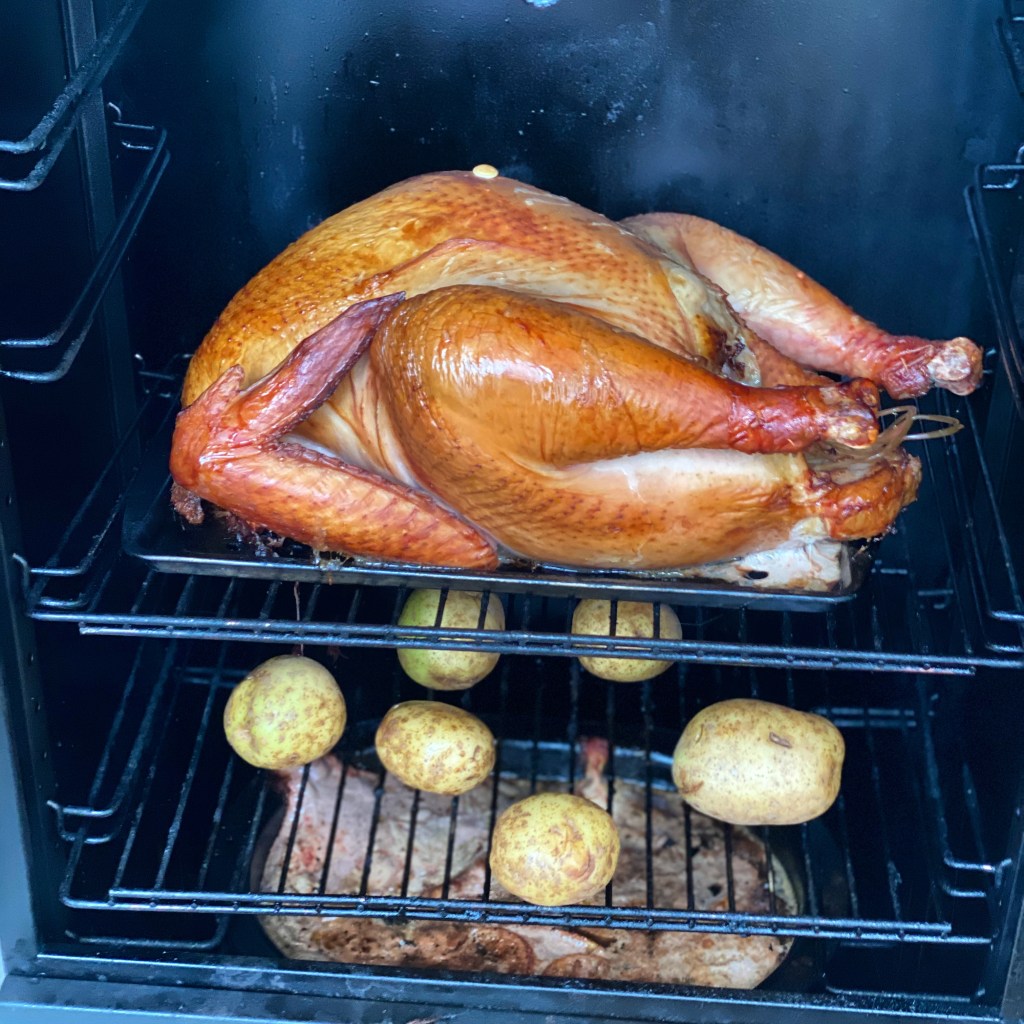
Instead, I smoked a turkey that we froze in our freezer last fall. Earlier in the week I brined the turkey with a homemade brine. We thawed the turkey in a brine for five days. We brought the brine to a boil before cooling to room temperature prior to submerging the turkey. We smoked the turkey with cherry wood chips with brine in the water pan. With three hours left, we put potatoes underneath the turkey to smoke and to be flavored by any drippings falling from the turkey.

The turkey three hours before dinner. Confession: I forgot to take a picture when finished due to the busyness of the moment.

The day could have been thoroughly miserable, but there was opportunity to find joy even in the midst of a dark world. We cannot choose the world in which we live. We can choose how we try to approach the difficulties. Sometimes there are neurochemical challenges which require medical help, patterns of habits which are detrimental, or a propensity towards anxiety, depression, or fear; however, we still can make a choice.

Last night, we had smoked turkey with smashed smoked potatoes. The turkey was moist and flavorful, the potatoes were tasty, and the inevitable cranberry sauce was devoured. We have enough leftovers for the next few days today and turkey broth cooking in the slow cooker. Even these moments can be beautiful if we choose to find a reason for hope and joy. Perhaps you’re not a cook or have nobody to cook with, but this day is still the day we have for today. We can choose to be enthusiastic about what is rather than angry about what is not.

Brine Recipe: For every five pounds of turkey: 1 clementine sliced into wedges, 1 tsp prague powder #1, 1 tsp peppercorns, ¼ c brown sugar mixed into a brine made with enough water to submerge the turkey)

Cinquain: Light Falls

CreakyHouseMan [CC BY-SA 4.0 (https://creativecommons.org/licenses/by-sa/4.0)%5D.
For the record, I’m the CreakyHouseMan
Light falls
On empty path
Through woods by still waters:
A shrouded path for another.
Light falls
...

This poem is dedicated to a church member who passed away this last weekend. I’ve visited him for over five years in various facilities as he’s fought through various struggles. His journey is now beyond my sight and in God’s hands…

Butterfly Garden

“Let the heavens be glad, and let the earth rejoice;

    let the sea roar, and all that fills it;

    let the field exult, and everything in it.

Then shall all the trees of the forest sing for joy”

Psalm 96:11-12

I was in a grumpy mood this morning and decided to slow down to see the beauty of God’s creation. Sometimes the best way to combat frustration and anger is to intentionally focus on God’s blessings…

All of these pictures were taken by me and are published through Wikimedia Commons under my username “CreakyHouseMan” [CC BY-SA 4.0]. All photos were taken in the Parsonage Butterfly Garden at the Maine Federated Church in Maine, NY.

Sermon: “A Spirit Filled Calling”

Sermon: “A Spirit Filled Calling
Date: July 28, 2019
Scriptures: Colossians 2:6-19; Luke 11:1-13

“We know through painful experience that
freedom is never voluntarily given by the oppressor;
it must be demanded by the oppressed.”

Rev. Dr. Martin Luther King, Jr. in “Letter from a Birmingham Jail”

Let us pray:

God, give us the strength to approach You. Help us to be bold and to choose to listen to what you say to us. Bless us and keep us both now and forever. Amen.

I have spent the last week seeking wisdom. A few weeks ago an idea started spinning up in multiple people’s minds and spirits. I have been praying through not whether I should listen to God’s calling but how it will look in my life.

I read through a book by a church leader named Paul Nixon that was called “I Refuse to Lead a Dying Church.” I heard bold words about leadership, following God’s calling, and changing church culture. I dreamed through what it meant that my heart was warmed by Paul Nixon’s set of choices on how a person approaches leadership. Could I choose to be bold over being mild? Could I choose to ac kkt now instead of later? Could I choose life over death? As a leader, I have always had a calling, but this felt deeper.

Rev. Dr. Martin Luther King, Jr., wrote the words in your bulletin that we read. He wrote: “We know through painful experience that freedom is never voluntarily given by the oppressor; it must be demanded by the oppressed.” He wrote it to a group of white clergymen who insisted that Dr. King’s actions in Birmingham were unwise. Dr. King insisted that the oppressed must demand to call for their own freedom. He insisted that the people rise to claim their freedom.

I pondered these words as I thought about our world. Dr. King was talking about a far more insidious and evil problem, but the words still kept filling my head with thoughts and dreams.

I identify as a millennial and my generation is very spiritual but divided from traditional organized religion. I have had many conversations with people my age who have said “Church is boring,” “Church is hypocritical,” and worst of all “Church doesn’t bless me–all it does is hurt me and people I love.” I have also had these same conversations with disaffected people both younger and older than my generation.

The thing is that I know these things may be true for some people, but only because the church has often forgotten the mission or left it behind to be more comfortable. This reality is tragic.

Look at what the Colossians are told: “As you therefore have received Christ Jesus the Lord, continue to live your lives in him, rooted and built up in him and established in the faith, just as you were taught, abounding in thanksgiving.”

When I think about what I was taught about Jesus Christ as a child, I remember being taught that Jesus loved me, that Jesus cared about what was going on in my life, and that I always had a place in God’s house. When I was a teenager, I gave my life to Christ because the Church had taught me that when everything went wrong, I had a Friend and Protector in Christ Jesus.

When I accepted that love, when I placed my identity in that strength, and when I learned more about Christ, I was thankful. I abounded in thanksgiving. Why? I abounded in gratitude because Jesus Christ’s love was closer than my right hand. When Paul says continue in the love the church taught me as a child, I see a love that means the world to me. There have been times in my life when I would rather have been separated from my arm than separated from that love.

People in my generation and people in general are oppressed by misinformation–the misinformation they have about God does harm. They do not understand how powerful God’s love can be for their lives. It hurts my soul to think people do not learn of this love because they think church is boring or irrelevant. This kind of good news brings joy and meaning to life! It breaks my heart to think people would come to church and see the church as some place harmful rather than some place beautiful. Such things are holding people in my generation down. Such things are breaking hearts and causing pain. Such things should not be.

I thought about the quote from Dr. King, I thought about what I was reading, and I wondered. What would it look like if we took the parable Jesus tells as a story with a message for us? If we were to believe that Jesus cares for our neighbors and if we were to ask God to lead us through breaking through those barriers, do we believe God would not answer? Would a parent give a child a scorpion instead of an egg for breakfast? Would a parent leave the door unanswered if their small child knocked on the door asking to come in? Of course not. I love my kids, I may love sleep, but if they came asking for something they needed in the middle of the night, I would get it for them. The same holds true for my friends–I may wish to stay in bed, but if they needed help, I would get up and help.

It is my belief that God wants to help too. As I have listened to God, respected friends in the church, and my own soul, I believe that God is preparing us for something new and exciting. I think we are facing multiple challenges and that obstacles are being thrown in our way, but I believe these are attempts to put something in the way of those who call out from the edges. I hear their cries: “Love me!” “Welcome me!” “Welcome my kids!” “Welcome my parents!” “Welcome my brokenness!” “Welcome my weirdness!” “Welcome me!”

It has become such a call in my thoughts that I am asking a question of myself: Who is knocking? Am I knocking on the door asking for help of God? Is God knocking on my door to ask me to pay attention to the least? Are the people knocking because they need something better?

The thing is that the things we believe divide people from the Jesus’ love aren’t there. Are they too loud or too lax compared to what they should be? Well if those are sins, they have been nailed to the cross. Are they drinking too much at the bar or spending too much on clothes? Well, if those are sins, they have been nailed to the cross. Are they unlike the people we knew growing up in church? Well, if that’s a sin, that has been nailed to the cross.

One of the amazing things about Paul’s words is that the act of forgiveness described is always listed in the past tense. Have you been forgiven of your sin? Well you were forgiven at the same time that people 200 years ago were forgiven. Have you been forgiven of your sin? Well, the people down the street were forgiven at the same time. Have you been forgiven of your sin? Well the people who haven’t been born yet, haven’t done terrible things yet, and haven’t asked for forgiveness were forgiven at the same time as us. We have all been buried with Christ and resurrected with Christ.

When Paul speaks of not being taken captive by false ideas and puffed up ways of thinking, Paul is encouraging the Colossians to think of what Christ has done. People were telling them that eating non-Kosher foods would damn them, but Paul tells them to stop believing the lies. People were telling them that there were Sabbath rules that had to be followed, but Paul told them to stop believing the lies. Their salvation did not rest in the rules but in Jesus Christ.

I went to church as a young man at my father’s church on Grand Island. I grew up believing that I had to wear the nicest clothes, sit quietly, and always behave perfectly. When our church launched a contemporary worship service, we started to attend worship with a bass guitar, clapping during worship, and with people who led worship in jeans. It was weird and I kind of rebelled against it for a long time as I tried to come to grips with the differences. I had come to my own faith in Christ, but could worship take place in church with guitars and clapping? Wasn’t that a youth group thing for when the adults were all off having coffee somewhere and couldn’t stop us?

I came to realize that worship wasn’t about sitting perfectly still or being perfectly dressed. Worship was about God. I knew God loved me as who I was, but it took me a while to realize that the Sabbath laws of Sunday morning church did not make me a good Christian. Only God’s love made me a Christian in a first place. All of my salvation came down to the actions of Jesus Christ, the gifting of the Holy Spirit, and the love my Creator. When Paul tells me to continue my life as I was rooted and built up in Christ, I find my own roots have strength not in tradition or historical accuracy. I find my roots only have life where they are connected to the love of God.

What is God calling me and others to do? Honestly, we’re still discerning what that looks like, but one thing is clear: If it will succeed, it will only be because it is founded on God’s love. How does that old hymn go?

My hope is built on nothing less
Than Jesus' blood and righteousness.
I dare not trust the sweetest frame
But wholly lean on Jesus' name.

On Christ the solid Rock I stand
All other ground is sinking sand.

Let us pray…

Whole Life Challenge: Day Eight

Today was a “core day” and my first time working out with a medicine ball. I wanted some variety from using my weight set, so I picked up a slam ball from the local sporting goods store. A lot of the exercises for the core can be done on one’s back, which reduces the risk of my throwing my back out. I was excited.

After two exercises, I went back through the list of potential exercises and looked for a light workout. I decided a twist was my best bet. All I had to do was hold the medicine ball straight out and twist from side to side.

My arms were engaged in an isometric exercise of holding the weight of the medicine ball in place while my core muscles worked in an isotonic manner. The first few reps of each set were easy. By the end of my last set, I was exhausted from holding the ball up at arm’s length.

As I showered up after stretching, I thought about how stress is a lot like an isometric exercise. You get used to holding the weight. Often the weight is not great, but as you carry the weight, it feels heavier and heavier.

My wellness exercise for the week is to “do nothing” for ten minutes a day. If you’ve ever held a heavy weight and let it go, you might find your arms automatically rise. Doing nothing felt like that today. My “arms” automatically raised as I did nothing. I had to keep focusing on just being present.

It is my hope as I lead that the spirituality I share is a blessing and not a weight. I would hate to think I’m weighing folks down. Too many people treat religion as a burden for me to believe that religion is always a blessing. If it were, people would line up to go to church.

I am reminded of the final verse of Psalm 23. “Surely goodness and mercy shall follow me all the days of my life, and I shall dwell in the house of the Lord my whole life long.” I often read this as goodness and mercy in my life.

What if the previous verse means something we often ignore? What if the anointing is to a holy purpose? What if the goodness and mercy spread to all we pass? What if we are the means of goodness and mercy? That’s the life I want to lead. I want my leadership to lift people up, not provide a weight that grows heavier and heavier.

“Still Morning”

Still morning with blooming lilies outside my window…
Steel cut oats linger in salty water
As coffee scents waft in the humid air.
Gray light trickles in through old still windows
As lazy flies begin to greet the day.

All is now quiet as mother and child
Bask in dream filled worlds beyond human reach.
The dogs sleep without a care in their heads.
Only the black cat watches with my soul.

If I could keep this moment in a jar
I would save it for darker days to come;
Yet, each day comes once and fades far away.
So, I sip and enjoy while I still can.

“Still Morning” by the Distracted Pastor, 2019

Whole Life Challenge: Day Two

On the second day of the Whole Life Challenge (WLC), I was sneaky. I am on my last day of vacation and did not have to lead worship. I wanted to visit a colleague’s church down the road. Our church has coffee hour after worship. My colleague’s church has a meal before worship. We arrived exactly on time and missed the meal. My kids were disappointed, but I didn’t have to walk past the donuts.

I am wondering about next Sunday when I return to church. Most food that is served in churches fits the mold of casseroles, jello, cookies, cakes, and other goodies. We rarely have fresh vegetables or fruit in any significant quantity. As the pastor, I am generally the last person through the line after greeting everyone and answering questions.

Cucumber slices are my favorite snack when doing the WLC…

If I want some fresh vegetables, hummus, cucumber slices, or other goodies, I may need to bring enough to share. It may seem silly to be concerned about such matters, but what will that look like if I provide that food every Sunday? What if this is a “lifestyle” change? How do we change a church culture that loves cookies and other sweets?

1 Corinthians 6:19-20 says: “…do you not know that your body is a temple of the Holy Spirit within you, which you have from God, and that you are not your own? For you were bought with a price; therefore glorify God in your body.”

How do we change how we eat in church? Perhaps it begins by realizing our bodies are temples. I have much to ponder as I chomp on these cucumbers.

Seeing Stereoptically

I recently was certified as a graduate of the Academy for Spiritual Formation #39. As a result, I can now read whatever books I would like to read! So, I went back to a book that one presenter Dr. Amy Oden wrote and found a book in her footnotes. As a result, the first fun book I am reading is “Broken Lights and Mended Lives: Theology and Common Life in the Early Church” by William Caferro. What is fun about studying church theology? I can spend two years in this book without being rushed… What a luxury!

Today, I started reading a book I chose to read! In the preface to Caferro’s book, I found the following statement: (preface, paragraph 3)

Of course, the different avenues that lead to early Christianity give us differing visions of what it was like. But they supply different views of the same thing. We cannot oppose, say, popular to official Christianity; instead, we must seek to use the two angles stereoptically to gain a deeper imagination of the early Church.

Broken Lights and Mended Lives: Theology and Common Life in the Early Church” by William Caferro. (preface, para. 3)

Ordinarily, I skim through the preface of a book; however, this statement caught my attention. Caferro is discussing a comment in Cult of the Saints by Peter Brown. According to Caferro, Brown suggests in his book that “more can be done by attempting to understand the cult of the saints from other points of view.” Caferro points out an inference that “no one approach is correct, but that there are many valid ways of gaining an understanding of the early church.” (ibid)

This quotation caught my attention because it holds a truth that seems worth noting in our day and age. The other day I was discussing the tension between dueling viewpoints in a post called “‘This is my song’ and John Chrysostom.” I noted that there was a tension between my love of the song and the lessons I am learning through studying early Church historical figures.

Can you understand this light entirely by only looking at one side?

Caferro’s quotation is interesting because it provides room for thought. What if the tension reveals a deep truth? What if there is something to be learned about looking at the tension from different angles? What if we can lessen the tension through intentionally looking at the challenge stereoptically?

For many years I had a far more dominant eye because of a condition called keratoconus. One eye could see clearly so I learned to drive and function with what was effectively monocular sight. I had no depth perception because of effectively having one functional point of view.

When I received a corneal transplant, I was almost immediately thrown for a loop. After several years with one point of view I could suddenly see with both eyes. I had depth perception for the first time in years. The result was amazing. I had to take the time to learn to see with both eyes again. When I moved past that tendency to have monocular vision to having true binocular vision I could suddenly see the world in a deeper way.

What if we were to consider that many of the challenges we may face in church culture are fewer issues of diametrically opposed ideas and instead people viewing the same situation from different angles? What if instead of trying to conquer the opinions of others, we accept that they may see something differently? What if seeing together might give each person a new perspective with more depth and clarity?

None of these ideas are new ideas. These ideas are as old as time, but it is still good to remember good life lessons when we have the opportunity.

Reflecting on “This is my song” and John Chrysostom

This morning we sang a hymn in place of the offertory. The hymn is a well-meaning hymn known as “This is my song” by Lloyd Stone and Georgia Harkness. The hymn has an interesting history: first as a poem and then as a hymn. The song is a stirring song set to the tune Finlandia.

Poet Lloyd Stone (1912-1993)

I also struggle with that particular song. I struggle for two reasons. First, I struggle with the song because I love the song. I think it is beautifully written, wonderfully lyricised, and matched perfectly with the stirring tune of Finlandia. If I were to choose a patriotic song as one I could adopt as my own, this would be the song I would choose first. I appreciate the balance between pride in one’s land and an appreciation for the viewpoint of others. I also appreciate that Dr. Harkness was a pioneering theologian whose work I love to support.

Dr. Georgia Harkness (1891-1974) was a leading Methodist theologian in an age when female theologians were definitely not the standard.

The second reason I struggle is that I am increasingly immersed in the early church. I enjoy reading through ancient sermons, ancient theologies, and reading about the lives of the leaders of the early church. Recently I was reading an excerpt from John Chrysostom (ca. 347-407 CE) in Amy Oden’s “And You Welcomed Me: A Sourcebook on Hospitality in the Early Church.” The excerpt was from Homily 16 on 2nd Corinthians from the Nicene and Post-Nicene Fathers series, v. 12, which was published in 1889, and the version I share below is sourced from the public domain. I will say Dr. Oden’s version reads far easier. Chrysostom wrote:

“Knowest thou not that we live in a foreign land, as though strangers and sojourners? Knowest thou not that it is the lot of sojourners to be ejected when they think not, expect not? which is also our lot. For this reason then, whatsoever things we have prepared, we leave here. For the Lord does not allow us to receive them and depart, if we have built houses, if we have bought fields, if slaves, if gear, if any other such thing. But not only does He not allow us to take them and depart hence, but doth not even account to thee the price of them. For He forewarned thee that thou shouldest not build, nor spend what is other men’s but thine own. Why therefore, leaving what is thine own, dost thou work and be at cost in what is another’s, so as to lose both thy toil and thy wages and to suffer the extremest punishment? Do not so, I beseech thee; but seeing we are by nature sojourners, let us also be so by choice; that we be not there sojourners and dishonored and cast out. For if we are set upon being citizens here, we shall be so neither here nor there; but if we continue to be sojourners, and live in such wise as sojourners ought to live in, we shall enjoy the freedom of citizens both here and there. For the just, although having nothing, will both dwell here amidst all men’s possessions as though they were his own; and also, when he hath departed to heaven, shall see those his eternal habitations. And he shall both here suffer no discomfort, (for none will ever be able to make him a stranger that hath every land for his city;) and when he hath been restored to his own country, shall receive the true riches. In order that we may gain both the things of this life and of that, let us use aright the things we have.”

John Chrysostom, Homily 16 on 2nd Corinthians from the Nicene and Post-Nicene Fathers series, v. 12

Effectively, Chrysostom is referencing the teachings of Jesus about treasurers on earth. Jesus tells us in Matthew 6:19-21 to avoid storing up treasures on earth. Chrysostom points out that one cannot take houses, fields, slaves (different time in history: not justifying the unjustifiable, but pointing out Chrysostom’s context), gear, or anything else out of this world. Chrysostom points out that we have been forewarned against building up our riches on earth or claiming the things of this world as treasure. We cannot take the things of this world with us. Indeed, it is only in the next life that we find ourselves growing into our true inheritance and riches.

What catches my eye in regards to the hymn and what causes me to ask deep questions is the line “For if we are set upon being citizens here, we shall be so neither here nor there; but if we continue to be sojourners, and live in such wise as sojourners ought to live in, we shall enjoy the freedom of citizens both here and there.” Chrysostom sees Christians as people on a journey through this life with a goal of reaching the next. If one stops to claim this place as one’s land, one will only have it for a moment. If one claims one citizenship to be in Heaven, then one has the freedom to both enjoy this world and move into the next without great loss. Indeed, a strict reading would say that one cannot move into the kin-dom of God by grasping tightly to a land, a nation, or one’s own goods.

Strictly speaking, the hymn we sang stands in opposition to one of the earliest Christian leaders because it claims that this is our land, our nation, and our space while Christian tradition teaches that we belong elsewhere. This world is a world in which we live in a fog. As Paul wrote in 1 Corinthians 13:11-12 to a community in conflict about the things of this world: “When I was a child, I spoke like a child, I thought like a child, I reasoned like a child; when I became an adult, I put an end to childish ways. For now we see in a mirror, dimly, but then we will see face to face. Now I know only in part; then I will know fully, even as I have been fully known.”

Writing to the church in Corinth, Paul tells them to stop acting childishly and to quit dividing themselves over earthly matters. This is a place where we see the world, each other, and God dimly (like in a mirror from an age when a modern mirror would be a miracle). The world to which we belong and where we are headed is where we will see clearly and be seen clearly. The world to which we belong is one in which we shall come into our full being.

Thus, I am torn by the hymn. I love the hymn, the words of peace, and the seeking of understanding of other people. I also realize that Chrysostom might look at the differences between nations and see people whose eyes might rest better on the world to come than the goods and lands of this world. Neither we in this land nor those folks in other lands can carry the goods of this world to the next life.

This hymn may be one of those places where we must live in the tension between ideals. The older I grow, the more I come to see that life requires a bit more flexibility than I once carried in my idealistic youth. As a friend likes to say at church: “Blessed are the flexible for they will not be bent out of shape!”

A Smooring Blessing

In the Carmina Gadelica, the process of smooring is described. Smooring was the process by which fire was kept during the night in the Highlands. Since wood was not readily obtainable, the Carmina Gadelica describes how fire would be kept so that the locally obtainable peat might burn more readily the next day. The act became very ritualistic and infused with prayer over centuries.

In my own spiritual practice, I have been considering how I can bring regular spirituality into my daily life. I have been pondering how my own daily life translates into a modern smooring. Looking at the Carmina Gadelica, which is in the public domain, we see the following prayer:

The sacred Three,
To save,
To shield,
To surround.
The hearth,
The house,
The household,
This eve,
This night,
Oh! This eve,
This night,
And every night,
Each single night.
Amen.

Untitled Smooring Blessing in Alexander Carmichael’s “Carmina Gadelica, v. 1”

The prayer was very Trinitarian, very grounded, and very conscious of the importance of this moment in time. Pondering how my spirituality of smooring fits into modern day, I am drawn to the simple answer that I might simply change the word hearth to bring the prayer into this day; however, what word would you choose? The hearth was a source of heat, food, and family life. Would the word be kitchen? Stove? Furnace? Looking through other prayers, one has trouble imagining Jesus’ mother Mary smooring the fire in the same way today as when Alexander Carmichael first published his work in 1900.

I really didn’t need much of an excuse to share this photo… Still, that candle is sacred to me as it is the candle we burned during our Covenant Group during the last session of the Two-Year Upper Room Academy for Spiritual Formation (39).

Most of the Smooring Blessings revolve around the mother of the house engaging in the act of smothering the embers at the end of the evening as she remembers the legacy of the saints all around her. Some blessings see saints out on the lawn and angels watching the hearth. Others see the Apostles standing there on the floor with an angel guarding the door of the house.

Another prayer candle in our home. Not quite a hearth…

I think an honest approach to this type of prayer might be to ponder the saints who have walked these paths in years past. Here is one of my attempts:

We “smoor the fire” on this night.
We tend house and all within.
Each dog, cat, fish, child, and spouse
Be blessed as we greet the dark.

May the Spirit watch our sleep
And bring wisdom to our dreams.
May peace fill every corner
from roof to the earth below.

May Christ’s kind hands be our hands
As we settle all in beds.
May warmth surround family
And keep the night’s chill outside.

May we awake to create
Good things out of daily life.
May our Maker smile on us:
We imagine a new day.

We walk on floors tread before.
May our night be blessed tonight.
Thank you for caring for those
Who have rested here before.

May those who follow be blessed
And give thanks for our blessing
As we give thanks now for theirs.
May thanks arise forever. Amen.

“A Modern Smooring Blessing” by The Distracted Pastor, 2019

Grief as an Octopus

This Saturday morning I am thinking about grief. My wife has started a wonderful new professional position, but we live in an imperfect world. I fell asleep in bed with my head next to hers as she talked about her professional challenges last night. I listened for a good long time before my exhaustion took me away. Thankfully, she does not read my blog regularly: my “secret” is safe for now. Let’s be honest: she may already know.

Professionally, in my own ministry I often face grief in homes, at funerals, on Sunday mornings, in hospital rooms, in meetings, in conferences, in the checkout line at the grocery store, and many other places. Personally, I have been grieving the act of registering for Annual Meetings this year because of the grief incurred globally. Now that the United Methodist Church’s Judicial Council ruling has effectively guaranteed a divisive United Methodist Annual Conference and a United Church of Christ Annual Meeting filled with well-meant sympathy and questions, I suppose my grief needs to be accepted.

Grief is in my thoughts this morning. I spent my quiet time this morning praying while doing the less than pleasant task of doing dishes. I might not have raisins to sort, but I try to learn from folks like Henri Nouwen and Brother Lawrence. Grief was in my thoughts as I scrubbed oily residue and emptied the sink trap.

My conclusion at the end of my time of contemplation is that grief reminds me of an octopus. Grief can be Krakenesque or found 20,000 leagues below the surface. Grief can be in the shallows of a reef teeming with life or plucking what little it can from the open currents.

Grief is a master of camouflage. The beast hides in plain sight until it reaches out. Grief grabs you only once before you see it in every eddy of sand. Grief can make you paranoid to swim out into the seas of life.

Grief also does not hide behind every rock in the sea of life. If we spend our whole lives afraid to swim, we may eventually regret our choices. As strange as it sounds, fish that do not move water through their gills will drown. Most fish can only hold still for a certain amount of time before they get air from the surface or the sea.

Tomorrow in church at Maine Federated, we will sing songs and read the story of Easter again. We will proclaim resurrection in a world of grief. We will swim, we will breathe, and face whatever octopi wait in the depths.