I found this prayer today while looking for some paper. It wasn’t dated, but I am guessing it was towards the end of one of my rare visits with my children.
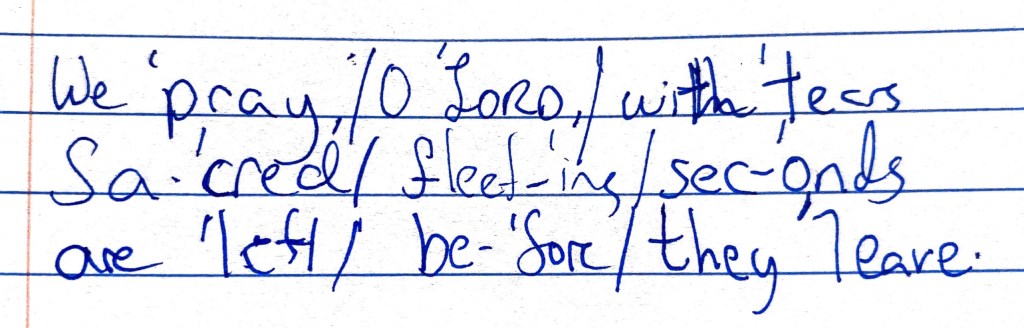
I found this prayer today while looking for some paper. It wasn’t dated, but I am guessing it was towards the end of one of my rare visits with my children.
The other day I shared a blessing from the United Methodist Book of Worship “For a Victim or Survivor of Crime or Oppression.” Since that day I have been working toward raising awareness by writing poetry based on the suggested poetry found in that blessing.
Today I wrote a poem based on Lamentations 3:1-24, which can be found in the Common English Bible through this hyperlink. As I pondered the reading, it seemed pretty dark at first. I was wondering what the compilers of the Book of Worship were thinking until I came across the shift from verses 19-24, which I found startling and incredibly powerful.
Verse 19 compares the feelings of homelessness and affliction to being poisoned to the brim with bitterness. I understood those feelings as I consider my past. I remember more than the feelings that came about in the first days after I filed for divorce. I remembered tears from a broken heart behind closed doors, sodden pillowcases, and the bitter feeling of knowing that promises made at the altar meant nothing. The shame, the guilt, the uselessness, and futility still come to mind easily even after time has begun to heal my wounds.
After all of this comes to mind, does Jeremiah give up hope? No, instead the very pain in Jeremiah’s soul transforms from a place of broken doubt to a place of stubborn waiting. The grief and loss do not translate into a faithless existence but into a spirit that will steadfastly wait for God to act. This! This is a feeling I know! “Waking” after sleepless nights, pulling on my boots, and stepping into my role as a minister with all of the confidence I could despite my own sorrow. This I know!
Helping church members say goodbye to loved ones with the compassion that comes from knowing what it is like to come home to an empty home! That was an act of faithful waiting! Sharing communion with people with the understanding that comes from knowing what it means to share a “meal” with others when you eat alone the rest of the week. That was an act of faithful waiting! Listening to the troubles of others knowing what it is like to have nobody at home to listen to my struggles. That was an act of faithful waiting!
Even now, I wait. The poem I wrote is as much a prayer for God to act as it is a piece of poetry inspired by this passage. I hope it is helpful and brings to mind the reality that brokenness does not mean that healing is beyond you.
"Homeless and poisoned in my inmost soul"
I ponder the broken and sleepless nights.
Endless tears fell into fathomless hole
as I thought of all of my stolen rights.

Future empty and present in shambles,
hopeful words called out from the ancient past
before wounds left me with frothing rambles:
that place where only ashes seem to last.

I remember the hope flickering faint.
I beheld the light that would not go out.
Even shattered, the call to be a saint,
not of perfect life, but one lived through doubt.

I remember and still I sit and wait
for the Just One to come bearing our fate.
October has been Domestic Violence Awareness month since it was first introduced by the National Coalition Against Domestic Violence in 1981. Regardless of the month, domestic violence is never okay, no matter the circumstances. If you or someone you know is in desperate need of help, contact the National Domestic Violence Hotline at 1−800−799−7233 or TTY 1−800−787−3224.
This poem was written as a reflection on Job 3:1-26. In that passage Job is broken, shattered, and ready to breathe his last breath. I have felt like Job, have cried in the night, and eventually found a place where peace began to fill my heart again. This poem also references Jeremiah 31:29-30.
Perish the day that I first took a breath?
Would my heavy gaze fall on mirrored sight
and see any reason to wish for death?
Would narrowed eyes see so little this night?

Job calls out with a heavy-ladened cry
In his words there are cryptic broken dreams
bloody losses soak visions dark with dye
heart shattered, soul scarred, will torn at the seams.

There is room for new thoughts within my heart
that twirl and show that pain may be passing.
Sisyphean burden left at the start
as sour grapes are left to those harassing.

Let their teeth chatter in deserved sorrow
and may Job find new hope for tomorrow.
October has been Domestic Violence Awareness month since it was first introduced by the National Coalition Against Domestic Violence in 1981. Regardless of the month, domestic violence is never okay, no matter the circumstances. If you or someone you know is in desperate need of help, contact the National Domestic Violence Hotline at 1−800−799−7233 or TTY 1−800−787−3224.
The following is shamelessly borrowed from the United Methodist Book of Worship. I share the content as the content was designed to be used by pastors (which I am) as a tool to share with those who need to hear the words (which I am doing here as an Ordained Elder within the United Methodist Church: (from the preface to the Book of Worship: “We believe that the United Methodist Book of Worship will strengthen our worship and empower our ministry and mission. May God’s grace be with all who use this book…”)).
I share this with the caveat that I did some altering on the pronoun options for inclusivity purposes. The following is the entry underneath the category of Blessings and is found on page 547-548 under the Heading of “For a VIctim or Survivor of Crime or Oppression”
Commentary: One of the following may be read before the blessing:
United Methodist Book of Worship, #547; (Book of Blessings, USA, 20th Century, alt.), alt.
Job 3:1-26 (Lamentation of Job)
Isaiah 59:6b-8, 15b-18 (God appalled by evil and injustice)
Lamentations 3:1-24 (One who knows affliction)
Lamentations 3:49-59 (You come to my aid)
Matthew 5:1-10 (The Beatitudes)
Matthew 10:28-31 (Do not be afraid)
Luke 10:25-37
Commentary One of the following hymns from the United Methodist Hymnal may be sung before the blessing:
479, “Jesus , Lover of my Soul”
488, “Jesus Remember Me”
480, “O Love That Wilt Not Let me Go”
512, “Stand by Me”
507, “Through it all”
Lord God of liberation,
you saw your people as slaves in Egypt
and delivered them from captivity,
you see the works of violence and weep.
Relieve the suffering of (Name),
grant (him/her/them/zir) peace of mind
and a renewed faith in your protection and care.
Protect us all from the violence of others,
keep us safe from the weapons of hate,
and restore us to tranquility and peace.
We ask this through Christ our Lord. Amen.
October has been Domestic Violence Awareness month since it was first introduced by the National Coalition Against Domestic Violence in 1981. Regardless of the month, domestic violence is never okay, no matter the circumstances. If you or someone you know is in desperate need of help, contact the National Domestic Violence Hotline at 1−800−799−7233 or TTY 1−800−787−3224.
How do you teach respect to a child? I don’t mean tyrannical respect, but a general respect for other people (e.g., How do you teach them to be considerate of the needs of other people, to have gratitude for the efforts others put into their relationship, etc.).
I always thought the best way to teach my children was through the example of my own actions. To this day I don’t tear down my former partner in front of our kids and even have difficulty at times expressing how bad things were when that means I have to say things that cast my former partner in a negative light.
At one level, I have done an excellent job and not tearing down my former partner. I have given an example to my children on how you can live with someone difficult without having to constantly tear them down.
It isn’t as easy when I consider how I teach them self-respect. There are times when I show respect to my former partner by being silent about terrible things that have happened to me. I have bit my tongue and allowed things to stand over the years that were not acceptable
This blog post doesn’t have the answers on how you do that, but writing it will force me to think today about how I show my self respect, how I teach my children to respect themselves, and how all of that fits into my relationship with my former partner I wish my cojourneyers luck
October has been Domestic Violence Awareness month since it was first introduced by the National Coalition Against Domestic Violence in 1981. Regardless of the month, domestic violence is never okay, no matter the circumstances. If you or someone you know is in desperate need of help, contact the National Domestic Violence Hotline at 1−800−799−7233 or TTY 1−800−787−3224.
Like many good things
Healing may take some time
Treat yourself gently
October has been Domestic Violence Awareness month since it was first introduced by the National Coalition Against Domestic Violence in 1981. Regardless of the month, domestic violence is never okay, no matter the circumstances. If you or someone you know is in desperate need of help, contact the National Domestic Violence Hotline at 1−800−799−7233 or TTY 1−800−787−3224.
This afternoon I had the joy of spending time with a former seminary classmate and his daughter over a cup of coffee. One of the largest struggles I have had to face while in recovery from both alcoholism and domestic violence has been the message that was handed to me by both my culture and my partner.
My culture taught me from an early age that alcoholics looked a certain way and were untrustworthy. I was not told that they had a disease with real physical roots. I was told that alcoholics drank out of paper bags under bridges or in book clubs depending on how much money was in their bank account. I was never given the perspective that an alcoholic was someone who could recover with support, care, and love. When I realized I had a problem with alcohol, I immediately was ashamed of who I was as a person despite the fact that I am a human being with a disease that was quite treatable and was not a one-way ticket to a lifestyle under a bridge.
My partner taught me through her actions and words that I wasn’t worthy of any better treatment than how society treated alcoholics. I was told multiple times that I was not good enough, was worthless, was inadequate, and told me, “God must love you because nobody else does.” Even though she is gone, I can still hear the exact inflection of and scorn in her voice as she cast such judgments over me and my value.
Do you know what my friend from seminary told me today? When my partner left, there was joyful cheering (along with the tears on the other end of the state). To be clear, they didn’t cheer because I was hurt. They were thankful that I was free from a sick and desperate situation that they saw coming years before I began to recognize what was happening. They believed in me, cared about me, and he went out of the way with his daughter to come and see me because I matter to them, which they did with the full and enthusiastic support of his wife (who is also my friend).
I often forget the simple truths my friend reminded me of this afternoon. I didn’t lose value because I became sick: I became a person in need of healing and support. I didn’t lose value because someone tore me to shreds: I just needed to look for value in people who believed in me, cared for me, and loved me as a friend and person. Now that the shackles are breaking, I can choose to keep investing in healthy relationships even as I continue to seek my freedom from the person who tore me down.
It is easy to forget how much we matter, especially if we are recovering from domestic abuse or an addiction. It is easy to forget that there may be people who love us and support us in spite of what others have said about us or done to us. Yes, God loves us: there may be people who love us as well.
If you’re recovering from abuse or addiction, may I invite you to believe that you have value? Although it is close to the end, may I suggest that a good thing to remember during National Suicide Prevention Week (which is also part of National Suicide Prevention Month, which is halfway to completion) is that you have value? As much as the tagline this month is about Domestic Violence, allow me to point out that in the United States you can dial 988 to reach someone who can support you if you are feeling suicidal. No matter what others may have told you, your life matters and I hope you stick around.
October has been Domestic Violence Awareness month since it was first introduced by the National Coalition Against Domestic Violence in 1981. Regardless of the month, domestic violence is never okay, no matter the circumstances. If you or someone you know is in desperate need of help, contact the National Domestic Violence Hotline at 1−800−799−7233 or TTY 1−800−787−3224.
I received my booster shot yesterday. I’m trying my best to take it easy after feeling unwell while walking my dog last night. Today my arm aches and I feel more tired than usual.
When I was married I saw our vows as promising that I would care for her when she was unwell and she would care for me when I was unwell. I was naïve to think that we both understood that commitment to each other when we were twenty five.
Today I’m alone. My attorney called to give me an update about working towards finalizing my divorce yesterday. I’m grieving that loss today while remembering how it felt to believe I could rely on someone.
Nobody is here to help me feel better today, but nobody is here tearing me down either.
If I were to give someone advice in similar circumstances i would relay to them the truth that there are lonely days when seeking peace and safety. It is possible to get through them and even to thrive because of them. I would tell them to have patience with the process.
October has been Domestic Violence Awareness month since it was first introduced by the National Coalition Against Domestic Violence in 1981. Regardless of the month, domestic violence is never okay, no matter the circumstances. If you or someone you know is in desperate need of help, contact the National Domestic Violence Hotline at 1−800−799−7233 or TTY 1−800−787−3224.
Okay, so this one is going to require a stretch of one’s imagination. This morning I was working through Genesis 1:1-2:3 out of the Common English Bible as a part of today’s reading with our church’s DISCIPLE Bible Study group. In my reading of this passage from the Common English Bible today I found the text to be replete with words of plenty. We noted in our study this week that the mindset of the reader, the context where the text is read, and other variables affect the way we approach scripture. Today I must be feeling very open hearted and expansive as the words that I read were filled with expansive imagery.
As an example I would point out how in Genesis 1:14-15 God speaks expansively of the lights in the dome of the sky. These lights are signals and signposts of the passage of time, the coming of seasons, and invite creation into sacred times. Keeping in mind that I take these portions of the scriptures as sharing truth born of wisdom rather than concrete facts born of the scientific method, I was the heavens brimming with lights pouring forth after the divine word. Letters from divine words arcing out from the divine mouth before shifting into stars, moons, and the special star known as our sun. In such ways, God speaks and the world and universe are transformed from chaos into creation.
When God speaks of humanity, even the Common English Bible uses words of mastery, but I did not read words of domination into the creation account today. Humanity masters the world not for domineering or destructive purposes but for the cause of caretaking. Humanity takes charge of the fish, the birds, the animals, the plants, and all of the wandering and stationary lifeforms that cover the globe for the purpose of creative caretaking. God spoke into the world words of life and humanity is invested with the divine image in order to continue to work in the divine image as caretakers and agents of blessing to help keep the world from slipping back into chaos.
The story is quite beautiful when read with an expansive and generous mindset. What does any of this have to do with Domestic Violence or Domestic Violence Awareness? In the end, the connection I made in my mind is a very delicate one.
If we are called to treat creation with such care and respect, how can we live lives where we exert our will violently on each other? If we are called to be caretakers and agents of blessing, how can we decide to turn our backs on this divine call to love in order to strike out at the people in our homes? If the very core of our creation narrative revolves around humanity existing for the purpose of blessing, how can we curse the people we live with day by day in such abominable ways?
To be certain, if I were to read this text as a text inviting domination, a case could be made, but the whole of scripture is wildly biased against such views. While there are certainly stories of domination in our scripture, the whole of the Bible is thrown from such ways of thought by the person of Jesus.
In John 8, Jesus was offered an opportunity to dominate another person and to stone to death a woman who committed adultery (in the context of a society where that was legal, which was a different context than our society where such punitive behavior is illegal, immoral, and labeled as absolutely wrong by both church and state). Even though it was permissible, legal, and in accordance with the religious rules of Jesus’ day, Jesus refused to engage in such brutal acts. This is just one example of many where Christ taught love in situations that invited brutality.
I cannot see Jesus approving of domestic violence taking place in our homes. Even if we could read words of domination into scriptures like those found in Genesis 1:28, I cannot see Jesus approving of such behavior. Passages like those in Genesis can be read with different eyes than those of a person seeking to dominate or subjugate others. If we can read such words with grace and plenty in our minds, then we can consider the idea that we were never meant to dominate, demean, or subjugate the people who share our slice of the garden in this life.
October has been Domestic Violence Awareness month since it was first introduced by the National Coalition Against Domestic Violence in 1981. Regardless of the month, domestic violence is never okay, no matter the circumstances. If you or someone you know is in desperate need of help, contact the National Domestic Violence Hotline at 1−800−799−7233 or TTY 1−800−787−3224.
“We recognize that men are also victims of domestic violence and abuse. We encourage communities to offer the same policies and protection as provided for women in similar situations. We affirm the right of men to live free from violence and abuse and urge governments to enact policies that protect men against all forms of violence and discrimination in any sector of society.
¶162.III.G, The Rights of Men, The Book of Resolutions of the United Methodist Church, 2016
We recognize that men’s role in raising children is in equal importance to women’s and call for equal rights as women in opportunities for parental leave. When parents divorce, men often have less contact with their children. We call for equal access to child-custody, but emphasize that the best interest of the child always is the most important.”
For today, I wanted to share this excerpt from the Book of Resolutions for a few reasons:
October has been Domestic Violence Awareness month since it was first introduced by the National Coalition Against Domestic Violence in 1981. Regardless of the month, domestic violence is never okay, no matter the circumstances. If you or someone you know is in desperate need of help, contact the National Domestic Violence Hotline at 1−800−799−7233 or TTY 1−800−787−3224.
I woke up yesterday morning with an aching knee. The few days before Sunday were full of Annual Conference business. Annual Conference is both the name of the regional body of churches that I serve within as a United Methodist and an exact description of how often the whole of that body meets to do business. Normally Annual Conference for us in the Upper New York Annual Conference is in the late spring just before summer, but this year our session was held virtually in the fall due to COVID concerns.
My knee ached because I have been walking all over the place during the past few days. As I write this entry on Sunday night, my knee will probably hurt once again tonight as I walked into town to reach the church, stood through church,, walked across town for lunch after church, participated in the CROP Walk after lunch, and then walked back home from town. My knee will probably ache tonight, but it likely will be a far more peaceful night than last night.
Why? I am not certain if it was the change in diet, lengthy Conference activity, or stress levels over the past few days, but I honestly had a terrible nightmare coming into Sunday morning. I dreamed a horrible dream that woke me up in panic and covered with sweat.
What was the dream about last night? To be blunt for the sake of this post, the dream was a dream where everything terrible I heard over the years came true. In the dream I was called and acted pathetic, was broke and unable to care for what needed to be cared for, and was run out of my job for not being good enough for my role as a minister. Everyone I met in the dream was angry with me, frustrated with me, or full of scorn for me. It was frankly terrifying to wake up feeling awful about myself.
So, what did I do after waking up with a hurting knee and a tortured spirit? I got up, took a shower, strapped on my boots, and went back to work. I walked to work, which I was able to do quite nicely despite my knee’s complaints the night before. I led Sunday School where we had a great conversation and then led worship which led to people coming up to me that were engaged in the message connecting scripture, theology, and the problem of domestic violence.. After a nice salad from the nearby deli, I then walked around town with church members raising money for world hunger and having some great conversations. When that was done I walked home, had a quick dinner, and then went out to grab a cup of coffee and milk to make my yogurt for the week ahead.
In other words, all those terrible things I heard in the dream didn’t stop me from doing what I had to do today. I stood up, laced my boots, and faced my fears, which turned out to be nothing important at all. I am thoroughly proud with myself for moving past my fears and nightmares into a healthier place tonight.
As the day draws to a close, I don’t know what’s ahead of me tonight, but I know one thing to be true: all the terrible things that I once heard from my abuser do not define who I am today. I don’t need to be ashamed of who I am as a person. I don’t need to seek the approval and love of a person who tore my spirit and soul down violently. I can choose to face today no matter what my abuser believes. I will live and I will do so in a way that makes me proud to be me.
October has been Domestic Violence Awareness month since it was first introduced by the National Coalition Against Domestic Violence in 1981. Regardless of the month, domestic violence is never okay, no matter the circumstances. If you or someone you know is in desperate need of help, contact the National Domestic Violence Hotline at 1−800−799−7233 or TTY 1−800−787−3224.
How do we begin to heal after the pain of the past? How do we start to find our way forward after trust is broken, hearts are shattered, and faith falls flat?
For me, one tool in my toolbox of healing is to care for other people. Often the things that I need on my path to a healthier place are the very things needed by people who have walked a similar path. While I need them, I don’t always recognize my needs. Being around and caring for people who have walked similar roads often helps me to see in others the things I need in my own life.
Do you know what I mean? I may need to hear a loving voice, but I don’t recognize that need until I see how much a friend needs to hear my loving voice. I may need to go easier on myself, but I will be harsh until I walk alongside someone who is just as harsh to themselves as me.
To put this in Biblical terms, I might relate it to what is said in the Common English Bible in Luke 6:38: “Give, and it will be given to you. A good portion—packed down, firmly shaken, and overflowing—will fall into your lap. The portion you give will determine the portion you receive in return.”
There have been places in my life where I have felt completely broken, but I have found the process of healing begins when I reach out loving hands to another person suffering. Selfishly, one reason I am being so open about my woundedness this month is to help others find a compassionate voice because I understand that compassion acts like a boomerang. When I send it out and away it comes back to me.
I hope that these posts bring encouragement to others and help them to understand that they are not alone. I hope that others find my voice to be loving, sympathetic, and inviting. I hope that others take encouragement from what I write this month and pour that love out to others. I hope that divine cycle of giving love and receiving love will keep spreading, but even if it never goes beyond the words on this page, I will reach out and invite others to reach with me.
Just as I think I am just done,
Everything switches as I hear
How another person has walked
Over roads I once might have tread.
Very slowly my closed heart creaks
As deep compassion stirs within:
Healing pours in as love flows out.
October has been Domestic Violence Awareness month since it was first introduced by the National Coalition Against Domestic Violence in 1981. Regardless of the month, domestic violence is never okay, no matter the circumstances. If you or someone you know is in desperate need of help, contact the National Domestic Violence Hotline at 1−800−799−7233 or TTY 1−800−787−3224.
I was walking as the sun set watching the leaves fall. Each has a season like us. Some fall quickly and some fall later, but each has a time to fall and gather with the others in the drifting ruach of the breeze.

“Grateful for God’s forgiving love, in which we live and by which we are judged, and affirming our belief in the inestimable worth of each individual, we renew our commitment to become faithful witnesses to the gospel, not alone to the ends of earth, but also to the depths of our common life and work.”
“Preamble to the Social Principles,” The Book of Resolutions of The United Methodist Church 2016.
What are the Social Principles of the United Methodist Church? Earlier in the preamble to the Social Principles within the Book of Resolutions, the Social Principles self-identify themselves as existing outside of church law. The principles “are a prayerful and thoughtful effort on the part of the General Conference to speak to the human issues in the contemporary world from a sound biblical and theological foundation as historically demonstrated in United Methodist traditions.”
The Social Principles are neither binding by church law nor restrictive of church member behavior. They are a work born of prophetic zeal and idealism which in the end hopefully points us towards a more holistic understanding of the world around us.
Why am I bringing this up during Domestic Violence Awareness month? I would point out at least two things about the paragraph that I originally quoted.
First, the Social Principles point towards the value of each individual. Yesterday my post pointed out that there should be a place for redemption in the church. Today I wanted to point out that even when redemption takes place, the redemption of another person’s life does not diminish the importance of wholeness and healing in the life of the victims of domestic violence.
Each person has inestimable worth and part of our common work is to affirm that value in the lives of people who have been demeaned, denigrated, or diminished through the sinful actions of others. Victims of Domestic Violence can feel broken, worthless, or even worth less than others. The lives of people who have gone through this experience are valuable and they are worthy of both God’s love and a loving place in God’s community.
Second, I want to point out that this paragraph points out that we both live within the forgiving love of God and are subject to judgment through and by that love. I’m generally not a hellfire and damnation preacher, but I do not deny that judgment will one day come for us all. I believe that God is far more gracious and kind than us, and I also believe wholeheartedly that God’s loving kindness sees and counts every tear and wound inflicted through our broken behavior and actions.
As a survivor of Domestic Violence myself, there are times when I honestly do not want to be forgiving. In those moments, there are times when I can only move forward by handing my pain over to my loving God. I can let go of a deathgrip on my anger, pain, and hurt because I understand that in time God will take care of things.
I don’t need to be vengeful for any vengeance necessary is in the hands of a God who is both kinder and better equipped to bring judgment without cruelty. I don’t need to carry anger around in my heart, for the pain which would fuel my anger doesn’t need to rest within me. I can let God care for the situation and move forward with life.
Judgment may come, but I don’t need to be the judge. Retribution may come, but I don’t need to be dealing it out. I don’t have to do a thing to harm the people who harmed me, for God will care for those who have done wrong. I am a person of inestimable value and I don’t need to cheapen my value by carrying around worthless and harmful things like rage, anger, and hatred. God has those things, so I can move forward with life without worrying about them every day.
If you have been through such pain, I invite you to consider that God both loves you and will one day deal with the sinfulness of the world. There can be healing and there can be wholeness even after everything that both you and I have gone through. It is not easy to hand over such things to God, but I invite you to consider what life might be like without carrying the baggage of pain, anger, and hatred with you everywhere you go.
October has been Domestic Violence Awareness month since it was first introduced by the National Coalition Against Domestic Violence in 1981. Regardless of the month, domestic violence is never okay, no matter the circumstances. If you or someone you know is in desperate need of help, contact the National Domestic Violence Hotline at 1−800−799−7233 or TTY 1−800−787−3224.
“We recognize that family violence and abuse in all its forms—verbal, psychological, physical, sexual—is detrimental to the covenant of the human community. We encourage the Church to provide a safe environment, counsel, and support for the victim and to work with the abuser to understand the root causes and forms of abuse and to overcome such behaviors. Regardless of the cause or the abuse, both the victim and the abuser need the love of the Church. While we deplore the actions of the abuser, we affirm that person to be in need of God’s redeeming love.”
¶161.II.H. “The Nurturing Community, Family Violence and Abuse” in The Book of Resolutions of The United Methodist Church, 2016
What does it mean that the church is a place for both the abuser and the abused? This question resonates deeply with me as a survivor of Domestic Violence. Can there be space in the church for both me and the person who tore me to shreds?
Yes. The short answer is that the church absolutely must be broad enough for both the abused and the abusers. Although I have my issues with the imperfect nature of the Book of Resolutions, to the best of my ability I understand that the church must make room both for those who need redemption and for those who lives need to be redeemed from the places of desolation, sorrow, and shattering.
Why? Wouldn’t it be easier to lean into the more judgmental parts of scripture? Although I generally refer to the larger section of the scriptures as the Hebrew Scriptures, can’t God “go Old Testament” once in a while with the fire, flames, and what not? Won’t God bring damnation to those who have hurt people deeply to the point where it feels imprinted on the soul? Aren’t there places where the wicked find out that they can’t have their cake and eat it too?
Absolutely those places exist in scripture. Honestly, my soul rests better at night knowing that such places exist in the theological life of the church. That being said, we can do better as a people than rely on damnation as our first recourse to sin in the world. Who among us is without sin in their lives?
Once upon a time, most of us crawled on the earth as toddlers. Each of us grew up in the same world that was filled with imperfection and brokenness. Some of those who abuse were once the innocent ones being abused. Some of those who abuse walked down dark roads none of us would choose to walk.
Would we want to be left to our own sorrow and judgment after we went on such a journey? If there truly is a chance for redemption, would any of us truly ask for redemption to pass us by? Would we want to suffer when grace might lead us back to life and lifegiving ways? Is that what we would want if we walked down such roads in those shoes?
We are called to love one another. We are called to treat each other like we would want to be treated. We are called to live lives filled with the unmerited favor known as grace. Judgment belongs to the Lord and there may come a day when judgment falls, but between now and then we are called to lives of faith, hope, and love.
Yes, that means that my abuser may one day shelter under the wings of the God that shelters me. Yes, that means that the Holy Spirit may need to sit us both down one day or keep us under opposite wings of the divine Mothering Hen (Mt. 23:37).
Should such a day come, I will ask God to help me to make room, even if I still have moments where the tears flow and I ask for God to “go Old Testament” every now and again. I will stretch for God as I believe and ask God to help me in my unbelief.
Even after such a moment, I do have to state clearly that forgiving and making room for an abuser does not justify abusive behavior, ever. Also, let’s be absolutely clear that I don’t need to be the person to bring my abuser back into the community of life. While I may give my blessing for their restoration, I do not feel the need to do it myself. If you have been abused, it might not be your responsibility either.
October has been Domestic Violence Awareness month since it was first introduced by the National Coalition Against Domestic Violence in 1981. Regardless of the month, domestic violence is never okay, no matter the circumstances. If you or someone you know is in desperate need of help, contact the National Domestic Violence Hotline at 1−800−799−7233 or TTY 1−800−787−3224.
The doctor’s appointment is over an hour away from where I live. I need to care for my eyes, especially as I have two potential eye conditions that can go awry quickly if left without care. For the past month it has felt like I have a loose stitch on the cornea I once had replaced and it is almost constantly in discomfort.
If I go to the appointment, will I still have money to buy my kids Christmas presents? If I go to the appointment, will they accept it if we end up eating peanut butter and jelly the next time I see them? Will they still love me if I spend the money I will need to spend on my eyes instead of spending that money on them?
On one level, this post has nothing to do with Domestic Violence. There’s a whole fleet of unrelated issues that I face as a person going through divorce at a distance from his children. On another level, this way of thinking is directly related to living with someone who taught me that caring for my needs was problematic and caused my family to suffer. Domestic Violence is not just about people hitting other people. Domestic Violence includes systematically tearing down others verbally until they forget how to care for their own needs.
As I look at the map, I hear those words telling me that I’m wasting money that my kids could use. At the same time, I need to take care of myself if my kids want to have a father who can see well enough to drive to see them. Sometimes I do not need to get another cup of coffee, but this particular need is not a question of whether or not I deserve a cup of coffee. There are legitimate needs in my life that need to be cared for despite being taught repeatedly that I needed to dismiss my own needs for the sake of my kids or the person who was once my wife.
It is okay to care for yourself. I have heard words that may be like those you might have heard or are hearing. Friend, it is okay to have legitimate needs and to fulfill those needs. There are times in life when it is absolutely valid to spend money to care for your needs, because those things are needs and not wants. You don’t need to be ashamed.
October has been Domestic Violence Awareness month since it was first introduced by the National Coalition Against Domestic Violence in 1981. Regardless of the month, domestic violence is never okay, no matter the circumstances. If you or someone you know is in desperate need of help, contact the National Domestic Violence Hotline at 1−800−799−7233 or TTY 1−800−787−3224.
“Don’t judge, so that you won’t be judged. You’ll receive the same judgment you give. Whatever you deal out will be dealt out to you. Why do you see the splinter that’s in your brother’s or sister’s eye, but don’t notice the log in your own eye? How can you say to your brother or sister, ‘Let me take the splinter out of your eye,’ when there’s a log in your eye? You deceive yourself! First take the log out of your eye, and then you’ll see clearly to take the splinter out of your brother’s or sister’s eye. Don’t give holy things to dogs, and don’t throw your pearls in front of pigs. They will stomp on the pearls, then turn around and attack you.
Matthew 7:1-6, CEB
One of the hardest things for me to accept along the path I have walked was my own need to have perspective. Along life’s journey I had come to believe that it was judgmental to look critically at someone else’s actions, especially if I knew that I was imperfect. I have had to learn to have perspective.
I am a trained Biblical scholar who has spent over a decade teaching other people to take the scriptures seriously. One of the largest tools in my toolbox is to model a response to scripture by considering deeply how the scriptures affect my every day life and living in light of those considerations. In particular, I have felt compelled by both belief and position to move past being judgmental to a place of loving acceptance of other people.
As a result when things happened that were unacceptable, I did my best to look for the log in my own eye. When I was yelled at for fulfilling a basic need, the assumption I immediately made was that the thing I thought I needed was the issue. Many times over the years I had wanted things that were less than necessary, so I thought that the needs I had in the those moments must now must also be unnecessary.
Over the years I spent a lot of time looking for the log in my own eye. I thought that all of the problems my family faced were my fault. I listened to the words over and over until I agreed with my partner when she stated that everything wrong in our life together was my fault. If I wasn’t so broken, things would be great. If I wasn’t so needy, she wouldn’t yell. If I could do a little better, she wouldn’t need to laugh at me.
In hindsight, the relationship was toxic to the point that I really did start having a problem that needed fixing. The primary problem was not that I fell short in many ways, although I still had shortcomings and still have shortcomings. The problem was that I took the good life that God had given to me and kept handing it over to someone who would stomp on what was good in me, turn, and attack me.
To be absolutely clear, the problem was not that I was too judgmental and should immediately stop to find out what was wrong with me. The problem was that I valued myself so little that I forgot one of the most holy tenets of my faith: that God loved me and cared about me deeply. While this was happening, I taught others that God was not okay with such behavior out in the world. The things I taught did not line up with the life I lived.
In practice, I forgot that God was not okay with the mocking laughter or the verbal abuse inside my marriage. Even as I taught that others should never hit their spouses or partners, I continued to forgive the pain of what I considered brief but forgivable moments throughout the years. I had all the grace I could muster for others but accepted no part of that grace in my own life.
I didn’t deserve such behavior and I should have asked for help. If you are going through something similar, you don’t deserve such treatment either. Years later, I am working hard to get to a point where I can look in a mirror without hearing the words that I should never have accepted in the first place. It hurts to admit it, but I can’t look at the good person in the mirror without hearing how I’m “pathetic.”
Being forgiving is a wonderful and noble thing. Humility is an important and powerful gift of the Spirit. Neither forgiveness nor humility make Domestic Violence acceptable. From my perspective as a Christian, I believe that each one of us have been given gifts that are holy and good. We should never throw them before the swine of the world that will trample them and attack us for sharing our lives.
October has been Domestic Violence Awareness month since it was first introduced by the National Coalition Against Domestic Violence in 1981. Regardless of the month, domestic violence is never okay, no matter the circumstances. If you or someone you know is in desperate need of help, contact the National Domestic Violence Hotline at 1−800−799−7233 or TTY 1−800−787−3224.
It can be easy to overlook the underlying issues that exist when considering the effects of Domestic Violence within the family. One issue that can be easily overlooked is how acts of Domestic Violence can affect the wellbeing of others. It may seem overly simplistic, but the simple things are often those most often overlooked.
As stated in other posts this month, the folks over at DomesticViolence.org wisely share that “Domestic violence shows itself in a number of different forms, whether it’s punching, slapping, choking, or threatening, manipulating, yelling and many others.” They are absolutely correct when they state that such acts are never okay, but why?
I like to rely on the wisdom of others as a United Methodist minister and as a person. One document of living wisdom from the ecclesial world is the Book of Resolutions, which is a collection of non-binding statements which often express the ideals and sentiments of the church as gathered every quadrennium (except for 2020) since 1792. The process of holy conferencing has not always been perfect, but the theory behind acts of holy conferencing remains sound (in my opinion).
The 2016 Book of Resolutions is an imperfect document created by a people who believe in striving towards perfection. The principles of Holy Conferencing helped to create this imperfect document. Even imperfect, the imperfections of this work do not preclude it from holding wisdom. The 2016 Book of Resolutions states in the section on the family within “The Nurturing Community” in ¶161.II.B. :
“We believe the family to be the basic human community through which persons are nurtured and sustained in mutual love, responsibility, respect, and fidelity. We affirm the importance of loving parents for all children. We also understand the family as encompassing a wider range of options than that of the two-generational unit of parents and children (the nuclear family). We affirm shared responsibility for parenting where there are two parents and encourage social, economic, and religious efforts to maintain and strengthen relationships within families in order that every member may be assisted toward complete personhood.”
¶161.II.B. “The Nurturing Community, The Family” in The Book of Resolutions of The United Methodist Church, 2016
The final statement of that section speaks to a family that ideally helps each person to become whole in each part of their personhood. Although the facets of human life are philosophically debatable, the aim for families to help each person become whole in body, spirit, and soul is an admirable aim.
What happens when we take the people in that system and shatter the dynamics between the members? Can a person be whole in spirit and soul as their body is covered in bruises? Can a person have a truly healthy body when their spirit is domineered and diminished by another person who should be nurturing them?
It is very easy to stand in judgment over situations where there is domestic violence: Are people being too sensitive? Couldn’t that person just say something? Shouldn’t they just stand up for themselves? Isn’t that person just asking for it?
It is easy to dismiss domestic violence from the outside, but from the inside things may not be so easily dismissed. Why doesn’t the person with thirty pounds of muscle just walk away from the person hitting them? Maybe they are frightened, threatened, or intimidated. Even if we never know why such a situation exists, it is still important to stand up for the ideal that every person should be provided a chance to be a whole and complete person.
Wholeness looks different from person from person, but each person should have a chance to live into their own personhood. Just like with the Book of Resolutions, things may not be perfect yet, but today is a good day to begin to work towards a more perfect tomorrow.
October has been Domestic Violence Awareness month since it was first introduced by the National Coalition Against Domestic Violence in 1981. Regardless of the month, domestic violence is never okay, no matter the circumstances. If you or someone you know is in desperate need of help, contact the National Domestic Violence Hotline at 1−800−799−7233 or TTY 1−800−787−3224.
A while back I had a deep conversation with someone I trust deeply. She asked me why I haven’t shared my poetry lately. I told her that isn’t that I have stopped writing poetry: I have one that I’ve been working on for over a month, which is unheard of on my end. Instead, my blog has remained empty due to a sense of fear, frustration, and worry.
How do you share poetry that is deeply personal when you feel as if your abuser will turn it against you in court? How do you express the depth of sorrow that fills every inch of your being when such an acknowledgment might lead to people saying that such expressions are marks of weakness? How can you be expected to care for children if you write these things that make you appear weak before others?
The poem I am writing is about the pain in and wounds on my knuckles after long sessions with my punching bag. As I burn calories striking the punching bag, my hands often end up aching deeply. At times, the skin has broken. Once, it took weeks for the tear over my knuckle to heal. More than once I have sat in my car, in my chair, at my desk, and even stood in the pulpit while feeling my fingers and knuckles throb from exercising the night before.
If I share a poem about hitting a boxing bag, will that be seen as a sign that I am violent? If I share how it has been a long time since I have felt safe, will that be enough to overcome the presumption that I must be a violent person just because I am a cisgender white male?
Do people know how my weight has made me feel unable to flee for decades? Do people know that my professional role and personal beliefs have often conspired to make me feel as if I have had to take the abuse time and time again? Do people know about the memories from being struck, the pain from hearing the derisive laughter, or even the sorrow of having children taken away because on the outside I may look like a bad guy at first glance? Do people know how I felt as if I would lose my job if I ever said anything and how it felt when my abuser acted as if nobody would ever believe me?
So, can I share that poem? Can I share poetry about how the bag welcomes my feelings when the world might not? Can I share a verse or two about how the pain of bloody knuckles sometimes makes me feel real and grounded during a troubling time in my life? Can I share that my knuckles ache but I am okay with that pain? Can I share that it means more to me when I choose to turn the other cheek when I actually know that I have an option? Can I share that the bloody knuckles come with the knowledge that I need not be afraid?
I can, but even in a month where the veil is pulled back on this issue in my life, I probably will not share that poem. It isn’t ready and I don’t know that I’m ready to trust others with my wounded soul when they read those words. Instead I will simply ask others whether or not they understand that people are not always the way they look on the surface.
October has been Domestic Violence Awareness month since it was first introduced by the National Coalition Against Domestic Violence in 1981. Regardless of the month, domestic violence is never okay, no matter the circumstances. If you or someone you know is in desperate need of help, contact the National Domestic Violence Hotline at 1−800−799−7233 or TTY 1−800−787−3224.
I had an eye appointment in Johnson City and went to a store where I used to take my children to look for Christmas presents and winter coats. I wanted a coat as I have been losing weight. It is closing and so many places where I took my children for six years stand empty, closed, or closing. I wrote this poem
Some days I wander,
walking past empty storefronts
Where family walked
looking for nice and warm clothes
to bundle up family

Now its always cold
and the memories burn low
Time changes faces
as old sweaters keep fraying
and worn sneakers still trudge on
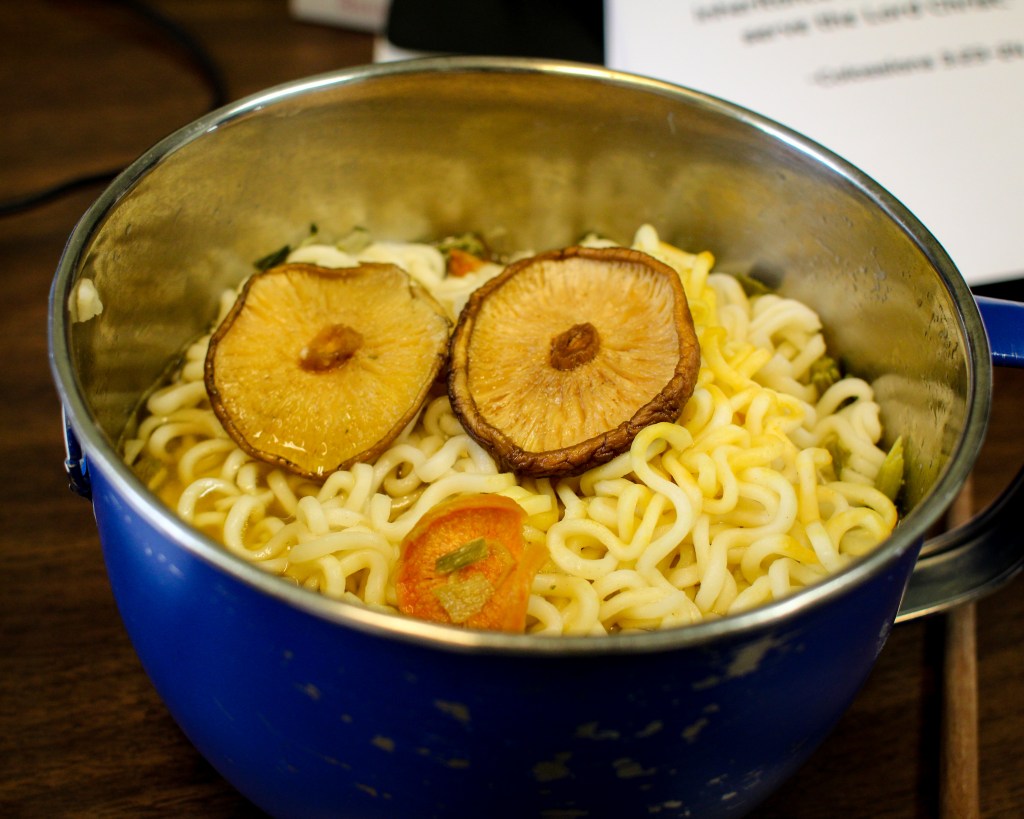
Ramen noodles soak
Mushrooms and veggies draw in
more than flavored broth:
they draw in hope for today
and give strength for tomorrow.
This morning started off well: a peanut butter and jelly sandwich with a tall glass of water before biking down to the church. The wonderful thing about biking to work is that you get to save gas money and help to care for the planet. Hours later, the crew leaves the church from the spring cleanup day. I head into my office and begin to work on cards thanking people for their service to the church today and for their service in helping to cleanup at Casowasco last Saturday.
After everyone has come and gone, the time for lunch draws near. I put a package of ramen, four dehydrated mushrooms, and a quarter cup of dehydrated veggies underneath the coffee maker’s spout. Twenty minutes later, I have Keurig Ramen, a common meal these days.
It isn’t the church’s fault that I’m not eating steak today. While I’d love to blame my former partner, it is not completely her fault either. It certainly is not the fault of the three blessings that I love with all of my heart and soul. We live in a broken world and after I am done voluntarily supporting my children who live across the state against my desires, I honestly have less in my bank account than I had when I served a church in seminary. I definitely did not see this place on my journey coming: I would have spent more time learning to cook better foods for fewer people for less.
For lunch today, my ramen looks back at me. I wrote a tanka about the ramen as I contemplated my lunch. I still wonder, what does the ramen see?
I hope it sees someone who is grateful for a good meal. I hope it sees someone who is grateful for what he has been given instead of someone who spends all of his time lamenting what is not right here. Actually, let me reword that: “I hope it sees someone who is working to be more grateful for what he has been given and to be less focused on what is lacking.” The intention is important, for I know I have a role in choosing how I react to these moments.
We don’t always get to choose what comes our way in this life. When we slow down and listen to the Spirit, we can be given a choice about how we react. I choose to react to these moments with hope.
Why seek victory?
Peace and love; all I desire.
I love my children.
Their mother also loves them.
We both love and we both long.

They live life halfway
without ever wanting this
chaos and discord.
They need their roots to sink in
and give them a peaceful life.

Where do we go now
when all is in the wild winds?
Tumbling through this life
as we wait to know what’s next
and each pray for an answer.

I don’t know it all.
YaH, You know what should come next
and I will listen,
even if I hear through tears.
Please watch over my children:
they matter more than I do.
The #rethinkchurch Lenten Photo-A-Day prompt for today is “silent.”
In our devotional today we are reading through a section of Matthew 10. Matthew 10:24-25 says:in the NRSV “A disciple is not above the teacher, nor a slave above the master; it is enough for the disciple to be like the teacher, and the slave like the master

Throughout the gospels, the story of Christ is one where Jesus seeks out time alone with God. Jesus spends time with God in prayer. In my own experience, I have always equated those times to moments of silence. Although it does not say so, I cannot imagine the disciples falling asleep if their prayer was some form of prayer in motion.
There are times when we are called to intensive prayer. For me, that often means being in a place where I can still my mind and my thoughts. To be clearly honest, there are times that my mind has been absolutely still and clear in the midst of a tumultuous location like in a crowd. There have also been times when I have been in peaceful spaces without an ounce of peace in my soul. Silence and stillness are not always the same as being in a place of peace and stillness.
What is important to me as we approach Holy Week is finding a place where I can find peace and stillness. Forget what the world says stillness and peace should look like as we approach holy week and the cross; we need the peace that enables us to follow. Whether that peace is found in a loud crowd or a silent setting, the peace we need is far more important than the appearance of peace. The silence inside is far more important than the sound levels outside..
The #rethinkchurch Lenten Photo-A-Day prompt for today is “Needs.” To be honest, there is absolutely no appropriate way that I can find to connect the word needs with both any photo in my collection and the theme of the devotional today.
In the devotional, the story we read today about Jesus’ life comes from John 9:1-40. In that story, Jesus brings sight into the life of a man who was born blind. To be entirely honest with you, I’ve never taken a photo of a blind person. The closest thing I have come to taking a photo of a blind person are the self-portraits I took when I had a corneal transplant a few years ago. My sight had grown so poor due to keratoconus that I was seeing quadruple at times in m one eye.
Nobody asked me the insanely pointed questions which were raised about the blind man in John 9. Nobody asked if I had keratoconus because my father or mother sinned. Nobody asked if my vision was hurt because of some great transgression. We don’t know everything about keratoconus, but it is likely that the latest medical journals do not point to divine punishment as a reason for a wacky cornea.
Instead, I chose a different picture for today. I chose a picture of a coffee pot brewing coffee on a camping trip two years ago. Why? Is it because I need coffee? Actually no, I was drinking tea at the time. Yes, there have been points in my life when I had foregone coffee for tea. Was it because everyone sometimes feels like they “need” a cup of something hot to start the day?

No, I shared this picture because it beautifully caught the flames, showed a moment of joy, and reminded me of a really happy sight in my past. Why was it a happy sight? It was a happy sight because someone donated a cornea and I can now see far better than seeing four images in one eye, and one image in the other.
Perhaps that’s the closest I will get to connecting this photo with the story of a blind person in need of compassion. While my story is not nearly as beautiful as the one in John 9, I have been in a place where I have been truly grateful to see. Sometimes the coffee pot is the most beautiful thing in front of us for a reason besides what it promises us. Sometimes it is just beautiful to see and have gratitude for sight.
The #RethinkChurch Lenten Photo-A-Day prompt for today is “gullible.” Actually, on the first of April the word for today is “keep.”

In my house there is a set of wooden blocks that all of my children have played with over the years. During a recent visit, the blocks were pulled out and I had a chance to play with my youngest. At one point she asked if her castle was beautiful. I told her that it was an amazing castle.
The bricks are not fancy bricks. As you can see, they’ve been written on, worn down, and in some places have started to chip and splinter away. While we have always made sure they are safe, they’re simple blocks. They don’t make sounds, they don’t scream out in bright colors, and they are extremely simple. They also have been the favorite toys of all of my children at one point or another, probably because I can’t help but play alongside them.
In the devotional today, we read the story of a man with a withered hand being healed by Jesus in Luke 6:6-11. Here was a man whose hand was wounded, whose wellbeing was considered less important than the Sabbath rules, and who was used as bait to trap Jesus. In other words, he was only useful in this moment as a tool rather than as a person.
Jesus loved the man and brought healing into his life. Where other people might see woundedness and assume it was a punishment from God, Jesus saw a person in pain. Where others were happily using the opportunity to find dirt on Jesus, Jesus saw a chance to do something wonderful for a man in pain. If this man was a toy, it would have been a pretty sad toy. Jesus restored rather than rejected. Jesus loved the man despite the consequences.
Jesus loved this man and healed him. In my life, I sometimes feel like the old bricks that might be ready for retirement. It is easy to dismiss your needs and value as unimportant or insignificant. We really should think twice before we try to throw our own self-worth out with the bath water. Jesus loves us even if we only see the worn edges or the lack of bells and whistles. Jesus loves us dearly as the people we are right now.
 Distracted Pastor Ramblings