Una Canción Nueva: One-Sided Violence

In October we remember Domestic Violence Awareness Month. I am reading and reflecting on both my experiences and the thoughts of others about domestic violence during this month. This action is important to me as a survivor of domestic violence.

One book I’m reading for Domestic Violence Awareness Month is “Telling the Truth: Preaching about Sexual and Domestic Violence,” which was written in 1998. In the chapter titled “Wings of Eagles and Holes in the Earth, Märie Fortune writes the following:

Howard Thurman, the black pastor and theologian whose writings convey profound insight into the human condition, observed: “When the power and tools of violence are on one side, the fact that there is no available and recognized protection from violence makes the resulting fear deeply terrifying.”Again Thurman: “Physical violence…need not fulfill itself in order to work its perfect havoc in [our] souls…Fear, then, becomes the safety device with which the oppressed surround themselves in order to give some measure of protection from complete nervous collapse.”:

Marie Fortune, “Wings of Eagles and Holes in the Earth

Since this sermon was written, research has shown that domestic violence is an issue for all people of all gender identities. When I read this thought, I remember days when I would check the door locks after a car drove slowly past my house. I remember being scared when my ex-wife came to my house without permission. I remember when the judge said it was all in my head. It’s horrible!

I especially remember when my attorney said: “Maybe if you had hit her, you wouldn’t be in this situation.” I remember feeling violently ill at the thought. Who would want to be that kind of man? I remember what it felt like to be hit in the ribs. How could I possibly do that to someone?

Marie Copeland went on to write in her sermon, “How do we protect ourselves? By accommodating our behavior to reduce our vulnerability to violence.” It is clear that this is true for everyone who experiences domestic violence. I still check the locks when I walk past the front door.

As a child, I believed a man was strong when he lifted heavy weights. Now, I believe a man is strong when he lives without fear. One day I will be strong again.


En Octubre recordamos el mes de concientización sobre la violencia doméstica. Estoy leyendo y reflexionando sobre ambas mis experiencias y los pensamientos de otra sobre violencia doméstica durante este mes. Esta acción es importante para mi como un sobreviviente de violencia doméstica.

Un libro estoy leyendo para el mes de concientización sobre la violencia doméstica es “Decir la verdad: Predicando sobre la violencia sexual y doméstica”, que fue escrito en 1998. En el capítulo titulado “Wings of Eagles and Holes in the Earth”, Marie Fortune escribió lo siguiente:

Howard Thurman, el pastor y teólogo negro cuyos escritos transmiten una profunda comprensión de la condición humana, observó: “Cuando el poder y las herramientas de la violencia están de un lado, el hecho de que no haya protección disponible y reconocida contra la violencia hace que el miedo resultante sea profundamente aterrador”. Thurman también: “La violencia física… no necesita realizarse por sí misma para producir su estrago perfecto en [nuestras] almas… El miedo, entonces, se convierte en el dispositivo de seguridad con el que los oprimidos se rodean para brindar cierta medida de protección contra un colapso nervioso completo”.

Marie Copeland, Wings of Eagles and Holes in the Earth

Desde que se escribió este sermón, las investigaciones han demostrado que la violencia doméstica es un problema para todas las personas de todas las identidades de género. Cuando leó esta pensaje, recuerdo dias cuando revisa las cerraduras de las puertas despues un carro maneje lento pasando mi casa. Recuerdo siente mieda cuando mi ex esposa llegé a mi casa sin permisión. Recuerdo cuando el juez dijo que todo estaba en mi cabeza. ¡Es horible!

(Solo por esta vez, estoy usando el Traductor de Google para asegurarme de que esta sección se entienda bien en español) Recuerdo especialmente cuando mi abogado me dijo: “Tal vez si la hubieras golpeado, no estarías en esta situación”. Recuerdo que me sentí terriblemente mal al pensarlo. ¿Quién querría ser ese tipo de hombre? Recuerdo lo que sentí cuando me golpearon en las costillas. ¿Cómo podría hacerle eso a alguien?

Marie Copeland continuó escribiendo en su sermón: “¿Cómo podemos protegernos? Adaptando nuestro comportamiento para reducir nuestra vulnerabilidad a la violencia”. Es claro que es verdad a todas las personas que experiencia violencia doméstica. Todavía reviso las cerraduras cuando paso por la puerta de entrada.

De nino, creiaba un hombre estuve fuerte cuando levantando pesas pesadas. Ahora, creo un hombre es fuerte cuando vive sin miedo. Un día volveré a ser fuerte.

Una Canción Nueva: Laity Sunday

In October we remember Domestic Violence Awareness Month. I am reading and reflecting on both my experiences and the thoughts of others about domestic violence during this month. This action is important to me as a survivor of domestic violence.

Today is Laity Sunday in the United Methodist Church. In my church, a layperson will lead the ministry and that layperson has my respect and also my trust. Sometimes it is not easy to let go and trust when other people lead, because the life of the church is connected to my life. It is hard to let go when my life, my home, and my self-esteem are connected to the life of the church, but I need to let go sometimes.

It’s horrible when and if I spend all my time afraid that everything will be horrible. How horrible! It’s true that I need to let go and trust other people because I don’t have omnipotence. It’s true in my work as a pastor. It’s also true that I need to let go of some things in my life as a survivor of domestic violence.

When I live with a lot of fears, tantrums, resentments, worries, and other things burning inside me, my life is miserable. It’s dangerous when I choose to live with an erratic fire inside my soul against the center of my heart. It’s like I dumped a bag of dog poop into my well and then made coffee with water from my well. It’s stupid and unhealthy!

What happened in the lives of domestic violence survivors was not acceptable. What happened needs healing. That is true, but until we heal, we do not have to live with increasing pain in our souls. We can choose to believe and let go one day at a time.


En Octubre recordamos el mes de concientización sobre la violencia doméstica. Estoy leyendo y reflexionando sobre ambas mis experiencias y los pensamientos de otra sobre violencia doméstica durante este mes. Esta acción es importante para mi como un sobreviviente de violencia doméstica.

Un libro estoy leyendo para el mes de concientización sobre la violencia doméstica es “Decir la verdad: Predicando sobre la violencia sexual y doméstica”, que fue escrito en 1998. En el capítulo titulado “Las llagas de Jesús, las llagas de mi pueblo”, M. Shawn Copeland escribió lo siguiente:

Hoy es el Domingo de los Laicos en la Iglesia Metodista Unida. En mi iglesia, una laica dirigirá el ministerio y esa laica tiene mi respeto y también mi confianza. A veces no es fácil dejarse llevar y confiar cuando otras personas dirigen, porque la vida de la iglesia está conectada con mi vida. Es deficil a dejarse cuando mi vida, mi casa, y mi autoestima son concecta con la vida de la iglesia, pero necesito a dejarse a veces.

Es horrible cuando y si paso todo mi tiempo con miedo de que todo sea horrible. ¡Qué horrible! Es verdad que necesito dejarme llevar y confiar en otras personas porque no tengo omnipotencia. Es verdad en mi trabajo como pastor. Tambien es verdad que necesito dajarme de algunas cosas en mi vida como un sobreviviente de violencia doméstica.

Cuando vivo con muchos miedos, rabietas, resentimientos, preocupaciones y otras cosas ardiendo en mi interior, mi vida es miserable. Es peligroso cuando elijo vivir con un fuego errático dentro de mi alma contra el centro de mi corazón. Es como si arrojara una bolsa de excremento de perro a mi pozo y luego hiciera café con agua de mi pozo. ¡Es estupido y no es saludable!

Lo que sucedió en las vidas de las sobrevivientes de la violencia doméstica no fue aceptable. Lo que sucedió necesita sanación. Eso es verdad, pero hasta que sanemos, no tenemos por qué vivir con un dolor cada vez mayor en nuestras almas. Podemos elegir creer y dejar ir un día a la vez.

Una Canción Nueva: Not Making it Worse

In October we remember Domestic Violence Awareness Month. I am reading and reflecting on both my experiences and the thoughts of others about domestic violence during this month. This action is important to me as a survivor of domestic violence.

Yesterday and two days ago I wrote about asking for help when demons from the past are haunting us. Yesterday I wrote and encouraged people who need help to ask for it. People of God, I encourage you not to make things worse by shaming people who need help.

I know that the Bible has a lot of things that revolve around community issues. Often, the things that the Bible addresses regarding community issues are beneficial to many people. The words of the gospel of Matthew, chapter 18, are amazing to many people. Sometimes the words can help with domestic violence issues, but when you don’t know the situation, the advice in that chapter can be dangerous.

It is possible that people who experience domestic violence may suffer or die when the abusers cannot hide in the shadows. Abusers may be kind to others and horrible to their victims. Although people may attend church, it is possible for those people to live in evil when in the shadows of ignorance.

When you don’t know what’s going on in a domestic violence survivor’s life, don’t shame people who ask for help. All people, regardless of gender identity, deserve to seek help and be believed. Some people may be liars, but when you don’t know, you don’t know and you don’t need to judge without understanding.


En Octubre recordamos el mes de concientización sobre la violencia doméstica. Estoy leyendo y reflexionando sobre ambas mis experiencias y los pensamientos de otra sobre violencia doméstica durante este mes. Esta acción es importante para mi como un sobreviviente de violencia doméstica.

Ayer y hace dos días escribí acerca de pedir ayuda cuando los demonios del pasado nos están acosando. Ayer escribí y animé a las personas que necesitan ayuda a pedirla. Pueblo de Dios, los animo a no empeorar las cosas avergonzando a las personas que necesitan ayuda.

Sé que la Biblia tiene muchas cosas que giran en torno a problemas de la comunidad. A menudo, las cosas que la Biblia trata sobre problemas de la comunidad son beneficiosas para muchas personas. Las palabras del evangelio de Mateo, capítulo 18, son increíbles para muchas personas. A veces, las palabras pueden ayudar con los problemas de violencia doméstica, pero cuando no se conoce la situación, el consejo de ese capítulo puede ser peligroso.

Es posible que las personas que experiencia violencia doméstica puede dolor o morir cuando los abusadores no puede esconder en los sombras. Las personas que abusan puede ser genial a otras y horible a su victimas. Aunque las personas puede attender la iglesia, es posible esos personas vivir malveda cuando adentro los sombras de ignorencia.

Cuando no sabes qué está pasando en la vida de una sobreviviente de violencia doméstica, no avergüenzas a las personas que piden ayuda. Todas las personas, independientemente de su identidad de género, merecen buscar ayuda y que se les crea. Es posible que algunas personas sean mentirosas, pero cuando no sabes, no sabes y no necesitas juzgar sin comprender.

Una Canción Nueva: Letting Go (part two)

In October we remember Domestic Violence Awareness Month. I am reading and reflecting on both my experiences and the thoughts of others about domestic violence during this month. This action is important to me as a survivor of domestic violence.

Yesterday I wrote on my blog about trusting Jesus when demons from the past are knocking at the door of your heart. Today, I need to tell the truth about the reality of domestic violence. Sometimes, the Lord wants to help you seek freedom from domestic violence. Today, the Lord loves you and wants you to seek help with your problems. Even if you are scared and worried, the Lord loves you and wants you to ask for help.

It is terrible to suffer from domestic violence. Why do we believe the Lord does not want us to call 800-799-SAFE or visit thehotline.org when we need help? It is unbelievable that we believe the Lord does not love us and want us to seek help!

Yes, it is good for us to call upon the Lord when demons from the past are bothering us, especially when the demons from the past are in the past. When demons from the past are in the present, we call upon the Lord and we also call upon others to help us. Today, our Lord loves us and hears us. When we call upon others we may find new freedom. When we do not call upon others, we may find that the very demons we hate are here until we seek help.


En Octubre recordamos el mes de concientización sobre la violencia doméstica. Estoy leyendo y reflexionando sobre ambas mis experiencias y los pensamientos de otra sobre violencia doméstica durante este mes. Esta acción es importante para mi como un sobreviviente de violencia doméstica.

Ayer escribí en mi blog acerca de confiar en Jesús cuando los demonios del pasado están llamando a la puerta de tu corazón. Hoy, necesito decir la verdad sobre la realidad de la violencia doméstica. A veces, el Señor quiere ayudarte a buscar la libertad de la violencia doméstica. Hoy, el Señor te ama y quiere que busques ayuda con tus problemas. Incluso si tiene miedo y está preocupado, el Señor se ama y desea que usted preguntar para ayudar.

Es terrible que sufrir de violencia doméstica. ¿Por qué creeimos el Señor no desea que llamar 800-799-SAFE o visitamos el sitio thehotline.org cuando neceisitamos ayudar? ¡Es incredible que creeimos el Señor no se ama y desea que buscar a ayudar!

Sí, es bueno que invoquemos al Señor cuando los demonios del pasado nos están molestando, especialmente cuando los demonios del pasado están en el pasado. Cuando los demonios del pasado están en el presente, invocamos al Señor y también invocamos a otros para que nos ayuden. Hoy, nuestro Señor nos ama y nos escucha. Cuando invocamos a otros podemos encontrar una nueva libertad. Cuando no invocamos a otros, podemos encontrar que los mismos demonios que odiamos están aquí hasta que buscamos ayudar.

Una Canción Nueva: Letting Go

In October we remember Domestic Violence Awareness Month. I am reading and reflecting on both my experiences and the thoughts of others about domestic violence during this month. This action is important to me as a survivor of domestic violence.

One day last week, I was having a conversation about the past. A person and I were talking about our fears and worries from the past. We wanted to live without our fears and worries, but the demons from the past wouldn’t let go. How frustrating!

It’s hard to let go of the past. Often, demons from the past come knocking at the door when it’s not good for our mental health. It’s like they have our mobile phone number and it’s not possible to turn it off. The phone sings and makes a disturbing noise when we just want to live in the present. It’s horrible!

In my recovery program we learn that we have to admit that we were powerless over our problems. We have to admit that our lives had become unmanageable. We didn’t believe that every problem needed God’s help, but there were some problems that we were powerless over. Sometimes our demons from the past are problems that we are powerless over. I see the same power in the demons of the past as I do in the horrible problems that I am powerless over.

In my past life, I had to decide to put my life in the Lord’s hands before seeking freedom and happiness. When I went to seek the Lord instead of struggling with my problems, I found new freedom and happiness. Today, why don’t I seek the Lord instead of struggling with the demons of the past? Jesus Christ descended into hell to save me. Why don’t I believe that Jesus can defeat my demons of the past even though I am powerless against them? Can I entrust these demons of the past to Jesus and walk away without becoming stuck?


En Octubre recordamos el mes de concientización sobre la violencia doméstica. Estoy leyendo y reflexionando sobre ambas mis experiencias y los pensamientos de otra sobre violencia doméstica durante este mes. Esta acción es importante para mi como un sobreviviente de violencia doméstica.

Un día de la semana pasada, estaba teniendo una conversación sobre el pasado. Una persona y yo hablamos sobre nuestros miedos y preocupaciones del pasado. Queríamos vivir sin nuestros miedos y preocupaciones, pero los demonios del pasado no lo salirnos. ¡Que frustrante!

Es difícil desprenderse del pasado. A menudo, los demonios del pasado llaman a la puerta cuando no es bueno para nuestra salud mental. Es como si tuvieran nuestro número de teléfono móvil y no fuera posible apagarlo. El teléfono canta y hace un ruido inquietante cuando solo queremos vivir el presente. ¡Es horrible!

En mi programa de recuperación aprendemos que tenemos que admitir que éramos impotentes ante nuestros problemas. Tenemos que admitir que nuestras vidas se habían vuelto ingobernables. No creíamos que todos los problemas necesitaban la ayuda de Dios, pero había algunos problemas ante los cuales éramos impotentes. A veces, nuestros demonios del pasado son problemas ante los cuales somos impotentes. Veo el mismo poder en los demonios del pasado que en los problemas horribles ante los cuales soy impotente.

En mi vida pasada, tuve que decidir poner mi vida en las manos del Señor antes de buscar la libertad y la felicidad. Cuando fui a buscar al Señor en lugar de luchar con mis problemas, encontré una nueva libertad y felicidad. Este dia, ¿por qué no busco al Señor en lugar de luchar con los demonios del pasado? Jesucristo descendió a los infiernos para salvarme. ¿Por qué no creo que Jesús puede vencer a mis demonios del pasado aunque yo sea impotente contra ellos? ¿Puedo confiarle a Jesús estos demonios del pasado y alejarme sin quedarme estancado?

Fear as the Gatekeeper

“Fear keeps some people in dead-end jobs and environments so miserable that they dread going to work—and yet they come back day after day because they are afraid to go into another field that would actually excite them. I’ve known people who stayed in abusive marriages because they were more afraid of venturing into the unknown than of staying with their abuser.”

Rev. Adam Hamilton, “Simon Peter: Flawed but Faithful Disciple”

Fear is sometimes the biggest gatekeeper to change. There are often other collaborating factors that keep us in our place, but fear itself can be the hardest obstacle to overcome. Rev. Hamilton writes about people who allow fear to keep them in abusive marriages in our chapter this week. He’s right.

I am in long-term recovery from a disease that I would likely have had resting in the background even if I never picked up a bottle. My mother was an alcoholic and I am one too. I often speak about how alcoholism is not a four-letter word and regularly point out how there is hope for people facing alcoholism both during communion services and throughout the week both at work and in my personal life.

I don’t often share openly about how strong a factor fear was in my own disease. I should have had both the education and the experience to know just how dangerous it was to mix alcohol with fear. It was easier to drink than to face the things I was afraid of doing. Standing up for myself, my children, and my future should have been a higher priority than escapism, but it wasn’t because I was afraid. I was afraid of my former partner, my district superintendent, and even the church leaders who really wanted what was best for me even when all I could hear was criticism. I was afraid.

After being called forward by Jesus, Simon Peter stepped out of the boat. He was able to take a few steps and live the kind of life many of us dream of experiencing. He didn’t run a marathon out on the waves, but he stepped further out into the unknown than any of the other disciples. He risked it all and found Jesus out on the waves.

On different seas, I risked it all. I could have scraped and cowered further, but I stood up for myself. I stood up for myself and said I didn’t want to be abused anymore. When my former partner responded to my asking for freedom by calling my District Superintendent and sharing my medical history without consent, I stood with my head tall in my conversation with my supervisor. I admitted I had a problem, had been working towards recovery for years, told her what I had been doing and what I was doing about it, and worked within the covenant community to find a way forward. I was honest with my SPRC and eventually spoke about my experiences openly from the pulpit. I risked stepping out into some pretty serious wind and waves in order to break the shackles of fear.

I don’t regret standing up for myself. In recovery circles, we talk about how we come to not regret the past nor wish to change it because the road we have walked down gives us the tools to help other people. The waves can be choppy and I have had to reach out a time or two, but I know one thing: I never want to feel the shackle of fear around my neck again. I would rather live in honest, open recovery than seek to hide my identity again. I’m grateful for the freedom that came from stumbling out of that boat.


Our church is offering a short-term Bible study for the season of Lent. While many studies for the season traditionally focus on spiritual practices or on the stories of holy week, this year we are reading “Simon Peter: Flawed but Faithful Disciple” by Rev. Adam Hamilton. The idea of the study is that we might consider how we follow Christ in our lives while considering the life of this flawed follower. These blog posts are designed with a principle I have learned from recovery work: “We identify with the stories of others and try not to contrast.” We grow more and live with greater serenity when we look for what we share in common with someone with whom we might otherwise disagree.

Jesus and the tiller

“Jesus may not make the storm go away, as he did for Peter and the disciples. The cancer may still be there. The spouse may still be gone. But Jesus is riding it out with us, and somehow that makes the storm less terrifying. That is part of what the Christian’s spiritual life is about. Feeling Jesus’ presence with us enables us to be calmed, even if the storm is raging all around us.”

Rev. Adam Hamilton, “Simon Peter: Flawed but Faithful Disciple”

I grew up on Lake Erie, which is much larger than either the Sea of Galilee or the Lake of the Ozarks which Rev. Hamilton so often references in our chapter this week. My father owned a twenty-four-foot sailboat which, as we read, is about the length of the boats from the time of Jesus. We would sail regularly as children, especially after my mother passed away. Grief is a tough thing and my father did what he had to do to survive difficult days while coping with the loss of his wife.

In our chapter this week, Rev. Hamilton writes about how comforting it is to know that Jesus is there with us when the storms rise. It reminded me of a popular song about Jesus taking the wheel of life as we go down the road of life. It is a beautiful and catchy song, but it differs from my experience of things in recent years.

A few years ago my life fell apart. Within a year and a half a pandemic struck, my disease hit a critical point, what was left of my marriage disintegrated, and I became more of a thing than a person in my own home. I once was given the opportunity to have a say in my own life, but was treated like a wounded animal that needed to be put down instead of as a human being with rights and a family. It isn’t pretty to say, but it does help to point out and normalize the conversation that these things happen to people of every gender, age, educational level, and station in life.

To be honest, it would have been the perfect time to have Jesus take the wheel of life. The problem is that the wheels on the car kept driving straight towards oblivion. I wanted to let go: don’t answer the mail, don’t go to work, don’t answer the phone, and certainly don’t tell people what was happening in my life. If Jesus had the wheel then personal responsibility was meaningless. It would have been great to just let go, but what would happen if I didn’t do what needed to be done next? I would probably be dead from either a resurfacing of my disease that I had spent years seeking to overcome or from being thrown out of my home for not doing the work I am called to do with my life.

As a kid on that boat, I was once going out with my father into a storm to ride on the winds and waves. We were going to go bow-first into the waves so that the winds wouldn’t toss us off course. My father went below deck for maybe five seconds. I moved the tiller a little to one side and we nearly capsized. In a moment the already frightening situation went from scary to terrifying. I thought we were going to die. To be honest, it is impressive that nobody was hurt or killed.

It is dangerous to let go of the tiller or to treat it as anything less than a critical piece of machinery upon which your life can depend. It is equally dangerous to just let go of the wheel and hope it will point down the road.

For me, one of the most important things in this chapter is the fact that Rev. Hamilton points out that Jesus is in the boat with us in the middle of the storms of life. Jesus’ presence does not mean that the storms will always cease or that there won’t be moments of chaotic fear, but it does give us the hope that we are not alone. Even as we gingerly hold the tiller, we do not need to face the storms alone.


Our church is offering a short-term Bible study for the season of Lent. While many studies for the season traditionally focus on spiritual practices or on the stories of holy week, this year we are reading “Simon Peter: Flawed but Faithful Disciple” by Rev. Adam Hamilton. The idea of the study is that we might consider how we follow Christ in our lives while considering the life of this flawed follower. These blog posts are designed with a principle I have learned from recovery work: “We identify with the stories of others and try not to contrast.” We grow more and live with greater serenity when we look for what we share in common with someone with whom we might otherwise disagree.

Fear in the midst of Deep Waters

“Many of the things that Jesus calls us to do leave us feeling a bit afraid. For me, that included answering the call to full-time ministry and starting a church, but it was also getting married, having children, caring for people I don’t know, going to places I’ve never been, giving money I didn’t think I could spare. In a thousand ways he’s had to reassure me with the words, ‘Don’t be afraid’ before he called me to his mission in the moment, for the day, in my life.”

Rev. Adam Hamilton, “Simon Peter: Flawed but Faithful Disciple

Sometimes it is difficult to identify with an author’s words instead of attempting to tear them down. I have never quite moved beyond that desire to be the smartest person in every room, and sometimes the old temptations of academia rear their bedeviling heads to encourage me to tear down the words of others.

At the same time, it is good to admit when someone’s words touch your soul. Yes, there are times the things I am called to do with my life leave me genuinely nervous or fearful. Ministers from my Annual Conference are already paid sparingly with our Annual Conference being one of the conferences with the lowest average compensation. I would likely make nearly twice as much if I lived in Georgia, but still have to pay off the same educational loans for the same educational standards. Add child support and car payments on top of the already difficult financial situation I was left in a few years ago, and yes: I completely understand it when Rev. Hamilton says that there are times when a call to generosity can inspire fear.

I am not alone in financial concerns and financial concerns are not the only place God calls us to trust. I live where the bishop sends me, but for many, the choice of where one chooses to live can mean living life alongside people whom Jesus would have us love despite our own inclinations. Others are called to live in places where forgiveness is a test of one’s faith and one’s patience. Still, others are called to trust doctors as the growth of cancer continues to plague the test results.

There are many places in life where the choice to trust God like Simon Peter is challenging, but Rev. Hamilton is absolutely correct when he asserts that God is there. God is there even in the uncomfortable bits. God is perhaps especially there in those moments.


Our church is offering a short-term Bible study for the season of Lent. While many studies for the season traditionally focus on spiritual practices or on the stories of holy week, this year we are reading “Simon Peter: Flawed but Faithful Disciple” by Rev. Adam Hamilton. The idea of the study is that we might consider how we follow Christ in our lives while considering the life of this flawed follower. These blog posts are designed with a principle I have learned from recovery work: “We identify with the stories of others and try not to contrast.” We grow more and live with greater serenity when we look for what we share in common with someone with whom we might otherwise disagree.

Poem in need of expression

I don’t have my own “word salad”:
My thoughts often get quite jumbled
and forgetting leaves me humbled,
but my soul is quite clear.

I care for people with my heart
and my head runs away at times.
If that is the worst of my crimes
then let me live in peace

If I could clear out hateful words
and live as if my life mattered
instead of this feeling scattered 
I might come to find peace.

Instead I hear her voice shredding
any confident words I share
as I seek to just show I care
I hear: “its word salad”

A Court Prayer

Why seek victory?
Peace and love; all I desire.
I love my children.
Their mother also loves them.
We both love and we both long.

They live life halfway
without ever wanting this
chaos and discord.
They need their roots to sink in
and give them a peaceful life.

Where do we go now
when all is in the wild winds?
Tumbling through this life
as we wait to know what’s next
and each pray for an answer.

I don’t know it all.
YaH, You know what should come next
and I will listen,
even if I hear through tears.
Please watch over my children:
they matter more than I do.

“Sacrifice” and the Bridge

The #RethinkChurch Lenten Photo-A-Day word of the day is “sacrifice.” It is a somewhat difficult thing to balance the idea of sacrifice with this week’s theme of hunger and fullness. The challenge does not rest in making a connection between these two ideas, but in making a connection that is not overly personal.

In the fairly Christian culture of my teenage years, there was a common description of what Christ does through the events of holy week. Christ makes a bridge between our lives and eternity. The idea behind the analogy is that there is a massive gap between our lives in this world and the life we were created to live. We can jump as far as we want, be as righteous as possible, and we still won’t be able to leap the distance.

What happens without Christ? We fall into the gap which can be described as torment, hell, or death. Instead of leaving us in this position, Jesus came for us, died for us, and created a way for us to reach the other side. Christ is our bridge.

The photo I selected for today is of a rickety bridge over a tributary to the Cayuta Creek. I found the bridge on a walk last fall while trying to think through some personal struggles. I found the bridge and to be honest, I really wanted to see what was on the other side of the bridge; however, at least in my head, there was not even the slightest possibility that the bridge would have supported my weight. The bridge appeared rickety, broken, and frightening.

One of the things I have come to understand in my own walk with Christ is the fact that my relationship with Jesus is a relationship that is founded on love and respect. God doesn’t force me to walk over the bridge to life. There are places in my relationship with Christ where I am offered life, but even as Jesus builds a bridge to life, I must choose to step out in faith.

Jesus’ sacrifice brings life and light into my darkness, but I must choose to step out in faith. It can be really frightening to trust Christ. Occasionally the bridge looks really frightening. Sometimes, we need to face our fears and step out onto the bridge even when it is scary. Christ sacrifices for us and sometimes we must choose to sacrifice our fears in order to choose life.

Untitled poem from a dream

Dreams like fog drift out from the depths of night.
Troubled thoughts steal all the warmth from our bed.
Hazy glimpses of events filled with fright:
I dream of habits I would bury dead.

Cold winds blow down the dreamy lane
Where dreaming guilt weighs down my soul.
Eyes open to a world more sane
As thoughts bend to the night's dark hole.

A staccato heartbeat
Slowly calms itself down.
I live where fingers meet
As soul seeks Heaven's Crown.

I would forget
Dark dreams untrue:
Part ways and yet,
Guilt clings like dew.

O God...
Bless me...
Break rod...
Free me...

Below the sun
I kneel and pray.
I seek the Son
By light of day.

Sunlight burns away fog
Revealing ways to see
Not all is miring bog.
There is much good in me.

Drifts lift to reveal a good heart
That seeks to be a good parent.
Terror unveiled to have a start
In desire to straighten parts bent.

I cannot change past nor keep dreams away
But sunlight reveals that the day has come.
Fog burns away over a cold clear way
Where any future has yet to become.

Whole Life Challenge: Day Six

I have been struggling for the past few days. My chest has been sore and healing from the muscles I worked out earlier this week. Today I was scheduled to work out my upper body. I had a great deal of apprehension about working out.

Psalm 27 speaks about fear and trust. The third verse says: “Though an army encamp against me, my heart shall not fear; though war rise up against me, yet I will be confident.” (NRSV)

I did not wake up very confident about my chances against the army of weights. I still worked out despite my concerns. I not only worked out, but I completed every set I began. It was close, but I succeeded.

People are often afraid of things they really need not fear. There are good reasons for concern, but fear as an abstract emotion is something that usually can and should be conquered.

If God does truly love us, then God’s love can help cast out our fear. This is my hope as I go to lie down for the evening: that I would face the night without fear of cramps and with confidence that I will rise to meet the challenge of “leg day” tomorrow.

Responding to a Weird World

Friends, Tuesday was an odd day for me as a minister. Two things happened which led me to go for a long walk around the block. The first is probably obvious to anyone who knows I am United Methodist or even goes back a few blog posts.

General Conference was taking place and the institutional global church further pressed back against people pushing for inclusion. I did not see the legislation pass in person because I felt the need to go and pray for the church.

The second thing that happened was that I had a conversation with a colleague from a nearby church who came to discuss recent events during worship at our church. His church now has locked doors during worship. They were concerned. I was asked about what happened, was I afraid, and we discussed churches that have panic buttons and armed security. My colleague and I discussed that he doesn’t carry the panic button because he is aware as one of the people up front he might be the first one targeted by a shooter.

I went to take a long walk because it is weird to feel both slammed with pressure from above when there are people and colleagues in my neighborhood in the middle of nowhere that are now worried that church is literally a physically unsafe place without locked doors.

I have received threatening notes in the past regarding my own safety for taking stands on including folks from the margins, although honestly more about racial inclusion and less about LGBTQIA+ inclusion. I have upcoming meetings scheduled for dates before the Judicial Council will meet to determine whether what was just passed is enforceable under our constitution. I am concerned about what will happen between now and when the Judicial Council will (in my opinion) likely strike down portions of what passed.

I’m just concerned because my honest response to both issues is the same. If someone came into my church with a theological or physical gun, my place is between the church and that person. I have children and a family to provide for in this life, but that place of risk is my place as a minister.

I have taken a number of long walks between Tuesday and today. I will likely continue to keep walking, praying, and honestly playing a few video games on my phone to help keep my anxiety down.

I will find that ditto… I need the Pokémon who is all things to all people.

Courage and Voting

Today’s blog post is two days in the making. I have been pondering what it means to be a Christian in an age where political differences in the United States are resulting in violence. Bombs are being mailed to opponents of the president and Republicans have been threatened at one particular early voting site in North Carolina. The world seems to be more and more violent the closer we get to November’s election.

I am wondering how we should reply to these situations. Scripture tells us to pray for the lands where we find ourselves. Even if some Christians do not appreciate the idea of Christians being a people living in exile, the thrust of Jeremiah 29 still points us to ponder how we relate to the “city where we are sent.”

Of course, none of this is easy. To be honest, in some circles, asking people to take Romans 13 seriously is a dangerous proposition. Calls by Paul to the Romans to be subject to governmental authorities are seen as less than applicable in some contexts, especially when we disagree with those authorities. A person who might quote Paul as sharing the gospel truth in one letter might chafe at considering his words in another. It is natural that we rejoice when governmental powers agree with us. Unfortunately, it seems increasingly common to call for their damnation when they disagree. Calls to respect people of different opinions in Romans 14 and 15 are seen as equally ludicrous at times.

It is difficult to live in such times. Whether you are a democrat, republican, or neither, these days are difficult days. As election day draws closer, there is a real sense of dread building in some circles. Will there be violence if one party loses favor or if another gains favor? Will there be violence if something changes or will there be violence if nothing changes? Heaven knows how many families are dreading Thanksgiving and those often turbulent conversations around the dinner table.

To be honest, I half expect to hear more stories about threats and potential bombings to increase as election day draws nearer. I am not seeking to be a pessimist. I find myself watching a pattern and pondering the outcome. In truth, my own days of believing in the myth of American exceptionalism in terms of believing in a political process that might be free of intimidation and gerrymandering are pretty much at an end. Perhaps I am simply choosing to save my idealism for my life of faith or perhaps I am simply worn thin by the matters of this world.

You may be asking what any of this has to do with being a pastor or spirituality. My simple answer is to say that it relates because these are the days where we need to have courage. Yes, the news is full of stories of challenges and those stories will increase. Yes, the President has warned there will be violence if his party loses the election next month, although it is strange he warns that the violence he seems to fear would be from the party that might gain political power. An honest appraisal might say that violence might occur regardless of who wins. Yes, the world might become a dark place after this election. Yes, these are days that require courage regardless of political party.

Then again, maybe these days are not as dire as it seems. Things might go poorly, but they also might go well. In a sense, these days are like every single day of our lives. Even in the best of times, all of us live with only one day. We all live in today. Yesterday has gone by. Tomorrow is a dream. Today is the only day that any of us has to live within. Since you cannot control the future and cannot change the past, today is like every day of your life. To borrow from the ancient philosopher Heraclitus, you can only step in the same river once.

The world is always changing and the natural uncertainty requires courage. It takes courage to live in a world which might change in a moment due to a blood clot, a missed stop sign, or an unexpected illness. It takes courage to live in a world where someone might leave tomorrow, where you might lose your job at the end of your shift, and where a loose dog might catch you while you wait for the school bus. It takes courage to live in this life and while the future might seem stressful, today is really the only day that any of us have ever had to live within.

I hate to bring in ancient monastics again, but I do enjoy them. There is an applicable gem in my often quoted copy of Benedicta Ward’s “The Sayings of the Desert Fathers: The Alphabetical Collection.” That gem is a quote from Abba Serinus. The quote goes: “Abba Serinus said, ‘I have spent my time in harvesting, sewing, and weaving, and in all these employments if the hand of God has not sustained me, I should not have been fed.’”

If you would prefer a biblical approach to the concept that life is a bit more transitory than some of us expect, Luke 12:13-21 contains a parable where Jesus warns people about the folly of building up riches on earth. A rich man has a bumper crop, plans to tear down his barns, and intends to build bigger barns to hold his massive crop. He plans to live out his days with wealth! Jesus shares that his folly is to plan to live out long days with his massive wealth. The rich man will die that very night. All of the crops from his wonderful harvest will not keep him from his own mortality.

Whether you approach the subject from the Abba’s viewpoint that all of life has led to this moment because God has provided or whether you hear Jesus’ warning about the uncertainty of tomorrow, in my opinion one thing is clear. We all have this one moment. We can respond with gratitude, make assumptions about the future, or even follow the advice of Ecclesiastes 5:18 (“This is what I have seen to be good: it is fitting to eat and drink and find enjoyment in all the toil with which one toils under the sun the few days of the life God gives us; for this is our lot.”). Regardless of how we spend our days, these days are the days we have.

So, how will we spend them? If today is the day you have to live, what will you do? Will you live in fear? Will you decide to ponder what comes in every package, worry about every group of people near every polling place, or will you step forward to take your place in history? If God has brought you to this time and place, is it not your responsibility to live in this moment?


IMG_3222

I invite you to participate…

Let us Seek: Do not be alarmed!

I was out in the world this morning. Cold or no cold, there are some appointments that cannot be put off. I had an appointment with a specialist that I had scheduled weeks in advance. I went to my appointment on cold medicine, advised everyone I was in contact with to wash their hands, and we made the best of things.

My appointment today was for a simple non-invasive type of treatment which took a few minutes. The doctor and I sat alone talking while she was going about her work. We began to talk and things went to deep matters in a few moments. I was not surprised. People often open up to me–I do not advertise that I am a minister, but I always seek to be polite and courteous. It can be amazing how quickly people come to trust you when you always say “please,” “thank you,” and tell them that you are grateful for what they are doing for you. I also believe that most people just want someone to listen.

She started talking about what she had heard in the news. She was afraid of what was happening in the world. She talked about intercontinental ballistic missiles, nuclear warheads, and the idea that someplace as nearby as Washington could be struck, although she did not rule out New York City. As medicated as I was at the time, I wondered aloud about the fact that people feared nuclear attacks on the Hoover Dam and the dam at Niagara Falls during the Cold War. We talked about how frightening things are, how strange everything seemed, and she wondered what she would do if a war broke out. She was frightened. I commiserated, listened, spoke very little, and prayed for her fears in my heart.

The conversation reminded me of a passage in Matthew about the end times. Discussions of nuclear winter, nuclear fallout, and global conflict often remind me of the passage found in the twenty fourth chapter. Matthew’s gospel reads in verses three through fourteen: (Common English Bible)

“Now while Jesus was sitting on the Mount of Olives, the disciples came to him privately and said, ‘Tell us, when will these things happen? What will be the sign of your coming and the end of the age.’


Jesus replied, ‘Watch out that no one deceives you. Many will come in my name, saying, ‘I’m the Christ.’ They will deceive many people. You will hear about wars and reports of wars. Don’t be alarmed. These things must happen, but this isn’t the end yet. Nations and kingdoms will fight against each other, and there will be famines and earthquakes in all sorts of places. But all these things are just the beginning of the sufferings associated with the end. They will arrest you, abuse you, and they will kill you. All nations will hate you on account of my name. At that time many will fall away. They will betray each other and hate each other. Many false prophets will appear and deceive many people. Because disobedience will expand, the love of many will grow cold. But the one who endures to the end will be delivered. This gospel will be proclaimed throughout the world as a testimony to all nations. Then the end will come.’”

I first came to know this passage well through the New Revised Standard Version of the Bible. In that translation verse six says “…you will hear of wars and rumors of wars; see that you are not alarmed…” These verses have all taken a vital place in my lived theology within this world of global information and easily spread global panic, but verse six has always rung out the loudest in my mind. As I lay on the table, I could almost hear a palpable voice repeating in my heart “you will hear wars and rumors of wars…” alternating with “Peace I leave with you; my peace I give you… Do not let your hearts be troubled and do not be afraid.” 

My doctor was afraid this morning. I chose not to be fearful, but to be compassionate. What is the good news? In this context, I believe it can be best expressed earlier in the Gospel of Matthew. In verses twelve through fourteen in chapter eighteen, Jesus tells a parable: (CEB)

“What do you think? If someone had one hundred sheep and one of them wandered off, wouldn’t he leave the ninety-nine on the hillsides and go in search for the one who wandered off? If he finds it, I assure you that he is happier about having that one sheep than about the ninety-nine who didn’t wander off. In the same way, my Father who is in heaven doesn’t want to lose one of these little ones.”

I invite you to think about the promise which inherently sits within this parable. My doctor, like many individuals, has an uncertainty about the future. The world seems to be less than the ideal many of us were taught as children. Most of us lose a sense of the innocence of childhood as we grow into the world, and I personally believe that there’s a correlation between this loss of innocence and the traditional drop in church attendance that tends to happen at around the same time. Losing our innocence hurts.and events like those depicted in the news can send us back into our grief over our loss even if it has been decades since we first realized the world is broken. The world can seem to be a confusing place and our fear can isolate us.

Into those moments of fear, there is an ancient promise embodied in the person of Jesus. God does not want to lose one of those little ones. God cares about the lost sheep of the world. Even when it seems that the world does not care one bit for our fears, God does care and will walk through the valley of darkness to lead us all home. There is space for us at the table, there is space in the flock, and there is deep grace despite our fears for all people. God has come near, God has shown compassion, and eternal life will come to those who follow the Shepherd. As Matthew records in the twenty ninth verse of chapter nineteen, “…all who have left houses, brothers, sisters, father, mother, children, or farms because of my name will receive one hundred times more and will inherit eternal life.

Friends, be at peace. God does not give as the world gives. Know that the path of a Christian is not an easy path, but there is a place of peace that awaits the end of our journey. Go! Be a blessing in a world of fear! Fight for justice and grace! Share the Good News! Walk with the lost sheep! Please, be compassionate

Let us Ramble: Pursuit of Smokiness

Yesterday was Independence Day in the United States. For most folks Independence Day is marked by celebration with a barbecue of chicken, hamburgers, hot dogs, sausages, or any other number of delicious foods. Tradition usually lends itself towards children staying up late to see fireworks and to listen to patriotic music.

The day celebrates the Declaration of Independence being ratified by Congress in 1776. The day celebrates a far different time in our nation. A lot of the celebration would probably be considered obtuse, strange, and irreverent to most of the folks who lived through the events of 1776. I must admit that I am less concerned with the historical tension in this holiday than with many of the religious holidays which normally pique my interest. I happen to like Independence Day.

One of the reasons I like Independence Day is that I like to grill. I enjoy using our grill. This year I did a bit of minor surgery on my charcoal grill/smoker with a dremel to add a rotisserie component. I woke up very early, set the fire smoking, and watched a turkey spin around and around on the spit. We were invited to a wedding renewal ceremony and picnic about noon. The turkey hit the perfect temperature right on time to head out to the party with a smoked bird. Here’s the bird about an hour before she was finished. The tiny yellow bits were part of an olive oil baste with thyme, marjoram, and garlic. When finished the turkey was deeply colored and extremely fragrant.

My smoked turkey about an hour before completion

I was really proud of the turkey, but I refused to put pictures online. My wife knows that I love to share bits of my cooking adventures, so she took a picture to post on my behalf. I almost stopped her from posting the picture. What was my reasoning? What if I had made a huge mistake and the turkey was awful? What if people saw the turkey and told me I had messed it up?

The turkey was decimated at the party. The turkey was just torn to shreds by people who had spent a good half hour smelling the fragrant meat while waiting for the guests of honor to arrive. I’m glad my wife saved me a piece when carving because the turkey was just destroyed. I understood why immediately upon tasting the meat. The meat was deeply flavored, deeply delicious, and tasty in a way that only smoked meat can taste. This turkey wasn’t just store-bought turkey. The bird had been prepared carefully, slowly, and it was absolutely delicious.

It raised a question in my mind. Why am I so afraid of failure? I have good gifts, I have talent, and I practice my craft. I cook dinner regularly in my house and I have never been afraid to attempt new things. I should believe in myself, but I regularly look in the mirror and assume the worst about myself. What if my fear really is just fear that should be put aside?

The situation reminds me of FDR’s first inaugural address in 1933. President Roosevelt stated “let me assert my firm belief that the only thing we have to fear is fear itself—nameless, unreasoning, unjustified terror which paralyzes needed efforts to convert retreat into advance.” Facing a nation in a fiscal crisis with a vast imbalance of population and resources, FDR approached a dangerous situation with the belief that the nation must advance or perish. While my concerns are not nearly so dire, I will say that my own fears in life are often unreasonable and unjustified. President Roosevelt said later in that address:

“Happiness lies not in the mere possession of money; it lies in the joy of achievement, in the thrill of creative effort. The joy and moral stimulation of work no longer must be forgotten in the mad chase of evanescent profits. These dark days will be worth all they cost us if they teach us that our true destiny is not to be ministered unto but to minister to ourselves and to our fellow men.”

If true happiness lies in the joy of achieving things, then why am I so terrified of failure? Why do I fret about money, resources, and future criticism when happiness will not lie down those paths? Why do any of us live in such fear? I smoked a turkey that I filled with herbs from my own garden, basted in an oil I infused with my own instincts, and then slow roasted in a smoker that I altered with my own hands, My wife was right to be proud of me. Smoking a turkey is not rocket science, but the turkey was something that I enjoyed creating which I brought together through my own efforts in cooking, gardening, crafting, and patience. What’s more, I took that gift and shared it in a place where people could enjoy it without price or cost. I used my talents to bless others.

What would the church look like if we were to live out this love together? What if we were more concerned with our ministry to ourselves and to others than with looking at what we can take from the world around us? What if we found joy in our work as a community instead of chasing our own profits to our own doom?

Let us Seek: Flowers in the cold

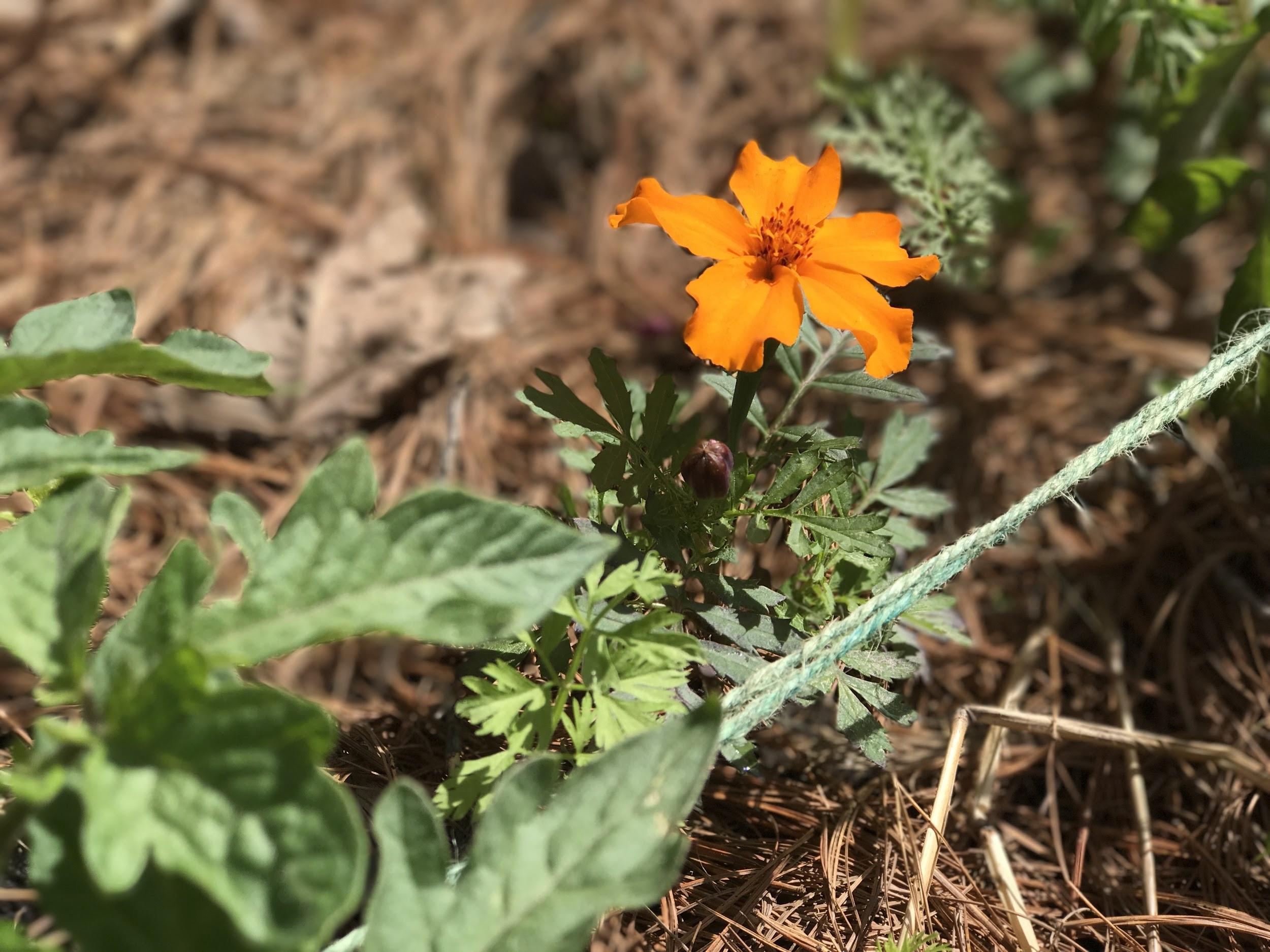
The last few nights have been very cold in the town of Maine, NY. I have gone to sleep with a prayer on my lips as I curled up into my bed. Each morning I have gone outside to check on the tomato plants and marigolds that have been hiding under burlap covers. I have pulled aside the cover and I have expected the worst case scenario to have taken place. This is what I saw as I pulled aside the burlap this morning…

Oh! The horror of it! A bright orange flower greeted me in the midst of happy tomato and carrot plants…

This beauty of a red and orange blossom also had been clearly struggling with the weather.

I had assumed that the very worst case scenario had occurred. Nothing had gone wrong with the plants. I had the same fear the night before, but nothing had gone wrong with the plants. I have assumed that something terrible would happen every night of this weekend. Nothing went wrong with the plants. They are all perfectly fine.

I occasionally have to remind myself of something very basic. I don’t need to go looking for trouble. Theodore Roosevelt was once quoted as saying “If you could kick the person in the pants responsible for most of your trouble, you wouldn’t sit for a month.” George Washington is quoted as saying “Worry is the interest paid by those who borrow trouble.” Jesus clearly taught that we should not worry about tomorrow. Consider this passage from Matthew 6:28b-33: (NRSV)

“Consider the lilies of the field, how they grow; they neither toil nor spin, yet I tell you, even Solomon in all his glory was not clothed like one of these. But if God so clothes the grass of the field, which is alive today and tomorrow is thrown into the oven, will he not much more clothe you—you of little faith? Therefore do not worry, saying, ‘What will we eat?’ or ‘What will we drink?’ or ‘What will we wear?’ For it is the Gentiles who strive for all these things; and indeed your heavenly Father knows that you need all these things. But strive first for the kingdom of God and his righteousness, and all these things will be given to you as well.”

I know these statements hold a lot of wisdom. I still catch myself being needlessly worried. Am I really so worried about tomato plants? Why do I choose to live in fear of a summer without tomato sandwiches? Why am I concerned that there won’t be enough tomatoes to sauce and preserve for quick meals when we’re all tired after the baby is born? Why do I choose to live this way? What does that say about my own relationship with God?

I’m clearly not in the same league as those flower blossoms. May God bless me with wisdom as I slow down to enjoy them before their season in the sunshine comes and goes.