Let us Ramble: Approaching Ten Years

Friends, I am approaching a milestone this summer. On July 1, 2008, I entered into pastoral ministry in a small town called Canisteo, NY. I was in the midst of life within seminary and was working towards ordination within the United Methodist Church. I was full of words.

Between July 1, 2008 and July 1, 2018, I will have been a pastor for 521 Sundays. I have helped to bury many people, been invited to preach in multiple places outside Sunday mornings, and have probably held an extra 40 special services for religious holidays. I have been asked to pray in public more times than I can count, have blessed countless meals and events, and have even offered prayer at a snowmobile race track in weather so cold that my eyeballs began to freeze! I have shared a lot of words over the years.

Do you know what I find most strange as I approach this very odd anniversary? Besides the realization that I have survived a decade in pastoral ministry, I find myself coming to value the moments when I am not called to speak to other people. I have come to appreciate moments when I am allowed to embrace silence.

taize-silence

I am reminded of the words of Thomas Merton from his book “Contemplative Prayer.” First published in 1969, the monastic Thomas Merton wrote the following:

“Many are avidly seeking but they alone find who remain in continual silence… Every man who delights in a multitude of words, even though he says admirable things, is empty within. If you love truth, be a lover of silence. Silence like the sunlight will illuminate you in God and will deliver you from the phantoms of ignorance. Silence will unite you to God…”

I have had a multitude of words come out of my mouth, but as I age into ministry, I find myself becoming a person who no longer delights in having a multitude of words to share. Where once I felt the need to teach everything I learned in seminary, I find myself drawn to share fewer things more deeply. Most of my sermons have grown shorter over the years, most of my words simpler, and most of the concepts I preach more fundamentally simple, although not easy.

Let me try to explain. The other day a good friend and I were discussing Dietrich Bonhoeffer’s understanding of grace. If you don’t know Bonhoeffer’s classic statement about grace it can be summed up in the line from “cheap grace is the deadly enemy of our church.” In his book on Discipleship, Bonhoeffer speaks about how he believed the church had been giving away grace so easily that people found it cheap and tawdry. True grace had a cost that was very dear. From this viewpoint, grace should never be seen as cheap as it is of inestimable value.

I found myself getting frustrated quickly while trying to express myself. I was not frustrated at my friend or at Bonhoeffer, but at the very limitation of my own language. God’s love and grace is of inestimable value, but there is something to be said about the challenge of saying “You are offering grace too cheaply” to another preacher, another person, another child of God. There are inherent challenges to even beginning to broach such a subject.

If I had a loaf of bread and there was a starving person in front of me, how could I stop to explain to the starving person that they might be treating the food as tawdry or cheap? The person is starving for food which we can neither produce or share without the grace of God. By the very grace of God, we have food to share with the starving.

That food exists because God has provided it through the love of Jesus, and as the Word of God made flesh, that raises more questions. Does not Isaiah 55:10-11 say: (NRSV)

“As the rain and the snow
come down from heaven,
and do not return to it
without watering the earth
and making it bud and flourish,
so that it yields seed for the sower and bread for the eater,
so is my word that goes out from my mouth:
It will not return to me empty,
but will accomplish what I desire
and achieve the purpose for which I sent it.”

If the grace we share comes from God through the Word made flesh, how can we look at that Word as being shared cheaply? Do we believe our method in sharing the word somehow breaks the divine purpose for which it is sent? Are we accusing each other of being false prophets when we do our best to faithfully provide for the hungry children of God? I am not expressing this idea well. Language failed me and still fails me in describing why this troubles me.

The closest I come to describing this challenge comes from a prayer from Gabriella Mistral, as translated by Langston Hughes. Gabriella Mistral was a Chilean poet who lived from the 19th into the 20th century.

“Like those jars that women put out to catch the dew of night,
I place my breasts before God. I give Him a new name.
I call Him the Filler, and I beg of Him the abundant liquid of life.
Thirstily looking for it, will come my son.”

We who serve in ministry bring words from God as found in scripture. I am not speaking simply of pastors. Sunday School teachers, prayer warriors, parents teaching children, children teaching parents, friends who love others, and all who share the gospel with others come to share something that comes from beyond ourselves. We come to the “Filler” and ask God for the liquid of life. It swells up within us and we share it with others. I’ve never breastfed a child as a male, but I can tell you as a partner and as a parent I have witnessed the challenges that come from teething children with sharp teeth. I have watched as my wife wondered if she would be able to create enough and have myself sometimes wondered if there’s enough milk in the world to fill that hungry mouth.

The world is thirsty and somewhere over the years, I have come to understand that what I can offer to the people of God does not come through a plethora of words. What I can offer that brings life, fullness, and goodness is born of my own dependency on God, on my relationship with the Holy Spirit, and upon what people are willing to drink without spitting up all over the place. Paul may invite us to move past spiritual milk into the bread of life with Jesus, but often I find myself able to share deeply only what is found in the “bread” that Christ invites me to break and share.

To call that grace which is offered to others who are starving as cheap… It sits wrongly in my soul and yet Bonhoeffer is right as well. The grace we offer is not cheap. It comes with a cost and is precious. There’s no perfect balance in these moments. I could write a soliloquy on how the needs, wants, and capacity of ourselves and others creates an almost impossible situation. I could fill the world with more words, but in truth, I would rather call on the Filler and wait in silence to see how God will provide for the needs of the children of God.

Allow me to continue the Merton quote found above:

“More than all things love silence: it brings you a fruit that tongue cannot describe. In the beginning we have to force ourselves to be silent. But then there is born something that draws us to silence. May God give you an experience of this ‘something’ that is born of silence.”

Approaching a decade into ministry, with literally thousands of prayers, sermons, and blessings underneath my belt as a minister, I sometimes long to simply share with people a powerful word that is simple, straightforward, complicated, and as deep as necessary. I have come through using hundreds of thousands of words publicly to value the power of silence as a teacher, a friend, a lover, and a comforter.

In many ways, I find comfort in the story found in 1 Kings 19:9-13. In that passage, Elijah is in the midst of a season of turmoil and challenge. Elijah is fleeing for his life from an angry queen who was married to the king of Israel. As he fled with the help of God he came upon Mount Horeb. The story goes:

“At [Mount Horeb] he came to a cave, and spent the night there.

Then the word of the Lord came to him, saying, ‘What are you doing here, Elijah?’ He answered, ‘I have been very zealous for the Lord, the God of hosts; for the Israelites have forsaken your covenant, thrown down your altars, and killed your prophets with the sword. I alone am left, and they are seeking my life, to take it away.’

He said, ‘Go out and stand on the mountain before the Lord, for the Lord is about to pass by.’ Now there was a great wind, so strong that it was splitting mountains and breaking rocks in pieces before the Lord, but the Lord was not in the wind; and after the wind an earthquake, but the Lord was not in the earthquake; and after the earthquake a fire, but the Lord was not in the fire; and after the fire a sound of sheer silence. When Elijah heard it, he wrapped his face in his mantle and went out and stood at the entrance of the cave. Then there came a voice to him that said, ‘What are you doing here, Elijah?’”

Where was God but in the “sheer silence?” When God is with Elijah in the silence, Elijah is asked a “what” question, but I hear other questions in between the texts. Why were you there Elijah? What are you seeking? Where is your heart?

There is a lot of value to silence and the more time I spend preaching and teaching, the more I come to value moments where we seek the one that is found beyond the rushing, the shaking, and the fury. I seek the One found in the silence.
Let us Bake: On Cookies

I have a confession to make in the subject of baking. I am uncomfortable with the concept of making cakes. Not just the big ones that are covered in fondant or frosting—I am concerned with mini-cupcakes, cupcakes, sheet-cakes, bundt-cakes, and all manner of cake-pops.

I do not like frosting. I have told several members of the Pastor Parish Relations Committee that I have one nemesis when I spend time in the church kitchen and that nemesis is not a person. My kitchen nemesis is frosting. As a perfectionist, I cannot manage to get the frosting completely even on a simple cake (on even my best of days) and that bothers me deeply and fundamentally. I struggle with Shepherd’s pies for the same reason, but those I manage through just applying massive quantities of potatoes in thick layers.

By now I probably have established my dislike of frosting, but let me make absolutely certain you understand my feelings on the subject. I do not like frosting in my house, I do not like it with a mouse, I do not like it with a box, I do not like it with a fox… My dislike of frosting requires “Suessical” levels of description. I think you get the point.

Still, I live in a world that likes sweet things and I like sweet things. How do I cope with living in a world where people come to visit, we need to take a plate of something to share, or there’s going to be a rough meeting and everyone will be cranky? I cope through making cookies. Sweet, sweet cookies.

Not the frosted one mind you—cookies should be enjoyed without icing, as God intended. I would know as I have both a degree saying that I have mastered the divine and the slightest tendency to exaggerate!

So, I find myself cooking cookies a lot more than I ever did before I took it on myself to take on the lion’s share of the cooking in our house. As I have more luck being creative with savory things, I am always on the lookout for another cookbook, another magazine article, or another recipe from a church kitchen. I could use the internet, but people on the internet use things like “frosting” and I do not want to get my hopes up with a recipe just to find my arch-nemesis is hiding in the details.

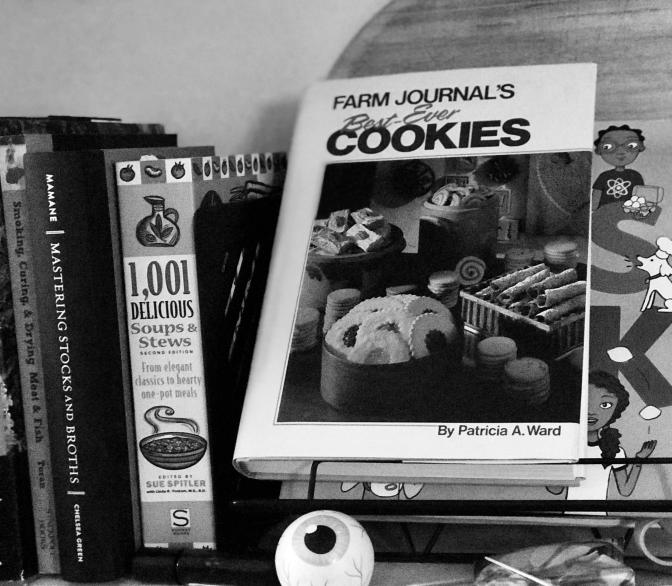
My newest cookie cookbook. Yes, it is older than me. You can tell the age of the cookbook by the fact that “lard” is a common ingredient in a lot of the recipes… The recipes still look delicious!

I have learned a few things about cookies while practicing the art of making tasty things. Some of the things I have learned even have a spiritual aspect!

One of the first things I learned was that cookie dough occasionally needs to be refrigerated before use. I like working with bread and especially bread that rises in a warm place. I like watching it grow to gigantic sizes before being beaten down. There is something beautiful about thinking of those tiny little grains of yeast growing, living, eating, and creating little communities that make my bread taste better. I like to think of them as living little tiny lives in a symbiotic relationship. A couple may give their lives to make my loaf of bread, but millions of their relatives are grown, kept safe, and given a chance to live in a safe environment so that there will be more yeast tomorrow. They are domesticated micro-organisms and I like to think of them as being as happy as cows in a field.

Cookies are different though. There’s nothing happily growing in the cookies. Cookie dough tends to be sticky, messy, and goopy. Cookie dough can be hard to portion, hard to roll, and hard to make uniformly sized, unless you refrigerate it! With some cookie dough, refrigerating the dough takes a sticky goop and makes it manageable. What would have been a disaster when first mixed separates calmly from a scoop after the dough is chilled.

What spiritual lesson do I get from this? I have learned that sometimes you need to take a step back from a situation and allow time to cool your passions. I work in a church and often there are situations that make me “hot under the collar.” In my case, they make me feel hot under the clerical collar, and that’s a problem at times. When I wear that collar, I represent something greater than myself. While others have the luxury of being themselves, when I stand there in a collar I represent a part of the continuum of the clergy who will come before and after me. In fact, I wear the collar in part to remind me that I am fulfilling my call to ministry as part of a tradition and with a family of colleagues.

At times, when I get mad, I need to let myself calm down. Occasionally that means excusing myself from a meeting to take a walk around the sanctuary before returning. Sometimes that means circling the metaphorical problem a number of times before blowing a horn and hoping that things will come crashing down without having to go and get crazy in my own little Jericho. Occasionally, I need to just take a couple of deep breaths.

When I cool down, things tend to go easier. I have an easier time forgiving, an easier time being flexible, an easier time realizing when I have made a mistake, an easier time asking for forgiveness, and especially an easier time being the human who has to live under that collar.

I imagine that most people would find that life goes a lot easier when they give themselves time to calm down like cookie dough. Consider Proverbs 14:15-17: (NRSV)

The simple believe everything,
but the clever consider their steps.
The wise are cautious and turn away from evil,
but the fool throws off restraint and is careless.
One who is quick-tempered acts foolishly,
and the schemer is hated.

Second, I have learned the value of practice. When I first try a recipe, I generally do everything in the recipe the way that it is written. I found one recipe for a double-chocolate macaroon which was quite delicious as written. The coconut in the recipe was very tasty and the recipe as written was delicious.

I could keep enjoying that recipe the way it was written, but I have learned something valuable in all of my time in the kitchen. Practice widens the ability to experiment. I took the recipe, pondered the ingredients, considered the coconut, and then looked at the oven. I toasted the coconut in the oven to bring out the flavor found in the unassuming white shreds. From the outside, you would not know that the coconut had been altered. The coconut was covered and interlaced with two types of chocolate before being cooked and was no longer white regardless of what happened before making the cookies, but the taste of the cookies.

The toasted coconut dances with the chocolate. A steaming hot cup of coffee, those toasted coconut cookies, and a good conversation move a pretty good afternoon to an amazing afternoon.

The only reason that I knew how to move the cookies from good to amazing was because I spent time in the kitchen practicing. In ministry, as in life, there is value to practicing until you can not only know how to do a thing, but how to improvise based on the resources you have around you. Practice helps in public speaking, public praying, and musical performance. Practice helps you to be better when a friend needs comfort, when a neighbor needs a hand, when the world turns upside down, and when the unexpected happens. Life is better when you put in the time to practice, learn to improvise, and get to a place where challenges can be met with confidence and faith.

Third, I learned to forgive myself when I burn the cookies. Let’s be honest. Everyone burns cookies now and again. Learning to let go and move on with life is a life skill that we all need from time to time. Just as I had to learn to forgive myself when I first burnt bread, just as I had to learn to forgive myself when I messed up soup so badly it made me want to cry, and just as in all other things, I had to learn to forgive myself the first time the cookies were so hard I could break a tooth on them without a good soak in warm milk. The cookies burn, you salvage what you can, and you move on with life.

I hope these reflections on lessons from cookies helps you to think about what lessons you might learn from your kitchen, especially if you spend a lot of time in there like me. May God bless you as you learn from life’s mistakes and may you never be forced to frost something that is fine without it!

Let us Ramble: Strange Praise Music…

Recently, I picked up an anthology of poetic translations of the Psalms named “The Poets’ Book of Psalms” as compiled, edited, and introduced by Laurance Wieder. I have an affinity for collecting alternative translations of the Psalms. I have enjoyed Robert Alter’s “The Book of Psalms: A Translation with Commentary” for several years now. I was recently introduced by Rabbi Rachel Barenblat to “Psalms in a translation for praying” by Rabbi Zalman Schachter-Shalomi.

In the newest part of my collection of alternative translations to my tried and true New Revised Standard Version (the Wieder collection) there is a poetic translation of Psalm 150. Psalm 150 is part of the Revised Common Lectionary reading for today. John Davies, who lived from 1569 – 1626 CE translated this particular version of the Psalm. Here, from across the centuries, is John Davies poetic translation of Psalm 150:

“To him with trumpets and with flutes,
With cornets, clarions, and with lutes,
With harps, with organs, and with shawms,
With holy anthems and with psalms,
With voice of angels and of men,
Sing Alleluia: amen, amen.”

Some basic background on Sir. John Davies can be found here. To summarize, Sir. Davies was more than an Irish poet. Sir Davies was an attorney with a somewhat motley career which included being one of the most respected attorneys of the Emerald Isle and also being disbarred at different points. He has a very interesting political career both in Ireland and in England.

Regardless, in my corner of creation, Sir Davies’ poems are what most catch my attention a few centuries after their original publication. His work, while understandable, draws attention to various areas which a modern translation might miss.

My copy of “The Poets’ Book of Psalms.” Also pictured, the citrus tree my family gave me for Christmas two years ago and the Peace Lily which was a gift given to my family by a nearby church when my family moved to Maine, NY from Boonville, NY. Also, an essential oil diffuser which is a very calming addition to my home desk.

I enjoy this poetic understanding of Psalm 150 as a result of the way it draws attention to a timeless truth which I have come to understand in my own path through life. Let me point out the instruments used in the praise of God in this poem. God is praised with cornets, clarions, lutes, harps, organs, and shawms. I must say that I hear organs in worship on a regular basis due to where I serve and I do enjoy the harp when it is played well, but I do not hear much music on the radio played on cornets, clarions, or lutes. Upon first reading the translation, I did not even know what shawms might be, but after a quick google search, I did learn that it was a flute-like instrument. Shawms are not very popular on the radio these days.

The timeless truth these strange things point out is that the praise of God is greater than any instrument. There are no guitars, drum kits, d’jembes, or any of the instruments you might find in most modern praise bands. Still, in Sir Davies’ day, people praised the Lord with their own happy music. Holy anthems and psalms of Sir Davies’ day might be different from from any radio singles or YouTube praise chorus that might be produced today, but it seems that both types, although separated by centuries and cultures, praised the Lord.

Praise of God is greater than the instruments we use. When praise comes from the heart, it can be shared through a piano, a snare drum, an organ, some shawms, a bass guitar, a lute, a lyre, a harpsichord, a shofar, a bodhran, or a cowbell. I am thankful that this timeless truth is pointed out through paying attention to a very old poem from an Irish attorney.

Let us Seek: “All that is required…”

In pondering today’s scripture reading from the Revised Common Lectionary, I found myself thinking back to “The Nature, Design, and General Rules of Our United Societies” as first printed in the 1808 Discipline under the heading “The General Rules of the Methodist Church.” In reading the description of the societies which gave birth to churches, there is much to ponder.

The classes which comprised each society consisted of individuals who would meet with a leader weekly to talk about how their own faith journey was progressing, find what was needed for life (whether that be encouragement, reproof, advice, comfort, etc.), and to collect what each was willing to give for the relief of their preachers, the church, and the poor. Each week (or (as I understand it) as often as possible in a circuit where the preacher would travel long distances), the leaders would meet with the minister to talk about challenges, which challenging class-members needed individualized attention from the minister, and to give funds to the stewards of the society. Those were different times with different understandings of what was expected of church members.

Having now given a, extremely basic overview of what classes were within the societies of yesteryear, I will share why I was thinking about the General Rules while pondering the reading for today, which is 1 John 3:10-16. There’s a line in the General Rules about how a person could become involved with those societies which sticks in the mind. The line says:

“There is only one condition previously required of those who desire admission into these societies: ‘a desire to flee from the wrath to come, and to be saved from their sins.’ But wherever this is really fixed in the soul it will be shown by its fruits.”

The General Rules go on to talk about how those who wish to continue in the societies that they evidence their desire to be saved through following guidelines on how to live life in terms of doing no evil (don’t take God’s name in vain, don’t profane the Sabbath, don’t engage in drunkenness, don’t engage in slaveholding, don’t quarrel, don’t buy or sell illegal goods, don’t charge unlawful interest on others, don’t speak evil of others (especially governmental leaders and ministers), etc.). doing good (feeding the hungry, clothing the naked, caring for the sick, visiting the imprisoned, exhorting all souls towards God, helping others within the household of faith, being frugal, having patience, etc.), and attending on the ordinances of God (go to church, spend time with the word, take communion, pray, fasting, etc.).

Some of these concepts are a bit foreign to us. A lot of our churches would be in trouble if we felt that speaking poorly of governmental leaders or our pastors was grounds for expulsion or reproof. We might raise an eyebrow at someone for drinking too much, suggest counseling, invite them to an Alcoholics Anonymous meeting, or simply pray deeply, but to expel someone from the church for even buying an alcoholic beverage is not a common standard for expulsion from church membership these days.

Times have changed over the centuries, but I continue to believe that there are still standards which we hold as church that continue to evolve. In some ways, we continue to struggle with some of the original concerns of the United Societies, but our role in the world has called us to be more vocal on other concerns.

Forgetting our identity as those who seek to live in this life as God’s people has proved disastrous in the past, such as when we forgot our call to avoid slavery as sin in the midst of the centuries that have passed since those rules were recorded in 1808. Forgetting our identity led to massive quantities of evil and suffering for those who were enslaved and in the souls of those who enslaved others. Forgetting our identity led to a grim chapter in our history which still has an effect today.

It is just as easy to forget our continually changing identity in the present as it was for those folks who struggled with slavery in bygone years. Reflecting on this reality, I pondered the scripture deeply in light of upcoming events.

This Saturday, April 21st, the Upper New York Annual Conference of the United Methodist Church will kickoff the “Imagine No Racism” Campaign. We are gathering as a Conference to seek to imagine a better world without racism and (hopefully) with equity, and this gathering came to mind as I read today’s scripture. 1 John 3:10-16 reads this way in the New Revised Standard Version:

“The children of God and the children of the devil are revealed in this way: all who do not do what is right are not from God, nor are those who do not love their brothers and sisters.

For this is the message you have heard from the beginning, that we should love one another. We must not be like Cain who was from the evil one and murdered his brother. And why did he murder him? Because his own deeds were evil and his brother’s righteous. Do not be astonished, brothers and sisters, that the world hates you. We know that we have passed from death to life because we love one another. Whoever does not love abides in death. All who hate a brother or sister are murderers, and you know that murderers do not have eternal life abiding in them. We know love by this, that he laid down his life for us—and we ought to lay down our lives for one another.”

What does it mean to desire to flee wrath by fleeting towards God? What does it mean to evidence that continuing effort by doing no intentional harm through our actions? What does it mean to do what is right in a world that is marked by racial injustice?

The very first message we heard, according to the writer of this epistle, was that we should love one another. First and foremost, the message was to love. How can we claim to live in love if we see people around us suffering due to their genetic composition? If Christ laid down His life for our lives, are we not called to do the same for each other? Does the need have to be as drastic as a life and death situation for us to be called to act?

I know many people who grew up with racial biases who would have nonetheless laid down their lives in order to save the lives of people (that they thought less of due to their ethnicity) due to their own moral, religious, and even political beliefs. To lay down one’s life is often a momentary decision and many individuals would have the courage to make that sacrifice in a moment.

I would love to say that those brave folks would lay down their privilege, their comfort, or their well-being over the long-term for those who are suffering from racial injustice, but I am not always certain that they would do the same over the (much more challenging) long term. In honesty, I would love to say that I know that I am perfectly laying down self-interest myself, but there is something to be said for the fact that moving away from “thoughts and prayers” for racial justice towards courageous acts to reassert equilibrium requires more than a moment’s courage or conviction for those of us who have privilege. I seek the courage and endurance to do so perfectly, but I often fall flat on my face. These words don’t come from a “holier than thou” stance. I often do not know how to move forward myself.

To move towards equilibrium will require more than most of us, including me, currently possess. It will require… imagination! Movement towards that equilibrium will also require the courage and character to do more than imagine, but it is hard to do anything but spin our wheels until we have an image of that more perfect (united) society in our collective mind and heart.

Although I hate to bring in my readings for The Academy for Spiritual Formation into yet another blog post, I am reminded of the writings of George Govorov. Theophan the Recluse (yes, that’s George Govorov) taught that growth in prayer must go through stages. I won’t quote a specific paragraph, because (as a friend put it) that particular chapter (the second) is kind of like a broken record.

  1. Prayer of the Body: Prayer shared in physical ways, often with specific actions (speaking, bowing head, kneeling, reading from a prayer-book, etc.)
  2. Prayer of the Mind: Prayer that has a resonance in the mind. There are no absent actions here. The prayer of the body is caught up into conscious thought and action through the mind. Each word is pondered in the mind, each movement is done with intention, etc.
  3. Prayer of the Heart: Prayer moves beyond word, thought, and deed to a place where it comes from the center of our being. Prayer of the heart does not preclude physical actions or pondering words, but goes deeper. In Bishop Theophan’s view, prayer of the heart is at the center of true prayer.

In Govorov’s view, moving through each stage of prayer takes time, effort, and dedication. For some, the place where they belong is in practicing with their body until rhythm is established. For others, there is a moment for letting the words rattle through their minds until it takes root. For other, true prayer requires the heart to work in concert with the body and mind. A person united in body, mind, and heart could truly enter into God’s presence through prayer until their soul was set alight through the Holy Spirit!

It is my hope that we would continue to go on towards Christ through events like the gatherings this Saturday. I pray we move past dwelling in the midst of death into living in a place of love. For some, that may mean learning new words and new actions. Prayers of repentance in the body might mean learning new ways of living, new ways of acting, and even new ways of speaking. For others, this may be an opportunity to connect our mind to things we are already doing. What does it mean to speak out for justice with words that are not platitudes but are deeply pondered? What does it mean to ponder the words of others instead of just listening with one ear and letting those words pass out the other? For others, this may be a moment to let the heart take hold of deep truths.

I am not certain where I fall in that realm of prayer for repentance. In some areas I am likely in one place and in another place in other places. Regardless, as I ponder the scripture today, I am reminded of my desire to flee the wrath that comes from living in the midst of death. May God give me the courage to have open ears this Saturday and to enter more deeply into a prayer which may take a lifetime or longer to comprehend.

This church in Sawmill, AZ helped me to grow as a person as I faced my own racial biases while on two United Methodist Volunteers In Mission trips. I cannot tell you how much I was blessed by the people of this small but mighty Diné church.

Let us Preach: “A Different Kind of Audit”

This open letter to St. John was shared from the pulpit this Sunday morning. Several folks requested I put it online for them to read again. Improvisational changes that were made on the fly are not included here. This is the manuscript that I read and adapted from this morning.

Date; Sunday, April 15th, 2018
Scriptures: 1 John 3:1-7, Luke 24:36-48
Preacher: Rev. Robert Dean
Message: “A Different Kind of Audit”

April 15, 2018

St. John
Patmos Island
Greece circa the end of first century CE

Dear John,

(No friends, this isn’t that kind of letter…)

Greetings in the name of Jesus Christ. I am writing this letter to you today from the community of the saints found many centuries and many miles from Patmos. Tradition tells us that you spent your last days in exile in Patmos, although people wonder if you are the same John who scribed the book of Revelation. In fact, to be entirely honest, many scholars wonder if you wrote the three letters which have been ascribed to you. Did your students write those letters after your death?

To be entirely honest, while authorship is an intriguing discussion for a Bible study, I’m writing today because our community is celebrating the season of Eastertide. We’re looking at stories of the resurrection, pondering the words of 1 John, and wondering what is expected of us. We live in a different age, a different time, and in different circumstances. It has been nearly two millennia since you witnessed Christ’s death and resurrection. It has been nearly two millennia since Jesus told Thomas that those who did not see but believed would be blessed. It has been a very long time.

I’m the pastor of this flock and that means a lot of different things in this time and age. I am here to encourage and to train people in the ways of faith. I am here to educate and inspire people to seek after Jesus. I am here to proclaim mysteries that seem ancient to many of the people in my church. I am called to witness to the life, the teachings, and the blessings of life with Jesus. I am called to witness to the life, the warnings, and the challenges of life with Jesus. I am called and ordained to baptize, to share the Lord’s supper, and to proclaim the word of God.

Yet, I wonder… What must it have been like to have seen Christ in the flesh? What must it have been like to see him take fish and eat after he had died? It must have been much easier to say to people “I have seen these things with my own eyes!” How much power rested in your lips when you proclaimed these truths which are now considered practically ancient to people for the first time? How much did it change their lives?

In a world with such high infant and pregnancy mortality rates, did grieving mothers and heart-broken widowers weep with joy to hear of one who had shown there was life after death? In a world without modern medicine, scientific method, or basic understanding of things like germs, was it awe-inspiring to see people be changed by stories of Christ’s healings? Could you see the hope show in their eyes?

The people I minister with have their own struggles. We’ve figured out a lot about germ theory, but cancer has become a faceless horror in many life. We’ve learned many mysteries about the human brain, but we have people who are still lost in the midst of depression, anxiety, and grief. War still remains and I sometimes wish we had swords to beat into plowshares instead of bombs, bullets, and grenades. We still face a world filled with challenge, sorrow, and pain.

John, how did you get the people to understand? Was your personal witness enough or was it an insistent, consistent, and powerful reminder of who God was in their lives? When the world would not recognize them as God’s children, did you invite them to remember God’s claim on their lives? When they themselves lost hope, did you remind them that even the darkness of the grave could not overcome Christ? How did you get them to see? Was it all God’s work in their lives or was there something they needed to claim, to grasp, to believe in order to find hope?

John, I’m a Methodist and our founder John Wesley believed that God gave grace to each person to help them come to a place where they could encounter Jesus. He called it prevenient grace and it was a grace that was poured out on all people. He taught God’s love was a source of light to all people and to me that grace is hope. The world can come to know a God who can change people.

The letter we read invites people to become pure as Christ is pure. The letter we read invites people to understand that they are invited to live lives marked with righteousness and goodness. The people are invited to live lives which are desperately needed in my world John. How do I convince them to see the truth of this life? The world is dark, but they are being remade into the likeness of the invisible image of God. Jesus told them that they are the light of the world and sometimes it seems they forget that concept.

In our day there’s something called an audit. An audit is a very close examination. For many folks, this word makes people especially nervous around the date I am writing you this letter. Today is traditionally the day that taxes are due in this country and occasionally the tax collectors will audit what an individual says they owe. Yes, tax collectors are still unpopular nearly 2,000 years later. Some things must be cross-cultural.

I bring up the idea of an audit because audits are meant to keep people honest. A tax audit is a close look at how one calculates what is owed to the government. Do you remember when Jesus said “Give to Caesar what is Caesar’s and to God what is God’s”? A tax audit is meant to make certain that our Caesar is getting what our Caesar claims for things like roads, protection, etc.

How do I convince people that we all might need to do a different kind of audit for our own sake? If we are made to be in relationship with you, if our hearts and souls are meant to be filled with love for God and neighbor, if we are meant to be remade in the image of God, doesn’t it make sense to slow down and see where we are on our faith journey? Does it not make sense to take a close look in seasons like this one?

To put it in practical terms, let’s look at a scripture Jesus said he came to fulfill. Jesus said “The Spirit of the Lord is on me, because he has anointed me to proclaim good news to the poor.He has sent me to proclaim freedom for the prisoners and recovery of sight for the blind, to set the oppressed free, to proclaim the year of the Lord’s favor” (Luke 4:18-19). If we were to take a close look at our lives, do we see ourselves in the midst of Christ’s mission as people who are being remade in Christ’s image?

Christ came to proclaim good news to the poor. Poverty is about more than money. My people and I live in a world where substance abuse is claiming lives all around us. People are addicted to alcohol, opioids, narcotics, and a host of other substances. Some of the people who are in the midst of these addictions open their eyes in sobriety and only see hopelessness and death. When we look in ourselves, do we see people who have experienced the risen Savior? Do we see in ourselves children of God who walk in hope? Can we dream of a world remade in your image where the hopelessness they feel is overshadowed by life? Can we share with them a world in which death has been overcome by life? Can we dream of a world where people look at one who should be dead or a ghost and find a Savior who is alive?

Christ came to restore sight to the blind. Blindness is about more than sight. Blindness is a way of life. The blind are often forced to trust others with their safety, their wellbeing, and their journey from one place to another. The blind are vulnerable in ways people with sight are not. Can we proclaim a world where people truly see the way and find hope beyond death, a place where none of us can truly see? When we examine ourselves, do we see beyond the curtain of death? In other words John, how can I invite people to ponder resurrection beyond their sight?

Christ came to set prisoners free, to break oppression, and to proclaim the Lord’s favor. John, how do I invite people to take a close look and see if they are shackled to things that just drag them down? John, you knew favor. When we celebrate the Lord’s table, we do not often draw attention to the fact that you were right there, sitting by Jesus’ side as the powerful words we remember were spoken…

Actually, that’s not true. You were not just sitting by Jesus’ side. You were reclining with Jesus. You were at peace with a teacher you loved and who loved you back. For all the oppression of Romans and pressures from religious leaders that might stand outside the door, you were at peace with Jesus. For all of the people who were planning to bind up Jesus in chains and for all of the challenges ahead, you were at peace with Jesus. You, John, of all people, knew what it means to be at peace with the person who was revealed to be the very image of God made flesh.

How do I invite people to be at peace like you? How do I find ways to cultivate that peace within myself? There are so many things we let take us captive John. We live in fear of war and sorrow. We live in fear of cancer and heartbreak. We live in fear of loss. We have been taught that perfect love casts out fear (1 John 4:18). As one who reclined with perfect love, saw that love resurrected from the grave, and as one who spent his life teaching others about that love, how do we believe like you believed? How do we live as you lived?

John, I realize that you cannot really write back. Patmos is another time and place isolated by nearly 2,000 years and a world of cultural differences. Still, perhaps the Holy Spirit can help us with answers to these questions. Your gospel did tell us that Christ would leave an Advocate who would teach us on God’s behalf. While I await God’s response through the Holy Spirit, I will say that I look forward to seeing you at the resurrection on the final day. Until then, may you rest in God’s peace.

May all honor, glory, and power be given to the God we both love,

Rev. Robert Dean
Maine Federated Church
Many miles and years in the future.

Let us Ramble: On being willing to fail

It has not happened often, but I have been asked a few times over my career as a minister for the best advice I have for people entering the ministry. I credit the scarcity of the question on the fact that I am completing my first decade of pastoral ministry on July 1st of this year. I have been asked a variant of this question a lot more often. How do you keep going in ministry?

I think this second question is prevalent as a result of a number of challenges faced by people entering into the ministry during this time. Our churches are tending to skew towards the higher age brackets, anxiety is rising, and often pastors are held accountable for the overall health of a congregation, even if they’ve been in an appointment for such a short period of time that there has been an inability for trust to be built, for change to occur, or for grief over the loss of a previous pastor to fully develop and be expressed within the hearts of congregants. Pastors are being placed in difficult situations which lead to poor health, poor moods, and unhealthy dynamics in personal and professional lives.

How do you keep going when a new church needs your attention but your daughter is grieving over the loss of her previous community? How do you decide between going to your daughter’s sports practice which you’ve missed two weeks in a row and helping set tables for a church fundraiser, especially when you know church meetings will make you miss her first three games in the upcoming weeks? How do you keep going through the thick and thin of a challenging time in ministry, especially if you don’t have a decade of relationships and trust to work with in your setting?

I give the same answer to both questions. You have to be willing to fail. I often hear the words of advice “Do you really want to die on that hill?” To survive on ministry, you have to be willing to die on some hills. I know that sounds crazy, but to survive over the long haul I believe that you have to be willing to sacrifice the easy path to seek after the life-giving death that comes with seeking after your ideals. I also do not believe this advice is for ministers alone. I think we all need to be willing to live out who we actually are in a very challenging world.

Let me give you a great example. I believe the best food is homemade. I know that there are great restaurants out there with wonderful food that I’ll never be able to make, but in reality, on a regular basis, the most consistent good food you can share with a family can come from your own kitchen.

Why? You know how your ingredients have been treated, you know how they were cooked, and if something goes wrong, you can adjust until you learn how to avoid that problem. You don’t need to rely on a cook that is paid an unfair wage, you don’t need to rely on a server that might be in a bad mood, and you don’t need to worry about the conditions of the kitchen. You can adjust the cooking to allergy needs or personal preferences. You know what is good and what is bad, and frankly, at least in our area, good ingredients like a nice roast and trimmings cost far less than a dinner for four at a restaurant.

How do you get to the point where that can be a reality? To bring the best to the table, you have to be willing to fail. You have to be willing to set an achievable goal and then seek after it heart and soul. You have to find a purpose that is worth your time and go after it, even if you’ll likely fail, because people cannot live on fast food alone. People need depth. People need macaroni and cheese made with carrots snuck in to get veggies into picky kids. People need a good marinated chicken breast that hasn’t sat in a refrigerator for weeks past when it should have been cooked. People need good food in their bodies.

My first attempt at gluten-free communion bread rolled to different thicknesses…

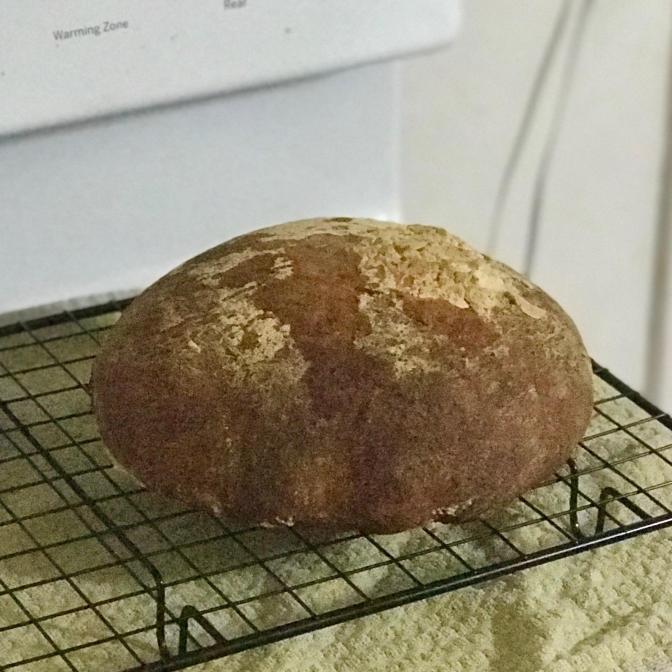
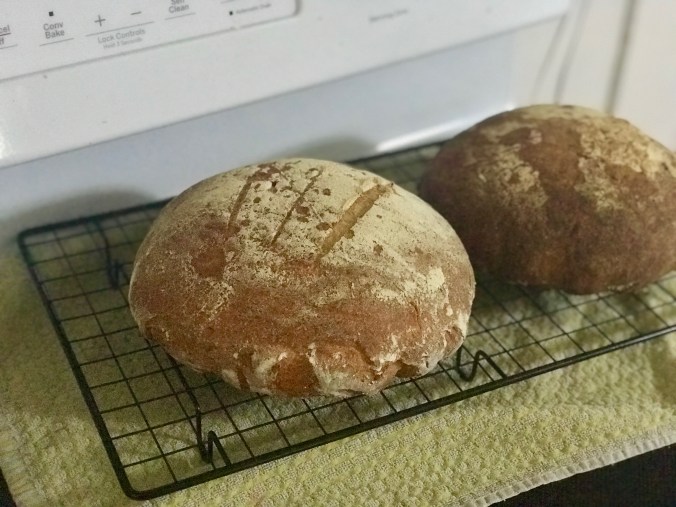
Let’s take this example as a good start. On Friday, my Sabbath (or as I like to refer to it my ”bread day”) I made my first attempt at making flatbread with gluten-free flour. To be fair, it is actually based on a recipe for Indian flatbread called roti. I substituted some Gluten-Free flour, tried to make the recipe as indicated, realized the dough was wrong, and began to adjust through the addition of things like binding agents and additional moisture.

The first attempt is gone. I rolled it too thin, decided to see how it tasted without eating breakfast, and then had a breakfast of far too thin roti which was both piping hot and delicious. I noted my problems, tried to roll it thicker, realized there was still a problem, added moisture to the edges, and tried again. All it all, I made six “loaves” of gluten-free bread, all of which probably won’t cut the mustard for use in church. It tastes great and a great tasting mistake is okay in my book, but it won’t do what it needs to do for my purposes.

Now, let’s say it will take three more attempts before I get this right. Maybe I’ll need to try something different a time or two. Perhaps chia seeds won’t be gelatinous enough to bind the bread together without eggwhite. Perhaps adding more xantham gum will make it taste awful. Let’s say I get to communion Sunday, bring something that is made to the best of my ability, and receive nothing but criticism. What will I do?

I can tell you what I will do. I will hold my head up high, take the criticism, and go back to the kitchen to keep working. Why? Why not take the easy path? Why not try another loaf of gluten-free bread that has been sitting on the shelf in the store? Why not buy the dough frozen? Why not quit while I am ahead?

The plain and simple reason why is that I do not want to quit. I keep going in ministry because I decide there are times when I am willing to die on a hill for the sake of that person who won’t come to communion because they’re embarrassed. Who am I to walk away when I know there is a concrete need in front of me? I am willing to die on a hill for the sake of making sure the means of grace is available to those person while we are all sharing from one loaf as one body of Christ. I am willing to die on that hill because it is better to die with integrity to my spirit than to live with a broken heart.

If you are going to be in ministry you are going to face difficult times. Ministers are many things. We stand up front talking about God and so people will take out their anger with God on us. We talk about inclusion in the body of Christ, so we will bear the brunt of criticism when a member of our church does something exclusive to hurt others. We are the person up front helping put together worship in a way that honors God and that might mean leaving out a favorite hymn of someone for a period that they feel is too long. We will face criticism for that as well. Doing your job as a shepherd means not everyone will be happy.

Spoiler alert: Those words apply to more than just ministers. Teachers, parents will complain. Nurses, patients will continue to buck the advice of the doctor despite your best efforts. Bus drivers, “the wheels on the bus” sung fifty times in a row might be a far better way to spend a given day than to hear cranky kids, wet from the rain, bicker all the way to school. All of us will be challenged and all of us will face situations that demand we make a choice of how we want to live our lives. Sometimes that will lead to us facing hardship, challenge, and occasionally persecution.

We will all face difficult times. The question as you face your difficult times is whether or not you can find things you are passionate about and be happy to die on the hill for that passion and for the sake of your own soul. To be fair, I have found that most people will understand why you are doing what you are doing if you explain it to them. Is gluten-free communion important to you? Explain it with passion, explain your willingness to keep trying, and express that this is one of those places where you have to maintain integrity with your own spirit and most mature people will try to work with you.

Actually, sometimes following your passion frees others to follow their passions. You might die on that hill, but when that resurrection love of God brings life back into your broken bones, you may just open your eyes to see people living into their own personhood all the more powerfully as a result of your example. People can be inspired by sacrifice as much as by success, and that’s important to remember as well.

In the meantime, if you are going through a hard time, whether in ministry or not, I want to encourage you to find a hill that you’re willing to die upon. Stand up for your heart and soul and sacrifice. Jesus taught us that “Anyone who loves their life will lose it, while anyone who hates their life in this world will keep it for eternal life.” Sometimes we need to stand up against that which we hate and be willing to find ourselves on the other side of our resurrection with life everlasting.

Let us Ramble: Common threads of grace

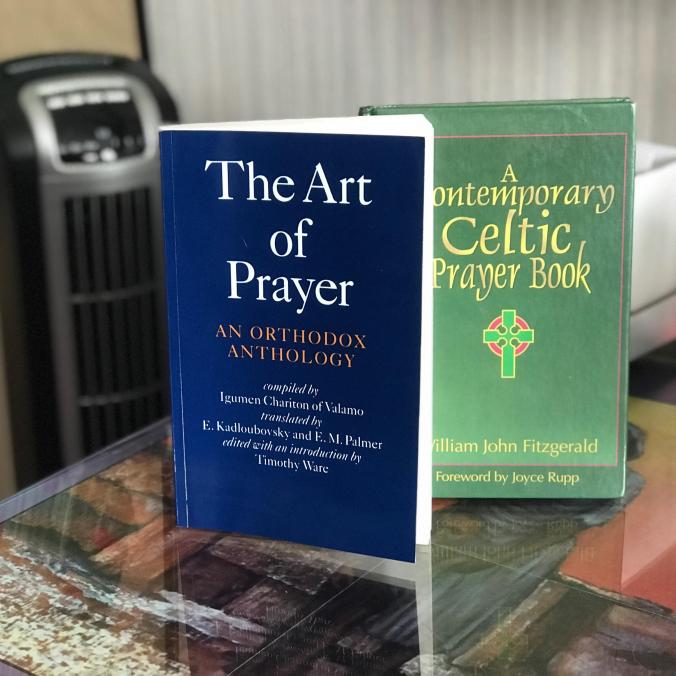
I have been working through my readings for the Academy for Spiritual Formation. In particular, I have been working through “The Art of Prayer: An Orthodox Anthology” as compiled by Igumen Chariton of Nalamo and Translated by Kadloubovsky and Palmer. I was reading through the second chapter when I was struck by the words of Theophan the Recluse on grace. Theophan writes in the section entitled “The prayer of the mind in the heart”:

“But no one is refused. Because all have grace, only one thing is necessary; to give this grace free scope to act. Grace receives free scope in so far as the ego is crushed and the passions uprooted. The more our heart is purified the more lively becomes our feeling towards God. And when the heart is fully purified, then this feeling of warmth towards God takes fire…Grace builds up everything because grace is always present in believers.”

Of course, as a good United Methodist, I was immediately drawn to these words on grace. John Wesley penned and preached a sermon entitled “Free Grace” in 1739, which was 76 years before Bishop Theophan was born. In that sermon, John Wesley wrote the following:

“The grace or love of God, whence cometh our salvation, is free in all and free for all.

First, it is free in all to whom it is given. It does not depend on any power or merit in man; no, not in any degree, neither in whole, nor in part. It does not in any wise depend either on the good works or righteousness of the receiver, nor on anything he has done, or anything he is. It does not depend on his endeavors. It does not depend on his good tempers, or good desires, or good purposes and intentions, for all these flow from the free grace of God. They are the streams only, not the fountain. They are the fruits of free grace, and not the root. They are not the cause, but the effects of it. Whatsoever good is in man, or is done by man, God is the author and doer of it all. Thus is his grace free in all, that is, no way depending on any power or merit in man, but to God alone, who freely gave us his own Son, and with him freely giveth us all things.”

I would like to think that Wesley’s work might have had an influence on that of Bishop Theophan, but given the time of the Bishop’s life, even as a scholar, it would be unlikely that Bishop Theophan would have been heavily influenced by a reformer like John Wesley within the Anglican church.

IMG_1851

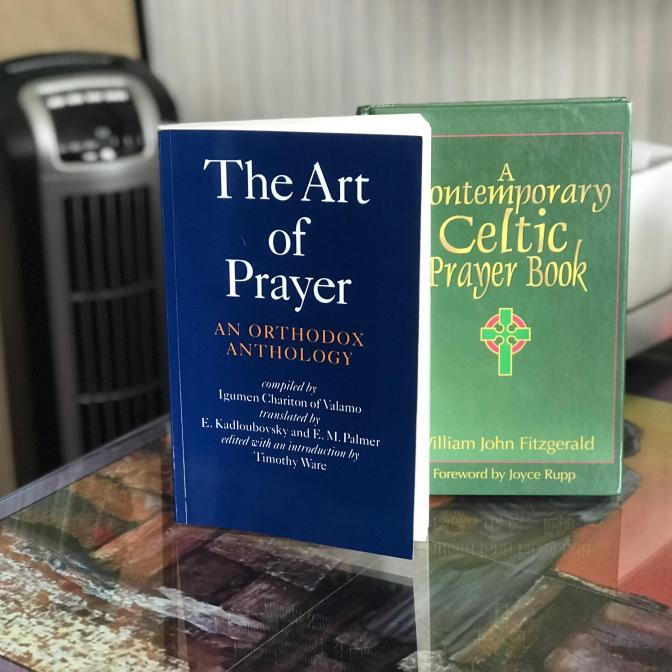
Two books in a stand isn’t nearly as catchy a phrase as two peas in a pod…


Regardless, clearly both Bishop Theophan and John Wesley agreed on the power of grace, the presence of grace being available for all people, and the ability for that grace to build up everything and to draw us closer to God.

All of this being said, there’s a major difference in thought here. While Bishop Theophan believed that grace was free for all, he warns the people reading his work to take care not to stifle the spirit. He writes earlier in the same paragraph quoted before:

“He who turns to God and is sanctified by the sacraments, immediately receives feeling towards God within himself, which from this moment begins to lay the foundation in his heart for the ascent on high. Provided he does not stifle it by something unworthy, this feeling will be kindled into flame, by time, perseverance, and labour. But if he stifles it by something unworthy, although the path of approach of approach and reconciliation to God is not thereby closed to him, this feeling will no longer be given at once and gratis. Before him is the sweat and work of seeking and of gaining it by prayer. But no one is refused…”

There is a difference in understanding here. Although both John Wesley and Bishop Theophan believe in the power of grace, there seems to be a disconnect on how that grace can and will be applied. For Bishop Theophan, if there is a stifling of the grace of God, at some point there is a place where labor becomes necessary to achieve a reconnection to God’s mighty acts of grace.

For Wesley, while there is a strong connection to the concept of choice, the reality is that the good which is done by humans is done through God. Although our choices may lead to blessed events like the floodgates of grace being opened, the freedom of grace beginning to work fully within us, and a reshaping of ourselves into the further image of Christ, these are but streams of God’s grace, not the fountain of the grace itself. To put it another way, we might grow branches out from the trunk of who we are in Christ, but without the roots made in, through, and by God, we will achieve nothing.

I might be making too strong a point for the differentiation here, but let’s think about the difference. What if Wesley is correct that if God, putting a stumbling block between sinners and salvation, would be acting like a crocodile shedding tears “over the prey which himself had doomed to destruction?” To complete the quote “Free Grace” by John Wesley:

“To say that [God] did not intend to save all sinners is to represent him as a gross deceiver of the people. You cannot deny that he says, ‘Come unto me, all ye that are weary and heavy laden.’ If then you say he calls those who cannot come, those whom he knows to be unable to come, those whom he can make able to come but will not, how is it possible to describe greater insincerity?’ You represent him as mocking his helpless creatures by offering what he never intends to give. You describe him as saying one thing and meaning another; as pretending the love which he had not. Him ‘in whose mouth was no guile’ you make full of deceit, void of common sincerity. Then especially, when drawing nigh the city, ‘he wept over it’, and said, ‘O Jerusalem, Jerusalem, thou that killest the prophets, and stonest them that are sent unto thee, how often would I have gathered thy children together… and ye would not…’ Now if you say, ‘They would’, but ‘he would not,’ you represent him (which who could hear’) as weeping crocodile’s tears, weeping over the prey which himself had doomed to destruction.”

These words, like many of the words of John Wesley, are very strong. To be honest though, there’s some merit to what Wesley wrote. How could God say “I desire good for all” while setting such a high standard for a future with God after a stifling of that grace? Does not grace abound when one chooses to turn from sin?

Do we choose to continue in sin knowing this to be the case? I would say that would grieve the heart of anyone who loves God and is grateful for salvation, but I cannot believe that God would put a firm barrier that some could not overcome between their desire to find salvation and the achievement of that goal. Even if that warming of the spirit is simply an assurance of salvation, I cannot believe that God would slam that door so heavily.

How could one even desire to move past a place of futility if the feeling “towards God” described by Bishop Theophan is stifled and no longer free of charge? Would you turn to God for a path towards salvation if you had not desire in your heart to draw nearer? Would not such a journey become nearly impossible given the fact that the reward itself is something that can only be seen and felt by faith and not the eyes? A person might work at a job they hate because of a paycheck that comes regularly, but would they do the same job with the assurance that they would be paid when the job was complete? Would they do so if they did not even feel an iota of love or desire to be near and with the one who would bring that good into their life?

There is much to think about with these streams of grace. What do you believe about grace? Is it free to all? Is John Wesley’s desciption a grace which is too “cheap” in the words of Bonhoeffer? Is grace something else entirely? What are your thoughts?

Let us Ramble: Patience and Wisdom

The other day I woke up early to get a wood chipper to help remove some branches from the church property. Winter was windy, one tree had to be cut down, and we had lots of loose branches to handle. I arose early in the morning and headed out to pick up a rented wood chipper. On the way, I stopped to get a cup of coffee. Yard work is thirsty work, especially early in the morning.

I stopped at a nearby donut shop and noticed a huge line of cars in the drive through. The cars were literally lining up to zipper-merge from both directions in order to get breakfast, coffee, or whatever the people wanted. The number of people idling in line in running cars was staggering.

The view from my car window. License plates blurred because I’m a nice guy.

I thought to myself that I would probably have to wait in line for quite a while inside if the store were that busy. I walked in the door and there were three people sitting at a table while people bustled behind the counter. Otherwise, the donut shop was empty. I walked right up, picked up my order, and was out the door in less time than it took one of those cars to move one position in the line.

As I slipped into my car, I wondered about the situation. Every time I went to that particular location in the morning it seemed that the line outside was always longer than the line inside. I regularly walked in and out while people sat and looked at me through their windows. Nothing staggeringly new was taking place this particular morning. I long ago learned that patience is a virtue, but not the only virtue. Wisdom and experience taught me to plan to walk into the restaurant instead of waiting in line. It is simply faster at that location to walk in the door. It is even faster if you order ahead on their smartphone app.

As I pondered this I thought about all of the other times I have “waited in line.” There are things that I really wanted to have happen in my life, but I would just sit there and watch the world pass by outside the window of my life. I would sit behind a useless steering wheel which could do nothing as I was not moving, twiddle my thumbs, and wait for the world to magically become a better place.

Occasionally, over the years I have had the wisdom to get out of the car a couple of times. I am married and have kids because I decided to step out of the car and enter into a relationship with a wonderful woman. I continue to be married because I do my best to move forward with life despite challenges that I could easily blame on others. I can cook because I decided to stop just longing to be able to create good food and began to ask questions of people who I knew could cook. I entered into the ministry, sought after the best parts of myself, and battled my demons. I didn’t always get out of the car, but I have learned the value of not waiting for everything to be handed over on a silver platter.

Now, let’s be clear. I am all for understanding the value of patience. Still, while patience is a virtue, sometimes in life we need to step out of the car. I regularly hear people speak of the world around them in tones that imply a certain kind of irritated, frustrated patience is all that can exist. People wish the world was kinder, wish their workplace was friendlier, or wonder why their church does not have more visitors. The world is full of lovely wishes that never change a thing because they are not acted upon by anyone.

What if the answer is that we need to get out of our car? Yes, we can wait until someone else invites a stranger to church, but what if we were to extend that invitation? Yes, we can hope that people in the workplace would be nicer to one another, but what if we were to seek out ways to be nice? Yes, we can bemoan the world becoming a crueler place, but we can also seek to bring love back into the dark places of the world.

We don’t need to wait in line for someone to bring what we need to our window. We can go to seek it out. We have the capacity as people for wonderful things. Let’s do some of them!

Let us Ramble: Prayer and Worship

Last Sunday night I had the pleasure of sitting in worship. My wife has been spending a lot of time with the good folks of the Newark Valley United Church of Christ. Once a month they have been having an evening worship service with communion. My family and I attend this service for two reasons. One, it is wonderful to support my wife by going to a church of her choice, which is a rarity as most Sunday mornings I am where I am appointed. Two, it is an opportunity to sit in worship as a person and not as the leader. Sunday morning is a time of worship for me, but I rarely get the privilege of listening to another preacher work through the word of God with the people of God.

So, Sunday night, Pastor Chris Xenakis, a colleague and the pastor of the Groton Community Church, was visiting to preach, serve communion, and lead worship. After his sermon, Chris said something to the effect of “Prayer is the most important part of worship. In many ways, all of worship is a prayer.” Pastor Xenakis is a wise man.

Chris’ words kept ringing through my ears after I returned home. After I realized that it was not going to go away until I figured out why it was bugging me, I went hunting through my readings for the Academy for Spiritual Formation. I found the source of my distraction in “The Art of Prayer: An Orthodox Anthology.” In that anthology, Bishop Theophan (1815-1894) of the Orthodox persuasion, is quoted as saying the following in the second chapter under the subheading “The test of everything”:

“Prayer is the test of everything; prayer is also the source of everything; prayer is the driving force of everything; prayer is also the director of everything. If prayer is right, everything is right. For prayer will not allow anything to go wrong.”

The affirmation of prayer by Bishop Theophan is deep, thought-provoking, and reminiscent of what Pastor Xenakis said during the service. Prayer is seen in this concept as that which exists at the heart of everything. Prayer provides everything, drives everything, and directs everything. The bold statement is made that everything is right when prayer is right.

null

My thought-provoking copy of “The Art of Prayer”

These concepts tug at my thoughts in deep ways. What is life but an act of worship? We worship when we use our resources to God’s glory. We worship when we choose to use our time wisely. We worship when we treat God, our neighbor, and ourselves with love. We worship when we tend to the world in which we have been placed. All of life can be seen as an invitation to worship. If all worship is a prayer, then truly prayer is at the very heart of our existence.

So, the question then becomes obvious. How do we know if our prayer is right? What litmus test can we apply to our actions, our stewardship, and our relationships that can show whether we are on the right track?

I believe the answer is love. Do our actions exhibit love? Do our prayers lead to more love? If God is love, then we should strive to be more loving. If God is love, then our actions should point towards the Source of love. If God is love, then we are invited to join in the great dance of love through Christ. I believe the true litmus test of our lives is whether or not we are sources of love like the one we worship and claim as our savior.

Inevitably, someone will question whether or not Jesus’ suffering was in line with the idea of prayer not allowing anything to go wrong. In the end, Jesus conquered his suffering and death. As a resurrection people, we are a people who understand that sometimes all is made well on the other side of suffering, struggle, and occasionally death. Can we be patient enough to allow all to be made well? Can we be patient enough to allow things to be made right even when it seems they all have gone wrong?

In the meantime, I am grateful that I went to the evening service on Sunday. It is nice to be in worship and to have the opportunity to both sing from the pews and to hear a good sermon. I will probably keep thinking about Chris’ words on worship and how Bishop Theophan invites us from across the centuries to ponder whether those prayers are the test of everything.

Let us Ramble: On Gluten-Free Communion

Today I intend to ruffle some feathers. I do not often choose to intentionally poke my head into controversial affairs, but I was recently the subject of several heated arguments around a practice our church has adopted for 2018. In 2018 our church is serving gluten-free communion bread to all people who come to the communion table.

I would love to say the most heated debates were in the church, but honestly, the church was not at the heart of the biggest debates. The biggest debates have taken place in my family’s kitchen. The phrase “Never discuss politics or religion” does not hold much water in a minister’s house. Discussions with family members often stray into religious matters and there are few things as capable of bringing consternation into a family meal than conversations around things held as holy as the sacraments. I am blessed to have an extended family who can live with differences of opinion as long as they say their piece. Regardless, I have learned to never bring this subject again during Easter dinner. I’m guessing it would not go over well at Christmas or Thanksgiving either.

Still, I am passionate about this subject, even as I understand the reticence of folks to having anything change. If a church has had the same type of bread for the past 50 years, it can be hard to understand why they need to change because of others. Would it not be enough if we were to put a couple of gluten free wafers on a plate? Why should we all have to “suffer” from having bad bread in order to allow one or two people an easier time coming to communion?

Well, I have theories and responses to those questions. First, let’s deal with the idea of having two loaves of bread. Consider the words from the “Service of Word and Table I” in the United Methodist Hymnal: “Because there is one loaf, we, who are many, are one body, for we all partake of the one loaf. The bread which we break is a sharing in the body of Christ.” While the body may be shared in other churches with different loaves, there is something powerful about witnessing that in the local church we are all sharing in one loaf as one body. There is no division when we share one loaf.

The other questions about suffering bad bread and about changing our own behavior will take a bit more nuance. I will say there is a thing called bad bread. Bad bread comes from people who have not taken the time to learn how to make bread. As we currently have a study based on the spirituality that can be drawn from bread baking, we are currently creating a crop of good bakers who may be able to rise (pun intended) to that particular challenge.

So, let’s go deep. In 2004 the church adopted the document “This Holy Mystery.” The document laid out the groundwork for the United Methodist Church’s understanding of the sacrament of communion. The document is a deep document, which has been reprinted in subsequent Books of Resolution, including the 2016 Book of Resolutions.

Here’s an interesting excerpt from “This Holy Mystery” found in the subsection labeled “Communion Elements.” The excerpt speaks on the use of alcohol at the communion table:

“Roman Catholicism, Eastern Orthodoxy, and many Protestant denominations
have always used wine in the Eucharist. During the movement against beverage
alcohol in the late nineteenth century, the predecessor bodies of The United
Methodist Church turned to the use of unfermented grape juice. This continues to be the position of the denomination.”

There is a tradition of using alcoholic wine at the communion table. Despite that tradition, the United Methodist Church does not use alcohol at the communion table. We share in the unfermented fruit of the vine. Why buck tradition to engage in a practice that differs from so many other denominations? Our church felt a call to battle the spirits of spirits and we continue to stand against the abuses of alcohol. Consider what it says in ¶3042 of the 2016 Book of Resolutions:

“As God’s children and participants in the gift of abundant life, we recognize the need to respond to those who know brokenness from the widespread abuse of alcohol and other drugs in our world. The experience of God’s saving grace offers wholeness to each individual. In light of the reality of alcohol and other drug abuse, the church has a responsibility to recognize brokenness and to be an instrument of education, healing, and restoration.”

Consider the words and the implications of this responsibility to recognize, educate, heal, and restore those struggling with alcoholism. Our love of these individuals has moved us as a denomination to do something strange. We recognized the problem and as a church we chose to change instead of continuing to follow tradition. Compassion and wisdom moved the church to consider the challenge faced by individuals. The church was convicted.

If you are not familiar with life in most churches, change is a difficult idea. For some people, change is a four letter word. Despite the power of tradition, inertia, and complacency, an entire denomination decided to do something different for the sake of people who had a need. The church felt a responsibility upon recognizing the brokenness of individuals. This motivated them to do things differently.

I can personally attest that there are folks who do not come forward at communion because of a number of factors. Some people think those wafers are nasty and they usually are pretty bad. I have to agree and sometimes admit that the gluten-variety are no picnic either. That being said, if we’re serving wafers, which occasionally happens when plans go askew, we can all suffer together.

Some people do not come forward because of embarrassment. Why are they embarrassed? Sadly, snide comments about having gluten-free communion is one reason. Some people believe they are drawing attention away from communion if they confuse things by asking for something different. Some people believe others will judge them for “wanting to be different” even if they have an actual concern like celiac’s disease.

For these folks, I will name the brokenness. The Lord’s table is a place of welcome and grace. If embarrassment keeps people from participating in this means of grace, the situation needs to be addressed. To avoid the difficulty being faced by individuals for the sake of our own comfort is selfish. In United Methodist tradition, the sacrament is a form of blessing from God. Our lives are literally made better by participating in the sacrament. How could we look at the table, see there are people who feel excluded, and not work to address the situation?

In other words, if we have to choose between our gluten-filled tradition and the possibility (in our church the certainty) that a gluten-free change will help to bless more people, are we not obligated to consider a change? If the second greatest commandment is to love our neighbor, are we not obligated to make certain that they are welcome at the communion table? In this odd, strange, topsy-turvy world, doesn’t our own integrity demand action?

The bread to be and several tools. Bob’s Red Mill does not sponsor me, although we would be happy to pray for them if they mailed us a couple of coupons. Gluten-free flour isn’t cheap!

Now, I want to be clear. I do not believe in judging other churches or other ministers. Each church has to make their own decisions. As far as my ministry is concerned, I am always seeking to draw the circle of inclusion wider. I will keep trying to serve gluten-free communion as often as possible to make certain people are not left out. So, wish me luck as I seek to perfect gluten-free bread making despite the fact that I personally add extra gluten to the bread I make for my family. Pray for me as well, because it is difficult to educate when you only have a few minutes on any given communion Sunday.

Let Us Ramble: On Split Animals

So, after the busyness of the Lenten season and a week taken away to provide childcare for my three children during their spring break, I am back in the saddle again. In the next few weeks I will be preparing for the next session of the Academy for Spiritual Formation and then it is time to prepare for Annual Meetings, so you can guess the direction of posts as those events draw closer.

In the meantime, in between changing diapers for my smiler and breaking up youthful hijinks between the two elder gooseballs, I have been pondering a passage from the Book of Genesis. In particular, I have been thinking about the nature of covenant.

As a pastor, I am surrounded by covenantal relationships. I have a covenant with God in my own personal spiritual life, a covenant with my wife to remain faithful until death parts us, a covenant with God to care for the children I have been entrusted with as a parent, a covenant with God to care for the people I minister with in my appointment as a minister, a covenant with the Maine Federated Church to support this local church, a covenant exists between the United Methodist Church and the Maine Federated Church that sets the guidelines for how the church cares for me and the parsonage in which I live, a covenant with the United Church of Christ to minister on their behalf in this community, a covenant between myself and other United Methodist Elders in my Conference’s Order of Elders, a covenant between myself and all pastors and deacons that serve within our common denomination, and finally a covenant with myself. Like I said, there’s a lot of covenant relationships in my life.

If that run-on sentence above doesn’t prove the point that it makes sense that I think about covenant a lot, then let me just assure you that I do think seriously about covenant and covenantal requirements often. Covenants are often conflicting and challenging. Which covenant takes priority on a daily basis? Do I spend another night away this month at another meeting or do I spend time with my children who sometimes don’t really see me except an hour a day some weeks? Do I sit in the office and wait for someone to come by the church or go visit people who cannot leave their homes? Do I blog about the nature of covenant or do I spend another few hours writing letters to church members? Covenants are complicated.

Genesis 15 lays out a sign of the covenant that is quite gruesome. Animals are split into two pieces and in the midst of the night a flaming torch and a smoking fire pot pass between the two lines of animal parts. It seems a bit gross, but the reality behind the imagery is even more frightening. In covenantal language, the promise is made. May I become like these animals (split in two) if I break this covenant. The severity of the response to a break in covenant is intentionally graphic, intentionally troubling, and intentionally recorded for the people so that they understand the importance of their covenant with God.

So, being surrounded by covenants, what do we do? Do we look at our relationship with God as being so important that we might be divided in two if we were to break it? Do we look at our relationship in the marriage covenant as being so powerfully binding? I have never been divorced, but many of the people I know who have been through the process refer to it as being a traumatic and spiritually violent process—almost as if they were torn in two. Do we look at our relationships we share with our beloved family in the church the same way? I know few places where a falling out can be as traumatic as in a church. Hearts break in those circumstances.

In honesty, where I found myself pondering covenant a lot this week was while thinking about the United Methodist Church. Are we facing a breaking in covenant as a whole? Have we been so brutally biased in our approaches to each other, to the looming conversations, and in our application of church politics that we have missed basic concepts such as loving each other? Has a lack of love led to a breaking of covenant? Are we tearing ourselves apart in some literally testimony to the concept that broken covenant leads to torn relationship and a torn body split in two?

As we go through this season of resurrection, what does it mean to go forward in covenant with a God who moves past death into life? There is much to ponder this Eastertide. I pray that we all go forward with love and peace.

Let Us Bake: Roti and Journaling

I woke up early yesterday morning. I had been paying attention to the weather forecast before going to bed and I knew that I would have to snowblow. I woke up extra early to clear the paths. Of course, there was no snow.

I decided to make some roti for breakfast out of one of my favorite cookbooks. I adjust the recipes to my kids tastes and share my adjusted recipes in person, but still feel somewhat hesitant to share recipes online that have too strong a basis on someone else’s work, so kudos to you Mr. Solomon. If it makes you feel better, Mr. Solomon, I often recommend people buy your book before I give them the recipe.

Anyway, my less spicy roti were prepared about half an hour before the kids were supposed to get out of bed. I heated up my pan, prepped the dough, and tossed the first roti on the pan to cook with what I imagine was an ironic look of satisfaction on my face. I ruined the first roti, which promptly wiped that smug look off of my face.

You see, I never flatten my roti flat enough on my first attempt. Every single time I make this recipe I refuse to remember that I ruined the first roti of the last batch. So, I make a super thick roti which is doughy in the middle and burnt on the outside. I then proceed to be my depression-era grandmother’s grandson. In other words, yesterday I ended up dunking my burnt/raw roti into my coffee to make it palatable while my kids and wife ate proper roti with homemade jam.

I never learn. Well, I should say that I am trying to learn through a very basic idea, but I will probably burn the roti at least once more. I have begun a cooking journal that I keep in my kitchen. When I try out a new recipe, adjust a recipe, or even just adjust a cooking method, I write down what I am doing in my notebook with an explanation as to why I have done what I have done.

I’m doing this for at least three reasons. First, I want to learn to be a better cook. I know that I have a tendency to be a bit of kinesthetic learner, so cooking the recipes is a good first step towards learning to cook them with excellence. Practicing helps me to learn, but so does the very act of writing out the recipe, the adjustments, and the reasoning behind what I have done on a given day. I become more intimately connected with my cooking by my writing in my cooking journal.

An excerpt from my cooking journal…

Second,I occasionally get something completely right. The other week I was working off of a recipe for cucumber salsa from one of my preserving books when I realized that half of the ingredients I needed were locally seasonal, were hard to come by in the middle of winter, and were completely out of stock. Rather than give up, I decided to start substituting for the missing herbs and peppers. I went way off of the chartered course with a basic knowledge of the necessary ph-balance for the canning method I intended to use. The salsa turned out fantastic. I write down my cooking methods, especially when wandering afield, so that I can recreate the accidental inspirations later.

Third, I know that my cooking will be a part of my children’s memory of my life. I want my kids to know how I made that one meal, to see how I tended to experiment with herbs, and to be aware that not everything I made turned out perfectly. I hope that they will not only have a record of how I cooked one day, but also the opportunity to create alongside me even after I pass away.

All of this being said, there is a distinct possibility that what is true of my cooking journal should be seen as true of my personal journal. Yes, I will leave my kids some of the poetry I wrote in notes. Yes, they will likely be able read some version of this blog. Yes, I am almost certain that there will be copies of my sermons kicking around in some dusty corner or another. All of this is true, but my journal is partially a record of my soul’s journey. They may not be able to know all of the circumstances, but the journal could be another piece of the puzzle for them to riddle out after I am gone.

Yes, I can try to remember when I make a spiritual breakthrough without writing down a record. There have been many points in my past where I have learned something powerful in my spiritual life that has moved me deeply. Just like baking, there’s a certain part of me that remembers when I learn something. I remember the first time I learned that I could make a bagel without a hole that was just as tasty! Still, there’s the lesson of the roti. Just because I learn something does not mean I will remember learning it later. A physical journal can become a repository of the things that I have learned even if I forget them for a season.

Yes, I can learn kinesthetically through some of the spiritual disciplines. Yes, I can have fond memories of my time engaging in physical worship in places like my seminary campus, the churches I have served, and the Academy for Spiritual Formation in Malvern. Yes, I can remember praying in Convention centers and in District Offices, but there is a power behind the kinesthetic action of writing in a journal. To reenter the same story every time that I write in the same book is to create a powerful kinesthetic bond between this spiritual practice and my spiritual life.

There are many reasons to journal both in one’s personal life and in the kitchen. I hope that is evident by this point in the post, Regardless, dear reader, if you have come this far, please feel free to join in my laughter. I know that my daughter actually believes the recipe I prepped for breakfast this morning calls for the ingredients in that recipe over there. She even copied the recipe into her handmade cookbook. Someday she will realize I threw in more cinnamon and nutmeg as well as substituted pure maple syrup for brown sugar.

Maybe I’ll tell her later today. Maybe…

Let us Ramble: The Ministry of Presence

“Hey, Pastor Rob! What does a pastor do when it isn’t Sunday morning? You don’t just work an hour a week, do you?”

Well, no, intrepid reader—I don’t just work one hour a week. Like many other clergy, as a pastor I do a lot of things behind the scenes. Some of them are often quite boring. Did you know who often gets called on to get that basket from the top shelf in the kitchen when there’s a church meal? Yeah, that’s me. Do you know who often takes first crack at getting the sink running again in the bathroom? Yup, that’s me. Do you know who sits in on most of the meetings as a resource, resident theologian, and guide? Yeppers.

I do a lot of things from preparing messages and Bible studies, to working towards completing my work with the Academy for Spiritual Formation through readings and covenant agreements, to writing notes and letters, to praying for a brighter future, and working to make those dreams a reality. A lot of what I do has to do with the future, but occasionally I am gifted with the ability of fulfilling the promises of the past.

This morning I walked into a worship service at a Nursing Home. Years ago, nearly three of my lifetimes ago, a pastor baptized a child on a Sunday morning and spoke about the role of the church in caring for this child of God. Today, in his stead (I can safely say “his” given the time-period of her baptism), I came into a worship service and pulled up a chair with a saint who lived out her life in the midst of her church.

She did not like to sing in public, so sitting by her side, I sang on her behalf to tunes on a CD player recorded at least two keys down from the way they are written in our hymnal. I coped (poorly, I’m afraid) with the shift and sung for and with the other ladies in the room. Everyone looked at me at one point or another. It was then that I realized that I not only had the youngest voice in the room, but I had the only male voice. To reference one of my favorite silly movies, I brought us down a whole octave!

We prayed together, I listened to the sermon, and I shared communion with all of the wonderful women gathered in that place. After the service I introduced myself to the chaplain, paid similar compliments to the ones I hear Sunday morning, met my church member’s friends, and then walked her back to her room for a chat.

It seems silly, but as I look back on all of the small things that I did today for the ministry, that moment of sitting with this saint (in the role of pastor and as fellow human on the same path) was probably one of the most sacred things that I did today. Yes, I made a few encouraging phone calls. Yes, I provided dinner for my family. Yes, I prepared for meetings tomorrow night and I did visit other folks in other facilities, but there was something sacred about sitting with a parishioner with no greater expectation than to be with her for a few minutes as we worshipped side by side. There is something holy about being present on behalf of a community that is simply holy.

I hope that my parishioner knows how sacred I found our time together today. In fact, I think I may just have to end this blog post to go write a letter!

Poem: Cracked Cisterns

The following poem is based on Jeremiah 2:1-13. I wrote my poem based on the New Revised Standard Version of the texts. I chose to write on Jeremiah 2:1-13 as it is the reading for the Second Tuesday of Lent in Year One of the Daily Office of the Book of Common Prayer.

Cracked Cisterns
Based upon Jeremiah 2:1-13

I recall days of years long since passed:
Singing songs, sharing sodas, and spending time.
Loving life with a pace both furious and fast,
As memories were created beautiful and sublime.

I remember laughter and gladness.
I remember sorrow and sadness.
I can see our steps stretched side by side.

Now we drink from different wells.
Water gushes from a cracked wall.
I watch as dried lives become shells
As the people once so close grow small.

I feel cold rain on far off shoulders.
I feel warm wind on riverside boulders.
I can see where we once were near.

Dry, parched lips seek something new.
In truth, they may need something old.
I stand with an extra cup—no idea what to do,
As hope’s light grows dim—flickering and cold.

Let us Ramble: “Keep watch, dear Lord…”

A peculiar thing happened to me last night. We had company in town to spend the evening, had celebrated with a meal out at a restaurant, and came home to a house full of laughter, happy dogs and a playful cat. I had spent a good half hour rocking my daughter to sleep, had found a cup of coffee, and was sitting down to read at my desk when I made a mistake. I reached down to get my headphones from next to my desk without checking the aquarium that sits directly next to my desk. I glanced up to find Seymour, my albino plecostomus doing his very best b-movie monster impression a couple of inches from my face.

He’s a freaky fish when you’re not prepared.

Yes, I was startled by a fish. In my defense, he’s a freaky looking fish when the light is low, the sun has set, and he is backlit by the blue aquarium light. He’s a scary little monster fish.

I laughed it off, took a picture, shared it on Facebook, and let it go for a while. Later that night, while contemplating life, I came across a prayer found within the compline prayer in Phyllis TIckle’s “The Divine Hours: Prayers for Springtime.” The prayer is originally from the compline service within “The Book of Common Prayer.” The prayer reads as follows:

“Keep watch, dear Lord, with those who work, or watch, or week this night, and give your angels charge over those who sleep. Tend the sick, Lord Christ; give rest to the weary, bless the dying, soothe the suffering, pity the afflicted, shield the joyous; and all for your love’s sake. Amen.”

A part of me recalled the work of Seymour within the fish tank. Seymour scared the daylights out of me last night, but he also was going about his work. Yes, he has work.

Let me be clear on the nature of my pet ownership. I have dogs because I love dogs and they keep me company when my family is away. I have and care for a cat, despite my allergies, because the cat keeps mice out of my house. I have a fish-tank because I find it calming. I have two catfish because they keep the bottom of the tank clean between water-changes. I have and care for Seymour, because Seymour cleans the glass. Seymour is a working fish—he earns that algae wafer when the walls of the aquarium are clean.

Is it wrong of me to think of Seymour falling under the blessing of this prayer? Well, I am betting the Book of Common Prayer was not composed with fish in mind, but I wouldn’t be surprised if dogs weren’t looked upon as worthy of blessing over the centuries as they kept cattle and families safe from predators. I wouldn’t be surprised if God’s blessing weren’t prayed often over livestock and other means of survival. Knowing at least my portion of humanity pretty well, I wouldn’t be surprised at all if remembering this tiny part of God’s creation were not a part of a long tradition of prayer.

Yes, a part of me recalled Seymour’s endless work on the glass of the fish tank, but then wandered towards other parts and places. I remembered the staff at a Nursing Home that had been caring for a church member who passed recently. I thought of the folks who were working the night shift near that bed which used to hold someone dear to the hearts of our congregation. I stopped to pray for those nurses, those aides, and the staff in that facility.

I remembered the staff at nearby Wilson and Lourdes hospitals. I remembered how often I had walked through those parking lots, those parking garages, and those corridors over the past few years. I thought of the doctors, the nurses, and the staff that had blessed so many different families through their ministries over the years. I remembered and prayed.

From there, I thought of the Maine Ambulance workers, the local fire department, the officers that keep the streets safe, and all of the folks resting before tomorrow. I thought of teachers dreaming of lesson plans and children, children resting before going to school to learn and possibly dash the hopes of following a lesson plan for their teachers, and for cafeteria workers who would get up really early to prepare food for hungry children who do not have breakfast at home.

All of this and more came about after reflecting on the work of silly startling Seymour. You can say what you want about the strangeness of praying for a fish who will live his life in a handful of fish tanks, but Seymour blessed me by bringing my thoughts into focus. Seymour led me to pray for others. Thanks Seymour—you have been a blessing to me.

Let us Bake: Holy Smoke!

Today, I’m baking my first loaf of bread while reading through Preston Yancey’s “Out of the House of Bread: Satisfying Your Hunger for God with the Spiritual Disciplines.” I’ve already let Yancey’s words begin to affect my style of making sandwich bread for my family, but today will be the first time I intentionally set about the 6 hour process of making bread.

I have spent the last few weeks enjoying morsels from Yancey’s book, but this week we are plunging into our study, so the time has come to not only become serious about working with Yancey’s book, but to become serious about baking bread.

This week we’re working through the chapter on “Mise en Place: The Examen.” At the heart of it, mise en place is the most important part of trying a recipe. Yancey summarizes the process (in the first paragraph of the chapter) as “checking in, giving the kitchen and your abilities a once-over to confirm you are able to complete the recipe.”

As a home cook, the process is like the preflight checklist before taking off in an airplane. You might as well try to fly a jet without fuel as try to bake a loaf of bread without the ingredients. Do I have the right equipment? I experimented with trying out the mise en place on the recipe provided by Yancey Preston and realized I didn’t have two of the right bowls for letting the bread proof in the refrigerator! Either Amazon’s mistake or my own actions led to me only having one when I needed two! I had a poor substitute for one of the bowls, but I didn’t have them prepared! I looked further and realized I’d need to pull out my Dutch Oven and check the seasoning.

To be honest, I was a bit shocked that I was so unprepared to make the bread! I cook often in our home and often make bread for my family’s lunches. To be aware that I was completely unprepared for the recipe in the book is something that rarely happens, but as I reflected on the process, I realized how much I have learned to cope, to substitute, and to adjust recipes simply because I forgot to look ahead to see if I had what I needed. As Preston Yancey says: (pg. 39)

“The practice of mise en place is essential but often skipped. We assume a lot in this life, and we are no different in our kitchens. We plunge ahead because we’ve made x or y before so surely this is like all those times before. Often it is, until the dreadful moment it is not and we are affronted once more by the sickly quality of presumption.”

The concept of reading through directions, collecting ingredients, and even double checking that I have enough of those ingredients should be second nature as I cook a lot in our home, but for some reason it is not a regular part of my practice in the kitchen. I know for a fact that I am a better cook when I double check that I have what I need before I begin my time cooking in the kitchen. I still find myself often ignoring my better judgment and relying on my ability to substitute or make do with what I have on hand.

So, am I alone in the pattern of ignoring my better judgment? I somehow doubt that I am alone in this bad pattern of behavior. What’s worse, I know that this behavior is clearly not restricted to the kitchen. I often go rushing off into things without thinking about the long run. Sometimes it is something like a new Bible study program for personal growth or an extreme exercise routine to help my body get healthier. I start off with the best of intentions, but find myself suddenly in a situation far above my skill level or capability. Occasionally I do not check in with someone else who needs to be a part of something, I assume that everything is in place, or I just decide I will go with the flow without proper preparation. I sometimes believe that I am a master at not properly planning!

I think there are two things I have learned from this week’s attempt at mise en place. First, I need to do my homework, check off my list, and simply be more aware of what I am doing. Second, I need to intentionally be more prepared for my own journey in the kitchen and through life.

Part of the mise en place, as previously mentioned, was to prepare my dutch oven for the stove. The stove was going to be heated to 500 degrees. The cast iron dutch oven is seasoned with shortening. Looking ahead should have warned me to be prepared for smoke. What happened? Was I prepared? Take a guess…

Thankfully, my nearly three month old found the puff of smoke amusing, the fact that I rushed into the next room with a magazine to wave at the chirping smoke alarm to be funny, and was perfectly alright with my need to be distracted for a moment. She was just as giggly after the smoke cleared.

The very first loaf of the bread from the book. A bit overly brown, the slashes weren’t deep enough on top, and it is definitely a good reminder that everything can be seen as a work in progress! If at first you don’t succeed (in doing it perfectly), obsess  endlessly over the next loaf!”

Part of the mise en place that I need to enact in my own life is the ability to roll with the punches with grace. I need to prepare myself for when things don’t go perfect every single time I bake, especially as I do have blind spots in how I often prepare. I need to learn to let some expectations go and to have the capacity to replace my frustration with amusement. That’s a preparation that needs to happen deep in my heart. It is also a preparation that goes beyond my cooking.

When I wake up in the morning, do I prepare my heart for things going wrong in my day? Do I tell God that I want today to be a wonderful day even if things go sideways? Do I seek to find places not only to feel gratitude but to foster gratitude in my life? Do I practice the mise en place to be ready for my life?

IMG_1756.JPG

You see, now that’s a little bit better!

I think Preston Yancey is correct that disciplines like the examen can help us to be prepared for the turmoils of life, but I also believe there is something powerful about the discipline of asking God to give us what we need for a given day or a given hour. Do we prepare ourselves for the kitchen of life? If nothing else comes out of this week’s study, I am grateful I now have that question to ponder.

How about you? Do you have a favorite practice for preparing for a day of life in the real world? Do you have some sort of pattern or practice that helps you to be ready for whatever comes in your path?

Let us Ramble: On Giving “Kine”

Today has been an ordinary day of ministry in New York State. The snow has been falling at a constant rate for a couple of hours, the kids are home from school due to the weather, and the mood around the house has been a bit cranky as both parents have had their plans of getting extraordinary amounts of good things done abandoned and thrown to the wind. Meetings were cancelled, plans postponed, and ideas adjusted. In case you had not realized it yet, life still happens to people who live a life in ministry—there is no magical “Get out of jail free” card handed out to ministers when they agree to serve a church.

Before the snow began to accumulate heavily, I went out to visit a member of my church on comfort care. Their identity is known to God and the most I will say is that the individual has had a long period of being seasoned by life. I spoke with the family, agreed to sit with the individual for a while so they could get some rest, and settled down into a chair with Bible and Kindle.

I read a little scripture, prayed some prayers for the individual, lifted up the family in my prayers, spoke for a few minutes about the memories I shared with the individual, and then sat still. After a few minutes of silence, I found myself drawn to my Kindle and the copy I keep on my Kindle of the Carmina Gadelica.

The Carmina Gadelica is a collection of prayers and poems transcribed by Alexander Carmichael after being collected and recorded in the time that crosses the boundary of the 19th and 20th centuries. The Carmina Gadelica is an intriguing book in the fact that it chronicles a blending of cultures between the Celtic traditions that survived and the Christian traditions that took root in the British isles. I find the Carmina Gadelica to be an interesting collection that is very thought provoking.

I was reading through the second volume when the prayer “The Incense” caught my attention. I have come to believe that context affects the way we see the world around us. Sitting by the bedside of this individual as they breathed beneath closed eyes that saw the world when I had visited the day before and that had been bright before pneumonia came to visit in my absence, I read “The Incense” differently than I had read it before.

The translation of the following poem comes from the “Carmina Gadelica: Volume II” as translated by Alexander Carmichael. The poem is entitled “The Incense”

“In the day of thy health,
thou wilt not give devotion,
thou wilt not give kine,
Nor wilt thou offer incense.

Head of haughtiness,
Heart of greediness,
Mouth unhemmed,
Nor ashamed art thou.

But thy winter wilt come,
And the hardness of thy distress,
And thy head shall be as
The clod in the earth.

Thy strength having failed,
Thine aspect having gone,
And thou a thrall,
On thy two knees.”

I looked up the word “kine” in the dictionary. “Cattle.” Kine is another word for cattle. What does it mean to give cattle in the context of days of health? What do cows have to do with incense or devotion? As a student of religion, my first thought is sacrifice. Sacrifice was once one of the ways how a person expressed regret, fealty, or even respect to God.

This cow is kine of a big deal…

The subject in “The Incense” refuses to give kine. They have no sense of devotion, no desire to sacrifice, and seemingly no reason to burn those herbs and fragrant plans which have been burnt in countless traditions to symbolize a drawing near to the divine. The person is haughty, greedy, unrestrained in their speech, and without shame in their time of strength, health, and well-being.

Yet, the poem goes on. Winter will come. They will come under the power of time, age, and weakness in time. Indeed, the person will one day find their life on earth equivalent to a clod of earth in the ground. The poem is bleak in many ways. The poem paints a picture of a person who does not understand their need in the days of their strength.

Sitting by a bedside, watching someone breathe breaths that might be some of their last in this life, and contemplating this poem was a different contemplation than many contemplations that I have had over the years. Am I wise enough to give kine in the days of my strength? Do I have the wisdom to realize that there will come a day when my choices have been removed from my path? If I do understand, do I let that wisdom affect the way that I live my life?

Can I live with gratitude for the gifts I have been given? Can I let that gratitude guide my choices? Can I choose to deny the parts of myself that want to be haughty, that live in greedy places, or that wish to live unhemmed by matters like compassion, empathy, or grace? Can I live a life marked by devotion and prayer? Can I live a life where kine are not for amassing into a giant herd for my profit, but instead exist in my life as a source of life and blessing for those around me? Can I live out my life in faith in such a way that I will one day find myself on my knees in a place marked by trust in God rather than the frailty that comes from regret?

Sitting with someone who reached an age where they were well seasoned affected the way I read the poem. I am not concerned by the individual I was sitting with while reading. The person I was visiting had a life that seemed marked by faith, hope, and love. The person’s presence was enough to remind me that, unless Jesus comes back in their lifetime, even the most righteous person will age and find themselves at a place on the threshold between one life and the next.

I pray that I have the wisdom in my own journey to find the humility the subject of “The Incense” seemed to miss. I pray that when I reach a place where I find myself on my knees, I will find myself enthralled by faith, hope, and love, but not fear.

Let us Ramble: Diving Inside

It has been no secret that I have been attending the Academy for Spiritual Formation through Upper Room Ministries over the past 9 months. Once a season, I have travelled to Malvern, Pennsylvania to meet with holy conversation partners and teachers about a variety of spiritual traditions and how they can affect the way we approach spirituality. As much as there is an academic side to the studies, I have found the program to be highly practical and personal.

For our upcoming session, we are looking at both the (w)holiness of the relationship between our physical bodies and our spiritual selves as well as Orthodox spirituality. By Orthodox I mean literally Orthodox Church spirituality—there has not been a ton of lectures teaching heretical matters or anything of that nature.

On a side note, the Academy has actually been a great place to have open discussions on spirituality from a great range of Christian (and Jewish!) traditions without a need for those kinds of arguments, which has been really refreshing after a long traditional education where argument and counter-argument sometimes seemed to be at the heart of the formative process. To put it simply, the Academy is more about discipleship than conversion, which is why I adore my time at the Academy and recommend it highly for people who are tired of argument and long for personal formation. Yes, by the way, it is open to clergy and laity—both are welcome and appreciated in my experience.

While I will admit that a lot of the Academy preparation for the next session makes me nervous as my back has been acting up and I understand that things like yoga might challenge it during the next session, I find myself coming back again and again to the readings for the Orthodox spirituality section of the Academy. In particular, I am working my way through “The Art of Prayer: An Orthodox Anthology” as compiled by Igumen Chariton of Valamo, edited by Timothy Ware, and translated by E. Kadloubovsky and F. M. Palmer.

My copy of “The Art of Prayer” along with a subtle suggestion of another cool book filled with very cool resources for next month for all of my Irish loving friends.

A quote has stuck out to me in the introduction by Timothy Ware. Ware quotes Theophan the Recluse as saying “The principal things is to stand with the mind in the heart before God, and to go on standing before [God] unceasingly day and night, until the end of life.” Related to the depth of this idea, on the sixty third page of the anthology (which is where the quote Ware was citing in the introduction resides in the anthology) Theophan writes: “Every prayer must come from the heart, and any other prayer is no prayer at all. Prayer-book prayers, your own prayers, and very short prayers, all must issue forth from the heart to God, seen before you.”

In our church we have been in a lot of deep conversations lately. I personally have been in several conversations where we have had deep debate over leadership from the heart and leadership from the head. Does compassion rule the day when making decisions? Does regulation designed to protect us have the final word in conversation? Does the advice of wise denominational officials have weight equal to the advice of our hearts?

The conversations have been deep, thoughtful, and often stressful in nature. To some extent, some of these conversations have had a depth and thoughtfulness I have not seen since some of those deep lunch table debates in seminary which took place between impassioned people with differing knowledge, tradition, and convictions.

I continue to find myself drawn back to these Orthodox Spirituality concepts in these conversations. Ware connects all parts of the self (identified in his worldview as body, soul, and spirit) through the combining connector known as the heart. The heart is intertwined with the body, the soul, and the spirit in a way that is uniting. On the eighteenth page, Ware says:

“The term ‘heart’ is of particular significance in the Orthodox doctrine of man. When people in the west today speak of the heart, they usually mean the emotions and affections. But in the Bible, as in most ascetic texts of the Orthodox Church, the heart has a far wider connotation. It is the primary organ of [a human’s] being, whether physical or spiritual; it is the centre of life, the determining principle of all of our activities and aspirations…it embraces in effect everything that goes to comprise what we call a ‘person.’”

Today’s post is called “diving inside.” I titled the post this way due to the fact that I have been spending much of the past week diving inside of myself in the midst of these deep conversations and asking questions of myself. If I led (or lived) only from the head, could I stand before God with a soul and spirit that has gone ignored? If I led (or lived) only from the heart, could I stand before God with soul and a body that had been ignored? How could a soul even survive before God without that spirit of courage tended by Jesus or that head full of knowledge that has formed me into who I am today? In short, diving into my life’s conversations lately, I wondered if in any circumstance or path I chose, could I possibly stand before God in my heart without my conviction shattering me into a thousand little pieces?

I do not find it coincidental that the Jesus prayer rests deeply within Orthodox spirituality. “Lord Jesus Christ, Son of God, have mercy on me.” Pondering these matters, I have regularly found myself praying this prayer over the past few weeks, but not solely this prayer.

For me, this prayer is held in contrast with the Lord’s prayer. I am making an audacious or possibly even a (forgive me, but this is literally the right word for the situation) bodacious request when I ask God to lead me besides still waters (Psalm 23 runs through my mind when I see God’s reign and God’s will being done in heaven—I am aware it is technically not in the prayer), when I ask God’s will to be done on earth despite the fact that I need forgiveness for my trespasses, or even when I ask God for daily bread. There’s a sense of an almost arrogant familiarity and assurance in the Lord’s prayer that stands at odds with the pure humility found in the Jesus prayer. The two prayers speak from two very different places.

As I have been diving into these deep conversations and into my own spirit, soul, mind, and especially my heart, I found myself grateful for both prayers. There have been times during these conversations when I have felt the only thing I could reasonably ask of God for myself was the mercy that comes from a place of pure and utter prostration before God’s throne. There have also been times when I have had the assurance to know that the daily bread I needed was the ability to extend compassion from a place of confidence, eyes wise enough to look past fear towards the brightest possible outcome while others struggled with fear and anxiety, and even at time to find hope in Christ’s provision even as the conversation needed insight far beyond the wisdom held by mere mortals like me.

I am reminded of the words our ordination class responded with at Annual Conference when asked “Wesley’s Historic Questions” (which are asked of every United Methodist minister). Every time we were asked a “Will you…” question, we responded “With God’s help, I will.”

In many cases, daily life is like answering those questions. Do I know the answer to every difficult question I face in ministry? Heavens, no. Do I make mistakes? Most assuredly I have made mistakes and will likely continue to make mistakes in the future. Do I have faith in Jesus Christ? Yes. Will I continue to seek after Christ? With God’s help, I will. Will I do my best to live my life from a place of peace where all parts of me can coexist? With God’s help, I will. With all this in mind, will I live my life in such a way that I can stand before God in my heart in prayer? With God’s help, I will.

In the end, I believe that Theophan the Recluse was correct. Every prayer must come from the heart. Since that is true, I must not only guard my heart. I must tend my heart like a garden, After all, in Matthew 15:10-20, the gospels record that Jesus taught that it is not what we eat that defiles us, but what comes comes out of the heart. If I am to stand before God, I must tend my heart zealously. To quote the New International Version of Proverbs 4:23: “Above all else, guard your heart, for everything you do flows from it.” If the Orthodox spirituality of Ware is correct, that guarding and tending of my heart means caring for what exists within me, in my body, in my spirit, and in my soul. With God’s help, I will.

Let us Ramble: Imperfect Hourglass

On my desk there are two hourglasses. One holds about enough sand to measure five minutes. The other holds a good ten minutes of sand. I collected them so that I could have a way to manage my time during my times of prayer. If we have two ears and one mouth, the purpose is clear. I might speak for five minutes and then listen for God in silence for ten minutes. In general, it works well both as a focus for my attention when I wander in silence and as an attention for my focus when I need to get to the point in what I am trying to communicate to God.

My two hourglasses!

I know that for some of you, that level of intentional focus might seem a little bit excessive, but for a person whose brain wanders easily… The tools help. The name of my blog (Distractedpastor.blog) was not a mistake.

Still, there are days when my focus is not there. There are times when I want to say more or listen more, but there’s a knock at the door or a buzz on my phone. There are times when I just want to give more into those moments. There are times I want to slow the hourglass down and give more, but do not have the opportunity.

I was reminded of this reality as I was perusing Bernard of Clairvaux’s “On Loving God” this morning. On the nineteenth page of the 1973 translation released by Cistercian Publishing, Bernard writes:

“My God, my help. I shall love you as much as I am able for your gift. My love is less than is your due, yet not less than I am able, for even if I cannot love you as much as I should, still I cannot love you more than I can. I shall only be able to love you more when you give me more, although you can never find my love worthy of you. For, ‘Your eyes have seen my imperfections, and all shall be written down in your book,’ all who do what they can, even if they cannot do all they should.”

I love the phrasing although I’m still parsing my way through the details of the words. “…for even if I cannot love you as much as I should, still I cannot love you more than I can…” How are we able to love God? We love God because God gives us the ability. We shall love more when God gives us more.

On some days, I sit to listen in prayer just as the world turns upside down. In those moments, I am usually able to find the earth before I go flying off into space. The ability to find purchase when everything goes wild can be difficult. In those moments, my fidelity to God’s love and purpose is usually as a result of the blessing God gives me.

On other days, everything is absolutely peaceful and I have the time to dive more deeply into God’s love and grace. In those moments I find myself able to bring more of myself into my relationship with God. In some moments, it even seems like the hourglass slows.

In between these moments, I rest in the knowledge that I do my best to do what I am able to do, even if I am not capable of doing everything that I should. My flaws are known to God, my brokenness apparent, and I bring what I can bring to the table.

I am reminded of one of my favorite pieces of art. The one of a kind portrait is hung in a cheap poster frame on my office wall. It is really poorly mounted, but hangs in a place of prominence. It is the very first work of art my oldest child brought home from school.

Now, when this painting was painted, was it perfect? No. Did the then 3 year old Grace understand how many nights I spent caring for her as an infant? Did she know how I felt when she spit up on my shoulder and the picture capturing that splotch of milk is what made it in the newspaper? Of course not, but she loved me as she was able. Warts and all, I have seen my daughter. I love her, so I love this painting.

The apple tree from my elder daughter’s first weeks of school

For me, this is what Bernard is talking about in his passage. I may never be able to love God as perfectly as God deserves. I may never be able to do something worthy of God’s affection. I can do what I am able to do, despite the moments that I spit up on God’s shoulder. Invariably, we all do as we can do in this world. I simply pray God will see the same affection in my love as I see in my daughter’s love.

Let us Ramble: Oh the places you’ll bless

In the fall of 2012, I was presented with a prayer blanket by the Pennellville Merry Stitchers. A series of unfortunate circumstances meant that I was only pastor in Pennellville for a few short months, but they had been very exciting and rich months of ministry. I have fond memories of walking down the street by the church, enjoying the occasionally rustic smell from the nearby farm, and the warm people I came to know briefly.

Their prayer blanket has come with me many places. I took it on the airplane when I flew to Ireland despite my terrible dislike of airplanes. It has been with me in moments of doubt. The prayer blanket has draped my shoulders through many a difficult moment of discernment.

Today the blanket is rolled up and supporting my back. I have had intermittent back troubles over the past few years and my back flared up after a long and stressful weekend. This morning as the medicine soothes muscle spasms, the prayer blanket is against the area of trouble. The sacred stitches are bringing comfort to hurting places.

One blessed blanket!

We do not often know how the things we do will affect other people. Sometimes the things that we do have negative consequences which we do not expect. Sometimes, the things we do bring blessing into unexpected areas. As my back rests against this bearer of prayers and blessing, I am reminded of good people and that they, for a brief time, loved me deeply as their pastor. There is a healing power to those memories and thoughts.

Stitch a stitch today. If you cannot stitch, then be merry. May your actions bless the world across years, even when you cannot see the effect of your love on others. Be a blessing.

Let Us Ramble: Celebration

There are several spiritual disciplines that I find difficult. In my life it seems that few disciplines are as hard to accept and to act upon as our call to celebration. It may seem a hard thing to believe, but celebration is difficult for me as an individual.

It may seem strange that a person who enjoys science fiction and cooking would have difficulty with celebration, but at some point I was infected by the idea that celebration was a sign of pride, of arrogance, of “loving the world,” and a thousand other things that I should shun. I was in my thirties before I even began to consider the possibility that celebration was a discipline. I am still working on entering more wholeheartedly into the act of celebration.

It is odd that it took me so long to understand the concept that God calls us to celebration. How many psalms mention taking joy in God’s works or entering into worship with music and dance? Matthew 11:18 records how Jesus was accused of celebrating too much! God calls us to have gratitude for the blessings that God has given to us and to rejoice in God’s love! We are called to celebrate!

I am reminded of this fact in particular today as I celebrate the birth of my middle child Joy. Joy is a reason for celebration. For all the ups and downs of life, we are called to celebrate and she is indeed a reason for great celebration.

Perhaps there is wisdom in the celebration of Job. Job is not known as a celebratory kind of man, but consider the description of Job. Job 1:5 speaks of Job’s tendency to come to the Lord with gratitude for his children each time they celebrated feast days. His love and celebration brought him to a place of gratitude, a place where sacrifice was willingly given for his children’s sake, and to a place where his thoughts of children led to God. In a way, he celebrated them.

I give thanks for my Joy. May God bless her and help me to celebrate her uniqueness and wonder more often. Amen!

Let us Ramble: An Arresting Quote on Charity

Recently, a college classmate of mine from years ago asked a question on Facebook. If I could write a paper on any female spiritual figure in history, which person would I choose? I love open-ended questions and spent a couple of days perusing the answers until late Thursday morning. I had been working on collecting reports for our Annual Meeting and had just completed a report for a member who is in need of a bit of a hiatus. In other words, I was out of coffee, had been up worrying about my infant with a fever most of the night, and was a bit bleary eyed. I took a few moments to look at my bookshelf for something that I could peruse for a few minutes while my wits came back around to meet me and the next item on my agenda.

My eyes fell on one of my favorite books from a few years back. I came across “The Mirror of Simple Souls” by Marguerite Porete. My edition is from “The Classics of Western Spirituality” of Paulist Press in 1993 and was translated by Ellen L. Babinsky with a preface by Robert E. Lerner. I immediately thought of the post, remembered that nobody seemed to have mentioned this wonderful author, and jumped to share with my old college friend.

IMG_1344.JPG

My copy of Marguerite Porete’s “The Mirror of Simple Souls.” I recommend it highly!

I picked up my copy, began to peruse, and then began to laugh. Did you ever wonder what would get a woman killed by the inquisition in France in 1310? Well, writing in vernacular French didn’t help. What made me laugh was the translation of a part of the trial where the inquisitor is shocked that not only did Marguerite not burn her copy of her book after a former bishop ruled it heretical, she kept thinking it was a good book, and dared to send it to another bishop as well as other simple folks “as if it were good!”

I do love a woman who believes in herself and her God! She spoke the language of the people, cared about the people, and kept on believing in God’s call on her life despite the challenges! Authority should be respected, but let’s be clear—Marguerite Porete saw authority abused and relied on her faith in the highest authority of all! Here was a woman who makes me smile!

I began to spend a few minutes browsing over the pages while working up the courage to go across the way to heat up a cup of coffee. I was reading along when something caught my eye worthy of a blog post and inspirational enough to get me to hold off on grabbing that cup of joe. Here’s what is translated from the fourth chapter of Marguerite Porete’s Mirror of Simple Souls:

“Charity is such a wise merchant that she earns profits everywhere where others lose, and she escapes the bonds that bind others and thus has great multiplicity of what pleases Love.”

I love this concept. As I pen this blog post for Monday morning, I am drawn to think about charity. Charity has many roots and I do not pretend to be an etymologist, but I noted with enthusiasm that the Online Etymology Dictionary stated that around the time of Marguerite Porete’s life, charity became connected with the concept of the affections we ought to feel for other people. In my own imaginary world, there is a distinct correlation between these facts!

I think about the ways we ought to feel for other people and how that inspires us a lot on Mondays. Recently, my primary visitation day for going to visit people in their homes or in care-facilities is on Mondays. As this is posted online (unless something goes askew) I am likely riding in my car down to visit one of our saints in the Triple Cities. Some of these visits are easy to accomplish as the saints in question are lively, ask deep questions, and appreciate a good visit. Some of these visits are heartbreaking at times when the saints are struggling.

When we consider how we ought to feel for others and then when we let those feelings affect who we are as people, we are entering into the purest form of charity. Charity is not meant as something begrudgingly given, something scowlingly given, or something unfortunate that has to happen in order for the charitable person to to be one of the good people. Charity is our opportunity to live into the same gracious love as our Lord and Savior first showed us. Charity is our opportunity to become the hands and feet of God and to enter into the dance of God’s love. Charity is an amazing thing!

Marguerite’s concept arrested my eyes because of the simple beauty of the idea. Charity finds profits where others lose. Charity finds freedom where others find fettering chains. Charity abounds in what pleases Love. These ideas are so simple and beautiful.

How can charity find profit where others lose? Perhaps it is because charity, when birthed by love, sees things through different eyes. The world says that you will never get rich by taking weekends off from work and volunteering to play basketball at the YMCA with kids. You will never get rich volunteering with the Boys and Girls Club or with your church. You also cannot buy the love those kids may come to have for you as a person. You cannot buy their affection, their love, their admiration, their imitation, or any of the other blessings that come being involved in a ministry of charity. You will never get rich with money—you may become rich with love.

How can charity find profit where others lose? Sometimes it is because love follows love. In the spring of 2013 I witnessed the worst community fire of my career in Boonville, NY. The church I was serving became a hub to help provide food, shelter, space for the American Red Cross, and information for the people who were displaced. Do you know what happened when we tried to buy lunch for the people who were displaced? We were matched by others and nobody went hungry. Do you know what happened when we started to collect clothes? The fellowship hall was filled with blessings. Every time we tried to give what we could, others joined in with us in charity. Perhaps you may find no personal profit in engaging in charity, but sometimes the love of God seen in you inspires others to bless those around us.

How does any of this promote freedom? I believe charity breaks the bonds that hold us in place. Often we get trapped within our own prisons by tradition, by circumstances, by our own limitations, and by our own imagination. There can be freedom when charity invites us to feel for others like we ought to feel, when charity motivates us to move past feeling to action, and when charity finally overwhelms our prisons.

The week of the fire in Boonville wasn’t just a holy week. The fire took place during THE Holy Week. We had to cancel our extra services on Thursday and Friday to care for people in need. We worshipped across church lines with Presbyterians and Baptists that week on Maundy Thursday and Good Friday respectively.

They welcomed us as guests and opened their hearts and church homes to us. What kept us from worshipping together before? Pride? Maybe. Tradition? Probably. Silliness? Definitely. I never enjoyed worship services so much as when we came into those churches, sat exhaustedly down, and we were welcomed and loved despite our tiredness and our Methodist personhoods. We United Methodists made space for others and through charity we found the freedom to look beyond our doors. We had the freedom to find our family and spend time with them. The family of Christ worshipped in a holy way that week.

When we engage in charity, we find ourselves in places where we can build up an abundance of love. I will likely be thinking of Marguerite’s call to charity was I walk through the doors of Bridgewater Rehabilitation or one of the United Methodist Homes this morning. I pray that you would find places to fall in love with God, to love your neighbor, and to connect with who you ought to be—someone filled with holy charity, freed by grace, and abounding in love.

Let Us Ramble: Random Chinese Food

Last night I had a meeting at the District Office in Endicott. It had been a long day between having a snow day for the kids and needing to get ready for Sunday. My wife had a meeting out of town and swept in the house twenty minutes before I needed to leave with a cute and cuddly baby that I had not seen all day.

We tried to talk as the family ate the huevos rancheros that I had cooked for their “breakfast for dinner.” The elder kids also wanted to talk with their mom. My wife and I did not have a chance to connect before I needed to leave. I sat in my car in Endicott and tried to think of something I could do to connect with my wife. I realized how hungry I was, looked at what I had eaten for dinner, and realized I probably needed more than 150 calories. It turns out one tiny tortilla with one egg is not exactly filling.

I brought home a container of mystery Chinese food. I literally walked in the restaurant, looked at the chef’s specialities, found something I had never tried and did not understand, and brought it home. It turned out to be a shrimp and vegetable dish with a nice light sauce. It was rather tasty.

Some days it takes work to connect with your spouse. As we ate Chinese, our baby was fussing and crying at us both. I took chopsticks full of rice in between moments of putting her pacifier back in place. The baby did not really settle for hours. It was not an easy evening after my meeting, but my wife and I found moments together over a new experience and a new food.

Marriage takes work. Even when everything seems to be going perfectly, marriage takes work. I am glad that I took time after a very long day to connect with my spouse.

Let us Ramble: Snowbanks as a Metaphor

On this past Christmas Eve I found myself preaching at church. Most years that would not have been news, but this year I was on paternity leave. My good friend who was providing pulpit supply was under the weather, so I pulled together a sermon based loosely on what I had been reading. I had been spending a lot of time reading the 1973 translation of Bernard of Clairvaux’s “On Loving God” produced by Cistercian Publications. My sermon was effectively revolved around the concept that we should love God and celebrate Christmas because it is a celebration of Christ becoming the incarnation of God’s love for us.

As I type this blog entry, the sounds of my two elder children are pouring in through the door between my church office and the church nursery. Outside it is still snowing despite the fact that the snow day my kids prayed for last night has become the reality of today. By the road there are piles of snow building besides cleared paths. The piles are growing with every pass of the snowblower. The snow keeps falling despite the fact that I asked it to stop nicely. The snow will keep falling because the snow is stubborn.

As I was pondering the snow this morning, I came to a realization. Technically, I had two realizations. First, I realized that the snow would be breaking my back if it were not for the blessed snowblower. I injured my back last year and have had to become very careful with how I use it in order to keep from injuring it again. If I were to lift up that much snow my back would be destroyed.

Snow is beautiful until it falls down the back of your shirt.

Second, I realized the snow could be seen as a great analogy. The snow is heavy, deep, and weighty. In the same way, the love I owe God is heavy, deep, and weighty. So, let’s draw in Bernard of Clairvaux. Bernard writes (on the eighteenth page):

“‘What shall I render to the Lord for all that he has given me?’ In his first work he gave me myself; in his second work he gave me himself; when he gave me himself, he gave me back myself. Given, and regiven, I owe myself twice over. What can I give God in return for himself? Even if I could give him myself a thousand times, what am I to God?”

So, God gives us two gifts. First, God created us. To bring in some language from Psalms, we are knit together in the womb by a loving God. We are created in the image of God by God. How in the world could we ever repay God for such love? Can we give anything to God that wasn’t made possible by our creation in the first place?

Second, God recreates us. Bernard writes (a couple of lines before the previous quote): “He spoke and they were made. But he who made me by a single word, in remaking me had to speak many words, work miracles, suffer hardships, and not only hardships but even unjust treatment.“ God went to extraordinary lengths to take me as a broken person and provide a path towards redemption through Jesus Christ. What could any of us do to repay that much kindness and love? What gift could we offer?

What God has done is like the snow falling from the sky. Try as I might, there’s no way that I could ever lift all of that snow. My debt to God for his loving creation and remaking of my life is deeper than any snow drift I could shovel, heavier than any snow falling from the sky, and utterly beyond my ability to shovel, melt, or remove. God’s love is like a blizzard and there’s no way that I can ignore the weight and the effect it has on my life.

Ultimately, all that we can really do is accept the gift of God’s love and respond as best as we can with the love we have in our hearts. The love of God will keep falling down on the beloved children God has adopted, May we respond with grateful hearts!

Let us Ramble: Solitude, Faith, and Community

A noise tickles my ears as a buzz begins at 5:59 AM. My phone buzzes and begins to flash. I wake up early to check if the paths need to be cleared of snow before the teachers and staff of the church community arrive. After a cold time clearing up the snow with my snowblower and a headlamp, a hot shower to warm up chilled bones, and a hot mug of coffee, I settle at the table with my notebook. Soon, as the eggs bake for breakfast sandwiches for my wife and children, I will find myself digging through the Revised Common Lectionary.

This day I am flicking through the story of Saul being chastised by Samuel for caring more about what his people want than what the Lord required. I write a poem about Saul’s predicament while thinking and praying about what God’s message for Saul says to me as a Christian, as a husband, as a father, and as a pastor. The words are deep this morning as my heart struggles to make sense of the story of God’s chosen one being rejected for his actions. I weigh the passage carefully with others that have been dwelling in my heart.

I find these moments of devotion while the room fills with the smells of cooking breakfast to be sacred. They are not always perfectly isolated. Sometimes I finish my poem while my kids are making cocoa across the room. Occasionally a crying baby will interrupt this time with her needs. It is a time that actually gets interrupted regularly towards the end, but it is also one of the most sacred moments of the day. Even with interruptions, the ground I walk upon in those moments is holy.

In these moments of personal devotion, I sort through my dreams and prayers from the recently passed night. In these moments of personal devotion, I find inspiration that often affects the way I live out my faith life. In these moments of personal devotion, I often find the fuel that feeds quiet prayers for the community which follow. Have I read about love? Standing in the window, cleaning up dishes, I pray with love for the people in my church and community who are in need. Have I read about sacrificing for others wellbeing? I find inspiration to pray for the bus drivers who pass by the window. The personal devotions of my morning feed my time in prayer and help me to do a better job at being a part of a vibrant church community.

Henri Nouwen, in his book “Discernment” wrote (on the tenth page of his book):

“Communion with God alone in prayer leads inevitably to community with God’s people, and then to ministry in the world. But it is good to begin this spiritual movement in solitude…When we are alone with God, the Spirit prays in us. The challenge is to develop a simple discipline of spiritual practice to embrace some empty time and empty space every day.”

For myself, the moments in my day that are emptiest and have space for the Holy Spirit are between checking the paths to see if they are clear and when my children get out of bed. The time that I spend alone with God in those quiet places strengthens my relationship with God. That strength then leads towards others.

Invariably, my time with God tends to lead towards other people. Sometimes my prayers are led towards my family, but more often than not, I find myself drawn to pray for situations around me in the community and in the church. I want to be clear about this fact. My personal devotions do more than inform my prayer. My personal devotions empower my ability to pray. If the spiritual life of a Christian is a river, my time in personal devotion is one of the springs where that spiritual life finds the living water.

When the Spirit prays in us, our lives change. If you look back at a number of the great figures of Christian history, a lot of them speak about powerful moments of connection with God. Some of the descriptions of these moments can induce a blush! These moments of intimacy with God generally did not come out of a place of constant action. If you look, most of these moments come in lives marked by time spent with God. Like any relationship, a relationship with God that is healthy requires time spent together.

So, how do you begin to discern the right time for spending time with God? The first thing I suggest to people who ask me in person is that they chart out their day in blocks. What regular patterns emerge in your daily life? I found myself needing to wake up early to take care of sidewalks for the winter. As such, for this literal season, a period between that daily chore and when the rest of the day began emerged. For some people, there is a lull in the late morning, especially if you are retired or work a second or third shift position. Each person is different and taking a look at your regular patterns can help you notice places that are empty.

Second, if a person cannot find those moments of free time I suggest that there be moments in your day that might be better used doing something else. Back when I tried to engage in evening devotions despite my tiredness, I used to spend my mornings before the girls woke up listening to the news. The news often made me anxious, led to me feeling inordinately stressed at the beginning of my day, and often served more as empty noise than something of substance. I was better served by spending that time with God than spending it listening to the news. I still check the news later in the day, but I first ground my heart and my soul in God before facing what the world will throw at me.

Third, I often suggest that you begin with a simple devotion. There are wonderful resources available through many fine publishers. A trip to a local bookstore will often provide a lot of helpful options. Our church provides copies of the Upper Room Daily Devotional and we would work with anyone who wanted to explore one of the other options available. There are also a number of reading plans available through places like Bible Gateway that can help you to explore your Bible over a set number of days. Even the United Methodist Hymnal has a pattern for daily worship and prayer in the rear of the hymnal. There are many options available.

Fourth, try new things on occasion. If you, like me, enjoy the Guide to Prayer for Ministers and Other Servants, consider using the Book of Common Prayer for a season. If you enjoy using Our Daily Bread, ponder trying out the Upper Room for a time. If you are going through a dry season, it might not help if that season is supposed to be teaching you something, but if your situation is simply fatigue—a change of pace might help.

What suggestions do you have for starting a time of personal devotions? Have any practices been particularly helpful?