Taking a break with quadrilles

Tonight I had the first night of three evenings in a row with committee meetings. I found myself coming home and needing to let off some steam by thinking about something besides the church. I noticed that dVerse~Poets Pub was having another poetry challenge. Today’s is the quadrille or a 44 word poem with the word “Spike” involved in some way, shape, or form in the poem. I tried a pair of different poems for fun.

The first poem is inspired by my marvelous wife who sometimes forgets just how talented she happens to be. At the Father-Daughter dance at the school the other day, a friend remarked how the look my daughter gave her sister came straight from her mother. My wife is fierce, strong, and intelligent–Athena personified in my life. So, this first quadrille poem is for her. Also, it is a rondelet because apparently I’m a glutton for punishment.

My favorite warrior princess… The kid is pretty great too.

You pierce my heart dear.
My heart rate spikes as I stop to wonder.
You pierce my heart dear.
Athena questions her footing in fear
While I listen and hear ringing thunder
As heaven’s mold she does break asunder.
You pierce my heart dear.

“Athena’s Rondelet,” by the Distracted Pastor, 2019. Written in honor of my wife.

My second poem is far less serious. It is entirely about a fictional video game character that I have been hanging out with off and on since July 13, 2016. We’ve been spending more time than usual lately as it turns out walking is the one exercise I can do well without throwing out my back. That comment is not an invitation for advice… The character is my Snorlax from Pokémon Go, which is totally not my intellectual property. Hey, free publicity though… I like your game. It is mindless and good motivation to keep on walking. The number of kilometers I have walked with this goon kinda shocks me. The poem’s form is ABABCC

My Snorlax is the best Snorlax… Well, he will be if he wakes up.

Five kilometers for just one candy.
My heart rate spikes as black ice makes me slip.
My Pokémon Snorlax will be handy
If I could only earn more on this trip.
I straighten up and continue walking.
No one loses weight sitting and talking.

“Pokémon Quadrille” by the Distracted Pastor, 2019. Feel free to use this Niantic!

The Small Sacrifices

Sacrifice daily.
Ask where today’s food comes from
Once or twice a week.

The role of a pastor is partially the role of a teacher. Many people think of preaching as a separate activity from other activities like Bible study, but a lot of the role can be combined into the overall category of teaching. I teach on Sunday morning through both preaching and my leadership of worship. Often I believe I teach more on Sunday morning through sharing the words around communion and in prayers than I do in the sermon. Indeed, one of the challenges pastors face is when people believe that the sermon is the focus of worship.

There is absolutely no way that one can effectively make disciples of Jesus Christ for the transformation of the world in just a few minutes a week. We teach beyond our sermons through the rest of worship, through Bible study, but also through things like conversations, social media, and blogging. One of the reasons I believe that the early church had such strident rules about what it took to be a leader in the church was that they understood the church leaders would be teaching and sharing with the community far more than just Sunday morning.

Today, I would like to try and teach a little bit about creation. Creation is where we all are in this moment. The air we breathe, the food we eat, and the land we live upon is all considered theologically to be a part of creation. Some of the earliest scriptures in the Bible (canonically) deal with the care of creation. Genesis 2:15 states that when humanity is placed into the world it is with the charge to care for where they are placed. Gardens are not self-tending and theologically humanity was made to garden. Indeed, in the earliest sections of Genesis humanity depended on plants for sustenance. Foraging is wonderful but civilization was built on gardens.

Let’s look at what it means if we are given the instruction to care for creation. How do we choose to care for the world? Do we do all that we can to damage it? Sometimes it does seem like that is our way of being, but is that destructive way theologically ethical?

What if there were ways to care for the world on a regular basis that did not ruin either your bank account or your way of life? What if the foods you choose could help the world to be a better place for everyone around? What if you invited the world to join you in that adventure?

A few months ago I was listening to a podcast called “The Splendid Table.” The episode I was listening to talked about eating anchovies. To be entirely honest, I was a bit horrified. My father invited us eat to a “blind robin” at midnight for good luck growing up and I wasn’t quite as big a fan of pickled foods at that time. I was very skeptical, but I looked into the idea of eating more seafood as a way to help make the world a better place.

Strangely, I did not begin my research at the library or on the internet. I had a grocery trip to run and looked at the canned fish. Several of the cans said “certified wild caught and sustainable.” Some digging led me to a United States Government Agency called “FishWatch.” There I was able to learn about how the Northern Anchovy is caught, how it has a low bycatch rate, and how it can be healthy (in moderation due to cholesterol levels).

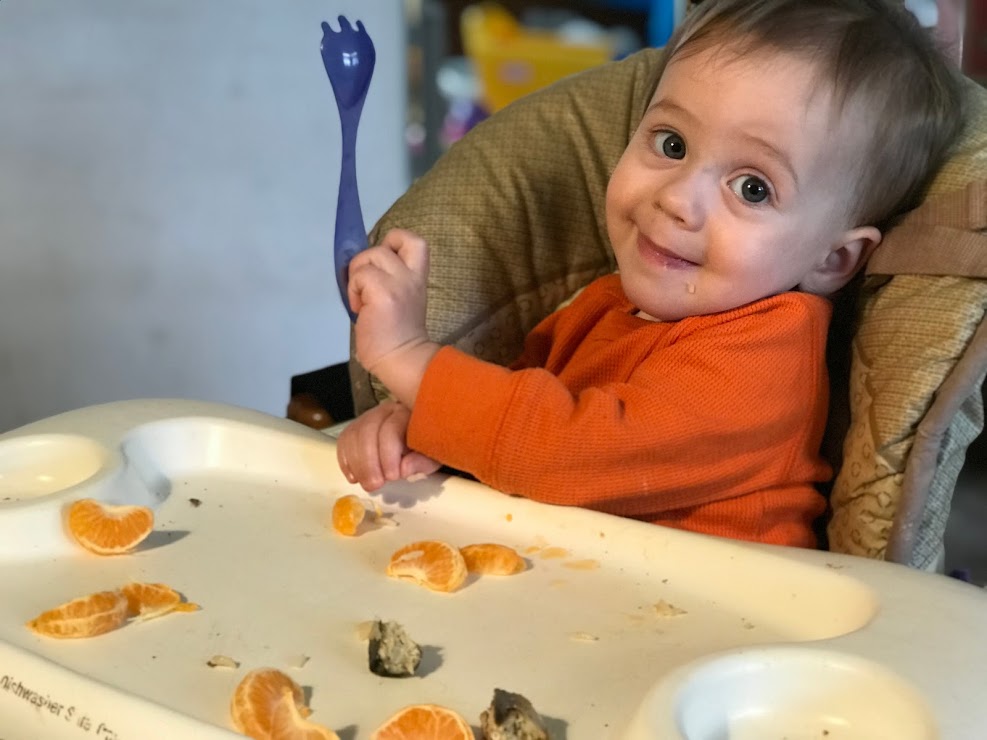
I began to experiment with anchovies and sardines. I learned that sardines can be ground into meatballs to add a flavor that my family loves while replacing some of the meat with a more sustainable protein. As I used the seafood more regularly, it became more and more normal to my palate. Look at the picture of my daughter and you’ll see that it is no burden at all when you get used to eating something new.

What am I suggesting? Well This Lent my family and I are experimenting (on the adult end) with preparing meals with fish and tofu instead of chicken, pork, or beef on Wednesdays and Fridays. If it works well, we’ll likely continue the practice after Lent ends. It might not change the world immediately, but helping to create a world where people eat sustainably might be one of the best things we can do this season.

I invite you to pray about how you and your family might be called to care for our environment this season. If we are to tend this “garden,” it will likely take intentionality. I invite you to consider if this might be something which you might be called to do with your life.

For my eldest…

Watching her face glow.
Captain Marvel stands up as
She smiles with a tear.
Oh Thanos, you're in for it:
My daughter will have no less.

Kevin Feige, I’m not a DC guy. I grew up with the X-Men, Spiderman, and Iron Man, but I can learn if you disappoint my daughters!

“Into the Wilderness”

Message: “Into the Wilderness”
Date: March 10, 2019 (First Sunday of Lent)
Text: Luke 4:1-13
Preacher: Rev. Robert Dean

Before we begin, there will be two quotes in today’s sermon from the book “Thou Dear God: Prayers that Open Hearts and Spirits” by Rev. Dr. Martin Luther King, Jr. I want to say two things.

First, he was an incredible author and I recommend that everyone spend time reading his words. As a European white guy, I found reading “Letter from A Birmingham Jail” to be both moving and poignant.

Second, it is important to me as a minister that I do my best to bring voices into these sermons which do not reflect the way many of us look or act in the pews. I hope that you ask yourself why that is important to me and what I might be trying to teach through that example.

Let us pray: Holy God, may the words of our mouths and the meditations of our hearts be acceptable in your sight, our Rock and our Redeemer. Amen.

Today we are entering the season of Lent. Lent is the forty non-Sabbath days we celebrate between Ash Wednesday and Easter. It is a season of fasting and contrition. It is a season of learning about one’s own heart and soul through experience. It is a season in the heart.

Growing up, reading passages like this morning’s passage always reminded me of Lent. Lent was a season of loss and deprivation. Yes, the celebration of Lent is tied to the forty days Jesus spends in the wilderness, but I am not certain I understood wilderness in those days. I imagined endless deserts in the Sahara. I wondered what Jesus could have done for forty days sitting on a sand dune.

As an adult one of the most amazing experiences I had was going on two United Methodist Volunteer in Mission trips to learn with and serve with the Diné who were named the Navajo by the European Spaniards who first had regular contact with them in terms of Europeans coming across the oceans.

The Diné are a proud people, but the places we were serving were in and outside of Sawmill, Arizona. There were beautiful vistas, beautiful people, but I took a while to understand what I saw in that wilderness. Why would a land with so few trees be called Sawmill?

I learned the trees had been clear-cut and sold. I wondered why there were many older women but so few older men around until I learned about the uranium mines. I saw people working hard to make it through.

One of the people I met was a man named Pastor Curly. Pastor Curly was a person who knew everyone in his community but had a task well beyond his means. I mean no disrespect to Pastor Curly. The amount of poverty in the areas where he served where incredible and Pastor Curly was neither rich nor powerful. He still stood up, taught, preached, prayed, and loved richly.

As a young man, I thought wilderness was just dunes of desert. Now I see wilderness differently. Wilderness is where the wilds of the world continue to exist and thrive. Wilderness is not always a place of deprivation.

Jesus spends forty days in his wilderness. At the end of those forty days he is tempted with food to sate his hunger, power to change the world, and even the respect of the people who would one day help crucify him. Each time he is offered one of these things, he is firm that he won’t take them.

At some level, even with all that hunger, what would one loaf of bread do? At some level, even if Jesus impressed all the people in the temple, would that change the way things would go? The question that gets to me though is my own temptation: “What good would having all that power over the world do?”

When I went into the wilderness of Sawmill, Arizona I was full of ideas about how we could help. We could fix windows, replace rotten floors, and do good for folks who could not do it for themselves. That goal was a noble goal.

What I didn’t realize was how I would learn that despite all the power, influence, and strength I have as an educated, influential, European, male who was on his way to being told by a bishop to “Take thou authority,” I was not the richer person when I met some Diné. Pastor Curly was developing a depth working in the wilderness that wasn’t born out of having power or authority, but born out of being present with people who needed a voice and presence of hope. Pastor Curly helped me to understand what it means to learn from the wilderness.

Here’s our first quote from Rev. Dr. Martin Luther King, Jr.:

“Lord help me to accept my tools. However dull they are, help me to accept them. And then Lord, after I have accepted my tools, then help me to set out and do what I can with my tools.”

I learned in the wilderness that my tools were not as sharp as I once thought they were. I was an idealist and wanted to change the world, but when I looked in my toolshed, I found axes which needed sharpening and oiling, screwdrivers with broken edges, and sledgehammers with loose handles.

In the wilderness, I found myself longing and sorrowful. My own people helped cause some problems faced by the Diné and I was powerless to reverse them. I didn’t have the tools I needed, but I had tools. In the wilderness, I found my path further unfold.

Why am I passionate about the church be open to everyone? I am passionate because I have a voice and how that voice is used matters. I can stay silent and let others insist nothing changes or I can take my dull axe, sharpen as best as I can, and swing at the logs of injustice. I can take my busted screwdriver and re-purpose it as an ice-pick and try to break through the ice of loneliness and fear that freezes people’s hearts. I can take these dull tools of mine, accept them, and then set out to do something good with them.

Since I went on those trips to see the Diné, I understand the wilderness differently. The wilderness is not simply a place of deprivation. Yes, much like the season of Lent, being in the wilds can be challenging. It can be very difficult to walk into places that are beyond our comfort-zones, but that doesn’t mean there is nothing of worth in those wilds. Out in the wilderness Jesus found something that enabled him to go forward on this journey.

The second prayer from Rev. Dr. Martin Luther King, Jr. will lead us towards our conclusion. He once prayed: “God grant that you will choose your good self thereby mastering your evil self.”

In the wilderness of Arizona, standing outside the window rock, an ancient meeting place of the Diné I was faced with a choice that brought me to tears. I could stay the person I was at home, return to the life I lived, and forget about everything I learned in the wilds. Alternatively, I could choose my “good self.”

I did my best to choose my good self, but like most things worthwhile, it is hard. Nobody looks at what Jesus does in the wilderness and says “That looks easy.” Our own journey through Lent may not be easy. You may find that there are beasts out there in the wilds and there will certainly be temptations.

Friends, this season I invite you to step out into the wilderness. I invite you to do the risky thing and choose your good self. I invite you to leave what is comfortable behind and find what tools may await you in the desert.

May God help us all to choose our good selves and to master our evil selves. May God bless the people gathering at the Sawmill United Methodist Church this morning. May God bless Pastor Curly as he ministers through his life today. Amen.

“Rest” Photo-A-Day Haiga

The word for the day for the #RethinkChurch Photo-A-Day challenge is “rest.” Being myself, I can’t leave well enough alone, so here’s a haiga! Today’s Sabbath reflection comes from last Friday. I kept whispering sweet words to my youngest daughter as she napped. She kept smiling.

I call you sweet heart.
I mean each word. As we rest
Your heart beats with mine

“Test” Photo-A-Day Haiga

The word for the day for the #RethinkChurch Photo-A-Day challenge is “test.” Being myself, I can’t leave well enough alone, so here’s a haiga! This photo describes life with a furnace you don’t own, can’t replace, and just want to go all “A Christmas Story” on but can’t because the kids are home and you’re a pastor.

I call you to fast.
You give up Facebook to me.
I want your anger.

“Her forehead” Poem

A few weeks ago I sat with a sick infant in the depths of night. Wet cloth cooling a fever from the now rare chicken pox. I rocked and contemplated what we would do if the fever spiked again. It was dark in that room in more ways that one.

A few weeks ago I sat with a parent in grief over an upcoming surgery. A sweet child in need of care. I contemplated her struggle and prayed for more than just the child. I prayed for my own forgiveness because I was grateful my child was not the one in need of that care.

A few weeks ago I sat and ate elementary school spaghetti. It was exactly how I remembered it. We sat, laughed, talked, and even danced as we tried to support some friends’ family in their hour of need. I could stomach school spaghetti far easier than letting my friends feel they were alone after caring for a baby who spent a lot of time in the NICU.

Yesterday I saw the ash on her forehead and I realized that she was mortal too. Today she is well but one day she will be in God’s hands. My heart broke as I realized a truth that had been walking through the edges of my soul.

On the day of ash
We contemplate our own path
Down through our life’s end.
Easier to see your own
Than on your daughter’s sweet face.

“Her Forehead” by The Distracted Pastor, 2019

“Full” Photo-A-Day Haiga

The word for the day for the #RethinkChurch Photo-A-Day challenge is “full.” Being myself, I can’t leave well enough alone, so here’s a haiga! This photo was taken at a spaghetti fundraiser for a family friend’s child (who happens to be probably as close to a best friend as my one year old has at this point).

Pasta on her face–
Hope filling up the belly.
We love our buddy.

My Jesus…

Two weeks ago I had the privilege to learn from Professor Carlos Cardoza-Orlandi from Baylor University at the recent session of the Academy for Spiritual Formation. Learning from Professor Cardoza-Orlandi was a challenging experience. We were challenged on multiple levels about our understanding of Christianity in the global south. The lesson was very timely the week before General Conference.

One lesson has rung through my mind the last few days. The good professor taught us that the world’s Christians do not have the same privilege that I had in my community as a child. When you’re not the dominant religion in an area, some assumptions of both the world around you and your own traditions can shift. I keep hearing the question “Who is your Jesus?” It has been running through my mind.

I want to be clear. I appreciate the Professor Carlos Cardoza-Orlandi enough to note that his opinions are not my opinion. I also want to be clear that my opinions do not need to be shared by everyone else in the body of Christ and this is alright with me. There’s enough room in the Kin-dom of God for there to be diversity.

So, who is my Jesus? My Jesus is radically loving, radically inclusive, and adept at turning the world upside down without people realizing what has happened.

My grammar checker had an issue with the phrase: “My Jesus is radically loving, radically inclusive, and adept at turning the world upside down without people realizing what has happened.” I find this to be semi-hilarious.

My Jesus is the Jesus whom Paul comes to know and eventually says “for I am convinced that neither death, nor life, nor angels, nor rulers, nor things present, nor things to come, nor powers, nor height, nor depth, nor anything else in all creation, will be able to separate us from the love of God in Christ Jesus our Lord.” (Romans 8:38-39).

My Jesus is the Jesus who throws the door open to a larger kin-dom (kindom) than imagined. My Jesus used the Apostles to share the gospel beyond traditional bounds. In Acts 8:26–40 the family is stretched to include a eunuch, which lest we forget is absolutely forbidden in Deuteronomy 23:1. Why shouldn’t you be baptized, Eunuch of Ethiopia? Well, because: “No one whose testicles are crushed or whose penis is cut off shall be admitted to the assembly of the Lord.” I guess that rule did not apply anymore.

My Jesus reached out to Romans and other Gentiles through Peter who is unequivocally told in Acts 10: “What God has made clean, you must not call profane.” My Jesus was there in the Holy Conferencing that took place in Acts 15:6-29 which opened the doors further. By the way, the Holy Spirit continued to pour itself out on those who engaged in fornication, hence we still have children’s moments where children born of believers come to be blessed. Thankfully, the United Methodist Church has not attempted to remove folks who are married and have children from leadership like several other major Christian denominations.

What’s more and what keeps ringing through my head is the story of the woman accused of adultery. In John 8:1-11 we read the story of a woman who is accused of an extramarital affair. Jesus tells her accusers that the one who is without sin should cast the first stone.

Nobody stones her. Nobody there is apparently without sin. Jesus says “I do not condemn you, either. Go. From now on sin no more.” Now, first of all, yes Jesus says do not sin again. To be entirely fair, she is very fortunate Jesus is there to offer this moment of protective grace. I may prevent a child from being beaten up in a parking lot on an afternoon, but if the child keeps walking through the parking lot when I am not there… There is more than one way of looking at that second sentence.

What is amazing is that in all the readings of this scripture, one thing was never pointed out to me. Jesus says “I do not condemn you.” Who is the one who has the ability to condemn sins? Who has the authority to forgive sins? If it is Christ, Jesus’ words “I do not condemn you” hold divine authority. She is forgiven.

What’s further, in a crowd full of people who have sin (including the woman accused of adultery), it is this woman alone who leaves forgiven of her sins. Hebrews 10:4 says “For it is impossible for the blood of bulls and goats to take away sins.” The folks may leave to go and make an offering for their own sinful behavior, but it is Christ alone who forgives.

Now, I cannot say that God’s love does not extend to these folks. Judgment is God’s alone, but I can say that in this moment there is only one person in the crowd we can claim is absolutely forgiven by Christ’s own words. The woman accused of adultery is the only one explicitly told “I do not condemn you…” We can even go further to point out Jesus did not stop the crowd from leaving by saying “Wait! Hold on! God understands and your sins will be forgiven. Throw those stones!”

My Jesus is the Jesus who forgives. My Jesus is the one through whom I baptize children into the Kindom of God in the name of the Father, Son, and Holy Spirit. My Jesus is the one who accepts those children even before they grow up into whatever person they may become in their adult days.

My Jesus is the Jesus who ate with sinners and tax collectors. My Jesus hangs out at Alcoholics Anonymous and in rehab centers. My Jesus sits with the homeless in the cold. My Jesus does a ton of caring through the children of the Kindom who bring food for community suppers, supply food pantries, donate towards medical supplies, walk alongside LGBTQIA+ folks as they struggle with depression and expulsion, cry with those imprisoned falsely in jails, mourn with those who are imprisoned fairly, and do every sort of thing they can in order to be with God’s children. Yes, all children are God’s children.

My Jesus is a pretty awesome Jesus. My Jesus is the reason I did not give up my faith after I grew up into adulthood. Some behavior that I have seen recently does not square up with that Jesus, but I need to be clear: My Jesus is worth following down the narrow path of life. I most certainly will follow that Jesus and will not be one of those who trample “under foot the Son of God, and has regarded as unclean the blood of the covenant by which he was sanctified, and has insulted the Spirit of grace?… It is a terrifying thing to fall into the hands of the living God.” (Hebrews 10:29-31, NASB)

For it is impossible for the blood of bulls and goats to take away sins. Therefore, when He comes into the world, He says,

“Sacrifice and offering You have not desired,
But a body You have prepared for Me;
In whole burnt offerings and sacrifices for sin You have taken no pleasure.
“Then I said, ‘Behold, I have come
(In the scroll of the book it is written of Me)
To do Your will, O God.’”

After saying above, “Sacrifices and offerings and whole burnt offerings and sacrifices for sin You have not desired, nor have You taken pleasure in them” (which are offered according to the Law), then He said, “Behold, I have come to do Your will.” He takes away the first in order to establish the second. By this will we have been sanctified through the offering of the body of Jesus Christ once for all.

Every priest stands daily ministering and offering time after time the same sacrifices, which can never take away sins; but He, having offered one sacrifice for sins for all time, sat down at the right hand of God, waiting from that time onward until His enemies be made a footstool for His feet. For by one offering He has perfected for all time those who are sanctified. And the Holy Spirit also testifies to us; for after saying,

“This is the covenant that I will make with them
After those days, says the Lord:
I will put My laws upon their heart,
And on their mind I will write them,”

He then says,

“And their sins and their lawless deeds
I will remember no more.”

Now where there is forgiveness of these things, there is no longer any offering for sin.

Therefore, brethren, since we have confidence to enter the holy place by the blood of Jesus, by a new and living way which He inaugurated for us through the veil, that is, His flesh, and since we have a great priest over the house of God, let us draw near with a sincere heart in full assurance of faith, having our hearts sprinkled clean from an evil conscience and our bodies washed with pure water. Let us hold fast the confession of our hope without wavering, for He who promised is faithful; and let us consider how to stimulate one another to love and good deeds, not forsaking our own assembling together, as is the habit of some, but encouraging one another; and all the more as you see the day drawing near.

For if we go on sinning willfully after receiving the knowledge of the truth, there no longer remains a sacrifice for sins, but a terrifying expectation of judgment and the fury of a fire which will consume the adversaries. Anyone who has set aside the Law of Moses dies without mercy on the testimony of two or three witnesses. How much severer punishment do you think he will deserve who has trampled under foot the Son of God, and has regarded as unclean the blood of the covenant by which he was sanctified, and has insulted the Spirit of grace? For we know Him who said, “Vengeance is Mine, I will repay.” And again, “The Lord will judge His people.” It is a terrifying thing to fall into the hands of the living God.

Hebrews 10:4-31, NASB

Responding to a Weird World

Friends, Tuesday was an odd day for me as a minister. Two things happened which led me to go for a long walk around the block. The first is probably obvious to anyone who knows I am United Methodist or even goes back a few blog posts.

General Conference was taking place and the institutional global church further pressed back against people pushing for inclusion. I did not see the legislation pass in person because I felt the need to go and pray for the church.

The second thing that happened was that I had a conversation with a colleague from a nearby church who came to discuss recent events during worship at our church. His church now has locked doors during worship. They were concerned. I was asked about what happened, was I afraid, and we discussed churches that have panic buttons and armed security. My colleague and I discussed that he doesn’t carry the panic button because he is aware as one of the people up front he might be the first one targeted by a shooter.

I went to take a long walk because it is weird to feel both slammed with pressure from above when there are people and colleagues in my neighborhood in the middle of nowhere that are now worried that church is literally a physically unsafe place without locked doors.

I have received threatening notes in the past regarding my own safety for taking stands on including folks from the margins, although honestly more about racial inclusion and less about LGBTQIA+ inclusion. I have upcoming meetings scheduled for dates before the Judicial Council will meet to determine whether what was just passed is enforceable under our constitution. I am concerned about what will happen between now and when the Judicial Council will (in my opinion) likely strike down portions of what passed.

I’m just concerned because my honest response to both issues is the same. If someone came into my church with a theological or physical gun, my place is between the church and that person. I have children and a family to provide for in this life, but that place of risk is my place as a minister.

I have taken a number of long walks between Tuesday and today. I will likely continue to keep walking, praying, and honestly playing a few video games on my phone to help keep my anxiety down.

I will find that ditto… I need the Pokémon who is all things to all people.

Thoughts after talking with a sick child…

J: I’m sorry. I didn’t mean to be sick.
Me: It is okay. Just because you are sick it doesn’t mean I don’t love you.

United Methodist friends, today is going to be rough. I didn’t sleep. Many of my friends didn’t sleep. We are tired, cranky, and a little bit tired of the arc of history being so long… I heard a speech on the livestream of General Conference yesterday about hearing the same arguments over and over… I sympathize. I am also very stubborn!

Young friends, we are birthing something new. If you have never raised a child, I will tell you that it takes a lot of patience. I cannot tell you how many times YESTERDAY I asked a toddler to stop pulling leaves off of the houseplant… Being a parent takes patience.

Older friends, do not be deceived. Something isn’t wrong just because our younger family in Christ is trying to do something new. To be honest, we have likely had siblings trying to help us through this struggle for decades. I know that is a truth for me.

Beloved family in Christ who are my age, we likely have decades to go before our time is done. We are the ones who can shepherd and support the generation after us. I can think of folks who shepherd and shepherded me along this path. Don’t give up.

Nothing can separate us from the love of Jesus Christ. Nothing,

“You have a voice” Rondelet

You have a voice.
You stand up tall and you speak loud.
You have a voice.
People lived and died to give voice
To those who gather and stand proud.
Others sit silent in the crowd.
You have a voice.

“You have a voice” by The Distracted Pastor, 2019

A prayer from a Gentile who was welcomed to Christ’s table thanks to the work of the apostles. I have a chance to lead and be a part of the church thanks to their efforts. I have a voice thanks to their efforts. How I use that voice matters.

Poem for General Conference

Hear the deep sound of how my heart does pound.
Listen to the call of Your servant child.
Draw madly near to those with this task dear
To those who seek You in these times so wild.

Fill Your children full in ways which will pull
Our community through this way forward.
Give them a deep trust in the ways which must
Guide our ships from seas of chaos: shoreward.

We really don’t know how things will go
As we trust Your Spirit to guide us all.
Abba please lead our way on through this day
And be with all those whose faith may shrink small.

God give us the grace which we need to face
The way we seek by the light of Your Son.
Things may be rough; help those tender be tough
When all is done may we who pray be one.

“Poem for General Conference” by the Distracted Pastor, 2019

Reflective Poetry and Prayer

I am currently entering into the final steps of preparing my second year project for the Academy for Spiritual Formation. I am thinking that I will have most of the project revolve around the usage of poetry and prayer. I was recently reading through a book I borrowed from the library called “The Art and Craft of Poetry” by Michael Bugeja. On the seventy third page of that tome, Mr. Bugeja quotes the poet Kevin Bezner as saying “All true poetry is religious poetry–all poems are prayers–but not in the sense of a belief in or worship of a god or a supernatural power.”

Given my particular approach to poetry, I found that statement to be intriguing. Mr. Bugeja paraphrases Mr. Bezner, saying “true or sincere poems, by their very nature, always reflect a poet’s faith, commitment, desire to commune, conscientiousness and devotion…”

If poetry does reflect and express the poet’s faith and commitment, then perhaps there is a sense at which heartfelt poetry is prayer. One of my greatest challenges with liturgy is the struggle to include the word “Amen” after every prayer. For a long time, hymns concluded with an amen. Nowadays, it seems as if almost every prayer needs and “Amen” in order to conclude.

Amen has a rich history and depth of meaning. The usage of the word for the congregation to enter into the depth of the prayer is helpful. When we say amen after someone prays, we become a part of that prayer orally. It is a wonderful act of inclusion in an act of worship, but often folks seem to believe that any prayer must have an amen. This is not true.

I thought I’d share a poem I recently wrote in an attitude of prayer after a saint invited me over to lunch. I wrote it for a thank you note, but I thought it was a perfect way of expressing how a prayer can be found in poetry.

Scents waft up from a warm bowl of chili rich yet faint.
As I sit to share a meal with an elder saint.
She has made special biscuits for us to share
And we break bread together with prayer.
With cheese and conversation our meal
Is filled with a depth you can feel.
I listen with quiet peace
As my inner cares cease.
I try to be here
With one so dear.
I’m thankful,
Grateful,
Full…

“Full” by The Distracted Pastor, 2019

The form itself was fairly simple. I started with thirteen syllables a line and decreased a syllable each consecutive line. The rhyming pattern is a set of 5 couplets with a rhyming envoi creating one tercet at the end. It is clearly a poem.

It is also clearly a prayer. I intended to express care, gratitude, and thankfulness for the opportunity. Although God is not addressed by name, there is homage paid to communion in the mentioning of the breaking of the bread. The person I shared a meal with is a saint, there’s a stillness while listening that ties back to the idea of silence in contemplation and prayer. Even the mentioning of saints can draw our thoughts to God.

Psalm 19:14 says “Let the words of my mouth and the meditation of my heart be acceptable to you, O Lord, my rock and my redeemer.” It is my belief that poetry that seeks to live into this verse really is prayer.

“It is grace, nothing but grace…”

I write this blog post for posting a few days before the beginning of the special session of the General Conference of the United Methodist Church. I write this blog with a lot of questions in my mind. What will happen over the next few days? What effects will that gathering have on the church as a whole?

My questions about the future have been inspiring questions in my mind. What does it mean that we are a “United” Methodist Church? What does it mean that we have deep divisions in our unity? Have we missed something?

I recently started rereading Dietrich Bonhoeffer’s “Life Together.” I have been pondering the nature of Christian community, the life of someone who had to make incredibly hard decisions to remain as faithful as he could, and it is nice to read about the life of someone who is not United Methodist during these troubling days. Still, Bonhoeffer has always been troubling. I found the following quote calling out for contemplation:

“Therefore, let those who until now have had the privilege of living a Christian life together with other Christians praise God’s grace from the bottom of their hearts. Let them thank God on their knees and realize: it is grace, nothing but grace, that we are still permitted to live in the community of Christians today.”

Dietrich Bonhoeffer, “Life Together,” page 4.

Bonhoeffer writes this quote in the midst of contemplating how rare it is for Christians to live in community. As Bonhoeffer points out, Jesus himself lived a life that involved isolation during many of the major events of his life. Jesus was alone even in the midst of the crowd for many events of what we call the “passion.” Bonhoeffer points out the lonely lives lived by many of the apostles, missionaries, and even individual Christians throughout the centuries.

Reading Bonhoeffer is always challenging, but these words were particularly biting in light of the upcoming events in the life of my denomination. Have we honestly thanked God that we have each other? Have we thanked God for the privilege of living in community with one another? Have we seen our living together as anything but a gift of unmerited favor?

Honestly, when I see some of the vitriol in the community of faith I share with other Christians I do not always see people thankful for grace. I have seen people stand there and say “You do not belong in the church” when they are only in the church by the grace of God. They have been given the blessing of belonging to a body of faith. They have been given a grace and it seems as if that grace is taken for granted.

How many Christians over the centuries longed for a place to belong with other Christians? How many of our churches exist because people came together to have a place to belong? Are we turning our back on that legacy of grace? Are we so thirsty for law, structure, and power that we would burn our community of grace to the ground if we do not get our own way?

It is far easier to tear down than to build something. It is far easier to destroy than to give life. As we head into General Conference, I am praying we remember that we are only together by the grace of God. I am praying that grace prevails.

An Amusing Story

This week I am attending the second last session of the Academy for Spiritual Formation. One of the things I have found at the Academy is a community of souls who are diverse and beautiful. There are also several folks who love awful jokes. So, while I did pre-write these posts, I thought I would share a joke that I have been working on for other folks who love bad jokes. It is a twist on a joke out of a book my kids gave me.

Two friends lived their entire lives next door to each other. Their families spent time together, their kids played together, and they were really great neighbors. Every year they would go hunting for water fowl and the friends would sit together for hours.

Over time one of the friends began to be bothered. It seemed like everything in life was grand, but his friend always found a way to look at the downside of things. If there was a rainbow, he’d complain about the rain. If there was a bumper crop of zucchini, he’d complain about eating the same thing every night. If he went hunting and did not reach his limit, he would complain about bad luck despite having birds to clean and feed his family. This man loved his friend, but it was increasingly difficult to find a sense of humor about his friend’s tendency to complain.

He became obsessed with pointing out the little blessings, but his friend seemed oblivious. After a few years of this, his long patient and helpful hunting dog passed away. Sure enough, his neighbor started complaining about how tough it was to train a new dog.

Nevertheless, the optimistic friend started training a little pup. Being a religious man with a sense of humor, he named his dog Jesus. “Jesus was always there for him.” “Jesus just wanted a closer walk with him.” You know the kind of jokes…

He loved the pup and started his training. He was shocked to find that when he began to train the dog to retrieve fowl the dog would walk on water to the bird to retrieve it. It was a miracle! He was shocked, awed, and finally thrilled that he at last had a chance to show his friend that not everything was bad in this life. There were miracles all around if we stop focusing on the terrible stuff all the time.

So, one day the two men go hunting. The man doesn’t tell a soul about his dog’s gift. Soon enough, the bird dog was sent to go get a downed fowl. The dog got out of the boat, walked over the pond, picked up the bird, and came back.

The friend was quiet and thoughtful for a moment. He slowly turned to the proud dog owner and put a hand on his shoulder. “I’m so sorry. First you lost your trusty hunting dog and now this. You just have the worst luck.”

The dog owner was flabbergasted. He asked how his friend could possibly look at this is something less than wonderful. The friend looked him in the eye, squeezed his shoulder, and said, “I don’t know how to tell you this, but I don’t think your dog can swim.”

Our dogs Lily and Wolf. They approve of this joke.

Alouette Ode to Psalm 150

Praise God with loud drum.
Praise God with low hum.
Praise God with rocking guitars.
Praise God with your voice.
Praise God with your choice.
Praise God beneath all the stars.

Breathe deep as you strum.
Breathe and let soul thrum.
Breathe deep and cry with your heart.
Breathe with open mind.
Breathe deep and be kind.
Breathe, rise, and make a fresh start.

“Alouette Ode to Psalm 150” by The Distracted Pastor, 2019

Today’s poem was inspired by Psalm 150. We’ll be reading the psalm this Sunday in church. I wrote it in the “Alouette” poetry form. I tied together the two stanzas by rhyming the first two lines in each stanza.

My process was to envision the first stanza as a response to God’s Presence (which echoes powerfully in Psalm 150) and the second stanza as the body breathing in preparation of living with that Presence in the world.

A Poem Born in Prayer

What happened to you?
I was raised in your old pews
And was taught deep faith.
I don’t recognize all this.
I lament what I now see.

It was not easy.
You remember the good things.
In my family
There have always been battles
As people work through this life.


Can we just go back
To the time of innocence 
When it all seemed well
Before our eyes were opened
And we saw through the curtain?

Those days were hard days.
People fought to bring the light
To entrenched evils.
People died to get us here
Where martyrs may yet come forth.


What should we do then?
Everything seems far too large
For my human hands.
Where should we go in these days
When all may be asked of us?

Let us go to pray
At the feet of my Lover.
My Love is as near
Now like once in Babylon
And in cold dark Roman cells.

Come near to the fire.
No fiery furnace burns hot
as my Love’s passion.
The days ahead may yet burn
But you will always be loved.

“A Poem born in Prayer” by the Distracted Pastor, 2019

I wrote this prayer poem in a conversation between my soul and God. The bold parts are a personification of the church. I was reminded in that time of prayer that nothing in the church was ever perfect. We cannot go back. The only way is forward.