Poetry and Prayer

Poems
Contemplation
Seeing with open eyes
Expressing reasons for wonder
Poems

“Poems” by The Distracted Pastor, 2019

I have recently been contemplating the idea of teaching. I am three quarters through the Academy for Spiritual Formation. I have been asking an interesting question. How do I share what I have been learning with others?

The very first session of the Academy we were invited to consider how God was being revealed around us by Wilkie Au. Since that lesson I have spent a lot of time walking through the various outdoor “Stations of the Cross” walking paths at the Malvern Retreat House.

It has been incredible noticing how I saw different things in different seasons. In the midst of winter, I took a picture of Christ crushed under the weight of the cross under a layer of newly fallen snow. I contemplated how cold the world must have been for Jesus in those moments. Blood loss was likely only one source of his suffering.

In the height of autumn, I saw Pilate standing in judgment as leaves fell from the sky. I contemplated how the world itself was growing colder and the days shorter as Pilate held his perpetual place of judgment over the solitary Christ. Leaves fell as judgment waited further down the path.
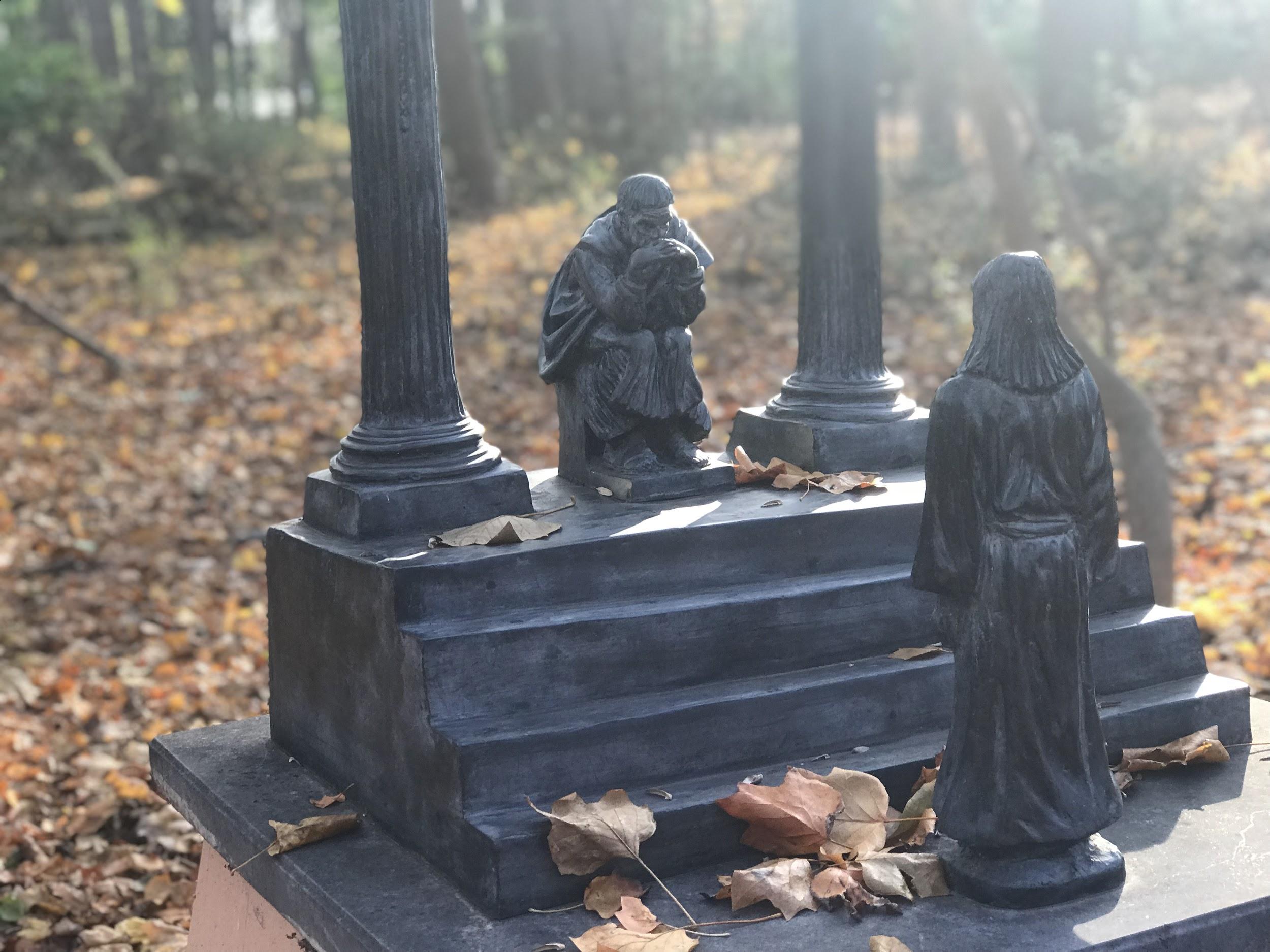
I have found those moments of contemplation to be life giving to my prayers. The very nature of the surrounding changed my contemplation, my prayer, and my focus in holy moments.

Walking through a path in the woods while praying is a valuable and wonderful experience. In this cold season, walking outside can be treacherous on frozen, freezing, and dangerously windy days. How can we enrich our prayers in a season which is dismally gray without continually focusing on the bleak, the dark, and the promise of spring that seems so very distant?

What if poetry is a window we can use for contemplation? Consider the poem “In a Vale.” The poem was written and published by Robert Frost in 1915. Let’s take a look as the poem is now in public domain.

When I was young, we dwelt in a vale
By a misty fen that rang all night,
And thus it was the maidens pale
I knew so well, whose garments trail
Across the reeds to a window light.

The fen had every kind of bloom,
And for every kind there was face,
And a voice that has sounded in my room
Across the sill from the outer gloom.
Each came singly unto her place,

But all came every night with the mist,
And often they brought so much to say
Of things of moment to which, they wist,
One so lonely was fain to list,
That the stars were almost faded away

Before the last went, heavy with dew,
Back to the place from which she came –
Where the bird was before it flew,
Where the flower was before it grew,
Where bird and flower were one and the same.

And thus it is I know so well
Why the flower has odor, the bird has song.
You have only to ask me, and I can tell.
No, not vainly there did I dwell,
Nor vainly listen all night long.

“In the Vale” by Robert Frost, 1915

First, Robert Frost was an incredible poet. When I was younger, I would have said that “He’s the kind of poet I want to be if I grow up.” Now it would be more accurate to say that he’s the kind of poet I would like to be if I ever grow up.

Second, consider the words Frost uses in his poem. If you have an overactive imagination like me, you might be blessed to leave the poem with the smell of earth in your nostrils, or the feeling of dew soaking into your sneakers as you see yourself walking out to greet the day.

Consider that a poem can be a window into a new place. What a gift this is to those who live underneath gloomy and gray skies! A poem can do more than inspire thoughts. Literature and stories were the original way people communicated visions of worlds beyond sight. Prose and poetry inspired religious belief, transported people to places of romance and ecstasy (e.g., consider the Song of Solomon in Judaism or the poems of Rumi in Sufi tradition), and opened the scope of people’s understanding of the world (e.g., Plato in Greece, Prince Shōtoku in Japan).

Like stories, poems can transport us to new places. What use is poetry? Poetry can be a way to see a world that can affect your prayer, change your viewpoint, and allow you to see a different existence than you might otherwise imagine. Poetry can be a way into memories from your own past, even when you did not write the poem. Poetry can be a blessing beyond belief.

I would like to encourage you to look into some poetry today. Consider that our world is an amazing place with amazing people. Explore their view through the power of their poems and see if you do not see the world a little differently. Perhaps the experience will change the way you pray today.

Open, Nurturing, Empowering…

This past weekend I was challenged with a question. The question revolved around my vision of ministry. What evolved from the question was the realization that I am often not clear about my own particular vision for ministry. What do I seek to embody in my ministry? Could I express my vision for ministry in the time it takes to ride an elevator?

I have been thinking consistently about that question since it came into my mind. I have been asking myself how to express my view of ministry. Side questions arose from this contemplation. Could others remember it? Could they see it in my actions? Do I have a phrase that helps me stay focused on my purposes?

What’s the phrase? “I believe that the church should seek to be ONE.” I want my vision to be Open, Nurturing, and Empowering.

Let me break those buzzwords down into something more succinct. Buzzwords are nice but they do not always serve the purposes which they need to serve for others. These lists are meant to be examples and not a complete or restrictive compilation of ideas.

I believe the church should be Open to new people, Open to new expressions, Open to people who are differently abled, Open to hear/converse with our neighbors, Open to taking God’s love out of the church building, and Open to hear God’s voice.

I believe the church should be Nurturing to people who want to know God more, Nurturing to those who have had few advantages and many obstacles, Nurturing to those who are wounded or in need, and Nurturing with/towards other communities and people in our neighborhood.

I believe the church should be Empowering to people who need God’s freedom in their daily life, Empowering to those who have been oppressed, Empowering to folks who believe their voice does not matter, Empowering to those who need to borrow our strength to break free from their shackles, and Empowering to people who want to seek to enter into life changing discipleship.

Seven years ago, I knelt before my Conference and was ordained into ministry because people were Open to my leadership, Nurtured my potential, and Empowered me to go forth in ministry. What kind of person would I be if I did not seek to do the same for others?

What do those things look like? I believe that is the subject of a lot of posts to come, but here’s a few snippets of what I’m proposing to lead about more openly:

  • You cannot be truly Open to the community if your building or community has significant barriers for differently abled folks.
  • You cannot be truly Open to the community if you don’t welcome folks who are different than you in culture, race, ethnicity, or viewpoint.
  • You cannot be fully Nurturing to the community if you immediately dismiss people when they find the courage to talk about real life problems that make you feel uncomfortable.
  • You cannot be fully Nurturing to new leadership if you respond to every request to try something new with an immediate “No way. We’ve never done that before.”
  • You cannot be wholly Empowering if you look down your nose at folks who haven’t had the same advantages as you.
  • You cannot be wholly Empowering of other people’s ministries within the church if you rely on authority for leadership in the church instead of relationship, vision, and calling.

What are the words of the communion liturgy? Because there is ONE loaf, we who are many are ONE body. May we all be ONE in the love and care of Jesus.

Room for the Weird

The other night something caught my eye when I was reading the introduction written by S. T. Joshi in “American Supernatural Tales.” Mr. Joshi was discussing a statement made by William Hazlitt in 1829 in the Edinburgh Review. Mr. Hazlitt believed the ages of ghosts had passed (along with ignorance and superstition) before the United states came into existence.

Mr. Hazlitt’s assertion itself did not catch my eye. What caught my eye was the way Mr. Joshi reframed the issue. Mr. Hazlitt asked:

“Since so much of supernatural fiction appears to find the source of its terrors in the depths of the remote past, how can a nation that does not have much of a past express the supernatural in literature?”

J. T. Hazlitt in the Introduction to “American Supernatural Tales”
Who wore it better? The cat on the cover of “American Supernatural Tales” or Pepper the cat?

How can a nation without a past express itself in supernatural literature? Does this question only apply itself to the original context? Can a nation with such a short memory for history express itself in these arenas?

This approach to the question intrigued me. How can one write good fiction that defies reality if one lives in an age where reality is black and white? Werewolves and Dr. Frankenstein’s monsters are entities of a time when such things were plausibly close to real, but just beyond reality. Our age is an age of scientific marvels, which is perhaps why our science fiction is extensive and excellent, but much of horror is jump scares and the monstrosity of humanity. Are there truly unique monsters in our age?

Mr. Hazlitt points out that H. P. Lovecraft wrote of William Faulkner’s tale “A Rose for Emily,” that: “… this is a dark and horrible thing which could happen, whereas the crux of a weird tale is something which could not possibly happen.” For something to be truly weird, it could not possibly happen…

All of these things raise a question in me: Can the weird still happen? Can things exist that could not possibly happen? In an age when the internet, technology, animation, and raw processing power make almost anything imaginable come to the screen, does the weird still exist? Can the weird still draw us into a special place where the natural laws and rules of things no longer apply?

I ask this in all sincerity because I believe that Mr. Lovecraft was correct. A weird tale requires something that could not possibly happen. Also, God is weird.

We live in an age bombarded with information and with possibility. We are living in the middle of the longest government shutdown in American history, which would have been unthinkable a few short years ago. Some of the most unfathomably large comic book stories of a medium that is blessed to present stories from one frame at a time have been brought off of the paper onto the screen. The modern equivalent of gods and goddesses walk on the silver screen when stories of far-off worlds are not being portrayed. We live in a world of possibility.

Is there still room in the midst of all of that information for the world to find the weirdness of God? Can God be weird if we keep swallowing all of that stuff without pausing to chew? What’s more, does all of this make life better?

I love superhero movies and science fiction, but they are like everything else: they are good in moderation. I enjoy watching humorous videos and listening to Weird Al, but they are like everything else: they are good in moderation. When the mind is filled with too much stuff, there is less room for imagination, creativity, and weirdness.

I like the universe to be a little weird. I like there to be a space where the weird God can be set apart from reality. We used to call that set apart weirdness holiness. As much as I love science fiction and superheroes, can a nation with neither an attention span for the past nor space for palpable weirdness really engage with the weird? Can we engage with God? If the space is too crowded, is there room in ourselves to step back and take space?

“Full Pews” – Snowy Day Reflection

The snow falls on a church holding one soul. Drifting snow causes roads to be treacherous or closed, but the space is full. The baptismal font is empty; yet echoes memories of families blessed. The carpet where chancel meets nave shows evidence of drips of communion juice. Tears shed by coffins never seem to stain. The stilled piano rings with neither spirituals nor hymns. The organ holds its breath. This place is quiet; yet it is not empty. Memories fill this place from altar to narthex.

The pews are all full.
Deep snow is no barrier
where memories dwell...
The sanctuary on Sunday during worship time during a “No Unnecessary Travel” Advisory

Thank you to some generous drivers approximately 80 years ago

Today was my wife’s grandmother’s memorial service in Olean. She’s being interred out west, so this was my family’s chance to formally pay our respects. The affair was meaningful, deep, and faithful. Grandma Betty was a really wonderful woman and I learned a lot about the woman whom I sat next to for many a holiday meal. Apparently her stories were not done catching me off guard even after she crossed to that other shore.

This evening I sat at our kitchen table and contemplated Ephesians 3:1-4. In particular, I was drawn to the concepts of mystery and grace. The contemplation was deep as I spent my time with these words. As I contemplated the growth of this one moment in time, I found myself caught in a million questions as I lifted questions to God in my heart.

“…for surely you have already heard of the commission of God’s grace that was given me for you, and how the mystery was made known to me by revelation…”

Parts of Ephesians 3:2-3, NRSV

Contemplation roamed for quite a while on questions of whether this commission of God’s grace would be received well in today’s church. Would we welcome one of the villains of our stories into the doors of our church if he were to come in repentance? Would we welcome a former persecutor into our midst? Would we welcome someone who was passionately into another culture that many would consider counter-Christian into our midst? Would we have the grace to walk with them through transitions which are usually less dramatic than that of Paul?

I contemplated these questions for a while, but I kept being drawn back to the concept of mysterious grace. The early church was blessed by the unexpected life story of Saul of Tarsus. I have been blessed by unexpected stories too. I learned of a new unexpected story today at the memorial service in Olean.

My contemplation candle holder… It burns often on my table.

I heard the story of a hitchhiker in the west who went to play at a tent revival with some friends. A local girl found God at that tent revival and hitchhiked to the Bible College where that hitchhiker attended. This young lady was a graduate of a class of 12. This girl from a very small area was married and had kids. Those hitchhikers were my wife’s grandparents.

Hope was not falling asleep easily tonight, so I was holding her as she settled while I prayed and contemplated. I realized in the middle of my contemplation that if it were not for some random person picking up a hitchhiker on the other side of the country nearly 80 years ago, my daughter would not have been in my arms. It was a powerful moment of realization. My blessings in this world would be very different if it weren’t for a hitchhiking evangelist getting a ride to a small town with a graduating class of twelve to lead a tent revival. My blessings would be different if those evangelists decided the small town was not worth their time.

Earlier today on the ride back from Olean, my daughter and I were listening to the audio book for “The Good Doctor” by Juno Dawson. In that audio book, the eponymous Doctor of Doctor Who made the statement: “There’s only two things I don’t believe in, and one’s coincidence…” Apparently, being a time-traveler makes you skeptical of randomness.

Now, I am definitely not a predestination proponent, but there’s something powerfully moving when you realize that your daughter possibly wouldn’t be in your arms if someone had not decided to give one of her great-grandparents a lift, but I would rather contemplate something besides an argument that has raged for centuries like predestination versus free will.

What I contemplated was the fact that there a lot of people out there who often look in the mirror and do not know where their life is headed. They see coincidence and fear stepping out of even partial safety to see what might lay outside their door. There are scary things out there in the world which are far more frightening than hitch hiking. People can become paralyzed by fears both of what might happen and what is happening. Here a few off the top of my head:

  • A person lives with someone who is physically abusive. Zie wishes to walk away, but what if zie loses his chance to see hir kids?
  • An alcoholic wants to stop drinking, but all of hir friends drink every weekend. What if zie ends up all alone?
  • A person wants to stop working at a job that is literally physically, mentally, or spiritually killing them. What if zie quits and ends up losing everything?
  • A person has a loved one (friend/child) who is doing something awful that might end up disastrously bad. Maybe it already has gone bad. Zie wants to say something or do something, but what happens if hir loved one walks away from zie forever?

These examples are but a few examples of how life can throw challenges that cause us to stop dead in our tracks in fear. What if our inability to move causes things to go awry? What if someone we do not know in 80 years will be a completely different person if we do nothing?

I don’t know who the person was who gave my wife’s grandparents rides across what sounded like a good portion of the western half of this country, but I am so grateful that they did. If you’re living in fear of doing something that might seem just as crazy, I invite you to have a conversation with a local religious leader, a counselor, or even a good friend. If necessary, speak to the police for an intervention or go to a support group to find help. Your bravery just might change the future.

Darkness and Light

Breakfast scent reaches far—
Wafting through all warm safe homes…
A shared moonstruck myth.

Rev. Robert Dean

Today marks the beginning of a new year. 2019 is here. I have many hopes for this new year, but I found myself unwilling to answer a question my wife asked our family at breakfast this morning. My wife asked “What are your hopes for 2019?”

My problem with her question was not that I had no answer. I have many answers for her question. I would love a great many things to happen over the next year. I would enjoy a happy year for my children and for the healing of some wounds that came to the surface in 2018. I would feel blessed if my ministry thrived and if I could see tangible results of God’s work in my life. I would enjoy many of these things a great deal.

My challenge with her question comes from the fact that 2018 helped to inject my theology and my thoughts with the wisdom of different centuries of Christianity. Would I be happy if my ministry thrived at the expense of another group of sisters and brothers in the faith? Would I find meaning in my children being blessed while other children nearby continue to suffer through the belief that nobody cares for them?

It clarified my thoughts on these matters as I entered my devotion this morning. I am working through Upper Room’s resource “The Upper Room Disciplines 2019” and found myself working through the reflections of Dr. Marshall Jenkins. The book describes Dr. Jenkins as an “author, spiritual director, and licensed psychologist.”

Today’s reflections were on finding the light in the darkness’s midst and revolved around Matthew 25:31-46, which is the story of the division of the sheep and goats at the end of things. While reflecting on this passage, Dr. Jenkins wrote intriguingly about the light and the darkness.

The first thing that caught my eye was that we must find light by first finding darkness. This idea caught my eye as someone who has struggled in the past and is continuing to struggle with eye issues. In particular, it reminded me of the time they removed my eye patch after my corneal transplant.

When the eye patch was removed, everything was bright. I had spent days with my eye covered and everything was bright. My eye had become so accustomed to the darkness that everything I saw, from the smallest led light to the intensely bright light shining through the clouds sent pain through my head. I do not believe I realized how bright headlights truly were until we went for a ride that evening.

I did not understand how powerful light was until that period of darkness. In the same way, it can be very difficult to find light in this world if we do not first see the darkness. Dr. Jenkins points out in the passage in the Disciplines that we instinctively avert our eyes from the darkness.

In my experience as a minister, that reality is true. When I was minister of a church that hosted an Alcoholics Anonymous group, I often heard more in conversation around the state of the fellowship hall after meetings than I did about how brave the women and men were facing their struggles. Ironically, I think the AA group left the hall cleaner than we did on Sunday mornings!

To be clear, at the church I once served, the complaints were few and far between, the church never talked about removing their access to the space, and they did their best to make sure AA could continue meeting in the church’s space. The point I am attempting to make is that it was far easier to discuss a trashcan accidentally left full than it was to talk about how amazingly brave the folks were who came to face their struggles. Like Dr. Jenkins said, it is human nature to avert our eyes from the darkness and churches are filled with humans.

Dr. Jenkins also does a wonderful job at pointing out that the places of darkness are where this passage states we will find Jesus. He states:

“Jesus himself told us where to look: among the hungry, thirsty, alien, vulnerable, sick, and imprisoned. From their dark predicament, their faces will reveal the light… the light of Christ appears to those who step into the night with the lowly.”

Dr. Jenkins in “The Upper Room Disciplines 2019”

What Dr. Jenkins states tracks with the passage. Jesus says in Matthew 25:40: “Truly I tell you, just as you did it to one of the least of these who are members of my family, you did it to me.”

All of it begs a question for me. If you’re wondering where Jesus is in this topsy turvy world, have you looked among the least? If you’re wondering how you can make the world a brighter place amid a world filled with darkness, have you brought your light into the life of people like those listed in Matthew 25?

Let’s be clear, I’m not recommending giving money for others to do the work, although I am certain that is a blessing. I am not even recommending that you send money to the church to support our ministries because that is not my goal. I am asking if you personally have walked alongside the kind of folks where you might find the light of Jesus? Have you faced the darkness enough to recognize the light?

All of this calls to mind the words of Dr. Amy Oden that I was reading the other day in “And You Welcomed Me: A Sourcebook on Hospitality in Early Christianity.” She writes:

“Christians of the first three centuries certainly understood themselves to be aliens, pilgrims in this world with citizenship in another. Given their political location in the Roman Empire, it is not surprising that stranger status would be a primary way Christians understood themselves and their place in the world. These Christians frequently remind one another that their true allegiance is not with the powers of this world and they must hold a sort of double consciousness, seeking to be good citizens in their communities yet never fully at home in the world.”

Dr. Amen Oden in “And You Welcomed Me: A Sourcebook on Hospitality in Early Christianity”

Perhaps it would be easier to see the darkness if we were to more fully grasp this understanding of our reality. In my experience, church folks tend to look at those who struggle in darkness and say “How can I help them out of their struggle?” We might do well to ask how their journey is similar to our journey. We may be blessed to ask how our journey might intertwine with their journey. Perhaps we should see ourselves less as those who have everything together and instead as people who are on our own journey as pilgrims and aliens through this world.

Ancient Advice for Thanksgiving

So, it is almost Thanksgiving Day in the United States of America. Many forks are preparing to gather with loved ones for a day of feasting, conversation, and merriment. Thanksgiving is a blessed day for many people.

Not everyone likes Thanksgiving. Some people are dreading Thanksgiving this year. There are challenging conversations which may take place over pie. United Methodists risk conversations about the Special Session of General Conference and other church dramatics. Citizens risk discussions of politics, voting choices, and future outlooks. Many folks know there are traditional arguments over family matters, cooking styles, or other matters. Conversations can be difficult on Thanksgiving.

On a personal level, some folks dread Thanksgiving because of what it will tempt them to eat. Will power is a necessity for many on Thanksgiving. Exercised muscles and hard earned toning will face the hordes. They cry out things like “It is a holiday!” Invitations to live a little often correspond with an expectation to consume a lot.

I wanted to bring ancient wisdom into this conversation. I have been enjoying the Desert Abbas and Ammas a great deal over the past year, but do not limit my reading to these ancient words. For your edification, I bring to you a quote from Benedicta Ward’s “The Sayings of the Desert Fathers: The Alphabetical Collection.” I also bring a quote to you from “The Epistle of Barnabas” in “Early Christian Writings: The Apostolic Fathers” as translated by Andrew Louth.

Let us begin with the Desert Abba, although it is likely that the epistle predates the sayings of the Abbas and Ammas. Here’s the quote for you today: (pg. 104)

“A brother questioned Abba Hierax saying,’Give me a word. How can I be saved? The old man said to him, ‘Sit in your cell, if you are hungry, eat, if you are thirsty, drink; only do not speak evil of anyone, and you will be saved.’ “

I want to stretch our understanding of what Abba Hierax says by breaking the passage down into three concepts. The brother sought a word about salvation. We are not seeking salvation in the eternal sense this Thanksgiving. Still, there is wisdom in seeking God’s salvific power to fill every day of our lives.

So, the first idea! Beloved, stay in your cell! For the Abbas and Ammas, the cell was the place they rested and prayed. The cell was a challenge to some and a a blessing for others. One could find out a lot about their being by remaining in their place. The cells had space for introspection. These places had space for rest. These rooms space for blessing.

Beloved, stay in your cell! When invited to a seat, enjoy that seat! You may not enjoy everyone around you in that place, but there may be room for blessing in your seat. Is your neighbor getting your goat? How is that neighbor getting your goat? What does that tell you about yourself? Why does that neighbor get your goat? What does that relationship tell you? Is your neighbor a challenge or a mirror for reflection? Is your neighbor an irritation or someone trying to connect? What if they only have certain tools and just need encouragement? Maybe something like sarcasm is almost their native language? Is this trouble is an opportunity to show love, to show grace, and to open a doorway to a better relationship?

Now, I strongly recommend that you do not stay if you are being abused. Be aware there may be possibility for personal growth growth if you figure out how it simply irritates you, annoys you, or frustrates you. You may leave your seat blessed beyond your imagination. Thank you Abba Hierax!

So, the second idea. Beloved, if you are hungry, eat. Beloved, if you are thirsty, drink. Sitting at the table is an opportunity to find sustenance for your body and soul. You may not like everything, but that is okay. There may be something at the table that will do more than sustain you. You may leave the table inspired to eat more of something strange. What if you do like that weird looking Brussel sprout dish? What if that one taste opens a door to a lifetime of new experiences? If you are hungry, eat.

Now, let’s be clear. Few of the Abbas would say to eat or drink to excess. Many of the Abbas and Ammas were clear that a person should engage in intentional moderation. So, if you are hungry, eat. When you have had enough, you may no longer be hungry. When thirsty, a glass of water may quench that thirst. If you eat when you are hungry and drink when you are thirst, you may leave your seat blessed beyond your imagination. Thank you Abba Hierax!

Finally, beloved, let us take this final word from Abba Hierax seriously. Beloved, do not speak evil of anyone. I saved the quote from the Epistle of Barnabas for this point in the post. The epistle says: (pg. 159)

“The principles of the Lord are three in number. Faith begins and ends with Hope, hope of life; judgement begins and ends with Holiness; and the works of holiness are evidenced by Love, and the joy and gladness it brings.”

If we are a people of faith, this epistle would recommend that our faith requires us to be a people of hope. We hope for life. When we speak evil of others, that never brings life into the equation.

If we must speak out of a place of judgment, the epistle would also ask questions of us. Do our actions begin in a place of holiness? Do our actions lead to a place of holiness? Remember, in this model holiness are evidenced by love, joy, and gladness. If love, joy, and gladness are not present when there is a temptation to be judgmental, then we should stop ourselves. If love, joy, and gladness are not the ultimate result of our actions, then we should stop ourselves.

Speaking out of a place of evil never does us well. Matthew 12 records an exchange between Jesus and the Pharisees where he was accused of acting out of an evil place. Jesus was charged with casting out demons by the power of Beelzebul. Jesus pointed out that this is madness. Jesus could not have acted out of an evil place to conquer evil—such actions would not stand the test of time.

If we are to be like Jesus, we should never meet evil with evil. We should never speak evil of anyone. As it says in 1 John 2:6, “Whoever says, ‘I abide in him,’ ought to walk just as he walked.” If speaking an evil word about another person is something you think would be unimaginable for Jesus, then you should seek to never speak such words. Thank you for the reminder and invitation back into truth and faithfulness to both Abba Hierax and to the author(s) of the Epistle to Barnabas.

In conclusion, I hope this little journey into obscurity encourages you this Thanksgiving. It is doubtful any of these authors would have understood at first glance our celebration of Thanksgiving. Still, one last aside. Abba Anthony once entered conversation with a hunter where the hunter became afraid that drawing his bow too many times would damage it. I’m sure the same thing is true of basting your turkey. Keep that oven door closed!


I made a diagram! Little victories are still victories!

“Supper Table” Questions

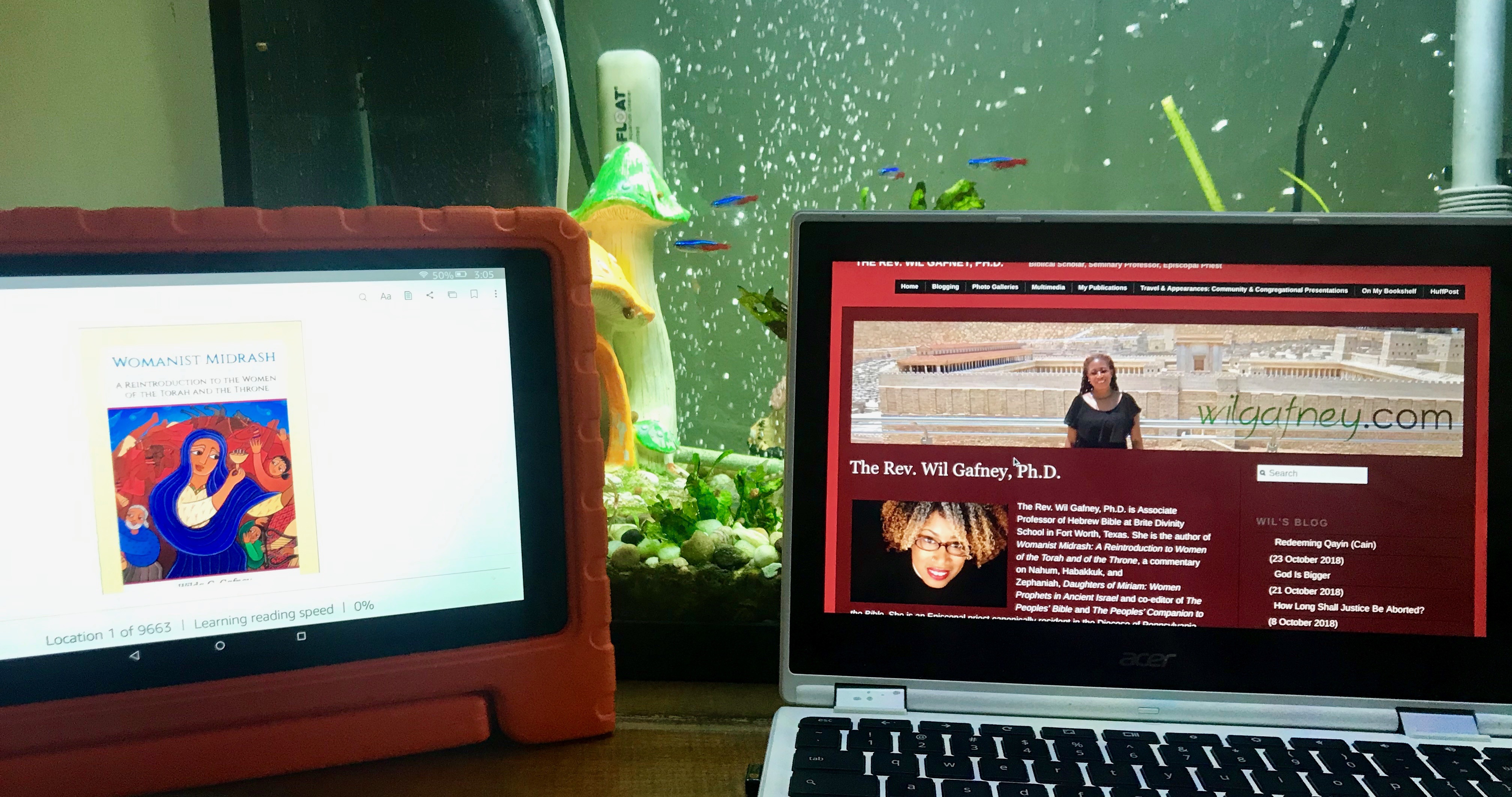
Today I began reading a new book I have been anticipating. I picked up a kindle version of “Womanist Midrash: A Reintroduction to the Women of the Torah and the Throne” by Dr. Wilda Gafney. I have to admit that I am excited by the voice Dr. Gafney uses in her writing. It will be no surprise to most that I immediately caught on to her conversation around the kitchen table in her home. I love this quote: (Gafney, p. 2)

“All are welcome at this table, and as a sign of that welcome I offer not only dishes I like; I try to meet the dietary needs of my guests—which is not the same as cooking exactly what they want exactly the way they want. I am no short-order cook…”

Dr. Gafney proposes to use the narrative of the supper table as a structure for her book. Even reading through the introduction, it makes sense. Her conversation intends to: (Gafney, p. 7)

“[affirm] the interpretive practices of black women as normative and as holding didactic value for other readers, womanist interpretation makes room at the table of discourse for the perspectives of the least privileged among the community and the honored guest of any background: the child who is invited into ‘adult’ conversation around the table with ‘Baby, what do you think?’ and the extra place at the table for whoever may come by.”

The concept of the extra place at the table excites me. As an introverted person, one of my favorite things to do is sit down with people I respect and listen to their conversations. I probably spoke too much in seminary. A few years out with a few years of pastoral experience, I wish I had spent more time listening, especially to the strange voices I did not understand.

I am enjoying this book. I feel as if there is plenty at the table. Let me give an example of how Dr. Gafney asks some amazing questions. I plan to chew the ideas over for a while and will hopefully encourage you to pull up a chair at the table.

Here‘s my personal example of how this book inspires questions. It is a few weeks before Advent. We are facing the same story that is retold time and time again. I could easily polish an old sermon, but who likes reheated leftovers in a season of feasting.

Instead, what if I were to look at some principles Dr. Gafney presents (p. 8) and ask myself hard questions? Have I given voice to Elizabeth in the past? Have I ever deeply pondered her place in the story? Is there room for a woman’s story in this season focused around the coming of Christ? Have I made room for that story? Have I checked to see if that story honors the African roots of the text?

These questions are powerful. I admit these questions are convicting. If I look at Dr. Gafney’s four womanist principles, the well draws deeper (p. 8). Do my words as a European male legitimize other voices including the biblical interpretation of black women? Does my ministry allow for the inherent value of each person in the text and in the community interpreting the text? Do I allow conversation with the text so that there is room for conversation outside of my personal cultural sphere? If we don’t make that room, can we rightfully expect diversity in our churches? Dr. Gafney does not ask this outright, but If we do not make that healthy room, should we hold ourselves accountable for that failure?

I believe these questions are especially important for me as a European male minister in a very homogeneous ministry setting. I am appointed to serve in a town surrounded with roads where someone from outside the hamlet will likely pass Confederate flags or road signs tagged with swastikas to reach the church. I serve in a town where you must travel by car to find any significant diversity in population. Who will ask these questions if I abstain?

Truthfully, I am a bit intimidated by Dr. Gafney’s book. I do not want to engage in cultural misappropriation. I respect her research and words. I want to honor her work and enjoy her scholarship as someone who at least tries to share the table. To paraphrase Dr. Gafney, I could go back and keep doing things the way I always have. I do not want to keep doing the same thing! I want to learn and experience new things!

There are moments already in my reading where I feel like I might belong at the kids’ table. Although, I will honestly say I do not sense there is a kids’ table in Dr. Gafney’s home. Maybe that is an American custom of European descendants? I do not know. I know I am looking forward to spending time with this book and recommend it to other folks who are interested in broadening their horizons.

Side note: Dr. Gafney (noted in the acknowledgment which doesn’t have a page number on my kindle edition) notes that Dr. Mark Brummitt helped to coin the phrase “womanist midrash.” If it is the same Dr. Brummitt, he was one of my favorite seminary professors and at one point offered to be an emergency midwife if my wife went into labor the semester she was in his course while pregnant. If it is the same Mark Brummitt then it is a small world.

Today’s “Snowy Day” blogging vista! Those neon tetras really like the cover of Dr. Gafney’s book! If they keep this up, they’ll take my job…

Space for the joy of “gōd-spellen”

“God of peace,
you strive to set within us
a Gospel joy.
It is there, very nearby,
ever renewed by the trusting way
you behold our lives.”

–Brother Roger of Taizé

For today’s blog I wanted to contemplate this prayer by Brother Roger. Brother Roger’s book of prayers entitled “Praying in Silence of Heart: One Hundred Prayers.” This small paperback collection sits on my office desk for when I cannot find inspiration. As a result, Brother Roger occasionally appears in my sermons, blogs, and contemplations.

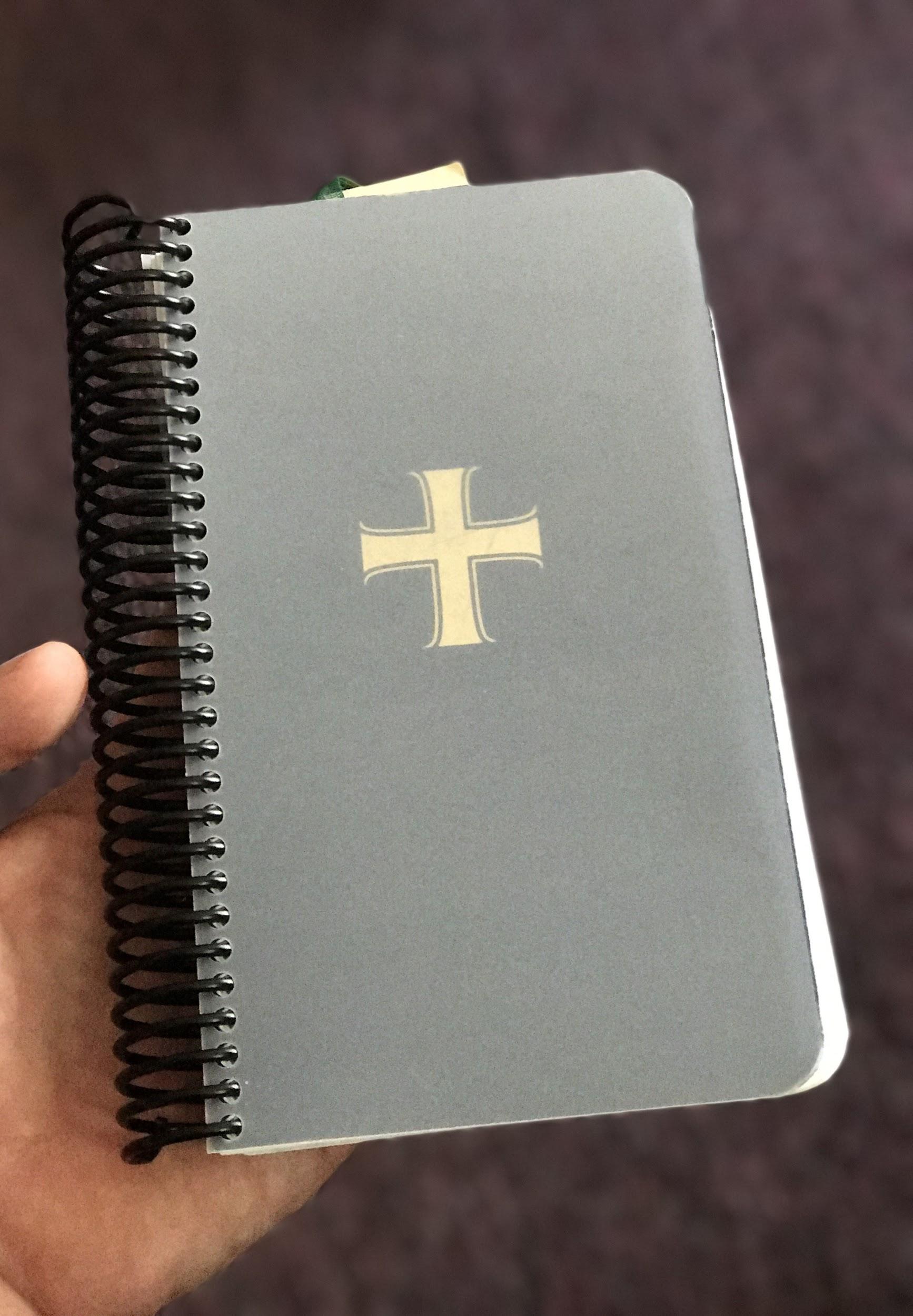
My copy of Brother Roger’s book of prayers.

This prayer catches me off guard. What catches my attention is how Brother Roger describes God as active. God strives, places, renews, and beholds. We may find joy within us, but it is a gifted joy. We are recipients of a gift. The joy we receive finds renewal in God’s action. We are passive in this transaction. We receive the gospel joy as God makes space in our souls.

I find this description both theologically sound and realistically upsetting. Theologically, God is a giver of grace. Grace is unmerited favor. The Holy Spirit is described in Galatians 5 as bringing about fruit in the lives of the believers including joy. In that passage joy is counted as a powerful fruit of the Spirit. Joy exists alongside the heavyweights love, peace, patience, kindness, generosity, faithfulness, gentleness, and self-control. Joy is not something that just comes about in life. Joy is a fruit of the Spirit and the Spirit is a gift of grace and love.

Joy is often confused and seen as a synonym of happiness. Traditionally, joy was once something deeper than happiness. Joy was a feast compared to the fast food of happiness. One could be happy for a day, but joy was something with depth and breadth beyond a moment. One of the most irritating memories I have of the holiday season was seeing a poster in a fast-food restaurant asking proclaiming “Joy to the [mass produced and frankly questionable sandwich].” Nearly a decade later, I am still mad at that restaurant for insulting joy. I believe joy should never be used to designate something coming with a side of fries.

Still, I find this realistically upsetting. Why? If this is theologically sound, why be upset? I am upset because I want to force joy into parts of my life. If my wife and I are arguing, I want to force joy into that place of conflict. If my kid is screeching in time with the beating of my pulse through my headache, I want to force joy into my skull alongside peace. If there is a meeting where anger abounds, I want to force joy into that place.

Instead, I must let God renew my joy. I must open my heart and be patient. I must allow the gospel joy to come into my life through God’s work. If I spoke Middle English before around 950 CE, perhaps it would be more clear. When gospel was tied to the phrase go[d]spell (gōd-spellen), it might have been more obvious. Sometimes we must let there be time for the words of the God spell to be spoken into our lives.

So, there’s a prescription offered by Brother Roger. We must let God work in us to find our joy renewed. May we all have the patience to let God renew the joy within us.

Let Us Ramble: On Baptismal Hope

Blessings friends. Sunday was an exciting Sunday at our church and in my own house. We celebrated worship with Rev. Dr. Marsha Williams, Associate Conference Minister of the New Conference of the United Church of Christ. We heard a powerfully thoughtful sermon on Christ’s love, shared communion, and eventually shared in a moment of sacramental beauty as my daughter was baptized. It was a holy and powerful moment as she was baptized in the name of the Father, Son, and Holy Spirit.

Sunday ended with memories of friends gathered, love shared, and God’s baptismal grace entering into the life of a child of God. As a parent, it was one of those moments where everything happens seemingly in a blur. Our church family has a new baptized member! What a joyful day!

Who knows where this newly baptized child of God will go? Reflecting back, I find myself drawn to reflect on “Our Time for Younger Disciples.” I shared with the children a reality. On Friday night I had sat with my friend and colleague Emily. Emily is preparing to welcome her third child into the world. She’s a woman of God who is called into ministry while living life as a mother similar to the way I am a man of God called into ministry while living life as a father. We both look like ministers although we look different, act different, and live different lives. God calls both of us and we are both children of God.

Rev. Dr. Marsha has a really cool title. She’s an Associate Conference Minister in the United Church of Christ and she has earned her doctorate. On an aside, while I do not aspire to Conference leadership in any denomination, I will admit that I want a doctorate someday. Anyway, Marsha is descended from a different part of the human family than my European roots and claims her African heritage with justifiable pride. We look very different. We’re married to two very different (but amazing) women, work out our call in different contexts, and each have our own traditions. We both look my ministers and pull portions of the same yoke for Jesus. We both look like ministers although we look different, act different, and live different lives. God calls both of us and we are both children of God.

I also shared with our younger friends that I have a friend at the Academy for Spiritual Formation named Hyunho. He’s a child of God from another completely different part of the human family who happily lives into his identity as a child with roots from South Korea. Hyunho is an Elder in the United Methodist Church like me! He is thoughtful, kind, intellectual, gracious, and kind. Hyunho has a humble and loving spirit that I long to have in my own life. His community’s practices and beliefs have inspired his approach to ministry within a cross-cultural appointment. In the midst of all of our differences, we are both called. We both look like ministers although we look different, act different, and live different lives. God calls both of us and we are both children of God.

I think back on these differences and similarities because God calls us all. The child we baptized Sunday may be called by God to be a scientist, a minister, a teacher, a nurse, or anything else. Each of the children who came forward for the children’s moment Sunday might be called to something different and strange—they will be called to believe in themselves and who they are called to be in this life! I hope our kids in church remember that God calls each of us. We are all called to be children of God—each and every one of us. I hope they live into the love of God that draws them near.

Let us Ramble: Approaching Ten Years

Friends, I am approaching a milestone this summer. On July 1, 2008, I entered into pastoral ministry in a small town called Canisteo, NY. I was in the midst of life within seminary and was working towards ordination within the United Methodist Church. I was full of words.

Between July 1, 2008 and July 1, 2018, I will have been a pastor for 521 Sundays. I have helped to bury many people, been invited to preach in multiple places outside Sunday mornings, and have probably held an extra 40 special services for religious holidays. I have been asked to pray in public more times than I can count, have blessed countless meals and events, and have even offered prayer at a snowmobile race track in weather so cold that my eyeballs began to freeze! I have shared a lot of words over the years.

Do you know what I find most strange as I approach this very odd anniversary? Besides the realization that I have survived a decade in pastoral ministry, I find myself coming to value the moments when I am not called to speak to other people. I have come to appreciate moments when I am allowed to embrace silence.

taize-silence

I am reminded of the words of Thomas Merton from his book “Contemplative Prayer.” First published in 1969, the monastic Thomas Merton wrote the following:

“Many are avidly seeking but they alone find who remain in continual silence… Every man who delights in a multitude of words, even though he says admirable things, is empty within. If you love truth, be a lover of silence. Silence like the sunlight will illuminate you in God and will deliver you from the phantoms of ignorance. Silence will unite you to God…”

I have had a multitude of words come out of my mouth, but as I age into ministry, I find myself becoming a person who no longer delights in having a multitude of words to share. Where once I felt the need to teach everything I learned in seminary, I find myself drawn to share fewer things more deeply. Most of my sermons have grown shorter over the years, most of my words simpler, and most of the concepts I preach more fundamentally simple, although not easy.

Let me try to explain. The other day a good friend and I were discussing Dietrich Bonhoeffer’s understanding of grace. If you don’t know Bonhoeffer’s classic statement about grace it can be summed up in the line from “cheap grace is the deadly enemy of our church.” In his book on Discipleship, Bonhoeffer speaks about how he believed the church had been giving away grace so easily that people found it cheap and tawdry. True grace had a cost that was very dear. From this viewpoint, grace should never be seen as cheap as it is of inestimable value.

I found myself getting frustrated quickly while trying to express myself. I was not frustrated at my friend or at Bonhoeffer, but at the very limitation of my own language. God’s love and grace is of inestimable value, but there is something to be said about the challenge of saying “You are offering grace too cheaply” to another preacher, another person, another child of God. There are inherent challenges to even beginning to broach such a subject.

If I had a loaf of bread and there was a starving person in front of me, how could I stop to explain to the starving person that they might be treating the food as tawdry or cheap? The person is starving for food which we can neither produce or share without the grace of God. By the very grace of God, we have food to share with the starving.

That food exists because God has provided it through the love of Jesus, and as the Word of God made flesh, that raises more questions. Does not Isaiah 55:10-11 say: (NRSV)

“As the rain and the snow
come down from heaven,
and do not return to it
without watering the earth
and making it bud and flourish,
so that it yields seed for the sower and bread for the eater,
so is my word that goes out from my mouth:
It will not return to me empty,
but will accomplish what I desire
and achieve the purpose for which I sent it.”

If the grace we share comes from God through the Word made flesh, how can we look at that Word as being shared cheaply? Do we believe our method in sharing the word somehow breaks the divine purpose for which it is sent? Are we accusing each other of being false prophets when we do our best to faithfully provide for the hungry children of God? I am not expressing this idea well. Language failed me and still fails me in describing why this troubles me.

The closest I come to describing this challenge comes from a prayer from Gabriella Mistral, as translated by Langston Hughes. Gabriella Mistral was a Chilean poet who lived from the 19th into the 20th century.

“Like those jars that women put out to catch the dew of night,
I place my breasts before God. I give Him a new name.
I call Him the Filler, and I beg of Him the abundant liquid of life.
Thirstily looking for it, will come my son.”

We who serve in ministry bring words from God as found in scripture. I am not speaking simply of pastors. Sunday School teachers, prayer warriors, parents teaching children, children teaching parents, friends who love others, and all who share the gospel with others come to share something that comes from beyond ourselves. We come to the “Filler” and ask God for the liquid of life. It swells up within us and we share it with others. I’ve never breastfed a child as a male, but I can tell you as a partner and as a parent I have witnessed the challenges that come from teething children with sharp teeth. I have watched as my wife wondered if she would be able to create enough and have myself sometimes wondered if there’s enough milk in the world to fill that hungry mouth.

The world is thirsty and somewhere over the years, I have come to understand that what I can offer to the people of God does not come through a plethora of words. What I can offer that brings life, fullness, and goodness is born of my own dependency on God, on my relationship with the Holy Spirit, and upon what people are willing to drink without spitting up all over the place. Paul may invite us to move past spiritual milk into the bread of life with Jesus, but often I find myself able to share deeply only what is found in the “bread” that Christ invites me to break and share.

To call that grace which is offered to others who are starving as cheap… It sits wrongly in my soul and yet Bonhoeffer is right as well. The grace we offer is not cheap. It comes with a cost and is precious. There’s no perfect balance in these moments. I could write a soliloquy on how the needs, wants, and capacity of ourselves and others creates an almost impossible situation. I could fill the world with more words, but in truth, I would rather call on the Filler and wait in silence to see how God will provide for the needs of the children of God.

Allow me to continue the Merton quote found above:

“More than all things love silence: it brings you a fruit that tongue cannot describe. In the beginning we have to force ourselves to be silent. But then there is born something that draws us to silence. May God give you an experience of this ‘something’ that is born of silence.”

Approaching a decade into ministry, with literally thousands of prayers, sermons, and blessings underneath my belt as a minister, I sometimes long to simply share with people a powerful word that is simple, straightforward, complicated, and as deep as necessary. I have come through using hundreds of thousands of words publicly to value the power of silence as a teacher, a friend, a lover, and a comforter.

In many ways, I find comfort in the story found in 1 Kings 19:9-13. In that passage, Elijah is in the midst of a season of turmoil and challenge. Elijah is fleeing for his life from an angry queen who was married to the king of Israel. As he fled with the help of God he came upon Mount Horeb. The story goes:

“At [Mount Horeb] he came to a cave, and spent the night there.

Then the word of the Lord came to him, saying, ‘What are you doing here, Elijah?’ He answered, ‘I have been very zealous for the Lord, the God of hosts; for the Israelites have forsaken your covenant, thrown down your altars, and killed your prophets with the sword. I alone am left, and they are seeking my life, to take it away.’

He said, ‘Go out and stand on the mountain before the Lord, for the Lord is about to pass by.’ Now there was a great wind, so strong that it was splitting mountains and breaking rocks in pieces before the Lord, but the Lord was not in the wind; and after the wind an earthquake, but the Lord was not in the earthquake; and after the earthquake a fire, but the Lord was not in the fire; and after the fire a sound of sheer silence. When Elijah heard it, he wrapped his face in his mantle and went out and stood at the entrance of the cave. Then there came a voice to him that said, ‘What are you doing here, Elijah?’”

Where was God but in the “sheer silence?” When God is with Elijah in the silence, Elijah is asked a “what” question, but I hear other questions in between the texts. Why were you there Elijah? What are you seeking? Where is your heart?

There is a lot of value to silence and the more time I spend preaching and teaching, the more I come to value moments where we seek the one that is found beyond the rushing, the shaking, and the fury. I seek the One found in the silence.

Let us Ramble: Prayer and Worship

Last Sunday night I had the pleasure of sitting in worship. My wife has been spending a lot of time with the good folks of the Newark Valley United Church of Christ. Once a month they have been having an evening worship service with communion. My family and I attend this service for two reasons. One, it is wonderful to support my wife by going to a church of her choice, which is a rarity as most Sunday mornings I am where I am appointed. Two, it is an opportunity to sit in worship as a person and not as the leader. Sunday morning is a time of worship for me, but I rarely get the privilege of listening to another preacher work through the word of God with the people of God.

So, Sunday night, Pastor Chris Xenakis, a colleague and the pastor of the Groton Community Church, was visiting to preach, serve communion, and lead worship. After his sermon, Chris said something to the effect of “Prayer is the most important part of worship. In many ways, all of worship is a prayer.” Pastor Xenakis is a wise man.

Chris’ words kept ringing through my ears after I returned home. After I realized that it was not going to go away until I figured out why it was bugging me, I went hunting through my readings for the Academy for Spiritual Formation. I found the source of my distraction in “The Art of Prayer: An Orthodox Anthology.” In that anthology, Bishop Theophan (1815-1894) of the Orthodox persuasion, is quoted as saying the following in the second chapter under the subheading “The test of everything”:

“Prayer is the test of everything; prayer is also the source of everything; prayer is the driving force of everything; prayer is also the director of everything. If prayer is right, everything is right. For prayer will not allow anything to go wrong.”

The affirmation of prayer by Bishop Theophan is deep, thought-provoking, and reminiscent of what Pastor Xenakis said during the service. Prayer is seen in this concept as that which exists at the heart of everything. Prayer provides everything, drives everything, and directs everything. The bold statement is made that everything is right when prayer is right.

null

My thought-provoking copy of “The Art of Prayer”

These concepts tug at my thoughts in deep ways. What is life but an act of worship? We worship when we use our resources to God’s glory. We worship when we choose to use our time wisely. We worship when we treat God, our neighbor, and ourselves with love. We worship when we tend to the world in which we have been placed. All of life can be seen as an invitation to worship. If all worship is a prayer, then truly prayer is at the very heart of our existence.

So, the question then becomes obvious. How do we know if our prayer is right? What litmus test can we apply to our actions, our stewardship, and our relationships that can show whether we are on the right track?

I believe the answer is love. Do our actions exhibit love? Do our prayers lead to more love? If God is love, then we should strive to be more loving. If God is love, then our actions should point towards the Source of love. If God is love, then we are invited to join in the great dance of love through Christ. I believe the true litmus test of our lives is whether or not we are sources of love like the one we worship and claim as our savior.

Inevitably, someone will question whether or not Jesus’ suffering was in line with the idea of prayer not allowing anything to go wrong. In the end, Jesus conquered his suffering and death. As a resurrection people, we are a people who understand that sometimes all is made well on the other side of suffering, struggle, and occasionally death. Can we be patient enough to allow all to be made well? Can we be patient enough to allow things to be made right even when it seems they all have gone wrong?

In the meantime, I am grateful that I went to the evening service on Sunday. It is nice to be in worship and to have the opportunity to both sing from the pews and to hear a good sermon. I will probably keep thinking about Chris’ words on worship and how Bishop Theophan invites us from across the centuries to ponder whether those prayers are the test of everything.

Let us Ramble: On Gluten-Free Communion

Today I intend to ruffle some feathers. I do not often choose to intentionally poke my head into controversial affairs, but I was recently the subject of several heated arguments around a practice our church has adopted for 2018. In 2018 our church is serving gluten-free communion bread to all people who come to the communion table.

I would love to say the most heated debates were in the church, but honestly, the church was not at the heart of the biggest debates. The biggest debates have taken place in my family’s kitchen. The phrase “Never discuss politics or religion” does not hold much water in a minister’s house. Discussions with family members often stray into religious matters and there are few things as capable of bringing consternation into a family meal than conversations around things held as holy as the sacraments. I am blessed to have an extended family who can live with differences of opinion as long as they say their piece. Regardless, I have learned to never bring this subject again during Easter dinner. I’m guessing it would not go over well at Christmas or Thanksgiving either.

Still, I am passionate about this subject, even as I understand the reticence of folks to having anything change. If a church has had the same type of bread for the past 50 years, it can be hard to understand why they need to change because of others. Would it not be enough if we were to put a couple of gluten free wafers on a plate? Why should we all have to “suffer” from having bad bread in order to allow one or two people an easier time coming to communion?

Well, I have theories and responses to those questions. First, let’s deal with the idea of having two loaves of bread. Consider the words from the “Service of Word and Table I” in the United Methodist Hymnal: “Because there is one loaf, we, who are many, are one body, for we all partake of the one loaf. The bread which we break is a sharing in the body of Christ.” While the body may be shared in other churches with different loaves, there is something powerful about witnessing that in the local church we are all sharing in one loaf as one body. There is no division when we share one loaf.

The other questions about suffering bad bread and about changing our own behavior will take a bit more nuance. I will say there is a thing called bad bread. Bad bread comes from people who have not taken the time to learn how to make bread. As we currently have a study based on the spirituality that can be drawn from bread baking, we are currently creating a crop of good bakers who may be able to rise (pun intended) to that particular challenge.

So, let’s go deep. In 2004 the church adopted the document “This Holy Mystery.” The document laid out the groundwork for the United Methodist Church’s understanding of the sacrament of communion. The document is a deep document, which has been reprinted in subsequent Books of Resolution, including the 2016 Book of Resolutions.

Here’s an interesting excerpt from “This Holy Mystery” found in the subsection labeled “Communion Elements.” The excerpt speaks on the use of alcohol at the communion table:

“Roman Catholicism, Eastern Orthodoxy, and many Protestant denominations
have always used wine in the Eucharist. During the movement against beverage
alcohol in the late nineteenth century, the predecessor bodies of The United
Methodist Church turned to the use of unfermented grape juice. This continues to be the position of the denomination.”

There is a tradition of using alcoholic wine at the communion table. Despite that tradition, the United Methodist Church does not use alcohol at the communion table. We share in the unfermented fruit of the vine. Why buck tradition to engage in a practice that differs from so many other denominations? Our church felt a call to battle the spirits of spirits and we continue to stand against the abuses of alcohol. Consider what it says in ¶3042 of the 2016 Book of Resolutions:

“As God’s children and participants in the gift of abundant life, we recognize the need to respond to those who know brokenness from the widespread abuse of alcohol and other drugs in our world. The experience of God’s saving grace offers wholeness to each individual. In light of the reality of alcohol and other drug abuse, the church has a responsibility to recognize brokenness and to be an instrument of education, healing, and restoration.”

Consider the words and the implications of this responsibility to recognize, educate, heal, and restore those struggling with alcoholism. Our love of these individuals has moved us as a denomination to do something strange. We recognized the problem and as a church we chose to change instead of continuing to follow tradition. Compassion and wisdom moved the church to consider the challenge faced by individuals. The church was convicted.

If you are not familiar with life in most churches, change is a difficult idea. For some people, change is a four letter word. Despite the power of tradition, inertia, and complacency, an entire denomination decided to do something different for the sake of people who had a need. The church felt a responsibility upon recognizing the brokenness of individuals. This motivated them to do things differently.

I can personally attest that there are folks who do not come forward at communion because of a number of factors. Some people think those wafers are nasty and they usually are pretty bad. I have to agree and sometimes admit that the gluten-variety are no picnic either. That being said, if we’re serving wafers, which occasionally happens when plans go askew, we can all suffer together.

Some people do not come forward because of embarrassment. Why are they embarrassed? Sadly, snide comments about having gluten-free communion is one reason. Some people believe they are drawing attention away from communion if they confuse things by asking for something different. Some people believe others will judge them for “wanting to be different” even if they have an actual concern like celiac’s disease.

For these folks, I will name the brokenness. The Lord’s table is a place of welcome and grace. If embarrassment keeps people from participating in this means of grace, the situation needs to be addressed. To avoid the difficulty being faced by individuals for the sake of our own comfort is selfish. In United Methodist tradition, the sacrament is a form of blessing from God. Our lives are literally made better by participating in the sacrament. How could we look at the table, see there are people who feel excluded, and not work to address the situation?

In other words, if we have to choose between our gluten-filled tradition and the possibility (in our church the certainty) that a gluten-free change will help to bless more people, are we not obligated to consider a change? If the second greatest commandment is to love our neighbor, are we not obligated to make certain that they are welcome at the communion table? In this odd, strange, topsy-turvy world, doesn’t our own integrity demand action?

The bread to be and several tools. Bob’s Red Mill does not sponsor me, although we would be happy to pray for them if they mailed us a couple of coupons. Gluten-free flour isn’t cheap!

Now, I want to be clear. I do not believe in judging other churches or other ministers. Each church has to make their own decisions. As far as my ministry is concerned, I am always seeking to draw the circle of inclusion wider. I will keep trying to serve gluten-free communion as often as possible to make certain people are not left out. So, wish me luck as I seek to perfect gluten-free bread making despite the fact that I personally add extra gluten to the bread I make for my family. Pray for me as well, because it is difficult to educate when you only have a few minutes on any given communion Sunday.

Let Us Ramble: On Split Animals

So, after the busyness of the Lenten season and a week taken away to provide childcare for my three children during their spring break, I am back in the saddle again. In the next few weeks I will be preparing for the next session of the Academy for Spiritual Formation and then it is time to prepare for Annual Meetings, so you can guess the direction of posts as those events draw closer.

In the meantime, in between changing diapers for my smiler and breaking up youthful hijinks between the two elder gooseballs, I have been pondering a passage from the Book of Genesis. In particular, I have been thinking about the nature of covenant.

As a pastor, I am surrounded by covenantal relationships. I have a covenant with God in my own personal spiritual life, a covenant with my wife to remain faithful until death parts us, a covenant with God to care for the children I have been entrusted with as a parent, a covenant with God to care for the people I minister with in my appointment as a minister, a covenant with the Maine Federated Church to support this local church, a covenant exists between the United Methodist Church and the Maine Federated Church that sets the guidelines for how the church cares for me and the parsonage in which I live, a covenant with the United Church of Christ to minister on their behalf in this community, a covenant between myself and other United Methodist Elders in my Conference’s Order of Elders, a covenant between myself and all pastors and deacons that serve within our common denomination, and finally a covenant with myself. Like I said, there’s a lot of covenant relationships in my life.

If that run-on sentence above doesn’t prove the point that it makes sense that I think about covenant a lot, then let me just assure you that I do think seriously about covenant and covenantal requirements often. Covenants are often conflicting and challenging. Which covenant takes priority on a daily basis? Do I spend another night away this month at another meeting or do I spend time with my children who sometimes don’t really see me except an hour a day some weeks? Do I sit in the office and wait for someone to come by the church or go visit people who cannot leave their homes? Do I blog about the nature of covenant or do I spend another few hours writing letters to church members? Covenants are complicated.

Genesis 15 lays out a sign of the covenant that is quite gruesome. Animals are split into two pieces and in the midst of the night a flaming torch and a smoking fire pot pass between the two lines of animal parts. It seems a bit gross, but the reality behind the imagery is even more frightening. In covenantal language, the promise is made. May I become like these animals (split in two) if I break this covenant. The severity of the response to a break in covenant is intentionally graphic, intentionally troubling, and intentionally recorded for the people so that they understand the importance of their covenant with God.

So, being surrounded by covenants, what do we do? Do we look at our relationship with God as being so important that we might be divided in two if we were to break it? Do we look at our relationship in the marriage covenant as being so powerfully binding? I have never been divorced, but many of the people I know who have been through the process refer to it as being a traumatic and spiritually violent process—almost as if they were torn in two. Do we look at our relationships we share with our beloved family in the church the same way? I know few places where a falling out can be as traumatic as in a church. Hearts break in those circumstances.

In honesty, where I found myself pondering covenant a lot this week was while thinking about the United Methodist Church. Are we facing a breaking in covenant as a whole? Have we been so brutally biased in our approaches to each other, to the looming conversations, and in our application of church politics that we have missed basic concepts such as loving each other? Has a lack of love led to a breaking of covenant? Are we tearing ourselves apart in some literally testimony to the concept that broken covenant leads to torn relationship and a torn body split in two?

As we go through this season of resurrection, what does it mean to go forward in covenant with a God who moves past death into life? There is much to ponder this Eastertide. I pray that we all go forward with love and peace.

Let us Ramble: Diving Inside

It has been no secret that I have been attending the Academy for Spiritual Formation through Upper Room Ministries over the past 9 months. Once a season, I have travelled to Malvern, Pennsylvania to meet with holy conversation partners and teachers about a variety of spiritual traditions and how they can affect the way we approach spirituality. As much as there is an academic side to the studies, I have found the program to be highly practical and personal.

For our upcoming session, we are looking at both the (w)holiness of the relationship between our physical bodies and our spiritual selves as well as Orthodox spirituality. By Orthodox I mean literally Orthodox Church spirituality—there has not been a ton of lectures teaching heretical matters or anything of that nature.

On a side note, the Academy has actually been a great place to have open discussions on spirituality from a great range of Christian (and Jewish!) traditions without a need for those kinds of arguments, which has been really refreshing after a long traditional education where argument and counter-argument sometimes seemed to be at the heart of the formative process. To put it simply, the Academy is more about discipleship than conversion, which is why I adore my time at the Academy and recommend it highly for people who are tired of argument and long for personal formation. Yes, by the way, it is open to clergy and laity—both are welcome and appreciated in my experience.

While I will admit that a lot of the Academy preparation for the next session makes me nervous as my back has been acting up and I understand that things like yoga might challenge it during the next session, I find myself coming back again and again to the readings for the Orthodox spirituality section of the Academy. In particular, I am working my way through “The Art of Prayer: An Orthodox Anthology” as compiled by Igumen Chariton of Valamo, edited by Timothy Ware, and translated by E. Kadloubovsky and F. M. Palmer.

My copy of “The Art of Prayer” along with a subtle suggestion of another cool book filled with very cool resources for next month for all of my Irish loving friends.

A quote has stuck out to me in the introduction by Timothy Ware. Ware quotes Theophan the Recluse as saying “The principal things is to stand with the mind in the heart before God, and to go on standing before [God] unceasingly day and night, until the end of life.” Related to the depth of this idea, on the sixty third page of the anthology (which is where the quote Ware was citing in the introduction resides in the anthology) Theophan writes: “Every prayer must come from the heart, and any other prayer is no prayer at all. Prayer-book prayers, your own prayers, and very short prayers, all must issue forth from the heart to God, seen before you.”

In our church we have been in a lot of deep conversations lately. I personally have been in several conversations where we have had deep debate over leadership from the heart and leadership from the head. Does compassion rule the day when making decisions? Does regulation designed to protect us have the final word in conversation? Does the advice of wise denominational officials have weight equal to the advice of our hearts?

The conversations have been deep, thoughtful, and often stressful in nature. To some extent, some of these conversations have had a depth and thoughtfulness I have not seen since some of those deep lunch table debates in seminary which took place between impassioned people with differing knowledge, tradition, and convictions.

I continue to find myself drawn back to these Orthodox Spirituality concepts in these conversations. Ware connects all parts of the self (identified in his worldview as body, soul, and spirit) through the combining connector known as the heart. The heart is intertwined with the body, the soul, and the spirit in a way that is uniting. On the eighteenth page, Ware says:

“The term ‘heart’ is of particular significance in the Orthodox doctrine of man. When people in the west today speak of the heart, they usually mean the emotions and affections. But in the Bible, as in most ascetic texts of the Orthodox Church, the heart has a far wider connotation. It is the primary organ of [a human’s] being, whether physical or spiritual; it is the centre of life, the determining principle of all of our activities and aspirations…it embraces in effect everything that goes to comprise what we call a ‘person.’”

Today’s post is called “diving inside.” I titled the post this way due to the fact that I have been spending much of the past week diving inside of myself in the midst of these deep conversations and asking questions of myself. If I led (or lived) only from the head, could I stand before God with a soul and spirit that has gone ignored? If I led (or lived) only from the heart, could I stand before God with soul and a body that had been ignored? How could a soul even survive before God without that spirit of courage tended by Jesus or that head full of knowledge that has formed me into who I am today? In short, diving into my life’s conversations lately, I wondered if in any circumstance or path I chose, could I possibly stand before God in my heart without my conviction shattering me into a thousand little pieces?

I do not find it coincidental that the Jesus prayer rests deeply within Orthodox spirituality. “Lord Jesus Christ, Son of God, have mercy on me.” Pondering these matters, I have regularly found myself praying this prayer over the past few weeks, but not solely this prayer.

For me, this prayer is held in contrast with the Lord’s prayer. I am making an audacious or possibly even a (forgive me, but this is literally the right word for the situation) bodacious request when I ask God to lead me besides still waters (Psalm 23 runs through my mind when I see God’s reign and God’s will being done in heaven—I am aware it is technically not in the prayer), when I ask God’s will to be done on earth despite the fact that I need forgiveness for my trespasses, or even when I ask God for daily bread. There’s a sense of an almost arrogant familiarity and assurance in the Lord’s prayer that stands at odds with the pure humility found in the Jesus prayer. The two prayers speak from two very different places.

As I have been diving into these deep conversations and into my own spirit, soul, mind, and especially my heart, I found myself grateful for both prayers. There have been times during these conversations when I have felt the only thing I could reasonably ask of God for myself was the mercy that comes from a place of pure and utter prostration before God’s throne. There have also been times when I have had the assurance to know that the daily bread I needed was the ability to extend compassion from a place of confidence, eyes wise enough to look past fear towards the brightest possible outcome while others struggled with fear and anxiety, and even at time to find hope in Christ’s provision even as the conversation needed insight far beyond the wisdom held by mere mortals like me.

I am reminded of the words our ordination class responded with at Annual Conference when asked “Wesley’s Historic Questions” (which are asked of every United Methodist minister). Every time we were asked a “Will you…” question, we responded “With God’s help, I will.”

In many cases, daily life is like answering those questions. Do I know the answer to every difficult question I face in ministry? Heavens, no. Do I make mistakes? Most assuredly I have made mistakes and will likely continue to make mistakes in the future. Do I have faith in Jesus Christ? Yes. Will I continue to seek after Christ? With God’s help, I will. Will I do my best to live my life from a place of peace where all parts of me can coexist? With God’s help, I will. With all this in mind, will I live my life in such a way that I can stand before God in my heart in prayer? With God’s help, I will.

In the end, I believe that Theophan the Recluse was correct. Every prayer must come from the heart. Since that is true, I must not only guard my heart. I must tend my heart like a garden, After all, in Matthew 15:10-20, the gospels record that Jesus taught that it is not what we eat that defiles us, but what comes comes out of the heart. If I am to stand before God, I must tend my heart zealously. To quote the New International Version of Proverbs 4:23: “Above all else, guard your heart, for everything you do flows from it.” If the Orthodox spirituality of Ware is correct, that guarding and tending of my heart means caring for what exists within me, in my body, in my spirit, and in my soul. With God’s help, I will.

Let us Ramble: An Arresting Quote on Charity

Recently, a college classmate of mine from years ago asked a question on Facebook. If I could write a paper on any female spiritual figure in history, which person would I choose? I love open-ended questions and spent a couple of days perusing the answers until late Thursday morning. I had been working on collecting reports for our Annual Meeting and had just completed a report for a member who is in need of a bit of a hiatus. In other words, I was out of coffee, had been up worrying about my infant with a fever most of the night, and was a bit bleary eyed. I took a few moments to look at my bookshelf for something that I could peruse for a few minutes while my wits came back around to meet me and the next item on my agenda.

My eyes fell on one of my favorite books from a few years back. I came across “The Mirror of Simple Souls” by Marguerite Porete. My edition is from “The Classics of Western Spirituality” of Paulist Press in 1993 and was translated by Ellen L. Babinsky with a preface by Robert E. Lerner. I immediately thought of the post, remembered that nobody seemed to have mentioned this wonderful author, and jumped to share with my old college friend.

IMG_1344.JPG

My copy of Marguerite Porete’s “The Mirror of Simple Souls.” I recommend it highly!

I picked up my copy, began to peruse, and then began to laugh. Did you ever wonder what would get a woman killed by the inquisition in France in 1310? Well, writing in vernacular French didn’t help. What made me laugh was the translation of a part of the trial where the inquisitor is shocked that not only did Marguerite not burn her copy of her book after a former bishop ruled it heretical, she kept thinking it was a good book, and dared to send it to another bishop as well as other simple folks “as if it were good!”

I do love a woman who believes in herself and her God! She spoke the language of the people, cared about the people, and kept on believing in God’s call on her life despite the challenges! Authority should be respected, but let’s be clear—Marguerite Porete saw authority abused and relied on her faith in the highest authority of all! Here was a woman who makes me smile!

I began to spend a few minutes browsing over the pages while working up the courage to go across the way to heat up a cup of coffee. I was reading along when something caught my eye worthy of a blog post and inspirational enough to get me to hold off on grabbing that cup of joe. Here’s what is translated from the fourth chapter of Marguerite Porete’s Mirror of Simple Souls:

“Charity is such a wise merchant that she earns profits everywhere where others lose, and she escapes the bonds that bind others and thus has great multiplicity of what pleases Love.”

I love this concept. As I pen this blog post for Monday morning, I am drawn to think about charity. Charity has many roots and I do not pretend to be an etymologist, but I noted with enthusiasm that the Online Etymology Dictionary stated that around the time of Marguerite Porete’s life, charity became connected with the concept of the affections we ought to feel for other people. In my own imaginary world, there is a distinct correlation between these facts!

I think about the ways we ought to feel for other people and how that inspires us a lot on Mondays. Recently, my primary visitation day for going to visit people in their homes or in care-facilities is on Mondays. As this is posted online (unless something goes askew) I am likely riding in my car down to visit one of our saints in the Triple Cities. Some of these visits are easy to accomplish as the saints in question are lively, ask deep questions, and appreciate a good visit. Some of these visits are heartbreaking at times when the saints are struggling.

When we consider how we ought to feel for others and then when we let those feelings affect who we are as people, we are entering into the purest form of charity. Charity is not meant as something begrudgingly given, something scowlingly given, or something unfortunate that has to happen in order for the charitable person to to be one of the good people. Charity is our opportunity to live into the same gracious love as our Lord and Savior first showed us. Charity is our opportunity to become the hands and feet of God and to enter into the dance of God’s love. Charity is an amazing thing!

Marguerite’s concept arrested my eyes because of the simple beauty of the idea. Charity finds profits where others lose. Charity finds freedom where others find fettering chains. Charity abounds in what pleases Love. These ideas are so simple and beautiful.

How can charity find profit where others lose? Perhaps it is because charity, when birthed by love, sees things through different eyes. The world says that you will never get rich by taking weekends off from work and volunteering to play basketball at the YMCA with kids. You will never get rich volunteering with the Boys and Girls Club or with your church. You also cannot buy the love those kids may come to have for you as a person. You cannot buy their affection, their love, their admiration, their imitation, or any of the other blessings that come being involved in a ministry of charity. You will never get rich with money—you may become rich with love.

How can charity find profit where others lose? Sometimes it is because love follows love. In the spring of 2013 I witnessed the worst community fire of my career in Boonville, NY. The church I was serving became a hub to help provide food, shelter, space for the American Red Cross, and information for the people who were displaced. Do you know what happened when we tried to buy lunch for the people who were displaced? We were matched by others and nobody went hungry. Do you know what happened when we started to collect clothes? The fellowship hall was filled with blessings. Every time we tried to give what we could, others joined in with us in charity. Perhaps you may find no personal profit in engaging in charity, but sometimes the love of God seen in you inspires others to bless those around us.

How does any of this promote freedom? I believe charity breaks the bonds that hold us in place. Often we get trapped within our own prisons by tradition, by circumstances, by our own limitations, and by our own imagination. There can be freedom when charity invites us to feel for others like we ought to feel, when charity motivates us to move past feeling to action, and when charity finally overwhelms our prisons.

The week of the fire in Boonville wasn’t just a holy week. The fire took place during THE Holy Week. We had to cancel our extra services on Thursday and Friday to care for people in need. We worshipped across church lines with Presbyterians and Baptists that week on Maundy Thursday and Good Friday respectively.

They welcomed us as guests and opened their hearts and church homes to us. What kept us from worshipping together before? Pride? Maybe. Tradition? Probably. Silliness? Definitely. I never enjoyed worship services so much as when we came into those churches, sat exhaustedly down, and we were welcomed and loved despite our tiredness and our Methodist personhoods. We United Methodists made space for others and through charity we found the freedom to look beyond our doors. We had the freedom to find our family and spend time with them. The family of Christ worshipped in a holy way that week.

When we engage in charity, we find ourselves in places where we can build up an abundance of love. I will likely be thinking of Marguerite’s call to charity was I walk through the doors of Bridgewater Rehabilitation or one of the United Methodist Homes this morning. I pray that you would find places to fall in love with God, to love your neighbor, and to connect with who you ought to be—someone filled with holy charity, freed by grace, and abounding in love.

Let us Ramble: On Unity

Unity is currently an interesting word within United Methodist circles. The United Methodist Church is currently in prayer for “The Commission on a Way Forward” (hereinafter, “Commission”) The Commission was established by the 2016 General Conference of the United Methodist Church by the General Conference delegates at the request of the Council of Bishops. Conversation has revolved around concepts like unity as the Commission has continued to meet over the past year.

As a result, of this conversation, my eyes have been drawn to the word “unity” when I have come across it both in my reading and in my study. I was drawn to thought when I came across the collect “For the Unity of the Church” in “The Book of Common Prayer and Administration of the Sacraments and Other RItes and Ceremonies of the Church: Together with the Psalter or Psalms of David according to the use of The Episcopal Church” (hereinafter, “BCPASORCCTPPDAUEP” (just kidding)). The collect reads: (certified 2007)

“Almighty Father, whose blessed Son before his passion prayed for his disciples that they might be one, even as thou and he are one: Grant that thy Church, being bound together in love and obedience to thee, may be united in one body by the one Spirit, that the world may believe in him whom thou didst send, the same thy Son Jesus Christ our Lord; who liveth and reigneth with thee, in the unity of the same Spirit, one God, now and forever, Amen.”

In a similar manner, I was drawn into prayer and contemplation by the first full paragraph of the letter “From the colony of the Church of God to the colony of the Church of God at Corinth, called and sanctified by the will of God through our Lord Jesus Christ,” which is found in “Penguin Classics: Early Christian Writings” as translated by Maxwell Staniforth and revised by Andrew Louth (New York: Penguin Books, 1968). The paragraph which caught my eye reads:

“Because of our recent series of unexpected misfortunes and set-backs, my dear friends, we feel there has been some delay in turning our attention to the causes of dispute in your community. We refer particularly to the odious and unholy breach of unity among you, which is quite incompatible with God’s chosen people, and which a few hot-headed and unruly individuals have inflamed to such a pritch that your venerable and illustrious name, so richly deserving of everyone’s affection, has been brought into disrepute.”

The concept of unity caught my attention sharply in both of these readings. I was sharply caught by the ideas in the letter from Rome to Corinth, which is generally considered to have been authored by Clement of Lyons, the bishop of Rome at that time. Clement’s words were very strong. Disunity is described as having brought the name of the church in Corinth into disrepute. Indeed, of all of the struggles being faced by the church in Corinth, the disunity in the community is the very first thing that the church of Rome brings to the forefront for conversation.

Certainly, there is a brief statement of thanksgiving and blessing as per the custom of letter writing in that era. The church in Corinth is acknowledged to be called and sanctified. Indeed, before the letter writer enters into our quote, the writer also expresses the blessing, “All grace and peace to you from God Almighty, through Jesus Christ.” The combination of these statements is very brief and Clement is very clear that this is a situation that deserves to be addressed even as the church in Rome has her own situations to work through in her journey of faith.

Indeed, Clement was very concerned about the disunity of the church. The very next sentence Clement writes is, “There was a time when nobody could spend even a short while among you without noticing the excellence and constancy of your faith.” The connection that I make in this reading is that the disunity of the church in Corinth has led to others seeing their faith as being inconsistent and less than excellent. There’s a high opinion of unity in Clement’s writing.

Indeed, the high opinion of unity is seen in the collect. The collect asks God for unity within the church so that the world might believe in Jesus Christ. The church is called to unity in the collect through the binding together of the church by both love and obedience. Love and obedience are seen as reasons for unity within the life of the church even as that unity is seen as a converting witness.

Indeed, Jesus prays in John 17:11, “Holy Father, protect them in your name that you have given me, so that they may be one, as we are one.” Jesus prayed that we would have unity as a people. There is a strong emphasis on the importance of unity in Clement, in the prayers of the church, and in the scriptures themselves.

So, if unity is so important, why is it ignored so often? Why do we engage in behavior like gossip if we know that there is almost no quicker way to stab unity in the back than to engage in gossip? Why do people hop from community to community looking for people like us if we know that we are called to be in community across the spectrum? Why do we do the very things that we do?

In many ways, the struggle of the church over questions of unity throughout the centuries reminds me of the writings of Paul. Ironically, while writing to the church in Corinth, Paul describes a struggle that he has faced in 2 Corinthians 12. Paul describes how there is a thorn in his side which has forced Paul to his knees in prayer repeatedly. Paul uses that thorn as a reminder of his weakness, a reminder of his dependency on the grace of God, and as an invitation to contemplate the power of Christ.

I wonder if our ongoing struggle with these concepts is continual because we are in need of a reminder of our weakness. I also wonder if our ongoing struggle with gossip is a sign of our unwillingness to let go of this most basic of sinful behaviors. Indeed, the works of the flesh listen in Galatians 5 include such sinful vices as dissensions, factions, strife, enmities, and other behaviors which should be excised from the life of the faithful. As Paul states in Galatians 5:21, those who do these things will not inherit the kingdom of God.

Unity is a concept that I believe we all need to be in prayer around as a community. God’s call is for us to be one. It deserves to be noted that God does not call for uniformity among the church. God’s call is for us to be united in Christ and unity does not require absolute conformity.

Paul seems to agree with this assertion that unity is important. Clement seems to agree with the assertion that unity is important. The collects and prayers of many modern denominations seem to agree with this assertion that unity is important as well. With such a great cloud of witnesses inviting us to see the importance of unity, it is crucial that we be in prayer both on obtaining unity and understanding what unity might actually look like in our context.

Let us Seek: Do not be alarmed!

I was out in the world this morning. Cold or no cold, there are some appointments that cannot be put off. I had an appointment with a specialist that I had scheduled weeks in advance. I went to my appointment on cold medicine, advised everyone I was in contact with to wash their hands, and we made the best of things.

My appointment today was for a simple non-invasive type of treatment which took a few minutes. The doctor and I sat alone talking while she was going about her work. We began to talk and things went to deep matters in a few moments. I was not surprised. People often open up to me–I do not advertise that I am a minister, but I always seek to be polite and courteous. It can be amazing how quickly people come to trust you when you always say “please,” “thank you,” and tell them that you are grateful for what they are doing for you. I also believe that most people just want someone to listen.

She started talking about what she had heard in the news. She was afraid of what was happening in the world. She talked about intercontinental ballistic missiles, nuclear warheads, and the idea that someplace as nearby as Washington could be struck, although she did not rule out New York City. As medicated as I was at the time, I wondered aloud about the fact that people feared nuclear attacks on the Hoover Dam and the dam at Niagara Falls during the Cold War. We talked about how frightening things are, how strange everything seemed, and she wondered what she would do if a war broke out. She was frightened. I commiserated, listened, spoke very little, and prayed for her fears in my heart.

The conversation reminded me of a passage in Matthew about the end times. Discussions of nuclear winter, nuclear fallout, and global conflict often remind me of the passage found in the twenty fourth chapter. Matthew’s gospel reads in verses three through fourteen: (Common English Bible)

“Now while Jesus was sitting on the Mount of Olives, the disciples came to him privately and said, ‘Tell us, when will these things happen? What will be the sign of your coming and the end of the age.’


Jesus replied, ‘Watch out that no one deceives you. Many will come in my name, saying, ‘I’m the Christ.’ They will deceive many people. You will hear about wars and reports of wars. Don’t be alarmed. These things must happen, but this isn’t the end yet. Nations and kingdoms will fight against each other, and there will be famines and earthquakes in all sorts of places. But all these things are just the beginning of the sufferings associated with the end. They will arrest you, abuse you, and they will kill you. All nations will hate you on account of my name. At that time many will fall away. They will betray each other and hate each other. Many false prophets will appear and deceive many people. Because disobedience will expand, the love of many will grow cold. But the one who endures to the end will be delivered. This gospel will be proclaimed throughout the world as a testimony to all nations. Then the end will come.’”

I first came to know this passage well through the New Revised Standard Version of the Bible. In that translation verse six says “…you will hear of wars and rumors of wars; see that you are not alarmed…” These verses have all taken a vital place in my lived theology within this world of global information and easily spread global panic, but verse six has always rung out the loudest in my mind. As I lay on the table, I could almost hear a palpable voice repeating in my heart “you will hear wars and rumors of wars…” alternating with “Peace I leave with you; my peace I give you… Do not let your hearts be troubled and do not be afraid.” 

My doctor was afraid this morning. I chose not to be fearful, but to be compassionate. What is the good news? In this context, I believe it can be best expressed earlier in the Gospel of Matthew. In verses twelve through fourteen in chapter eighteen, Jesus tells a parable: (CEB)

“What do you think? If someone had one hundred sheep and one of them wandered off, wouldn’t he leave the ninety-nine on the hillsides and go in search for the one who wandered off? If he finds it, I assure you that he is happier about having that one sheep than about the ninety-nine who didn’t wander off. In the same way, my Father who is in heaven doesn’t want to lose one of these little ones.”

I invite you to think about the promise which inherently sits within this parable. My doctor, like many individuals, has an uncertainty about the future. The world seems to be less than the ideal many of us were taught as children. Most of us lose a sense of the innocence of childhood as we grow into the world, and I personally believe that there’s a correlation between this loss of innocence and the traditional drop in church attendance that tends to happen at around the same time. Losing our innocence hurts.and events like those depicted in the news can send us back into our grief over our loss even if it has been decades since we first realized the world is broken. The world can seem to be a confusing place and our fear can isolate us.

Into those moments of fear, there is an ancient promise embodied in the person of Jesus. God does not want to lose one of those little ones. God cares about the lost sheep of the world. Even when it seems that the world does not care one bit for our fears, God does care and will walk through the valley of darkness to lead us all home. There is space for us at the table, there is space in the flock, and there is deep grace despite our fears for all people. God has come near, God has shown compassion, and eternal life will come to those who follow the Shepherd. As Matthew records in the twenty ninth verse of chapter nineteen, “…all who have left houses, brothers, sisters, father, mother, children, or farms because of my name will receive one hundred times more and will inherit eternal life.

Friends, be at peace. God does not give as the world gives. Know that the path of a Christian is not an easy path, but there is a place of peace that awaits the end of our journey. Go! Be a blessing in a world of fear! Fight for justice and grace! Share the Good News! Walk with the lost sheep! Please, be compassionate

Let us Look: Jesus is Condemned

One of the blessings of the Academy for Spiritual Formation is that it is located at the Malvern Retreat House. Our stay while at the Retreat House is at the Family Life Center. There are wonderful walking paths near the Retreat House for contemplative walks. One of the paths includes a set of fifteen Stations of the Cross. Yes, I said fifteen. It is a very unique set of Stations.

While we were at the Academy this past July, we were invited to consider the possibility of looking at beautiful works of art as invitations to contemplation. Kataphatic (sometimes spelled cataphatic despite the fact that the Greek root word began with a “kappa”) contemplation and prayer is not very common in most Protestant circles, but even the most pragmatic of Christians has probably felt an invitation to consider what Christ had done when they considered the image of Christ on the cross.

I am seeking to practice a bit more of what Spiritual Director and former Jesuit Wilkie Au called “crabgrass contemplation,” which is a term he admittedly borrowed from the book “Noisy Contemplation” by William Callahan. The four steps of this contemplation are as follows;

  1. Show up
  2. Slow down
  3. Stay still
  4. Stay with

Showing up is the first step which is recommended in this contemplation. Wilkie shared a joke with us while we were on retreat that illustrated this point beautifully. A person was praying to God and asking why God never answered their prayer. God decided that it was time to address the matter. A big booming voice from Heaven rang out over the person in prayer saying “Aren’t you the one who keeps asking me to help them win the lottery?” The praying person nods their head mutely in astonishment. The voice rang out again saying “Look. I can see you are scared, so I will meet you halfway on this one. Have you considered buying a lottery ticket?”

It is a mildly humorous joke, but it is an even better invitation. If you want to find God in contemplation, you must first show up. Nobody wakes up surprised that they have not learned to speak Spanish if they never study! The invitation is made clearly and it invites us to show up.

Slowing down is the second step to this form of contemplation. I have had struggles with eyesight over the past few years, especially as I have recovered from my corneal transplant since this past March. It can take me a moment or two to focus my eyesight and really see something well. I need to slow down and take the effort to focus if I want to see something. On occasion, I have even found that I need to get out a specialized instrument to help me see which I could never use on the run. You might be amazed at how much more beautiful that robin in the yard looks when I slow down, take out my spyglass (I had one functional eye for a while–binoculars were overkill), and look with purpose instead of rushing through the yard. Slowing down in our faith is one way to focus our minds for contemplation.

Staying still is the third step and one of my least favorite steps in this method of contemplation. I have a very precocious seven year old daughter who likes to run, jump, sing, talk, and make noise. My wife blames me for this part of her daughter’s personality because I used to be that child. My mass is what now uses all of that excess energy, but it can be very difficult for me to slow down in my mind. I want to sing, I want to hum, I want to monologue, and I want to be active. Staying still is the invitation which comes next in this process and it can be challenging, but useful.

Finally, the last step is staying with the thing that we are contemplating. For me this is a different than staying still. I often will find myself in contemplation having the same eureka moment time and time again. One reason this might be a part of my pattern of being is that I often take the first morsel and run off in joy. I never notice what I am missing. This pattern could be likened to being invited to a five-course meal and running off after the salad. We are invited to stay with the item we contemplate.

I wanted to publically practice this form of contemplation with the Stations of the Cross for several reasons. First, I want to model the idea of contemplation within a Protestant context. We tend to be afraid of what John Wesley would have called Romish things, but there is a beauty to considering what Christ has done for us and is doing within us. If a Station brings us to consider the actions of Jesus within the Passion narrative, then should we not consider that a blessing?

Second, I want to spend some time connecting these Stations within the Biblical narrative. Not every station is as firmly planted within the scriptures, but each station expresses a truth which I believe should be deeply embedded within our group consciousness as Christians.

So, without further ado, I invite you to consider the first Station of the Cross located outside of the Malvern Retreat House. The station is entitled “Jesus is Condemned to Death” and it was dedicated to the friends and relatives of the Santoleri family. The artist who created the sculptures was Timothy Schmaltz.

“Jesus is Condemned to Death” by Timothy Schmaltz

As I arrive at this place of contemplation, I consider the truth of contemplation which sits directly in front of me. As Herod sits in a contemplative posture in front of Jesus with crossed hands, so I sit considering the scene in front of me. Jesus stands upright at the base of the stairs upon which the judge sits in contemplation. Jesus waits, looking, and watching.

Biblically, I must admit that I think there’s a dissonance in the story. John 19 states that Jesus would have been flogged, beaten, and crowned with a crown of thorns by the point of his condemnation. Mark’s Gospel in chapter 15 does not have an explicit flogging before judgment is passed, but Jesus would have been bound. Also, where is the crowd? Likewise, Matthew 26 records the scribes and leaders beat Jesus, but there is no mention of a flogging; however, there is a place where Herod sitting on a seat is mentioned. Luke 22 and 23 have mockery, beating, and a fancy robe placed on Jesus, but this scene does not appear so readily. Indeed, Matthew has Jesus washing his hands while sitting on the judgment seat, which is probably as close as we can get to this particular image.

As I slow down and contemplate this scent of Jesus’ life, I am drawn to the inconsistencies with the story. Where is the crowd yelling for condemnation? Where is Barabbas? Why does Jesus appear so very calm? Who should I identify with in this image?

As I stay with the image, the question I ask myself is whether I am in image by intention. Consider for a moment that there is a crowd in this moment. The crowd is you and me. The crowd is everyone who walked this path and slowed down to look. The crowd stares at Jesus from thousands of Stations of the Cross around the world and throughout history. We are the crowd who sees Jesus standing in judgment. We are asked the question: “What would you have been yelling?” Would we be joining in the condemnation or would we have fled as the cock crowed that morning like Peter? Would we have had the courage of the women who would walk the road with Jesus, eventually even being with Jesus as he hung on the cross?

Herod’s hands are grasped together in a form that suggest to me a feeling of angst. I too feel the angst of Herod on considering what is ahead on the path towards Golgotha. The only person who doesn’t seem to feel angst in this interpretation is Jesus. Jesus has prayed in the Garden of Gethsemane that this cup would pass, but this is the moment when the prayer is ultimately answered. Jesus will begin his journey towards the cross.

How does this idea stay with me today? I think there’s a piece of my heart that needs to wrestle with questions of what I would have done as I watched this scene unfold in front of me. I think there’s a piece of my heart that needs to comprehend that Jesus would not have run away like I would have liked to run away. Ultimately, there needs to be a place of love in my heart for the willingness of Jesus alongside the pain of watching Christ suffer.

If we are called to be remade in the image of Jesus, then perhaps a good thing to contemplate is what it means to be willing to enter into love despite the pain it might cause for us. If such a contemplation brings me closer to the heart of Jesus, then such a contemplation is a blessing regardless of what name you claim as a Christian.

Let us Seek: Sovereign God, part deux

Sometimes, I argue with myself. My habit to write the next day’s blog post and schedule it for 9:00 AM the following morning. On occasion, I find inspiration to continue with a previous line of thought. Occasionally, I find myself arguing with both myself and my blog entry for the day.

This morning I posted about a reflection on the sovereignty of God. My post came about after reflection on scripture as seen through the light of a book I am reading for the Academy for Spiritual Formation. That book is “Psalms of the Jewish LIturgy: A Guide to Their Beauty, Power & Meaning” by Rabbi Miriyam Glazer. In the book, the argument is made that the sovereignty of God is a sacrosanct concept. Adonai reigns so our world is seen in a different light.

I made the “mistake” of spending time in my devotions this morning, which is always a risky affair. I was working through one of my favorite resources, which is Upper Room’s “A Guide to Prayer for Ministers and Other Servants” (henceforth, “Guide”) This resource is the very resource which led me to consider applying for the Academy in the first place. Before finding the Guide I had always seen Upper Room as that tiny little book which I took to individuals when I visited or handed out to folks when they wanted something to read to go deeper. The Guide was deep, methodical, and practical for me as someone who likes structure in their prayer life to balance out my lack of attention span–there is a reason my blog uses the phrase “Distracted Pastor.”

Quick aside, one of my colleagues at the Academy recommended that I take my new Worship Book to the artist formerly known as Kinkos to get it bound with a spiraling ring to make it easier to use. I took my Guide there and for less than nine dollars it is now far easier to use and has nice protective covers to keep it safe. Getting my devotional book bound with a ring was a great idea as I now don’t have to weigh the pages down while taking notes in my journal.

Look how easily it sits flat!

The plastic cover is a nice protective touch…

Anyway, back on subject, I made the mistake of working through the Guide and found myself reflecting on a passage that was the exact opposite of what our good Rabbi Miriyam Glazer stated. Mind you, the author whom the guide quoted is a Christian, so that is somewhat to be expected. Still, the cognitive dissonance has been bothering me as I attempt to stay with both readings.

The following excerpt is stated to be from “Prayer” by Simon Tugwell, a Dominican historian and author. The excerpt is found in the readings for reflection for this week.

“[God in Jesus] does not come in strength but in weakness, and he chooses the foolish and weak and unimportant things of the world, things that are nothing at all, to overthrow the strength and impressiveness of the world. As we saw earlier, he is like the judo expert who uses the strength of his opponent to bring him to the ground; it is the art of self-defense proper to the weak.

This is why, if we keep clamoring for things we want from God, we may often find ourselves disappointed, because we have forgotten the weakness of God and what we may call the poverty of God. We had thought of God as the dispense or all the good things we would possibly desire; but in a very real sense, God has nothing to give at all except himself.”

I imagine most people can see the dissonance between these two sets of conceptions. On the Rabbi’s side we have a God who reigns. Adonai reigns; therefore, we have hope that the future can be a place of blessing. On the Dominican’s side we have a God who has entered the form of Jesus. There is a sense of a self-imposed weakness. God has nothing to give except himself in the form of Jesus. God has nothing to give except himself; therefore, we should not see God as the dispenser of all the good things we would possibly desire.

I have to say that my knee-jerk reaction is to immediately side with Rabbi Glazer. My fear is that my reaction is very human. How could God do something so very foolish? Well, God does what God does. In the most ancient of addresses, God claims the name “I am who I am.”

The challenging part in the midst of all of this chaos is the reality that the Reading for Reflection in the Guide does not stand alone. The psalm of the week is Psalm 105. Psalm 105 is not a psalm of passivity. God acts deeply, thoroughly, and completely in the psalm to assert the placement of the people of God. A few examples:

  • The psalm invokes the actions of God in a time of famine through the servant Joseph. (Ps 105:16-23)
  • The psalm invokes the action of God in establishing a covenant with the immigrants Abraham, Isaac, and Jacob which will never be forgotten. God protects those immigrants with might (Ps 105:7-14, 42-45)
  • The Psalm invokes the powerful and sometimes brutal story of the Exodus (Ps 105:24-45)

The actions claimed in the Psalm are not the actions of a passive God of weakness. The Psalm claims the power of Adonai. Adonai reigns! All of this begs a simple question. Why did Bishop Job and Pastor Shawchuck, the compilers of the Guide, choose to include this passage for reflection? Was it merely to inspire there to be interesting thoughts in the minds of those who sought God this week? Even without Rabbi Glazer’s contribution to this conversation, Psalm 105 and this reflection seem at odds with each other.

I have been pondering these differences for several hours and I am brought to a place where I once again go back to things I learned way back in my philosophy classes at Roberts Wesleyan College. Yes, I was indeed the student who insisted with all of the depths of my heart that I believed that God could do the incredible. I believed that God could make a square circle.

The concepts was simple. Could God do something that was logically impossible? Could God create a rock so heavy that God could not lift it? That concept never stuck within me. I was obsessed with the square circle. Could God make an object that was fully a circle and fully a square? Such a logical fallacy seems impossible.

To say that I received a bit of mockery, ribbing, and even disdain at the time for the strength and consistency of my view is to put it mildly. I have since learned to live into that tension, especially as I lived into theology. Can God truly be fully human and fully divine? Can God really be the One God as expressed in trinitarian theology? Can God really care for humanity to the extent that God would come into the world in the form of weakness to engage in an act of strength that would help Jesus emerge as the victor who would break down the division of sin that had lasted for ages past? There are all sorts of paradoxes in Christianity. There are many koans to be considered.

What is the sound of one hand clapping? I have no idea. How can Jesus be fully human and fully divine? I have no idea. How can God create a square circle? I have no idea. How can God move in weakness and foolishness to save the world? I have no idea, but I believe that Jesus has done this thing quite beautifully.

What are your thoughts in regards to this contradiction? Do you have any ideas or reflections?

Let us Ramble: Ministry within a Culture

I was reading through my coursework for the Academy for Spiritual Formation this morning when a quote from another book caught my eye. I was reading through “Thirsty for God” by Bradley Holt when he quoted Eugene Peterson. I have never really read a lot of Eugene Peterson’s work, especially as my first reaction was a knee-jerk reaction to “The Message.” I happen to like the New Revised Standard Version of the Bible and my first impression of Peterson’s translation was a bit biassed. Nonetheless, I was caught by the quotation from “Take and Read: Spiritual Reading” by Peterson. The excerpt went as follows: (Holt, 143)

“My conviction is that the pastor must refuse to be shaped by the culture, whether secular or ecclesiastical, and insist on becoming a person of prayer in the community of worship. This is our assigned task; anything less or other is malpractice.”

Now, as someone who spent a few years working through academic settings in college and seminary, I must first admit that I do not like having the context of Peterson’s quote. I am working on remedying that situation through a copy of Peterson’s work. Regardless, the quote is striking.

What does it mean that a pastor should not be shaped by either secular or ecclesiastical culture? I can understand the request that a pastor set a special concern in their ministry for prayer, but does that call fundamentally change our approach to ministry? Should it reshape our approach to culture?

For context, consider the earlier histories which Professor Holt shared about the early church. Two groups of monastics entered into their approaches to the monastic life in roughly the same age. The Coptic Antony entered into ministry in the desert as an offensive against the devil in the devil’s own territory much like his master Jesus Christ entered into the devil’s territory during his temptation (Holt, 52). His ministry was (by nature) isolated from both ecclesiastical and secular culture. Amma Theodora, Blessed Syncletica, Athanasius, Pachomius, and other Desert Mothers and Fathers entered into ministry in a similar fashion (Holt, 52-53).

In contrast, Columba established a ministry in Iona after being influenced by his own actions in 632 CE (Holt, 68). Brigid of Kildare lived among the people of Ireland until 523 and Patrick in the early to mid 400s CE (Holt, 67). These individuals knew the work of the earlier Desert Mothers and Fathers but continued to engage their ministries in locations where they could interact with the world around them on a regular basis. Their influence on modern Celtic art is one example of a place where they certainly had interaction with the culture around them. A person could argue that they influenced the culture, but time spent reading through the Carmina Gadelica seems to imply a lot more of the interactions were mutual in nature.

The earlier Desert Mothers and Fathers withdrew in an attempt to be faithful from both culture and their former lives. The Irish monastics seemed to attempt to be faithful while withdrawing from their former lives but not necessarily from the culture where they lived and ministered. They exist down two different paths from a fork on the road of their journeys.

The current life of the church seems to be a similar crossroads. Some churches believe that the church should withdraw from the world around us into fidelity without using cultural tools of current times. I serve a church which worships to an organ with hymnals in a building without air conditioning. They seem comfortable worshiping in this way. Other churches withdraw from the world into a place of fidelity while using modern tools such as guitars, projectors, movie clips, and a host of other tools from the world. Worship in both places is affected and shaped by culture. The former churches are usually shaped by the culture of the past century and the latter churches are shaped by the tools of this age.

Worship has been clearly shaped by the culture around us. Church structure has been clearly shaped by the culture around us. What does it mean that Eugene Peterson believes that the pastor must remain in a place where the cultures of the world and the church are refused on principle? Can one become a person of prayer while allowing the world to alter one’s identity as a pastor?

Was it not righteous and just for the pastors of ages past to allow their lives to be shaped by the communities where they served? Does anyone believe that the pastors who were beaten and arrested while seeking justice during the struggle for civil rights were less faithful for allowing the culture of the world to change them and their practices? Does anyone believe that the pastors who have allowed their prayers and thoughts to be bent to the suffering of indigenous peoples are somehow being less than faithful?

More importantly, what is the context of that quote! I guess that I will have to wait until the book arrives, I find time to digest it, and can follow up upon this post. In the meantime, I hope that this post has inspired some thoughts and conversations. Blessings today.

Let us Ramble: Free Will

What choices are you making today?

I grew up into my own faith during an age of culture wars within the church. Some churches were beginning to adopt more charismatic contemporary worship and other churches were holding to the music of ages past. Some churches fought over drumsets and other churches restored magnificent pipe organs.

I have survived those culture wars. I now live with the view that Psalm 100:1 is ultimately what matters. Is it a joyful noise to the Lord? Well, good enough! Do I prefer certain music? Of course, but I am not the only person in worship on any given Sunday.

I am living in the midst of an ongoing cultural clash between different schools of Biblical interpretation. This is exemplified by the current struggles over LGBTQIA theology, but also rises up to the challenge on discussions of spiritual gifts, spiritual practices, and even the limits of God’s grace. I am surviving this clash by keeping my eye on my ultimate goal. I run this race with Jesus.

Interestingly, the culture clash that I believe is most important to our current situation became “yesterday’s news” before I even truly entered ministry. I believe this reality is a great tragedy because one part of the challenge we face as a culture requires the presence of a vital piece of theology.

I believe that we absolutely need an orthodoxy and orthopraxy that supports the concept of free will. We have become a culture that is complacent when we face situations that seem beyond our control. We have become a people that allows fate to decide some of the most difficult choices in our lives. To riff on the excellent work of Dylan Thomas, we go gentle into our own goodnights. There is no rage against the dying of our light, our neighbor’s light, or any light. We passively accept fate like people in Thomas’ poem accepted the end of life.

Let me explain what I mean through examples. These examples apply to many people, but certainly not everyone. In many cases they refer to very few people.

People are living within marriages where things are going to shambles. A lot of people live in marriages where things are going awry. I talk with people about marriage more than almost any other subject. People often accept that there is nothing they can do because their partner won’t change. Free will means that we can change their own behavior, but we almost always focus on the behavior of another person as the root of our problems. People give up their ability to change their circumstances and often do not realize what they are doing when they surrender their own choices.

People live life with children that have challenges. They accept they can do nothing about the situation because their children do not do exactly what they want them to do in life. People can be happy to give their children choices but are unwilling to accept that their choices have consequences. By letting go of their own free will they have set themselves up for further aggravation and hopelessness.

People are living in communities that are filled with anger and hatred. Facebook is filled with posts from angry individuals who rage at each other. People assume that nothing can be done, but we each can choose to set an example by our own behavior. We can affect our community through living out lives of grace and compassion, but we allow ourselves to be fated to frustration.

People can be frustrated by the lives we live in the United States. Politicians represent the people and ultimately power rests with the people. King George learned this lesson the hard way. If absolute power corrupts absolutely, ultimately the weight of corruption falls on the people who grant power in the first place. We tend to not accept our responsibility as citizens. One of the highlights of being a part of the Kingdom of Heaven is that we do not have to be in charge. In our secular lives in the United States, the buck ultimately stops with the American people.

We can choose to select our own identity in this world. We can choose how our behavior will affect our future. We can choose who we will become in the future by our actions today. We can make the world great tomorrow through our use of love and grace today. We must only choose to grab the helm of life and turn the ship around.

There are no shoals that we must strike. There are no hurricanes that must lie in our path. There is an ocean of possibility if we but believe that we can trim our own sails, lift our own anchors, and shift our own rudder. We can make the world a better place if we trust in God, accept God’s power to transform our lives, and live into the image of Jesus.

Let us Ramble: The Narrow Path to Mars

Today has been a wonderful day. Saturday is one of my easier days in ministry. While I do not truly take the two days off a week that is expected of me by my Annual Conference, Saturday is an easier day for me as it almost always begins with family time. Today we went out to lunch and then went to the planetarium at Roberson Museum and Science Center in Binghamton.

At the planetarium we watched a video on the history of humanity’s relationship with Mars, especially in terms of how it fits into the efforts of NASA (National Aeronautics and Space Administration) and the European Space Agency. I was struck by all of the attempts to reach Mars that utterly and completely failed over the years. There were a lot of probes, rovers, and other missions which failed spectacularly. Indeed, modern missions are informed powerfully by a history of failures. In a perfect world, these failures and challenges help to inform modern attempts to reach Mars.

The concept of necessity behind learning from the past came to mind as I was reading through my book for the Academy for Spiritual Formation. I was reading through “Thirsty for God: A Brief HIstory of Christian Spirituality” by Bradley Holt when I was reminded thoroughly of the efforts of the people exploring Mars. Professor Holt says: (12)

“The first reason to study the tradition and present day Christian family is to make us aware of our own narrowness, our own parochialism. Knowing a larger part of the whole tradition gives us better questions to ask of the fads of the present. We are endangered not only with ethnocentrism, judging all things by the customs of our own ethnic group, but also with ‘presentism,’ judging all previous ages as inferior to our own.”

Can you imagine what would happen if an engineer at NASA said “The United States has best space program! Why would we study what happened with the Beagle 2’s solar panels?” Well, if that person sent a rover or a manned mission to Mars and that mission failed in the same way, you could imagine how foolish that engineer would seem. If only that engineer had learned from the mistakes of others then NASA could have avoided the same mistakes.

I will admit, I do not believe that a NASA engineer would turn down hard data that could help to create a better plan for a space mission. Engineers are trained to consider as many facets of a problem as possible. I do know that Christianity has had a long history of folks engaging in this kind of behavior. We tend to avoid learning from other communities, whether they are Baptists down the street or Orthodox folks from centuries past. We have made a lifestyle out of believing we are the latest and greatest believers that have ever followed Jesus. This seems especially true of the Eurocentric church in the United States.

It is true—Wesleyans and Methodists have traditionally held John Wesley on a pedestal and he was not an American or even a fan of the American Revolution. It is true—Lutherans love Martin Luther even though he was a German monk turned reformer. Roman Catholics may identify strongly with Pope Benedict, Pope Francis, or Pope John Paul II—each of which came from a homeland outside the United States. Many Christians have their exemplars from other cultures, but it seems to me as if most of them are exceptions to the general rule.

I do not base this on a random assertion. I have had many conversations with individuals that state clearly and unabashedly that American Christianity holds two things above any other: love of God and love of country. There is a strong ethnocentrism in American Christianity that would be unacceptable in other realms of study or belief. There is a strong presentism in American Christianity that ignores the lessons of the faithful who walked in ages past and studied things that are now considered superseded by modern scholarship. My experience of American Christianity supports Professor Holt’s assumptions.

My own experience and own history of scholarship support Professor Holt’s assumptions, which is one reason I am undertaking the Academy experience in the first place. I will admit that I know the story of John Wesley in many ways that I do not know scholars, theologians, and mystics from other cultures. I will admit my scholarship and study focused around individuals connected with the institutions where I studied theology and Christianity either directly or through the recommendation of faculty.

There is a value to learning from a wide variety of sources which cannot be overstated. Christians are part of a rich tradition that has had adherents, leaders, scholars, and theologians from across the world. We have had many people who have had many different opinions. To be clear, I agree with Professor Holt that another reason to study the history and practices of spirituality is to learn the boundaries of our tradition (13), but it needs to be said that the boundaries are often further than any of us normally experience in the practice of our Christianities.

I am thankful today for inspiration through scientific study applied to the history of space exploration around Mars. The study has inspired me to look deeply at my own faith journey and the ways in which I approach realms outside of my narrowness. I hope that we all find ways to interact with and become a blessing with traditions outside of our own tradition.

Let us Ramble: Tall Curbs and God

The other day I sat in a Dunkin Donuts outside Syracuse looking out the window. I was in the city for Annual Conference and was beginning the day with a cup of coffee before heading to the OnCenter for the day’s events. I noticed a table outside the window. It was a beautiful table in a very pragmatic sense. It had three benches and a fourth side open for a wheelchair for folks with accessibility needs. I was really excited to see the table!

accessible-table.jpg

The table in question…

Unfortunately, the table was in the middle of a grassy section surrounded by a mulched landscaping filled with shrubs and over an 8” curb. The only section without mulch was in the middle of a very busy driveway with very fast traffic, For anyone with a wheelchair to get to the table it would require either a very capable individual or a significant amount of help. It made me shake my head. I am assuming that the person who purchased this table had wonderful intentions, but that those intentions were blocked by poor planning. I imagined it would drive me nuts if I wanted to sit there on a nice and sunny day but could not make my way to the table.

I was reminded of this moment in the past two weeks while reading through a book for the Academy for Spiritual Formation. I was reading through “Abide: Keeping Vigil with the Word of God” by Macrina Wiederkehr when the following quote came to my attention: (pg. 12)

“On some days we struggle to feel anything—certainly not some magnetic mystery tugging us toward intimacy. The most important question is, are we accessible? Can God get in? Or, is our need for certainty so overpowering that it become a prison walling out even the divine? Whatever our inclination, God is always calling us beyond what we can see with the naked eye.”

Reading these words on the nature of approaching the scriptures reminded me of that table outside Dunkin Donuts. I want God to be active in my life. I want to hear the Word ringing throughout my heart and my soul, but let’s be honest. The Word of God is not always a safe word. As Hebrews 4:12 says “Indeed, the word of God is living and active, sharper than any two-edged sword, piercing until it divides soul from spirit, joints from marrow; it is able to judge the thoughts and intentions of the heart.” Sister Wiederkehr even points out: (11)

“The Hebrew people believed that one could not see the face of God and live…When I am confronted by God’s Word, I am sometimes able to recognize that some change is needed in my life. Ordinarily I name this piece of growth, transformation. Of Course, the other side of transformation is that until I am able to integrate the change into my life, with a certain acceptance it feels more like death.”

I want God to be in my life but the Word of God is a dangerous word that can transform my life in ways that I cannot always anticipate. As much as I love Micah 6:8, sometimes it softens the reality of the spiritual life. I can often convince myself that I can enact justice, love kindness, and walk humbly with God in ways that are comfortable for my soul. The Word of God sometimes calls me to a humility that can be difficult to bear. Enacting justice sometimes means letting go of my own privilege and that is neither easy nor comfortable.

So, am I accessible to God’s movement in my life? Have I grown beautiful shrubs that are less ornamental hedgerows around my heart and effectively more like a maze or labyrinth? Have I created places where God’s word can easily reach my core or do I have the tallest of curbs creating a subtle barrier? Am I willing to allow God into my heart and soul if God might bring discomfort, challenge, or even death to some bogarted piece of my soul or being that I would keep from God?

These are difficult questions for me to answer, but I believe that they are questions all Christians must be willing to consider. Do we love God enough to ask these kinds of tough questions? Here are a few questions I could have asked myself in years past (which I personally struggled with for many years and still have my moments of struggle—I imagine you have your own difficult questions):

  • God created both my wife and me. We were blessed into a partnership in this life together. We are compatriots and companions on this journey through life. Culturally, the world does not always agree with that viewpoint. Does my place in the family as the father mean that I have some kind of special privilege when it comes to who changes the baby when the diaper is dirty in a restaurant? Am I willing to support restaurants with changing tables in one bathroom and not another?
  • Does my view of human sexuality keep me from sharing God’s love with someone because they disagree with me? Does my comfortable place of inclusion within my culture keep me from asking tough questions about how my view affects others?
  • I tend to see God’s love in my life as a source of blessing which sometimes spills into the physical world. Is it right to get angry at a member of the Seneca Nation because they would like restitution for events of the past? Is it right to get upset because my father [owned] a piece of property within disputed territory? As a person who is a member of the most affluent ethnicity within one of the most affluent nations in the world, can I ethically believe that I know what a member of the Seneca nation believes or feels?
  • God created the earth in wonderful ways! It is full of good creatures and good people. So, where’d that meat come from in that cheeseburger I just ate? Did the hen who laid the eggs I ate for breakfast ever experience an open field? Who grew and picked the coffee beans that I used to brew my coffee? Did they have the capacity to eat as well as I did this morning?
  • God created the world and the people who live upon it. God has created and blessed the people who comprise many nations. Can I truly believe an America first view of the world when we’re just living here? If we’re theologically tenants and temporally just passing through, is that kind of viewpoint just, fair, or righteous?

The Word of God is sharp! It can lead to very difficult places when we allow it into our hearts. So, is my heart accessible or not? Do I want that kind of accessibility when it could change who I am in a heartbeat? If I say that i do, what am I willing to put before God to make that a reality? Will I look on God if it might mean personal sacrifice?

Let us be Ramble: Poetry in a Jumble

Hello from the land between one space and another. Last week I finished up the last of the Annual Meetings for the two halves of my church charge. Next week we are welcoming a new Administrative Assistant into our church office. I have been without an assistant (during the day) for four months and things have been a little chaotic around the office.

This is the land between one moment and another. Exacerbating this time between moments is the fact that our preschool program is off on a field trip this morning. This church is a very quiet place today. I am taking advantage of the quiet to sit in our future assistant’s office to work and pray today. I am trying to imbue the room with prayer in an attempt to be a blessing to our new assistant.

A few minutes ago I was sitting in the quiet and reading through my next book for the Academy for Spiritual Formation. I began to enter into the next book on my list which is “Abide: Keeping Vigil with the Word of God” by Macrina Wiederkehr. In many ways, this book is very different than the last book that I read for the academy. This book is focused on entering into the text and helping readers to grow deeper in their own time in scripture. There is less exposition and more reflection. Regardless, here is what Sister Wiederkehr writes on the very nature of entering into a quest for the word of God: (pg. 8)

“It is not easy to find the Word of God in the midst of a jumble of words. The secret is connection. A community of words connects with each other and somehow in that connection we discern God’s Word for us. Praying with the white space between the words, sentences, and paragraphs is also important. The artist in us needs white space—our place of waiting, listening, and being. White space is the womb and the tomb in which we abide. We will experience birth, life, and death there, as we keep vigil with the Word of God”

As I reflected on these words in this empty space a few things stuck out to me revolving around the white space and the connections between words through spaces. This paragraph was incredibly effective at drawing things out of my depths.

The first place this paragraph took me was into the present. I am sitting in a church office which is unoccupied by an assistant at the moment. My wife has been assisting before and after her work, but in general, this office has been empty. It is a white space. Melissa sat in this place and blessed this community. Bonnie sat in this place and blessed this community. My wife has sat in this place in a different way in an attempt to make space for the person who would follow her.

Soon our new assistant will begin her own ministry of blessing from this place. She will do things differently. She’ll connect to some traditions out of Bonnie’s methods and some tradition’s out of Melissa’s methods. She’ll create her own traditions and methods. Soon this place will begin to be reshaped by her presence in our midst. In the meantime, this sacred space is empty, quiet, and waiting in stillness. This is a holy moment—this is “the womb and the tomb” where a new ministry will be born, live, and someday conclude. Hopefully that conclusion will be many years and many blessings from now. This is a sacred white space.

The second place this paragraph took me to in my reflection was to Annual Conference. The entire idea behind Annual Conference is supposed to be “holy conferencing.” Somewhere in the midst of all of the debate, motions, and rules of order there is supposed to be a place where the Holy Spirit works, moves, and expresses itself through the people gathered together in prayer and discernment.

This paragraph reminded me of Annual Conference because of the sacred white spaces. I recall Cathy Hall Stengel standing up in conference this year asking the bishop where there was space for people not on two sides of a particular issue to express their voices. She called for white space. I recall JJ Warren standing up and expressing his call to ordained ministry when the doors had been closed on him due to his sexuality and requesting room to respond to God’s inevitable and unavoidable call on his soul. He was requesting that creative white space be made for the Holy Spirit to call the people God was calling into ministry.

I recall many moments where there was a need for creativity, grace, and kindness. Places were required for life to be born, live, and conclude through the power of the Holy Spirit. There needed to be white spaces before all became an unending cacophony of noise without rest, meter, or even tonal structure.

These thoughts came out as I pondered this selection, but I also found myself drawn to the concept of the connection of words. If everyone carries a bit of God’s image within them, then there is a bit of God’s creative word in all of the people we see. Sister Wiederkehr wrote (pg. 9) that “Every person you encounter during the hours of your day is a word that God has spoken into the world. You too are one of God’s spoken words. And now God speaks through you.” We are connected to each other through the very fact that we are part of the poetry God is writing in this moment.

My brother in Christ Kevin Nelson from Schenectady First United Methodist Church shared the African concept of “ubuntu” on the floor of Conference last week. He translated it roughly as “I am who I am because of who we are.” In my mind, his view of connectedness draws from this idea from Sister Wiederkehr nicely. We are who we are because of the voice of God spoken into each person at the table.

Why do we seek justice? The people we seek to help each carry a bit of God’s poetic word in our midst. Why do we seek love, mercy, and grace? The people who need these things (including ourselves) are all bearers of God’s creative word. Why do we comb through the scriptures listening, abiding, and trusting in God’s encompassing love? We do these things because who we are as a people has called us into a poetic dialogue with scripture. The words on the page, the words in our lives, and the white spaces between connect to create something beautiful.

Is this easy? No! In retrospect, the very first sentence of the quote I referenced above has proven foundational in all of the places where Sister Wiederkehr’s words led me to reflect today. It is definitely not easy to find the word of God in the midst of the jumble of words we come across in life. Even discounting the carriers of God’s words who like to honk car horns, cut people off, and act less than kindly, the words in the Bible itself can be jumbled, confused, and distracting.

As I do enter into the word myself this day, I will do so realizing the challenge within me. Following Sister Wiederkehr’s advice, I will wait for God, read God’s word, spend time listening to what was written with an obedient heart, pray through where God is leading me, and finally abide in the midst of the jumble. With God’s blessing the word of God expressed in my life will join in the dance of poetry found within the scriptures. Together it is my prayer that I will join in the great proclamation of God’s love and compassion.