Let us Ramble: The Ministry of Presence

“Hey, Pastor Rob! What does a pastor do when it isn’t Sunday morning? You don’t just work an hour a week, do you?”

Well, no, intrepid reader—I don’t just work one hour a week. Like many other clergy, as a pastor I do a lot of things behind the scenes. Some of them are often quite boring. Did you know who often gets called on to get that basket from the top shelf in the kitchen when there’s a church meal? Yeah, that’s me. Do you know who often takes first crack at getting the sink running again in the bathroom? Yup, that’s me. Do you know who sits in on most of the meetings as a resource, resident theologian, and guide? Yeppers.

I do a lot of things from preparing messages and Bible studies, to working towards completing my work with the Academy for Spiritual Formation through readings and covenant agreements, to writing notes and letters, to praying for a brighter future, and working to make those dreams a reality. A lot of what I do has to do with the future, but occasionally I am gifted with the ability of fulfilling the promises of the past.

This morning I walked into a worship service at a Nursing Home. Years ago, nearly three of my lifetimes ago, a pastor baptized a child on a Sunday morning and spoke about the role of the church in caring for this child of God. Today, in his stead (I can safely say “his” given the time-period of her baptism), I came into a worship service and pulled up a chair with a saint who lived out her life in the midst of her church.

She did not like to sing in public, so sitting by her side, I sang on her behalf to tunes on a CD player recorded at least two keys down from the way they are written in our hymnal. I coped (poorly, I’m afraid) with the shift and sung for and with the other ladies in the room. Everyone looked at me at one point or another. It was then that I realized that I not only had the youngest voice in the room, but I had the only male voice. To reference one of my favorite silly movies, I brought us down a whole octave!

We prayed together, I listened to the sermon, and I shared communion with all of the wonderful women gathered in that place. After the service I introduced myself to the chaplain, paid similar compliments to the ones I hear Sunday morning, met my church member’s friends, and then walked her back to her room for a chat.

It seems silly, but as I look back on all of the small things that I did today for the ministry, that moment of sitting with this saint (in the role of pastor and as fellow human on the same path) was probably one of the most sacred things that I did today. Yes, I made a few encouraging phone calls. Yes, I provided dinner for my family. Yes, I prepared for meetings tomorrow night and I did visit other folks in other facilities, but there was something sacred about sitting with a parishioner with no greater expectation than to be with her for a few minutes as we worshipped side by side. There is something holy about being present on behalf of a community that is simply holy.

I hope that my parishioner knows how sacred I found our time together today. In fact, I think I may just have to end this blog post to go write a letter!

Poem: Cracked Cisterns

The following poem is based on Jeremiah 2:1-13. I wrote my poem based on the New Revised Standard Version of the texts. I chose to write on Jeremiah 2:1-13 as it is the reading for the Second Tuesday of Lent in Year One of the Daily Office of the Book of Common Prayer.

Cracked Cisterns
Based upon Jeremiah 2:1-13

I recall days of years long since passed:
Singing songs, sharing sodas, and spending time.
Loving life with a pace both furious and fast,
As memories were created beautiful and sublime.

I remember laughter and gladness.
I remember sorrow and sadness.
I can see our steps stretched side by side.

Now we drink from different wells.
Water gushes from a cracked wall.
I watch as dried lives become shells
As the people once so close grow small.

I feel cold rain on far off shoulders.
I feel warm wind on riverside boulders.
I can see where we once were near.

Dry, parched lips seek something new.
In truth, they may need something old.
I stand with an extra cup—no idea what to do,
As hope’s light grows dim—flickering and cold.

Let us Ramble: “Keep watch, dear Lord…”

A peculiar thing happened to me last night. We had company in town to spend the evening, had celebrated with a meal out at a restaurant, and came home to a house full of laughter, happy dogs and a playful cat. I had spent a good half hour rocking my daughter to sleep, had found a cup of coffee, and was sitting down to read at my desk when I made a mistake. I reached down to get my headphones from next to my desk without checking the aquarium that sits directly next to my desk. I glanced up to find Seymour, my albino plecostomus doing his very best b-movie monster impression a couple of inches from my face.

He’s a freaky fish when you’re not prepared.

Yes, I was startled by a fish. In my defense, he’s a freaky looking fish when the light is low, the sun has set, and he is backlit by the blue aquarium light. He’s a scary little monster fish.

I laughed it off, took a picture, shared it on Facebook, and let it go for a while. Later that night, while contemplating life, I came across a prayer found within the compline prayer in Phyllis TIckle’s “The Divine Hours: Prayers for Springtime.” The prayer is originally from the compline service within “The Book of Common Prayer.” The prayer reads as follows:

“Keep watch, dear Lord, with those who work, or watch, or week this night, and give your angels charge over those who sleep. Tend the sick, Lord Christ; give rest to the weary, bless the dying, soothe the suffering, pity the afflicted, shield the joyous; and all for your love’s sake. Amen.”

A part of me recalled the work of Seymour within the fish tank. Seymour scared the daylights out of me last night, but he also was going about his work. Yes, he has work.

Let me be clear on the nature of my pet ownership. I have dogs because I love dogs and they keep me company when my family is away. I have and care for a cat, despite my allergies, because the cat keeps mice out of my house. I have a fish-tank because I find it calming. I have two catfish because they keep the bottom of the tank clean between water-changes. I have and care for Seymour, because Seymour cleans the glass. Seymour is a working fish—he earns that algae wafer when the walls of the aquarium are clean.

Is it wrong of me to think of Seymour falling under the blessing of this prayer? Well, I am betting the Book of Common Prayer was not composed with fish in mind, but I wouldn’t be surprised if dogs weren’t looked upon as worthy of blessing over the centuries as they kept cattle and families safe from predators. I wouldn’t be surprised if God’s blessing weren’t prayed often over livestock and other means of survival. Knowing at least my portion of humanity pretty well, I wouldn’t be surprised at all if remembering this tiny part of God’s creation were not a part of a long tradition of prayer.

Yes, a part of me recalled Seymour’s endless work on the glass of the fish tank, but then wandered towards other parts and places. I remembered the staff at a Nursing Home that had been caring for a church member who passed recently. I thought of the folks who were working the night shift near that bed which used to hold someone dear to the hearts of our congregation. I stopped to pray for those nurses, those aides, and the staff in that facility.

I remembered the staff at nearby Wilson and Lourdes hospitals. I remembered how often I had walked through those parking lots, those parking garages, and those corridors over the past few years. I thought of the doctors, the nurses, and the staff that had blessed so many different families through their ministries over the years. I remembered and prayed.

From there, I thought of the Maine Ambulance workers, the local fire department, the officers that keep the streets safe, and all of the folks resting before tomorrow. I thought of teachers dreaming of lesson plans and children, children resting before going to school to learn and possibly dash the hopes of following a lesson plan for their teachers, and for cafeteria workers who would get up really early to prepare food for hungry children who do not have breakfast at home.

All of this and more came about after reflecting on the work of silly startling Seymour. You can say what you want about the strangeness of praying for a fish who will live his life in a handful of fish tanks, but Seymour blessed me by bringing my thoughts into focus. Seymour led me to pray for others. Thanks Seymour—you have been a blessing to me.

Let us Bake: Holy Smoke!

Today, I’m baking my first loaf of bread while reading through Preston Yancey’s “Out of the House of Bread: Satisfying Your Hunger for God with the Spiritual Disciplines.” I’ve already let Yancey’s words begin to affect my style of making sandwich bread for my family, but today will be the first time I intentionally set about the 6 hour process of making bread.

I have spent the last few weeks enjoying morsels from Yancey’s book, but this week we are plunging into our study, so the time has come to not only become serious about working with Yancey’s book, but to become serious about baking bread.

This week we’re working through the chapter on “Mise en Place: The Examen.” At the heart of it, mise en place is the most important part of trying a recipe. Yancey summarizes the process (in the first paragraph of the chapter) as “checking in, giving the kitchen and your abilities a once-over to confirm you are able to complete the recipe.”

As a home cook, the process is like the preflight checklist before taking off in an airplane. You might as well try to fly a jet without fuel as try to bake a loaf of bread without the ingredients. Do I have the right equipment? I experimented with trying out the mise en place on the recipe provided by Yancey Preston and realized I didn’t have two of the right bowls for letting the bread proof in the refrigerator! Either Amazon’s mistake or my own actions led to me only having one when I needed two! I had a poor substitute for one of the bowls, but I didn’t have them prepared! I looked further and realized I’d need to pull out my Dutch Oven and check the seasoning.

To be honest, I was a bit shocked that I was so unprepared to make the bread! I cook often in our home and often make bread for my family’s lunches. To be aware that I was completely unprepared for the recipe in the book is something that rarely happens, but as I reflected on the process, I realized how much I have learned to cope, to substitute, and to adjust recipes simply because I forgot to look ahead to see if I had what I needed. As Preston Yancey says: (pg. 39)

“The practice of mise en place is essential but often skipped. We assume a lot in this life, and we are no different in our kitchens. We plunge ahead because we’ve made x or y before so surely this is like all those times before. Often it is, until the dreadful moment it is not and we are affronted once more by the sickly quality of presumption.”

The concept of reading through directions, collecting ingredients, and even double checking that I have enough of those ingredients should be second nature as I cook a lot in our home, but for some reason it is not a regular part of my practice in the kitchen. I know for a fact that I am a better cook when I double check that I have what I need before I begin my time cooking in the kitchen. I still find myself often ignoring my better judgment and relying on my ability to substitute or make do with what I have on hand.

So, am I alone in the pattern of ignoring my better judgment? I somehow doubt that I am alone in this bad pattern of behavior. What’s worse, I know that this behavior is clearly not restricted to the kitchen. I often go rushing off into things without thinking about the long run. Sometimes it is something like a new Bible study program for personal growth or an extreme exercise routine to help my body get healthier. I start off with the best of intentions, but find myself suddenly in a situation far above my skill level or capability. Occasionally I do not check in with someone else who needs to be a part of something, I assume that everything is in place, or I just decide I will go with the flow without proper preparation. I sometimes believe that I am a master at not properly planning!

I think there are two things I have learned from this week’s attempt at mise en place. First, I need to do my homework, check off my list, and simply be more aware of what I am doing. Second, I need to intentionally be more prepared for my own journey in the kitchen and through life.

Part of the mise en place, as previously mentioned, was to prepare my dutch oven for the stove. The stove was going to be heated to 500 degrees. The cast iron dutch oven is seasoned with shortening. Looking ahead should have warned me to be prepared for smoke. What happened? Was I prepared? Take a guess…

Thankfully, my nearly three month old found the puff of smoke amusing, the fact that I rushed into the next room with a magazine to wave at the chirping smoke alarm to be funny, and was perfectly alright with my need to be distracted for a moment. She was just as giggly after the smoke cleared.

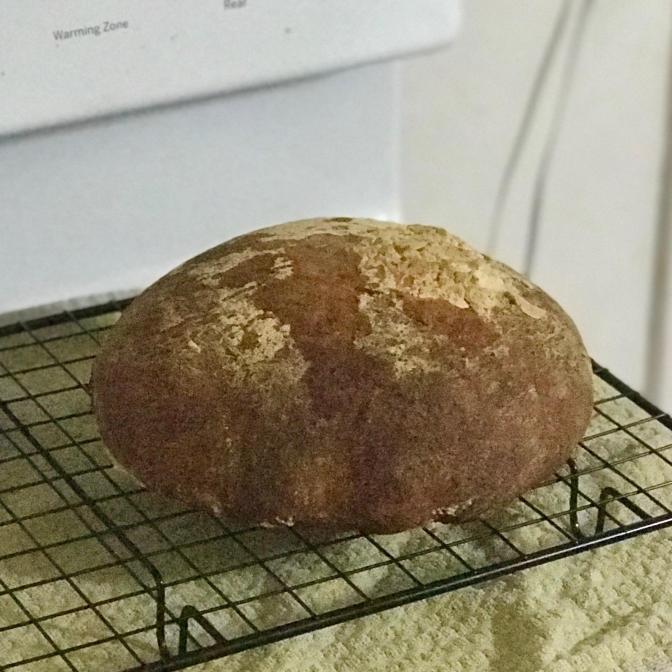
The very first loaf of the bread from the book. A bit overly brown, the slashes weren’t deep enough on top, and it is definitely a good reminder that everything can be seen as a work in progress! If at first you don’t succeed (in doing it perfectly), obsess  endlessly over the next loaf!”

Part of the mise en place that I need to enact in my own life is the ability to roll with the punches with grace. I need to prepare myself for when things don’t go perfect every single time I bake, especially as I do have blind spots in how I often prepare. I need to learn to let some expectations go and to have the capacity to replace my frustration with amusement. That’s a preparation that needs to happen deep in my heart. It is also a preparation that goes beyond my cooking.

When I wake up in the morning, do I prepare my heart for things going wrong in my day? Do I tell God that I want today to be a wonderful day even if things go sideways? Do I seek to find places not only to feel gratitude but to foster gratitude in my life? Do I practice the mise en place to be ready for my life?

IMG_1756.JPG

You see, now that’s a little bit better!

I think Preston Yancey is correct that disciplines like the examen can help us to be prepared for the turmoils of life, but I also believe there is something powerful about the discipline of asking God to give us what we need for a given day or a given hour. Do we prepare ourselves for the kitchen of life? If nothing else comes out of this week’s study, I am grateful I now have that question to ponder.

How about you? Do you have a favorite practice for preparing for a day of life in the real world? Do you have some sort of pattern or practice that helps you to be ready for whatever comes in your path?

Let us Ramble: On Giving “Kine”

Today has been an ordinary day of ministry in New York State. The snow has been falling at a constant rate for a couple of hours, the kids are home from school due to the weather, and the mood around the house has been a bit cranky as both parents have had their plans of getting extraordinary amounts of good things done abandoned and thrown to the wind. Meetings were cancelled, plans postponed, and ideas adjusted. In case you had not realized it yet, life still happens to people who live a life in ministry—there is no magical “Get out of jail free” card handed out to ministers when they agree to serve a church.

Before the snow began to accumulate heavily, I went out to visit a member of my church on comfort care. Their identity is known to God and the most I will say is that the individual has had a long period of being seasoned by life. I spoke with the family, agreed to sit with the individual for a while so they could get some rest, and settled down into a chair with Bible and Kindle.

I read a little scripture, prayed some prayers for the individual, lifted up the family in my prayers, spoke for a few minutes about the memories I shared with the individual, and then sat still. After a few minutes of silence, I found myself drawn to my Kindle and the copy I keep on my Kindle of the Carmina Gadelica.

The Carmina Gadelica is a collection of prayers and poems transcribed by Alexander Carmichael after being collected and recorded in the time that crosses the boundary of the 19th and 20th centuries. The Carmina Gadelica is an intriguing book in the fact that it chronicles a blending of cultures between the Celtic traditions that survived and the Christian traditions that took root in the British isles. I find the Carmina Gadelica to be an interesting collection that is very thought provoking.

I was reading through the second volume when the prayer “The Incense” caught my attention. I have come to believe that context affects the way we see the world around us. Sitting by the bedside of this individual as they breathed beneath closed eyes that saw the world when I had visited the day before and that had been bright before pneumonia came to visit in my absence, I read “The Incense” differently than I had read it before.

The translation of the following poem comes from the “Carmina Gadelica: Volume II” as translated by Alexander Carmichael. The poem is entitled “The Incense”

“In the day of thy health,
thou wilt not give devotion,
thou wilt not give kine,
Nor wilt thou offer incense.

Head of haughtiness,
Heart of greediness,
Mouth unhemmed,
Nor ashamed art thou.

But thy winter wilt come,
And the hardness of thy distress,
And thy head shall be as
The clod in the earth.

Thy strength having failed,
Thine aspect having gone,
And thou a thrall,
On thy two knees.”

I looked up the word “kine” in the dictionary. “Cattle.” Kine is another word for cattle. What does it mean to give cattle in the context of days of health? What do cows have to do with incense or devotion? As a student of religion, my first thought is sacrifice. Sacrifice was once one of the ways how a person expressed regret, fealty, or even respect to God.

This cow is kine of a big deal…

The subject in “The Incense” refuses to give kine. They have no sense of devotion, no desire to sacrifice, and seemingly no reason to burn those herbs and fragrant plans which have been burnt in countless traditions to symbolize a drawing near to the divine. The person is haughty, greedy, unrestrained in their speech, and without shame in their time of strength, health, and well-being.

Yet, the poem goes on. Winter will come. They will come under the power of time, age, and weakness in time. Indeed, the person will one day find their life on earth equivalent to a clod of earth in the ground. The poem is bleak in many ways. The poem paints a picture of a person who does not understand their need in the days of their strength.

Sitting by a bedside, watching someone breathe breaths that might be some of their last in this life, and contemplating this poem was a different contemplation than many contemplations that I have had over the years. Am I wise enough to give kine in the days of my strength? Do I have the wisdom to realize that there will come a day when my choices have been removed from my path? If I do understand, do I let that wisdom affect the way that I live my life?

Can I live with gratitude for the gifts I have been given? Can I let that gratitude guide my choices? Can I choose to deny the parts of myself that want to be haughty, that live in greedy places, or that wish to live unhemmed by matters like compassion, empathy, or grace? Can I live a life marked by devotion and prayer? Can I live a life where kine are not for amassing into a giant herd for my profit, but instead exist in my life as a source of life and blessing for those around me? Can I live out my life in faith in such a way that I will one day find myself on my knees in a place marked by trust in God rather than the frailty that comes from regret?

Sitting with someone who reached an age where they were well seasoned affected the way I read the poem. I am not concerned by the individual I was sitting with while reading. The person I was visiting had a life that seemed marked by faith, hope, and love. The person’s presence was enough to remind me that, unless Jesus comes back in their lifetime, even the most righteous person will age and find themselves at a place on the threshold between one life and the next.

I pray that I have the wisdom in my own journey to find the humility the subject of “The Incense” seemed to miss. I pray that when I reach a place where I find myself on my knees, I will find myself enthralled by faith, hope, and love, but not fear.

Let us Ramble: Diving Inside

It has been no secret that I have been attending the Academy for Spiritual Formation through Upper Room Ministries over the past 9 months. Once a season, I have travelled to Malvern, Pennsylvania to meet with holy conversation partners and teachers about a variety of spiritual traditions and how they can affect the way we approach spirituality. As much as there is an academic side to the studies, I have found the program to be highly practical and personal.

For our upcoming session, we are looking at both the (w)holiness of the relationship between our physical bodies and our spiritual selves as well as Orthodox spirituality. By Orthodox I mean literally Orthodox Church spirituality—there has not been a ton of lectures teaching heretical matters or anything of that nature.

On a side note, the Academy has actually been a great place to have open discussions on spirituality from a great range of Christian (and Jewish!) traditions without a need for those kinds of arguments, which has been really refreshing after a long traditional education where argument and counter-argument sometimes seemed to be at the heart of the formative process. To put it simply, the Academy is more about discipleship than conversion, which is why I adore my time at the Academy and recommend it highly for people who are tired of argument and long for personal formation. Yes, by the way, it is open to clergy and laity—both are welcome and appreciated in my experience.

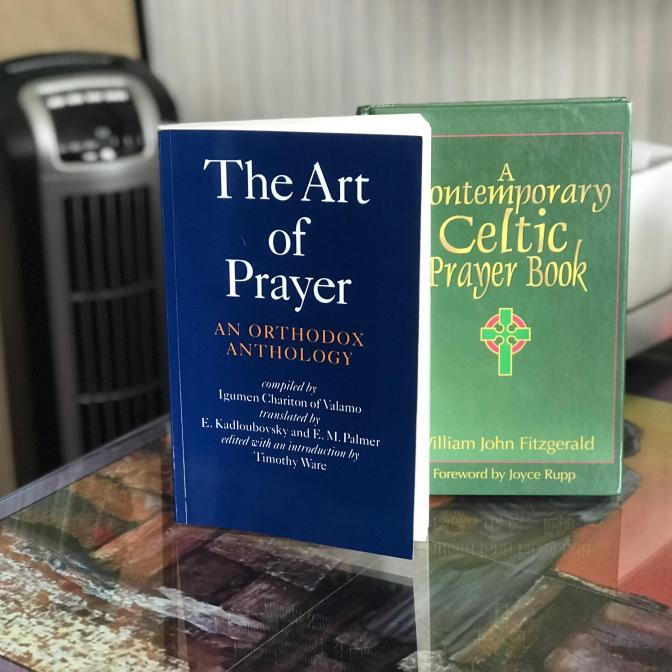
While I will admit that a lot of the Academy preparation for the next session makes me nervous as my back has been acting up and I understand that things like yoga might challenge it during the next session, I find myself coming back again and again to the readings for the Orthodox spirituality section of the Academy. In particular, I am working my way through “The Art of Prayer: An Orthodox Anthology” as compiled by Igumen Chariton of Valamo, edited by Timothy Ware, and translated by E. Kadloubovsky and F. M. Palmer.

My copy of “The Art of Prayer” along with a subtle suggestion of another cool book filled with very cool resources for next month for all of my Irish loving friends.

A quote has stuck out to me in the introduction by Timothy Ware. Ware quotes Theophan the Recluse as saying “The principal things is to stand with the mind in the heart before God, and to go on standing before [God] unceasingly day and night, until the end of life.” Related to the depth of this idea, on the sixty third page of the anthology (which is where the quote Ware was citing in the introduction resides in the anthology) Theophan writes: “Every prayer must come from the heart, and any other prayer is no prayer at all. Prayer-book prayers, your own prayers, and very short prayers, all must issue forth from the heart to God, seen before you.”

In our church we have been in a lot of deep conversations lately. I personally have been in several conversations where we have had deep debate over leadership from the heart and leadership from the head. Does compassion rule the day when making decisions? Does regulation designed to protect us have the final word in conversation? Does the advice of wise denominational officials have weight equal to the advice of our hearts?

The conversations have been deep, thoughtful, and often stressful in nature. To some extent, some of these conversations have had a depth and thoughtfulness I have not seen since some of those deep lunch table debates in seminary which took place between impassioned people with differing knowledge, tradition, and convictions.

I continue to find myself drawn back to these Orthodox Spirituality concepts in these conversations. Ware connects all parts of the self (identified in his worldview as body, soul, and spirit) through the combining connector known as the heart. The heart is intertwined with the body, the soul, and the spirit in a way that is uniting. On the eighteenth page, Ware says:

“The term ‘heart’ is of particular significance in the Orthodox doctrine of man. When people in the west today speak of the heart, they usually mean the emotions and affections. But in the Bible, as in most ascetic texts of the Orthodox Church, the heart has a far wider connotation. It is the primary organ of [a human’s] being, whether physical or spiritual; it is the centre of life, the determining principle of all of our activities and aspirations…it embraces in effect everything that goes to comprise what we call a ‘person.’”

Today’s post is called “diving inside.” I titled the post this way due to the fact that I have been spending much of the past week diving inside of myself in the midst of these deep conversations and asking questions of myself. If I led (or lived) only from the head, could I stand before God with a soul and spirit that has gone ignored? If I led (or lived) only from the heart, could I stand before God with soul and a body that had been ignored? How could a soul even survive before God without that spirit of courage tended by Jesus or that head full of knowledge that has formed me into who I am today? In short, diving into my life’s conversations lately, I wondered if in any circumstance or path I chose, could I possibly stand before God in my heart without my conviction shattering me into a thousand little pieces?

I do not find it coincidental that the Jesus prayer rests deeply within Orthodox spirituality. “Lord Jesus Christ, Son of God, have mercy on me.” Pondering these matters, I have regularly found myself praying this prayer over the past few weeks, but not solely this prayer.

For me, this prayer is held in contrast with the Lord’s prayer. I am making an audacious or possibly even a (forgive me, but this is literally the right word for the situation) bodacious request when I ask God to lead me besides still waters (Psalm 23 runs through my mind when I see God’s reign and God’s will being done in heaven—I am aware it is technically not in the prayer), when I ask God’s will to be done on earth despite the fact that I need forgiveness for my trespasses, or even when I ask God for daily bread. There’s a sense of an almost arrogant familiarity and assurance in the Lord’s prayer that stands at odds with the pure humility found in the Jesus prayer. The two prayers speak from two very different places.

As I have been diving into these deep conversations and into my own spirit, soul, mind, and especially my heart, I found myself grateful for both prayers. There have been times during these conversations when I have felt the only thing I could reasonably ask of God for myself was the mercy that comes from a place of pure and utter prostration before God’s throne. There have also been times when I have had the assurance to know that the daily bread I needed was the ability to extend compassion from a place of confidence, eyes wise enough to look past fear towards the brightest possible outcome while others struggled with fear and anxiety, and even at time to find hope in Christ’s provision even as the conversation needed insight far beyond the wisdom held by mere mortals like me.

I am reminded of the words our ordination class responded with at Annual Conference when asked “Wesley’s Historic Questions” (which are asked of every United Methodist minister). Every time we were asked a “Will you…” question, we responded “With God’s help, I will.”

In many cases, daily life is like answering those questions. Do I know the answer to every difficult question I face in ministry? Heavens, no. Do I make mistakes? Most assuredly I have made mistakes and will likely continue to make mistakes in the future. Do I have faith in Jesus Christ? Yes. Will I continue to seek after Christ? With God’s help, I will. Will I do my best to live my life from a place of peace where all parts of me can coexist? With God’s help, I will. With all this in mind, will I live my life in such a way that I can stand before God in my heart in prayer? With God’s help, I will.

In the end, I believe that Theophan the Recluse was correct. Every prayer must come from the heart. Since that is true, I must not only guard my heart. I must tend my heart like a garden, After all, in Matthew 15:10-20, the gospels record that Jesus taught that it is not what we eat that defiles us, but what comes comes out of the heart. If I am to stand before God, I must tend my heart zealously. To quote the New International Version of Proverbs 4:23: “Above all else, guard your heart, for everything you do flows from it.” If the Orthodox spirituality of Ware is correct, that guarding and tending of my heart means caring for what exists within me, in my body, in my spirit, and in my soul. With God’s help, I will.

Let us Ramble: Imperfect Hourglass

On my desk there are two hourglasses. One holds about enough sand to measure five minutes. The other holds a good ten minutes of sand. I collected them so that I could have a way to manage my time during my times of prayer. If we have two ears and one mouth, the purpose is clear. I might speak for five minutes and then listen for God in silence for ten minutes. In general, it works well both as a focus for my attention when I wander in silence and as an attention for my focus when I need to get to the point in what I am trying to communicate to God.

My two hourglasses!

I know that for some of you, that level of intentional focus might seem a little bit excessive, but for a person whose brain wanders easily… The tools help. The name of my blog (Distractedpastor.blog) was not a mistake.

Still, there are days when my focus is not there. There are times when I want to say more or listen more, but there’s a knock at the door or a buzz on my phone. There are times when I just want to give more into those moments. There are times I want to slow the hourglass down and give more, but do not have the opportunity.

I was reminded of this reality as I was perusing Bernard of Clairvaux’s “On Loving God” this morning. On the nineteenth page of the 1973 translation released by Cistercian Publishing, Bernard writes:

“My God, my help. I shall love you as much as I am able for your gift. My love is less than is your due, yet not less than I am able, for even if I cannot love you as much as I should, still I cannot love you more than I can. I shall only be able to love you more when you give me more, although you can never find my love worthy of you. For, ‘Your eyes have seen my imperfections, and all shall be written down in your book,’ all who do what they can, even if they cannot do all they should.”

I love the phrasing although I’m still parsing my way through the details of the words. “…for even if I cannot love you as much as I should, still I cannot love you more than I can…” How are we able to love God? We love God because God gives us the ability. We shall love more when God gives us more.

On some days, I sit to listen in prayer just as the world turns upside down. In those moments, I am usually able to find the earth before I go flying off into space. The ability to find purchase when everything goes wild can be difficult. In those moments, my fidelity to God’s love and purpose is usually as a result of the blessing God gives me.

On other days, everything is absolutely peaceful and I have the time to dive more deeply into God’s love and grace. In those moments I find myself able to bring more of myself into my relationship with God. In some moments, it even seems like the hourglass slows.

In between these moments, I rest in the knowledge that I do my best to do what I am able to do, even if I am not capable of doing everything that I should. My flaws are known to God, my brokenness apparent, and I bring what I can bring to the table.

I am reminded of one of my favorite pieces of art. The one of a kind portrait is hung in a cheap poster frame on my office wall. It is really poorly mounted, but hangs in a place of prominence. It is the very first work of art my oldest child brought home from school.

Now, when this painting was painted, was it perfect? No. Did the then 3 year old Grace understand how many nights I spent caring for her as an infant? Did she know how I felt when she spit up on my shoulder and the picture capturing that splotch of milk is what made it in the newspaper? Of course not, but she loved me as she was able. Warts and all, I have seen my daughter. I love her, so I love this painting.

The apple tree from my elder daughter’s first weeks of school

For me, this is what Bernard is talking about in his passage. I may never be able to love God as perfectly as God deserves. I may never be able to do something worthy of God’s affection. I can do what I am able to do, despite the moments that I spit up on God’s shoulder. Invariably, we all do as we can do in this world. I simply pray God will see the same affection in my love as I see in my daughter’s love.

Let us Ramble: An Arresting Quote on Charity

Recently, a college classmate of mine from years ago asked a question on Facebook. If I could write a paper on any female spiritual figure in history, which person would I choose? I love open-ended questions and spent a couple of days perusing the answers until late Thursday morning. I had been working on collecting reports for our Annual Meeting and had just completed a report for a member who is in need of a bit of a hiatus. In other words, I was out of coffee, had been up worrying about my infant with a fever most of the night, and was a bit bleary eyed. I took a few moments to look at my bookshelf for something that I could peruse for a few minutes while my wits came back around to meet me and the next item on my agenda.

My eyes fell on one of my favorite books from a few years back. I came across “The Mirror of Simple Souls” by Marguerite Porete. My edition is from “The Classics of Western Spirituality” of Paulist Press in 1993 and was translated by Ellen L. Babinsky with a preface by Robert E. Lerner. I immediately thought of the post, remembered that nobody seemed to have mentioned this wonderful author, and jumped to share with my old college friend.

IMG_1344.JPG

My copy of Marguerite Porete’s “The Mirror of Simple Souls.” I recommend it highly!

I picked up my copy, began to peruse, and then began to laugh. Did you ever wonder what would get a woman killed by the inquisition in France in 1310? Well, writing in vernacular French didn’t help. What made me laugh was the translation of a part of the trial where the inquisitor is shocked that not only did Marguerite not burn her copy of her book after a former bishop ruled it heretical, she kept thinking it was a good book, and dared to send it to another bishop as well as other simple folks “as if it were good!”

I do love a woman who believes in herself and her God! She spoke the language of the people, cared about the people, and kept on believing in God’s call on her life despite the challenges! Authority should be respected, but let’s be clear—Marguerite Porete saw authority abused and relied on her faith in the highest authority of all! Here was a woman who makes me smile!

I began to spend a few minutes browsing over the pages while working up the courage to go across the way to heat up a cup of coffee. I was reading along when something caught my eye worthy of a blog post and inspirational enough to get me to hold off on grabbing that cup of joe. Here’s what is translated from the fourth chapter of Marguerite Porete’s Mirror of Simple Souls:

“Charity is such a wise merchant that she earns profits everywhere where others lose, and she escapes the bonds that bind others and thus has great multiplicity of what pleases Love.”

I love this concept. As I pen this blog post for Monday morning, I am drawn to think about charity. Charity has many roots and I do not pretend to be an etymologist, but I noted with enthusiasm that the Online Etymology Dictionary stated that around the time of Marguerite Porete’s life, charity became connected with the concept of the affections we ought to feel for other people. In my own imaginary world, there is a distinct correlation between these facts!

I think about the ways we ought to feel for other people and how that inspires us a lot on Mondays. Recently, my primary visitation day for going to visit people in their homes or in care-facilities is on Mondays. As this is posted online (unless something goes askew) I am likely riding in my car down to visit one of our saints in the Triple Cities. Some of these visits are easy to accomplish as the saints in question are lively, ask deep questions, and appreciate a good visit. Some of these visits are heartbreaking at times when the saints are struggling.

When we consider how we ought to feel for others and then when we let those feelings affect who we are as people, we are entering into the purest form of charity. Charity is not meant as something begrudgingly given, something scowlingly given, or something unfortunate that has to happen in order for the charitable person to to be one of the good people. Charity is our opportunity to live into the same gracious love as our Lord and Savior first showed us. Charity is our opportunity to become the hands and feet of God and to enter into the dance of God’s love. Charity is an amazing thing!

Marguerite’s concept arrested my eyes because of the simple beauty of the idea. Charity finds profits where others lose. Charity finds freedom where others find fettering chains. Charity abounds in what pleases Love. These ideas are so simple and beautiful.

How can charity find profit where others lose? Perhaps it is because charity, when birthed by love, sees things through different eyes. The world says that you will never get rich by taking weekends off from work and volunteering to play basketball at the YMCA with kids. You will never get rich volunteering with the Boys and Girls Club or with your church. You also cannot buy the love those kids may come to have for you as a person. You cannot buy their affection, their love, their admiration, their imitation, or any of the other blessings that come being involved in a ministry of charity. You will never get rich with money—you may become rich with love.

How can charity find profit where others lose? Sometimes it is because love follows love. In the spring of 2013 I witnessed the worst community fire of my career in Boonville, NY. The church I was serving became a hub to help provide food, shelter, space for the American Red Cross, and information for the people who were displaced. Do you know what happened when we tried to buy lunch for the people who were displaced? We were matched by others and nobody went hungry. Do you know what happened when we started to collect clothes? The fellowship hall was filled with blessings. Every time we tried to give what we could, others joined in with us in charity. Perhaps you may find no personal profit in engaging in charity, but sometimes the love of God seen in you inspires others to bless those around us.

How does any of this promote freedom? I believe charity breaks the bonds that hold us in place. Often we get trapped within our own prisons by tradition, by circumstances, by our own limitations, and by our own imagination. There can be freedom when charity invites us to feel for others like we ought to feel, when charity motivates us to move past feeling to action, and when charity finally overwhelms our prisons.

The week of the fire in Boonville wasn’t just a holy week. The fire took place during THE Holy Week. We had to cancel our extra services on Thursday and Friday to care for people in need. We worshipped across church lines with Presbyterians and Baptists that week on Maundy Thursday and Good Friday respectively.

They welcomed us as guests and opened their hearts and church homes to us. What kept us from worshipping together before? Pride? Maybe. Tradition? Probably. Silliness? Definitely. I never enjoyed worship services so much as when we came into those churches, sat exhaustedly down, and we were welcomed and loved despite our tiredness and our Methodist personhoods. We United Methodists made space for others and through charity we found the freedom to look beyond our doors. We had the freedom to find our family and spend time with them. The family of Christ worshipped in a holy way that week.

When we engage in charity, we find ourselves in places where we can build up an abundance of love. I will likely be thinking of Marguerite’s call to charity was I walk through the doors of Bridgewater Rehabilitation or one of the United Methodist Homes this morning. I pray that you would find places to fall in love with God, to love your neighbor, and to connect with who you ought to be—someone filled with holy charity, freed by grace, and abounding in love.

Let Us Ramble: Random Chinese Food

Last night I had a meeting at the District Office in Endicott. It had been a long day between having a snow day for the kids and needing to get ready for Sunday. My wife had a meeting out of town and swept in the house twenty minutes before I needed to leave with a cute and cuddly baby that I had not seen all day.

We tried to talk as the family ate the huevos rancheros that I had cooked for their “breakfast for dinner.” The elder kids also wanted to talk with their mom. My wife and I did not have a chance to connect before I needed to leave. I sat in my car in Endicott and tried to think of something I could do to connect with my wife. I realized how hungry I was, looked at what I had eaten for dinner, and realized I probably needed more than 150 calories. It turns out one tiny tortilla with one egg is not exactly filling.

I brought home a container of mystery Chinese food. I literally walked in the restaurant, looked at the chef’s specialities, found something I had never tried and did not understand, and brought it home. It turned out to be a shrimp and vegetable dish with a nice light sauce. It was rather tasty.

Some days it takes work to connect with your spouse. As we ate Chinese, our baby was fussing and crying at us both. I took chopsticks full of rice in between moments of putting her pacifier back in place. The baby did not really settle for hours. It was not an easy evening after my meeting, but my wife and I found moments together over a new experience and a new food.

Marriage takes work. Even when everything seems to be going perfectly, marriage takes work. I am glad that I took time after a very long day to connect with my spouse.

Let us Ramble: Solitude, Faith, and Community

A noise tickles my ears as a buzz begins at 5:59 AM. My phone buzzes and begins to flash. I wake up early to check if the paths need to be cleared of snow before the teachers and staff of the church community arrive. After a cold time clearing up the snow with my snowblower and a headlamp, a hot shower to warm up chilled bones, and a hot mug of coffee, I settle at the table with my notebook. Soon, as the eggs bake for breakfast sandwiches for my wife and children, I will find myself digging through the Revised Common Lectionary.

This day I am flicking through the story of Saul being chastised by Samuel for caring more about what his people want than what the Lord required. I write a poem about Saul’s predicament while thinking and praying about what God’s message for Saul says to me as a Christian, as a husband, as a father, and as a pastor. The words are deep this morning as my heart struggles to make sense of the story of God’s chosen one being rejected for his actions. I weigh the passage carefully with others that have been dwelling in my heart.

I find these moments of devotion while the room fills with the smells of cooking breakfast to be sacred. They are not always perfectly isolated. Sometimes I finish my poem while my kids are making cocoa across the room. Occasionally a crying baby will interrupt this time with her needs. It is a time that actually gets interrupted regularly towards the end, but it is also one of the most sacred moments of the day. Even with interruptions, the ground I walk upon in those moments is holy.

In these moments of personal devotion, I sort through my dreams and prayers from the recently passed night. In these moments of personal devotion, I find inspiration that often affects the way I live out my faith life. In these moments of personal devotion, I often find the fuel that feeds quiet prayers for the community which follow. Have I read about love? Standing in the window, cleaning up dishes, I pray with love for the people in my church and community who are in need. Have I read about sacrificing for others wellbeing? I find inspiration to pray for the bus drivers who pass by the window. The personal devotions of my morning feed my time in prayer and help me to do a better job at being a part of a vibrant church community.

Henri Nouwen, in his book “Discernment” wrote (on the tenth page of his book):

“Communion with God alone in prayer leads inevitably to community with God’s people, and then to ministry in the world. But it is good to begin this spiritual movement in solitude…When we are alone with God, the Spirit prays in us. The challenge is to develop a simple discipline of spiritual practice to embrace some empty time and empty space every day.”

For myself, the moments in my day that are emptiest and have space for the Holy Spirit are between checking the paths to see if they are clear and when my children get out of bed. The time that I spend alone with God in those quiet places strengthens my relationship with God. That strength then leads towards others.

Invariably, my time with God tends to lead towards other people. Sometimes my prayers are led towards my family, but more often than not, I find myself drawn to pray for situations around me in the community and in the church. I want to be clear about this fact. My personal devotions do more than inform my prayer. My personal devotions empower my ability to pray. If the spiritual life of a Christian is a river, my time in personal devotion is one of the springs where that spiritual life finds the living water.

When the Spirit prays in us, our lives change. If you look back at a number of the great figures of Christian history, a lot of them speak about powerful moments of connection with God. Some of the descriptions of these moments can induce a blush! These moments of intimacy with God generally did not come out of a place of constant action. If you look, most of these moments come in lives marked by time spent with God. Like any relationship, a relationship with God that is healthy requires time spent together.

So, how do you begin to discern the right time for spending time with God? The first thing I suggest to people who ask me in person is that they chart out their day in blocks. What regular patterns emerge in your daily life? I found myself needing to wake up early to take care of sidewalks for the winter. As such, for this literal season, a period between that daily chore and when the rest of the day began emerged. For some people, there is a lull in the late morning, especially if you are retired or work a second or third shift position. Each person is different and taking a look at your regular patterns can help you notice places that are empty.

Second, if a person cannot find those moments of free time I suggest that there be moments in your day that might be better used doing something else. Back when I tried to engage in evening devotions despite my tiredness, I used to spend my mornings before the girls woke up listening to the news. The news often made me anxious, led to me feeling inordinately stressed at the beginning of my day, and often served more as empty noise than something of substance. I was better served by spending that time with God than spending it listening to the news. I still check the news later in the day, but I first ground my heart and my soul in God before facing what the world will throw at me.

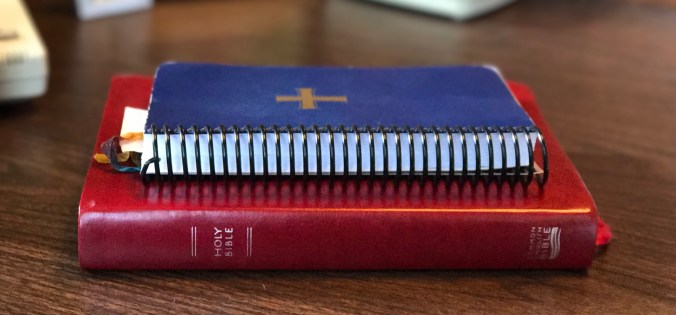
Third, I often suggest that you begin with a simple devotion. There are wonderful resources available through many fine publishers. A trip to a local bookstore will often provide a lot of helpful options. Our church provides copies of the Upper Room Daily Devotional and we would work with anyone who wanted to explore one of the other options available. There are also a number of reading plans available through places like Bible Gateway that can help you to explore your Bible over a set number of days. Even the United Methodist Hymnal has a pattern for daily worship and prayer in the rear of the hymnal. There are many options available.

Fourth, try new things on occasion. If you, like me, enjoy the Guide to Prayer for Ministers and Other Servants, consider using the Book of Common Prayer for a season. If you enjoy using Our Daily Bread, ponder trying out the Upper Room for a time. If you are going through a dry season, it might not help if that season is supposed to be teaching you something, but if your situation is simply fatigue—a change of pace might help.

What suggestions do you have for starting a time of personal devotions? Have any practices been particularly helpful?

Let Us Ramble: Hobbit Holes and Worship

So, I decided that I would spend a day doing a light-hearted blog post. The blog has been pretty dense since I returned from paternity leave, which reflects some challenges behind the scenes of ministry. In the midst of everything, I found myself needing to read to my infant the other day. She would not calm down without hearing my voice while rocking back and forth. I decided to read to her, looked through my Kindle purchases, and began to read her “The Hobbit” by J.R.R. Tolkien.

In the very first chapter, Bilbo encounters Gandalf. Gandalf is seeking aid in an adventure. When Gandalf expresses difficulty with finding someone to join him, Bilbo replies: “We are plain quiet folk and have no use for adventures. Nasty disturbing uncomfortable things! Make you late for dinner! I can’t think what anybody sees in them!”

I started to laugh when I read this passage. I found humor in the fact that Bilbo will definitely go on an adventure, but also because I am aware that the hobbit acts a lot like me! Over the years I have truly enjoyed several versions of “Bag End.” In the apartment that we first shared when I was in seminary, I took over the walk-in closet in our living room and turned it into my office. I spent many hours under a single incandescent light bulb with books of theology, an aging computer, and a cup of coffee. It was definitely my own little hole in the ground. To be honest, it was absolute bliss…

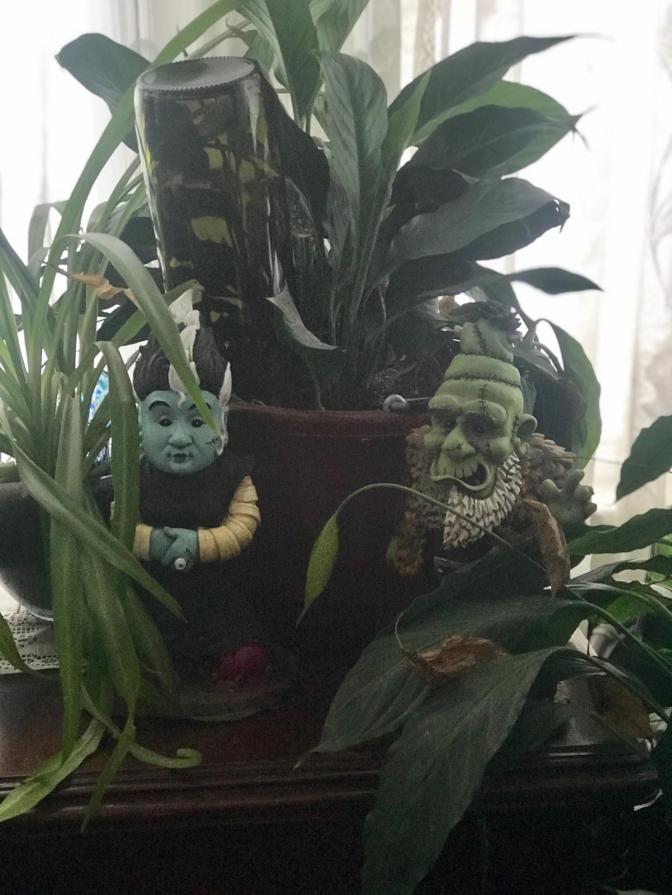
Since we left that apartment, I have not really had a hole to hide in of quite the same caliber, but I have enjoyed several offices over the year. The closest I have come is my current home office which is filled with plants, garden gnomes, and within sight of several rather tookish children that enjoy their own adventures.

Two of my favorite garden gnomes sit right next to the computer desk in our “library.”

I can understand the enjoyment of a space. There is something safe and secure about being in a familiar place with reminders of pleasant days and happy nights. If you invest a space with a lot of happy cups of coffee, hours of research, or even just time spent happily interacting with friends, a space can become pretty comfortable. In fact, it can be hard to walk away from such spaces sometimes…

There is a challenge that comes with living in a land where adventure can come from simply stepping outside of one’s door! Winter is here in the United States. With winter in this particular location comes things like snow, ice, and slush. This area is by no means the snowiest place that I have ever lived. To be entirely honest, it is actually the least snowy location where I have ever resided, but less snow is not the same as no snow.

Some Sundays, freezing temperatures strike and nobody is at the church. Some nights we would have a committee meeting but there’s a forecast that keeps us from having anywhere near quorum.It can be really frustrating to deal with winter adventures, and sometimes we seem to embody the spirit of Bilbo Baggins. “Go to church? In this weather? We are plain quiet folk and have no use for adventures. Nasty disturbing uncomfortable things! Make you late for dinner! I can’t think what anybody sees in them!”

So, here is some advice for people in church leadership during winter:

  1. Love other people. I have been quoting Hebrews 13:1 a lot lately. In that verse we are reminded to “let mutual love continue.” Sometimes people will let us down and not make it to a meeting. Love them. Love them. When you are done, love them some more. Yes, they might take advantage of your love and continue to engage in the behavior that bothers you, but extend love first. All mutual love comes from someplace and we must be willing to love first. I am reminded of the passage I read the other day in “Ways of Imperfection” by Simon Tugwell. In that passage, on page 18, Tugwell points out a story where abba Poemen was in a conversation where several monks were discussing how to deal with a monk who kept falling asleep in church. After several rather strict ideas are suggested, abba Poemen is reported by Tugwell as saying: “If I see that my brother has gone to sleep, I cradle his head in my lap.” If ancient monastic Egyptians can understand the idea of compassionate loving in such circumstances, certainly we can as well.
  2. Consider the circumstances. If you have a meeting with a saint who cannot drive after dark or on roads that might be challenging after peak maintenance hours, do not plan that meeting when things might be iffy. Roads (in our area) are often sketchy after dark and first thing in the morning. A little prior planning never hurt an administrator or worship planner. Late night services might fit the mood of an occasion like a “New Year’s Eve Prayer Vigil,” but be aware your worship time and the weather that surrounds it might affect some people in ways beyond their control.
  3. Consider situational problems. If someone no longer comes because they slipped in your parking lot, consider ways you can make your parking lot safer. Alternatively, ask someone (or go yourself if you are able) to walk with them from their car into the church meeting. Again, a little prior planning is an integral part to good leadership.
  4. Let things go. Nobody is helped when you dwell on things you cannot control. The weather turned sideways and your one absolutely perfect sermon of the year was heard by five people? Well, that happens sometimes. It is better to let go of your frustrations than to let them take root in your soul. You are a walking temple of God. Do not track dirt into your heart.

Those are four pieces of advice for leaders of churches during the slippery months. Do you have any other suggestions? What has worked for you?

Let Us Ramble: Nineveh and Change

I would like to begin this entry by pointing out that I sometimes struggle with the work of the Council of Bishops. I find that they often equivocate on challenging issues and I long for firm statements marked by honest reflection on scripture, tradition, reason, and experience. I long for deep statements based on the discernment that comes from the Holy Spirit. I sometimes feel disappointed, but that’s what happens when imperfect people gather together. Disappointment happens and that disappointment is inevitable. I still respect that body of leaders and consider their words carefully.

So, when I see statements like the one made last week by the Council of Bishops, I find myself doing more than simply paying close attention. I practically cheered when I read the Council of Bishops refer to racist behavior as racist, harmful behavior as being harmful, and urging on United Methodists to call for an apology from President Trump. These unequivocating and straightforward statements were startling coming from the voice of the bishops of the United Methodist Church. I would expect such words from an individual bishop, the General Board of Church and Society, or even individual conferences, clergy, or churches. As it would be almost impossible for the General Conference to gather globally to release a real-time call for repentance, this is probably as close as a statement can come to being a statement on behalf of the church. In the very least, such unity among so many of the leaders of the denomination is a powerful statement. My wife summed it up when she looked it up last night after we discussed how the statement had affected me. She simply said: “Wow!”

So, today I am honoring their request to call for an apology. To be honest though, I do not believe an apology will be enough. I want to call for repentance, but not just from Donald Trump. I believe we have an illness in our society that has allowed us to bring this kind of behavior to the highest levels of leadership. I believe we need to take a long, hard, and somber look at ourselves.

This past weekend the Revised Common Lectionary scripture included John 1:46. I did not preach out of the lectionary this past Sunday, but I know many of my colleagues did preach out of that prophetic moment in scripture. Jesus is beginning his ministry and calls Philip to follow. Philip comes across several of his friends and invites them on the journey with him. One of them, Nathanael, asks Philip if anything good could possibly come out of Nazareth…

Many of my colleagues point out that Nazareth was one of “those places.” Recent national news has focused conversation on several of “those places” in our own world. Could anything good come out of Haiti? Could anything good come out the heart of Africa? Could anything good come from one of “those places?” How are those places tied to the people who live in them? What does it say about the descendants of those places when we speak it such hateful terms?

As many of “those places” are filled with people created in the image of God, many of my colleagues had a field day, but I avoided the temptation to lash out. Today is a national holiday celebrating Rev. Dr. Martin Luther King, Jr., a man whose ancestry arose out of one of “those places.” I wanted to save my words for a more fitting day like today.

So today, I wanted to begin with a story. The story is an old story and was once passed from family to family and from community to community until it was written down.

Once upon a time, there was a kingdom in a far off land. The people of this kingdom were wicked, cruel, and hostile. The king was powerful, mighty, and by no means innocent. People affected by the people of this kingdom cried out to God on account of the kingdom and the great city within it. God heard the cries of the injured, saw the wickedness of the land, and sent a prophet to tell them that their end was coming. For three days the prophet walked across the city and stated their fate.

People burst into a panic. They stripped off their fine garments and covered themselves in sackcloth. They stopped eating—mighty and meek, all of the people joined in mourning. When the king of the kingdom heard the news, he joined in their grief, he sat down in ashes in garments made of sackcloth. He decreed with his nobles that all would join in the great mourning. Humans and animals together joined in the mourning.

God saw their repentance and changed their fate. Their humility and repentance saved them from their own destruction. The prophet was not exactly happy about the situation, but repentance came to that city.

Those of you who enjoy your Hebrew Scriptures probably realize that I was retelling the story found in the book of Jonah about the city of Nineveh. In my career I have preached several times about the story of Jonah being swallowed up and many more times about how Jonah needed to learn about compassion, but I am not certain that I have ever preached on the subject of what happens in Nineveh itself. Nineveh, the great city and all of her people, has sadly become a bit of a means for other lessons in most of my sermons, messages, and reflections.

Yet, I find myself drawn to Nineveh as I consider recent events. In the translation that goes by the name the New Revised Standard Version, Hebrews 13:1-3 says:

“Let mutual love continue. Do not neglect to show hospitality to strangers, for by doing that some have entertained angels without knowing it. Remember those who are in prison, as though you were in prison with them; those who are being tortured, as though you yourselves were being tortured.”

The author of Hebrews calls on the church to do many things in this chapter of scripture. We are called to things like mutual love, empathy, compassion, and even to simply remember what others are going through in different circumstances. We are warned not to forget our duty toward hospitality, for who knows when we might seek to entertain strangers and instead find ourselves in the company of angels?

As a Christian, when I hear words like those shared by the President of the United States last week, I find myself appalled. When the door is slammed shut in the face of people and places where there are serious problems, Is slamming the door in the face of those facing modern struggles really all that different than the people of the early church forgetting those struggling in prison or facing torture? If these conversations really do go hand in hand with conversations around harder standards for asylum seekers, then we need to realize that the words of Hebrews might apply directly to us without much interpretation.

it is my great fear that we are slamming the door in the face of not only angels, but in the face of people created in the image of God. We are slamming the door in the face of those who call out for justice to a God who listens. When we willingly forget our duty to Christ by neglecting love, compassion, empathy, and even memory, we are doing something incredibly wicked. Do we actually believe that we are so unique as a nation that we are above reproach? Where does that kind of blindness come from as a people? Do we forget that God is ruler above nations and not for nations?

Surprisingly enough, when I googled the phrase “sackcloth suit,” there were entries and sponsored ads. Unsurprisingly, the Brooks Brothers suit Google tried to sell me was not made up of sackcloth. In honesty, looking back into Catholic tradition, there has been a history of “hair shirts” made of irritating haircloth meant to inspire discomfort and thus inspire humility, which is quite fascinating. Looking at the history of the practice, the rarity of practice in modern times, and it seems unlikely that I could find any hairshirts at the local mall.

Of course, that’s probably a moot point. I have difficulty seeing sackcloth on many of the folks that I see when I walk past an interview on a television in a store, in restaurant, or on my Facebook feed. I will say that I did go out of my way to pick up a swatch of burlap while out after church yesterday and attempted to make a burlap necklace. I can tell you two things:

  • First, I’m not great at arts and crafts.
  • Second, wearing it for a couple of hours was a real irritating experience. My neck was itchy, irritated, and it made my shirt look terrible. I was considering wearing it for Lent, but it was so difficult to wear without being noticeable that I am going to have to consider alternatives if I am seeking to practice my piety before God and not before other people.

My terrible necklace, wound around my wrist, so you don’t need to see the hints of gray beginning to show up in my goatee…

The attempt did answer a really important question for me though. Is it comfortable to go out of one’s way to repent? Oh, heavens no. The King of Nineveh and the people of that place must have been really uncomfortable and very motivated. They went out of their way to not only refrain from food and drink, but went further to introduce a level of discomfort into their life that must have been incredibly frustrating.

The Council of Bishops is correct. President Trump’s words were racist, are offensive to all people of God who believe that the people of those nations are made in the image of God, and they caused a significant amount of harm both internationally and domestically. President Trump needs to repent. We need to repent also.

I say these things as someone who has needed to do a significant amount of repenting in his own life. I grew up on Grand Island, NY. I grew up believing the Seneca Nation was trying to take away our hometown and I had a lot of very strong opinions about the Seneca. I grew up among a people who looked at the native population of what was my hometown with a less than Christian light. Let’s be honest, at times I was downright racist. I thought of reservations in ways like our President speaks about other sovereign nations like those named last week.

I was wrong. The things I believed were wrong. The way I acted in my heart towards my human sisters and brothers in the Seneca nation was wrong.

My change in attitude started thanks to a band called Five Iron Frenzy singing about social justice and introducing me to a book. I read“Bury my Heart at Wounded Knee” by Dee Brown as a teenager and it confused me greatly. The stories I read were so unlike the stories people had shared throughout my life.

My convictions continued to change when I was invited to go on a Volunteer in Mission trip to Four-Corners Native American Ministries. I was broken down further in my heart while helping fix windows in the homes of widows, standing underneath the Window Rock in the heart of the country of the Wind Talkers, looking over American flags flying over the graves of brave patriots and warriors, and walking through the Navajo Nation Museum in Window Rock, AZ. My best friend Michael (rest in peace, my brother) stood with me under a blue sky as I began to confess my sin and my struggle underneath the eye of Window Rock. It was Michael who told me that I had a lifetime of amends to make and that I would have to keep working at things. I have sought to challenge and grow in my understanding since that day and since that conversation.

I was so ignorant and so foolish to accept as normal what I had swallowed hook, line, and sinker as a kid. I never had an issue with hanging around North Buffalo near my grandmother’s house, even as the neighborhood changed from a primarily European neighborhood to a more diverse neighborhood. I was happy to spend time within walking distance of a comic book store and a “Record Theatre.” (Thanks for the memories Mr. Silver…) I didn’t care who lived between Grandma’s house and my comics and my music. To this day, I still feel more nervous on a reservation than I do in a city, but I know this one thing to be true: If I believe that God’s image is in all people, then all people are worth treating as children of God, whether they live in a city, on a country road, in a Haitian village, on the coast of Africa, or anywhere in God’s beautiful creation.

I do not aim criticisms at the President of the United States lightly or from a place of superiority. I have been complicit in my own biases over the years. Still, truth must be held as truth. Evil is evil. Racism is racism. There is a severe need for not only an apology, but for true repentance when we engage in the acts of accepting and advocating for evil.

The old phrase of Rev. Charles F. Aked stands true as much today as it was in the fight against the abuses of alcohol: “It has been said that for evil men to accomplish their purpose it is only necessary that good men should do nothing.” As a people, we cannot in good conscience stand by in times like these without calling for repentance. What’s more, we cannot in good conscience stand by without examining our own behavior and seeing if we are also in need of repentance.

May God help us all in these challenging times. May we move towards repentance without hypocrisy.

Let us Ramble: Humility and Community

This year in my annual report to the church there’s a strong statement. I wrote in November and revised earlier this month the idea that “ We need to remember that we are a community unified and united in purpose.” I did not make this statement lightly as unity within the body of Christ is one of the most challenging and most important characteristics of a healthy church.

You will notice I did not write the phrase “uniformity” as the goal is one of connection and not utter conformity. Unity and unification around a concept is important for any community, but especially a religious community. To borrow from Henri Nouwen (on the ninth page in his book “Discernment”) we should be united around the idea of our “one true desire—to know God’s heart and do God’s will in all things.”

There is nothing as antithetical to unification around this desire than arrogance. Arrogance leads us to believe it is okay to ignore God’s call to simple concepts like talking to people instead of about people. Arrogance leads us to believe that we are better than each other or better than those called to particular ministries. Arrogance leads us to engage in a lot of the behaviors that hurt and harm churches.

I think Bernard of Clairvaux puts it well. The saint from the 1100s has been translated (by the Cisterian Order in their 1973 critical translation) as saying “If ignorance makes beasts of us, arrogance make us like demons. It is pride, the greatest of sins, to use gifts as if they were one’s by natural right and while receiving benefits to usurp the benefactor’s glory.”

Now, what’s interesting about this quote is that Bernard prefaces it by pointing out that everyone should know two facts: what they are and that they are not who they are by their own power. Bernard states clearly that everyone needs to know that they are who they are by the gift of God and to accept their role with humility.

Leaders in the church (both lay and clergy) are called by God to places of leadership. They are given gifts and graces to fulfill their role. It is great arrogance to both take these gifts for granted and to ignore the responsibilities that come with them. Bernard warns strongly against dulling one’s blessing by forgetting one’s call and forgetting the purpose for which one has been blessed. Bernard, holding a very strong opinion, writes (pardon the 1970s language of translation)

“When a man, promoted to a high dignity, does not appreciate the favor he received, because of his ignorance he is rightly compared to the animals with whom he shares his present state of corruption and mortality. It also happens when a man, not appreciating the gift of reason, starts mingling with the herds of dumb beasts to the extent that, ignoring his own interior glory, he models his conduct on the object of his sense. Led on by curiosity, he becomes like any other animal since he does not see he has receive more than they.”

Leaders are called to live up to the blessings they have received. One of the greatest challenges that faces me as a United Methodist Elder is the echoes of the words spoken by Bishop Marcus Matthews over me at my ordination. I was told to “Take thou authority…” The bestowed authority is an authority that comes with challenges that are well addressed by this article from Ministry Matters. Nonetheless, it is a promotion that comes from a place of high dignity within my tradition.

On my desk there’s a list of people with arrows. I was ordained by Bishop Marcus Matthews, who was ordained by Bishop James Kenneth Mathews, who was ordained by Bishop Benton Thoburn Badly, who was ordained by Bishop James Mills Thorburn, who was ordained by Bishop Edward Raymond Ames, who was ordained by Bishop Robert Richford Roberts, who was ordained by Bishop Francis Asbury, who was ordained by Bishop Thomas Coke, who was ordained by Archbishop Potter, who was the Archbishop of Canterbury or the Church of England, which was born out of direct apostolic succession from the beginning of the church.

There’s a high calling to the authority that was passed to me by Bishop Matthews. To ignore the weight and the responsibility of that calling would be a great sin. My authority as an Elder in apostolic succession comes with a great responsibility to not only maintain the standards of my office but to lead with integrity the people of God towards our one great and true desire.

Bernard’s words are not simply for leaders though. Believers in the church who are called to follow (both lay and clergy—especially if clergy serve in an episcopally based system or in a system where there is discernment of the body held over the discernment of the clergy) are called to know who they are, where they are, what is expected of them, and to accept the gifts granted to them by God with humility as well. Leaders are gifts from God often sent to teach us things that come unnaturally without help. Do leaders make mistakes? Yes, but they are often present to teach us things beyond ourselves.

As an Elder in that line of apostolic succession, I am also called to be a follower. I am asked to respect the bishop who has been discerned and sent to be the leader of my Annual Conference, am asked to respect my District Superintendent and the clergy who are called to assist in leadership through both the Order of Elders and the Board of Ordained Ministry. I am called to respect the Annual and General Conference, the Book of Discipline, the Book of Resolutions, and even to consider the non-binding words of the Council of Bishops with respect. I am called to participate in the life of the Conference and to use my voice, but I am also called to be a part of a system that is larger than myself. I am even called to consider the advice of the folks that I am called to lead, even if obedience is not required in that last situation due to the traditions surrounding both freedom of the pulpit and the role of the pastor within my church tradition. The calling to be a follower is as integral to my leadership as my call to be a leader.

In both these roles there’s a role both for knowledge and humility. Bernard writes:

“We should, therefore, fear that ignorance which gives us a too low opinion of our selves. But we should fear no less, but rather more, that which makes us think ourselves better than we are. This is what happens when we deceive ourselves thinking some good is in us of ourselves. But indeed you should detest and avoid even more than these two forms of ignorance that presumption by which you, knowingly and on purpose, seek your glory in goods that are not your own and that you certain are not in you by your own power.”

Bernard (in context) is talking about more than just physical goods. Bernard previously calls accepting praise for the spiritual blessings and spiritual roles that God has granted and gifted ability for to be no less than vainglory, which is excessive pride and vanity. Goods in Bernard’s view are more than just physical things. All that we have is given to us for the glory of God. When we claim anything as rightly ours by our own hand, whether it be a pair of jeans, a work of art, or a paycheck, then we are missing the point of why we have what we have in this life. To tie it back to Henri Nouwen, we have what we have for our “one true desire—to know God’s heart and do God’s will in all things.”

It is the greatest arrogance to take what we have been given for this one purpose and to use it to do the exact opposite. God is love and calls us to love. If we turn what God has given us to purposes of hate, isn’t that rightly named demonic? God calls us to care for the least of the children of God. If we hoard what we have from God to the detriment of those who need us to be the hands and feet of Christ, isn’t that the very heart of arrogance? Aren’t such acts drawing away or usurping the very glory of our one true benefactor?

When we are blessed by God we are called to live for that one true desire. When the Holy Spirit works and weaves within us, the tapestry is meant for God’s glory. When the Son grants us life and a place within the family of God, we are called to follow his teachings instead of our own.

Let us Ramble: Holy Movement

I have been working through some books lately on spiritual formation. One of them is “Discernment: Reading the Signs of Daily Life” by Henri Nouwen. I am finding it a rich feast of a book which is written to people of all sorts. I highly recommend it if you enjoy a good deep book!

I found myself pumping my fist to one particular passage on the ninth page. Henri Nouwen writes:

“Those who live lives worthy of their calling have been ‘reborn from above’ and are able to see with the eyes of faith and hear with spiritual ears. Their lives of discernment are characterized by single-mindedness: they have but one true desire—to know God’s heart and do God’s will in all things. In the words of Jesus to Nicodemus, they live the truth and seek to ‘come to the light, so that it may be clearly seen that their deeds have been done in God’ (John 3:21 NRSV). Such persons are so caught up in God’s love that everything else can only receive its meaning and purpose in the context of that love. They ask only what questions: ‘What is pleasing to the Spirit of God?’ And as soon as they have heard the sound of the Spirit in the silence and solitude of their hearts, they follow its promptings even if it upsets their friends, disrupts their environment, and confuses their admirers.

People reborn in the Holy Spirit with spiritual understanding come across as very independent, not because of psychological training or individuation but because of the fruit of the Spirit which ‘blows where it chooses, and you hear the sound of it, but you do not know where it comes from or where it goes’ (John 3:8). Spiritual rebirth is an evergreen openness to let the spirit of Jesus blow us where it pleases.”

At various times in my career I have been accused of being too quick to bolt out the door to situations beyond my understanding. There’s some truth to the accusation, but I have to admit that sometimes people love that I have this tendency. I will be praying and I will feel a need to call someone and I will call at just the right moment. I once felt the urge to pull into a hospital and went into the wrong entrance where I met a colleague whose wife had just been admitted in need of a prayer and a hug. The Spirit definitely blows where it pleases and I find nothing so exhilarating as coming across the Spirit at work! I have come to embrace that part of my spirit that loves hearing that quiet voice.

This sign is sitting in our church garage. I want to mount it over my desk!

Of course, this tendency to be always on the move is a very Methodist kind of tendency. Read the Book of Discipline of the UMC and you will eventually find the historic examination put before every Elder before full admittance into ministry. In ¶336 of 2016 Book of Discipline you will find the 19th examination to be in the hard-coding of ministry for United Methodist pastors. That examination asks

: “Will you observe the following instructions? Be diligent. Never be unemployed. Never be triflingly employed. Never trifle away time; neither spend any more time at any one place than is strictly necessary…do not mend our rules, but keep them; not for wrath, but for conscience’ sake.”

I believe Nouwen’s evergreen openness to the Spirit works very well with the historic nature of the Methodist circuit riders. When the road and the circuit used to be before you there was a world of possibility with infinite opportunities. Encouraging circuit riders to never idle away the time made sense. Again, this was not meant to be done in fear of God’s anger but instead to aid an easy conscience in the minds and souls of those called to ministry.

Nowadays, I think that these words are often lost in our culture. To believe that we should never trifle away time is something this is bucked against even within religious circles and the idea of never spending more time than necessary someplace is beyond most of us in the ministry world. Between office hours, worship slide creation, bulletins, and other things that tie us to a desk it can be easy to see why such thoughts of intentional movement are beyond most of us. We are often ensnared by the very things meant to help us accomplish ministry!

There is a part of me that misses the idea of intentionally seeking that disruptive still small voice of God. Let’s be honest—I long for that voice on a regular basis. Do you long for that voice? Do you thirst to know what pleases God and feel passionate about joining into that great ministry? If so, my friends, I invite you to listen, to seek, to discern, and then to follow.

Let us Ramble: Bookmarks

I love to read and yesterday I had a few fleeting moments of free time in the middle of my day. A few weeks back my children helped me glue together fancy pieces of paper with old fashioned glue sticks so that I could cut them up and laminate bookmarks for the plethora of books I am currently juggling. I go through a lot of bookmarks between Academy books, science fiction anthologies, short stories, and the occasional need for several bookmarks in a given Bible during a given service. I prepared to make a lot of bookmarks.

The goal was that the glue would hold the paper together so I would not get any annoying slivers of the back of one piece of paper on another. I had nice pumpkins on the side of one of the bookmarks and a nice brick wall motif on the other side. It looked kind of nice as the earthtones of the bricks went nicely with the orange of the pumpkins. I was looking forward to lots and lots of earth tones.

I sliced, I diced, I julienned… Okay, I am kidding. I just used the paper cutter. I cut them all into perfect shapes so that I could put together the perfect set of bookmarks for the fall. I have a new kid on the way, so I know I will need a lot of bookmarks as I dive into the collection of books while rocking. I laminated with exactly a quarter inch of laminate around each bookmark. They were going to be perfect.

I looked down and saw a bunch of bricks peeking out from under the desk. I thought I might have an extra bookmark, but… no pumpkins on the other side. I whipped through the bookmarks. There was a pumpkin bookmark with a glaring-white back in the midst of my perfect bookmarks. Ugh… I was so close to getting everything right! Perfectionism demanded I throw it away!

So close to perfection…

So, realizing my heart was telling me something important, I stopped. Why did it need to be a perfect bookmark? Wasn’t it a laminated bookmark? Wouldn’t it hold the page just fine? Didn’t I love pumpkins? What is wrong with a white back anyway? Why was I so upset about a bookmark not matching the rest?

I slowed down and realized that I was getting carried away. Nothing in life is perfect. Nothing is absolutely, completely, 100% according to plan… What seems to truly matter is what we do with our imperfections. If God can work in my life and I am not perfect, couldn’t I give this poor bookmark a chance?

I still have the bookmark. It won’t be the first one I choose, but I still have it. The bookmark will be a reminder to me that I need to work with the imperfections even as I ask God to work with my imperfections. To put it another way, I can ask God to forgive me my trespasses, even as I forgive the trespass of this poor bookmark.

May you find room to live into the imperfections today. May that space bless you.

Let us Seek: The Mourning Faithful

I decided to tackle a difficult subject in today’s blog post. One of the sets of readings for today in the Revised Common Lectionary includes Genesis 49:29-50:14. This passage is one of the more poignant moments in the relationship between Joseph and his father Jacob.

Jacob had loved Joseph dearly as a child. The coat which Jacob gave to Joseph is the inspiration behind one of the most popular musicals of the last century. The affection of Jacob for Joseph was pervasive and powerful enough that it inspired artistry from ancient times until the modern day. Their separation had been ended after a period of grief and mourning after circumstances led them together again as a family in the context of a famine in the land of Jacob and abundant stockpiling in the land of Joseph’s servitude in Egypt. The struggles between Joseph and his brothers led to Joseph being able to provide for his family in a time of need. God blessed Jacob and his family through even the rough circumstances endured by Joseph. Joseph’s faithfulness saved his family. Today’s story is about the next separation between Jacob and Joseph.

Joseph was faithful. Joseph’s father still died. Jacob did not live forever. The affection and love between the two moved from a daily reality into a matter of memory for Joseph. Joseph still experienced lost despite all of his faithfulness, all of his goodness, and all of his fidelity to God.

Even faithful people experience loss. Many people see the loss of a parent, a friend, or a child as a punishment from God. Sometimes loss can feel like a punch in the gut and I would never belittle or berate someone for feeling grief. Still, it must be said that for now death is a reality which all people must face in time.

Scripture is filled with the faithful of ages past and almost every single person in the stories of the scripture experienced death both in their immediate family and eventually in their own experience. Were it not for Enoch in Genesis 5 and Elijah in 2 Kings 2, every single person in the scriptures who have been described as dying or would have died by chronological inevitability, including Jesus Christ, the Son of God.

Yes, Jesus died. Yes, Jesus rose. Yes, Jesus will come again.

One of the promises in life which is clung to by many of the faithful is that death will eventually be no more. I look forward with anticipation to being with my mother and my grandparents again on the distant shore which I will reach when I have passed from this life or Christ comes again, but neither of those moments have yet to pass in my life. For now, death is a reality which we all must face, whether we are Jacob, Joseph, or even my own children.

I believe that Joseph’s journey can teach us some things about our own journeys of grief. First, I think there is something wise in the concept of leaving room for our own grief. Joseph not only goes about the task of preparing his father’s body—Joseph enters into grief. He takes time to go on a journey to the land of Jacob and he spends time there in mourning. He accepts his sorrow, laments what has happened, and spends seven days in grief. He does not simply rush through the motions—Joseph takes time to grieve.

Second, Joseph does not shun his loss or pretend it does not happen. Joseph goes to Pharaoh, explains his promise, and takes time away from his responsibilities. Joseph did not live in a time where he earned paid time off for his service to the Egyptian monarch. Joseph had to intentionally ask for space. His request could have serious consequences (like those experienced for rejecting another man’s wife earlier in his life), but Joseph is willing to risk the consequences because he has accepted the value of what must happen. His grief might have a cost but Joseph is willing to pay the cost, even if it causes him influence, pride, or even prestige.

Third, Joseph eventually returns to life. In time, after he has paid all due respect and has cared for his responsibilities, Joseph goes on with life. Joseph returns to Egypt and resumes the tasks which have been set before him by the Pharaoh.

In time, we all enter places of grief. In time, we all struggle. Even the most faithful of individuals eventually has to face the journey to the other shore, whether in the life of a loved one or on our own journey. As you inevitably face grief, I pray you find the tenacity, courage, and eventual ability to move forward that was modeled by Joseph.

Let us Ramble: Stilling hunger

I was not hungry as I began my devotions this morning. A parishioner had a bumper crop of hot peppers which she recently shared with me. I was not hungry for food at all as my stomach was filled with an omelette that was stuffed with spicy goodness.

I was not thirsty as I began my devotions this morning. I had an ethically-sourced cup of coffee which sated my thirst quite nicely. The cup of coffee was a good cup of coffee with strong flavor.

I was neither hungry nor thirsty as I began my devotions this morning, but that state of being changed as I spent time in reflection. I came across a quote from Henri Nouwen as I was working through my favorite devotional book “A Guide to Prayer for Ministers and Other Servants.” This quote from Henri Nouwen is sourced by the Guide as coming from “Reaching Out”:

“The Gospel doesn’t just contain ideas worth remembering. It is a message responding to our individual human condition. The Church is not an institution forcing us to follow its rules. It is a community of people inviting us to still our hunger and thirst at its tables.”

As I came out of the reverie, contemplation, and depths of my devotions, I found myself wanting to share this quote with others. There were deeper matters in my devotion this morning, but this was a word I felt needed to be shared for a simple reason. I am not certain the world sees the church in this light.

A Powerful Pair

My devotional and one of my Bibles


I grew up in a northern home in a house that was very Protestant. My mother had been Roman Catholic but had become United Methodist when she married my father. We went to a United Methodist Church every Sunday and were taught things like “God loves all people.” There were moments when my family struggled with racism, but I do not believe that is a unique situation. On the whole, we were taught that the church was open to people of all races and ethnicities. My general thought process was that if God welcomed people of every variety into the family, shouldn’t we? Even in the extremely European communities where my family lived, seeing someone of another race was not the kind of thing that made one exclude and hate, so much as just being the kind of thing that made you say “Oh, hey. That’s different. Whatever.” I was not the most enlightened of kids, but at least I was not malicious. I was more ignorant than anything else.

When the time came to be educated about the past of our nation I remember reading stories of the activities of the KKK with horror. I was not just horrified about the way that people treated the “other” in these stories. I was offended by someone burning a cross as a symbol of hatred. I was furious that they would try and use a symbol of love and inclusion to threaten people! The behavior I was learning about was simply unacceptable.

I saw the church as a place where God’s love leveled the playing field of life. I saw the church as the place where we could look beyond our differences and find community. I saw the church as a place where even ignorant kids like me could find a home as we grew. I was absolutely horrified by what I learned. I began to ask questions of youth leaders and my good friend Jim Patterson who was an elder in an urban Presbyterian Church invited me to think deeply about what united us with different people.

In college I studied with Dr. Middleton who brought a global perspective to my theology, although it was still very much a western perspective. When I went to seminary I studied African religious history and African American religious theology. I was enthralled because the words I was reading were far different than those in my own heart. I literally read “Stony the Road We Trod” to my daughter as an infant on the day she was born because I did not want to fall behind and because she liked the sound of my voice as she napped against my chest. I read, I pondered, I made friends, and I tried to know more and more about how the Bible looked to people who were not like me.

For me, the church had become a place where I could safely challenge my own assumptions, grow deeper in my faith, and help the world to become a better place. When I hungered for knowledge, there was almost always a wise colleague or friend who could help me go deeper. When I thirsted for righteousness, there was almost always some place I could go to work towards a better world. When I had a need to belong, to grow, to work, to live, and to be a part of something greater than myself, the church was there to push me forward.

I do not think the world sees the church in the same way, especially when sometimes the first exposure people have to Christianity is images of burning crosses, abortion protestors with horrifying pictures, or bullhorn wielding “prophets” telling everyone they are going to burn in hell. Not everyone is lucky enough to have been nudged into the path of knowledge, faith, and blessing which I was blessed enough to find in my own life.

I am hungry and thirsty. The coffee still takes care of my natural thirst and that omelette is doing remarkably well at holding off my hunger, but I am hungry and thirsty for other things. The world does not see what a blessing the church can be in the midst of life. I want people to see a world where the church can be a place more concerned with community than regulations. I want people to see a world where the church is more concerned with bringing good food to the table than in meeting the budget so we can have fancier napkins. I want people to know that the church exists to be a blessing. All of our lives are made better each time someone joins in at the table. I wish people understood the power of the church fully active and empowered. Indeed, Irenaeus, the glory of God is humanity fully alive in Christ.

Let us Ramble: Contemplations on being Contagious

Once again, I have been drawn into deep thought by my children’s favorite podcast. My kids adore the NPR Podcast Wow in the World with Guy Raz and Mindy Thomas. Last week my kids asked to listen to the podcast while we were running an errand to the grocery store in Johnson City. The podcast was entitled “A Case FOR the Giggles” and revolved around a study out of Georgia State University. The study was on the health benefits of laughter.

The podcast was very amusing. The podcast was full of laughter which spread throughout our van as we drove through the hills outside Binghamton. The podcast also caught my attention when it began to speak about the idea of contagious laughter. Laughter, much like yawning, is contagious. Simply being around another person who is laughing can cause a person to smile if not laugh,

As I contemplated contagious behavior, I began to think about other behaviors which are contagious. The creators of the podcast suggested a social experiment where we look at how other behaviors might be contagious. The study suggestion was to see if people would engage in mimicking your behavior. I thought back through past situations in my life and here is what I came up with:

  • Stress is contagious. If you enter a room and you are filled with stress that stress is extremely contagious.
  • Body language is contagious. If you are in a deep conversation and lean towards someone, they will lean in like you. If you cross your arms and sit back, they may do the same thing.
  • Panic is contagious. If one person begins to panic in a crowded place, things can go downhill quickly.
  • Anger is contagious. I do not go out on Black Friday as a result of this contagion.
  • Greed is contagious. If there are a limited amount of resources and you hoard as much as you can, others will likely follow suit.

I noticed that a lot of the examples I could come up with for contagious behavior revolved around pretty negative things. Yawning, body language, and laughing may be neutral activities, but anger, panic, greed, and stress can be pretty negative. I was contemplating this idea when I thought back to my time at the Academy this last session.

I remembered that when people smiled, grinned, and even made space for each other, the space was transformed, even in the midst of absolute silence. There were a number of periods of silence each day and what I discovered was that silence was not the end of communication. The sense of peace, welcome, and grace filled the room.

So, is peace contagious? Yesterday in my private devotions I was reading through Luke 10:1-12. In that chapter Jesus says the following to the seventy disciples that he is sending ahead of him: (Luke 10:4-7, NRSV)

“Carry no purse, no bag, no sandals, and greet no one on the road. Whatever house you enter, first say ‘Peace to this house!’ And if anyone is there that shares in peace, your peace will rest on that person; but if not, it will return to you. Remain in the same house, eating and drinking whatever they provide, for the laborer deserves to be paid. Do not move from house to house.”

What if what Jesus is telling the seventy disciples is to be contagious with their peace? He tells the seventy disciples to share their peace widely as they go. Each home they enter should be offered peace. As they preach in these towns, Jesus tells them to proclaim the kingdom of God and to heal those who are ill, but only if they are welcome. If they are not welcomed, they are invited to knock the contagious dust off their feet and move on.

What if the invitation to the seventy disciples applies to us? What if we are to offer our peace to people when we enter into their lives? What if we are to begin our relationships with others through the gift of peace? We live in a world that suggests fear and carefulness is the correct response to strange folks. What if the very first thing we are called to do is to offer peace? What if we have been going about things all wrong?

Can you imagine a world where the peace of God spreads like a contagion? Can you imagine a world where it inoculates us from things like fear, hatred, and angst? Can you imagine a place where grace and kindness spread like the joy of laughter? While I do not like being contagious when it comes to a cold or sickness, there is something powerful about the idea of being contagious with God’s grace.

What if all of the fruits of the Spirit were such contagious things? Perhaps the very contagious nature of love, joy, peace, patience, kindness, generosity, gentleness, faithfulness, and self-control that is why they are described as fruit filled with seeds. I hope they are contagious, because I know the people I know and the whole world could use more of these gifts. May they spread like wildfire among the saints and those people that they love.

Let us Ramble: Transients

I struggled to finish my sermon this weekend at the Maine Federated Church. The subject was challenging, but I was prepared. I struggled to finish my sermon because the cold of the previous week had beaten my voice to a pulp. We were preaching on baptism and how baptism was opened to people of all races. We shared that God loved all people. I publicly declared that God does not think of one race as superior to another. We spoke of deep things even as my voice started to crack.

Sunday night, I watched my Facebook feed explode with statements from pastors and committed Christians from across the spectrum. The vast majority of them were incredibly clear. “Racism is bad.” “God loves all people.” A few of the statements were provocative. A few statements seemed more concerned with politics than with what was actually happening. My public statement on Facebook was to reblog a “Litany against White Supremacy.” I will admit, I was still exhausted by my cold, so I was willing to let that stand for a day or two until I could get a good night’s rest.

Well, I am rested now. I have a cup of hot coffee to sooth my throat muscles, I have spent some time centering myself in my daily devotions, and I am prepared to enter into my pastoral role as one of the resident theologians in my community. So, let’s lay out the theological argument I wish to make. I will not be pulling punches today.

  1. It is a Christian’s duty to live with a sense of humility
  2. It is a Christian’s duty to love people like Jesus
  3. White Supremacy should be considered an abomination

I believe that it is a Christian’s duty to live with a sense of humility. I believe that is a belief that long predates Christianity, has been passed down from our Hebrew forebearers, and should be passed along from generation to generation. I believe that pride has been an issue for the church for nearly the entirety of our history and must be fought with all sincerity.

In my own studies I have been reading through “Penguin Classics: Early Christian Writings,” which is a translation by Maxwell Staniforth (revised by Andrew Louth) of some early letters of church leaders. One letter translated was from the church in Rome to the church in Corinth. It was written by one of the early church leaders in Rome named Clement and is generally considered to have been written during the last decade of the first century with a high probability of having been written around 96 CE. A passage from this letter from one church to another strikes me as fitting and applicable: (¶30)

“Since then we are the Holy One’s own special portion, let us omit no possible means of sanctification. We must bid farewell to all slandering, lewd and unclean coupling, drinking and rioting, vile lusting, odious fornicating, and the pride which is an abomination. God, it says, opposes the proud, but he gives grace to the humble; so let us attach ourselves firmly to men who have received this grace. Let us clothe ourselves in a mutual tolerance of one another’s views, cultivating humility and self-restraint, avoiding all gossiping and backbiting, and earning our justification by deeds and not by words… Self-assertion, self-assurance, and a bold manner are the marks of men accursed of God; it is those who show consideration for others, and are unassuming and quiet, who win His blessing.”

So, Clement was very opinionated. Clement uses several words and makes several claims that I am unwilling to make throughout his letter, especially on the role of women in their homes. I am very glad that this letter is not a part of our scriptures for several reasons, but there are some gems to be found in this old letter.

First, there seems to be a strong opposition to pride in Clement’s worldview. In some places, such as Clement’s insistence on quiet obedience of women, the adoption of humility as a driving force of church life is less than ideal in a modern context, In other places, such as the passage above, there’s a real sense of force behind Clement’s words. Looking through the list of sins Clement lists, the one which is singled out for being especially onerous is pride. Pride is the thing which Clement nails over and over again throughout his letter.

  • ¶16 “Christ belongs to the lowly of heart, and not to those who would exalt themselves over His flock. The coming of our Lord Jesus Christ, the Sceptre of God’s Majesty, was in no pomp of pride and haughtiness—as it could so well have been—but in self-abasement…
  • ¶35 “Wickedness and wrongdoing of every kind must be utterly renounced; all greed, quarreling, malice and fraud, scandal-mongering and back-biting, enmity towards God, glorification of self, presumption, conceit, and want of hospitality; for men who do these things—and not only men who do them, but men who consent to them—are held in detestation by God”
  • ¶39 “Men who have no intelligence or understanding, men who are without sense or instruction, make a mock of us and ridicule us, in their wish to raise themselves in their own esteem. But what is there that anyone who is mortal can really effect? What force is there in anyone born on this earth?”

Clement was very clear in his letter that pride was a serious issue. It can be inferred that Clement speaks out of the worldview of the early church. The conception of pride being an issue and the value of humility was nothing new to Clement or the church in which he lived. We can head back to the end of 1 Chronicles to see King David share similar sentiments. David says in 1 Chronicles 29:10-18: (NRSV)

“Blessed are you, O Lord, the God of our ancestor Israel, forever and ever. Yours, O Lord, are the greatness, the power, the glory, the victory, and the majesty; for all that is in the heavens and on the earth is yours’ yours is the kingdom, O Lord, and you are exalted as head above all. Riches and honor come from you, and you rule over all. In your hand are power and might; and it is in your hand to make great and to give strength to all. And now, our God, we give thanks to you and praise your glorious name.

But who am I, and what is my people, that we should be able to make this freewill offering? For all things come from you, and of your own have we given you. For we are aliens and transients before you, as were all our ancestors; our days on earth are like a shadow, and there is no hope. O Lord our God, all this abundance that we have provided for building you a house for your holy name comes from your hand and is all your own. I know, my God, that you search the heart, and take pleasure in uprightness; in the uprightness of my heart I have freely offered all these things, and now I have seen your people, who are present here, offering freely and joyously to you. O Lord, the God of Abraham, Isaac, and Israel, our ancestors, keep forever such purposes and thoughts in the hearts of your people, and direct their hearts towards you.”

At this moment in the story of scripture, David has prepared the way for his son Solomon to build a temple in Jerusalem. David has accomplished a great deal in his life and is approaching the end of his reign. David has led imperfectly but is completing his reign in peace, which is a blessing few of his descendents would know as the generations would pass. Here at the end David gives thanks to God through an honest lens that gives thanks to God and puts his life in perspective.

David sees himself as a transient in these words. He does not claim the right and power over all that he had done and all that he has gained. He seeks humility. He states that all of God’s blessings are from and ultimately are for God’s purposes. He lives out the humility that Clement claims we must seek. Clement is echoing David’s statement on human transience in this life when he asks what real effect the proud can have in this world. The people of God are here in this world for a moment. The people are being invited to live in humility by both Clement and David.

Going back further we see a real sense of a call to humility from the earlier tales of faith. When Abram was called in Genesis 12:2-3, the following words are shared (in the New Revised Standard Version) with the one who would become Abraham: “I will make of you a great nation, and I will bless you, and make your name great, so that you will be a blessing. I will bless those who bless you, and the one who curses you I will curse; and in you all the families of the earth shall be blessed”

From the very beginning, the call of God comes with an understanding that the blessing that will come to Abraham is for the very purpose of Abraham becoming a blessing to all the families of the earth. His call is to head out into the world as a transigent. His call, the call to create a nation, will begin with him being an immigrant in a strange land. The call of Abraham is not into a castle or highly advantaged place in society, but to live as a stranger in a strange land.

Throughout the scriptures, God calls the humble time and time again. Even figures like Jacob, who was not humble, had to go through humbling circumstances before they were fully ready to take their place in the story of God’s life-bringing and grace. Being a Christian is a call into a tradition which has been marked by a strong need for humility. Jesus told a parable in Matthew 26 about an employer who hired servants throughout the day and paid each the same amount to each. The ones who began earliest in the day believed they deserved more, but it was the employer’s choice to be generous. All who follow Christ are called to understand that by God’s choice the first may become last just as the last may become first.

I also believe it is a Christian’s duty to love people like Jesus. When Jesus came across the other, Jesus acted with compassion. It is true that Jesus called people to repentance and expressed extreme disappointment and occasionally foretold woe for cities that refused to repent like those in Matthew 11:30-34 and the Samaritan village in Luke 9:51-56. Jesus also expressed hope for those of other races than those of Jewish descent when we shared the parable of the Good Samaritan in Luke 10:25-37, shared a story of a faith-filled Roman Centurion in Matthew 8:5-12, and told the story of the Samaritan woman in John 4:1-42. Jesus seems less concerned with where people are from than how they react.

Jesus’ love was not bound to one race or one people. The very call of Acts 1:8 is to make disciples by witnessing to the ends of the earth. The very call of the Great Commission in Matthew 28:18-20 is to go out and make disciples of all nations. The call of God is to reach out to all people because God called for all people. Jesus’ compassion was for every people of earth—that is why are were sent out to share the good news in the first place.

This should go without saying, but this love informs us. If we want to live a life with Jesus, we will be remade through and like Jesus. Paul wrote to the church of Romans in 8:9-12:

“But you are not in the flesh; you are in the Spirit, since the Spirit of God dwells in you. Anyone who does not have the Spirit of Christ does not belong to him. But if Christ is in you, though the body is dead because of sin, the Spirit is life because of righteousness. If the Spirit of him who raised Jesus Christ from the dead will give life to your mortal bodies also through his Spirit that dwells in you.”

Later on the effect of God’s Spirit and Christ’s love is further laid out by Paul in Romans 10:10-13:

“For one believes with the heart and so is justified, and one confesses with the mouth and so is saved. The scripture says. ‘No one who believes in him will be put to shame.’ For there is no distinction between Jew and Greek—the same Lord is Lord of all and is generous to all who call on him, For, ‘Everyone who calls on the name of the Lord shall be saved.’”

So, let’s be clear on these points. Our life, our eternal life, comes from God. Jesus’ Spirit comes into us and gives us life. The Spirit of Christ who loved faithful people of different backgrounds has opened salvation to all who call on the name of the Lord. The God of the Jewish people is the same God as those who are Greek, Roman, African, Asian, or any other form of human.

With all these things in mind, I have to say that I firmly believe that white supremacy is an abomination which must be resisted with all of our strength, all of our willpower, and all of our heart. White supremacy claims that one race is superior to other races, but God has called us to humility. To claim an inherent greatness for people of one skin color is to walk in the exact opposite direction of where Jesus walked. To claim an inherent inferiority for people of other ethnicities is abominable for many reasons, but especially because it stands in direct contradiction to the teachings of Jesus.

In Luke 14:7-14, the following is shared by Jesus Christ, the author and perfecter of our faith:

“When he noticed how the guests chose the places of honor, he told them a parable. ‘When you are invited by someone to a wedding banquet, do not sit down at the place of honor, in case someone more distinguished than you has been invited by your host, and the host who invited both of you may come and say to you, ‘Give this person your place,’ and then in disgrace you would start to take the lowest place. But when you are invited, go and sit down at the lowest place, so that when your host comes, he may say to you, ‘Friend, move up higher’; then you will be honored in the presence of all who sit at the table with you. For all who exalt themselves will be humbled, and those who humble themselves will be exalted.’

He said also to the one who had invited him, ‘When you give a luncheon or dinner, do not invite your friends or your brothers or your relatives or rich neighbors, in case they may invite you in return, and you would be repaid. But when you give a banquet, invite the poor, the crippled, the lame, and the blind. And you will be blessed, because they cannot repay you; for you will be repaid at the resurrection of the righteous.’”

When teaching on humility, Jesus first told people to choose the worst places at the table. To be certain, there is a chance that this is a story about practically putting oneself in a place where someone could be honored by the host when they are asked to move up, but there’s also a real sense of Jesus noticing what is happening around him and inviting people to a place of honest humility. Jesus states that a person or people will be humbled when they seek to their own exaltation.

Is there any more clear description of self-exaltation than to say that your race is inherently superior to all of the others? Is there any more clear way of looking at this situation than as an invitation to being humbled for your actions? Is there really something so special about being white that leads people to believe that they alone are exempt from the call to humility? As a white male, I have to say that whites are no more exempt from this rule than men—any attempt, whether based on gender or race, to say that my people are superior to other people (either as men or as people of European descent) is foolhardy and an abomination.

Who should come to the banquet of celebration? The other is to be invited. We are called to humility and hospitality in life, Events like those in Charlottesville this past weekend are incompatible with Christian teaching. People who live out their faith through terrorism and violence do not exemplify the Christian life and they are certainly not acting on behalf of Christians who hear our call as a people to humility, repentance, and community.

Let us Ramble: “The Natural World”

Okay, so today I wanted to put out a blog post that addressed something I hinted at in yesterday’s post. This is more educational than pastoral. Teaching is a part of the role of a pastor in the United Methodist Church, especially in times of crisis. Yesterday I wrote about fear. Today I write about applying faith to action.

Our world stands at a precipice. We have rushed up to the edge of a cliff and are looking off the edge. There is a need for wisdom and discernment in the world. A voice needs to cry out with wisdom! In a world with a thousand and one opinions for every person, there should be some place we can turn when things are out of sorts to find a consensus of wise minds. Yes, the Bible is one such place to find guidance, but nuclear weapons are not mentioned by name in the scripture.

Thankfully, the United Methodist Church meets for holy conferencing every four years. While I am not always a fan of everything that comes out of General Conference, there is one resource that I believe best expresses the heart of what good holy conferencing can create. Unfortunately, not many United Methodists read the words of our Book of Resolutions. The Book of Resolutions are non-binding on people within the church and as such are free to express our most passionate ideals while not forcing churches in wildly different circumstances to engage in the same behaviors.

Here’s what the 2016 Book of Resolutions of the United Methodist Church (¶160.1) says about “The Natural World:” (my underlines)

All creation is the Lord’s, and we are responsible for the ways in which we use and abuse it. Water, air, soil, minerals, energy resources, plants, animal life, and space are to be valued and conserved because they are God’s creation and not solely because they are useful to human beings. God has granted us stewardship of creation. We should meet these stewardship duties through acts of loving care and respect. Economic, political, social, and technological developments have increased our human numbers, and lengthened and enriched our lives. However, these developments have led to regional defoliation, dramatic extinction of species, massive human suffering, overpopulation, and misuse and overconsumption of nature and nonrenewable resources, particularly by industrialized societies. This continued course of action jeopardizes the natural heritage that God has entrusted to all generations. Therefore, let us recognize the responsibility of the church and its members to place a high priority on changes in economic, political, social, and technological lifestyles to support a more ecologically equitable and sustainable world leading to a higher quality of life for all of God’s creation.

As United Methodists have gathered in Holy Conferencing, we have come to the conclusion as a global body that there are some things we believe about the world around us. We believe that this world is a world that is entrusted to us but does not exist entirely for us. Our planet has a natural heritage this planet possesses that abuses have caused us to damage and debilitate in some cases. Plants, creatures, and the earth itself all consist parts of God’s creation. We are called to care for this earth as caretakers and stewards.

While there are people who still argue about and around climate change, the vast majority of people understand that the deployment of nuclear weapons would be a damaging act that would do a massive amount of harm to the earth, the plants, the biosphere, and the creatures including humans. United Methodists believe that the way we treat the world can jeopardize the natural heritage entrusted to all people and all who live upon and in the world itself. As a people, we cannot abide the concept of nuclear war and the ramifications it has on human and natural life. We have the technology and we have the ability to develop non-technological responses (e.g. diplomacy, sanctions, isolation) to deal with tyranny without resorting to nuclear exchanges.

The suffering which would take place as the result of a nuclear exchange would be massive. As people of faith, there are many things we can do. We can pray for our leaders and for other world leaders. We can study peace-making and begin to create a culture of peace-making that can influence challenges like these in the future. We can also write or call our representatives in this earthly nation and ask them to express displeasure (and abject horror) to other leaders in the world about the possibility of a nuclear exchange.

Regardless of feelings of helplessness, questions of efficacy, or doubts about our own abilities, it is the obligation of stewards to care for creation. We are stewards of creation and we have an obligation to seek a way forward which will care for creation in the face of nuclear annihilation. To do anything less would be an abdication of our responsibility as caretakers of a planet that has given us all of the great elements that provide us life.

A Collect for these days: “Holy God, You are the One who stitched this world together. Knit together Your caretakers in action, deed, and love through your Holy Spirit so that we may work together to keep this world from being torn asunder through the most brutal and violent of forces. We pray these things through the power of the Holy Spirit. Amen.”

Let us Seek: Do not be alarmed!

I was out in the world this morning. Cold or no cold, there are some appointments that cannot be put off. I had an appointment with a specialist that I had scheduled weeks in advance. I went to my appointment on cold medicine, advised everyone I was in contact with to wash their hands, and we made the best of things.

My appointment today was for a simple non-invasive type of treatment which took a few minutes. The doctor and I sat alone talking while she was going about her work. We began to talk and things went to deep matters in a few moments. I was not surprised. People often open up to me–I do not advertise that I am a minister, but I always seek to be polite and courteous. It can be amazing how quickly people come to trust you when you always say “please,” “thank you,” and tell them that you are grateful for what they are doing for you. I also believe that most people just want someone to listen.

She started talking about what she had heard in the news. She was afraid of what was happening in the world. She talked about intercontinental ballistic missiles, nuclear warheads, and the idea that someplace as nearby as Washington could be struck, although she did not rule out New York City. As medicated as I was at the time, I wondered aloud about the fact that people feared nuclear attacks on the Hoover Dam and the dam at Niagara Falls during the Cold War. We talked about how frightening things are, how strange everything seemed, and she wondered what she would do if a war broke out. She was frightened. I commiserated, listened, spoke very little, and prayed for her fears in my heart.

The conversation reminded me of a passage in Matthew about the end times. Discussions of nuclear winter, nuclear fallout, and global conflict often remind me of the passage found in the twenty fourth chapter. Matthew’s gospel reads in verses three through fourteen: (Common English Bible)

“Now while Jesus was sitting on the Mount of Olives, the disciples came to him privately and said, ‘Tell us, when will these things happen? What will be the sign of your coming and the end of the age.’


Jesus replied, ‘Watch out that no one deceives you. Many will come in my name, saying, ‘I’m the Christ.’ They will deceive many people. You will hear about wars and reports of wars. Don’t be alarmed. These things must happen, but this isn’t the end yet. Nations and kingdoms will fight against each other, and there will be famines and earthquakes in all sorts of places. But all these things are just the beginning of the sufferings associated with the end. They will arrest you, abuse you, and they will kill you. All nations will hate you on account of my name. At that time many will fall away. They will betray each other and hate each other. Many false prophets will appear and deceive many people. Because disobedience will expand, the love of many will grow cold. But the one who endures to the end will be delivered. This gospel will be proclaimed throughout the world as a testimony to all nations. Then the end will come.’”

I first came to know this passage well through the New Revised Standard Version of the Bible. In that translation verse six says “…you will hear of wars and rumors of wars; see that you are not alarmed…” These verses have all taken a vital place in my lived theology within this world of global information and easily spread global panic, but verse six has always rung out the loudest in my mind. As I lay on the table, I could almost hear a palpable voice repeating in my heart “you will hear wars and rumors of wars…” alternating with “Peace I leave with you; my peace I give you… Do not let your hearts be troubled and do not be afraid.” 

My doctor was afraid this morning. I chose not to be fearful, but to be compassionate. What is the good news? In this context, I believe it can be best expressed earlier in the Gospel of Matthew. In verses twelve through fourteen in chapter eighteen, Jesus tells a parable: (CEB)

“What do you think? If someone had one hundred sheep and one of them wandered off, wouldn’t he leave the ninety-nine on the hillsides and go in search for the one who wandered off? If he finds it, I assure you that he is happier about having that one sheep than about the ninety-nine who didn’t wander off. In the same way, my Father who is in heaven doesn’t want to lose one of these little ones.”

I invite you to think about the promise which inherently sits within this parable. My doctor, like many individuals, has an uncertainty about the future. The world seems to be less than the ideal many of us were taught as children. Most of us lose a sense of the innocence of childhood as we grow into the world, and I personally believe that there’s a correlation between this loss of innocence and the traditional drop in church attendance that tends to happen at around the same time. Losing our innocence hurts.and events like those depicted in the news can send us back into our grief over our loss even if it has been decades since we first realized the world is broken. The world can seem to be a confusing place and our fear can isolate us.

Into those moments of fear, there is an ancient promise embodied in the person of Jesus. God does not want to lose one of those little ones. God cares about the lost sheep of the world. Even when it seems that the world does not care one bit for our fears, God does care and will walk through the valley of darkness to lead us all home. There is space for us at the table, there is space in the flock, and there is deep grace despite our fears for all people. God has come near, God has shown compassion, and eternal life will come to those who follow the Shepherd. As Matthew records in the twenty ninth verse of chapter nineteen, “…all who have left houses, brothers, sisters, father, mother, children, or farms because of my name will receive one hundred times more and will inherit eternal life.

Friends, be at peace. God does not give as the world gives. Know that the path of a Christian is not an easy path, but there is a place of peace that awaits the end of our journey. Go! Be a blessing in a world of fear! Fight for justice and grace! Share the Good News! Walk with the lost sheep! Please, be compassionate

Let us Ramble: On Commitment

There is something foul afoot in the Dean household. My family was in the Olean and Buffalo areas this past weekend visiting with relatives. Every single one of them had a cold yesterday. Yesterday was a foul day full of a lot of phlegmy sounds.

When everyone had settled into bed for the night I drove into town to pick up supplies. Liquids, liquids, and more liquids. We also had begun to run low on that most effective of medicines. We were low on chicken broth. With three folks fighting colds and a father who has to keep his body healthy to resist the plague, chicken broth is a powerful thing to have around.

As I drove into town I thought about the evening that had almost taken place. I was supposed to go into town to play a tabletop game with a colleague and his friends. There were invitations for my family to enjoy a nice lasagna with my colleague’s family. As a very isolated introvert, it is the kind of event that is really healthy for me. When my family became ill, those plans had to be put aside. My family needed me. I drove and thought over the night’s events that could have been while remembering what had taken place in our kitchen while a chorus of coughs serenaded me from the next room.

Earlier in the day I set to work to make kluski noodles. When I was young, a hot bowl of wonton soup was my favorite cold remedy. Often, I wouldn’t even eat the wontons. I would just drink down the hot broth with gusto. As I grew older, I went to college where I learned that the Chinese restaurants in the vicinity were not up to par. Their broth was way too watery and the wontons were generally nothing to write home about. I was frustrated, looked for alternatives, and found kluski noodle soup at the store. The soup was really fragrant, the noodles were small enough to enjoy without scratching things up on the way down, and this was a great alternative to the wonton soup of my childhood.

I brought forward my love of this soup into my marriage. It was quite a sight when my wife and I would get sick My wife felt better when wrapped in her grandfather’s old robe. I only felt better when I had plenty of broth to drink. She’d wrap up and watch me sip cup after cup of broth. We both felt better, which was the goal. As the parent of two daughters, my plan has continued to work while the three of them fight over one bathrobe. You can always make more soup for more bowls.

So, I set about the task of making kluski noodles for soup. I asked for recommendations, received a wonderful recipe from my mother-in-law which her mother used to cook, and set to work. I measured, I sifted, I mixed, I realized I made a mistake, I corrected, mixed some more, and rolled them out before attacking with a pizza cutter. Here’s what they looked like when all rolled and cut.

Kluski noodles!

Not exactly uniform, but uniform isn’t the rule of the day when you’re making homemade soup. I set about making the broth. I was out of bone broth, so I used some dried chicken soup base and set out into the garden with a pair or scissors to attack the lemon thyme, sage, and parsley plants. Along with some ground peppercorns, a dash of garlic powder, and a leaf off of my bay tree, the soup base was ready to simmer for a few hours to mix flavors and fill the house with the smell of health.

I did not always know how to cook. While I am almost certain most people who have eaten in my kitchen would find it odd to believe, especially when I am feeling particularly miserable and tell people my fantasy of running away to become a cook in an isolated diner in someplace quiet like Maine or North Dakota. I actually was a horrible cook when my wife married me.

I learned to cook in seminary while my wife was working to make sure we had those niceties which do not come easily when you are getting an education on student loans. Due to my wife’s working with the developmentally disabled we had things like food, soap, and deodorant. I still believe that my classmates adored my wife for that last blessing alone.

I started simple with things like grilled cheese, which I had already learned to cook in home economics in school. I flipped the sandwiches way too often, didn’t use my nose to smell, had little experience, and burned the living daylights out of a lot of them at first. I practiced and I learned. Highlights of my first year of cooking:

  • I learned it is harder to burn things in a crockpot. Harder does not mean impossible.
  • I somehow made split pea and ham soup with neither split peas or ham!
  • I learned that Campbell’s soup is good in a pinch, but not sufficient alone to help a hungry Kayti make it through a shift at work.
  • I learned that I had an affinity for cooking eggs. We understood each other and my wife started calling me her “King of Eggs.” I still find that to be one of the nicest things anyone has ever called me.

I practiced, practiced, and practiced. When my wife became pregnant I began to practice cooking with the things she was craving, usually with mixed results. When my child came along, I began to look into soft foods like porridge. I began to steam things, sauté, and “unfortunately” finally left the seminary and became appointed to a place where cable was a part of our housing package. In other words, I was finally exposed to the Food Network where I became obsessed with people like Alton Brown. We still get the Food Network magazine years after telling our beloved parsonage committees that they do not need to pay for cable as it is neither helpful nor desirable in a house with small kids. I like my advertisements like I like my clickbait–easily ignorable in a sidebar, not blasting in my face decibels louder than a television program every three minutes.

In time I began to see cooking as more than a hobby. Cooking was a way I could bless the people around me, including my family. If you’re looking for me around 3:30 PM on an afternoon, the place to look for me is generally at the parsonage. If you come around 4:00 PM, you may even get an invitation to dinner if it is stretchable. I cook dinner almost every night because it is one way I live out my commitment to my wife “for better or worse.” The same love and commitment fuels me as a parent as I continue to push back against my youngest daughter’s whims against “weird” vegetables like pepper and strange food like “fish.” I have been given a gift, but that gift is not for me alone. In a paraphrase of the words of the Abrahamic blessing, God has said “I will bless you so that you may be a blessing to others.”

In continuing the story of the soup, I added some frozen turkey bits from a previously roasted turkey, some carrots, and yellow pepper to the broth about half an hour before my wife was going to be home. Normally I wouldn’t have added them so early, but let’s be clear here–sick people do not love crunchy vegetables. Softer carrots and softer peppers are good for the throat, especially as the pepper oils spread into the broth and slowly condition my youngest child to like the taste of peppers–I will win the pepper-war eventually. When my wife walked in the door, the slightly dried noodles were tossed in the pot. In a few minutes (far less time required than when cooking dried noodles), the soup was ladled out to salivating kids. A prayer, a blessing, and sore throats began to enjoy.

Yummy soup

My kids claimed it was the most delicious soup they’d ever eaten. My wife said it was really good. To be honest, it was pretty good. I drank a couple extra ladles of broth to make sure my body would stay nice and healthy.

As I collected my groceries and returned home, I thought about all of these things. I thought about the game that I had missed and the fellowship over lasagna that could have been mine that evening. I reflected and gave thanks that a perfect day had not occurred, but that my commitment to learning, practicing, and caring had allowed me to bring blessing into my sick family. Commitment is not always about the large things in life. Commitment is often lived out in the little things, like learning to plant herbs and use them to make a good cup of soup.

Rob’s “Kluski” Noodle Soup (makes… a lot of brothy soup that is easy on bellies and throats)

  • 1 gallon Chicken Soup Base (or skimmed poultry bone broth)
  • 2 cups of previously roasted turkey (small bits–I imagine any poultry would do, but I would recommend something chunky, not sliced. My wife would say to buy a rotisserie chicken at the grocery store and chop it up. I would tell you to reserve the bones and skin to make bone broth later, especially if people might be sick for a couple of days. Yes, I know that’s a beef bone broth recipe, but just substitute chicken. It works, I promise.)
  • 1 cup of sliced carrots
  • 1 yellow pepper, diced
  • 1 dash garlic powder
  • 1 teaspoon ground pepper
  • Noodles!
    • 2 cups flour, sifted
    • ½ teaspoon salt (shh–I used the “No-Salt” my dad left behind to cut down on the sodium)
    • 2 Eggs
    • 2 half-eggshells of water (old recipe indeed)
  • 1 Bouquet Garni (tie together with enough string to tie it to the handle of pot so that you can remove it easily)
    • 5 sprigs (3 inches) of Lemon Thyme
    • 2 sprigs parsley with stems (3 inches)
    • 1 sprig sage (3 inches)
    • 1 bay leaf

First, make the noodles. On a clean surface, like a large rolling board or a silicone rolling mat, sift the flour and salt together. Make a well in the flour. Crack the eggs into the well. Work the eggs through the flour, which is surprisingly easier if you do it before you add the water. When thoroughly mixed, form another well and add the water. At this point, I use a spatula to make sure the water doesn’t escape until the dough is formed. Roll the dough as flat as possible and cut into the desired shape. Kluskis are usually about 2 inches long and maybe a half centimeter wide. I didn’t do a very good job at this part, but they still tasted good.

Bring broth to a boil. Reduce to simmer. Add spices and the bouquet garni after tying it to the handle. Leave it to summer for at least an hour. The soup will smell very lemony, but that’s okay. The thyme will not overpower the soup. With half an hour to go, put in the veggies and turkey. If the turkey is frozen, add the turkey a few minutes earlier and bring the broth up to a boil. I personally remove the bouquet at this point so the tumbling vegetables don’t break too many leaves off. The thyme lost several leaves, but after this long a boil, they’ll just slip down the throat with the broth without causing even a hiccup to the most sensitive of throats.

When you’re almost ready to eat (seriously, only a few minutes), set the table and add the noodles. They will float when nearly done. Taste one noodle (I use chopsticks to pull it out–kluskis are dense but should taste cooked through) and adjust broth if necessary, although I didn’t need to do anything. Serve with lots of broth to make unhealthy throats happy.

Let us Ramble: Questions of Knowledge

When I was in college one of my favorite courses was taught by Professor Andy Koehl and it was on the very nature of knowledge. Epistemology was a wonderful course and it caused me to think deeply about how I knew the things that I thought I knew. Epistemology was a course that lent itself to navel gazing and deep contemplation about the nature of life.

Last Monday morning I sat and listened to a former Jesuit Priest and current spiritual director named Wilkie Au. He spoke to us about the nature of knowledge in a different way than Dr. Koehl had taught in college, which makes sense as philosophy and spiritual formation are two different schools of thought with very different purposes. Wilkie taught us about the nature of knowledge and challenged us to think deeply about the things we know about God.

Wilkie Au laid out the concept of knowledge having layers. Some knowledge is informational. I had a burrito for lunch on Monday and that burrito was filled with tofu. The knowledge of what I had for lunch is simply information which states facts. Information is static knowledge that does not change.

Some knowledge is formational. There are things which we learn that change the way we see the world around us—this knowledge creates a lens on reality which changes our perspective. The week before last my kids and I were listening to a podcast from NPR called Wow in the World which talked about the effects of methane from cow flatulence on climate change. The podcast challenged people to replace some of the protein they eat with insect or plant based protein. The information in that podcast changed my perspective and changed my lunch order from a beef based burrito to a tofu based burrito. It still tasted good smothered in hot sauce.

Wilkie finally challenged us to consider that some knowledge is transformational. The knowledge shapes, forms, and helps a person to live a life marked by authenticity. My listening to the podcast did not transform my life, at least not yet. If I were to live into the knowledge that my lunch choice could help make the world a better place, consistently move towards that truth, and eventually allow that information to change the way that I live my life on a daily basis that information could be said to be transformational.

Now, how does this affect a life of faith? I have lots of information about my God in my brain. I have whole reams of knowledge from my education which tell me about the themes of various books of the Bible, conceptions of the lives of figures from scriptures and history, and a lot of knowledge about the lived life of the church. A lot of that is information which is helpful, practical, and applicable. I also have a lot of knowledge which has helped to form my perspective. I know that God loves people, so I try to choose to consistently love people. I know that God cares for the hungry, so I support the local food bank and our CHOW pantry. This information forms my view of the world and even begins the beginning steps of transformation.

The question I am left with is whether I let the love of God become something that I know which begins to transform my heart and soul. Do I allow God’s love to go that deeply into my soul that it begins to draw out the deep parts of myself? Do I allow that formational knowledge to express itself in my actions so I begin the act of transforming the world around me? While Dr. Koehl might ask how I could know my neighbor is not the effect of the work of some Cartesian demon, Wilkie Au might ask me how my love of God might transform the way I treat that neighbor. How does what I know transform who I am into the image of Christ? For that matter, does what I know transform me into the image of Christ or does it drive me farther from the life of the Spirit?

As I said, we asked tough questions this past week. I continue to recommend you take the opportunity to experience an Academy if you have an opportunity.

Let us Ramble: Upon Reflection

So, this is my first blogpost since I attended the first session of the Academy for Spiritual Formation, which is a ministry that operates through Upper Room Ministries. I returned home late on Friday night and spent most of Saturday recovering from the joy that is driving through Pennsylvania and New York during construction season.

Sunday morning we prepared for worship and I was asked repeatedly about my experience. I told the truth. I was tired, emotionally exhausted, spiritually exhausted, but thoroughly aware that I had found a place where I could find depth, blessing, and community. I reflected with people about the powerful music and my unexplained need to sing the bass part in the four part harmony that emerged naturally from the voices around the table until I experienced vocal-fry. I reflected with people about the challenges of silence and about how I looked really peaceful as I sat silently up front while waiting for the service. I reflected with folks about walking into a situation with a lot of strangers and finding community.

As I reflected, I pondered what I would say for my first blogpost after the session. What I want to say is that I do not believe the Academy for Spiritual Formation is for everyone, but that I found it to be an incredibly moving and powerful experience. If entering into a community where you will learn new things, experience life together with communal silence and song, and explore the depths of spiritual formation seems exciting for you, then I might recommend you look into the Academy. If you want to spend time praying with other people as you explore your faith, share the Eucharist day after day in a refreshing experience that recalls our call to “constant communion,” and spend more time with the Psalms that most of us do in a year, then I invite you to explore the possibility.

In three months I will experience the joy of returning to Malvern where I will share communion with new friends, go deeper into the history of spirituality and spiritual formation, and probably find new areas of growth which I did not know needed to be explored. I imagine God will show up again in a powerful way. I am looking forward to heading back and invite you all to go along with me on the journey as I study, ponder, and reflect both on what has just happened and what will come in the months ahead. Blessings!

Let us Ramble: Pursuit of Smokiness

Yesterday was Independence Day in the United States. For most folks Independence Day is marked by celebration with a barbecue of chicken, hamburgers, hot dogs, sausages, or any other number of delicious foods. Tradition usually lends itself towards children staying up late to see fireworks and to listen to patriotic music.

The day celebrates the Declaration of Independence being ratified by Congress in 1776. The day celebrates a far different time in our nation. A lot of the celebration would probably be considered obtuse, strange, and irreverent to most of the folks who lived through the events of 1776. I must admit that I am less concerned with the historical tension in this holiday than with many of the religious holidays which normally pique my interest. I happen to like Independence Day.

One of the reasons I like Independence Day is that I like to grill. I enjoy using our grill. This year I did a bit of minor surgery on my charcoal grill/smoker with a dremel to add a rotisserie component. I woke up very early, set the fire smoking, and watched a turkey spin around and around on the spit. We were invited to a wedding renewal ceremony and picnic about noon. The turkey hit the perfect temperature right on time to head out to the party with a smoked bird. Here’s the bird about an hour before she was finished. The tiny yellow bits were part of an olive oil baste with thyme, marjoram, and garlic. When finished the turkey was deeply colored and extremely fragrant.

My smoked turkey about an hour before completion

I was really proud of the turkey, but I refused to put pictures online. My wife knows that I love to share bits of my cooking adventures, so she took a picture to post on my behalf. I almost stopped her from posting the picture. What was my reasoning? What if I had made a huge mistake and the turkey was awful? What if people saw the turkey and told me I had messed it up?

The turkey was decimated at the party. The turkey was just torn to shreds by people who had spent a good half hour smelling the fragrant meat while waiting for the guests of honor to arrive. I’m glad my wife saved me a piece when carving because the turkey was just destroyed. I understood why immediately upon tasting the meat. The meat was deeply flavored, deeply delicious, and tasty in a way that only smoked meat can taste. This turkey wasn’t just store-bought turkey. The bird had been prepared carefully, slowly, and it was absolutely delicious.

It raised a question in my mind. Why am I so afraid of failure? I have good gifts, I have talent, and I practice my craft. I cook dinner regularly in my house and I have never been afraid to attempt new things. I should believe in myself, but I regularly look in the mirror and assume the worst about myself. What if my fear really is just fear that should be put aside?

The situation reminds me of FDR’s first inaugural address in 1933. President Roosevelt stated “let me assert my firm belief that the only thing we have to fear is fear itself—nameless, unreasoning, unjustified terror which paralyzes needed efforts to convert retreat into advance.” Facing a nation in a fiscal crisis with a vast imbalance of population and resources, FDR approached a dangerous situation with the belief that the nation must advance or perish. While my concerns are not nearly so dire, I will say that my own fears in life are often unreasonable and unjustified. President Roosevelt said later in that address:

“Happiness lies not in the mere possession of money; it lies in the joy of achievement, in the thrill of creative effort. The joy and moral stimulation of work no longer must be forgotten in the mad chase of evanescent profits. These dark days will be worth all they cost us if they teach us that our true destiny is not to be ministered unto but to minister to ourselves and to our fellow men.”

If true happiness lies in the joy of achieving things, then why am I so terrified of failure? Why do I fret about money, resources, and future criticism when happiness will not lie down those paths? Why do any of us live in such fear? I smoked a turkey that I filled with herbs from my own garden, basted in an oil I infused with my own instincts, and then slow roasted in a smoker that I altered with my own hands, My wife was right to be proud of me. Smoking a turkey is not rocket science, but the turkey was something that I enjoyed creating which I brought together through my own efforts in cooking, gardening, crafting, and patience. What’s more, I took that gift and shared it in a place where people could enjoy it without price or cost. I used my talents to bless others.

What would the church look like if we were to live out this love together? What if we were more concerned with our ministry to ourselves and to others than with looking at what we can take from the world around us? What if we found joy in our work as a community instead of chasing our own profits to our own doom?