This Saturday morning I am thinking about grief. My wife has started a wonderful new professional position, but we live in an imperfect world. I fell asleep in bed with my head next to hers as she talked about her professional challenges last night. I listened for a good long time before my exhaustion took me away. Thankfully, she does not read my blog regularly: my “secret” is safe for now. Let’s be honest: she may already know.
Professionally, in my own ministry I often face grief in homes, at funerals, on Sunday mornings, in hospital rooms, in meetings, in conferences, in the checkout line at the grocery store, and many other places. Personally, I have been grieving the act of registering for Annual Meetings this year because of the grief incurred globally. Now that the United Methodist Church’s Judicial Council ruling has effectively guaranteed a divisive United Methodist Annual Conference and a United Church of Christ Annual Meeting filled with well-meant sympathy and questions, I suppose my grief needs to be accepted.
Grief is in my thoughts this morning. I spent my quiet time this morning praying while doing the less than pleasant task of doing dishes. I might not have raisins to sort, but I try to learn from folks like Henri Nouwen and Brother Lawrence. Grief was in my thoughts as I scrubbed oily residue and emptied the sink trap.
My conclusion at the end of my time of contemplation is that grief reminds me of an octopus. Grief can be Krakenesque or found 20,000 leagues below the surface. Grief can be in the shallows of a reef teeming with life or plucking what little it can from the open currents.
Grief is a master of camouflage. The beast hides in plain sight until it reaches out. Grief grabs you only once before you see it in every eddy of sand. Grief can make you paranoid to swim out into the seas of life.
Grief also does not hide behind every rock in the sea of life. If we spend our whole lives afraid to swim, we may eventually regret our choices. As strange as it sounds, fish that do not move water through their gills will drown. Most fish can only hold still for a certain amount of time before they get air from the surface or the sea.
Tomorrow in church at Maine Federated, we will sing songs and read the story of Easter again. We will proclaim resurrection in a world of grief. We will swim, we will breathe, and face whatever octopi wait in the depths.
Recently I was reading an article in the April 2019 edition of Sojourners magazine called “Kill the Chicken to Scare the Monkeys” by theologian and anthropologist Michel Chambon. I found the article fascinating as it reflected on the ongoing relationship between Chinese Protestant Christianity and the government under which they live. I found it fascinating because it had a greater level of reflection on the relationship between the church and state in a land I know little about in general.
I read various things about Christian practice I did not even realize where are part of the practice of my beloved family in another nation. Did you know that Christians lead large calisthenic groups in places like Nanping? Did you know that the Chinese are also facing the crisis of an aging population? I did not know that was happening. Most of the news I have seen over the years has focused on trade issues, pollution issues, or religious-freedom issues. In particular, they taught me growing up that the Chinese church was consistently and constantly under pressure. In fact, the church that the sources I read taught me about growing up could never exist openly–a public gathering of Christians to exercise was beyond my comprehension.
What makes this interesting is how Mr. Chambon presents the information. Mr. Chambon states:
“The Chinese state–like every other state–operates under its own political tradition and in relation to its own national culture. Chinese religious police is not only defined by a supposedly coherent national law but also through the agency of local officials who play a key role in its implementation. In practice, state control is heterogenous and varies from district to district. It relies on the balance of power between local officials, religious actors, social needs, and regional history.
In some places, local officials have imposed stricter regulation and monitoring on Christians and other social actors. In other places, they have destroyed Christian churches and jailed a few leaders. But in my view, this does not represent a general crackdown on Christianity. It reflects instead the Chinese policy of ‘killing a chicken to scare the monkeys’–applying a heavy hand on one group is publicized to push others toward self-limitation and censorship.”
Michel Chambon in “Kill the Chicken to Scare the Monkeys” (Sojourners, April 2019, pg. 8)
At some level, this should have not needed to be spelled out to make sense. Part of the struggle of the United Methodist Church is the belief we can set an international policy on human-sexuality without understanding that there needs to be a reliance “on the balance of power between local officials, religious actors, social needs, and regional history.”
At some level, the attempt to apply one set of laws across the board internationally is to engage in the same idealistic hubris which I felt must apply to Chinese culture of my imagination for decades of my life. The attempt to enforce such legislation without balancing the needs of the local area is at least naïve. I am certain there are folks who believe the “coherency” of church law requires uniformity, but that may be misguided. Yes, there are those moments of persecution which are regrettable and terrible, but what if that is a part of the policy of applying a heavy hand to push others towards “self-limitation and censorship?”
What really struck me and threw me for a loop was that I recognized this policy of “killing a chicken to scare the monkeys” in my culture. I have seen this policy my entire life. In my context as an European American Protestant Christian, I have not seen this policy enacted from the top down. Our government says there is freedom in this land. I have seen this policy enacted at the grassroots and in the middle of society. I have seen it applied in the way we treat indigenous tribes, immigrants, and the descendants of our own hunger for slavery.
In June 2015 when Dylann Roof entered Emanuel African Methodist Episcopal Church in Charleston, South Carolina, was it to put an end to every group of African American Christians? Clearly, Dylann Roof did not end the African American church when he murdered nine of the Christian family. In my experience, the church surrounded the people of Emanuel African Methodist Episcopal Church regardless of denomination or race. That is my perception. Did Dylann Roof’s violence lead folks to self-limitation and censorship?
Photo of Emanuel African Methodist Episcopal Church in 2008. Photo by “Cal Sr” and used under Creative Commons Attribution 2.0 Generic (CC BY 2.0) License
Here’s the thing: as a part of the dominating culture of American Imperialism, I am uncertain I can say that Dylann Roof accomplished the same goal as the Chinese policy. I can say I refuse to use an honorific to refer to him, but how did his actions affect those in churches like Emanuel African Methodist Episcopal Church? Did the people like those gathered in other communities similar to Emanuel African Methodist Episcopal Church walk away with a message? Did people who worshipped in synagogues or mosques hear the shots of a member of the dominant culture towards a group of African American Christians and hear a message? Did they see violence against a subset of the dominant religion (Christianity) and fear for their own future when they do not share the same experience of God?
Thinking back to those moments, I realize that I took part in an ecumenical memorial for those family members in faith down south, but I did not reach out to people who might have received just as violent a message. I did not stand alongside those who might also have been intimidated. The African American Christians were the chickens who were slaughtered, I rushed to the hen house to soothe the flock, but ignored the rest of the surrounding people.
When I reflect on Mr. Chambon’s article, what really strikes me is that I have been blind. I was not only blind in my understanding of Chinese culture. I have been blind in the way I have treated my own neighbors. I was blind as a teenager every time I was silent when a friend would drive to the nearby Native American reservation to act like hooligans. I was blind as a college student when I stood by ignoring the Muslim community after September 11, 2001. I was blind to injustice when people grabbed anyone who was not pale (like me) out of the line in airport security lines.
The challenge Mr. Chambon’s article leads me towards is a difficult challenge. When I know that African American males are disproportionately jailed, who else is hearing that message? How do be in ministry with those folks who are disproportionately jailed and those who are also given those messages? When I hear that folks are labeled as coming from s%#thole countries, how do I not only build up the people I meet from those places but also the others who hear words of disparagement? How do I open my eyes further? How do I honor my own principles and ethics? How do I stop letting blinders fetter my sight?
For the season of Lent we have been focusing on two scriptures each Sunday at the Maine Federated Church. The second scripture is the scripture that primarily informs our message and liturgy. The first scripture we read is read after our prayer of confession. For the last two Sundays we have focused on passages out of Epistles.
This Sunday we are drawing on Jesus’ teaching in Luke 14:11-17. In the New Revised Standard Version that teaching is described as a parable by the text. I honestly see it more in the realm of practical teaching.
When [Jesus] noticed how the guests chose the places of honor, he told them a parable. “When you are invited by someone to a wedding banquet, do not sit down at the place of honor, in case someone more distinguished than you has been invited by your host; and the host who invited both of you may come and say to you, ‘Give this person your place,’ and then in disgrace you would start to take the lowest place. But when you are invited, go and sit down at the lowest place, so that when your host comes, he may say to you, ‘Friend, move up higher’; then you will be honored in the presence of all who sit at the table with you. For all who exalt themselves will be humbled, and those who humble themselves will be exalted.”
Luke 14:11-17, NRSV
The basics of this passage are pretty apparent. Do not fight over places of honor, but instead sit in places marked by humility. For some reason, this passage always reminds of Thanksgiving as a young man at my aunt and uncle’s house. If you’re invited to a meal, offer to sit at the kids’ table if there are not enough seats at the “adult” table. As an adult I have come to realize that sometimes there is more fun at the kids’ table anyway.
If this is practical advice why connect it with the prayer of confession? Here’s my rationale. Jesus is trying to teach the guests at this meal a lesson about humility, but the issue is not actually where they are sitting. They are jockeying for positions because they believe they are more important than other people at the table.
When we come for forgiveness to God, we are invited to come with hope, confidence, and faith; however, we do not come with the assumption that we deserve forgiveness more than our neighbor. We are called to a place of honest humility. If we come with repentant hearts, the response is always “Friend, move up higher.” If we come with a sense of arrogance or superiority, then we have perhaps missed the point of this teaching.
Another piece of early Christian writing called “The Didache” says this in part 1.3: “Do not parade your own merits, or allow yourself to behave presumptuously, and do not make a point of associating with persons of eminence, but choose the companionship of honest and humble folk.” If we are indeed called like the early church to cultivate the companionship of the honest and humble, then it would seem that humility and honesty are traits we should seek to emulate with our lives. Perhaps there is no better time to practice these traits than when we come before God seeking forgiveness.
Sacrifice daily. Ask where today’s food comes from Once or twice a week.
The role of a pastor is partially the role of a teacher. Many people think of preaching as a separate activity from other activities like Bible study, but a lot of the role can be combined into the overall category of teaching. I teach on Sunday morning through both preaching and my leadership of worship. Often I believe I teach more on Sunday morning through sharing the words around communion and in prayers than I do in the sermon. Indeed, one of the challenges pastors face is when people believe that the sermon is the focus of worship.
There is absolutely no way that one can effectively make disciples of Jesus Christ for the transformation of the world in just a few minutes a week. We teach beyond our sermons through the rest of worship, through Bible study, but also through things like conversations, social media, and blogging. One of the reasons I believe that the early church had such strident rules about what it took to be a leader in the church was that they understood the church leaders would be teaching and sharing with the community far more than just Sunday morning.
Today, I would like to try and teach a little bit about creation. Creation is where we all are in this moment. The air we breathe, the food we eat, and the land we live upon is all considered theologically to be a part of creation. Some of the earliest scriptures in the Bible (canonically) deal with the care of creation. Genesis 2:15 states that when humanity is placed into the world it is with the charge to care for where they are placed. Gardens are not self-tending and theologically humanity was made to garden. Indeed, in the earliest sections of Genesis humanity depended on plants for sustenance. Foraging is wonderful but civilization was built on gardens.
Let’s look at what it means if we are given the instruction to care for creation. How do we choose to care for the world? Do we do all that we can to damage it? Sometimes it does seem like that is our way of being, but is that destructive way theologically ethical?
What if there were ways to care for the world on a regular basis that did not ruin either your bank account or your way of life? What if the foods you choose could help the world to be a better place for everyone around? What if you invited the world to join you in that adventure?
A few months ago I was listening to a podcast called “The Splendid Table.” The episode I was listening to talked about eating anchovies. To be entirely honest, I was a bit horrified. My father invited us eat to a “blind robin” at midnight for good luck growing up and I wasn’t quite as big a fan of pickled foods at that time. I was very skeptical, but I looked into the idea of eating more seafood as a way to help make the world a better place.
Strangely, I did not begin my research at the library or on the internet. I had a grocery trip to run and looked at the canned fish. Several of the cans said “certified wild caught and sustainable.” Some digging led me to a United States Government Agency called “FishWatch.” There I was able to learn about how the Northern Anchovy is caught, how it has a low bycatch rate, and how it can be healthy (in moderation due to cholesterol levels).
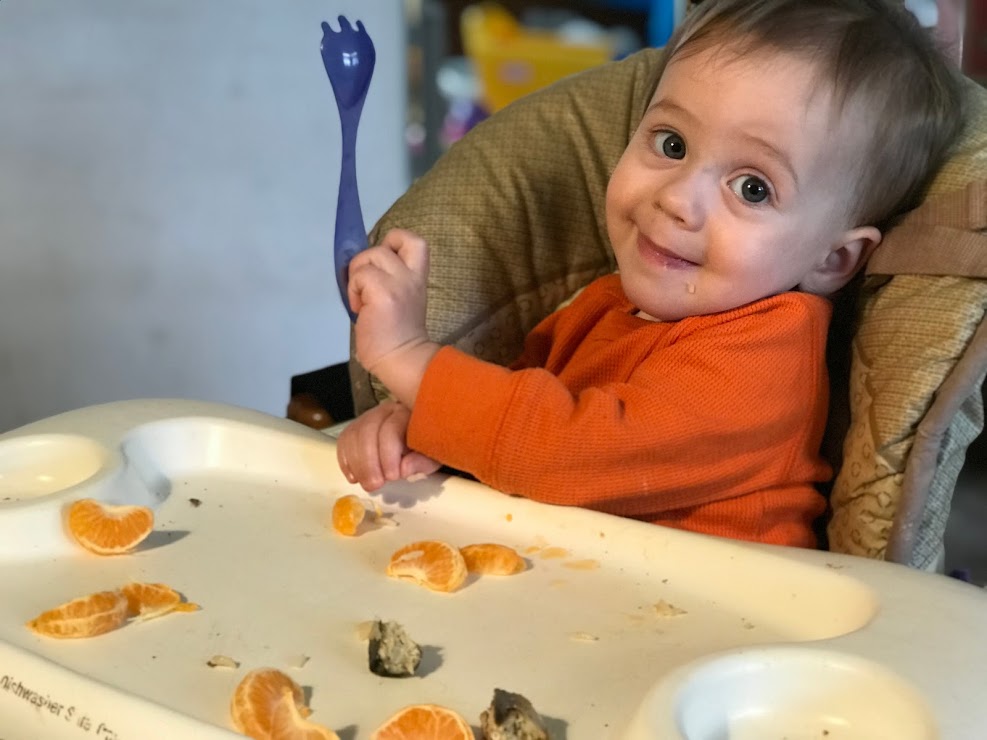
I began to experiment with anchovies and sardines. I learned that sardines can be ground into meatballs to add a flavor that my family loves while replacing some of the meat with a more sustainable protein. As I used the seafood more regularly, it became more and more normal to my palate. Look at the picture of my daughter and you’ll see that it is no burden at all when you get used to eating something new.
What am I suggesting? Well This Lent my family and I are experimenting (on the adult end) with preparing meals with fish and tofu instead of chicken, pork, or beef on Wednesdays and Fridays. If it works well, we’ll likely continue the practice after Lent ends. It might not change the world immediately, but helping to create a world where people eat sustainably might be one of the best things we can do this season.
I invite you to pray about how you and your family might be called to care for our environment this season. If we are to tend this “garden,” it will likely take intentionality. I invite you to consider if this might be something which you might be called to do with your life.
Two weeks ago I had the privilege to learn from Professor Carlos Cardoza-Orlandi from Baylor University at the recent session of the Academy for Spiritual Formation. Learning from Professor Cardoza-Orlandi was a challenging experience. We were challenged on multiple levels about our understanding of Christianity in the global south. The lesson was very timely the week before General Conference.
One lesson has rung through my mind the last few days. The good professor taught us that the world’s Christians do not have the same privilege that I had in my community as a child. When you’re not the dominant religion in an area, some assumptions of both the world around you and your own traditions can shift. I keep hearing the question “Who is your Jesus?” It has been running through my mind.
I want to be clear. I appreciate the Professor Carlos Cardoza-Orlandi enough to note that his opinions are not my opinion. I also want to be clear that my opinions do not need to be shared by everyone else in the body of Christ and this is alright with me. There’s enough room in the Kin-dom of God for there to be diversity.
So, who is my Jesus? My Jesus is radically loving, radically inclusive, and adept at turning the world upside down without people realizing what has happened.
My grammar checker had an issue with the phrase: “My Jesus is radically loving, radically inclusive, and adept at turning the world upside down without people realizing what has happened.” I find this to be semi-hilarious.
My Jesus is the Jesus whom Paul comes to know and eventually says “for I am convinced that neither death, nor life, nor angels, nor rulers, nor things present, nor things to come, nor powers, nor height, nor depth, nor anything else in all creation, will be able to separate us from the love of God in Christ Jesus our Lord.” (Romans 8:38-39).
My Jesus is the Jesus who throws the door open to a larger kin-dom (kindom) than imagined. My Jesus used the Apostles to share the gospel beyond traditional bounds. In Acts 8:26–40 the family is stretched to include a eunuch, which lest we forget is absolutely forbidden in Deuteronomy 23:1. Why shouldn’t you be baptized, Eunuch of Ethiopia? Well, because: “No one whose testicles are crushed or whose penis is cut off shall be admitted to the assembly of the Lord.” I guess that rule did not apply anymore.
My Jesus reached out to Romans and other Gentiles through Peter who is unequivocally told in Acts 10: “What God has made clean, you must not call profane.” My Jesus was there in the Holy Conferencing that took place in Acts 15:6-29 which opened the doors further. By the way, the Holy Spirit continued to pour itself out on those who engaged in fornication, hence we still have children’s moments where children born of believers come to be blessed. Thankfully, the United Methodist Church has not attempted to remove folks who are married and have children from leadership like several other major Christian denominations.
What’s more and what keeps ringing through my head is the story of the woman accused of adultery. In John 8:1-11 we read the story of a woman who is accused of an extramarital affair. Jesus tells her accusers that the one who is without sin should cast the first stone.
Nobody stones her. Nobody there is apparently without sin. Jesus says “I do not condemn you, either. Go. From now on sin no more.” Now, first of all, yes Jesus says do not sin again. To be entirely fair, she is very fortunate Jesus is there to offer this moment of protective grace. I may prevent a child from being beaten up in a parking lot on an afternoon, but if the child keeps walking through the parking lot when I am not there… There is more than one way of looking at that second sentence.
What is amazing is that in all the readings of this scripture, one thing was never pointed out to me. Jesus says “I do not condemn you.” Who is the one who has the ability to condemn sins? Who has the authority to forgive sins? If it is Christ, Jesus’ words “I do not condemn you” hold divine authority. She is forgiven.
What’s further, in a crowd full of people who have sin (including the woman accused of adultery), it is this woman alone who leaves forgiven of her sins. Hebrews 10:4 says “For it is impossible for the blood of bulls and goats to take away sins.” The folks may leave to go and make an offering for their own sinful behavior, but it is Christ alone who forgives.
Now, I cannot say that God’s love does not extend to these folks. Judgment is God’s alone, but I can say that in this moment there is only one person in the crowd we can claim is absolutely forgiven by Christ’s own words. The woman accused of adultery is the only one explicitly told “I do not condemn you…” We can even go further to point out Jesus did not stop the crowd from leaving by saying “Wait! Hold on! God understands and your sins will be forgiven. Throw those stones!”
My Jesus is the Jesus who forgives. My Jesus is the one through whom I baptize children into the Kindom of God in the name of the Father, Son, and Holy Spirit. My Jesus is the one who accepts those children even before they grow up into whatever person they may become in their adult days.
My Jesus is the Jesus who ate with sinners and tax collectors. My Jesus hangs out at Alcoholics Anonymous and in rehab centers. My Jesus sits with the homeless in the cold. My Jesus does a ton of caring through the children of the Kindom who bring food for community suppers, supply food pantries, donate towards medical supplies, walk alongside LGBTQIA+ folks as they struggle with depression and expulsion, cry with those imprisoned falsely in jails, mourn with those who are imprisoned fairly, and do every sort of thing they can in order to be with God’s children. Yes, all children are God’s children.
My Jesus is a pretty awesome Jesus. My Jesus is the reason I did not give up my faith after I grew up into adulthood. Some behavior that I have seen recently does not square up with that Jesus, but I need to be clear: My Jesus is worth following down the narrow path of life. I most certainly will follow that Jesus and will not be one of those who trample “under foot the Son of God, and has regarded as unclean the blood of the covenant by which he was sanctified, and has insulted the Spirit of grace?… It is a terrifying thing to fall into the hands of the living God.” (Hebrews 10:29-31, NASB)
For it is impossible for the blood of bulls and goats to take away sins. Therefore, when He comes into the world, He says,
“Sacrifice and offering You have not desired, But a body You have prepared for Me; In whole burnt offerings and sacrifices for sin You have taken no pleasure. “Then I said, ‘Behold, I have come (In the scroll of the book it is written of Me) To do Your will, O God.’”
After saying above, “Sacrifices and offerings and whole burnt offerings and sacrifices for sin You have not desired, nor have You taken pleasure in them” (which are offered according to the Law), then He said, “Behold, I have come to do Your will.” He takes away the first in order to establish the second. By this will we have been sanctified through the offering of the body of Jesus Christ once for all.
Every priest stands daily ministering and offering time after time the same sacrifices, which can never take away sins; but He, having offered one sacrifice for sins for all time, sat down at the right hand of God, waiting from that time onward until His enemies be made a footstool for His feet. For by one offering He has perfected for all time those who are sanctified. And the Holy Spirit also testifies to us; for after saying,
“This is the covenant that I will make with them After those days, says the Lord: I will put My laws upon their heart, And on their mind I will write them,”
He then says,
“And their sins and their lawless deeds I will remember no more.”
Now where there is forgiveness of these things, there is no longer any offering for sin.
Therefore, brethren, since we have confidence to enter the holy place by the blood of Jesus, by a new and living way which He inaugurated for us through the veil, that is, His flesh, and since we have a great priest over the house of God, let us draw near with a sincere heart in full assurance of faith, having our hearts sprinkled clean from an evil conscience and our bodies washed with pure water. Let us hold fast the confession of our hope without wavering, for He who promised is faithful; and let us consider how to stimulate one another to love and good deeds, not forsaking our own assembling together, as is the habit of some, but encouraging one another; and all the more as you see the day drawing near.
For if we go on sinning willfully after receiving the knowledge of the truth, there no longer remains a sacrifice for sins, but a terrifying expectation of judgment and the fury of a fire which will consume the adversaries. Anyone who has set aside the Law of Moses dies without mercy on the testimony of two or three witnesses. How much severer punishment do you think he will deserve who has trampled under foot the Son of God, and has regarded as unclean the blood of the covenant by which he was sanctified, and has insulted the Spirit of grace? For we know Him who said, “Vengeance is Mine, I will repay.” And again, “The Lord will judge His people.” It is a terrifying thing to fall into the hands of the living God.
I just returned from an intensive formation process and I am struggling to catch up with General Conference stuff. I will miss posting something meaningful today. #Human
I am currently entering into the final steps of preparing my second year project for the Academy for Spiritual Formation. I am thinking that I will have most of the project revolve around the usage of poetry and prayer. I was recently reading through a book I borrowed from the library called “The Art and Craft of Poetry” by Michael Bugeja. On the seventy third page of that tome, Mr. Bugeja quotes the poet Kevin Bezner as saying “All true poetry is religious poetry–all poems are prayers–but not in the sense of a belief in or worship of a god or a supernatural power.”
Given my particular approach to poetry, I found that statement to be intriguing. Mr. Bugeja paraphrases Mr. Bezner, saying “true or sincere poems, by their very nature, always reflect a poet’s faith, commitment, desire to commune, conscientiousness and devotion…”
If poetry does reflect and express the poet’s faith and commitment, then perhaps there is a sense at which heartfelt poetry is prayer. One of my greatest challenges with liturgy is the struggle to include the word “Amen” after every prayer. For a long time, hymns concluded with an amen. Nowadays, it seems as if almost every prayer needs and “Amen” in order to conclude.
Amen has a rich history and depth of meaning. The usage of the word for the congregation to enter into the depth of the prayer is helpful. When we say amen after someone prays, we become a part of that prayer orally. It is a wonderful act of inclusion in an act of worship, but often folks seem to believe that any prayer must have an amen. This is not true.
I thought I’d share a poem I recently wrote in an attitude of prayer after a saint invited me over to lunch. I wrote it for a thank you note, but I thought it was a perfect way of expressing how a prayer can be found in poetry.
Scents waft up from a warm bowl of chili rich yet faint. As I sit to share a meal with an elder saint. She has made special biscuits for us to share And we break bread together with prayer. With cheese and conversation our meal Is filled with a depth you can feel. I listen with quiet peace As my inner cares cease. I try to be here With one so dear. I’m thankful, Grateful, Full…
“Full” by The Distracted Pastor, 2019
The form itself was fairly simple. I started with thirteen syllables a line and decreased a syllable each consecutive line. The rhyming pattern is a set of 5 couplets with a rhyming envoi creating one tercet at the end. It is clearly a poem.
It is also clearly a prayer. I intended to express care, gratitude, and thankfulness for the opportunity. Although God is not addressed by name, there is homage paid to communion in the mentioning of the breaking of the bread. The person I shared a meal with is a saint, there’s a stillness while listening that ties back to the idea of silence in contemplation and prayer. Even the mentioning of saints can draw our thoughts to God.
Psalm 19:14 says “Let the words of my mouth and the meditation of my heart be acceptable to you, O Lord, my rock and my redeemer.” It is my belief that poetry that seeks to live into this verse really is prayer.
Praise God with loud drum. Praise God with low hum. Praise God with rocking guitars. Praise God with your voice. Praise God with your choice. Praise God beneath all the stars.
Breathe deep as you strum. Breathe and let soul thrum. Breathe deep and cry with your heart. Breathe with open mind. Breathe deep and be kind. Breathe, rise, and make a fresh start.
“Alouette Ode to Psalm 150” by The Distracted Pastor, 2019
Today’s poem was inspired by Psalm 150. We’ll be reading the psalm this Sunday in church. I wrote it in the “Alouette” poetry form. I tied together the two stanzas by rhyming the first two lines in each stanza.
My process was to envision the first stanza as a response to God’s Presence (which echoes powerfully in Psalm 150) and the second stanza as the body breathing in preparation of living with that Presence in the world.
Tomorrow we are looking at Isaiah 45:9-13,15-19 at our church service. We will be focusing on the call of the community to live with a purpose, but as usual, church is only so long and there is more in the passage that is worthy of our time.
In particular, I wanted to take a moment to look at the last two verses. In the NRSV, the Isaiah 45:18-19 calls out for attention given our world’s modern challenges.
For thus says the Lord, who created the heavens (he is God!), who formed the earth and made it (he established it; he did not create it a chaos, he formed it to be inhabited!): I am the Lord, and there is no other. I did not speak in secret, in a land of darkness; I did not say to the offspring of Jacob, “Seek me in chaos.” I the Lord speak the truth, I declare what is right.
Isaiah 45:18-19, NRSV
God does not create the world to be a jumble of chaos in the scriptures. God created a world that was meant and is meant to be inhabited. The world is very carefully crafted. Indeed, we live in a beautiful world filled with majestic creatures.
To be blunt, a lot of those beautiful creatures are going extinct and huge swaths of the earth are struggling to cope with human induced climate change. For the entirety of our existence, humans have had an impact on the world. We systematically hunted certain animals to extinction over the course of our existence. Now our behaviors are bringing extinction to creatures not through the use of a bullet or arrow but by changing the chemicals in streams, filling oceans with plastic, and removing habitats through intentional deforestation.
To me, this is an outrage and an offense to both the gift we have been granted and the world which we received. This world was meant to be inhabited just as the hotel has rooms that are meant to be rented. We are invited to this world like someone invited to stay at a friend’s house for a season. If we were to treat a hotel room like we have treated our world, we would be charged to repair the damage. If we were to destroy our friend’s house, we would likely lose that friendship. Why is the way we treat this world seen differently?
I would invite you to consider whether we are called to treat our world better. More information about climate challenges can be found here.
Have you ever stopped to wonder whether life would be different if we paid closer attention to the world? Would life be different if we focused on other matters than those that preoccupy us?
Recently I was reading a letter from Dietrich Bonhoeffer to his parents in April 1943. Eberhard Bethge translated the version I was reading. The letter I was reading was written on the fourteenth of April. Bonhoeffer wrote:
“Spring is really coming now. You will have plenty to do in the garden; I hope that Renate’s wedding preparations are going well. Here in the prison yard there is a thrush which sings beautifully in the morning, and now in the evening too. One is grateful for little things, and that is surely a gain.”
If you are unfamiliar with Bonhoeffer’s story, Bonhoeffer was arrested for taking very public stances against the Nazi regime in Germany and for engaging in espionage. He was executed for his crimes during the last days of hostilities in 1945. Bonhoeffer was one of the most prominent Lutheran martyrs of the 20th century.
Bonhoeffer is writing to his father at the beginning of his imprisonment in the letter I was reading. They had separated Bonhoeffer from family, from his fiancee, and from his community of faith within the confessional church. Bonhoeffer was facing charges which could easily lead to his execution.
What catches my eye is that Bonhoeffer notices the thrush in the prison yard. He could have obsessed over his imprisonment and isolation. He could have focused on being confined in his cell for long hours at night or being neglected simple things like shoelaces and shaving cream. In the midst of everything, Bonhoeffer notices the thrush.
I am not imprisoned in my home. I have access to the world around me and my children are a regular part of my life. There are so many things I could focus on in life. I could notice the sound of my daughter singing to herself, the blessing of having a partner who helps me to be a better person, or a million and one other things.
Instead I find myself focusing on matters that are not helpful. Do I have opinions about politics? Yes, I most certainly have opinions. Do I have an obligation to speak out against abuses? Yes, I most certainly have times when I must take a stand. There are many things I could focus on in this moment.
We all have only so many days in this world. What do we notice as we spend our time under the sun?
I pray that my calling in the world will come with the awareness that Bonhoeffer seemed to possess. Will I miss the thrush? I pray that I do not miss the thrush in my life today. May I gain blessings through all the little things.
I wanted to post a post for Valentine’s Day that is a reminder that love has never been an easy thing to handle. Stalwart figures from church history faced challenges when it came to issues of love.
We don’t know the story behind this aspect of his life, but St. Paul clearly had opinions of marriage and love which may or may not have been the result of personal troubles. He believed the time in this life was short and wrote the Corinthian church in 1 Corinthians 7:25-28 (NRSV): “Now concerning virgins, I have no command of the Lord, but I give my opinion as one who by the Lord’s mercy is trustworthy. I think that, in view of the impending crisis, it is well for you to remain as you are. Are you bound to a wife? Do not seek to be free. Are you free from a wife? Do not seek a wife. But if you marry, you do not sin, and if a virgin marries, she does not sin. Yet those who marry will experience distress in this life, and I would spare you that.”
The Desert Abbas and Ammas genuinely discouraged romantic entanglements. Some of them even refused to talk with folks that might lead to even the risk of their being attracted romantically.
The monastic movement generally promoted and engaged in celibacy. There were exceptions and times when individual monks went astray from their vows, but most monastics certainly faced a challenging life.
Martin Luther started a whole reformation movement without the support of a life partner until he married an escaped nun named Katherine von Bora. He literally snuck her out of a convent in a fish barrel.
Generally every relationship with a woman in John Wesley’s life ended poorly.
Lots of people struggled with romance and romantic desires through the history of the church. If you are alone today, it is good to know that you are in good company. I would invite you to know that you have worth outside of a romantic relationship, that you are a beloved child of God, and that the fourteenth of February really is just another day.
On a less romantic note, I recently found this excellent recollection of the situation that arose between John Wesley and Mrs. Beta Hawkins. While they were certainly not in a romantic relationship, here’s a few of my favorite highlights of that interaction:
“Sir, you have abused me! You have insulted me! And I am going to put this pistol ball through your brain!” Then she pulled out a pair of scissors and said, “And I’m going to cut that long hair!”
Wesley grabbed both her hands and she fell on top of him on the bed. He called out to the maid, “Get her off! Get her off!” Beta called out to the maid, “You hold him still or I’ll shoot you, too!”
Dr. Hawkins came in. “What is that scoundrel doing in my house?” he exclaimed. “Sir, what are you doing on top of my wife?” Wesley replied, “Sir, I am not. She is on top of me! Get her off!”
I pray that your day goes a lot more smoothly than John Wesley’s day once did. Also, if people really don’t like you and may shoot you, don’t go alone to their house. That’s always a bad choice.
Frost covers a world In need of kind and warm grace. Are you called to act? Ice over living water Is often broken by love.
“Ice and Love” by The Distracted Pastor. 2019
Today we awoke to a house surrounded by ice. Ice is a wonderful gift in the middle of a hot summer day in a cold drink. In the middle of winter, ice can often be a challenge more than a slight inconvenience.
For the past few hours I have been working at deicing the church parking lot in anticipation of upcoming events at the church. I have made little headway and our local radio station is predicting further ice tonight.
While broadcasting salt across the ice this morning I thought back to the times in my life when I worked with the homeless, especially during my college years. I thought about the challenges faced by folks who want to the right thing to help someone, but do not know what to do. If you give someone money, will it be used wisely? If you give them a flashlight, will they trade it for something else?
One of the first lessons I learned is that you cannot control what others do. If you bless someone with a flashlight, they might trade it for something else. If you offer them a blanket, they might exchange it for a drink of something untoward. You cannot control what other people do, but that does not mean that there are not concrete things you can do to help others.
Here are a few of things I would suggest:
Blanket Blessing
Hot meal
Handwarmers
Gift Certificate
Keep a blanket blessing in your trunk. I suggest a warm blanket that is not large or bulky. Roll that blanket up with two pairs of new thick, warm socks, a knit cap, and a pair of gloves. The time to make these blessing blankets is not now. If you wait until end of season sales, stock up on the gloves, hats, and winter socks when they’re on clearance. Set a limit to what you want to do next winter (e.g., one set, five sets, ten sets) and store them with your winter snow brush. Put them in your trunk when you put your snow brush back in your car next fall.
Offer to buy someone a meal instead of giving them money. If they are hungry, ask them if you can buy them something to eat and then follow through. If you do not have time to sit with them, offer to bring them drive-thru or takeout. Offer to get them a hot drink with the food. The heat goes a long way. Note: Some people will say no to your offer or try and convince you to just give them the money. Use your best judgment, but I would suggest you offer the food and hot drink.
Instead of offering people money, buy a box of those chemical hand warmers at the end of the season. Offer them to people who are out in the cold. It is a simple gift. As a caution, check the expiration date if you’re buying for the next season. Unlike the blanket blessing, they expire.
If you live in a semi-rural location or in a location with more local businesses than chain restaurants, talk with a local restauranteur. Ask if you can buy a certificate for a “meal” complete with warm drink, food, and the tip included. If you talk with a small business owner and explain what you are doing, they may help you out. This may be something that ends up being traded, but if you are concerned it is still better than giving money.
Be as the clay. Mix living water with your dust: Be as the clay. Bend, mold, move, and flex as you must; Be made in furnace fired by trust; In joyful purpose with life thrust: Be as the clay.
“Be as the Clay” Rondelet by The Distracted Pastor, 2019
This week in church we’re looking at Jeremiah 18:1-6 with our children during worship. In the passage, Jeremiah is called to walk down to a potter’s house to observe the potter at work.
With our children we will talk about how God can work in our lives. Clay itself can be nasty stuff when you dig a shovel into a yard and find the dense stuff below a thin layer of topsoil. It can be challenging work to move enough of the stuff to plant even the smallest of tree bulbs. Clay is difficult stuff; however, in the hands of a master potter clay can be wonderful for creating beautiful things. We will tell our kids they are being made into beautiful creations. Call it naive hope or call it prophecy, I believe each of the kids in our church have a bright future ahead of them as awesome people.
The clay cross I painted and fired years ago…
The challenge is that there’s a second side to this story. Jeremiah is a prophet called to a place that needs prophetic work done in their lives. The clay needs to be reworked in Israel. As their potter, God claims the right to rework what has been done.
I wrote the rondelet above to look at this reality. I wanted to lean into the concept of being clay. We work hard at building lives in this world and it can be difficult to trust even God to rework the clay of our lives when we become comfortable with the way things are in our lives.
We sometimes need to be reworked. We need to work that living water into our lives, to be flexible, and to even be fired in the oven. We might be tempted to look at this reworking as punishment, especially if we are comfortable. Sometimes, we will put up with a lot of cracks and chips to stay comfortable. Some of us would do anything to just be left alone.
The attitude that says “Just leave me be” does not necessarily help us. If I have a broken arm that has set poorly, it may need to be broken and set again. If I have a heart valve that is leaking, I may need to see my cardiologist if I want to live a longer life. When sick we need a doctor. When cracked, we may need to see our Potter.
This reworking is not necessarily pleasant. If you are struggling through a remaking, I want you to know that you are neither the first nor the last to face a challenge in your life of faith. You are more than likely surrounded by people who have faced their own challenges. You are not alone.
Yesterday I preached a sermon on why God allows evil in the world. The sermon was hard to preach. Yesterday, we were blessed with a guest who shared a longer testimony than we’re used to in church while my watch buzzed at me to wrap up. Patience is difficult for me. Yesterday, I attended a fundraiser for a friend whose family is struggling with illness in a small child. I just want to make everything right.
Today there is no poetry in my heart. Today there are no deep reflections. Today I need rest. I will try and post something meaningful tomorrow. While you wait, I invite you to ponder how you know when your soul and body needs a moment of silence.
Be still. As scents fill you, As odd sights confound you, And as you want to run away: Be still…
“Be Still” by The Distracted Pastor, 2019
I recently spent time with someone who was ill in a care facility. I wrote this post a while back to help preserve the person’s identity, but this post is not about their story. This post is about my story and my experience.
The situation on my end was that I was waiting in a care facility which is filled with people facing challenges. The staff was present and diligent, but it is a facility full of people with differing needs. I found myself waiting impatiently as the sounds, scents, and distractions which come in such a place filled my senses.
I ordinarily do not spend time waiting in such facilities. I enter, I head straight where I need to go, focus on the individual, visit with family, pray, and head out the door. I generally do not have time to sit, to think, or to read in such places. I do not have time for my mind to wander. This day was different, so I opened my Kindle to read as I waited.
This blessed book has the advantage of taking up no extra space in my bag and the capacity to be read in dark rooms!
The chapter is not a long chapter. Abbess Paintner referred to three quotations in that section. As much as I respect the Abbess’ selection of ancient sources, her wisdom shines forth in her annotations. She writes:
“Sitting in our cell requires patience to not run from ourselves or flee back into the world of distraction and numbness. It means being fully present to our inner life without anxiety. Interior peace comes through sitting in silence, through attentiveness and watchfulness.”
Abbess Paintner in the second footnote for chapter ten
I found myself reflecting on the concepts of patience and stillness as my senses picked up on less than pleasant smells. In that moment, the place I was called to spend my time was that room with everything in the air. My cell was a chair in the midst of this person’s life. I found myself trying to be attentive, watchful, and present even as some part of me tried not to breathe too deeply. The scents, the sights, and the sounds made me more than a little anxious.
I found myself struggling in those moments after reading the Abbess’ thoughts. Was I letting those scents keeping me from being present with the individual sleeping in the bed? Was I letting my dislike of the scents keep me from being present with someone whose every breath contains the aromas that were filling my nostrils? There was some part of me that struggled with shame for focusing on the distractions and another part that wondered if the distractions might not be the blessing in disguise.
I was filled with questions, but the one that stuck with me was the loudest question that filled my mind. Was I open to knowing this was someone’s experience? Was I open to walking with someone as their body struggled? Was I open to being God’s hands and feet in such a place? Was I willing to see God in that place?
It would be easy to numb myself to the situation. I could run to my car and refill my diffuser with peppermint. I could rush home, put on the aromatic earl gray tea to settle my senses, and I could rush home to hug my toddler who seems to always smell of lavender when you smell her hair. It would be easy to flee back to distraction and numbness, but would I find true peace in distraction?
I find myself casting my mind to Matthew 25. In Matthew 25, the Son of Man comes in glory to bring judgment to an imperfect world. The Son of Man separates folks and says to one group that they are blessed because they gave food to the hungry, drink to the thirst, welcome to the stranger, clothes to the naked, care to the sick, and visited the imprisoned. The people did not understand when they had done these things. The Son of Man replies (in the NRSV) “Truly, I tell you, just as you did it to one of the least of these who are members of my family, you did it to me.”
We who are engaged in helping care for others often look on this passage and find comfort. We have given a dollar at the Red Kettle at Christmas, have donated a can of food to the food pantry, and gave a little extra when we could. We have helped the least of these. I could rush home and say “I visited one of the least of these! I’m good!”
Would Christ ask “Did you really visit the least of these or did you do the least you could for these?” Are we open to realize we may be called to radical love that sits through the dirt of life? Are we open to realize that loving God’s children may mean sitting in smelly places? Are we open to realize that God may call us to a deeper fellowship with those in need than the bare minimum?
I do not write such challenging words from a place of judgment. If anything, I feel convicted by my own words. What does this look like in our lives? If we are to live into God’s kingdom, do we all need to live radically transformed lives? Perhaps we are not all called to a care facility, but perhaps we are all called somewhere beyond what is comfortable for us. It is worth contemplating.
This past weekend I was challenged with a question. The question revolved around my vision of ministry. What evolved from the question was the realization that I am often not clear about my own particular vision for ministry. What do I seek to embody in my ministry? Could I express my vision for ministry in the time it takes to ride an elevator?
I have been thinking consistently about that question since it came into my mind. I have been asking myself how to express my view of ministry. Side questions arose from this contemplation. Could others remember it? Could they see it in my actions? Do I have a phrase that helps me stay focused on my purposes?
What’s the phrase? “I believe that the church should seek to be ONE.” I want my vision to be Open, Nurturing, and Empowering.
Let me break those buzzwords down into something more succinct. Buzzwords are nice but they do not always serve the purposes which they need to serve for others. These lists are meant to be examples and not a complete or restrictive compilation of ideas.
I believe the church should be Open to new people, Open to new expressions, Open to people who are differently abled, Open to hear/converse with our neighbors, Open to taking God’s love out of the church building, and Open to hear God’s voice.
I believe the church should be Nurturing to people who want to know God more, Nurturing to those who have had few advantages and many obstacles, Nurturing to those who are wounded or in need, and Nurturing with/towards other communities and people in our neighborhood.
I believe the church should be Empowering to people who need God’s freedom in their daily life, Empowering to those who have been oppressed, Empowering to folks who believe their voice does not matter, Empowering to those who need to borrow our strength to break free from their shackles, and Empowering to people who want to seek to enter into life changing discipleship.
Seven years ago, I knelt before my Conference and was ordained into ministry because people were Open to my leadership, Nurtured my potential, and Empowered me to go forth in ministry. What kind of person would I be if I did not seek to do the same for others?
What do those things look like? I believe that is the subject of a lot of posts to come, but here’s a few snippets of what I’m proposing to lead about more openly:
You cannot be truly Open to the community if your building or community has significant barriers for differently abled folks.
You cannot be truly Open to the community if you don’t welcome folks who are different than you in culture, race, ethnicity, or viewpoint.
You cannot be fully Nurturing to the community if you immediately dismiss people when they find the courage to talk about real life problems that make you feel uncomfortable.
You cannot be fully Nurturing to new leadership if you respond to every request to try something new with an immediate “No way. We’ve never done that before.”
You cannot be wholly Empowering if you look down your nose at folks who haven’t had the same advantages as you.
You cannot be wholly Empowering of other people’s ministries within the church if you rely on authority for leadership in the church instead of relationship, vision, and calling.
What are the words of the communion liturgy? Because there is ONE loaf, we who are many are ONE body. May we all be ONE in the love and care of Jesus.
Yesterday was a stressful day. I am in Syracuse attending Launchpad, which trains folks in strategies to help start new ministries. The day was very full and my brain was fried by the time we broke for dinner. My wife, our friend, and I tried to talk about what we thought over Indian, but it quickly devolved into story time.
“The ancient rabbis teach that on the seventh day, God created menuha—tranquility, peace, and repose—rest, in the deepest possible sense of fertile, healing stillness. Until the Sabbath, creation was unfinished. Only after the birth of menuha, only with tranquility and rest, was the circle of creation made full and complete.”
Last night I was filled with ideas. To be honest, they were burgeoning on burning out my brain. I slowed down, took a moment to breathe, and realized there was wisdom in these words. I was tired, I was exhausted, and I had been breathing in new thoughts, new ideas, and new “creations” in my brain all day. It was only in slowing down to exhale, to rest, and find peace that I found balance.
Sabbath in the Christian tradition has generally been relegated to one day of the week. In modern culture, even the Sabbath is a day when we fill time with stuff and things.
Sometimes it is important to remember that God created something beautiful in Sabbath. We all need moments of rest, repose, and restoration. To believe such things can only be needed on a single day of the week is to miss something true.
It is not an accident what follows when Paul writes to the church and encourages it to not be anxious about anything, but to present their concerns to God with praise and thanksgiving. The people are told that the peace of God will guard their hearts and minds in Christ Jesus. Something like that blessed creation of Sabbath that finishes the seven days of creation fills and guards hearts and minds in Christ Jesus. (Philippians 4:6-7)
Are you stressed out today? Have you taken moments to rest? Have you breathed out and given over your worries and requests to God? Sometimes anxiety is a medical condition which requires help, sometimes it takes works to let go of the stressful things in our lives, but is there a chance that taking a moment of Sabbath rest might be what your heart and soul needs?
If you do not know what that might look like, here are a few practical suggestions:
Take time to journal in a quiet place. Ask yourself simple questions. Where have I seen God this week? Where have I found places of peace in the past?
Sit quietly for a while. Do not rush this one by assuming a day is the best place to begin. Five minutes might be all you can handle at first. Work your way into silence regularly and see how it affects you.
"Dad, I am hungry!"
"Hi hungry! I am your dad!"
I laugh at her sigh.
I turn with my warmest smile
And look in an empty fridge.
“Hungry Kyoka” The Distracted Pastor, 2019
I wanted to share this kyoka this morning for a simple reason. A kyoka is a form of poetry in which the profane or mundane is placed into a poetic form. For some people “Dad jokes” are profanely terrible. For other folks family conversations in a kitchen are commonplace.
For me, what is profane is neither the bad humor nor the commonality of the situation. What is profane is that there are many families in this world and in our community that have little or nothing in their fridges. Humor is one response to tragedy. The tragedy of families which struggle to feed their families is a profanity in a country where people regularly propose billions of dollars for a wall while families starve.
There are people in our communities who do not have enough to eat without assistance. I have performed funerals for people who have died of complications from malnourishment. Not all of those situations were from a lack of access to food, but I can tell you sometimes having nothing in the fridge leads to mental distress, spiritual crisis, and physical challenges.
Here where I live in Broome County we are blessed to have access to both the Community Hunger Outreach Warehouse (CHOW) operated by the Broome County Council of Churches and to the Food Bank of the Southern Tier which extends out from Broome County to also cover Chemung, Schuyler, Steuben, Tioga, and Tompkins counties.
Homemade bread is a blessing which requires ingredients, cooking utensils, and an oven (or campfire if courageous/desperate). Some people do not have those things.
I wanted to invite you to become involved in hunger outreach in your local context. If you are one of the people who follow this blog because you love Christian contemplation, consider how many of the saints learned the value of contemplation through action. If you are a poetry person, consider how difficult it can be to create or enjoy beautiful poetry when you are distracted by a growling stomach. Hungry has inspired many wonderful pieces of art, but I am certain it was not enjoyable. Please consider volunteering time or resources to one of these wonderful missions or a similar mission near you.
Allow me a moment to say there are many commonalities among world religions. Almost all of them point to both the value of love and the reciprocal blessing of kindness. Call it karma, the promise of the Parable of the Sheep and the Goats, or by another phrase meaningful to you. It is good to show kindness to people in need.
Here are five ways to get started in helping fight hunger:
Pick a designated non-perishable item of the month that you use a lot of in your life. If you pick peanut butter, purchase an extra jar when it is on your grocery list. Donate it to a local food bank or food pantry.
Do not automatically say “No” if you live in an area where grocery stores might invite you to donate to a pantry. The Food Bank of the Southern Tier occasionally invites people to “Check out Hunger.” A similar program might be available near you.
If you go to church, offer to help make sure there is healthy food for times of fellowship like “Coffee Hour.” If you see a friend who looks like they might need an extra cookie, offer to get them one while you “Get a cup of coffee.” If your church is willing, find a family who might need a blessing and offer them the leftover goodies (with grace and an understanding if they say no).
Pay attention to your neighbors. If you know a family is going hungry, “Secret Santa” them by paying for a pizza or other food to be delivered from a local restaurant anonymously. Make sure you cover the driver’s tip so that the person is not embarrassed.
Call a Food Pantry, Food Bank, or Soup Kitchen. Ask what they need and volunteer what you can in time or in goods.
My daughter’s eyes. She was too young to understand my words Sunday… Hopefully a seed will take root!
“Can you see deep down?” The Distracted Pastor, 2019
Holy One, do You know me?
Deep down can You see?
All of the places in me?
They just look at me
And they simply laugh away.
Sometimes it breaks me
To wake up and see just me.
I walk lonely ways.
There are many simple ways
That You might help me.
My wounded, lonely spirit
Cries sadly, Spirit.

Can you see my heart Spirit?
You knit all of me
knowing my bones and spirit?
My sad cracked spirit?
What could you possibly see
You love me Spirit?
The world needed me Spirit?
Not hiding away?
Not shunned or thrown far away
From this life Spirit?
I am confused by Your ways.
Help me see Your ways.

I can see some of the ways
With happy Spirit.
When I walk down pleasant ways
I trace Your ways–
Fingerprints of You in Me.
Marks of Your deep ways
Show in the subtlest of ways
When I slow to see
The goodness that You must see
In Your ancient ways.
You draw me from far away.
I can't stay away.

Things that I would toss away
You bless through Your ways.
You toss ideal away.
Discard it away
As You stitch up my Spirit.
Weave, subtle Spirit.
Bless my imperfect spirit
As You work in me,
As You work to renew me.
Do not stay away.
Open my eyes–help me see
The perfect You see.

I can't always clearly see
How You work away
To form what You hope to see.
Pain distracts, You see?
Work in me Your calming ways.
Bless my eyes to see
The vision that You did see
When You put spirit
In my flesh by Your Spirit.
Bless my soul to see
The loveliness within me,
the best part of me.

Holy One, you do know me.
Though it's hard to see
You are never far away.
Teach me Your deep ways
Until spirit knows Spirit.
Sunday mornings I lead worship at the Maine Federated Church. This past Sunday I spoke with our younger disciples about Psalm 139. Psalm 139 is a tricky psalm in places, so we focused on the first 18 verses. There are words about God surrounding someone on every side, words about God crafting someone with care, and words about God’s deep love.
As I shared with the kids, I saw reflections in their eyes. My eyesight isn’t the best, but there was hope and pain in those young eyes. Perhaps one or two had already been told they were not the wonderful kids I believe that they happen to be. I wrote this canzone to work into the struggle I have shared with them over the years. Can these words really apply to us? Can we move from doubt to belief?
For the record, this is the first truly complicated form of poetry I have attempted. I am not adept with the canzone or sestina, so I would adore kind feedback or recommendations of other poems in these forms I should check out.
Today I wrote a poem in response to quadrille challenge #72 on the Poets’ Pub at dVerse. I wrote the poem while having a cup of green tea, despite the words of the poem. Given the fact that I am baking stuffed potatoes in the other room, it is surprising that they didn’t make their way into the quadrille.
Steep your tea and think your thoughts for our days are brief!
The challenge is to write a forty four word poem. I based my poem on a 44 letter poem I wrote based on the unitoum form, although it is not officially a unitoum as it is only three stanzas long. As a result, the related quadrille is not a proper pantoum, but does have the neat feature of having the letters in the last word adding up to 44 letters in a 44 word poem. I like the symmetry of that construction. In honesty, I personally enjoy the 44 letter poem more than I like the resulting quadrille.
Steep and Steep
Black leaves steep.
Pour out Your
Pot of fragrant tea.
Fill your mug now.

As you sip your
Tea think about life.
Go slowly now.
Ponder things and drink

Think about your life
While there is
Still time to drink
And switch life up.
Today’s post is out of sync for most folks. I serve as a minister and thus operate on a different schedule than most of my community. My community consists of a majority of people (but not all) who either work weekdays or live in a cycle where weekends are normal. We have a few individuals who work shifts on weekends, but most either work those weekday jobs or have other purposes in their life (e.g. stay at home parents, retirees, etc.)
As a minister, Monday morning is a time when I prepare for the week ahead. Often that means taking time for reflection. My “Spiritual Renewal Day” is Friday, which is unfortunate as it means my only regular companions for my Sabbath are pets and my toddler. Saturday is a day fraught with community events, denominational events, children’s events, and complications with worship preparations. This past Saturday I had to choose between a historical society coffeehouse, a district training day in the United Methodist Church, the upcoming week’s grocery shopping, worship prep, and my daughter’s birthday party. I chose my daughter’s birthday party, worship prep, and grocery shopping.
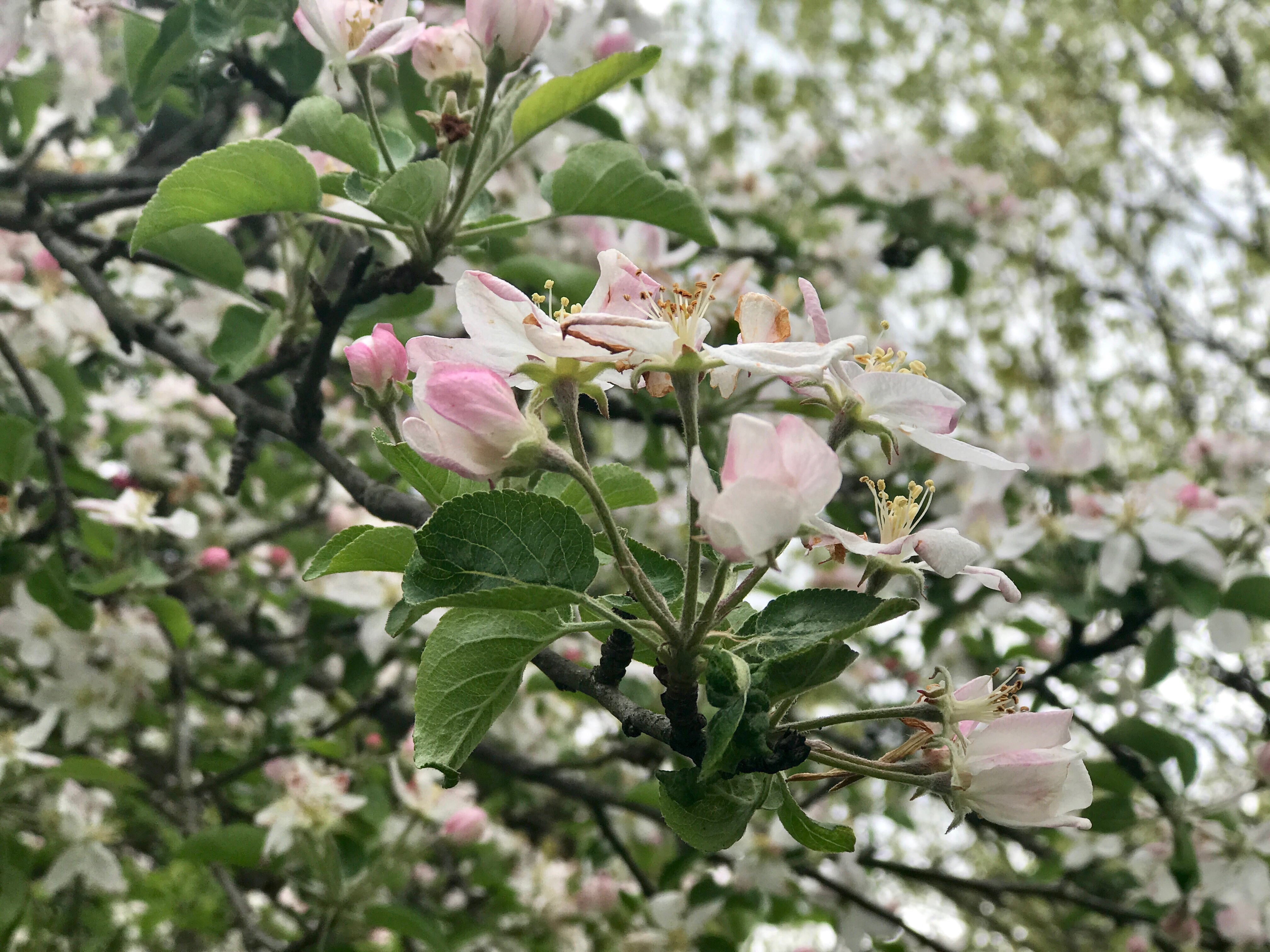
Apple blossoms only bloom after the rest of winter…
Monday is not my spiritual renewal day, but Monday morning is a time my spirit requires me to slow down. Part of that slowing down is reading for personal growth, for the Academy for Spiritual Formation, for an upcoming book or Bible studies, or for upcoming sermons (although on principle, I rarely read anything on the subject I am preaching on the upcoming Sunday).
Today I began by reading further into Rev. Wayne Muller’s book “Sabbath: Finding Rest, Renewal, and Delight in our Busy Lives.” I find Mr. Muller’s writings to be interesting. From my reading, I have the feeling that we share a common attribute in introversion. I may be wrong, but I found his love of rest to speak to my introverted soul.
There are days when it seems as if Mr. Muller knows my heart. It feels like continual overcommitment leads to a violence against my soul (pg. 3). As a minister, I am often asked to be a voice or presence on nearly every committee, am expected (on my Methodist side) to hold each committee accountable to our common identity and purpose, to be present in the lives of the homebound and sick, to be available 24/7 for hospital calls, and am expected to lead in most forms of outreach.
The sense of needing to be everywhere for everyone is a common struggle among clergy. Many clergy struggle from burnout and many are accused of not being present enough when their families are falling apart, their relationships are crumbling, and facing loneliness. I have struggled with the constant pull of ministry on my life for years. I believe this common struggle is one reason Mr. Muller’s words struck so deeply with me today. In his chapter on “The Joy of Rest” Mr. Muller writes:
“The practice of Shabbat, or Sabbath, is designed specifically to restore us, a gift of time in which we allow the cares and concerns of the marketplace fall away. We set aside time to delight in being alive, to savor the gifts of creation, and to give thanks for the blessings we have missed in our necessary preoccupation with our work. Ancient texts suggest we light candles, sing songs, pray, tell stories, worship, eat, nap, and make love. It is a day of delight, a sanctuary in time. Within this sanctuary, we make ourselves available to the insights and blessings that arise only in the stillness of time.”
“Sabbath: Finding Rest, Renewal, and Delight in our Busy Lives,” by Wayne Muller (pg. 26)
When was the last time you woke up with the goal of delighting in being alive? I have had days where I have woken up with the goal of worshipping, the plan to sing songs or tell stories, but it is rare that I have woken up with the goal of delight. As someone who has publicly faced the challenges of mental health over the years, waking up with the goal of delighting in my life seems particularly foreign to my mindset.
Wouldn’t it be wonderful to set aside time to delight in being alive? Many Christians struggle to fight for conceptual ideas like sexual propriety, the lives of unborn children, and other idealistic strivings. Laying aside those questions, what would life be like if we were to put a tenth of the energy we see poured into those causes poured into delighting in life? What would life be like if we gathered for worship Sunday mornings and said we are here to delight in each other’s company? What if we delighted in each other’s company?
Candles that burn openly in the wind often don’t burn for long.
In my mind, I see a church filled with people going past “Hey. Good to see you!” or “Hi. How are you?… I’m good.” What would it look like if we delighted in each other? How would that change the way we see church? How would that change the way we see our mission?
A church that focused on treating the Sabbath how Mr. Muller describes Sabbath is the kind of church I would love to be a part of as an individual. A community focused on songs, worship, delight, prayer, stories, and even in bringing love into our homes… there is a wonderful vision!
The other night something caught my eye when I was reading the introduction written by S. T. Joshi in “American Supernatural Tales.” Mr. Joshi was discussing a statement made by William Hazlitt in 1829 in the Edinburgh Review. Mr. Hazlitt believed the ages of ghosts had passed (along with ignorance and superstition) before the United states came into existence.
Mr. Hazlitt’s assertion itself did not catch my eye. What caught my eye was the way Mr. Joshi reframed the issue. Mr. Hazlitt asked:
“Since so much of supernatural fiction appears to find the source of its terrors in the depths of the remote past, how can a nation that does not have much of a past express the supernatural in literature?”
J. T. Hazlitt in the Introduction to “American Supernatural Tales”
Who wore it better? The cat on the cover of “American Supernatural Tales” or Pepper the cat?
How can a nation without a past express itself in supernatural literature? Does this question only apply itself to the original context? Can a nation with such a short memory for history express itself in these arenas?
This approach to the question intrigued me. How can one write good fiction that defies reality if one lives in an age where reality is black and white? Werewolves and Dr. Frankenstein’s monsters are entities of a time when such things were plausibly close to real, but just beyond reality. Our age is an age of scientific marvels, which is perhaps why our science fiction is extensive and excellent, but much of horror is jump scares and the monstrosity of humanity. Are there truly unique monsters in our age?
Mr. Hazlitt points out that H. P. Lovecraft wrote of William Faulkner’s tale “A Rose for Emily,” that: “… this is a dark and horrible thing which could happen, whereas the crux of a weird tale is something which could not possibly happen.” For something to be truly weird, it could not possibly happen…
All of these things raise a question in me: Can the weird still happen? Can things exist that could not possibly happen? In an age when the internet, technology, animation, and raw processing power make almost anything imaginable come to the screen, does the weird still exist? Can the weird still draw us into a special place where the natural laws and rules of things no longer apply?
I ask this in all sincerity because I believe that Mr. Lovecraft was correct. A weird tale requires something that could not possibly happen. Also, God is weird.
We live in an age bombarded with information and with possibility. We are living in the middle of the longest government shutdown in American history, which would have been unthinkable a few short years ago. Some of the most unfathomably large comic book stories of a medium that is blessed to present stories from one frame at a time have been brought off of the paper onto the screen. The modern equivalent of gods and goddesses walk on the silver screen when stories of far-off worlds are not being portrayed. We live in a world of possibility.
Is there still room in the midst of all of that information for the world to find the weirdness of God? Can God be weird if we keep swallowing all of that stuff without pausing to chew? What’s more, does all of this make life better?
I love superhero movies and science fiction, but they are like everything else: they are good in moderation. I enjoy watching humorous videos and listening to Weird Al, but they are like everything else: they are good in moderation. When the mind is filled with too much stuff, there is less room for imagination, creativity, and weirdness.
I like the universe to be a little weird. I like there to be a space where the weird God can be set apart from reality. We used to call that set apart weirdness holiness. As much as I love science fiction and superheroes, can a nation with neither an attention span for the past nor space for palpable weirdness really engage with the weird? Can we engage with God? If the space is too crowded, is there room in ourselves to step back and take space?
For it was you who formed my inward parts; you knit me together in my mother’s womb. I praise you, for I am fearfully and wonderfully made. Wonderful are your works; that I know very well. My frame was not hidden from you, when I was being made in secret, intricately woven in the depths of the earth. Your eyes beheld my unformed substance. In your book were written all the days that were formed for me, when none of them as yet existed. How weighty to me are your thoughts, O God! How vast is the sum of them! I try to count them—they are more than the sand; I come to the end—I am still with you.
Psalm 139:13-18, NRSV
Human beings are precious. The scriptures tell us several times and places that we are made in a very wonderful way. Psalm 139 tells us that we are very carefully created. The New Testament tells us that our bodies are temples of the Holy Spirit in 1 Corinthians, but the context of that passage does not relate (in my own opinion) to this discussion.
I have a very slow metabolism. My metabolism runs as the breakneck speed of molasses in a freezer. If I were to become a desert hermit, that would likely be an asset. Living in a society of plenty, I find it to be a bit of a liability. I used to weigh a lot more, have been hovering around the same weight for a couple of years, and fantasize about dropping lower.
One of my problems is that I don’t eat any meal but dinner on a regular basis at the same time. Dinner in our house is usually at almost exactly 5:00 PM. Every other meal is just wildly all over the place and breakfast is normally non-existent for me. This is a problem. I have been given a body and I want to take care of it. My ingrained habits are not helping…
I am trying to join my wife in being healthier this year. One way I am trying to do that is to find healthier ways of eating lunch. Rather than skipping meals, eating one big meal, or just constantly snacking my way through the less healthy things in our house, I am trying to be intentional about picking healthier food.
Perhaps that is why I am today offering up for public knowledge the best thing since sliced bread. Okay, the recipe is not that good, but it is pretty good and fairly healthy. I recently got a copy of “Polish Heritage Cookery” by Robert & Maria Strybel. It is a lovely cookbook with a lot of the heritage foods that I keep trying to cook out of my mom’s Polish cookbook, but with a lot better explanation. In other words, I keep messing up my mom’s recipes and needed help.
I was looking for something to make for church the other day and went to the new cookbook for help. I found a recipe for “korki z ogórków faszerowane” or Stuffed Cucumber Corks. I wanted something a little less carnivorous, so I kept searching. The next entry was “ogórki nadziewane twarogiem” or Cheese Stuffed Cucumbers. The recipe looked perfect, except I didn’t have farmers cheese. I substituted some neufchatel cheese and prepared the corks for Fellowship time after church. The recipe as written was not a healthy recipe but it certainly looked good!
The cucumber corks went over smashingly. The leftover were devoured and I went back to try the more carnivorous cucumbers on my own. We had some leftover Christmas Beef Roast from my favorite Irish cookbook. I made the salad according to the recipe in the Polish cookbook and it was good, but the calories were not so great. Additionally, it took weeks to prepare the Christmas roast, and I don’t have that time on a regular basis.
So, I tossed around the question in my head a few days. I wanted something rich in protein, tasty, variable, and more sustainable. I was throwing around thickening up cottage cheese, when I looked down the dairy case to find something very interesting.
Hummus! Pliable, versatile, vegetarian, gluten-free, and delicious hummus! What would happen if I were to take some hummus, take my seedless cucumber, and combine the two with the help of my melon baller?
So, without further ado: Hummus corks! A European/Middle Eastern mashup!
Ingredients: Cucumbers (seedless) and hummus…
Slice a thin portion from your cucumber. By the end of my lunch, I was down to about a half an inch per slice of cucumber.Use a melon baller (or spoon) to remove most of the inside of the cucumber. The original cork recipe did not call for a seedless cucumber, but I found the seedless cucumber held up to this process much better without leaking.Fill the cucumber cavity with hummus! This particular hummus was flavored with lemon and dill. It was a very tasty lunch and I was able to cut up the parts I scooped out with my toddler!
The lunch that resulted from this recipe was a very light lunch, but it was decidedly tasty. In the future, I might recommend making this the night before and using the pieces pulled out from the corks as part of a salad to go with dinner.












 Distracted Pastor Ramblings