Let us Ramble: “Keep watch, dear Lord…”

A peculiar thing happened to me last night. We had company in town to spend the evening, had celebrated with a meal out at a restaurant, and came home to a house full of laughter, happy dogs and a playful cat. I had spent a good half hour rocking my daughter to sleep, had found a cup of coffee, and was sitting down to read at my desk when I made a mistake. I reached down to get my headphones from next to my desk without checking the aquarium that sits directly next to my desk. I glanced up to find Seymour, my albino plecostomus doing his very best b-movie monster impression a couple of inches from my face.

He’s a freaky fish when you’re not prepared.

Yes, I was startled by a fish. In my defense, he’s a freaky looking fish when the light is low, the sun has set, and he is backlit by the blue aquarium light. He’s a scary little monster fish.

I laughed it off, took a picture, shared it on Facebook, and let it go for a while. Later that night, while contemplating life, I came across a prayer found within the compline prayer in Phyllis TIckle’s “The Divine Hours: Prayers for Springtime.” The prayer is originally from the compline service within “The Book of Common Prayer.” The prayer reads as follows:

“Keep watch, dear Lord, with those who work, or watch, or week this night, and give your angels charge over those who sleep. Tend the sick, Lord Christ; give rest to the weary, bless the dying, soothe the suffering, pity the afflicted, shield the joyous; and all for your love’s sake. Amen.”

A part of me recalled the work of Seymour within the fish tank. Seymour scared the daylights out of me last night, but he also was going about his work. Yes, he has work.

Let me be clear on the nature of my pet ownership. I have dogs because I love dogs and they keep me company when my family is away. I have and care for a cat, despite my allergies, because the cat keeps mice out of my house. I have a fish-tank because I find it calming. I have two catfish because they keep the bottom of the tank clean between water-changes. I have and care for Seymour, because Seymour cleans the glass. Seymour is a working fish—he earns that algae wafer when the walls of the aquarium are clean.

Is it wrong of me to think of Seymour falling under the blessing of this prayer? Well, I am betting the Book of Common Prayer was not composed with fish in mind, but I wouldn’t be surprised if dogs weren’t looked upon as worthy of blessing over the centuries as they kept cattle and families safe from predators. I wouldn’t be surprised if God’s blessing weren’t prayed often over livestock and other means of survival. Knowing at least my portion of humanity pretty well, I wouldn’t be surprised at all if remembering this tiny part of God’s creation were not a part of a long tradition of prayer.

Yes, a part of me recalled Seymour’s endless work on the glass of the fish tank, but then wandered towards other parts and places. I remembered the staff at a Nursing Home that had been caring for a church member who passed recently. I thought of the folks who were working the night shift near that bed which used to hold someone dear to the hearts of our congregation. I stopped to pray for those nurses, those aides, and the staff in that facility.

I remembered the staff at nearby Wilson and Lourdes hospitals. I remembered how often I had walked through those parking lots, those parking garages, and those corridors over the past few years. I thought of the doctors, the nurses, and the staff that had blessed so many different families through their ministries over the years. I remembered and prayed.

From there, I thought of the Maine Ambulance workers, the local fire department, the officers that keep the streets safe, and all of the folks resting before tomorrow. I thought of teachers dreaming of lesson plans and children, children resting before going to school to learn and possibly dash the hopes of following a lesson plan for their teachers, and for cafeteria workers who would get up really early to prepare food for hungry children who do not have breakfast at home.

All of this and more came about after reflecting on the work of silly startling Seymour. You can say what you want about the strangeness of praying for a fish who will live his life in a handful of fish tanks, but Seymour blessed me by bringing my thoughts into focus. Seymour led me to pray for others. Thanks Seymour—you have been a blessing to me.

Let us Bake: Holy Smoke!

Today, I’m baking my first loaf of bread while reading through Preston Yancey’s “Out of the House of Bread: Satisfying Your Hunger for God with the Spiritual Disciplines.” I’ve already let Yancey’s words begin to affect my style of making sandwich bread for my family, but today will be the first time I intentionally set about the 6 hour process of making bread.

I have spent the last few weeks enjoying morsels from Yancey’s book, but this week we are plunging into our study, so the time has come to not only become serious about working with Yancey’s book, but to become serious about baking bread.

This week we’re working through the chapter on “Mise en Place: The Examen.” At the heart of it, mise en place is the most important part of trying a recipe. Yancey summarizes the process (in the first paragraph of the chapter) as “checking in, giving the kitchen and your abilities a once-over to confirm you are able to complete the recipe.”

As a home cook, the process is like the preflight checklist before taking off in an airplane. You might as well try to fly a jet without fuel as try to bake a loaf of bread without the ingredients. Do I have the right equipment? I experimented with trying out the mise en place on the recipe provided by Yancey Preston and realized I didn’t have two of the right bowls for letting the bread proof in the refrigerator! Either Amazon’s mistake or my own actions led to me only having one when I needed two! I had a poor substitute for one of the bowls, but I didn’t have them prepared! I looked further and realized I’d need to pull out my Dutch Oven and check the seasoning.

To be honest, I was a bit shocked that I was so unprepared to make the bread! I cook often in our home and often make bread for my family’s lunches. To be aware that I was completely unprepared for the recipe in the book is something that rarely happens, but as I reflected on the process, I realized how much I have learned to cope, to substitute, and to adjust recipes simply because I forgot to look ahead to see if I had what I needed. As Preston Yancey says: (pg. 39)

“The practice of mise en place is essential but often skipped. We assume a lot in this life, and we are no different in our kitchens. We plunge ahead because we’ve made x or y before so surely this is like all those times before. Often it is, until the dreadful moment it is not and we are affronted once more by the sickly quality of presumption.”

The concept of reading through directions, collecting ingredients, and even double checking that I have enough of those ingredients should be second nature as I cook a lot in our home, but for some reason it is not a regular part of my practice in the kitchen. I know for a fact that I am a better cook when I double check that I have what I need before I begin my time cooking in the kitchen. I still find myself often ignoring my better judgment and relying on my ability to substitute or make do with what I have on hand.

So, am I alone in the pattern of ignoring my better judgment? I somehow doubt that I am alone in this bad pattern of behavior. What’s worse, I know that this behavior is clearly not restricted to the kitchen. I often go rushing off into things without thinking about the long run. Sometimes it is something like a new Bible study program for personal growth or an extreme exercise routine to help my body get healthier. I start off with the best of intentions, but find myself suddenly in a situation far above my skill level or capability. Occasionally I do not check in with someone else who needs to be a part of something, I assume that everything is in place, or I just decide I will go with the flow without proper preparation. I sometimes believe that I am a master at not properly planning!

I think there are two things I have learned from this week’s attempt at mise en place. First, I need to do my homework, check off my list, and simply be more aware of what I am doing. Second, I need to intentionally be more prepared for my own journey in the kitchen and through life.

Part of the mise en place, as previously mentioned, was to prepare my dutch oven for the stove. The stove was going to be heated to 500 degrees. The cast iron dutch oven is seasoned with shortening. Looking ahead should have warned me to be prepared for smoke. What happened? Was I prepared? Take a guess…

Thankfully, my nearly three month old found the puff of smoke amusing, the fact that I rushed into the next room with a magazine to wave at the chirping smoke alarm to be funny, and was perfectly alright with my need to be distracted for a moment. She was just as giggly after the smoke cleared.

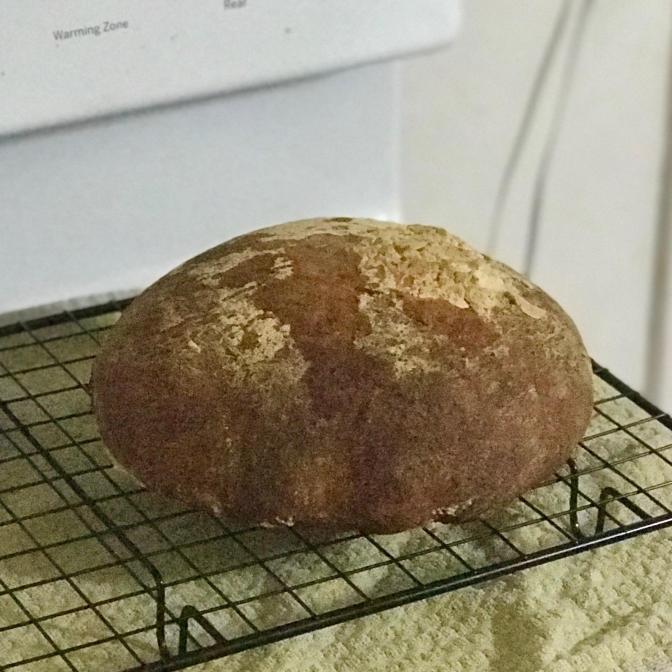
The very first loaf of the bread from the book. A bit overly brown, the slashes weren’t deep enough on top, and it is definitely a good reminder that everything can be seen as a work in progress! If at first you don’t succeed (in doing it perfectly), obsess  endlessly over the next loaf!”

Part of the mise en place that I need to enact in my own life is the ability to roll with the punches with grace. I need to prepare myself for when things don’t go perfect every single time I bake, especially as I do have blind spots in how I often prepare. I need to learn to let some expectations go and to have the capacity to replace my frustration with amusement. That’s a preparation that needs to happen deep in my heart. It is also a preparation that goes beyond my cooking.

When I wake up in the morning, do I prepare my heart for things going wrong in my day? Do I tell God that I want today to be a wonderful day even if things go sideways? Do I seek to find places not only to feel gratitude but to foster gratitude in my life? Do I practice the mise en place to be ready for my life?

IMG_1756.JPG

You see, now that’s a little bit better!

I think Preston Yancey is correct that disciplines like the examen can help us to be prepared for the turmoils of life, but I also believe there is something powerful about the discipline of asking God to give us what we need for a given day or a given hour. Do we prepare ourselves for the kitchen of life? If nothing else comes out of this week’s study, I am grateful I now have that question to ponder.

How about you? Do you have a favorite practice for preparing for a day of life in the real world? Do you have some sort of pattern or practice that helps you to be ready for whatever comes in your path?

Let us Ramble: On Giving “Kine”

Today has been an ordinary day of ministry in New York State. The snow has been falling at a constant rate for a couple of hours, the kids are home from school due to the weather, and the mood around the house has been a bit cranky as both parents have had their plans of getting extraordinary amounts of good things done abandoned and thrown to the wind. Meetings were cancelled, plans postponed, and ideas adjusted. In case you had not realized it yet, life still happens to people who live a life in ministry—there is no magical “Get out of jail free” card handed out to ministers when they agree to serve a church.

Before the snow began to accumulate heavily, I went out to visit a member of my church on comfort care. Their identity is known to God and the most I will say is that the individual has had a long period of being seasoned by life. I spoke with the family, agreed to sit with the individual for a while so they could get some rest, and settled down into a chair with Bible and Kindle.

I read a little scripture, prayed some prayers for the individual, lifted up the family in my prayers, spoke for a few minutes about the memories I shared with the individual, and then sat still. After a few minutes of silence, I found myself drawn to my Kindle and the copy I keep on my Kindle of the Carmina Gadelica.

The Carmina Gadelica is a collection of prayers and poems transcribed by Alexander Carmichael after being collected and recorded in the time that crosses the boundary of the 19th and 20th centuries. The Carmina Gadelica is an intriguing book in the fact that it chronicles a blending of cultures between the Celtic traditions that survived and the Christian traditions that took root in the British isles. I find the Carmina Gadelica to be an interesting collection that is very thought provoking.

I was reading through the second volume when the prayer “The Incense” caught my attention. I have come to believe that context affects the way we see the world around us. Sitting by the bedside of this individual as they breathed beneath closed eyes that saw the world when I had visited the day before and that had been bright before pneumonia came to visit in my absence, I read “The Incense” differently than I had read it before.

The translation of the following poem comes from the “Carmina Gadelica: Volume II” as translated by Alexander Carmichael. The poem is entitled “The Incense”

“In the day of thy health,
thou wilt not give devotion,
thou wilt not give kine,
Nor wilt thou offer incense.

Head of haughtiness,
Heart of greediness,
Mouth unhemmed,
Nor ashamed art thou.

But thy winter wilt come,
And the hardness of thy distress,
And thy head shall be as
The clod in the earth.

Thy strength having failed,
Thine aspect having gone,
And thou a thrall,
On thy two knees.”

I looked up the word “kine” in the dictionary. “Cattle.” Kine is another word for cattle. What does it mean to give cattle in the context of days of health? What do cows have to do with incense or devotion? As a student of religion, my first thought is sacrifice. Sacrifice was once one of the ways how a person expressed regret, fealty, or even respect to God.

This cow is kine of a big deal…

The subject in “The Incense” refuses to give kine. They have no sense of devotion, no desire to sacrifice, and seemingly no reason to burn those herbs and fragrant plans which have been burnt in countless traditions to symbolize a drawing near to the divine. The person is haughty, greedy, unrestrained in their speech, and without shame in their time of strength, health, and well-being.

Yet, the poem goes on. Winter will come. They will come under the power of time, age, and weakness in time. Indeed, the person will one day find their life on earth equivalent to a clod of earth in the ground. The poem is bleak in many ways. The poem paints a picture of a person who does not understand their need in the days of their strength.

Sitting by a bedside, watching someone breathe breaths that might be some of their last in this life, and contemplating this poem was a different contemplation than many contemplations that I have had over the years. Am I wise enough to give kine in the days of my strength? Do I have the wisdom to realize that there will come a day when my choices have been removed from my path? If I do understand, do I let that wisdom affect the way that I live my life?

Can I live with gratitude for the gifts I have been given? Can I let that gratitude guide my choices? Can I choose to deny the parts of myself that want to be haughty, that live in greedy places, or that wish to live unhemmed by matters like compassion, empathy, or grace? Can I live a life marked by devotion and prayer? Can I live a life where kine are not for amassing into a giant herd for my profit, but instead exist in my life as a source of life and blessing for those around me? Can I live out my life in faith in such a way that I will one day find myself on my knees in a place marked by trust in God rather than the frailty that comes from regret?

Sitting with someone who reached an age where they were well seasoned affected the way I read the poem. I am not concerned by the individual I was sitting with while reading. The person I was visiting had a life that seemed marked by faith, hope, and love. The person’s presence was enough to remind me that, unless Jesus comes back in their lifetime, even the most righteous person will age and find themselves at a place on the threshold between one life and the next.

I pray that I have the wisdom in my own journey to find the humility the subject of “The Incense” seemed to miss. I pray that when I reach a place where I find myself on my knees, I will find myself enthralled by faith, hope, and love, but not fear.

Let us Ramble: Diving Inside

It has been no secret that I have been attending the Academy for Spiritual Formation through Upper Room Ministries over the past 9 months. Once a season, I have travelled to Malvern, Pennsylvania to meet with holy conversation partners and teachers about a variety of spiritual traditions and how they can affect the way we approach spirituality. As much as there is an academic side to the studies, I have found the program to be highly practical and personal.

For our upcoming session, we are looking at both the (w)holiness of the relationship between our physical bodies and our spiritual selves as well as Orthodox spirituality. By Orthodox I mean literally Orthodox Church spirituality—there has not been a ton of lectures teaching heretical matters or anything of that nature.

On a side note, the Academy has actually been a great place to have open discussions on spirituality from a great range of Christian (and Jewish!) traditions without a need for those kinds of arguments, which has been really refreshing after a long traditional education where argument and counter-argument sometimes seemed to be at the heart of the formative process. To put it simply, the Academy is more about discipleship than conversion, which is why I adore my time at the Academy and recommend it highly for people who are tired of argument and long for personal formation. Yes, by the way, it is open to clergy and laity—both are welcome and appreciated in my experience.

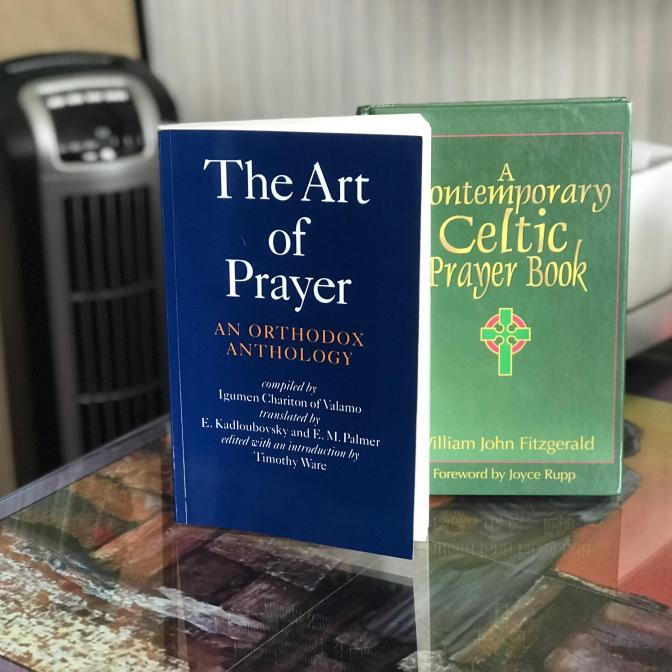
While I will admit that a lot of the Academy preparation for the next session makes me nervous as my back has been acting up and I understand that things like yoga might challenge it during the next session, I find myself coming back again and again to the readings for the Orthodox spirituality section of the Academy. In particular, I am working my way through “The Art of Prayer: An Orthodox Anthology” as compiled by Igumen Chariton of Valamo, edited by Timothy Ware, and translated by E. Kadloubovsky and F. M. Palmer.

My copy of “The Art of Prayer” along with a subtle suggestion of another cool book filled with very cool resources for next month for all of my Irish loving friends.

A quote has stuck out to me in the introduction by Timothy Ware. Ware quotes Theophan the Recluse as saying “The principal things is to stand with the mind in the heart before God, and to go on standing before [God] unceasingly day and night, until the end of life.” Related to the depth of this idea, on the sixty third page of the anthology (which is where the quote Ware was citing in the introduction resides in the anthology) Theophan writes: “Every prayer must come from the heart, and any other prayer is no prayer at all. Prayer-book prayers, your own prayers, and very short prayers, all must issue forth from the heart to God, seen before you.”

In our church we have been in a lot of deep conversations lately. I personally have been in several conversations where we have had deep debate over leadership from the heart and leadership from the head. Does compassion rule the day when making decisions? Does regulation designed to protect us have the final word in conversation? Does the advice of wise denominational officials have weight equal to the advice of our hearts?

The conversations have been deep, thoughtful, and often stressful in nature. To some extent, some of these conversations have had a depth and thoughtfulness I have not seen since some of those deep lunch table debates in seminary which took place between impassioned people with differing knowledge, tradition, and convictions.

I continue to find myself drawn back to these Orthodox Spirituality concepts in these conversations. Ware connects all parts of the self (identified in his worldview as body, soul, and spirit) through the combining connector known as the heart. The heart is intertwined with the body, the soul, and the spirit in a way that is uniting. On the eighteenth page, Ware says:

“The term ‘heart’ is of particular significance in the Orthodox doctrine of man. When people in the west today speak of the heart, they usually mean the emotions and affections. But in the Bible, as in most ascetic texts of the Orthodox Church, the heart has a far wider connotation. It is the primary organ of [a human’s] being, whether physical or spiritual; it is the centre of life, the determining principle of all of our activities and aspirations…it embraces in effect everything that goes to comprise what we call a ‘person.’”

Today’s post is called “diving inside.” I titled the post this way due to the fact that I have been spending much of the past week diving inside of myself in the midst of these deep conversations and asking questions of myself. If I led (or lived) only from the head, could I stand before God with a soul and spirit that has gone ignored? If I led (or lived) only from the heart, could I stand before God with soul and a body that had been ignored? How could a soul even survive before God without that spirit of courage tended by Jesus or that head full of knowledge that has formed me into who I am today? In short, diving into my life’s conversations lately, I wondered if in any circumstance or path I chose, could I possibly stand before God in my heart without my conviction shattering me into a thousand little pieces?

I do not find it coincidental that the Jesus prayer rests deeply within Orthodox spirituality. “Lord Jesus Christ, Son of God, have mercy on me.” Pondering these matters, I have regularly found myself praying this prayer over the past few weeks, but not solely this prayer.

For me, this prayer is held in contrast with the Lord’s prayer. I am making an audacious or possibly even a (forgive me, but this is literally the right word for the situation) bodacious request when I ask God to lead me besides still waters (Psalm 23 runs through my mind when I see God’s reign and God’s will being done in heaven—I am aware it is technically not in the prayer), when I ask God’s will to be done on earth despite the fact that I need forgiveness for my trespasses, or even when I ask God for daily bread. There’s a sense of an almost arrogant familiarity and assurance in the Lord’s prayer that stands at odds with the pure humility found in the Jesus prayer. The two prayers speak from two very different places.

As I have been diving into these deep conversations and into my own spirit, soul, mind, and especially my heart, I found myself grateful for both prayers. There have been times during these conversations when I have felt the only thing I could reasonably ask of God for myself was the mercy that comes from a place of pure and utter prostration before God’s throne. There have also been times when I have had the assurance to know that the daily bread I needed was the ability to extend compassion from a place of confidence, eyes wise enough to look past fear towards the brightest possible outcome while others struggled with fear and anxiety, and even at time to find hope in Christ’s provision even as the conversation needed insight far beyond the wisdom held by mere mortals like me.

I am reminded of the words our ordination class responded with at Annual Conference when asked “Wesley’s Historic Questions” (which are asked of every United Methodist minister). Every time we were asked a “Will you…” question, we responded “With God’s help, I will.”

In many cases, daily life is like answering those questions. Do I know the answer to every difficult question I face in ministry? Heavens, no. Do I make mistakes? Most assuredly I have made mistakes and will likely continue to make mistakes in the future. Do I have faith in Jesus Christ? Yes. Will I continue to seek after Christ? With God’s help, I will. Will I do my best to live my life from a place of peace where all parts of me can coexist? With God’s help, I will. With all this in mind, will I live my life in such a way that I can stand before God in my heart in prayer? With God’s help, I will.

In the end, I believe that Theophan the Recluse was correct. Every prayer must come from the heart. Since that is true, I must not only guard my heart. I must tend my heart like a garden, After all, in Matthew 15:10-20, the gospels record that Jesus taught that it is not what we eat that defiles us, but what comes comes out of the heart. If I am to stand before God, I must tend my heart zealously. To quote the New International Version of Proverbs 4:23: “Above all else, guard your heart, for everything you do flows from it.” If the Orthodox spirituality of Ware is correct, that guarding and tending of my heart means caring for what exists within me, in my body, in my spirit, and in my soul. With God’s help, I will.

Let us Ramble: Imperfect Hourglass

On my desk there are two hourglasses. One holds about enough sand to measure five minutes. The other holds a good ten minutes of sand. I collected them so that I could have a way to manage my time during my times of prayer. If we have two ears and one mouth, the purpose is clear. I might speak for five minutes and then listen for God in silence for ten minutes. In general, it works well both as a focus for my attention when I wander in silence and as an attention for my focus when I need to get to the point in what I am trying to communicate to God.

My two hourglasses!

I know that for some of you, that level of intentional focus might seem a little bit excessive, but for a person whose brain wanders easily… The tools help. The name of my blog (Distractedpastor.blog) was not a mistake.

Still, there are days when my focus is not there. There are times when I want to say more or listen more, but there’s a knock at the door or a buzz on my phone. There are times when I just want to give more into those moments. There are times I want to slow the hourglass down and give more, but do not have the opportunity.

I was reminded of this reality as I was perusing Bernard of Clairvaux’s “On Loving God” this morning. On the nineteenth page of the 1973 translation released by Cistercian Publishing, Bernard writes:

“My God, my help. I shall love you as much as I am able for your gift. My love is less than is your due, yet not less than I am able, for even if I cannot love you as much as I should, still I cannot love you more than I can. I shall only be able to love you more when you give me more, although you can never find my love worthy of you. For, ‘Your eyes have seen my imperfections, and all shall be written down in your book,’ all who do what they can, even if they cannot do all they should.”

I love the phrasing although I’m still parsing my way through the details of the words. “…for even if I cannot love you as much as I should, still I cannot love you more than I can…” How are we able to love God? We love God because God gives us the ability. We shall love more when God gives us more.

On some days, I sit to listen in prayer just as the world turns upside down. In those moments, I am usually able to find the earth before I go flying off into space. The ability to find purchase when everything goes wild can be difficult. In those moments, my fidelity to God’s love and purpose is usually as a result of the blessing God gives me.

On other days, everything is absolutely peaceful and I have the time to dive more deeply into God’s love and grace. In those moments I find myself able to bring more of myself into my relationship with God. In some moments, it even seems like the hourglass slows.

In between these moments, I rest in the knowledge that I do my best to do what I am able to do, even if I am not capable of doing everything that I should. My flaws are known to God, my brokenness apparent, and I bring what I can bring to the table.

I am reminded of one of my favorite pieces of art. The one of a kind portrait is hung in a cheap poster frame on my office wall. It is really poorly mounted, but hangs in a place of prominence. It is the very first work of art my oldest child brought home from school.

Now, when this painting was painted, was it perfect? No. Did the then 3 year old Grace understand how many nights I spent caring for her as an infant? Did she know how I felt when she spit up on my shoulder and the picture capturing that splotch of milk is what made it in the newspaper? Of course not, but she loved me as she was able. Warts and all, I have seen my daughter. I love her, so I love this painting.

The apple tree from my elder daughter’s first weeks of school

For me, this is what Bernard is talking about in his passage. I may never be able to love God as perfectly as God deserves. I may never be able to do something worthy of God’s affection. I can do what I am able to do, despite the moments that I spit up on God’s shoulder. Invariably, we all do as we can do in this world. I simply pray God will see the same affection in my love as I see in my daughter’s love.

Let us Ramble: Oh the places you’ll bless

In the fall of 2012, I was presented with a prayer blanket by the Pennellville Merry Stitchers. A series of unfortunate circumstances meant that I was only pastor in Pennellville for a few short months, but they had been very exciting and rich months of ministry. I have fond memories of walking down the street by the church, enjoying the occasionally rustic smell from the nearby farm, and the warm people I came to know briefly.

Their prayer blanket has come with me many places. I took it on the airplane when I flew to Ireland despite my terrible dislike of airplanes. It has been with me in moments of doubt. The prayer blanket has draped my shoulders through many a difficult moment of discernment.

Today the blanket is rolled up and supporting my back. I have had intermittent back troubles over the past few years and my back flared up after a long and stressful weekend. This morning as the medicine soothes muscle spasms, the prayer blanket is against the area of trouble. The sacred stitches are bringing comfort to hurting places.

One blessed blanket!

We do not often know how the things we do will affect other people. Sometimes the things that we do have negative consequences which we do not expect. Sometimes, the things we do bring blessing into unexpected areas. As my back rests against this bearer of prayers and blessing, I am reminded of good people and that they, for a brief time, loved me deeply as their pastor. There is a healing power to those memories and thoughts.

Stitch a stitch today. If you cannot stitch, then be merry. May your actions bless the world across years, even when you cannot see the effect of your love on others. Be a blessing.

Let Us Ramble: Celebration

There are several spiritual disciplines that I find difficult. In my life it seems that few disciplines are as hard to accept and to act upon as our call to celebration. It may seem a hard thing to believe, but celebration is difficult for me as an individual.

It may seem strange that a person who enjoys science fiction and cooking would have difficulty with celebration, but at some point I was infected by the idea that celebration was a sign of pride, of arrogance, of “loving the world,” and a thousand other things that I should shun. I was in my thirties before I even began to consider the possibility that celebration was a discipline. I am still working on entering more wholeheartedly into the act of celebration.

It is odd that it took me so long to understand the concept that God calls us to celebration. How many psalms mention taking joy in God’s works or entering into worship with music and dance? Matthew 11:18 records how Jesus was accused of celebrating too much! God calls us to have gratitude for the blessings that God has given to us and to rejoice in God’s love! We are called to celebrate!

I am reminded of this fact in particular today as I celebrate the birth of my middle child Joy. Joy is a reason for celebration. For all the ups and downs of life, we are called to celebrate and she is indeed a reason for great celebration.

Perhaps there is wisdom in the celebration of Job. Job is not known as a celebratory kind of man, but consider the description of Job. Job 1:5 speaks of Job’s tendency to come to the Lord with gratitude for his children each time they celebrated feast days. His love and celebration brought him to a place of gratitude, a place where sacrifice was willingly given for his children’s sake, and to a place where his thoughts of children led to God. In a way, he celebrated them.

I give thanks for my Joy. May God bless her and help me to celebrate her uniqueness and wonder more often. Amen!

Let us Ramble: An Arresting Quote on Charity

Recently, a college classmate of mine from years ago asked a question on Facebook. If I could write a paper on any female spiritual figure in history, which person would I choose? I love open-ended questions and spent a couple of days perusing the answers until late Thursday morning. I had been working on collecting reports for our Annual Meeting and had just completed a report for a member who is in need of a bit of a hiatus. In other words, I was out of coffee, had been up worrying about my infant with a fever most of the night, and was a bit bleary eyed. I took a few moments to look at my bookshelf for something that I could peruse for a few minutes while my wits came back around to meet me and the next item on my agenda.

My eyes fell on one of my favorite books from a few years back. I came across “The Mirror of Simple Souls” by Marguerite Porete. My edition is from “The Classics of Western Spirituality” of Paulist Press in 1993 and was translated by Ellen L. Babinsky with a preface by Robert E. Lerner. I immediately thought of the post, remembered that nobody seemed to have mentioned this wonderful author, and jumped to share with my old college friend.

IMG_1344.JPG

My copy of Marguerite Porete’s “The Mirror of Simple Souls.” I recommend it highly!

I picked up my copy, began to peruse, and then began to laugh. Did you ever wonder what would get a woman killed by the inquisition in France in 1310? Well, writing in vernacular French didn’t help. What made me laugh was the translation of a part of the trial where the inquisitor is shocked that not only did Marguerite not burn her copy of her book after a former bishop ruled it heretical, she kept thinking it was a good book, and dared to send it to another bishop as well as other simple folks “as if it were good!”

I do love a woman who believes in herself and her God! She spoke the language of the people, cared about the people, and kept on believing in God’s call on her life despite the challenges! Authority should be respected, but let’s be clear—Marguerite Porete saw authority abused and relied on her faith in the highest authority of all! Here was a woman who makes me smile!

I began to spend a few minutes browsing over the pages while working up the courage to go across the way to heat up a cup of coffee. I was reading along when something caught my eye worthy of a blog post and inspirational enough to get me to hold off on grabbing that cup of joe. Here’s what is translated from the fourth chapter of Marguerite Porete’s Mirror of Simple Souls:

“Charity is such a wise merchant that she earns profits everywhere where others lose, and she escapes the bonds that bind others and thus has great multiplicity of what pleases Love.”

I love this concept. As I pen this blog post for Monday morning, I am drawn to think about charity. Charity has many roots and I do not pretend to be an etymologist, but I noted with enthusiasm that the Online Etymology Dictionary stated that around the time of Marguerite Porete’s life, charity became connected with the concept of the affections we ought to feel for other people. In my own imaginary world, there is a distinct correlation between these facts!

I think about the ways we ought to feel for other people and how that inspires us a lot on Mondays. Recently, my primary visitation day for going to visit people in their homes or in care-facilities is on Mondays. As this is posted online (unless something goes askew) I am likely riding in my car down to visit one of our saints in the Triple Cities. Some of these visits are easy to accomplish as the saints in question are lively, ask deep questions, and appreciate a good visit. Some of these visits are heartbreaking at times when the saints are struggling.

When we consider how we ought to feel for others and then when we let those feelings affect who we are as people, we are entering into the purest form of charity. Charity is not meant as something begrudgingly given, something scowlingly given, or something unfortunate that has to happen in order for the charitable person to to be one of the good people. Charity is our opportunity to live into the same gracious love as our Lord and Savior first showed us. Charity is our opportunity to become the hands and feet of God and to enter into the dance of God’s love. Charity is an amazing thing!

Marguerite’s concept arrested my eyes because of the simple beauty of the idea. Charity finds profits where others lose. Charity finds freedom where others find fettering chains. Charity abounds in what pleases Love. These ideas are so simple and beautiful.

How can charity find profit where others lose? Perhaps it is because charity, when birthed by love, sees things through different eyes. The world says that you will never get rich by taking weekends off from work and volunteering to play basketball at the YMCA with kids. You will never get rich volunteering with the Boys and Girls Club or with your church. You also cannot buy the love those kids may come to have for you as a person. You cannot buy their affection, their love, their admiration, their imitation, or any of the other blessings that come being involved in a ministry of charity. You will never get rich with money—you may become rich with love.

How can charity find profit where others lose? Sometimes it is because love follows love. In the spring of 2013 I witnessed the worst community fire of my career in Boonville, NY. The church I was serving became a hub to help provide food, shelter, space for the American Red Cross, and information for the people who were displaced. Do you know what happened when we tried to buy lunch for the people who were displaced? We were matched by others and nobody went hungry. Do you know what happened when we started to collect clothes? The fellowship hall was filled with blessings. Every time we tried to give what we could, others joined in with us in charity. Perhaps you may find no personal profit in engaging in charity, but sometimes the love of God seen in you inspires others to bless those around us.

How does any of this promote freedom? I believe charity breaks the bonds that hold us in place. Often we get trapped within our own prisons by tradition, by circumstances, by our own limitations, and by our own imagination. There can be freedom when charity invites us to feel for others like we ought to feel, when charity motivates us to move past feeling to action, and when charity finally overwhelms our prisons.

The week of the fire in Boonville wasn’t just a holy week. The fire took place during THE Holy Week. We had to cancel our extra services on Thursday and Friday to care for people in need. We worshipped across church lines with Presbyterians and Baptists that week on Maundy Thursday and Good Friday respectively.

They welcomed us as guests and opened their hearts and church homes to us. What kept us from worshipping together before? Pride? Maybe. Tradition? Probably. Silliness? Definitely. I never enjoyed worship services so much as when we came into those churches, sat exhaustedly down, and we were welcomed and loved despite our tiredness and our Methodist personhoods. We United Methodists made space for others and through charity we found the freedom to look beyond our doors. We had the freedom to find our family and spend time with them. The family of Christ worshipped in a holy way that week.

When we engage in charity, we find ourselves in places where we can build up an abundance of love. I will likely be thinking of Marguerite’s call to charity was I walk through the doors of Bridgewater Rehabilitation or one of the United Methodist Homes this morning. I pray that you would find places to fall in love with God, to love your neighbor, and to connect with who you ought to be—someone filled with holy charity, freed by grace, and abounding in love.

Let Us Ramble: Random Chinese Food

Last night I had a meeting at the District Office in Endicott. It had been a long day between having a snow day for the kids and needing to get ready for Sunday. My wife had a meeting out of town and swept in the house twenty minutes before I needed to leave with a cute and cuddly baby that I had not seen all day.

We tried to talk as the family ate the huevos rancheros that I had cooked for their “breakfast for dinner.” The elder kids also wanted to talk with their mom. My wife and I did not have a chance to connect before I needed to leave. I sat in my car in Endicott and tried to think of something I could do to connect with my wife. I realized how hungry I was, looked at what I had eaten for dinner, and realized I probably needed more than 150 calories. It turns out one tiny tortilla with one egg is not exactly filling.

I brought home a container of mystery Chinese food. I literally walked in the restaurant, looked at the chef’s specialities, found something I had never tried and did not understand, and brought it home. It turned out to be a shrimp and vegetable dish with a nice light sauce. It was rather tasty.

Some days it takes work to connect with your spouse. As we ate Chinese, our baby was fussing and crying at us both. I took chopsticks full of rice in between moments of putting her pacifier back in place. The baby did not really settle for hours. It was not an easy evening after my meeting, but my wife and I found moments together over a new experience and a new food.

Marriage takes work. Even when everything seems to be going perfectly, marriage takes work. I am glad that I took time after a very long day to connect with my spouse.

Let us Ramble: Snowbanks as a Metaphor

On this past Christmas Eve I found myself preaching at church. Most years that would not have been news, but this year I was on paternity leave. My good friend who was providing pulpit supply was under the weather, so I pulled together a sermon based loosely on what I had been reading. I had been spending a lot of time reading the 1973 translation of Bernard of Clairvaux’s “On Loving God” produced by Cistercian Publications. My sermon was effectively revolved around the concept that we should love God and celebrate Christmas because it is a celebration of Christ becoming the incarnation of God’s love for us.

As I type this blog entry, the sounds of my two elder children are pouring in through the door between my church office and the church nursery. Outside it is still snowing despite the fact that the snow day my kids prayed for last night has become the reality of today. By the road there are piles of snow building besides cleared paths. The piles are growing with every pass of the snowblower. The snow keeps falling despite the fact that I asked it to stop nicely. The snow will keep falling because the snow is stubborn.

As I was pondering the snow this morning, I came to a realization. Technically, I had two realizations. First, I realized that the snow would be breaking my back if it were not for the blessed snowblower. I injured my back last year and have had to become very careful with how I use it in order to keep from injuring it again. If I were to lift up that much snow my back would be destroyed.

Snow is beautiful until it falls down the back of your shirt.

Second, I realized the snow could be seen as a great analogy. The snow is heavy, deep, and weighty. In the same way, the love I owe God is heavy, deep, and weighty. So, let’s draw in Bernard of Clairvaux. Bernard writes (on the eighteenth page):

“‘What shall I render to the Lord for all that he has given me?’ In his first work he gave me myself; in his second work he gave me himself; when he gave me himself, he gave me back myself. Given, and regiven, I owe myself twice over. What can I give God in return for himself? Even if I could give him myself a thousand times, what am I to God?”

So, God gives us two gifts. First, God created us. To bring in some language from Psalms, we are knit together in the womb by a loving God. We are created in the image of God by God. How in the world could we ever repay God for such love? Can we give anything to God that wasn’t made possible by our creation in the first place?

Second, God recreates us. Bernard writes (a couple of lines before the previous quote): “He spoke and they were made. But he who made me by a single word, in remaking me had to speak many words, work miracles, suffer hardships, and not only hardships but even unjust treatment.“ God went to extraordinary lengths to take me as a broken person and provide a path towards redemption through Jesus Christ. What could any of us do to repay that much kindness and love? What gift could we offer?

What God has done is like the snow falling from the sky. Try as I might, there’s no way that I could ever lift all of that snow. My debt to God for his loving creation and remaking of my life is deeper than any snow drift I could shovel, heavier than any snow falling from the sky, and utterly beyond my ability to shovel, melt, or remove. God’s love is like a blizzard and there’s no way that I can ignore the weight and the effect it has on my life.

Ultimately, all that we can really do is accept the gift of God’s love and respond as best as we can with the love we have in our hearts. The love of God will keep falling down on the beloved children God has adopted, May we respond with grateful hearts!

Let us Ramble: Solitude, Faith, and Community

A noise tickles my ears as a buzz begins at 5:59 AM. My phone buzzes and begins to flash. I wake up early to check if the paths need to be cleared of snow before the teachers and staff of the church community arrive. After a cold time clearing up the snow with my snowblower and a headlamp, a hot shower to warm up chilled bones, and a hot mug of coffee, I settle at the table with my notebook. Soon, as the eggs bake for breakfast sandwiches for my wife and children, I will find myself digging through the Revised Common Lectionary.

This day I am flicking through the story of Saul being chastised by Samuel for caring more about what his people want than what the Lord required. I write a poem about Saul’s predicament while thinking and praying about what God’s message for Saul says to me as a Christian, as a husband, as a father, and as a pastor. The words are deep this morning as my heart struggles to make sense of the story of God’s chosen one being rejected for his actions. I weigh the passage carefully with others that have been dwelling in my heart.

I find these moments of devotion while the room fills with the smells of cooking breakfast to be sacred. They are not always perfectly isolated. Sometimes I finish my poem while my kids are making cocoa across the room. Occasionally a crying baby will interrupt this time with her needs. It is a time that actually gets interrupted regularly towards the end, but it is also one of the most sacred moments of the day. Even with interruptions, the ground I walk upon in those moments is holy.

In these moments of personal devotion, I sort through my dreams and prayers from the recently passed night. In these moments of personal devotion, I find inspiration that often affects the way I live out my faith life. In these moments of personal devotion, I often find the fuel that feeds quiet prayers for the community which follow. Have I read about love? Standing in the window, cleaning up dishes, I pray with love for the people in my church and community who are in need. Have I read about sacrificing for others wellbeing? I find inspiration to pray for the bus drivers who pass by the window. The personal devotions of my morning feed my time in prayer and help me to do a better job at being a part of a vibrant church community.

Henri Nouwen, in his book “Discernment” wrote (on the tenth page of his book):

“Communion with God alone in prayer leads inevitably to community with God’s people, and then to ministry in the world. But it is good to begin this spiritual movement in solitude…When we are alone with God, the Spirit prays in us. The challenge is to develop a simple discipline of spiritual practice to embrace some empty time and empty space every day.”

For myself, the moments in my day that are emptiest and have space for the Holy Spirit are between checking the paths to see if they are clear and when my children get out of bed. The time that I spend alone with God in those quiet places strengthens my relationship with God. That strength then leads towards others.

Invariably, my time with God tends to lead towards other people. Sometimes my prayers are led towards my family, but more often than not, I find myself drawn to pray for situations around me in the community and in the church. I want to be clear about this fact. My personal devotions do more than inform my prayer. My personal devotions empower my ability to pray. If the spiritual life of a Christian is a river, my time in personal devotion is one of the springs where that spiritual life finds the living water.

When the Spirit prays in us, our lives change. If you look back at a number of the great figures of Christian history, a lot of them speak about powerful moments of connection with God. Some of the descriptions of these moments can induce a blush! These moments of intimacy with God generally did not come out of a place of constant action. If you look, most of these moments come in lives marked by time spent with God. Like any relationship, a relationship with God that is healthy requires time spent together.

So, how do you begin to discern the right time for spending time with God? The first thing I suggest to people who ask me in person is that they chart out their day in blocks. What regular patterns emerge in your daily life? I found myself needing to wake up early to take care of sidewalks for the winter. As such, for this literal season, a period between that daily chore and when the rest of the day began emerged. For some people, there is a lull in the late morning, especially if you are retired or work a second or third shift position. Each person is different and taking a look at your regular patterns can help you notice places that are empty.

Second, if a person cannot find those moments of free time I suggest that there be moments in your day that might be better used doing something else. Back when I tried to engage in evening devotions despite my tiredness, I used to spend my mornings before the girls woke up listening to the news. The news often made me anxious, led to me feeling inordinately stressed at the beginning of my day, and often served more as empty noise than something of substance. I was better served by spending that time with God than spending it listening to the news. I still check the news later in the day, but I first ground my heart and my soul in God before facing what the world will throw at me.

Third, I often suggest that you begin with a simple devotion. There are wonderful resources available through many fine publishers. A trip to a local bookstore will often provide a lot of helpful options. Our church provides copies of the Upper Room Daily Devotional and we would work with anyone who wanted to explore one of the other options available. There are also a number of reading plans available through places like Bible Gateway that can help you to explore your Bible over a set number of days. Even the United Methodist Hymnal has a pattern for daily worship and prayer in the rear of the hymnal. There are many options available.

Fourth, try new things on occasion. If you, like me, enjoy the Guide to Prayer for Ministers and Other Servants, consider using the Book of Common Prayer for a season. If you enjoy using Our Daily Bread, ponder trying out the Upper Room for a time. If you are going through a dry season, it might not help if that season is supposed to be teaching you something, but if your situation is simply fatigue—a change of pace might help.

What suggestions do you have for starting a time of personal devotions? Have any practices been particularly helpful?

Let Us Ramble: Hobbit Holes and Worship

So, I decided that I would spend a day doing a light-hearted blog post. The blog has been pretty dense since I returned from paternity leave, which reflects some challenges behind the scenes of ministry. In the midst of everything, I found myself needing to read to my infant the other day. She would not calm down without hearing my voice while rocking back and forth. I decided to read to her, looked through my Kindle purchases, and began to read her “The Hobbit” by J.R.R. Tolkien.

In the very first chapter, Bilbo encounters Gandalf. Gandalf is seeking aid in an adventure. When Gandalf expresses difficulty with finding someone to join him, Bilbo replies: “We are plain quiet folk and have no use for adventures. Nasty disturbing uncomfortable things! Make you late for dinner! I can’t think what anybody sees in them!”

I started to laugh when I read this passage. I found humor in the fact that Bilbo will definitely go on an adventure, but also because I am aware that the hobbit acts a lot like me! Over the years I have truly enjoyed several versions of “Bag End.” In the apartment that we first shared when I was in seminary, I took over the walk-in closet in our living room and turned it into my office. I spent many hours under a single incandescent light bulb with books of theology, an aging computer, and a cup of coffee. It was definitely my own little hole in the ground. To be honest, it was absolute bliss…

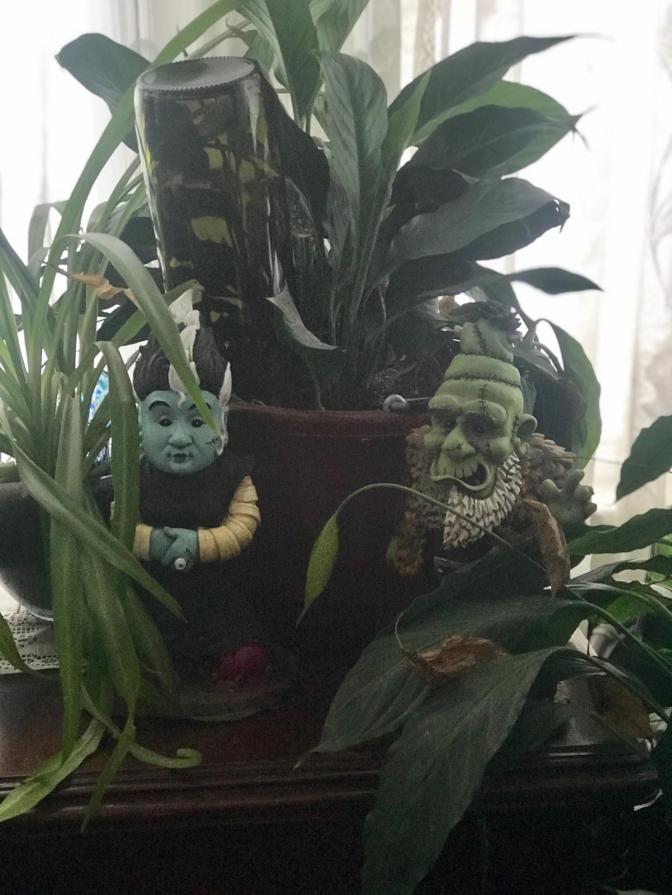
Since we left that apartment, I have not really had a hole to hide in of quite the same caliber, but I have enjoyed several offices over the year. The closest I have come is my current home office which is filled with plants, garden gnomes, and within sight of several rather tookish children that enjoy their own adventures.

Two of my favorite garden gnomes sit right next to the computer desk in our “library.”

I can understand the enjoyment of a space. There is something safe and secure about being in a familiar place with reminders of pleasant days and happy nights. If you invest a space with a lot of happy cups of coffee, hours of research, or even just time spent happily interacting with friends, a space can become pretty comfortable. In fact, it can be hard to walk away from such spaces sometimes…

There is a challenge that comes with living in a land where adventure can come from simply stepping outside of one’s door! Winter is here in the United States. With winter in this particular location comes things like snow, ice, and slush. This area is by no means the snowiest place that I have ever lived. To be entirely honest, it is actually the least snowy location where I have ever resided, but less snow is not the same as no snow.

Some Sundays, freezing temperatures strike and nobody is at the church. Some nights we would have a committee meeting but there’s a forecast that keeps us from having anywhere near quorum.It can be really frustrating to deal with winter adventures, and sometimes we seem to embody the spirit of Bilbo Baggins. “Go to church? In this weather? We are plain quiet folk and have no use for adventures. Nasty disturbing uncomfortable things! Make you late for dinner! I can’t think what anybody sees in them!”

So, here is some advice for people in church leadership during winter:

  1. Love other people. I have been quoting Hebrews 13:1 a lot lately. In that verse we are reminded to “let mutual love continue.” Sometimes people will let us down and not make it to a meeting. Love them. Love them. When you are done, love them some more. Yes, they might take advantage of your love and continue to engage in the behavior that bothers you, but extend love first. All mutual love comes from someplace and we must be willing to love first. I am reminded of the passage I read the other day in “Ways of Imperfection” by Simon Tugwell. In that passage, on page 18, Tugwell points out a story where abba Poemen was in a conversation where several monks were discussing how to deal with a monk who kept falling asleep in church. After several rather strict ideas are suggested, abba Poemen is reported by Tugwell as saying: “If I see that my brother has gone to sleep, I cradle his head in my lap.” If ancient monastic Egyptians can understand the idea of compassionate loving in such circumstances, certainly we can as well.
  2. Consider the circumstances. If you have a meeting with a saint who cannot drive after dark or on roads that might be challenging after peak maintenance hours, do not plan that meeting when things might be iffy. Roads (in our area) are often sketchy after dark and first thing in the morning. A little prior planning never hurt an administrator or worship planner. Late night services might fit the mood of an occasion like a “New Year’s Eve Prayer Vigil,” but be aware your worship time and the weather that surrounds it might affect some people in ways beyond their control.
  3. Consider situational problems. If someone no longer comes because they slipped in your parking lot, consider ways you can make your parking lot safer. Alternatively, ask someone (or go yourself if you are able) to walk with them from their car into the church meeting. Again, a little prior planning is an integral part to good leadership.
  4. Let things go. Nobody is helped when you dwell on things you cannot control. The weather turned sideways and your one absolutely perfect sermon of the year was heard by five people? Well, that happens sometimes. It is better to let go of your frustrations than to let them take root in your soul. You are a walking temple of God. Do not track dirt into your heart.

Those are four pieces of advice for leaders of churches during the slippery months. Do you have any other suggestions? What has worked for you?

Let Us Ramble: Nineveh and Change

I would like to begin this entry by pointing out that I sometimes struggle with the work of the Council of Bishops. I find that they often equivocate on challenging issues and I long for firm statements marked by honest reflection on scripture, tradition, reason, and experience. I long for deep statements based on the discernment that comes from the Holy Spirit. I sometimes feel disappointed, but that’s what happens when imperfect people gather together. Disappointment happens and that disappointment is inevitable. I still respect that body of leaders and consider their words carefully.

So, when I see statements like the one made last week by the Council of Bishops, I find myself doing more than simply paying close attention. I practically cheered when I read the Council of Bishops refer to racist behavior as racist, harmful behavior as being harmful, and urging on United Methodists to call for an apology from President Trump. These unequivocating and straightforward statements were startling coming from the voice of the bishops of the United Methodist Church. I would expect such words from an individual bishop, the General Board of Church and Society, or even individual conferences, clergy, or churches. As it would be almost impossible for the General Conference to gather globally to release a real-time call for repentance, this is probably as close as a statement can come to being a statement on behalf of the church. In the very least, such unity among so many of the leaders of the denomination is a powerful statement. My wife summed it up when she looked it up last night after we discussed how the statement had affected me. She simply said: “Wow!”

So, today I am honoring their request to call for an apology. To be honest though, I do not believe an apology will be enough. I want to call for repentance, but not just from Donald Trump. I believe we have an illness in our society that has allowed us to bring this kind of behavior to the highest levels of leadership. I believe we need to take a long, hard, and somber look at ourselves.

This past weekend the Revised Common Lectionary scripture included John 1:46. I did not preach out of the lectionary this past Sunday, but I know many of my colleagues did preach out of that prophetic moment in scripture. Jesus is beginning his ministry and calls Philip to follow. Philip comes across several of his friends and invites them on the journey with him. One of them, Nathanael, asks Philip if anything good could possibly come out of Nazareth…

Many of my colleagues point out that Nazareth was one of “those places.” Recent national news has focused conversation on several of “those places” in our own world. Could anything good come out of Haiti? Could anything good come out the heart of Africa? Could anything good come from one of “those places?” How are those places tied to the people who live in them? What does it say about the descendants of those places when we speak it such hateful terms?

As many of “those places” are filled with people created in the image of God, many of my colleagues had a field day, but I avoided the temptation to lash out. Today is a national holiday celebrating Rev. Dr. Martin Luther King, Jr., a man whose ancestry arose out of one of “those places.” I wanted to save my words for a more fitting day like today.

So today, I wanted to begin with a story. The story is an old story and was once passed from family to family and from community to community until it was written down.

Once upon a time, there was a kingdom in a far off land. The people of this kingdom were wicked, cruel, and hostile. The king was powerful, mighty, and by no means innocent. People affected by the people of this kingdom cried out to God on account of the kingdom and the great city within it. God heard the cries of the injured, saw the wickedness of the land, and sent a prophet to tell them that their end was coming. For three days the prophet walked across the city and stated their fate.

People burst into a panic. They stripped off their fine garments and covered themselves in sackcloth. They stopped eating—mighty and meek, all of the people joined in mourning. When the king of the kingdom heard the news, he joined in their grief, he sat down in ashes in garments made of sackcloth. He decreed with his nobles that all would join in the great mourning. Humans and animals together joined in the mourning.

God saw their repentance and changed their fate. Their humility and repentance saved them from their own destruction. The prophet was not exactly happy about the situation, but repentance came to that city.

Those of you who enjoy your Hebrew Scriptures probably realize that I was retelling the story found in the book of Jonah about the city of Nineveh. In my career I have preached several times about the story of Jonah being swallowed up and many more times about how Jonah needed to learn about compassion, but I am not certain that I have ever preached on the subject of what happens in Nineveh itself. Nineveh, the great city and all of her people, has sadly become a bit of a means for other lessons in most of my sermons, messages, and reflections.

Yet, I find myself drawn to Nineveh as I consider recent events. In the translation that goes by the name the New Revised Standard Version, Hebrews 13:1-3 says:

“Let mutual love continue. Do not neglect to show hospitality to strangers, for by doing that some have entertained angels without knowing it. Remember those who are in prison, as though you were in prison with them; those who are being tortured, as though you yourselves were being tortured.”

The author of Hebrews calls on the church to do many things in this chapter of scripture. We are called to things like mutual love, empathy, compassion, and even to simply remember what others are going through in different circumstances. We are warned not to forget our duty toward hospitality, for who knows when we might seek to entertain strangers and instead find ourselves in the company of angels?

As a Christian, when I hear words like those shared by the President of the United States last week, I find myself appalled. When the door is slammed shut in the face of people and places where there are serious problems, Is slamming the door in the face of those facing modern struggles really all that different than the people of the early church forgetting those struggling in prison or facing torture? If these conversations really do go hand in hand with conversations around harder standards for asylum seekers, then we need to realize that the words of Hebrews might apply directly to us without much interpretation.

it is my great fear that we are slamming the door in the face of not only angels, but in the face of people created in the image of God. We are slamming the door in the face of those who call out for justice to a God who listens. When we willingly forget our duty to Christ by neglecting love, compassion, empathy, and even memory, we are doing something incredibly wicked. Do we actually believe that we are so unique as a nation that we are above reproach? Where does that kind of blindness come from as a people? Do we forget that God is ruler above nations and not for nations?

Surprisingly enough, when I googled the phrase “sackcloth suit,” there were entries and sponsored ads. Unsurprisingly, the Brooks Brothers suit Google tried to sell me was not made up of sackcloth. In honesty, looking back into Catholic tradition, there has been a history of “hair shirts” made of irritating haircloth meant to inspire discomfort and thus inspire humility, which is quite fascinating. Looking at the history of the practice, the rarity of practice in modern times, and it seems unlikely that I could find any hairshirts at the local mall.

Of course, that’s probably a moot point. I have difficulty seeing sackcloth on many of the folks that I see when I walk past an interview on a television in a store, in restaurant, or on my Facebook feed. I will say that I did go out of my way to pick up a swatch of burlap while out after church yesterday and attempted to make a burlap necklace. I can tell you two things:

  • First, I’m not great at arts and crafts.
  • Second, wearing it for a couple of hours was a real irritating experience. My neck was itchy, irritated, and it made my shirt look terrible. I was considering wearing it for Lent, but it was so difficult to wear without being noticeable that I am going to have to consider alternatives if I am seeking to practice my piety before God and not before other people.

My terrible necklace, wound around my wrist, so you don’t need to see the hints of gray beginning to show up in my goatee…

The attempt did answer a really important question for me though. Is it comfortable to go out of one’s way to repent? Oh, heavens no. The King of Nineveh and the people of that place must have been really uncomfortable and very motivated. They went out of their way to not only refrain from food and drink, but went further to introduce a level of discomfort into their life that must have been incredibly frustrating.

The Council of Bishops is correct. President Trump’s words were racist, are offensive to all people of God who believe that the people of those nations are made in the image of God, and they caused a significant amount of harm both internationally and domestically. President Trump needs to repent. We need to repent also.

I say these things as someone who has needed to do a significant amount of repenting in his own life. I grew up on Grand Island, NY. I grew up believing the Seneca Nation was trying to take away our hometown and I had a lot of very strong opinions about the Seneca. I grew up among a people who looked at the native population of what was my hometown with a less than Christian light. Let’s be honest, at times I was downright racist. I thought of reservations in ways like our President speaks about other sovereign nations like those named last week.

I was wrong. The things I believed were wrong. The way I acted in my heart towards my human sisters and brothers in the Seneca nation was wrong.

My change in attitude started thanks to a band called Five Iron Frenzy singing about social justice and introducing me to a book. I read“Bury my Heart at Wounded Knee” by Dee Brown as a teenager and it confused me greatly. The stories I read were so unlike the stories people had shared throughout my life.

My convictions continued to change when I was invited to go on a Volunteer in Mission trip to Four-Corners Native American Ministries. I was broken down further in my heart while helping fix windows in the homes of widows, standing underneath the Window Rock in the heart of the country of the Wind Talkers, looking over American flags flying over the graves of brave patriots and warriors, and walking through the Navajo Nation Museum in Window Rock, AZ. My best friend Michael (rest in peace, my brother) stood with me under a blue sky as I began to confess my sin and my struggle underneath the eye of Window Rock. It was Michael who told me that I had a lifetime of amends to make and that I would have to keep working at things. I have sought to challenge and grow in my understanding since that day and since that conversation.

I was so ignorant and so foolish to accept as normal what I had swallowed hook, line, and sinker as a kid. I never had an issue with hanging around North Buffalo near my grandmother’s house, even as the neighborhood changed from a primarily European neighborhood to a more diverse neighborhood. I was happy to spend time within walking distance of a comic book store and a “Record Theatre.” (Thanks for the memories Mr. Silver…) I didn’t care who lived between Grandma’s house and my comics and my music. To this day, I still feel more nervous on a reservation than I do in a city, but I know this one thing to be true: If I believe that God’s image is in all people, then all people are worth treating as children of God, whether they live in a city, on a country road, in a Haitian village, on the coast of Africa, or anywhere in God’s beautiful creation.

I do not aim criticisms at the President of the United States lightly or from a place of superiority. I have been complicit in my own biases over the years. Still, truth must be held as truth. Evil is evil. Racism is racism. There is a severe need for not only an apology, but for true repentance when we engage in the acts of accepting and advocating for evil.

The old phrase of Rev. Charles F. Aked stands true as much today as it was in the fight against the abuses of alcohol: “It has been said that for evil men to accomplish their purpose it is only necessary that good men should do nothing.” As a people, we cannot in good conscience stand by in times like these without calling for repentance. What’s more, we cannot in good conscience stand by without examining our own behavior and seeing if we are also in need of repentance.

May God help us all in these challenging times. May we move towards repentance without hypocrisy.

Let us Ramble: Humility and Community

This year in my annual report to the church there’s a strong statement. I wrote in November and revised earlier this month the idea that “ We need to remember that we are a community unified and united in purpose.” I did not make this statement lightly as unity within the body of Christ is one of the most challenging and most important characteristics of a healthy church.

You will notice I did not write the phrase “uniformity” as the goal is one of connection and not utter conformity. Unity and unification around a concept is important for any community, but especially a religious community. To borrow from Henri Nouwen (on the ninth page in his book “Discernment”) we should be united around the idea of our “one true desire—to know God’s heart and do God’s will in all things.”

There is nothing as antithetical to unification around this desire than arrogance. Arrogance leads us to believe it is okay to ignore God’s call to simple concepts like talking to people instead of about people. Arrogance leads us to believe that we are better than each other or better than those called to particular ministries. Arrogance leads us to engage in a lot of the behaviors that hurt and harm churches.

I think Bernard of Clairvaux puts it well. The saint from the 1100s has been translated (by the Cisterian Order in their 1973 critical translation) as saying “If ignorance makes beasts of us, arrogance make us like demons. It is pride, the greatest of sins, to use gifts as if they were one’s by natural right and while receiving benefits to usurp the benefactor’s glory.”

Now, what’s interesting about this quote is that Bernard prefaces it by pointing out that everyone should know two facts: what they are and that they are not who they are by their own power. Bernard states clearly that everyone needs to know that they are who they are by the gift of God and to accept their role with humility.

Leaders in the church (both lay and clergy) are called by God to places of leadership. They are given gifts and graces to fulfill their role. It is great arrogance to both take these gifts for granted and to ignore the responsibilities that come with them. Bernard warns strongly against dulling one’s blessing by forgetting one’s call and forgetting the purpose for which one has been blessed. Bernard, holding a very strong opinion, writes (pardon the 1970s language of translation)

“When a man, promoted to a high dignity, does not appreciate the favor he received, because of his ignorance he is rightly compared to the animals with whom he shares his present state of corruption and mortality. It also happens when a man, not appreciating the gift of reason, starts mingling with the herds of dumb beasts to the extent that, ignoring his own interior glory, he models his conduct on the object of his sense. Led on by curiosity, he becomes like any other animal since he does not see he has receive more than they.”

Leaders are called to live up to the blessings they have received. One of the greatest challenges that faces me as a United Methodist Elder is the echoes of the words spoken by Bishop Marcus Matthews over me at my ordination. I was told to “Take thou authority…” The bestowed authority is an authority that comes with challenges that are well addressed by this article from Ministry Matters. Nonetheless, it is a promotion that comes from a place of high dignity within my tradition.

On my desk there’s a list of people with arrows. I was ordained by Bishop Marcus Matthews, who was ordained by Bishop James Kenneth Mathews, who was ordained by Bishop Benton Thoburn Badly, who was ordained by Bishop James Mills Thorburn, who was ordained by Bishop Edward Raymond Ames, who was ordained by Bishop Robert Richford Roberts, who was ordained by Bishop Francis Asbury, who was ordained by Bishop Thomas Coke, who was ordained by Archbishop Potter, who was the Archbishop of Canterbury or the Church of England, which was born out of direct apostolic succession from the beginning of the church.

There’s a high calling to the authority that was passed to me by Bishop Matthews. To ignore the weight and the responsibility of that calling would be a great sin. My authority as an Elder in apostolic succession comes with a great responsibility to not only maintain the standards of my office but to lead with integrity the people of God towards our one great and true desire.

Bernard’s words are not simply for leaders though. Believers in the church who are called to follow (both lay and clergy—especially if clergy serve in an episcopally based system or in a system where there is discernment of the body held over the discernment of the clergy) are called to know who they are, where they are, what is expected of them, and to accept the gifts granted to them by God with humility as well. Leaders are gifts from God often sent to teach us things that come unnaturally without help. Do leaders make mistakes? Yes, but they are often present to teach us things beyond ourselves.

As an Elder in that line of apostolic succession, I am also called to be a follower. I am asked to respect the bishop who has been discerned and sent to be the leader of my Annual Conference, am asked to respect my District Superintendent and the clergy who are called to assist in leadership through both the Order of Elders and the Board of Ordained Ministry. I am called to respect the Annual and General Conference, the Book of Discipline, the Book of Resolutions, and even to consider the non-binding words of the Council of Bishops with respect. I am called to participate in the life of the Conference and to use my voice, but I am also called to be a part of a system that is larger than myself. I am even called to consider the advice of the folks that I am called to lead, even if obedience is not required in that last situation due to the traditions surrounding both freedom of the pulpit and the role of the pastor within my church tradition. The calling to be a follower is as integral to my leadership as my call to be a leader.

In both these roles there’s a role both for knowledge and humility. Bernard writes:

“We should, therefore, fear that ignorance which gives us a too low opinion of our selves. But we should fear no less, but rather more, that which makes us think ourselves better than we are. This is what happens when we deceive ourselves thinking some good is in us of ourselves. But indeed you should detest and avoid even more than these two forms of ignorance that presumption by which you, knowingly and on purpose, seek your glory in goods that are not your own and that you certain are not in you by your own power.”

Bernard (in context) is talking about more than just physical goods. Bernard previously calls accepting praise for the spiritual blessings and spiritual roles that God has granted and gifted ability for to be no less than vainglory, which is excessive pride and vanity. Goods in Bernard’s view are more than just physical things. All that we have is given to us for the glory of God. When we claim anything as rightly ours by our own hand, whether it be a pair of jeans, a work of art, or a paycheck, then we are missing the point of why we have what we have in this life. To tie it back to Henri Nouwen, we have what we have for our “one true desire—to know God’s heart and do God’s will in all things.”

It is the greatest arrogance to take what we have been given for this one purpose and to use it to do the exact opposite. God is love and calls us to love. If we turn what God has given us to purposes of hate, isn’t that rightly named demonic? God calls us to care for the least of the children of God. If we hoard what we have from God to the detriment of those who need us to be the hands and feet of Christ, isn’t that the very heart of arrogance? Aren’t such acts drawing away or usurping the very glory of our one true benefactor?

When we are blessed by God we are called to live for that one true desire. When the Holy Spirit works and weaves within us, the tapestry is meant for God’s glory. When the Son grants us life and a place within the family of God, we are called to follow his teachings instead of our own.

Let us Ramble: Holy Movement

I have been working through some books lately on spiritual formation. One of them is “Discernment: Reading the Signs of Daily Life” by Henri Nouwen. I am finding it a rich feast of a book which is written to people of all sorts. I highly recommend it if you enjoy a good deep book!

I found myself pumping my fist to one particular passage on the ninth page. Henri Nouwen writes:

“Those who live lives worthy of their calling have been ‘reborn from above’ and are able to see with the eyes of faith and hear with spiritual ears. Their lives of discernment are characterized by single-mindedness: they have but one true desire—to know God’s heart and do God’s will in all things. In the words of Jesus to Nicodemus, they live the truth and seek to ‘come to the light, so that it may be clearly seen that their deeds have been done in God’ (John 3:21 NRSV). Such persons are so caught up in God’s love that everything else can only receive its meaning and purpose in the context of that love. They ask only what questions: ‘What is pleasing to the Spirit of God?’ And as soon as they have heard the sound of the Spirit in the silence and solitude of their hearts, they follow its promptings even if it upsets their friends, disrupts their environment, and confuses their admirers.

People reborn in the Holy Spirit with spiritual understanding come across as very independent, not because of psychological training or individuation but because of the fruit of the Spirit which ‘blows where it chooses, and you hear the sound of it, but you do not know where it comes from or where it goes’ (John 3:8). Spiritual rebirth is an evergreen openness to let the spirit of Jesus blow us where it pleases.”

At various times in my career I have been accused of being too quick to bolt out the door to situations beyond my understanding. There’s some truth to the accusation, but I have to admit that sometimes people love that I have this tendency. I will be praying and I will feel a need to call someone and I will call at just the right moment. I once felt the urge to pull into a hospital and went into the wrong entrance where I met a colleague whose wife had just been admitted in need of a prayer and a hug. The Spirit definitely blows where it pleases and I find nothing so exhilarating as coming across the Spirit at work! I have come to embrace that part of my spirit that loves hearing that quiet voice.

This sign is sitting in our church garage. I want to mount it over my desk!

Of course, this tendency to be always on the move is a very Methodist kind of tendency. Read the Book of Discipline of the UMC and you will eventually find the historic examination put before every Elder before full admittance into ministry. In ¶336 of 2016 Book of Discipline you will find the 19th examination to be in the hard-coding of ministry for United Methodist pastors. That examination asks

: “Will you observe the following instructions? Be diligent. Never be unemployed. Never be triflingly employed. Never trifle away time; neither spend any more time at any one place than is strictly necessary…do not mend our rules, but keep them; not for wrath, but for conscience’ sake.”

I believe Nouwen’s evergreen openness to the Spirit works very well with the historic nature of the Methodist circuit riders. When the road and the circuit used to be before you there was a world of possibility with infinite opportunities. Encouraging circuit riders to never idle away the time made sense. Again, this was not meant to be done in fear of God’s anger but instead to aid an easy conscience in the minds and souls of those called to ministry.

Nowadays, I think that these words are often lost in our culture. To believe that we should never trifle away time is something this is bucked against even within religious circles and the idea of never spending more time than necessary someplace is beyond most of us in the ministry world. Between office hours, worship slide creation, bulletins, and other things that tie us to a desk it can be easy to see why such thoughts of intentional movement are beyond most of us. We are often ensnared by the very things meant to help us accomplish ministry!

There is a part of me that misses the idea of intentionally seeking that disruptive still small voice of God. Let’s be honest—I long for that voice on a regular basis. Do you long for that voice? Do you thirst to know what pleases God and feel passionate about joining into that great ministry? If so, my friends, I invite you to listen, to seek, to discern, and then to follow.

Let us Ramble: The Will of God and Disappointment

So, I am coming up to the end of my paternity leave. I have been spending a lot of time caring for an infant, two older children, and their mother over the past two months. There has been time for bonding, time for cooking, time for laughing, time for crying, and a lot of time for reflection while changing diapers.

In the midst of this time of leave, I have been reading a number of books. One of those books is Simon Tugwell’s “Ways of Imperfection: An Exploration of Christian Spirituality.” Tugwell’s book begins rather strongly with some strong words of admonition. Tugwell speaks of the many moods that the church has held over the span of her life. In my own words, it seems that Tugwell believes that the church has been timid, self-assured, arrogant, humble, bold, and headstrong at different points in her life.

With all of these moods in her past, in times of crisis there are often a myriad of directions in which she can wander. I do not find this particularly shocking as I too have a myriad of directions that I can travel to when under stress. Sometimes I snap at the stressor, occasionally I shrink back, sometimes I have patience, and sometimes I will do something completely different. Tugwell, on the very first page of his work, makes the admonition that in “a time of confusion like our own, when people become disillusioned with the church and with christianity, should be a salutary, educative time, when we face the facts.”

Tugwell proceeds to point out that the church must struggle through questions and seasons of disappointment. I believe there are two reasons why Tugwell is correct in inviting us to confront our disappointment..

First, as Tugwell himself argues, the church is not about fulfilling our hopes, dreams, and ambitions. As a minister, at moments I daydream of coming into a packed church which is filled with parishioners on a Sunday morning. I know lay leaders who have dreamed of people begging to bake for coffee hour or for acolytes who will always light the candles perfectly without any need of guidance. Many people have hopes, dreams, and ambitions about life in the church, but Tugwell is correct. The church of Jesus Christ does not exist to fulfill our own will, but “is a mechanism for subjecting all things to the will of God.”

What does that mean? I do not believe that means forcing our views on others, but it may mean realizing the things we desire and the things that God desires are often very different. I might want to have a perfect acolyting moment every Sunday, but that child who cannot walk without assistance may be called by God to have a role in lighting the candles. Involving her might mean doing something different, like setting up a temporary ramp or assisting her up the stairs. Allowing her that role in the life of the church may cause us to end church five minutes late. Are those five minutes my time or God’s time? My view of what should be may have to go unfulfilled and that can be disappointing. My view of what should be might have to be discarded entirely, but the church of Jesus Christ does not exist to do my will but God’s will.

Second, hinted at by Tugwell, but not entirely fleshed out, is another reason why a church following Jesus might be frustrating and frustrated. Tugwell, while referring to the spirituality of St. Ignatius of Antioch, writes on the third page of “Ways of Imperfection:”

“[Jesus] is our true life, and apart from him we are only ghosts, masquerading as human beings but lacking substance. Faith is the beginning of life, but this has to be fulfilled in charity, and this is a practical matter, involving generosity to others, patient endurance of insults, gentleness, and above all else, belonging to the church, in communion with the bishop and his clergy.”

If Jesus is our true life then we are called into newness. I had professor in undergrad named Dr. Casey Davis who always spoke about the “already and not yet.” Christ is our true life and in Christ we have circumcised hearts! We are already living into that new life but to be entirely transformed has yet to take place. We will live into the fruits of the Spirit fully and completely. We have already begun but the complete fruition of that task has yet to be accomplished. We are already becoming more like Christ but that transformation is a process that can take a lifetime and usually longer.

Disappointment is necessary because we are living in an imperfect world as imperfect people. We should face that disappointment and imperfection with open eyes and courageous hearts. Despite our best efforts, we are but ghosts. Our righteousness is like a rag compared to that of Christ. The church is disappointing at times because it is full of people on their way towards Jesus. When the church is purified and enters into glory, she may lose everything about her that disappoints, but we are still on the journey. Tugwell is right to invite us to be aware of our situation.

So, what if we look at disappointment with the church as an opportunity? What if we find places in the midst of our disappointment to find the will of God? Where are we being led? What opportunities and adventures lie in our future when things are not perfect? Where is the voice of God leading us? What can these up and down moments on the journey teach us about the will of God and where we should be led?

One last quote from Tugwell this morning. On the seventh page, Tugwell quotes the writer of the didache as saying: “If you can carry the whole yoke of the Lord, you will be perfect. If you cannot, do what you can.” What if instead of focusing on our challenges, we do what we can?

Let us Ramble: Bookmarks

I love to read and yesterday I had a few fleeting moments of free time in the middle of my day. A few weeks back my children helped me glue together fancy pieces of paper with old fashioned glue sticks so that I could cut them up and laminate bookmarks for the plethora of books I am currently juggling. I go through a lot of bookmarks between Academy books, science fiction anthologies, short stories, and the occasional need for several bookmarks in a given Bible during a given service. I prepared to make a lot of bookmarks.

The goal was that the glue would hold the paper together so I would not get any annoying slivers of the back of one piece of paper on another. I had nice pumpkins on the side of one of the bookmarks and a nice brick wall motif on the other side. It looked kind of nice as the earthtones of the bricks went nicely with the orange of the pumpkins. I was looking forward to lots and lots of earth tones.

I sliced, I diced, I julienned… Okay, I am kidding. I just used the paper cutter. I cut them all into perfect shapes so that I could put together the perfect set of bookmarks for the fall. I have a new kid on the way, so I know I will need a lot of bookmarks as I dive into the collection of books while rocking. I laminated with exactly a quarter inch of laminate around each bookmark. They were going to be perfect.

I looked down and saw a bunch of bricks peeking out from under the desk. I thought I might have an extra bookmark, but… no pumpkins on the other side. I whipped through the bookmarks. There was a pumpkin bookmark with a glaring-white back in the midst of my perfect bookmarks. Ugh… I was so close to getting everything right! Perfectionism demanded I throw it away!

So close to perfection…

So, realizing my heart was telling me something important, I stopped. Why did it need to be a perfect bookmark? Wasn’t it a laminated bookmark? Wouldn’t it hold the page just fine? Didn’t I love pumpkins? What is wrong with a white back anyway? Why was I so upset about a bookmark not matching the rest?

I slowed down and realized that I was getting carried away. Nothing in life is perfect. Nothing is absolutely, completely, 100% according to plan… What seems to truly matter is what we do with our imperfections. If God can work in my life and I am not perfect, couldn’t I give this poor bookmark a chance?

I still have the bookmark. It won’t be the first one I choose, but I still have it. The bookmark will be a reminder to me that I need to work with the imperfections even as I ask God to work with my imperfections. To put it another way, I can ask God to forgive me my trespasses, even as I forgive the trespass of this poor bookmark.

May you find room to live into the imperfections today. May that space bless you.

Let us Ramble: “Blessed are we who are poor”

Today I would like to address why I took a break from blogging for a few weeks. I would like to preface that conversation with a quote from Simon Tugwell. The quote appears in “A Guide to Prayer for Ministers and Other Servants” by Upper Room Press. The quote is sourced from the work “Prayer.”

“Blessed are the poor! How easily we take that always to mean somebody else. Yet if we want to be with God, we must learn to hear it as ‘blessed are we who are poor’, we who have not got anything very impressive to give to anybody, whose giving may very well be rather a nuisance, but who still have not given up giving.”

I took a break from blogging because my poorness came to my surface. I was burning the candle at both ends both professionally and personally. Church ministry required 110% as the fall kicked into high gear. There were campouts, meals, sermons, prayer ministries, and countless places where God’s grace was needed. I tried to be everywhere at once, which was the problem as my children seemingly moved from being children in attitude to being tweens overnight. Neither has reached double digits, but they both have the attitude. When you add in the needs of my pregnant wife, there was a lot to do at home.

I found myself running from place to place constantly. I was trying to be all things to all people and I needed some time to find peace. Everyone has moments when they need to focus on the divine for more than a few moments. Jesus spent time continually seeking after God in isolated places. I needed some space to simply focus upon my own time and relationship with God, especially as church and family needs have remained constant.

From here out, I am going to attempt to find a better balance. The process of learning to say no, to setting boundaries in healthier places, and in finding places of quiet may not be an easy process, but I believe that it will be a good process. Thank you for your patience with me during these moments of silence.

Let us Ramble: Anthems and Priorities

I am just concluding taking a short break from blogging. I will post on the reason for that break tomorrow, but today I feel compelled to speak a word into the world in which I live. I am a member of two nations. During this life on earth, I am an American citizen. Throughout this life and into the next, I am a citizen of Christ’s kingdom through the grace of God. What is more, as a minister I am expected to follow God and to teach the truth even when it leads to persecution, which this post might.

Balancing between the role of being a citizen in an earthly nation and being a citizen of Christ’s kingdom is a bit difficult at time, but actually most of the difficulty is social rather than ethical. Ultimately, my citizenship through Christ is what matters most to me. As I was reading through Psalm 86 this morning I found myself agreeing with the psalmist time and time again.

In the Common English Bible, verse 11 says “Teach me your way, Lord, so that I can walk in your truth. Make my heart focused only on honoring your name.” Verses 14-15 say “The arrogant rise up against me, God. A gang of violent people want me dead. They don’t give a thought for you. But you, my Lord, are a God of compassion and mercy; you are very patient and full of faithful love.” Verses 8-10 say “My Lord! There is no one like you among the gods! There is nothing that can compare to your works! All the nations that you’ve made will come and bow down before you, Lord; they will glorify your name, because you are awesome and a wonder-worker. You are God. Just you.”

I love Psalm 86. I will admit that I am definitely a monotheist in my heart, soul, and mind. I love God and deeply believe in the words, the mission, and the person of Jesus Christ. I am dedicated to God.

My dedication to God means that I pledge allegiance to Christ alone. I respect the land where I live, but ultimately that land is land. What matters to me first and foremost is God and I care about what matters to God.

What does Psalm 86 say about God? God is patient and loving. If I want to be like God, I will be patient and loving. God is compassionate and merciful. If I want to be like God, I will be compassionate and merciful. If imitation is really the sincerest form of flattery, I will take these attributes and work them into my life.

In honesty, as a Christian and as a minister, I sometimes find myself stunned that there are people who claim the name of Jesus who believe that we can do anything less than seek to be like our compassionate, merciful, patient, and loving God. The logic of claiming to follow Jesus and seeking to act contrary to the teachings of Jesus seems absurd. We are called to love God with all of who we are and to treat other people like we would like to be treated!

These concepts are some of the most basic in Christianity. These things are part of the life we are called to live…

So, how can we get mad at people who kneel to bring an awareness to a need for compassion, mercy, patience, and love? If we love a God who is just, how can we get mad at people calling out for justice? If we believe that God reached out to the suffering Israelites in Egypt when they called out to God for justice, why do we believe God would not do the same in the midst of this time and in our midst?

A lot of people seem incredibly mad at a bunch of wealthy NFL players calling out for justice, but I can tell you from personal experience that people who are desperately in need call out for justice who are neither wealthy nor famous. Our country has problems and God hears the call of the needy even if we ignore it. We are angry about people not paying enough respect to a song while there are people who are suffering silently without any other voice that are people loved by God and created in the image of God. How does that compute? Are we angry they are using their voice or angry that we cannot ignore it?

Would the conversation be different if the President of the United States led the way in pointing out the injustice instead of tweeting against the free speech he is expected to preserve? Would things be different if he led from a place of principled leadership instead of from a place of stirring up anger and hatred? Would things be different if he were to put on sackcloth and ashes instead of planning military parades to intimidate others? I am not certain that the conversation would change greatly as racism and prejudice are unfortunately deeply ingrained in our culture, but I will remember moments like these the next time I vote and make choices in my own life. I will probably need to remember these moments for the rest of my life. The arc of history is certainly long… Thankfully, patience is a part of my curriculum as a disciple of God.

All of this to say, I am going to keep working on my own life. I will continue to look for ways to embody compassion, mercy, patience, and love. I will seek justice. I will do all of these things because Psalm 86 is correct. The Lord is God. Just the Lord.

Let us Look: Veronica Wipes the Face of Jesus

Today’s blog post is a continuation of the series on the Stations of the Cross crafted by artist Timothy Schmaltz which is located outside the Malvern Retreat House where my cohort of the Academy for Spiritual Formation meets for our sessions. Today’s image is one of the more difficult for me as a Protestant, as the event has no record in the canonical gospels.

IMG_0540.JPG

Station of the Cross by Timothy Schmaltz

The image is based on the concept of St. Veronica wiping the face of Jesus. The format which I have been using to contemplate these stations is to show up to the contemplation, slow down into the contemplation, stay still with the contemplation, and finally stay with the contemplation as I go out into the world.

Showing up to an image of Veronica requires me to honestly state that I do not understand the need to add to the Biblical accounts with apocryphal stories. A friend gave me a copy of a book retelling the folk-tale of the “Three Trees.” The story was a beautiful story, but it was a story. The story was an interesting parable and commentary on self-image/self-worth, but it was a story. To honestly approach this text requires me to state that I struggle with apocryphal stories. In the case of adding these stories, I find myself protesting (and being very Protestant) internally.

Slowing down into the story requires work for me, but as I slow into the image, I find myself appreciating the compassion that the folklore around St. Veronica’s tale contains. Was Veronica the woman healed by Jesus after touching the hem of his garment? Did she come back to Jesus and share compassion after his compassion was shown to her? If so, do we have a parallel in story to the Samaritan leper healed with nine others in Luke 17?

The thing about the leper’s tale is that the leper could have easily walked away from Jesus after Jesus had done what was asked of him. The other nine lepers walked away and the story of Luke’s gospel neither records ill-effects or curses upon the other nine. The Samaritan leper is told by Jesus that the leper’s faith has made the leper well. To hear such words from Jesus would be seen as quite a boon to the folks receiving the gospel account—they will never hear those words or that voice in this life until Jesus returns or they cross to the distant shore. The Samaritan leper is blessed.

Perhaps one of the valuable parts of Veronica’s inclusion is the invitation people have to see reciprocal compassion shared into the life of Jesus. The life of Veronica is one which legends seem to indicate was neither easy nor pleasant. If she is the one who has been bleeding for years, that could not have been pleasant, healthy, or even acceptable in that society. She was unclean. The legend allows Veronica to return love to the one who freed her from that state.

Perhaps the value of staying still with Veronica is the understanding that we all have our broken places where we bleed. We all have places where we sometimes feel unclean and unworthy of God’s love. What if the wonderful part of being still with the concept of Veronica is understanding that we might be invited into similar places of acceptance, compassion, and even reciprocity with this saint. Perhaps one day in this life (or definitely on the other shore) we might see our love returned (face to face) to the one who first loved us.

This concept of sharing that love and having it accepted is what shall stay with me as I go forward. May God lead me to such a blessed moment as Veronica’s moment in this legend.

May my Roman Catholic friends have compassion with me as I continue to work my way through these stations. All worldviews evolve over time. Thank you for your patience.

Let us Look: Jesus is helped by Simon

Today’s blog post is a continuation of the series on the Stations of the Cross crafted by artist Timothy Schmaltz which is located outside the Malvern Retreat House where my cohort of the Academy for Spiritual Formation meets for our sessions. The series is predicated on the concept that Jesus’ crucifixion is pivotal both in the story of the life of Jesus Christ and in the stories of those who follow Jesus. Romans 6:3 states that everyone who was baptized into Christ’s life were also baptized into Christ’s death. Jesus’ passion narrative has become part of the narrative of our own salvation.

The format which I have been using to contemplate these stations is to show up to the contemplation, slow down into the contemplation, stay still with the contemplation, and finally stay with the contemplation as I go out into the world. Showing up involves not only taking the time to contemplate the imagery but also taking time to center upon contemplation in that moment. Slowing down with the image means lingering into the contemplation past the initial things that are noticeable. Staying still involves pondering the deeper questions that arise, which may or not be comfortable to sit win in the moment.

By my very nature, part of my showing up to a scripture is going through the steps of analyzing the subject. I cannot focus on contemplation until I spend some time going through my preconceptions. As such, a bit of scriptural analysis is the first bit of preparation that I do before going deeper into contemplation.

IMG_0536.JPG

“Jesus is helped by Simon” by Timothy Schmaltz

Today’s contemplation takes place within the synoptic gospels—Matthew, Mark, and Luke. John actually states that Jesus carried the cross by himself in John 19:17. To be fair, the gospel of John does not mention Jesus falling either.

In the earliest gospel, Mark 15:21 says that a passer-by named Simon of Cyrene, the father of Alexander and Rufus, is compelled to carry cross in the verse directly after Jesus is led forth to be crucified. There is no mention of Jesus falling or struggling. Matthew’s description is likewise spartan. Jesus neither falls nor struggles before the soldiers compel a man from Cyrene named Simon to carry the cross in Matthew 27:32. Luke does not describe Jesus as falling before the description of Simon of Cyrene is forced to carry the cross behind Jesus in Luke 23:26.

IMG_0537.JPG

“Jesus is helped by Simon” by Timothy Schmaltz

In fact, Jesus is not described as falling in any of the canonical gospels. Simon is simply compelled to carry the cross, which presumably happens because Jesus is struggling. One of the challenges that Protestants often have with the stations of the cross is that there are large portions of the stations which are not described in the scriptures. The stories which are passed down from generation to generation often are not seen as binding or authoritative as the canonical scriptures.

This place of struggle with what is canonical and what is inspired by oral tradition is where I find myself as I show up to this station. I did not mention that neither of the previous stations were outside of canonical scriptures for the past two weeks, but that has been weighing on my mind. As I slow down in this moment, I find myself drawn to contemplation around both the idea of what is canonical and what is important to know as we seek after Christ’s face.

IMG_0538.JPG

“Jesus is helped by Simon” by Timothy Schmaltz

Pondering these three images of this station of the cross, I find myself drawn to the imagery. Simon of Cyrene is compelled to help Jesus, but Simon does not seem angry about this task in Mr. Schmaltz’s depiction. Simon seems willing to help a man who is already about to collapse. He seems willing to use his strength, which is a good thing as all of the gospels depict that Jesus has already been through a lot on this journey. He appears bent over by the weight of the cross and it is a minor miracle Jesus does not fall every other step with the robe that Mr. Schmaltz has placed upon Jesus. He ’s bent over by the weight of things.

We are often obsessed with the canonical story as Protestants. We are a people born of a strange time in the history of the church. We are a bit sensitive about these matters, but some of these stories make sense. If Jesus really is fully human, would it not make sense that he would fall after what he has been through? If Jesus really is fully human, would it not make sense that he would need a hand? I was taught in seminary that Jesus died fairly quickly as some crucifixions could last days. The evidence of time shown in the scriptures shows that Jesus was already in a fairly dicey condition.

As I stay in this moment, I am drawn to contemplate the reality of things. Jesus taught his disciples to do for other people what we would like them to do for us. Jesus has a moment here in his passion narrative where the great teacher has his teaching lived out in his own experience. Who wouldn’t want a hand in a moment like the one Jesus is experiencing? Who wouldn’t be grateful for the gift offered by the man of Cyrene named Simon?

I think that is perhaps what will stay with me as I leave behind this period of contemplation. We are taught to do for others what we would like them to do for us. Simon of Cyrene blesses Jesus by doing something that Jesus is unable to do. He offers Jesus a treasure of a gift, even if it might have been compelled.

Perhaps our role as grateful Christians is to pay forward the kindness of Simon of Cyrene. I wonder what burdens people are collapsing under in the lives around me. How could I be a blessing like Simon of Cyrene in my community, in my family, and in my world? How can I use my strength to do for others what I wish someone would do for me if I were in their shoes?


Let us Look: Jesus Meets His Mother

For the past few weeks I have been posting reflections on the work of the artist Timothy Schmaltz which is found outside the Malvern Retreat House. The Malvern Retreat House is where my cohort of the Academy for Spiritual Formation meets every three months.

The point of the reflections have been to go deeper into the passion narrative. I have been following a pattern through these contemplations. I seek to show up, slow down, stay still, and stay with each image. Each area of contemplation has led me deeper into each image, so I have been careful to attempt to do all four steps with every meditation.

As I show up with the image, I take the time to be aware of who I am as a person. My own perspective will change the way that I see the station, so I seek to find out where I am in relation to this image as I arrive in this place of contemplation.

The first thing I am aware of in my own life is my tendency to rush past these contemplations. I believe this is partially because I want to move forward quickly, but I am also aware of my own tendencies to always rush past these types of moments. As a self-identified Protestant, I have found myself willing to rush past the passion into the resurrection. I cannot say every Protestant rushes through the passion narrative, but I have the tendency to rush.

The time that I have personally spent with the cross has been time spent either pushing a theological agenda or marching through to Easter. In my earlier days, I would describe the cross as a bridge. I would stand on one side of a giant chasm, eternal life would stand on the other, and I would describe the gap as the place where sin leads to death. A cross would be placed between the two and there would be a bridge. Theologically, I still believe that there is a lot of truth in this illustration, but I would rush over the bridge both in my own description and in my own reality. I do not enjoy time thinking about Jesus’ suffering and I do not want to ruminate on thoughts of Jesus’ suffering, even if I know that such ruminations may bear fruit.

The cross is uncomfortable as it was the place where Jesus suffered. The cross continues as a symbol of a place of sorrow and a place of pain. In today’s contemplation I find myself drawn to an understanding that I am not the only one who sees the sorrow in this moment in time. The station today is entitled “Jesus Meets His Mother.”

“Jesus meets His Mother” by Timothy Schmaltz

“Jesus meets His Mother” by Timothy Schmaltz

As I slow down with this image, I find myself drawn into the imagery. There’s a real sorrow in this station. Jesus has been held for generations of Christians as being fully human and fully divine. Jesus had a mother and today’s image has her clinging to her son’s chest in sorrow. Jesus, as her son, reaches down to hold her as well. Although Jesus holds her, I wonder if he thought of the times she had held him in his infancy and childhood. I wonder if Mary thought of the times she kept Jesus safe by holding him in her arms.

Mary can no longer protect Jesus. Jesus cannot avoid the path that he must tread. There’s a profound sorrow in this image that strikes me deeply. As I stay still with this image I find myself thinking about my own children and my own mother. Could I honestly imagine what it would be like to hold my daughter as she went to her death? The sentence has been announced and Mary will lose her son at the end of his journey. He is going to die.

Even if she has a hope in his resurrection, nobody would want to watch their son go through this kind of pain. In my own contemplation I am drawn back to my younger daughter Joy at the hospital around a year ago. She went into surgery for a tonsillectomy without any real concept of what pain she would be going through in the next few days. She thought her immunization shots were awful. I remember her cries of pain after the surgery. I remember holding her close to my chest as she wept in pain. I remember the feeling of absolute helplessness that I felt while I held her tight and wished the pain away.

Was Mary having such memories of the first time Jesus stubbed his toe, got picked on by a neighbor, or had a rough day? Did she feel the hot bruises on his body? Did she see the blood pouring from her son’s forehead? Can you imagine the sorrow she must have felt? I could not wish this fate on any parent.

As I think about what will stay with me about this contemplation, I think it is a deep appreciation for what Mary went through as a parent. I will hug my kids extra tight tonight as they go to bed. I will think about what Mary went through and I will mourn the sorrow of her pain. Thank God that Easter happens, but can you imagine dwelling in that loss for three days?

Let us Seek: The Mourning Faithful

I decided to tackle a difficult subject in today’s blog post. One of the sets of readings for today in the Revised Common Lectionary includes Genesis 49:29-50:14. This passage is one of the more poignant moments in the relationship between Joseph and his father Jacob.

Jacob had loved Joseph dearly as a child. The coat which Jacob gave to Joseph is the inspiration behind one of the most popular musicals of the last century. The affection of Jacob for Joseph was pervasive and powerful enough that it inspired artistry from ancient times until the modern day. Their separation had been ended after a period of grief and mourning after circumstances led them together again as a family in the context of a famine in the land of Jacob and abundant stockpiling in the land of Joseph’s servitude in Egypt. The struggles between Joseph and his brothers led to Joseph being able to provide for his family in a time of need. God blessed Jacob and his family through even the rough circumstances endured by Joseph. Joseph’s faithfulness saved his family. Today’s story is about the next separation between Jacob and Joseph.

Joseph was faithful. Joseph’s father still died. Jacob did not live forever. The affection and love between the two moved from a daily reality into a matter of memory for Joseph. Joseph still experienced lost despite all of his faithfulness, all of his goodness, and all of his fidelity to God.

Even faithful people experience loss. Many people see the loss of a parent, a friend, or a child as a punishment from God. Sometimes loss can feel like a punch in the gut and I would never belittle or berate someone for feeling grief. Still, it must be said that for now death is a reality which all people must face in time.

Scripture is filled with the faithful of ages past and almost every single person in the stories of the scripture experienced death both in their immediate family and eventually in their own experience. Were it not for Enoch in Genesis 5 and Elijah in 2 Kings 2, every single person in the scriptures who have been described as dying or would have died by chronological inevitability, including Jesus Christ, the Son of God.

Yes, Jesus died. Yes, Jesus rose. Yes, Jesus will come again.

One of the promises in life which is clung to by many of the faithful is that death will eventually be no more. I look forward with anticipation to being with my mother and my grandparents again on the distant shore which I will reach when I have passed from this life or Christ comes again, but neither of those moments have yet to pass in my life. For now, death is a reality which we all must face, whether we are Jacob, Joseph, or even my own children.

I believe that Joseph’s journey can teach us some things about our own journeys of grief. First, I think there is something wise in the concept of leaving room for our own grief. Joseph not only goes about the task of preparing his father’s body—Joseph enters into grief. He takes time to go on a journey to the land of Jacob and he spends time there in mourning. He accepts his sorrow, laments what has happened, and spends seven days in grief. He does not simply rush through the motions—Joseph takes time to grieve.

Second, Joseph does not shun his loss or pretend it does not happen. Joseph goes to Pharaoh, explains his promise, and takes time away from his responsibilities. Joseph did not live in a time where he earned paid time off for his service to the Egyptian monarch. Joseph had to intentionally ask for space. His request could have serious consequences (like those experienced for rejecting another man’s wife earlier in his life), but Joseph is willing to risk the consequences because he has accepted the value of what must happen. His grief might have a cost but Joseph is willing to pay the cost, even if it causes him influence, pride, or even prestige.

Third, Joseph eventually returns to life. In time, after he has paid all due respect and has cared for his responsibilities, Joseph goes on with life. Joseph returns to Egypt and resumes the tasks which have been set before him by the Pharaoh.

In time, we all enter places of grief. In time, we all struggle. Even the most faithful of individuals eventually has to face the journey to the other shore, whether in the life of a loved one or on our own journey. As you inevitably face grief, I pray you find the tenacity, courage, and eventual ability to move forward that was modeled by Joseph.

Let us Seek: “If it had not been…”

One set of today’s readings from the Revised Common Lectionary includes Psalm 124. Psalm 124 is one of my favorite psalms from a rhetorical perspective. I adore the repetition of the phrase “If it had not been for the Lord who was on our side.” The phrase is used twice in the first two verses of the psalm. They are only separated by the phrase “Let Israel now say” in an attempt to compel the people of God to join in the chorus.

The psalm reminds me of countless worship services, concerts, and festivals where I have heard a singer invite the audience or congregation to join in the music. While this is not a call and response situation, the power of the phrasing brings to mind the same compulsion to join in the song of the faithful. Robert Altar notes that he shares this impression in his translation and commentary “The Book of Psalms: A Translation with Commentary” (New York: W. W. Norton & Company, 2007). Altar writes: (443)

“The second of these two versets is a formal exhortation, probably on the part of a choral leader, to the community of worshippers to chant the words of the liturgical text that begins in the first verset and continues in verse 2 through to the end of the psalm… The Hebrew, with its abundant use of incremental repetition, has a strong rhythmic character that would have lent itself to singing or chanting”

I am glad Altar agrees with my reflections and my tendencies with this psalm. One reason that I am glad is that I always appreciate being verified in my assumptions by a respected scholar like Robert Altar. The second reason that I am glad is that psalms like this psalm always strike me as invitations.

What if this psalm is an invitation to look at our own perspectives and experiences with a similar lens? The Psalmist claims the help of the Lord in the midst of challenges within this psalm. The Psalmist looks at the circumstances of challenge in life and notes God’s presence has made a difference in the life circumstances of the congregation. This invitation is especially powerful when we consider that the community as a whole is invited to join in the proclamation.

If I were a Hebrew man who was joining in this psalm, what might I think about as I talk about the powerful and salvific presence of God? Surely, I would consider the events of the Pentateuch and the salvation of the Jewish people, but I might also consider the times when I was sick and I felt God draw me out of the darkness. Surely, I would consider the events in the lives of the prophets, but I might also remember the times I stood by listening to my wife screaming as a child was brought safely into the world. There might be many thoughts on my mind as I joined in the psalm if I were a Hebrew man in the great congregation of the faithful.

So, what do I think of when I consider this psalm today? If it were not for the Lord, would my kids be healthy and safe? Surely, I am blessed by the world where my children live, but let us be clear. My children bear my genes and often my idiosyncrasies. I am surprised enough to have survived my own silliness and to have lived into the life I now lead. I am even more surprised it appears to be happening again! If it were not for the Lord, would I be here today? If it were not for the Lord, would my kids be safe and happy? I believe God has had a role in the lives of my family. If it were not for the Lord, my own silliness might swallow us up. Thanks be to God!

Where do you feel blessed by the Lord? What places in your life might have turned out differently if it were not for the Lord?

Let us Ramble: On Unity

Unity is currently an interesting word within United Methodist circles. The United Methodist Church is currently in prayer for “The Commission on a Way Forward” (hereinafter, “Commission”) The Commission was established by the 2016 General Conference of the United Methodist Church by the General Conference delegates at the request of the Council of Bishops. Conversation has revolved around concepts like unity as the Commission has continued to meet over the past year.

As a result, of this conversation, my eyes have been drawn to the word “unity” when I have come across it both in my reading and in my study. I was drawn to thought when I came across the collect “For the Unity of the Church” in “The Book of Common Prayer and Administration of the Sacraments and Other RItes and Ceremonies of the Church: Together with the Psalter or Psalms of David according to the use of The Episcopal Church” (hereinafter, “BCPASORCCTPPDAUEP” (just kidding)). The collect reads: (certified 2007)

“Almighty Father, whose blessed Son before his passion prayed for his disciples that they might be one, even as thou and he are one: Grant that thy Church, being bound together in love and obedience to thee, may be united in one body by the one Spirit, that the world may believe in him whom thou didst send, the same thy Son Jesus Christ our Lord; who liveth and reigneth with thee, in the unity of the same Spirit, one God, now and forever, Amen.”

In a similar manner, I was drawn into prayer and contemplation by the first full paragraph of the letter “From the colony of the Church of God to the colony of the Church of God at Corinth, called and sanctified by the will of God through our Lord Jesus Christ,” which is found in “Penguin Classics: Early Christian Writings” as translated by Maxwell Staniforth and revised by Andrew Louth (New York: Penguin Books, 1968). The paragraph which caught my eye reads:

“Because of our recent series of unexpected misfortunes and set-backs, my dear friends, we feel there has been some delay in turning our attention to the causes of dispute in your community. We refer particularly to the odious and unholy breach of unity among you, which is quite incompatible with God’s chosen people, and which a few hot-headed and unruly individuals have inflamed to such a pritch that your venerable and illustrious name, so richly deserving of everyone’s affection, has been brought into disrepute.”

The concept of unity caught my attention sharply in both of these readings. I was sharply caught by the ideas in the letter from Rome to Corinth, which is generally considered to have been authored by Clement of Lyons, the bishop of Rome at that time. Clement’s words were very strong. Disunity is described as having brought the name of the church in Corinth into disrepute. Indeed, of all of the struggles being faced by the church in Corinth, the disunity in the community is the very first thing that the church of Rome brings to the forefront for conversation.

Certainly, there is a brief statement of thanksgiving and blessing as per the custom of letter writing in that era. The church in Corinth is acknowledged to be called and sanctified. Indeed, before the letter writer enters into our quote, the writer also expresses the blessing, “All grace and peace to you from God Almighty, through Jesus Christ.” The combination of these statements is very brief and Clement is very clear that this is a situation that deserves to be addressed even as the church in Rome has her own situations to work through in her journey of faith.

Indeed, Clement was very concerned about the disunity of the church. The very next sentence Clement writes is, “There was a time when nobody could spend even a short while among you without noticing the excellence and constancy of your faith.” The connection that I make in this reading is that the disunity of the church in Corinth has led to others seeing their faith as being inconsistent and less than excellent. There’s a high opinion of unity in Clement’s writing.

Indeed, the high opinion of unity is seen in the collect. The collect asks God for unity within the church so that the world might believe in Jesus Christ. The church is called to unity in the collect through the binding together of the church by both love and obedience. Love and obedience are seen as reasons for unity within the life of the church even as that unity is seen as a converting witness.

Indeed, Jesus prays in John 17:11, “Holy Father, protect them in your name that you have given me, so that they may be one, as we are one.” Jesus prayed that we would have unity as a people. There is a strong emphasis on the importance of unity in Clement, in the prayers of the church, and in the scriptures themselves.

So, if unity is so important, why is it ignored so often? Why do we engage in behavior like gossip if we know that there is almost no quicker way to stab unity in the back than to engage in gossip? Why do people hop from community to community looking for people like us if we know that we are called to be in community across the spectrum? Why do we do the very things that we do?

In many ways, the struggle of the church over questions of unity throughout the centuries reminds me of the writings of Paul. Ironically, while writing to the church in Corinth, Paul describes a struggle that he has faced in 2 Corinthians 12. Paul describes how there is a thorn in his side which has forced Paul to his knees in prayer repeatedly. Paul uses that thorn as a reminder of his weakness, a reminder of his dependency on the grace of God, and as an invitation to contemplate the power of Christ.

I wonder if our ongoing struggle with these concepts is continual because we are in need of a reminder of our weakness. I also wonder if our ongoing struggle with gossip is a sign of our unwillingness to let go of this most basic of sinful behaviors. Indeed, the works of the flesh listen in Galatians 5 include such sinful vices as dissensions, factions, strife, enmities, and other behaviors which should be excised from the life of the faithful. As Paul states in Galatians 5:21, those who do these things will not inherit the kingdom of God.

Unity is a concept that I believe we all need to be in prayer around as a community. God’s call is for us to be one. It deserves to be noted that God does not call for uniformity among the church. God’s call is for us to be united in Christ and unity does not require absolute conformity.

Paul seems to agree with this assertion that unity is important. Clement seems to agree with the assertion that unity is important. The collects and prayers of many modern denominations seem to agree with this assertion that unity is important as well. With such a great cloud of witnesses inviting us to see the importance of unity, it is crucial that we be in prayer both on obtaining unity and understanding what unity might actually look like in our context.