Let us Ramble: Keeping Focus

I have not posted much lately on my blog. One of the reasons is that I have been traveling for denominational Conferences over the last few weeks. One of the things that I did not realize when I took this appointment was that these meetings would often fall back to back. Another reason is that I have been focusing on doing some more intensive sermon prep given the things going on in our culture.

Let’s try to explain this in parable form. The work of a minister is like that of a baker. Every week they are expected to bake food that will feed people. Some people need sweets and others need something hearty. Some folks need something to build conversation around (like a dippable biscotti) while others need something that will last them for a journey (like… hardtack?). Each week people will come in need of food. A wise baker pays attention to what people need and desire.

Recently, there’s been so much dissension and frustration filling the world that I have felt a need to focus on bringing forth something that will fuel people for the journey. Mix in a little bit of a call for justice, a bit of history, a touch of feminine spirituality, with a whole lot of the Good News… You can see what I have been trying to bring forth and you can see that it takes some focus, some knowledge, some study, and a whole lot of prayer.

Meanwhile, people are going about life while I prepare these sermons. Some people are burning the candle at both ends with a call for justice that is both timely and righteous. I want to encourage such fervor, but also remind people that the journey will be difficult. People more than likely will oppose them and their efforts, no matter how noble or heartfelt their intentions.

Ultimately, the people in the trenches decide how they will relate to other people and the opposition they might bring into their lives. The God that I serve has always laid on my heart a strong belief in free will, so I wanted to share a couple of words from a wise scholar in our recent church past.

Rev. Dr. Howard Thurman was a wise professor and leader within the African-American tradition. These days, Rev. Dr. Thurman is considered a respected and wise figure well beyond the bounds of that tradition. His words were often visionary and deep. He wrote the following in his book “Jesus and the Disinherited:” (pg. 28)

“If a man knows precisely what he can do to you or what epithet he can hurl against you in order to make you lose your temper, your equilibrium, then he can always keep you under subjection. It is a man’s reaction to things that determines their ability to exercise power over him.”

Now, Rev. Dr. Thurman wrote these words in 1976, so they’re not entirely in line with modern sensibilities on gender address, but they are still filled with wisdom. I love the simplicity of these words and I love the fact that I came about these words while looking for something completely different.

If someone knows how to throw off your temper or your equilibrium, then you are in a vulnerable place. I don’t know if I would say that you will always be kept under subjection or subjugation, but I do believe that it is almost impossible to act with freedom when you allow yourself to continually be dominated by the actions of others. If your spirit and soul are able to be pushed into a knee-jerk reaction as a result of a simple provocation, then your ability to exercise decision making is highly curtailed.

We live in days where there are folks who continually push buttons both in the world and in the church. I do not believe it is political in the slightest to point out that the sitting president of the nation in which I live (in June of 2018) makes a habit of making strong statements that provoke other people. If anything, he is a great example of someone who attempts regularly to coerce and cajole people to his point of view through throwing people off of their equilibrium.

Friends, many of us have been engaging in ministries that will require time, patience, and perseverance to bring to fruition. We do not have the time or luxury to become puppets to the attempts at subjection and subjugation by others who do not agree. I invite you to ponder Rev. Dr. Thurman’s words and to move forward with care.

Let us Ramble: Approaching Ten Years

Friends, I am approaching a milestone this summer. On July 1, 2008, I entered into pastoral ministry in a small town called Canisteo, NY. I was in the midst of life within seminary and was working towards ordination within the United Methodist Church. I was full of words.

Between July 1, 2008 and July 1, 2018, I will have been a pastor for 521 Sundays. I have helped to bury many people, been invited to preach in multiple places outside Sunday mornings, and have probably held an extra 40 special services for religious holidays. I have been asked to pray in public more times than I can count, have blessed countless meals and events, and have even offered prayer at a snowmobile race track in weather so cold that my eyeballs began to freeze! I have shared a lot of words over the years.

Do you know what I find most strange as I approach this very odd anniversary? Besides the realization that I have survived a decade in pastoral ministry, I find myself coming to value the moments when I am not called to speak to other people. I have come to appreciate moments when I am allowed to embrace silence.

taize-silence

I am reminded of the words of Thomas Merton from his book “Contemplative Prayer.” First published in 1969, the monastic Thomas Merton wrote the following:

“Many are avidly seeking but they alone find who remain in continual silence… Every man who delights in a multitude of words, even though he says admirable things, is empty within. If you love truth, be a lover of silence. Silence like the sunlight will illuminate you in God and will deliver you from the phantoms of ignorance. Silence will unite you to God…”

I have had a multitude of words come out of my mouth, but as I age into ministry, I find myself becoming a person who no longer delights in having a multitude of words to share. Where once I felt the need to teach everything I learned in seminary, I find myself drawn to share fewer things more deeply. Most of my sermons have grown shorter over the years, most of my words simpler, and most of the concepts I preach more fundamentally simple, although not easy.

Let me try to explain. The other day a good friend and I were discussing Dietrich Bonhoeffer’s understanding of grace. If you don’t know Bonhoeffer’s classic statement about grace it can be summed up in the line from “cheap grace is the deadly enemy of our church.” In his book on Discipleship, Bonhoeffer speaks about how he believed the church had been giving away grace so easily that people found it cheap and tawdry. True grace had a cost that was very dear. From this viewpoint, grace should never be seen as cheap as it is of inestimable value.

I found myself getting frustrated quickly while trying to express myself. I was not frustrated at my friend or at Bonhoeffer, but at the very limitation of my own language. God’s love and grace is of inestimable value, but there is something to be said about the challenge of saying “You are offering grace too cheaply” to another preacher, another person, another child of God. There are inherent challenges to even beginning to broach such a subject.

If I had a loaf of bread and there was a starving person in front of me, how could I stop to explain to the starving person that they might be treating the food as tawdry or cheap? The person is starving for food which we can neither produce or share without the grace of God. By the very grace of God, we have food to share with the starving.

That food exists because God has provided it through the love of Jesus, and as the Word of God made flesh, that raises more questions. Does not Isaiah 55:10-11 say: (NRSV)

“As the rain and the snow
come down from heaven,
and do not return to it
without watering the earth
and making it bud and flourish,
so that it yields seed for the sower and bread for the eater,
so is my word that goes out from my mouth:
It will not return to me empty,
but will accomplish what I desire
and achieve the purpose for which I sent it.”

If the grace we share comes from God through the Word made flesh, how can we look at that Word as being shared cheaply? Do we believe our method in sharing the word somehow breaks the divine purpose for which it is sent? Are we accusing each other of being false prophets when we do our best to faithfully provide for the hungry children of God? I am not expressing this idea well. Language failed me and still fails me in describing why this troubles me.

The closest I come to describing this challenge comes from a prayer from Gabriella Mistral, as translated by Langston Hughes. Gabriella Mistral was a Chilean poet who lived from the 19th into the 20th century.

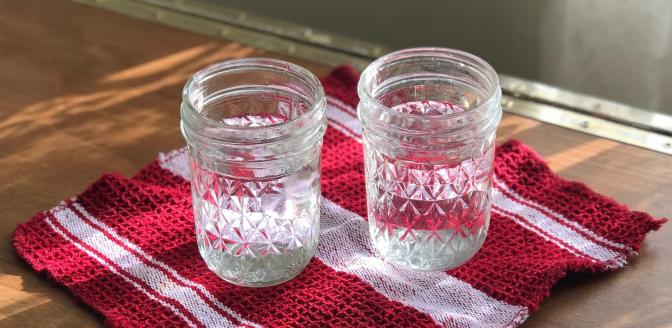
“Like those jars that women put out to catch the dew of night,
I place my breasts before God. I give Him a new name.
I call Him the Filler, and I beg of Him the abundant liquid of life.
Thirstily looking for it, will come my son.”

We who serve in ministry bring words from God as found in scripture. I am not speaking simply of pastors. Sunday School teachers, prayer warriors, parents teaching children, children teaching parents, friends who love others, and all who share the gospel with others come to share something that comes from beyond ourselves. We come to the “Filler” and ask God for the liquid of life. It swells up within us and we share it with others. I’ve never breastfed a child as a male, but I can tell you as a partner and as a parent I have witnessed the challenges that come from teething children with sharp teeth. I have watched as my wife wondered if she would be able to create enough and have myself sometimes wondered if there’s enough milk in the world to fill that hungry mouth.

The world is thirsty and somewhere over the years, I have come to understand that what I can offer to the people of God does not come through a plethora of words. What I can offer that brings life, fullness, and goodness is born of my own dependency on God, on my relationship with the Holy Spirit, and upon what people are willing to drink without spitting up all over the place. Paul may invite us to move past spiritual milk into the bread of life with Jesus, but often I find myself able to share deeply only what is found in the “bread” that Christ invites me to break and share.

To call that grace which is offered to others who are starving as cheap… It sits wrongly in my soul and yet Bonhoeffer is right as well. The grace we offer is not cheap. It comes with a cost and is precious. There’s no perfect balance in these moments. I could write a soliloquy on how the needs, wants, and capacity of ourselves and others creates an almost impossible situation. I could fill the world with more words, but in truth, I would rather call on the Filler and wait in silence to see how God will provide for the needs of the children of God.

Allow me to continue the Merton quote found above:

“More than all things love silence: it brings you a fruit that tongue cannot describe. In the beginning we have to force ourselves to be silent. But then there is born something that draws us to silence. May God give you an experience of this ‘something’ that is born of silence.”

Approaching a decade into ministry, with literally thousands of prayers, sermons, and blessings underneath my belt as a minister, I sometimes long to simply share with people a powerful word that is simple, straightforward, complicated, and as deep as necessary. I have come through using hundreds of thousands of words publicly to value the power of silence as a teacher, a friend, a lover, and a comforter.

In many ways, I find comfort in the story found in 1 Kings 19:9-13. In that passage, Elijah is in the midst of a season of turmoil and challenge. Elijah is fleeing for his life from an angry queen who was married to the king of Israel. As he fled with the help of God he came upon Mount Horeb. The story goes:

“At [Mount Horeb] he came to a cave, and spent the night there.

Then the word of the Lord came to him, saying, ‘What are you doing here, Elijah?’ He answered, ‘I have been very zealous for the Lord, the God of hosts; for the Israelites have forsaken your covenant, thrown down your altars, and killed your prophets with the sword. I alone am left, and they are seeking my life, to take it away.’

He said, ‘Go out and stand on the mountain before the Lord, for the Lord is about to pass by.’ Now there was a great wind, so strong that it was splitting mountains and breaking rocks in pieces before the Lord, but the Lord was not in the wind; and after the wind an earthquake, but the Lord was not in the earthquake; and after the earthquake a fire, but the Lord was not in the fire; and after the fire a sound of sheer silence. When Elijah heard it, he wrapped his face in his mantle and went out and stood at the entrance of the cave. Then there came a voice to him that said, ‘What are you doing here, Elijah?’”

Where was God but in the “sheer silence?” When God is with Elijah in the silence, Elijah is asked a “what” question, but I hear other questions in between the texts. Why were you there Elijah? What are you seeking? Where is your heart?

There is a lot of value to silence and the more time I spend preaching and teaching, the more I come to value moments where we seek the one that is found beyond the rushing, the shaking, and the fury. I seek the One found in the silence.


Let us Ramble: On being willing to fail

It has not happened often, but I have been asked a few times over my career as a minister for the best advice I have for people entering the ministry. I credit the scarcity of the question on the fact that I am completing my first decade of pastoral ministry on July 1st of this year. I have been asked a variant of this question a lot more often. How do you keep going in ministry?

I think this second question is prevalent as a result of a number of challenges faced by people entering into the ministry during this time. Our churches are tending to skew towards the higher age brackets, anxiety is rising, and often pastors are held accountable for the overall health of a congregation, even if they’ve been in an appointment for such a short period of time that there has been an inability for trust to be built, for change to occur, or for grief over the loss of a previous pastor to fully develop and be expressed within the hearts of congregants. Pastors are being placed in difficult situations which lead to poor health, poor moods, and unhealthy dynamics in personal and professional lives.

How do you keep going when a new church needs your attention but your daughter is grieving over the loss of her previous community? How do you decide between going to your daughter’s sports practice which you’ve missed two weeks in a row and helping set tables for a church fundraiser, especially when you know church meetings will make you miss her first three games in the upcoming weeks? How do you keep going through the thick and thin of a challenging time in ministry, especially if you don’t have a decade of relationships and trust to work with in your setting?

I give the same answer to both questions. You have to be willing to fail. I often hear the words of advice “Do you really want to die on that hill?” To survive on ministry, you have to be willing to die on some hills. I know that sounds crazy, but to survive over the long haul I believe that you have to be willing to sacrifice the easy path to seek after the life-giving death that comes with seeking after your ideals. I also do not believe this advice is for ministers alone. I think we all need to be willing to live out who we actually are in a very challenging world.

Let me give you a great example. I believe the best food is homemade. I know that there are great restaurants out there with wonderful food that I’ll never be able to make, but in reality, on a regular basis, the most consistent good food you can share with a family can come from your own kitchen.

Why? You know how your ingredients have been treated, you know how they were cooked, and if something goes wrong, you can adjust until you learn how to avoid that problem. You don’t need to rely on a cook that is paid an unfair wage, you don’t need to rely on a server that might be in a bad mood, and you don’t need to worry about the conditions of the kitchen. You can adjust the cooking to allergy needs or personal preferences. You know what is good and what is bad, and frankly, at least in our area, good ingredients like a nice roast and trimmings cost far less than a dinner for four at a restaurant.

How do you get to the point where that can be a reality? To bring the best to the table, you have to be willing to fail. You have to be willing to set an achievable goal and then seek after it heart and soul. You have to find a purpose that is worth your time and go after it, even if you’ll likely fail, because people cannot live on fast food alone. People need depth. People need macaroni and cheese made with carrots snuck in to get veggies into picky kids. People need a good marinated chicken breast that hasn’t sat in a refrigerator for weeks past when it should have been cooked. People need good food in their bodies.

My first attempt at gluten-free communion bread rolled to different thicknesses…

Let’s take this example as a good start. On Friday, my Sabbath (or as I like to refer to it my ”bread day”) I made my first attempt at making flatbread with gluten-free flour. To be fair, it is actually based on a recipe for Indian flatbread called roti. I substituted some Gluten-Free flour, tried to make the recipe as indicated, realized the dough was wrong, and began to adjust through the addition of things like binding agents and additional moisture.

The first attempt is gone. I rolled it too thin, decided to see how it tasted without eating breakfast, and then had a breakfast of far too thin roti which was both piping hot and delicious. I noted my problems, tried to roll it thicker, realized there was still a problem, added moisture to the edges, and tried again. All it all, I made six “loaves” of gluten-free bread, all of which probably won’t cut the mustard for use in church. It tastes great and a great tasting mistake is okay in my book, but it won’t do what it needs to do for my purposes.

Now, let’s say it will take three more attempts before I get this right. Maybe I’ll need to try something different a time or two. Perhaps chia seeds won’t be gelatinous enough to bind the bread together without eggwhite. Perhaps adding more xantham gum will make it taste awful. Let’s say I get to communion Sunday, bring something that is made to the best of my ability, and receive nothing but criticism. What will I do?

I can tell you what I will do. I will hold my head up high, take the criticism, and go back to the kitchen to keep working. Why? Why not take the easy path? Why not try another loaf of gluten-free bread that has been sitting on the shelf in the store? Why not buy the dough frozen? Why not quit while I am ahead?

The plain and simple reason why is that I do not want to quit. I keep going in ministry because I decide there are times when I am willing to die on a hill for the sake of that person who won’t come to communion because they’re embarrassed. Who am I to walk away when I know there is a concrete need in front of me? I am willing to die on a hill for the sake of making sure the means of grace is available to those person while we are all sharing from one loaf as one body of Christ. I am willing to die on that hill because it is better to die with integrity to my spirit than to live with a broken heart.

If you are going to be in ministry you are going to face difficult times. Ministers are many things. We stand up front talking about God and so people will take out their anger with God on us. We talk about inclusion in the body of Christ, so we will bear the brunt of criticism when a member of our church does something exclusive to hurt others. We are the person up front helping put together worship in a way that honors God and that might mean leaving out a favorite hymn of someone for a period that they feel is too long. We will face criticism for that as well. Doing your job as a shepherd means not everyone will be happy.

Spoiler alert: Those words apply to more than just ministers. Teachers, parents will complain. Nurses, patients will continue to buck the advice of the doctor despite your best efforts. Bus drivers, “the wheels on the bus” sung fifty times in a row might be a far better way to spend a given day than to hear cranky kids, wet from the rain, bicker all the way to school. All of us will be challenged and all of us will face situations that demand we make a choice of how we want to live our lives. Sometimes that will lead to us facing hardship, challenge, and occasionally persecution.

We will all face difficult times. The question as you face your difficult times is whether or not you can find things you are passionate about and be happy to die on the hill for that passion and for the sake of your own soul. To be fair, I have found that most people will understand why you are doing what you are doing if you explain it to them. Is gluten-free communion important to you? Explain it with passion, explain your willingness to keep trying, and express that this is one of those places where you have to maintain integrity with your own spirit and most mature people will try to work with you.

Actually, sometimes following your passion frees others to follow their passions. You might die on that hill, but when that resurrection love of God brings life back into your broken bones, you may just open your eyes to see people living into their own personhood all the more powerfully as a result of your example. People can be inspired by sacrifice as much as by success, and that’s important to remember as well.

In the meantime, if you are going through a hard time, whether in ministry or not, I want to encourage you to find a hill that you’re willing to die upon. Stand up for your heart and soul and sacrifice. Jesus taught us that “Anyone who loves their life will lose it, while anyone who hates their life in this world will keep it for eternal life.” Sometimes we need to stand up against that which we hate and be willing to find ourselves on the other side of our resurrection with life everlasting.

Let us Ramble: Patience and Wisdom

The other day I woke up early to get a wood chipper to help remove some branches from the church property. Winter was windy, one tree had to be cut down, and we had lots of loose branches to handle. I arose early in the morning and headed out to pick up a rented wood chipper. On the way, I stopped to get a cup of coffee. Yard work is thirsty work, especially early in the morning.

I stopped at a nearby donut shop and noticed a huge line of cars in the drive through. The cars were literally lining up to zipper-merge from both directions in order to get breakfast, coffee, or whatever the people wanted. The number of people idling in line in running cars was staggering.

The view from my car window. License plates blurred because I’m a nice guy.

I thought to myself that I would probably have to wait in line for quite a while inside if the store were that busy. I walked in the door and there were three people sitting at a table while people bustled behind the counter. Otherwise, the donut shop was empty. I walked right up, picked up my order, and was out the door in less time than it took one of those cars to move one position in the line.

As I slipped into my car, I wondered about the situation. Every time I went to that particular location in the morning it seemed that the line outside was always longer than the line inside. I regularly walked in and out while people sat and looked at me through their windows. Nothing staggeringly new was taking place this particular morning. I long ago learned that patience is a virtue, but not the only virtue. Wisdom and experience taught me to plan to walk into the restaurant instead of waiting in line. It is simply faster at that location to walk in the door. It is even faster if you order ahead on their smartphone app.

As I pondered this I thought about all of the other times I have “waited in line.” There are things that I really wanted to have happen in my life, but I would just sit there and watch the world pass by outside the window of my life. I would sit behind a useless steering wheel which could do nothing as I was not moving, twiddle my thumbs, and wait for the world to magically become a better place.

Occasionally, over the years I have had the wisdom to get out of the car a couple of times. I am married and have kids because I decided to step out of the car and enter into a relationship with a wonderful woman. I continue to be married because I do my best to move forward with life despite challenges that I could easily blame on others. I can cook because I decided to stop just longing to be able to create good food and began to ask questions of people who I knew could cook. I entered into the ministry, sought after the best parts of myself, and battled my demons. I didn’t always get out of the car, but I have learned the value of not waiting for everything to be handed over on a silver platter.

Now, let’s be clear. I am all for understanding the value of patience. Still, while patience is a virtue, sometimes in life we need to step out of the car. I regularly hear people speak of the world around them in tones that imply a certain kind of irritated, frustrated patience is all that can exist. People wish the world was kinder, wish their workplace was friendlier, or wonder why their church does not have more visitors. The world is full of lovely wishes that never change a thing because they are not acted upon by anyone.

What if the answer is that we need to get out of our car? Yes, we can wait until someone else invites a stranger to church, but what if we were to extend that invitation? Yes, we can hope that people in the workplace would be nicer to one another, but what if we were to seek out ways to be nice? Yes, we can bemoan the world becoming a crueler place, but we can also seek to bring love back into the dark places of the world.

We don’t need to wait in line for someone to bring what we need to our window. We can go to seek it out. We have the capacity as people for wonderful things. Let’s do some of them!

Poem: Cracked Cisterns

The following poem is based on Jeremiah 2:1-13. I wrote my poem based on the New Revised Standard Version of the texts. I chose to write on Jeremiah 2:1-13 as it is the reading for the Second Tuesday of Lent in Year One of the Daily Office of the Book of Common Prayer.

Cracked Cisterns
Based upon Jeremiah 2:1-13

I recall days of years long since passed:
Singing songs, sharing sodas, and spending time.
Loving life with a pace both furious and fast,
As memories were created beautiful and sublime.

I remember laughter and gladness.
I remember sorrow and sadness.
I can see our steps stretched side by side.

Now we drink from different wells.
Water gushes from a cracked wall.
I watch as dried lives become shells
As the people once so close grow small.

I feel cold rain on far off shoulders.
I feel warm wind on riverside boulders.
I can see where we once were near.

Dry, parched lips seek something new.
In truth, they may need something old.
I stand with an extra cup—no idea what to do,
As hope’s light grows dim—flickering and cold.

Let us Ramble: On Giving “Kine”

Today has been an ordinary day of ministry in New York State. The snow has been falling at a constant rate for a couple of hours, the kids are home from school due to the weather, and the mood around the house has been a bit cranky as both parents have had their plans of getting extraordinary amounts of good things done abandoned and thrown to the wind. Meetings were cancelled, plans postponed, and ideas adjusted. In case you had not realized it yet, life still happens to people who live a life in ministry—there is no magical “Get out of jail free” card handed out to ministers when they agree to serve a church.

Before the snow began to accumulate heavily, I went out to visit a member of my church on comfort care. Their identity is known to God and the most I will say is that the individual has had a long period of being seasoned by life. I spoke with the family, agreed to sit with the individual for a while so they could get some rest, and settled down into a chair with Bible and Kindle.

I read a little scripture, prayed some prayers for the individual, lifted up the family in my prayers, spoke for a few minutes about the memories I shared with the individual, and then sat still. After a few minutes of silence, I found myself drawn to my Kindle and the copy I keep on my Kindle of the Carmina Gadelica.

The Carmina Gadelica is a collection of prayers and poems transcribed by Alexander Carmichael after being collected and recorded in the time that crosses the boundary of the 19th and 20th centuries. The Carmina Gadelica is an intriguing book in the fact that it chronicles a blending of cultures between the Celtic traditions that survived and the Christian traditions that took root in the British isles. I find the Carmina Gadelica to be an interesting collection that is very thought provoking.

I was reading through the second volume when the prayer “The Incense” caught my attention. I have come to believe that context affects the way we see the world around us. Sitting by the bedside of this individual as they breathed beneath closed eyes that saw the world when I had visited the day before and that had been bright before pneumonia came to visit in my absence, I read “The Incense” differently than I had read it before.

The translation of the following poem comes from the “Carmina Gadelica: Volume II” as translated by Alexander Carmichael. The poem is entitled “The Incense”

“In the day of thy health,
thou wilt not give devotion,
thou wilt not give kine,
Nor wilt thou offer incense.

Head of haughtiness,
Heart of greediness,
Mouth unhemmed,
Nor ashamed art thou.

But thy winter wilt come,
And the hardness of thy distress,
And thy head shall be as
The clod in the earth.

Thy strength having failed,
Thine aspect having gone,
And thou a thrall,
On thy two knees.”

I looked up the word “kine” in the dictionary. “Cattle.” Kine is another word for cattle. What does it mean to give cattle in the context of days of health? What do cows have to do with incense or devotion? As a student of religion, my first thought is sacrifice. Sacrifice was once one of the ways how a person expressed regret, fealty, or even respect to God.

This cow is kine of a big deal…

The subject in “The Incense” refuses to give kine. They have no sense of devotion, no desire to sacrifice, and seemingly no reason to burn those herbs and fragrant plans which have been burnt in countless traditions to symbolize a drawing near to the divine. The person is haughty, greedy, unrestrained in their speech, and without shame in their time of strength, health, and well-being.

Yet, the poem goes on. Winter will come. They will come under the power of time, age, and weakness in time. Indeed, the person will one day find their life on earth equivalent to a clod of earth in the ground. The poem is bleak in many ways. The poem paints a picture of a person who does not understand their need in the days of their strength.

Sitting by a bedside, watching someone breathe breaths that might be some of their last in this life, and contemplating this poem was a different contemplation than many contemplations that I have had over the years. Am I wise enough to give kine in the days of my strength? Do I have the wisdom to realize that there will come a day when my choices have been removed from my path? If I do understand, do I let that wisdom affect the way that I live my life?

Can I live with gratitude for the gifts I have been given? Can I let that gratitude guide my choices? Can I choose to deny the parts of myself that want to be haughty, that live in greedy places, or that wish to live unhemmed by matters like compassion, empathy, or grace? Can I live a life marked by devotion and prayer? Can I live a life where kine are not for amassing into a giant herd for my profit, but instead exist in my life as a source of life and blessing for those around me? Can I live out my life in faith in such a way that I will one day find myself on my knees in a place marked by trust in God rather than the frailty that comes from regret?

Sitting with someone who reached an age where they were well seasoned affected the way I read the poem. I am not concerned by the individual I was sitting with while reading. The person I was visiting had a life that seemed marked by faith, hope, and love. The person’s presence was enough to remind me that, unless Jesus comes back in their lifetime, even the most righteous person will age and find themselves at a place on the threshold between one life and the next.

I pray that I have the wisdom in my own journey to find the humility the subject of “The Incense” seemed to miss. I pray that when I reach a place where I find myself on my knees, I will find myself enthralled by faith, hope, and love, but not fear.

Let Us Ramble: Random Chinese Food

Last night I had a meeting at the District Office in Endicott. It had been a long day between having a snow day for the kids and needing to get ready for Sunday. My wife had a meeting out of town and swept in the house twenty minutes before I needed to leave with a cute and cuddly baby that I had not seen all day.

We tried to talk as the family ate the huevos rancheros that I had cooked for their “breakfast for dinner.” The elder kids also wanted to talk with their mom. My wife and I did not have a chance to connect before I needed to leave. I sat in my car in Endicott and tried to think of something I could do to connect with my wife. I realized how hungry I was, looked at what I had eaten for dinner, and realized I probably needed more than 150 calories. It turns out one tiny tortilla with one egg is not exactly filling.

I brought home a container of mystery Chinese food. I literally walked in the restaurant, looked at the chef’s specialities, found something I had never tried and did not understand, and brought it home. It turned out to be a shrimp and vegetable dish with a nice light sauce. It was rather tasty.

Some days it takes work to connect with your spouse. As we ate Chinese, our baby was fussing and crying at us both. I took chopsticks full of rice in between moments of putting her pacifier back in place. The baby did not really settle for hours. It was not an easy evening after my meeting, but my wife and I found moments together over a new experience and a new food.

Marriage takes work. Even when everything seems to be going perfectly, marriage takes work. I am glad that I took time after a very long day to connect with my spouse.

Let us Ramble: Bookmarks

I love to read and yesterday I had a few fleeting moments of free time in the middle of my day. A few weeks back my children helped me glue together fancy pieces of paper with old fashioned glue sticks so that I could cut them up and laminate bookmarks for the plethora of books I am currently juggling. I go through a lot of bookmarks between Academy books, science fiction anthologies, short stories, and the occasional need for several bookmarks in a given Bible during a given service. I prepared to make a lot of bookmarks.

The goal was that the glue would hold the paper together so I would not get any annoying slivers of the back of one piece of paper on another. I had nice pumpkins on the side of one of the bookmarks and a nice brick wall motif on the other side. It looked kind of nice as the earthtones of the bricks went nicely with the orange of the pumpkins. I was looking forward to lots and lots of earth tones.

I sliced, I diced, I julienned… Okay, I am kidding. I just used the paper cutter. I cut them all into perfect shapes so that I could put together the perfect set of bookmarks for the fall. I have a new kid on the way, so I know I will need a lot of bookmarks as I dive into the collection of books while rocking. I laminated with exactly a quarter inch of laminate around each bookmark. They were going to be perfect.

I looked down and saw a bunch of bricks peeking out from under the desk. I thought I might have an extra bookmark, but… no pumpkins on the other side. I whipped through the bookmarks. There was a pumpkin bookmark with a glaring-white back in the midst of my perfect bookmarks. Ugh… I was so close to getting everything right! Perfectionism demanded I throw it away!

So close to perfection…

So, realizing my heart was telling me something important, I stopped. Why did it need to be a perfect bookmark? Wasn’t it a laminated bookmark? Wouldn’t it hold the page just fine? Didn’t I love pumpkins? What is wrong with a white back anyway? Why was I so upset about a bookmark not matching the rest?

I slowed down and realized that I was getting carried away. Nothing in life is perfect. Nothing is absolutely, completely, 100% according to plan… What seems to truly matter is what we do with our imperfections. If God can work in my life and I am not perfect, couldn’t I give this poor bookmark a chance?

I still have the bookmark. It won’t be the first one I choose, but I still have it. The bookmark will be a reminder to me that I need to work with the imperfections even as I ask God to work with my imperfections. To put it another way, I can ask God to forgive me my trespasses, even as I forgive the trespass of this poor bookmark.

May you find room to live into the imperfections today. May that space bless you.

Let us Seek: Do not be alarmed!

I was out in the world this morning. Cold or no cold, there are some appointments that cannot be put off. I had an appointment with a specialist that I had scheduled weeks in advance. I went to my appointment on cold medicine, advised everyone I was in contact with to wash their hands, and we made the best of things.

My appointment today was for a simple non-invasive type of treatment which took a few minutes. The doctor and I sat alone talking while she was going about her work. We began to talk and things went to deep matters in a few moments. I was not surprised. People often open up to me–I do not advertise that I am a minister, but I always seek to be polite and courteous. It can be amazing how quickly people come to trust you when you always say “please,” “thank you,” and tell them that you are grateful for what they are doing for you. I also believe that most people just want someone to listen.

She started talking about what she had heard in the news. She was afraid of what was happening in the world. She talked about intercontinental ballistic missiles, nuclear warheads, and the idea that someplace as nearby as Washington could be struck, although she did not rule out New York City. As medicated as I was at the time, I wondered aloud about the fact that people feared nuclear attacks on the Hoover Dam and the dam at Niagara Falls during the Cold War. We talked about how frightening things are, how strange everything seemed, and she wondered what she would do if a war broke out. She was frightened. I commiserated, listened, spoke very little, and prayed for her fears in my heart.

The conversation reminded me of a passage in Matthew about the end times. Discussions of nuclear winter, nuclear fallout, and global conflict often remind me of the passage found in the twenty fourth chapter. Matthew’s gospel reads in verses three through fourteen: (Common English Bible)

“Now while Jesus was sitting on the Mount of Olives, the disciples came to him privately and said, ‘Tell us, when will these things happen? What will be the sign of your coming and the end of the age.’


Jesus replied, ‘Watch out that no one deceives you. Many will come in my name, saying, ‘I’m the Christ.’ They will deceive many people. You will hear about wars and reports of wars. Don’t be alarmed. These things must happen, but this isn’t the end yet. Nations and kingdoms will fight against each other, and there will be famines and earthquakes in all sorts of places. But all these things are just the beginning of the sufferings associated with the end. They will arrest you, abuse you, and they will kill you. All nations will hate you on account of my name. At that time many will fall away. They will betray each other and hate each other. Many false prophets will appear and deceive many people. Because disobedience will expand, the love of many will grow cold. But the one who endures to the end will be delivered. This gospel will be proclaimed throughout the world as a testimony to all nations. Then the end will come.’”

I first came to know this passage well through the New Revised Standard Version of the Bible. In that translation verse six says “…you will hear of wars and rumors of wars; see that you are not alarmed…” These verses have all taken a vital place in my lived theology within this world of global information and easily spread global panic, but verse six has always rung out the loudest in my mind. As I lay on the table, I could almost hear a palpable voice repeating in my heart “you will hear wars and rumors of wars…” alternating with “Peace I leave with you; my peace I give you… Do not let your hearts be troubled and do not be afraid.” 

My doctor was afraid this morning. I chose not to be fearful, but to be compassionate. What is the good news? In this context, I believe it can be best expressed earlier in the Gospel of Matthew. In verses twelve through fourteen in chapter eighteen, Jesus tells a parable: (CEB)

“What do you think? If someone had one hundred sheep and one of them wandered off, wouldn’t he leave the ninety-nine on the hillsides and go in search for the one who wandered off? If he finds it, I assure you that he is happier about having that one sheep than about the ninety-nine who didn’t wander off. In the same way, my Father who is in heaven doesn’t want to lose one of these little ones.”

I invite you to think about the promise which inherently sits within this parable. My doctor, like many individuals, has an uncertainty about the future. The world seems to be less than the ideal many of us were taught as children. Most of us lose a sense of the innocence of childhood as we grow into the world, and I personally believe that there’s a correlation between this loss of innocence and the traditional drop in church attendance that tends to happen at around the same time. Losing our innocence hurts.and events like those depicted in the news can send us back into our grief over our loss even if it has been decades since we first realized the world is broken. The world can seem to be a confusing place and our fear can isolate us.

Into those moments of fear, there is an ancient promise embodied in the person of Jesus. God does not want to lose one of those little ones. God cares about the lost sheep of the world. Even when it seems that the world does not care one bit for our fears, God does care and will walk through the valley of darkness to lead us all home. There is space for us at the table, there is space in the flock, and there is deep grace despite our fears for all people. God has come near, God has shown compassion, and eternal life will come to those who follow the Shepherd. As Matthew records in the twenty ninth verse of chapter nineteen, “…all who have left houses, brothers, sisters, father, mother, children, or farms because of my name will receive one hundred times more and will inherit eternal life.

Friends, be at peace. God does not give as the world gives. Know that the path of a Christian is not an easy path, but there is a place of peace that awaits the end of our journey. Go! Be a blessing in a world of fear! Fight for justice and grace! Share the Good News! Walk with the lost sheep! Please, be compassionate

Let us Ramble: On Commitment

There is something foul afoot in the Dean household. My family was in the Olean and Buffalo areas this past weekend visiting with relatives. Every single one of them had a cold yesterday. Yesterday was a foul day full of a lot of phlegmy sounds.

When everyone had settled into bed for the night I drove into town to pick up supplies. Liquids, liquids, and more liquids. We also had begun to run low on that most effective of medicines. We were low on chicken broth. With three folks fighting colds and a father who has to keep his body healthy to resist the plague, chicken broth is a powerful thing to have around.

As I drove into town I thought about the evening that had almost taken place. I was supposed to go into town to play a tabletop game with a colleague and his friends. There were invitations for my family to enjoy a nice lasagna with my colleague’s family. As a very isolated introvert, it is the kind of event that is really healthy for me. When my family became ill, those plans had to be put aside. My family needed me. I drove and thought over the night’s events that could have been while remembering what had taken place in our kitchen while a chorus of coughs serenaded me from the next room.

Earlier in the day I set to work to make kluski noodles. When I was young, a hot bowl of wonton soup was my favorite cold remedy. Often, I wouldn’t even eat the wontons. I would just drink down the hot broth with gusto. As I grew older, I went to college where I learned that the Chinese restaurants in the vicinity were not up to par. Their broth was way too watery and the wontons were generally nothing to write home about. I was frustrated, looked for alternatives, and found kluski noodle soup at the store. The soup was really fragrant, the noodles were small enough to enjoy without scratching things up on the way down, and this was a great alternative to the wonton soup of my childhood.

I brought forward my love of this soup into my marriage. It was quite a sight when my wife and I would get sick My wife felt better when wrapped in her grandfather’s old robe. I only felt better when I had plenty of broth to drink. She’d wrap up and watch me sip cup after cup of broth. We both felt better, which was the goal. As the parent of two daughters, my plan has continued to work while the three of them fight over one bathrobe. You can always make more soup for more bowls.

So, I set about the task of making kluski noodles for soup. I asked for recommendations, received a wonderful recipe from my mother-in-law which her mother used to cook, and set to work. I measured, I sifted, I mixed, I realized I made a mistake, I corrected, mixed some more, and rolled them out before attacking with a pizza cutter. Here’s what they looked like when all rolled and cut.

Kluski noodles!

Not exactly uniform, but uniform isn’t the rule of the day when you’re making homemade soup. I set about making the broth. I was out of bone broth, so I used some dried chicken soup base and set out into the garden with a pair or scissors to attack the lemon thyme, sage, and parsley plants. Along with some ground peppercorns, a dash of garlic powder, and a leaf off of my bay tree, the soup base was ready to simmer for a few hours to mix flavors and fill the house with the smell of health.

I did not always know how to cook. While I am almost certain most people who have eaten in my kitchen would find it odd to believe, especially when I am feeling particularly miserable and tell people my fantasy of running away to become a cook in an isolated diner in someplace quiet like Maine or North Dakota. I actually was a horrible cook when my wife married me.

I learned to cook in seminary while my wife was working to make sure we had those niceties which do not come easily when you are getting an education on student loans. Due to my wife’s working with the developmentally disabled we had things like food, soap, and deodorant. I still believe that my classmates adored my wife for that last blessing alone.

I started simple with things like grilled cheese, which I had already learned to cook in home economics in school. I flipped the sandwiches way too often, didn’t use my nose to smell, had little experience, and burned the living daylights out of a lot of them at first. I practiced and I learned. Highlights of my first year of cooking:

  • I learned it is harder to burn things in a crockpot. Harder does not mean impossible.
  • I somehow made split pea and ham soup with neither split peas or ham!
  • I learned that Campbell’s soup is good in a pinch, but not sufficient alone to help a hungry Kayti make it through a shift at work.
  • I learned that I had an affinity for cooking eggs. We understood each other and my wife started calling me her “King of Eggs.” I still find that to be one of the nicest things anyone has ever called me.

I practiced, practiced, and practiced. When my wife became pregnant I began to practice cooking with the things she was craving, usually with mixed results. When my child came along, I began to look into soft foods like porridge. I began to steam things, sauté, and “unfortunately” finally left the seminary and became appointed to a place where cable was a part of our housing package. In other words, I was finally exposed to the Food Network where I became obsessed with people like Alton Brown. We still get the Food Network magazine years after telling our beloved parsonage committees that they do not need to pay for cable as it is neither helpful nor desirable in a house with small kids. I like my advertisements like I like my clickbait–easily ignorable in a sidebar, not blasting in my face decibels louder than a television program every three minutes.

In time I began to see cooking as more than a hobby. Cooking was a way I could bless the people around me, including my family. If you’re looking for me around 3:30 PM on an afternoon, the place to look for me is generally at the parsonage. If you come around 4:00 PM, you may even get an invitation to dinner if it is stretchable. I cook dinner almost every night because it is one way I live out my commitment to my wife “for better or worse.” The same love and commitment fuels me as a parent as I continue to push back against my youngest daughter’s whims against “weird” vegetables like pepper and strange food like “fish.” I have been given a gift, but that gift is not for me alone. In a paraphrase of the words of the Abrahamic blessing, God has said “I will bless you so that you may be a blessing to others.”

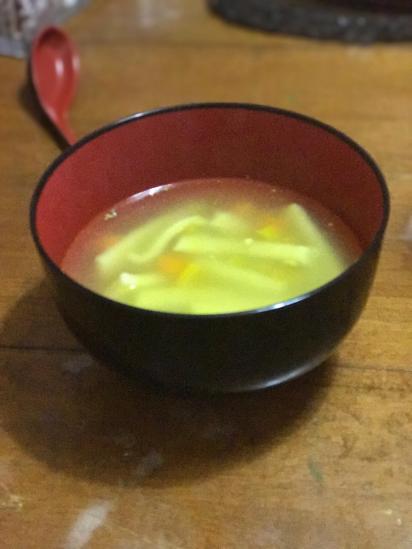
In continuing the story of the soup, I added some frozen turkey bits from a previously roasted turkey, some carrots, and yellow pepper to the broth about half an hour before my wife was going to be home. Normally I wouldn’t have added them so early, but let’s be clear here–sick people do not love crunchy vegetables. Softer carrots and softer peppers are good for the throat, especially as the pepper oils spread into the broth and slowly condition my youngest child to like the taste of peppers–I will win the pepper-war eventually. When my wife walked in the door, the slightly dried noodles were tossed in the pot. In a few minutes (far less time required than when cooking dried noodles), the soup was ladled out to salivating kids. A prayer, a blessing, and sore throats began to enjoy.

Yummy soup

My kids claimed it was the most delicious soup they’d ever eaten. My wife said it was really good. To be honest, it was pretty good. I drank a couple extra ladles of broth to make sure my body would stay nice and healthy.

As I collected my groceries and returned home, I thought about all of these things. I thought about the game that I had missed and the fellowship over lasagna that could have been mine that evening. I reflected and gave thanks that a perfect day had not occurred, but that my commitment to learning, practicing, and caring had allowed me to bring blessing into my sick family. Commitment is not always about the large things in life. Commitment is often lived out in the little things, like learning to plant herbs and use them to make a good cup of soup.

Rob’s “Kluski” Noodle Soup (makes… a lot of brothy soup that is easy on bellies and throats)

  • 1 gallon Chicken Soup Base (or skimmed poultry bone broth)
  • 2 cups of previously roasted turkey (small bits–I imagine any poultry would do, but I would recommend something chunky, not sliced. My wife would say to buy a rotisserie chicken at the grocery store and chop it up. I would tell you to reserve the bones and skin to make bone broth later, especially if people might be sick for a couple of days. Yes, I know that’s a beef bone broth recipe, but just substitute chicken. It works, I promise.)
  • 1 cup of sliced carrots
  • 1 yellow pepper, diced
  • 1 dash garlic powder
  • 1 teaspoon ground pepper
  • Noodles!
    • 2 cups flour, sifted
    • ½ teaspoon salt (shh–I used the “No-Salt” my dad left behind to cut down on the sodium)
    • 2 Eggs
    • 2 half-eggshells of water (old recipe indeed)
  • 1 Bouquet Garni (tie together with enough string to tie it to the handle of pot so that you can remove it easily)
    • 5 sprigs (3 inches) of Lemon Thyme
    • 2 sprigs parsley with stems (3 inches)
    • 1 sprig sage (3 inches)
    • 1 bay leaf

First, make the noodles. On a clean surface, like a large rolling board or a silicone rolling mat, sift the flour and salt together. Make a well in the flour. Crack the eggs into the well. Work the eggs through the flour, which is surprisingly easier if you do it before you add the water. When thoroughly mixed, form another well and add the water. At this point, I use a spatula to make sure the water doesn’t escape until the dough is formed. Roll the dough as flat as possible and cut into the desired shape. Kluskis are usually about 2 inches long and maybe a half centimeter wide. I didn’t do a very good job at this part, but they still tasted good.

Bring broth to a boil. Reduce to simmer. Add spices and the bouquet garni after tying it to the handle. Leave it to summer for at least an hour. The soup will smell very lemony, but that’s okay. The thyme will not overpower the soup. With half an hour to go, put in the veggies and turkey. If the turkey is frozen, add the turkey a few minutes earlier and bring the broth up to a boil. I personally remove the bouquet at this point so the tumbling vegetables don’t break too many leaves off. The thyme lost several leaves, but after this long a boil, they’ll just slip down the throat with the broth without causing even a hiccup to the most sensitive of throats.

When you’re almost ready to eat (seriously, only a few minutes), set the table and add the noodles. They will float when nearly done. Taste one noodle (I use chopsticks to pull it out–kluskis are dense but should taste cooked through) and adjust broth if necessary, although I didn’t need to do anything. Serve with lots of broth to make unhealthy throats happy.

Let us Ramble: Gelatin and Chopsticks

Last Thursday I took my children to lunch. The two minions had spent three days sitting fairly quietly in the church’s board room and were understandably at the end of their patience. I know this because they came into my office and began to repeatedly chant “Dad, feed us. Om-nom-nom.”

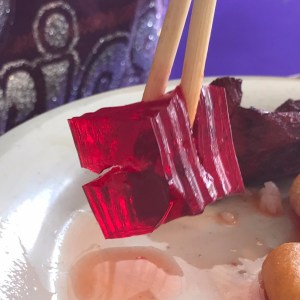
We went out for lunch at a nearby buffet. I proceeded to watch what might have been the most agonizing thing that I saw all week. I watched my daughter try to eat a gelatin cube with chopsticks.

image

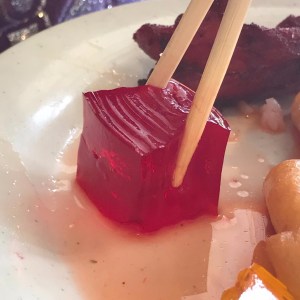
At first, she would seem to be making progress. She’d place the chopsticks exactly where they should go for a nice grasp on any other type of food.

image

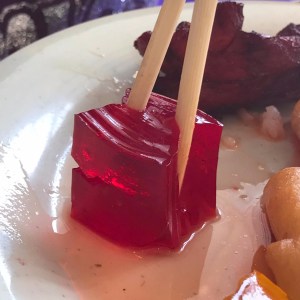
After she began to apply pressure things began to go sideways. The chopsticks would slip into the sides of the gelatin and the edges would begin to give way to the pressure applied by my daughter.

image

At one point she managed to pick up the gelatin. Her grip did not last for long and soon the gelatin plummeted to the plate again. She was determined to eat her lunch without using her fork, but this gelatin was trying her patience. I was lucky enough to convince her to let me grab a picture or three despite her frustration.

I share this story to express a reality of life. Many people often come across situations in life where they believe that they have everything needed to face life’s challenges. They reach out to grasp life by the horns and suddenly realize that they are grabbing the horns of an ornery bull without a backup plan.

Sometimes in life the challenge is as simple as stripping that one screw necessary to complete putting together a piece of furniture. The situation is frustrating but not a matter of life or death. At other times, the challenges we unexpectedly face can be far more serious. Sometimes the situations we are face are both serious and severe.

Watching my daughter attempt to pick up gelatin with chopsticks was agonizing to me in part because I have tried to eat slippery foods with chopsticks in the past. My daughter was frustrated, but she certainly wasn’t alone in her frustration. I sympathized with her, told her that eating slippery foods with chopsticks can be hard, and let her know that it was okay to use her fork. I gave her a form of permission to let go of her frustration and to just get on with her life.

In my opinion, the value of community shows itself in moments like those spent on Thursday with my daughters. We all face difficult situations and sometimes the thing we need most is someone to stand with us in the frustration. Community does not always provide answers, but the best communities often provide the context and compassion necessary to make it through dark times.

My hope is that the churches which I serve in my ministry will help to provide community in places where compassion and context are necessary in the lives of our community members and our neighbors. The church does not often provide the silver-bullets necessary to slay the werewolves of life, but we do point in the direction of the God who provides comfort, grace, and life. The church does not always share grace as perfectly as we should, but we do hopefully surround folks with the gentleness and kindness that comes through the Holy Spirit.

Let us Ramble: Waiting for S’mores

It had been a very busy Wednesday. The day had been long. I slumped into my camping chair and watched as a fire began to spread in my family’s fire ring.

I was tired. The children have been in the office with me this week and had joined me for Senior Lunch. My youngest daughter had an audience for her antics. The senior citizens were amused. I was very tired.

I was tired. The children had been very well behaved on Tuesday morning in the church office. By Tuesday night they were beginning to snipe at each other. On Wednesday morning the bickering began shortly after we arrived. By Wednesday afternoon… I was very tired.

I was tired. A storm knocked down a tree in the field last week. I had been dragging the logs out of the field with an old “Radio Flyer” style wagon without a comfortable pull-handle nor any form of shock-absorbers. One of our Buildings and Grounds folks was able to set the church tractor up with a trailer to help me do the job without walking a thousand miles with the wagon. Even with the tractor’s help there was still a lot of wood and a lot of work. The last big and irregularly shaped piece that I grabbed to load into the trailer slipped through my fingers and tore a gash in my wrist as I scrambled to catch it before it could strike my foot. That ornery and unwieldy piece of wood was the first piece in the fire ring. I was very tired.

I was tired. It would be at least half an hour until my kids returned home from their swim lessons at the YMCA. I was very tired, but the lemon-flavored seltzer water was pretty refreshing. The smoke rose and the very human and fairly spiteful bit of myself smiled as the wood which hurt my wrist began to burn away into nothingness.

The ornery piece of firewood burning…

I was tired, but thought back to the fact that my kids’ biggest problem that morning had been who would have the first turn being the teacher as the played school. I was tired, but thought back to the fact that the senior citizens who we sat with at lunch seemed to reconnect to a bit of their past and smile as they saw me tormented by my child. I was tired, but thought back to the fact that Paul had helped me to use the trailer so that I wouldn’t collapse of exhaustion. I was tired, but that bedraggled piece of wood was getting what it deserved and would provide enough heat to make my kids s’mores after they returned from swim lessons.

I was tired, but I decided to be grateful as I stared into the flames. I knew that tomorrow would have enough problems, but for that one moment I could decide to be content with the blessings of a cool glass of seltzer water, a warm fire, and the promise of time together alone with my wife sitting by the fire after the kids went to bed.

Let us be Grateful: On Ridiculous Things

Last Sunday was Father’s Day and my family celebrated with me after church. The weather was hot, so they took me down the street to Kelli’s Deli, which is air conditioned. They ordered me a ridiculous pizza for lunch which I normally would not order. My younger child is a picky eater, so I do not generally order strange things. My wife knew that I had wanted to try the pizza for at least a year. On Sunday they bought the pizza for lunch. Yes, they ordered a cheeseburger pizza for lunch.

IMG_0413 2.JPG

Cheeseburger Pizza! Delicious!

The strange pizza was an utterly ridiculous gift to a person who appreciates simple gestures of affection. I spend a lot of time cooking for my family. I love saucy and spiced foods but we rarely eat them in our home because of our children’s tastes. I love pickles but we rarely have them as a part of our meals because of our children’s tastes. I love a lot of food that I never cook because my children have turned their noses up at foods that were too strange or too different.

My kids sitting with me and eating a weird pizza with me was a great Father’s Day gift. My youngest might have struggled to eat anything but the crust, but she still tried to make an attempt to eat a single bite with only minimal complaining. She only tried to change our order twice to something she would rather eat and that’s an improvement over most meals lately. Don’t feel too bad for her—she ate at least three pieces of our church’s Fathers’ Day cake at Fellowship Hour.

It seems strange, but it really is the little things that help a person feel appreciated. I invite you to remember that sometimes a kind word or a bit of love can turn a person’s day around. Today you may have the opportunity to make the world a better place for someone you come across in your life. I invite you to share love—be ridiculous if necessary. Sometimes it means more than you know.

Let us Ramble: In-between Spaces

My readings for the Academy for Spiritual Formation have led to me doing a lot of contemplation. Today I was reading through “Abide: Keeping Vigil with the Word of God” by Macrina Wiederkehr. Here’s the passage that led to contemplation today: (24)

“Then suddenly you find yourself back in those in-between times. Distressing and boring as these in-between times of the season may seem; they can also be nourishing spaces for the soul. This waiting between dying and rising is like being in the tomb. It is a waiting room that is essential for spiritual growth. In this quiet tomb-place we feel, once again, that ancient tugging at the heart. We experience being drawn, like a magnet to the divine.”

Sister Wiederkehr had been speaking on the beauty she finds in the in-between times of life. She enjoys walking as the sun rises and sets. She enjoys the time between seasons. She finds these are the best times to romance the Word of God.

I’m not a morning person and I often put my children to bed around the time of sunset most of the year. I know that the dawn is beautiful, but that is not where I experience my in-between moments. The place where I have been experiencing the in-between moments like Sister Wiederkehr describes is in my garden.

A pepper plant from our garden. We need to weed again…

My garden is currently in an in-between place. Sister Wiederkehr explored the in-between nature of winter turning into spring, but I also connect more to that in-between place when spring is turning into summer. The plants have started to take root, the leaves are growing, and there are already a few blossoms on the tomato plants. There is growth and in time the pepper-plant in the image above will begin to create food for my family.

Spring is a time of hope, promise, and busyness in preparing the garden. Summer and autumn are seasons when these promises become a reality when the harvest comes in to be canned, frozen, and eaten. This is that in-between place where there is occasional weeding, occasional watering, and a lot of waiting.

I often feel like I experience these same moments in my spiritual life. I rush to make plans after reading a book, organize a wonderful event, or have a revelation that begins to change my outlook on life. I complete what needs to be done and then simply have to wait to see what will happen. This time of waiting in-between moments can be boring, but I agree with Sister Wiederkehr. These moments are essential for spiritual growth.

By my garage, at the base of a simple flower there will soon grow a tomato. The tomato will be small and green. I can watch it day in and day out. The tomato will be ripe on the day it turns ripe and not a day before then. As much as I would like to rush things, the tomato requires time, sun, and water to thrive. The tomato requires good soil, good nutrients, and time. I have provided sun, water, good soil, and nutrients to the best of my ability. Now, I need to have patience.

Spiritual lives require patience. A healthy spiritual life does not grow all at once. There may be mountain-top experiences and times when we receive revelation that shakes us to the core, but most of the time we need to have patience with God and with ourselves. One of the few times that God grew a plant overnight for a person of God in scripture it was almost immediately cut down by a worm to help teach Jonah a lesson. God can do all things and that includes asking us to be patient and wait.

In my experience Sister Wiederkehr is right about the silent, tomb-like places. The quiet-places are necessary to our growth as individuals. The silences also teach us how to hear God in the stillness and to feel that magnetic draw towards the divine. I invite all of us (including myself) to know the wisdom and longing that comes with patience in the quiet places of our spiritual lives.

Let us Reflect: Life between denominations

Today is a day of transition for me. Last week I attended the 54th Annual Meeting of the New York Conference of the United Church of Christ. After celebrating the Ascension of Jesus Christ and Memorial Day in my town, I am preparing to head out to Syracuse for the 8th Session of the Upper New York Annual Conference of the United Methodist Church. As a pastor at a Federated congregation I am authorized to serve as a minister within the United Church of Christ even as I serve within my ordained capacity as an Elder within the United Methodist Church. I serve within the one church and have my membership and service within the other.

A relative of mine once said that it must feel like I am being constantly torn in two. I often get asked questions about the local church’s way of being, questions about how I balance responsibilities, and questions about how I manage to make all of the meetings. To be fair, I often ask that last question. Yes, it can be challenging when you have twice as many denominational meetings as many of your colleagues.

This time of year is often difficult for me professionally. I go to one denominational meeting. I celebrate the successes, embraces the challenges, and mourn the losses of colleagues and friends. I proceed to then go to the other denomination’s meeting. I am again called to celebrate the successes, embrace challenges, and mourn losses. I often share ideas that are working within the other church with friends from the others. Sometimes that is accepted as a good thing. Occasionally, I am told to keep what I am saying to myself. For the record, people are not necessarily being mean—tradition has a very bad habit of enshrining itself as unchangeable.

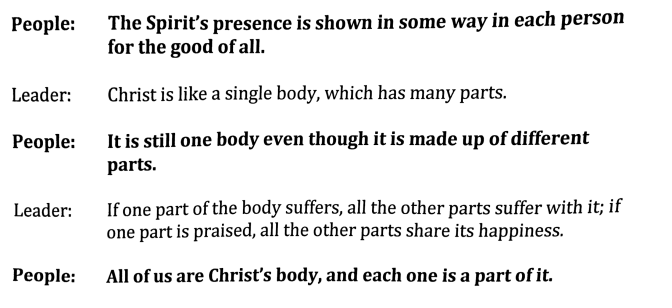
I was pondering this strange place between congregations the other day at the meeting of the UCC. In the middle of a prayer for the ministry of the UCC I was drawn to think about that balance between denominations, Here’s the excerpt that caught my attention.

Prayer-portions.jpg

As I thought through this prayer I was drawn to the beauty and simplicity of the words. The Spirit of God is indeed shown in each person. The blessing of the Spirit is not just for our own life, but for the good of all. Each person is blessed and called to be a part of God’s ongoing work in the world.

The Window

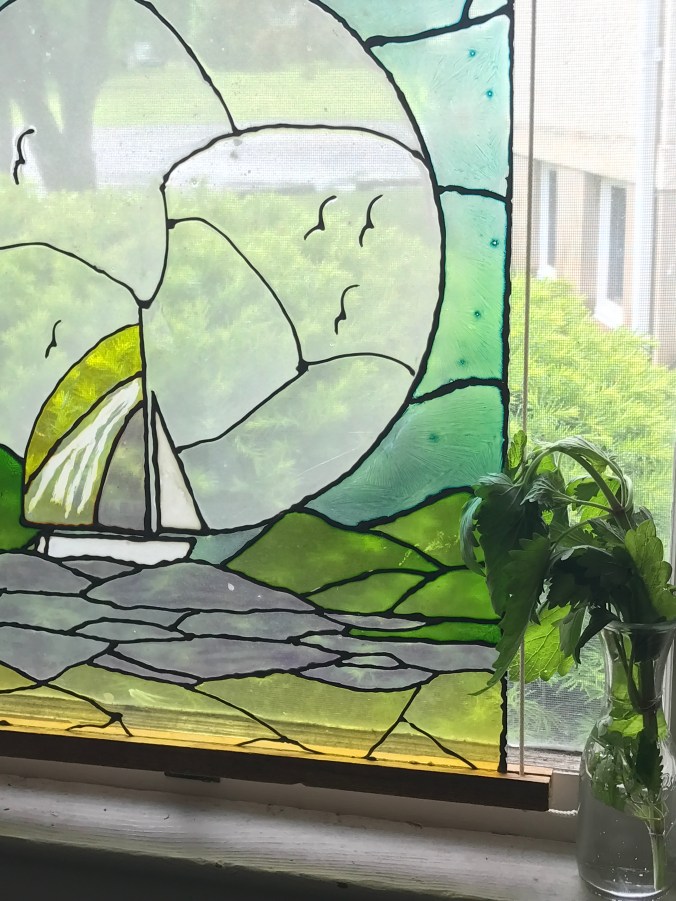
In this office window hangs a plastic stained glass window of a boat at sea. It reminds me of the call to be a missionary, especially as it came from my first pastoral parish (Canisteo First UMC). Next to the window is a cutting of catnip for our cat from a member of our local UCC Society here in Maine. The bush outside has peeked in at ministers from both denominations.

I am a blessed man. I am blessed while going about my service with the community of saints that span two denomination. I am blessed to be able to see the connections and relationships between the two churches. I am blessed to Christ’s body in each of the lives of the saints. Some are United Methodists, some are members of the United Church of Christ, and all are a blessed part of God’s body.

Yes, balancing two denominations is somewhat challenging. Yes, the number of meetings can get a bit long. Yes, some days I am just plain lucky that my head is firmly attached to my neck. I am blessed to be in this strange place. This place is more beautiful than most people know.

Let us Ramble: Wild Lettuce

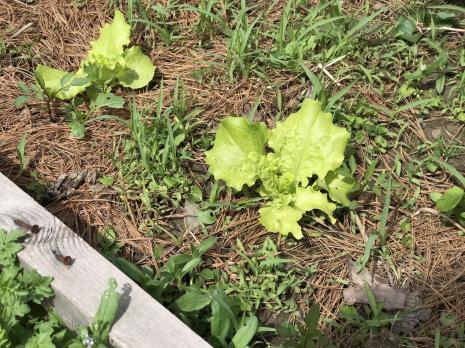
Have you ever found a blessing where you expected none? A few days ago I went outside to take a picture of a zucchini plant for another blogpost when I noticed something bright green alongside the path through the garden. I looked closely and I found a wild lettuce plant!

Random lettuce plants!

Now, it wasn’t truly wild in the sense of being unexplainable. Last year we planted lettuce and some of it literally went to seed. All winter long it snowed and the dogs trampled over the garden. All winter long the path nearby was assaulted by shovels and ice removing salts. All winter long this section of ground underwent abuse.

This spring the earth had a gift for me before I even had a chance to till and plant. The lettuce was light, fragrant, and delicious. I know this because I gobbled down a leaf immediately after I took this picture. The leaf was quite tender and tasty.

It makes me wonder what other blessings are hiding just beyond my sight. I should keep my eyes open! There may be pumpkins hiding around the corner!