The #RethinkChurch Lenten Photo-A-Day prompt for today is “Protect.” The scripture reading in our devotional today is a story (found in Luke 6:6-11) of Jesus healing a man on the Sabbath. The individual had a hand that is described in the New Revised Standard Version of the Bible as being “withered.”
While the daily prompts have generally fit nicely with our devotional, today’s prompt is a bit challenging. I do not always do yoga, but I have been known to stretch ideas when necessary. Hopefully I will not stretch the idea of protecting too far.
What an interesting thing it is to see Jesus love someone and have compassion despite the fact that other people did not see his actions as being holy or righteous. The healing Christ performed on the Sabbath may have been fine on another day, but to violate the Sabbath commandments to avoid work seemingly struck them as a violation of the law.
At one level, I have to admit that I find the reaction of the religious leaders to be an understandable reaction. Their reaction might even be seen as admirable if you consider the extent of their commitment to their faith. While their heart was clearly in a different place than Jesus’ heart, it is understandable that there might be a push towards a very strict faith. The people in our story were living in a world that seemingly had turned against the people of God through the powerful forces of foreign empires and armies. They believed fiercely in their faith because they were likely concerned about losing their way if they loosened their grasp.
Still, as admirable as their tenacity was in such circumstances, they still missed the point. Jesus saw an individual who was hurt and who needed compassion. The people were so focused on the rules that they lost their perspective. I wish I could say that this was a problem that has disappeared over the centuries, but the modern church has often struggled with compassion and love when confronted with hurt people who are easily labeled as “sinners.”
Lily the Dog watching over us
In choosing a photo to portray this point, I went through my old photos and found a picture of my dog Lily standing underneath the trees in one of our favorite spots on the Interloken trail in the Finger Lakes National Forest. Lily looked so noble while looking around to make certain that everything was safe and that we were alone in the fields.
I still do not know how to tell a dog that we are sitting in the middle of a pasture that is fenced in on every side. There are no predators in the field. On that particular day, there weren’t even any cattle in sight. We were in an empty field and there was no reason to be anxious.
I have noticed over the years that we often get our hackles up and prepare to defend ourselves and our faith from threats that really aren’t threats. At the best of those times, we look like Lily being overprotective in an empty field. At the worst of times, we end up causing or threatening real harm to people who have done nothing more than have a withered hand on the Sabbath.
Personally, I plan to spend some time today thinking about the fact that there may be places in my life where I am dead set on protecting something and possibly missing the forest for the trees. I know that my dog isn’t the only silly creature in my home.
The #RethinkChurch Lenten Photo-A-Day prompt for today is “alone.” What a word for contemplation, especially for a father in the midst of working his way through a separation! “Alone” is a word that I have pondered many times over the past few months.
A phrase stands out in our devotional reading for today: “Even when put in a challenging place, Jesus responds to challenge with compassion.” If we are called to become more like Jesus during this journey towards the cross, then what does it look like when we seek to respond to our challenges with compassion?
When writing this section of the devotional, my life was in a far more different place. As I work through this devotional alongside the members of my church, it is with a sense of wonder. Who was the person who wrote these words? I remember the hours working on this devotional, but now see the passages with different eyes and definitely answer the questions differently than I would have when I wrote this devotional.
In selecting a photo for today, I wanted to think about what it means to truly be alone. At the beginning of this oddly horrifying and challenging set of circumstances, I found myself filled with grief over the quiet house, the silent bedrooms, and the challenges of cooking for fewer people. Now, I find myself often coming across beautiful and wonderful things that are bitterly sweet.
Black Diamond Trail in Trumansburg, NY
I took this photo on a cold winter’s day while walking with my dog down a nearby trail. The path was empty of anyone, although there was clearly evidence that I was not the first person to enter the woods. For the entirety of the journey, I was alone with my dog. The wind blew through the branches, the dog snuffled through snow drifts and marked the snow, but it was otherwise silent.
It was beautifully still and silent. A world of icy stillness and solitude for just my dog and me. The sunlight shone through the branches and the snow sparkled underneath golden beams. It was truly amazing that I was able to see such beauty and it felt like that moment was for me and me alone. In the beauty and quiet, I felt as if God was walking right there with me.
It was sweet to know that I still matter enough that God draws near to me in such still spaces. It was sweet to know that God loves me deeply and truly despite the challenges of the past few months. It was also bitter to realize that I might have shared such a moment with my children a year ago.
How do I respond to these challenging moments with compassion? How do I love the people who have broken my heart through either their choices or simply doing their work? These are thoughts for my journal and not my blog, but I can state that this is where the journey for me begins today.
The #RethinkChurch word of the day for the Lenten Photo-A-Day challenge is “Tempted.” Oh, what a prompt for the contemplative practice of Visio Divina. Oh, what wonderful things I look forward to seeing as I wake for the day, post my photo on my Instagram, and then pick a photo to contemplate before waking up to face my day today.
I wonder what I will see today. Will I see muffins or cookies? Are people already regretting following the tradition of giving up meat on Fridays when a steak would be delicious? What is tempting? Will there be acknowledgment of love and temptation despite the nature of the season?
As I read through the devotional today, I find myself contemplating the nature of Jesus standing in his hometown of Nazareth. Everyone has their own expectations of Jesus, but my ongoing understanding is that Jesus was not, is not, and never shall be a person who simply does what everyone around him wanted, wants, or will want. Jesus was an individual who came to do the will of God and not an individual who simply came to do what other people always wanted.
Still, the temptation must have been amazing for people. Here is the carpenter’s son who has been doing all of these amazing things. What will he do for us? How quickly the temptation must have been to switch to “What should he be doing for us?” or “What do we deserve from him?”
I have no idea if the paintbrush of the Biblical narrative is fair to the people of Nazareth, but I can say that I often feel tempted to think less about others and more about myself. I am often tempted to grab onto life and to take a hold of what I want and what I think I deserve. I have moments where I want to take, take, and take some more.
“Russula Emetica” a.k.a. “The Sickener”
So, what photo ties these ideas together for me today? This photo of a mushroom was taken last year in the Finger Lakes National Forest. It looks lovely, doesn’t it? It is also highly poisonous. If you see it, I would imagine that you also might think that it looks like a candy mushroom or something Alice would eat to gain some marvelous transformation. Do not eat it: this mushroom is extremely poisonous. It is a temptation, but not every temptation falls under the scope of the adage “You should try anything once.” or “How do you know you don’t like it unless you try it?” This temptation might kill you and will definitely make you ill, so don’t give in!
There are lots of temptations that come through life. Not all of them are healthy, even if you can justify the temptation in your head. Some of the temptations might kill you if you give in. Feeling like you deserve something does not mean you should have it. Thinking that something would be incredible and great does not always mean that you should have it, do it, or take it.
I am grateful that Jesus was generally a man of peace. I am grateful he did not respond to the frustrations of the people of Nazareth with some of the responses other people might be inclined to enact on people being unreasonable and aggressive. I hope that I can have such self-control when I face temptation.
The word of the day for the #ReThinkChurch Photo A Day campaign is “Full.” In our devotional, Ash Wednesday revolves around the depth of old words. Our devotional journey begins with the reminder that: “Old words whisper out over many pews today.” The old words do resonate throughout this day and throughout the season ahead of us.
The traditional words that might ring through your memories may be “Remember that you are dust, and to dust you shall return.” Perhaps you remember hearing “Repent, and believe the gospel.” Perhaps the words that ring through your memories are not rooted in old and meaningful liturgies. Perhaps you hear are “The journey has begun. Let us journey together with Christ.”
In contemplating the words that ring out through my memory thanks the Photo-A-Day, I remember the words that have historically have little to do with Ash Wednesday, even if they are fitting. I remember two lines from the Wesley Covenant Prayer, which is often shared each January by Methodist congregations. The lines are “Let me be full. Let me be empty.”
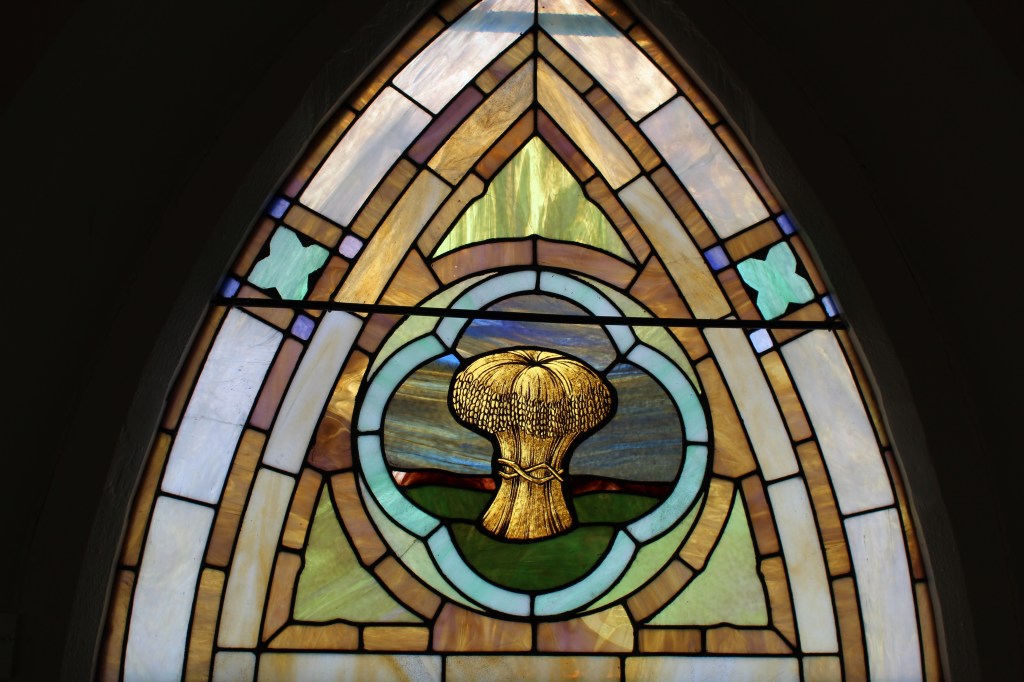
“Wheat Sanctuary Window” in Trumansburg UMC
What does it mean to be full? One photo I considered using is the photo I edited of the window with sheaves of wheat from our sanctuary. The reason I would share such a photo is that I want to be filled with God’s love and light to the point where I am gathered in with the harvest. I do not desire to be set aside or blown away by the wind. I want to be gathered in as a treasure. I want my life to be so full of goodness that I would be gathered in with the wheat.
At the same time: “Let me be full. Let me be empty.” I want to be the person that God want me to be. If my life is filled with glorious goodness and obvious giftedness, so be it. If I am easily seen as a person whose life should be gathered in, so be it. Also, if I seek to be faithful but stumble throughout my days, so be it. If I seek to be easily gathered in but end up rubbing all of the other stalks of wheat the wrong way or end up being a cornstalk in the middle of the wheat, so be it.
Ultimately, the old words whisper out. This season is about the fact that God’s grace was necessary. Jesus walked down the road on a journey of redemption and we all need the love that Jesus shared long ago. I would be full, but even if I am empty, God’s grace is truly what I need on this journey.
I think this is the photo that I will end up using today: a tomato growing on a vine in the middle of winter. By all rights, the photo makes no sense. Who grows tomatoes in the middle of winter? Will it even taste the same after spending the winter under a grow lamp? Will it be delicious or weird? Will it become a vibrant healthy tomato or simply fall off the vine one day? Will the flowers nearby ever grow their own blessings or will they fall to the counter in exhausted emptiness? I don’t know. Let it be full. Let it be empty. An excellent analogy and start to a season of both wonder and solemnity.
Today we’re reading through Matthew 9:9-13 as a people. In Matthew 9:12 of The Inclusive Bible, the words which comprise the title of this post are spoken by Jesus. Jesus states freely that people who are in good health don’t need a doctor, which leads to a question: If Jesus is in the process of bringing life into the lives of poor, then why is the “Doctor Jesus” spending time with people who could objectively be seen as rich?
In my opinion, there’s a common misconception about church. People believe that church is a place for people who have everything together. It is common to find people who find church people to be self-righteous, judgmental, and hypocritical. Interestingly, Jesus did not seen to spend his time with the people who had everything together.
People could objectively look at the scriptures Jesus and see a hypocritical teacher who says a blessing will fall on the poor while spending time with the rich., but is that truly the message we should take away from the story? Jesus does not say the rich are healthy. In fact, Jesus implies the people who he is sharing a table with are not healthy. Wealth does not equal spiritual health in Jesus’ eyes. The tax collectors and notorious sinners are ill: the doctor has come to make a “house call.”
Throughout this week, Jesus will stretch our understanding of what it means to be wealthy and who is in need of blessing. May God give us wisdom in a world that glorifies riches and sometimes isolates on a pedestal the very folks who need loving and healing community the most.
Today we are looking at Luke 6:6-11, which contains the story of Jesus healing a person with a withered hand. The story is an interesting one and certainly lends into the story of Lent. The last verse of our reading indicates that the religious scholars and Pharisees left the synagogue on that day looking for ways to do something about their “Jesus problem.”
The Lenten journey is one which ends in the events of Holy Week. There is no Lent where Jesus ends the season without suffering on the behalf of the people God loves. The desire of individuals to take care of this Jesus problem increases as the season progresses.
What’s interesting to me about this approach to Lent with the Beatitudes is that we see how a portion of Jesus’ teaching affects both Jesus’ life and potential the lives of the people who hear his teachings. Jesus offers healing to a person with a withered hand and the people walk away with sinister thoughts in their hearts.
I wonder how the person felt whose hand was healed upon that day. If it were me, I am doubtful I would have walked away grumbling about what Jesus had done. I would likely celebrate the unexpected blessing that came into my life.
This Lent, God may have something for us. God may give a blessing into our lives which we may not be expecting. God may give a blessing to us that we do not believe we deserve. God may bring a piece of radical healing into our lives, especially if we find ourselves struggling to find our place in this world.
I pray that God is with us all tonight and into tomorrow as we prepare to enter into worship. May God add blessing to our lives and may we celebrate it together in worship tomorrow.
Our reading today focused on Luke 4:31-37. The passage immediately follows our passage from yesterday. In the passage Jesus of Nazareth is approached by a person who is “possessed” while in nearby Capernaum.
Jesus is asked two questions: What does Jesus have to do with them and has he come to destroy them? Jesus frees the person of their condition, but the questions remain. What has Jesus come to do?
This Lent, that’s really the question we all must ask before we dive into the matters found in the beatitudes. What has Jesus come to do? Jesus’ teachings can radically affect the way we interact with the world. What has Jesus come to do in our lives?
One of the things I am appreciating about both using this devotional and writing this devotional is that it approaches Lent from a completely different angle than most Lenten studies. It is my hope and prayer that spending time in less traditional scriptures might help us to see things differently this season. What has Jesus to do with us? What might Jesus want to do in our lives?
Only time will tell how things will look, but I believe Christ has come to bring grace into my life. Things I have done may need to be discarded, patterns in my life may need to be destroyed, but I believe that at the end of this journey and Lent I will find myself alive in Christ.
Our reading today focused on Luke 4:14-30. The passage speaks about the proclamation of Jesus in his hometown of Nazareth. Jesus reads from Isaiah. Jesus proclaims that the words of Isaiah have been fulfilled:
“The Spirit of the Lord is upon me, because he has anointed me to bring good news to the poor. He has sent me to proclaim release to the captives and recovery of sight to the blind, to let the oppressed go free, to proclaim the year of the Lord’s favor.”
Luke 4:18-19, NRSV, where Jesus references a portion of Isaiah 61:1-2
The reason we are looking at this in our devotional is a perceived connection between the proclamation from Isaiah and the radical words of the Beatitudes. The poor are blessed and here Jesus proclaims that the blessing is good news. In the original reference which Jesus is references, Isaiah also points out that the mourning will be comforted.
What’s interesting to me is the way that the Nazarenes are frustrated that the blessing will not begin in their midst. Their community has sheltered Jesus’ family, despite Jesus’ colorful birth narrative. In this gospel in particular, Jesus is effectively born under taboo circumstances. Jesus is not conceived in a culturally acceptable time-frame. They are pleasantly shocked the carpenter’s son is able to surpass the traditional role of a carpenter’s son until Jesus proclaims that they will not receive preferential treatment.
Interestingly, there’s a very common word in modern circles that describes what the people are experiencing. The people of Nazareth feel entitled to be blessed first for having a role in Jesus’ life. They are expressing a sense of privilege. Surely, Jesus must bless them first, right?
I have three daughters and one of them is still getting used to the idea of clothes. In particular, she wants to dress herself or wear nothing at all. The other day I captured the perfect image of her point in life.
This is not how pants work…
Yes, that’s my child trying to put pants on over her head. I am aware that there’s a pants trick going around the internet where you put your legs in one side of the pants and your body through the other side, but that isn’t in her wheelhouse right now. She was genuinely confused about why the pants weren’t working.
The people of Nazareth are genuinely upset about what is happening. Jesus is not supposed to act this way as a child of the community. What Jesus is doing in saying he will not go out of the way to bless his hometown is beyond the pale of proper behavior for the people of Nazareth. They feel a sense of privilege which does not find this acceptable.
Yesterday, we talked about how the call of Lent is to “Repent, and believe the gospel.” Many individuals find themselves in the midst of a slog of a pit in their lives. As a minister and as a Christian who has engaged in evangelism on regular basis before entering into ministry as a professional, I came across many people who effectively said that their regular attendance at church, their being a good person, or even their family’s devotion meant that God should immediately bail them out of the tough parts of life.
To be brutally honest, there are times in life when that kind of belief is simply not consistent with how the spiritual life works. There are situations we face where we have to do more than notice we’re in the bog of life. We are called to repent of what led us to this place, turn towards God, and believe the gospel. Occasionally that belief is best manifested in honest attempts to step forward with faith despite the difficulty.
There’s truthfully moments where God will walk with us, but we must let go of that privilege. If you’re addicted to some substance or behavior, you may need to believe while you choose to not engage in that behavior or entering into dangerous places. If you’re struggling with mental health concerns, you may need to believe while regularly taking medicine to help your body function. If you’re grieving, you may need to believe while understanding there are stages of grief you may have to experience.
Sometimes, we each need to understand that the pants go on our legs despite our belief that they’ll work the way we want them to work. The humility that comes with a lot of Lenten practices can be an excellent place to practice what may become necessary on your journey.
May God bless us today as we ponder what we each might take for granted in our spiritual journey. May God help this to be a fruitful day.
Our church is beginning a journey along with many in the greater Christian Church today. Several of our members are gathering with our neighboring churches to begin the Lenten journey with an ecumenical service in a few hours. We will sing, pray, and reflect on our lives as Christians.
Today’s entry focuses on the passage which lies behind the majority of the devotional. The passage we read together today is Luke 6:17-26 and the focus of the devotional is a phrase out of the United Methodist Book of Worship. The liturgy for the Ash Wednesday service uses two distinct phrases during the imposition of the ashes.
The first is very traditional: “Remember that you are dust, and to dust you shall return.” This phrase has a lot of depth, especially as it is echoed in the traditional words during many memorial services. There is a direct correlation with the phrase “Ashes to ashes, dust to dust.”
The second phrase is also traditional. Our devotional is focused on the words of this phrase. “Repent, and believe the gospel.” When using this phrase, the Lenten journey begins with two instructions. We are called to repent. We are called to believe the gospel.
Photo from Chenango Valley State Park in Chenango Forks, NY
Often, the call to repentance is a major part of Lent. Repentance is not simply a matter of feeling guilt. The call is not to live in shame. Repentance is the process of recognizing your failings/shortcomings and turning towards God onto a better path.
In truth, there are many places in my own life where I feel as if I were walking through a field like the one in my picture. I walk along while looking at the sky until I find myself tumbling into the freezing cold waters below. Sometimes I know there’s a pit nearby, but sometimes I wander into the murky freezing water without any warning.
Repentance is about more than simply acknowledging that there’s a problem. Repentance is often about realizing that the only way out of the pit that we find ourselves standing in is with the help of God. Many people who have found themselves dealing with anything from an addiction, grief, depression, or chronic anxiety might tell you the ONLY way out of that pit is often with God’s help.
The reason I love this particular phrase on Ash Wednesday is the idea that we are called to believe. The photo I showed you is a desolate one, but did you notice the birds? There’s life down in that pit of freezing water. The water is cold, the situation would be miserable if you were trying to climb out the opposite side, but there’s still life.
The call on us today is not only to repent on this journey, but to believe in the gospel. Jesus Christ can work in our lives this Lent. The Holy Spirit can guide us through the darkest of our days throughout the years. Our Creator can create life in the midst of our lives. Let’s repent, and believe in the gospel.
Hello friends, I have not fallen off the face of the earth. I have been focusing on working on longer works lately. One of those products has finally come to fruition.
I recently created a Lenten Devotional based around the teachings of Christ on the Beatitudes. It isn’t perfect, but my first attempt at publishing can be found on Amazon as both a Large-Print Book and as a Kindle ebook. The book is called: “In the Path of the Beatitudes: A Lenten Devotional.”
I hope that it can be a blessing to folks who want to spend some time reflecting on the teachings of Christ during the season of Lent. The devotional has daily scripture readings, a reflection, and journaling/discussion questions for personal growth.
Jesus is nailed to the cross, summer 2017Jesus is nailed to the cross, summer 2017Jesus is nailed to the cross, summer 2017Jesus is nailed to the cross, fall 2017Jesus is nailed to the cross, fall 2017Jesus is nailed to the cross, fall 2017Jesus is nailed to the cross, winter 2018Jesus is nailed to the cross, winter 2018Jesus is nailed to the cross, spring 2018Jesus is nailed to the cross, spring 2018
Jesus is nailed to the cross, spring 2018
Jesus is nailed to the cross, summer 2018Jesus is nailed to the cross, summer 2018Jesus is nailed to the cross, summer 2018
Note: A friend of mine once called this statue “Jesus with a six pack.” Artistic license is alive and well, even in statuary.
Jesus is stripped of his garments, Summer 2017Jesus is stripped of his garments, fall of 2017Jesus is stripped of his garments, winter 2018Jesus is stripped of his garments, spring 2018Jesus is stripped of his garments, spring 2018Jesus is stripped of his garments, summer 2018 Jesus is stripped of his garments, summer 2018
Message: “The ‘Stone’ comes with praises” Date: April 14, 2019 Scripture: Luke 19:28-40 Preacher: Rev. Robert Dean
After he had said this, he went on ahead, going up to Jerusalem.
When he had come near Bethphage and Bethany, at the place called the Mount of Olives, he sent two of the disciples, saying, “Go into the village ahead of you, and as you enter it you will find tied there a colt that has never been ridden. Untie it and bring it here. If anyone asks you, ‘Why are you untying it?’ just say this, ‘The Lord needs it.’” So those who were sent departed and found it as he had told them. As they were untying the colt, its owners asked them, “Why are you untying the colt?” They said, “The Lord needs it.” Then they brought it to Jesus; and after throwing their cloaks on the colt, they set Jesus on it. As he rode along, people kept spreading their cloaks on the road. As he was now approaching the path down from the Mount of Olives, the whole multitude of the disciples began to praise God joyfully with a loud voice for all the deeds of power that they had seen, saying,
“Blessed is the king who comes in the name of the Lord! Peace in heaven, and glory in the highest heaven!”
Some of the Pharisees in the crowd said to him, “Teacher, order your disciples to stop.” He answered, “I tell you, if these were silent, the stones would shout out.”
Luke 19:28-40, NRSV
We are entering Holy Week this morning and we hear that strange story of the palms and cloaks on the road into Jerusalem. We find Jesus entering Jerusalem and being hailed. We find angry religious leaders, excited disciples, and exuberant children of Israel. Today is a day of excitement and joy. We have been building up to this day since Jesus’ last liturgical appearance here. Jesus is born and enters the temple. Wonderful words of prophecy and hope. Going forth from next Sunday, we will see a new faith born out of the events of this week. There’s a reason this is called Holy Week. Holy Week is pivotal to the Christian faith.
“Palm Sunday in Spain,” 1873 by Jean-Georges Vibert French Public Domain Image courtesy of the Metropolitan Museum of Art
This week is pivotal not only in terms of church tradition but also it how it forms us. These stories change how we understand God. One of the reasons we encourage kids to attend Holy Week events is because they can change the way we see God and these stories in both their beauty and their sorrow teach us about the love of God.
Growing up, we were required at the Trinity United Methodist Church to go through a long confirmation process before we were offered membership. We were not alone as members of the church of all ages had several month process of education before you could join the church, but confirmands had to go through the whole Christian year together with their leaders before joining the church. We began in the fall during “Ordinary Time,” walked through Advent where we helped with Christmas programs for younger kids, took a retreat together in the season after Christmas, helped the church through Lent by taking part in helping lead Holy Week services, and finally entered membership on Pentecost.
The whole process was quite an experience, but in my memory this week was the most formative one. I remember trying to get my head around how you could receive such lavish praise one day and be crucified a few days later. When we stop to ask that question, there are a million and one reasons it might have happened.
Was it a jealous religious leadership acting maliciously?
Were the wrong people in Jerusalem the day Herod brings Jesus before the crowd?
Was Herod sick and tired of dealing with the locals and literally washed his hands of them?
Were Jesus’ teachings being heard by ordinary folks who realized they required a lot more than a welcome parade?
These ideas a few ideas of many and it may have been a combination of these things and more, but I remember looking on these moments of extreme difference and being puzzled.
I grew up near Buffalo during the years of Jim Kelly’s leadership of the Buffalo Bills, so I knew how fickle fame could be. Scott Norwood was a villain, Frank Reich was a hero, and the week before Norwood missed the kick during the Super Bowl he was awesome and the week before Reich led one of the greatest comebacks in history, he was riding the bench. I know that fame can be fickle, but this was more than that level of fickle behavior.
Something happens during Holy Week I have spent decades trying to figure out. In many ways, the curiosity and awe inspired by Holy Week led to me becoming a minister. I want to draw your attention to another passage. In Luke 20:17-19, we find these words:
“What then does this text mean:
‘The stone that the builders rejected has become the cornerstone’?
Everyone who falls on that stone will be broken to pieces; and it will crush anyone on whom it falls.” When the scribes and chief priests realized that he had told this parable against them, they wanted to lay hands on him at that very hour, but they feared the people.
Luke 20:17-19, NRSV
Now, context matters, so this passage immediately follows a parable Jesus tells about the owner of a vineyard who leases out the property while he goes on a long journey. The owner sends to the people leasing the vineyard a servant after many years away. The tenants will not pay. They beat the servant and send him away. They beat the next servant who comes. Finally, the landlord sends his son. The tenants kill the son to try to benefit from the son’s death.
The religious leaders understand that Jesus is telling a story about them. They are furious and that upsets them, but what’s interesting is that old quotation. It comes from Psalm 118:19-22:
Open to me the gates of righteousness, that I may enter through them and give thanks to the Lord. This is the gate of the Lord;
the righteous shall enter through it. I thank you that you have answered me and have become my salvation. The stone that the builders rejected has become the chief cornerstone.
Psalm 118:19-22, NRSV
The religious leaders object to Jesus being given such praise on the day we now celebrate as Palm Sunday. The religious leaders question him and he refers to a coronation psalm. Jesus, being questioned about the goodness of his deeds and teachings, tells them that the gates should be open, that God’s salvation is near, and that the very thing the builders have rejected will become the chief cornerstone upon which salvation will be built.
Over the years, I have never really wrapped my head around all the events of Holy Week. I believe part of the Christian walk is this ongoing attempt to contemplate, ponder, and meditate over these days. I understand this though: today we celebrate the entrance into Jerusalem by Christ. Christ is who the people need and not who the people want. Jesus is the foundation of the future they need and a breaking from what the people imagined.
On this day, we celebrate Jesus entering a city built upon generation after generation of people doing their best. Jesus will enter a temple of ornate stone and beautiful worship. Jesus will smell the scents, see the people, see the abuses of the temple, and will teach. The very person the people need will be the one who is rejected. The very stone upon which the future will be built must first be rejected.
If this sermon seems like only a bit of the story of Holy Week, it is because this is only one part. As we enter Holy Week, I want to challenge you to come back to church before next Sunday. Come Thursday night and ponder Holy Communion over a meal. Come Friday to hear the story and empty the sanctuary. Come by yourself and read the gospel stories during one of the quiet days when Wide Horizons is on break and you’ll find Teagen and myself working away in our office. Interrupt me to ask questions. I promise I won’t mind as I may be pondering the same things myself. Grab your Bible and take a long walk with it. I invite you to enter further into the story.
Take time this week. Meanwhile, contemplate this: We often never know what we need until the moment is past. Like those people long ago, we may believe Christ is coming into our lives to do what we expect. If Holy Week teaches us one thing, it is that Christ comes and will be Christ. Let us welcome Christ into our lives. Let us pray…
Jesus falls, summer 2017Jesus falls for a third time, summer 2017Jesus falls for the third time, fall 2017Jesus falls for the third time, fall 2017Jesus falls for the third time, winter 2018Jesus falls for a third time, winter 2018Jesus falls for the third time, spring 2018Jesus falls for the third time, spring 2018Jesus falls for the third time, summer 2018Jesus falls for the third time, summer 2018
Jesus Speaks to the Women of Jerusalem, summer 2017Jesus speaks with the women of Jerusalem, summer 2017Jesus speaks with the women of Jerusalem, fall 2017Jesus speaks with the women of Jerusalem, fall 2017Jesus speaks with the women of Jerusalem, fall 2017Jesus speaks with the women of Jerusalem, fall 2017Jesus speaks with the women of Jerusalem, winter 2018Jesus speaks with the women of Jerusalem, winter 2018Jesus speaks with the women of Jerusalem, spring 2018Jesus speaks with the women of Jerusalem, spring 2018Jesus speaks with the women of Jerusalem, spring 2018Jesus speaks with the women of Jerusalem, summer 2018Jesus speaks with the women of Jerusalem, summer 2018
Jesus meets Mary, summer of 2018Jesus meets Mary, summer of 2018Jesus meets Mary, spring of 2018 Jesus meets Mary, spring of 2018Jesus meets Mary, spring of 2018Jesus meets Mary, winter of 2018Jesus meets Mary, winter of 2018Jesus meets Mary, fall of 2017Jesus meets Mary, fall of 2017Jesus meets Mary, fall of 2017Jesus meets Mary, summer of 2017Jesus meets Mary, summer of 2017
Christ falls, summer of 2018Christ falls, summer of 2018Christ falls, summer of 2018Christ falls, spring of 2018
Christ falls, spring of 2018
Christ falls, winter of 2018Christ falls, winter of 2018Christ falls, fall of 2017 Christ falls, fall of 2017Christ falls, summer of 2017 Christ falls, summer of 2017
Message: “Settling the Space” Date: April 7, 2019 Scripture: John 12:1-8 Preacher: Rev. Robert Dean
“Six days before the Passover Jesus came to Bethany, the home of Lazarus, whom he had raised from the dead. There they gave a dinner for him. Martha served, and Lazarus was one of those at the table with him. Mary took a pound of costly perfume made of pure nard, anointed Jesus’ feet, and wiped them with her hair. The house was filled with the fragrance of the perfume. But Judas Iscariot, one of his disciples (the one who was about to betray him), said, ‘Why was this perfume not sold for three hundred denarii and the money given to the poor?’ (He said this not because he cared about the poor, but because he was a thief; he kept the common purse and used to steal what was put into it.) Jesus said, ‘Leave her alone. She bought it so that she might keep it for the day of my burial. You always have the poor with you, but you do not always have me.’ “
John 12:1-18, NRSV
This season we have been looking at the Lenten journey as a journey into our own wilderness. We have explored the fact that Jesus found something out in the wilds when he fasted for forty days and we have joined in that journey. We have explored the idea the fact that there are frightening things out in the world when we look at our own hearts and at the world around us. We have looked at how we must sometimes clear out the broken parts of ourselves with God’s help. It has been quite a journey.
Today we continue that journey with an honest question: What happens when we walk into that wilderness and find our home? What does it mean to settle into that land? When the woods are cleared, the crops are planted, and we find a place to lay a foundation for our heart’s home, what does that look like for us today? We’ll take a look at that question through the lens of our passage from John, but first let us pray:
Holy Christ, we are less than two weeks away from Holy Week. Next Sunday the journey towards the cross intensifies as we read how you enter Jerusalem for that final week before the crucifixion. Be with us today as we go into this scripture which is our scripture for this moment. Give us wisdom and clarity. Give us peace and patience. Help us to understand what you might be saying to your church. Amen.
The Didache was one of the earliest writings and contains, among many things, a picture of how the early church functioned. Most interestingly today, the DIdache included a description of how to go about serving communion in church.
In the early church communion was vital to the community life. It was seen as a commandment of God to embrace this holy meal whenever the church gathered. As you will see, the service is short and straightforward. The responses are far more prevalent after the meal is served than before, some elements we use today are missing, and other elements seem eerily similar to parts of our own service.
The bread spread over the hills…
Why engage in this service today? There’s a very simple reason. We are gathered towards the end of Lent and Holy Week is coming. We have been seeking our way through this wilderness and we are using this very old service as a way of reminding ourselves of a very important truth: “There’s a place for us at the table.”
Nearly 2,000 years ago the table was prepared for the people. With chalice and bread the church was drawn to God. These truths have not changed. The table has been open for God’s children for nearly 2,000 years. This truth existed long before we were born and will be true long after we have passed on from this world.
The question we have to ask ourselves is whether we see our space at that table. Do we see how we belong to God in this world? Do we have eyes open enough to recognize that place in all of us which belongs with Christ? To use the wilderness analogy, do we open our eyes when we see that clearing besides the still waters of Psalm 23? Do we recognize the gift of the divine in all of our lives: the opportunity to belong without question to and with Christ?
This question is quite serious. It can be very easy to turn our eyes from God and forget our place with Christ. Can we recognize how easy it is to be blinded by the goods and things of this world? Is it possible that even our comfort in this world can blind us to our place with Christ?
Can there be life and space for us in a concrete world?
In our scriptures we see that temptation. Judas looks at the table before him in Lazarus’ home and sees waste. The scriptures tell us that he is a thief from the common purse, but there’s something even more fiendish going on in this place. Judas’ greed has drawn his eyes to Mary’s gift and in his quest to satisfy his desires Judas tries to come between Mary and Jesus.
Judas’ eyes are not on Mary as a person in grief. He does not see that she is coming from a place of love and possibly of grief. All he sees is what is in front of him. His lust for wealth has blinded him to God’s purposes. While Judas will serve a purpose, he has lost his way.
Strangely, while it appears that the disciples are continually ignorant of what will happen, Mary seemingly understands things are about to go terribly wrong. Mary’s eyes are not on the perfume and her thoughts are not on the cost of the perfume. Mary’s eyes are on Christ, who is right in front of her. Her eyes are focused on Jesus.
In Luke 18 Jesus shares a story of a Pharisee and a Tax Collector. The tax collector prays for forgiveness to God with humility while the Pharisee stands around thanking God that he is better than everyone around him. The Pharisee has his eyes on the world around him, but the tax collector is focused on God and asking for mercy. Jesus says in Luke 18:14: “I tell you that this [tax collector], rather than the [Pharisee], went home justified before God. For all those who exalt themselves will be humbled, and those who humble themselves will be exalted.”
When you read this story, who do you think goes to sleep that night justified? Is it Mary who comes to anoint the feet of Christ with love or Judas who keeps his eyes on the costly perfume? Who do you believe has a place at Christ’s table? In my opinion, Mary definitely has that place at the table.
Mary has suffered more than most. Scriptures tell us that Mary and her sister send a message to Jesus when Lazarus is about to die. They live through the grief when Jesus does not arrive before his death. They live through the shock of Lazarus’ resurrection. For that matter, even before this took place, Mary’s own sister chastises her in front of Jesus for learning from Jesus rather than diving in to help with the housework. Mary and Jesus have a rich history, but here in this place we find Mary understanding the truth that she has a place with Jesus that allows her to be intimate with her savior, she has a place with Jesus that allows her to expect Christ will protect her from those who might see these actions as too intimate (which is really important in a world where an adulteress can be stoned to death), and she has a confidence that she will be welcomed by Christ.
She knows her place. We who wander through the wilderness of Lent can forget that this is a season of practice. In our darkest moments and in our greatest triumphs, we never lose our place in God’s love. The spot at this table, the “bread spread over the hills,” and the juice in this chalice is meant for us. We have a home in the wilderness because when we wander into the wilderness we can find Christ, and once we enter into that love, nothing can separate us from that love in Christ Jesus.
We are using this old liturgy because it reminds us that this table has been open around the world for a very long time. Saints of old gathered to share their praises and eat this bread. The cup has been passed to people of every nation and people. The table is here for us as it has stood for all of God’s children for generation upon generation.
I invite you to prepare your heart for this feast. God comes to share with us again today. As we break bread, as we share the cup, and as we open our arms to each other in love, we do these things as a people who are welcome. Let all who need to ask forgiveness, come before God in the moments ahead. Let all who need to ask for courage, come before God in the moments ahead. I invite you into an attitude of prayer as we approach the throne. Let us enter into silence and then prayer…
Jesus takes up his cross, summer of 2018 Jesus takes up his cross, summer of 2018 Jesus takes up his cross, summer of 2018Jesus takes up his cross, spring of 2018 Jesus takes up his cross, spring of 2018Jesus takes up his cross, spring of 2018Jesus takes up his cross, winter of 2018Jesus takes up his cross, winter of 2018Jesus takes up his cross, fall of 2017Jesus takes up his cross, fall of 2017Jesus takes up his cross, summer of 2017
Jesus before Herod, afternoon in the summer of 2018Jesus before Herod, afternoon in the summer of 2018Jesus before Herod, in the morning of Spring 2018Jesus before Herod, in the morning of Spring 2018Jesus before Herod in the winter of 2018Jesus before Herod, in the fall of 2017Jesus before Herod, in the fall of 2017Jesus before Herod in the summer of 2017










 Distracted Pastor Ramblings