Querido Jesús: 2 Corintios 5:6-10, 14-17

«Por lo tanto, si alguno está en Cristo, es una nueva creación. ¡Lo viejo ha pasado, ha llegado ya lo nuevo!» 2 Corintios 5:17, NVI

Padre Celestial, mi vida vieja ha pasado y estoy trabajando para saber cómo ya será vida nueva. Yo Quiero tener tu Palabra adentro de mi vida. Yo puedo a sostener tu verdad y promesas cerca de mi porque tú ayudame y amame.

Todo lo que es viejo y roto en mi cuerpo celestial ya quedó recreado con tu amor, pero mi vida en este mundo aún necesito trabajo. Mi Salvador, cuando tropiezo, estoy embarazoso con mis faltas y mis problemas. Por favor, ayudame.

Ayudame a saber esta verdad: vivimos en fe y esperanza, no por vista o por miedo. Estoy segura tu escúchame cuando estoy asustado. Tu comprendes las cosas de que mi pienso en esos momentos y ya siempre amame. Gracias Jesucristo. Te amo y tu amame. Amén


“Therefore, if anyone is in Christ, they are a new creation. The old has gone: it has become new!” 2 Corinthians 5:17, Translated from NVI

Heavenly Father, my old life has passed and I am working to know what the new life will be like. I want to have your Word inside my life. I can hold your truth and promises close to me because you help me and love me.

Everything that is old and broken in my heavenly body has already been recreated with your love, but my life in this world still needs work. My Savior, when I stumble, I am embarrassed with my faults and my problems. Please, help me.

Help me know this truth: we live in faith and hope, not by sight or fear. I’m sure you listen to me when I’m scared. You understand the things that I think about in those moments and you always love me. Thank you Jesus Christ. I love you and you love me. Amen.

Boat Potatoes

“We often knock Peter because, as we’ll see in a moment, he’s going to take his eyes off of Jesus and begin to sink. But notice the other eleven disciples never even thought about getting out of the boat. Ortberg calls them ‘boat potatoes.’ They stayed where they were. They remained in the boat because they were afraid of what could happen if they moved beyond it.”

Rev. Adam Hamilton, “Simon Peter: Flawed but Faithful Disciple”

It is impossible for me to overstate how much I appreciate the fact that the term “boat potatoes” exists. This is single-handedly one of the funniest descriptions of something that happens all the time that I have read in a very long time.

Am I guilty of being a “boat potato?” Probably! There have definitely been points where I have just shrugged and gone along with life because that’s simply how a person is supposed to live their life. Can I think of a moment where I have been a boat potato recently?

I don’t know if I have or not. The thing about the other eleven disciples is that we learn that they are, in fact, boat potatoes, because Simon Peter steps out of the boat. If Simon Peter wasn’t there, then we might perhaps just think of them as ordinary people who would never step out of a boat. As already covered this week in an earlier post, sitting in the boat is the sensible thing to do. It would be weird to try and walk on the water in the first place. It would be absolutely bonkers to consider getting out of the boat onto the surface of the lake in the middle of a storm.

They are revealed as being boat potatoes because one of them decided to put himself into a potato cannon of faith and light the ignitor by asking Jesus if he could come out on the water. Without the revelatory presence of SImon Peter, there’s no way to know.

So, am I another boat potato? I guess the only way to know is to look around me and see whether or not I am just sitting in the boat. Alternatively, if I look around and notice nobody is out on the water with me, am I just unhinged or am I proving, definitively, that I am not a boat potato?


Our church is offering a short-term Bible study for the season of Lent. While many studies for the season traditionally focus on spiritual practices or on the stories of holy week, this year we are reading “Simon Peter: Flawed but Faithful Disciple” by Rev. Adam Hamilton. The idea of the study is that we might consider how we follow Christ in our lives while considering the life of this flawed follower. These blog posts are designed with a principle I have learned from recovery work: “We identify with the stories of others and try not to contrast.” We grow more and live with greater serenity when we look for what we share in common with someone with whom we might otherwise disagree.

It does sound stupid

“Have you ever thought about what an odd thing that is to say in this situation? It sounds almost idiotic. I try to put myself in Peter’s position. I don’t know what Jesus is doing, or how he’s doing it, but if I see him walking on the water in a storm that might cause me to drown, I imagine I would say, ‘Jesus, come get in the boat!’ I’d even throw him a life jacket. I’d reach out my hand to help pull him in. But Peter does the opposite. He has the audacity to ask Jesus to bid him to step out of the boat and walk on the water. That gives you a clue as to why Peter is the prince of the apostles. When everyone else was too scared or too confused to respond, Peter took the lead. He alone thought to himself, ‘If Jesus can walk on the water, maybe I can do it too.’ ”

Rev. Adam Hamilton, “Simon Peter: Flawed but Faithful Disciple”

I think we should all agree that Rev. Hamilton is correct. What Peter does in this telling of the story is absolutely strange. Who, being in the right frame of mind, would possibly make that same choice to decide to get out of a perfectly good boat to walk on the water? Simon Peter actually stepped out of the boat and onto the water just moments after everyone around him was freaking out and believing that Jesus was a ghost.

You know those videos that have the security camera footage where the absolutely unexplainable happens? You know, those weird videos where one moment everything will be quiet and the next moment there’s a disembodied head floating past a window. Jesus is effectively out there like a disembodied head in the window and Peter says, “Hey, I should go over there!”

Why? Peter, why? Who goes into the dark basement when there’s a serial killer on the loose? Who goes for a walk through the graveyard when that weird meteorite is passing over head and letting off strange radiation? Who gets out of a sailboat in the middle of a storm when there’s almost not chance you could swim through the wind and the waves?

Simon Peter, that’s who. Rev. Hamilton calls him the prince of the disciples and I have to be honest, that’s a weird way to describe someone who risked winning the Darwin Award. Hamilton puts it clearly:

“Peter had been working on the water for his entire adult life. His experience had taught him that getting out of a boat on the lake meant that a person either would have to sink or swim; walking was not an option. And in a storm like that, and being far from shore, swimming wasn’t much of an option either. Yet here was Simon Peter, stepping out of the boat, no life jacket, no life buoy. Just Jesus.”

What Peter does in this story is completely off the rails and is profoundly absurd. Peter arguably does one of the craziest things a person does in scripture. Peter also is the only one of twelve who came to know what it was like to walk on water that day. Rev. Hamilton does point out that Peter waits for Jesus to invite him instead of just stepping out of the boat, but it is still an arguably unhinged thing to even think to ask such a question.

Perhaps the difference between being faithful and being unhinged is, occasionally, a matter of perspective. It is an interesting to consider now and again.


Our church is offering a short-term Bible study for the season of Lent. While many studies for the season traditionally focus on spiritual practices or on the stories of holy week, this year we are reading “Simon Peter: Flawed but Faithful Disciple” by Rev. Adam Hamilton. The idea of the study is that we might consider how we follow Christ in our lives while considering the life of this flawed follower. These blog posts are designed with a principle I have learned from recovery work: “We identify with the stories of others and try not to contrast.” We grow more and live with greater serenity when we look for what we share in common with someone with whom we might otherwise disagree.

The Stumbling Block

I wrote this poem while thinking of the passage from Matthew 18:6-9, which says that it is better to be drown in the sea than to cause someone else to stumble. I am trying to come to a place of peace with the frustration which is continuing to take root in me despite my best efforts. I am working as hard as I can to burn off the anger through diet, exercise, and even spiritual disciplines, but there are times when things are simply wrong and more than an irritation. There are times when people do real harm to you and that pain becomes a thorn in the side that will not go away.

Even if there may be divine punishment for the person who causes another person to stumble, it still hurts deeply to be the person with broken toes, scraped knees, and a noticeable limp. I don’t doubt for a second that all that is happening is noticed and noted in the Book of Life and any equivalent book with opposite purpose. It would still be nice if there could be some relief.

Broken heart longs for them
The hugs, smiles, and dumb jokes
as joy is hard to coax
when you're alone

Prayers flow as I walk
Burn the anger with fat.
I look more and more flat
but rage lives on.

Walking, praying, fasting:
I curse this stumbling block
as on the Door I knock
and ask for help.

Even so, upon further reflection, a better passage to consider might be Romans 14:12-19 which is far more balanced in perspective. What I mean by balanced is that Paul does a decent job in Romans in balancing the concerns. Yes, it is wrong when someone else causes us harm, but Paul writes in a way that invites people to look inside before looking at one’s neighbor. It is not right for your neighbor to harm you, but first consider whether or not you will be ashamed when you give your account to God about how you lived your life and what you did, which is different from what your neighbor did to you.

So, how do I live with this pain in my side and sorrow in my heart? I see wisdom in Paul’s words in 2nd Corinthians 12:7-12. I have asked time and time again for this thorn to be removed, but it hasn’t budged. I guess that God’s strength is shown in my weakness, so I’ll keep trudging down the road while remembering the simple truth from a few verses earlier in Romans 14:7-10:

“We don’t live for ourselves and we don’t die for ourselves. If we live, we live for the Lord, and if we die, we die for the Lord. Therefore, whether we live or die, we belong to God. This is why Christ died and lived: so that he might be Lord of both the dead and the living. But why do you judge your brother or sister? Or why do you look down on your brother or sister? We all will stand in front of the judgment seat of God”

Romans 14:7-10, Common English Bible

This life I live with thorn-gifted pain is the life that I have to live. My “neighbor” may look at me with disdain or judgment, keep me from my children in defiance of the court order, and teach them that it is dangerous to speak with me (since I might call Child Protective Services if something goes wrong and the kids are in danger). Even with that sorrow and pain, I am called to live, so I will live. When the day of my death comes, even if I am alone I will die in the Lord with hope in my heart that:

“We have access by faith into this grace in which we stand through him, and we boast in the hope of God’s glory. But not only that! We even take pride in our problems, because we know that trouble produces endurance, endurance produces character, and character produces hope. This hope doesn’t put us to shame, because the love of God has been poured out in our hearts through the Holy Spirit, who has been given to us.”

Romans 5:2-5, Common English Bible

Thorn in my side or not, I will live in hope and I shall not be ashamed of the Lord. I will seek hope all of my days, even with broken bones in my soul, for God loves me and will make all of this right one day. Even with broken places in my soul, I am still fearfully and wonderfully made and God loves me. I am God’s child and I trust that my Parent will hold me as close as I wish I could hold my children.

Under God’s Wings

“Be merciful to me, O God, be merciful to me,
for in you my soul takes refuge;
in the shadow of your wings I will take refuge,
until the destroying storms pass by.”

—Psalm 57:1 (NRSV)

Tomorrow is election day in the United States. In our town of Maine, there are many choices to make between incumbents and challengers. With the political climate being as it has been lately, there is a lot of tension in many hearts and minds. What will happen if one candidate wins an election? What will happen if another candidate wins? Tension and anxiety are high.

I was pondering the reality of this election before entering morning prayer. The Psalm of the day in my prayers was Psalm 57. The first verse of the Psalm stuck with me. The imagery of the Psalm begins with the image of a petitioner asking God to be merciful as their soul takes refuge. This soul turns to God and seeks safety underneath the wings of God.

The imagery that stuck in my mind was one of a Parent providing safety for a child during a chaotic storm. Images floated through my brain of a robin spreading wings over nestlings during a rainstorm, a father penguin standing over his chick throughout a winter storm while his partner walks to the sea, or a mother goose protecting her goslings.

This imagery stuck in my mind when I finally reached my computer. I felt the urge to click on Facebook, to read the news, and do many of the things I told myself I would not do before Tuesday evening. I thought about what I might absorb from such an anxious world, thought of the imagery of the Psalm, and went about my day.

Tomorrow will be what tomorrow will be regardless of my anxiety. I will vote, I will pray, but I will not be afraid. God is greater than any storm and nothing can separate me from the love of God in Christ Jesus. Tomorrow will come, tomorrow may end with me calling out, but tonight I shall trust that God’s wings are enough to shelter me.

IMG_3222


Let us Seek: Shipwreck ahoy!

For today’s blog I thought we could spend some time with one of the readings from the Revised Common Lectionary. Today’s readings include a beautiful passage from the Book of Acts. I believe that this passage has a good word for all of us. The passage I am referring to reads: (Acts 27:7-12, NRSV)

“We sailed slowly for a number of days and arrived with difficulty off Cnidus, and as the wind was against us, we sailed under the lee of Crete off Salmone. Sailing past it with difficulty, we came to a place called Fair Havens, near the city of Lasea.

Since much time had been lost and sailing was now dangerous, because even the Fast had already gone by, Paul advised them, saying, “Sirs, I can see that the voyage will be with danger and much heavy loss, not only of the cargo and the ship, but also of our lives.” But the centurion paid more attention to the pilot and to the owner of the ship than to what Paul said. Since the harbor was not suitable for spending the winter, the majority was in favor of putting to sea from there, on the chance that somehow they could reach Phoenix, where they could spend the winter. It was a harbor of Crete, facing southwest and northwest.”

The Apostle Paul has been a leader in the church for several years. Paul had also been a leader within the religious elite of the Jewish people before converting to Christianity. Paul was a leader who knew how to convince others to his point of view.

Paul still manages to end up on a boat that is headed into a shipwreck. Paul may be spirit-filled, wise, and a leader of others, but Paul is still on a boat that is going on a very perilous journey that will end in disaster.
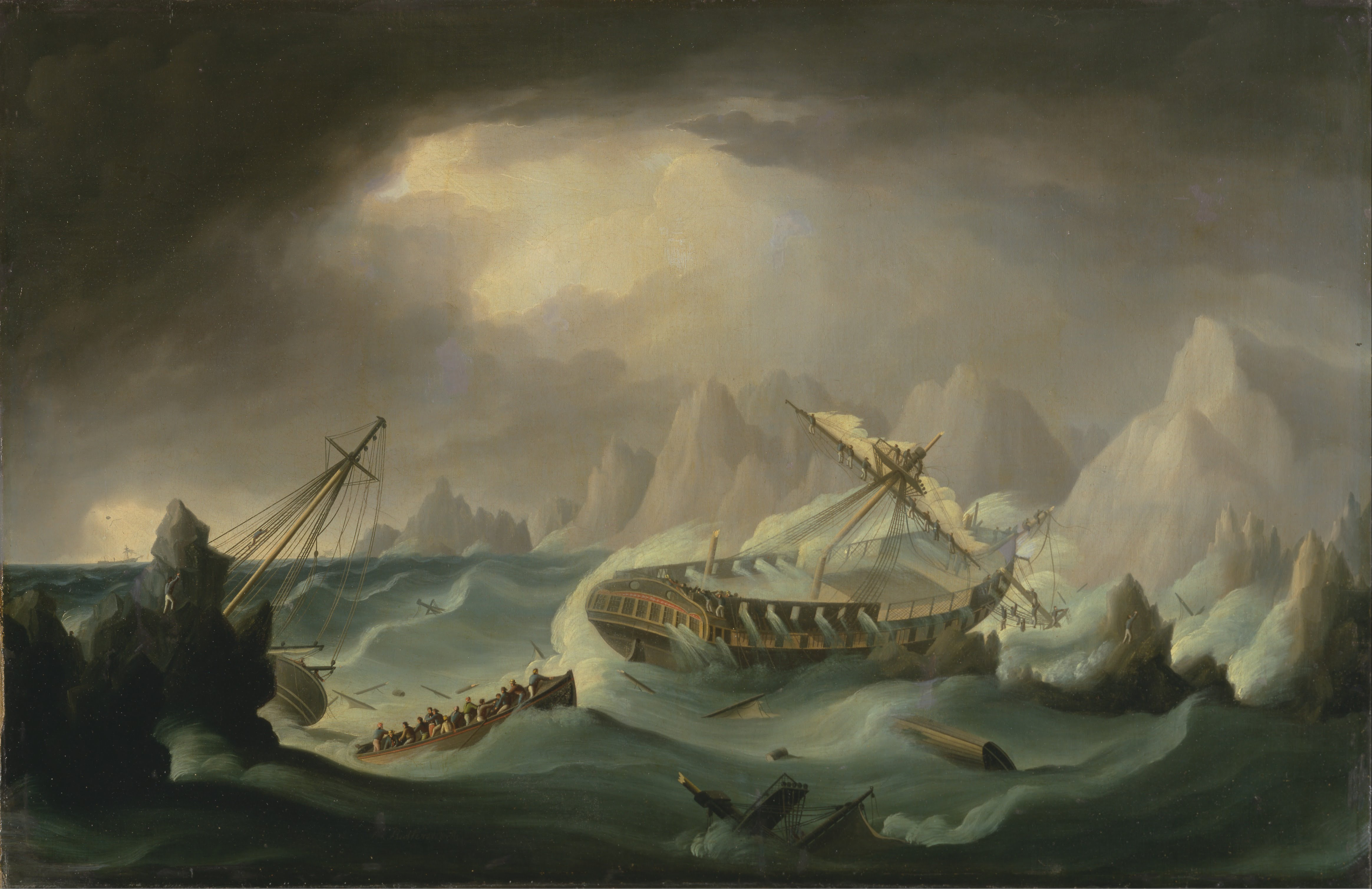
"Shipwreck off a Rocky Coast" by Thomas Butterworth

“Shipwreck off a Rocky Coast” by Thomas Butterworth, ~1810 CE. Located in the “Yale Center for British Art”

Have you ever felt as if you are on a boat headed for disaster which you cannot control? We all have moments in our lives where things seem out of control. We all have moments where we could tear out whatever hair we have in frustration. Interestingly enough, most of us know that on occasion everyone faces these moments in our heads but we still refuse to believe it with our hearts.

When you read the Bible it becomes absolutely clear on many things, but let’s focus on one point in particular today. Bad things happen to good people. Whether you are Job, Abraham, Paul, or even Jesus Christ, life involves moments that are neither avoidable nor pleasant. Job was considered a peerless person by Christ (Job 1:8) but still loses almost everything. Abraham is called into a new life and a new covenant multiple times by God, but still needs to rescue his nephew from captivity (Genesis 14). Paul (as previously stated) was shipwrecked despite knowing that the journey ahead of him would lead to disaster. Jesus Christ was crucified–the cup of suffering was not taken away.

Jesus Christ also stated (Matthew 5:44-45) that we should “love your enemies and pray for those who persecute you, so that you may be children of your Father in heaven; for he makes his sun rise on the evil and on the good, and sends rain on the righteous and on the unrighteous.” While he was speaking of love, Jesus taught the same truth that I am trying to express in the midst of his lesson. The sun rises and the rain falls on both the good people of the world and on those with a propensity towards evil.

Being a follower of Jesus Christ does not mean that everything will be perfect. In fact, being a follower of Jesus Christ often means that you will face difficulties. The promise made to believers is not a promise that they will be free from challenge. The promise God makes through Jesus Christ is that we will not be alone in our challenge.

We who follow Christ are given hope through the love of God. We who follow Christ are given presence through not only the Holy Spirit but through the powerful presence of Jesus in our lives. Consider the words of John 17: (NRSV)

“Righteous Father, the world does not know you, but I know you; and these know that you have sent me. I made your name known to them, and I will make it known, so that the love with which you have loved me may be in them, and I in them.”

If Christ is the messenger, then we are the recipients of the love he carried into the world for us. That love is deep, powerful, and meaningful. The thunderstorms of life will strike, crash, and thunder around us, but we have the love Christ has planted in our hearts. Paul the Shipwrecked wrote this in Romans 8: (NRSV)

“I consider that the sufferings of this present time are not worth comparing with the glory about to be revealed to us. For the creation waits with eager longing for the revealing of the children of God; for the creation was subjected to futility, not of its own will but by the will of the one who subjected it, in hope that the creation itself will be set free from its bondage to decay and will obtain the freedom of the glory of the children of God. We know that the whole creation has been groaning in labor pains until now; and not only the creation, but we ourselves, who have the first fruits of the Spirit, groan inwardly while we wait for adoption, the redemption of our bodies. For in hope we were saved. Now hope that is seen is not hope. For who hopes for what is seen? But if we hope for what we do not see, we wait for it with patience.

Likewise the Spirit helps us in our weakness; for we do not know how to pray as we ought, but that very Spirit intercedes with sighs too deep for words. And God, who searches the heart, knows what is the mind of the Spirit, because the Spirit intercedes for the saints according to the will of God.

We know that all things work together for good for those who love God, who are called according to his purpose. For those whom he foreknew he also predestined to be conformed to the image of his Son, in order that he might be the firstborn within a large family. And those whom he predestined he also called; and those whom he called he also justified; and those whom he justified he also glorified.

What then are we to say about these things? If God is for us, who is against us? He who did not withhold his own Son, but gave him up for all of us, will he not with him also give us everything else? Who will bring any charge against God’s elect? It is God who justifies. Who is to condemn? It is Christ Jesus, who died, yes, who was raised, who is at the right hand of God, who indeed intercedes for us. Who will separate us from the love of Christ? Will hardship, or distress, or persecution, or famine, or nakedness, or peril, or sword? As it is written,

‘For your sake we are being killed all day long;
we are accounted as sheep to be slaughtered.’

No, in all these things we are more than conquerors through him who loved us. For I am convinced that neither death, nor life, nor angels, nor rulers, nor things present, nor things to come, nor powers, nor height, nor depth, nor anything else in all creation, will be able to separate us from the love of God in Christ Jesus our Lord.”

My friends, Paul’s words speak for themselves. May you have faith and trust even as the boats of life carry you into the storms. May God help you, comfort you, and give you peace. May the peace of God that surpasses all understanding guard your hearts and minds in Christ Jesus (Philippians 4:7).