In October we remember Domestic Violence Awareness Month. I am reading and reflecting on both my experiences and the thoughts of others about domestic violence during this month. This action is important to me as a survivor of domestic violence.
One book I am reading during Domestic Violence Awareness Month is a book I read all year long. The book is “The Sayings of the Desert Fathers,” which was translated by Benedicta Ward. In the sayings, Abba Poemen said, “Men speak to perfection but they do precious little about it.”
Unfortunately, it is true. In the church, many people talk a lot about the world’s problems, but never act to change the situation. Yes, it is true that I am a pastor. Yes, it is true that I speak about domestic violence this month and at other times of the year. Unfortunately, I am already looking for how to live in the solution, but I do not understand how to live and progress without hypocrisy.
My hope is that this blog will raise awareness about the issue of domestic violence and that people will try to live with truth and action. St. John said in 1 John 3:18, “Dear children, let us not love in word or lip service, but in action and in truth.”
En Octubre recordamos el mes de concientización sobre la violencia doméstica. Estoy leyendo y reflexionando sobre ambas mis experiencias y los pensamientos de otra sobre violencia doméstica durante este mes. Esta acción es importante para mi como un sobreviviente de violencia doméstica.
Un libro que estoy leyendo durante el Mes de Concientización sobre la Violencia Doméstica es un libro que leo todo el año. El libro es “Los dichos de los Padres del Desierto”, que fue traducido por Benedicta Ward. En los dichos, Abba Poemen dijo: “Los hombres hablan a la perfección, pero hacen muy poco al respecto”.
Desgraciadamente, es cierto. En la iglesia, mucha gente habla mucho de los problemas del mundo, pero nunca actúa para cambiar la situación. Sí, es cierto que soy pastor. Sí, es cierto que hablo sobre la violencia doméstica este mes y en otros momentos del año. Desgraciadamente, ya estoy buscando cómo vivir en la solución, pero no entiendo cómo vivir y progresar sin hipocresía.
Mi esperanza es que este blog genere conciencia sobre el problema de la violencia doméstica y que haya personas que intenten vivir con la verdad y la acción. San Juan dijo en 1 Juan 3:18, “queridos hijos, no amemos de palabra ni de labios para afuera, sino con hechos y de verdad”.
In October we remember Domestic Violence Awareness Month. I am reading and reflecting on both my experiences and the thoughts of others about domestic violence during this month. This action is important to me as a survivor of domestic violence.
One book I am reading during Domestic Violence Awareness Month is a book I read throughout the year. The book is “The Sayings of the Desert Fathers,” which was translated by Benedicta Ward. In the sayings, Abba Macarius the Great said, “If you rebuke someone, you yourself are carried away by anger and are satisfying your own passion; do not lose yourself, therefore, in order to save another.”
Sometimes, I want to rebuke people who live with domestic violence in their words, actions, and lives. I want to live with an “eye for an eye and a tooth for a tooth” mentality, but Jesus said, “Do not resist someone who mistreats you. If someone slaps you on the right cheek, turn the other also.” I say domestic violence is wrong and I hate acts of violence, but anger can burn me to ashes
I need to take care of myself when I’m angry at bad people. It’s not good to fight to the death over my anger. The people who love me want me to live and live a great life. I need to take care of myself when I get carried away by my emotions. When I’m angry at bad people and I don’t take care of myself, I make a bad situation worse. It’s not good.
En Octubre recordamos el mes de concientización sobre la violencia doméstica. Estoy leyendo y reflexionando sobre ambas mis experiencias y los pensamientos de otra sobre violencia doméstica durante este mes. Esta acción es importante para mi como un sobreviviente de violencia doméstica.
Un libro que estoy leyendo durante el Mes de Concientización sobre la Violencia Doméstica es un libro que leo durante todo el año. El libro es “Los dichos de los Padres del Desierto”, que fue traducido por Benedicta Ward. En los dichos, Abba Macarius el Gran dijo: “Si reprendes a alguien, tú mismo te dejas llevar por la ira y estás satisfaciendo tu propia pasión; no te pierdas, por lo tanto, para salvar a otro”.
A veces, quiero reprender a las personas que viven con violencia doméstica en sus palabras, acciones y vidas. Quiero vivir con la mentalidad de “ojo por ojo y diente por diente”, pero Jesús dijo: “No resistan a quien los maltrate. Si alguien los abofetea en la mejilla derecha, pónganle también la otra”. Digo que la violencia doméstica es mala y odio los actos de violencia, pero la ira puede quemarme hasta convertirme en cenizas.
Necesito cuidarme cuando estoy enojado con gente mala. No es bueno luchar hasta la muerte por mi ira. La gente que me ama quiere que viva y viva una gran vida. Necesito cuidarme cuando me dejo llevar por mis emociones. Cuando estoy enojado con gente mala y no me cuido, empeoro una mala situación. No es bueno.
In October we remember Domestic Violence Awareness Month. I am reading and reflecting on both my experiences and the thoughts of others about domestic violence during this month. This action is important to me as a survivor of domestic violence.
One book I am reading during Domestic Violence Awareness Month is a book I read all year long. The book is “The Sayings of the Desert Fathers,” which was translated by Benedicta Ward. In the sayings, Abba Poemen said that Abba Ammonas said, “A man can stay in his cell for a hundred years without learning to live in his cell.”
It’s true! When I think about how I live my experience, I wonder what I have learned about living with the demons of the past. It’s easy to live with fears and worries. It’s easy to accept my complaints and anger about the past. It’s easy to beat myself up about my past faults and dream of a different life.
Yes, that is clear. If a man can remain in his cell for a hundred years without learning to live in his cell, I may live with my faults for a hundred years without learning to change from my past weaknesses. I may live in pain all my remaining days. I may live in the misery and pain of the past, but I can live with new hope when I learn to change with the Holy Spirit.
The abba said that it is possible to live without changing, but it is possible to live and change. If it were not possible to learn to live differently, the abba would have no need to say what he said. If it were not possible to change with the power of the Holy Spirit, the other abba would have no need to write what he wrote. It is possible to change, although it is difficult.
If you want to change, it is possible. It is possible to change and live with hope if you are a survivor of domestic violence. It is possible to change and repent if you are a perpetrator of domestic violence. It is possible to change or not to change. The abba pointed to a possibility for our lives. We need to choose to change.
En Octubre recordamos el mes de concientización sobre la violencia doméstica. Estoy leyendo y reflexionando sobre ambas mis experiencias y los pensamientos de otra sobre violencia doméstica durante este mes. Esta acción es importante para mi como un sobreviviente de violencia doméstica.
Un libro que estoy leyendo durante el Mes de Concientización sobre la Violencia Doméstica es un libro que leo todo el año. El libro es “Los dichos de los Padres del Desierto”, que fue traducido por Benedicta Ward. En los dichos, Abba Poemen dijo que Abba Ammonas dijo: “Un hombre puede permanecer en su celda durante cien años sin aprender a vivir en su celda.”
¡Es verdad! Cuando pienso en cómo vivo mi experiencia, me pregunto qué aprendo acerca de vivir con los demonios del pasado. Es fácil vivir con miedos y preocupaciones. Es fácil aceptar mis quejas y enojo por el pasado. Es fácil castigarme por mis faltas pasadas y soñar con una vida different.
Sí, eso está claro. Si un hombre puede permanecer en su celda durante cien años sin aprender a vivir en su celda, es posible que yo viva con mis faltas durante cien años sin aprender a cambiar de mis debilidades pasadas. Es posible que yo viva con dolor todos los días que me queden. Puedo vivir en la miseria y el dolor del pasado, pero puedo vivir con una nueva esperanza cuando aprendo a cambiar con el Espíritu Santo.
El abba dijo que es posible vivir sin cambiar, pero es posible vivir y cambiar. Si no fuera posible aprender a vivir de otra manera, el abba no tendría necesidad de decir lo que ha dicho. Si no fuera posible cambiar con el poder del Espíritu Santo, el otro abba no tendría necesidad de escribir lo que ha escrito. Es posible cambiar, aunque es difícil.
Si desea a cambiar, es posible. Es posible a cambiar y vivir con esperanza si un sobreviviente de violencia doméstica. Es posible a cambiar y repentir si un perpretador de violencia doméstica. Es posible a cambiar o no cambiar. El abba puntagaba a una posebilidad para nuestras vidas. Necesitamos a eligir a cambiar.
In October we remember Domestic Violence Awareness Month. I am reading and reflecting on both my experiences and the thoughts of others about domestic violence during this month. This action is important to me as a survivor of domestic violence.
One book I am reading during Domestic Violence Awareness Month is a book I read throughout the year. The book is “The Sayings of the Desert Fathers,” which was translated by Benedicta Ward. In the sayings, Abba John said, “Humility and fear of the Lord are above all other virtues.”
When I read these thoughts in the past, I realized that living with humility is simply living without arrogance. That is not entirely true. Humility is not simply living without being proud of greatness. Humility is also not living with the assumption that you are worthless.
The book of Genesis says, “God saw what he had made, and behold, it was very good.” When we assume that we have no goodness or evil despite what God can see, we assume that we understand better than the Lord. It is not good. It is arrogant.
It is good when we accept the word of the Lord that says that the Lord loves us. It is good when we accept the words of the Lord that invite us to live with clean hearts. Both positions of humility are very good and point to the wisdom of Abba John.
En Octubre recordamos el mes de concientización sobre la violencia doméstica. Estoy leyendo y reflexionando sobre ambas mis experiencias y los pensamientos de otra sobre violencia doméstica durante este mes. Esta acción es importante para mi como un sobreviviente de violencia doméstica.
Un libro que estoy leyendo durante el Mes de Concientización sobre la Violencia Doméstica es un libro que leo durante todo el año. El libro es “Los dichos de los Padres del Desierto”, que fue traducido por Benedicta Ward. En los dichos, Abba Juan dije “Humilidad y miedo del Señor son arribas del todo otras virtudades.””
Cuando leí estos pensamientos en el pasado, comprendí que vivir con humildad es simplemente vivir sin arrogancia. No es del todo cierto. La humildad no es simplemente vivir sin estar orgulloso de la grandeza. La humildad tampoco es vivir con la suposición de que no vales nada.
El libro de Génesis dice: “Vio Dios lo que había hecho, y he aquí que era bueno en gran manera”. Cuando asumimos que no tenemos bondad ni maldad a pesar de lo que Dios puede ver, asumimos que entendemos mejor que el Señor. No es bueno. Es arrogante.
Es bueno cuando aceptamos la palabra del Señor que dice que el Señor nos ama. Es bueno cuando aceptamos las palabras del Señor que nos invitan a vivir con corazones limpios. Ambas posiciones de humildad son muy buenas y apuntan a la sabiduría del Abba Juan.
So, it is almost Thanksgiving Day in the United States of America. Many forks are preparing to gather with loved ones for a day of feasting, conversation, and merriment. Thanksgiving is a blessed day for many people.
Not everyone likes Thanksgiving. Some people are dreading Thanksgiving this year. There are challenging conversations which may take place over pie. United Methodists risk conversations about the Special Session of General Conference and other church dramatics. Citizens risk discussions of politics, voting choices, and future outlooks. Many folks know there are traditional arguments over family matters, cooking styles, or other matters. Conversations can be difficult on Thanksgiving.
On a personal level, some folks dread Thanksgiving because of what it will tempt them to eat. Will power is a necessity for many on Thanksgiving. Exercised muscles and hard earned toning will face the hordes. They cry out things like “It is a holiday!” Invitations to live a little often correspond with an expectation to consume a lot.
Let us begin with the Desert Abba, although it is likely that the epistle predates the sayings of the Abbas and Ammas. Here’s the quote for you today: (pg. 104)
“A brother questioned Abba Hierax saying,’Give me a word. How can I be saved? The old man said to him, ‘Sit in your cell, if you are hungry, eat, if you are thirsty, drink; only do not speak evil of anyone, and you will be saved.’ “
I want to stretch our understanding of what Abba Hierax says by breaking the passage down into three concepts. The brother sought a word about salvation. We are not seeking salvation in the eternal sense this Thanksgiving. Still, there is wisdom in seeking God’s salvific power to fill every day of our lives.
So, the first idea! Beloved, stay in your cell! For the Abbas and Ammas, the cell was the place they rested and prayed. The cell was a challenge to some and a a blessing for others. One could find out a lot about their being by remaining in their place. The cells had space for introspection. These places had space for rest. These rooms space for blessing.
Beloved, stay in your cell! When invited to a seat, enjoy that seat! You may not enjoy everyone around you in that place, but there may be room for blessing in your seat. Is your neighbor getting your goat? How is that neighbor getting your goat? What does that tell you about yourself? Why does that neighbor get your goat? What does that relationship tell you? Is your neighbor a challenge or a mirror for reflection? Is your neighbor an irritation or someone trying to connect? What if they only have certain tools and just need encouragement? Maybe something like sarcasm is almost their native language? Is this trouble is an opportunity to show love, to show grace, and to open a doorway to a better relationship?
Now, I strongly recommend that you do not stay if you are being abused. Be aware there may be possibility for personal growth growth if you figure out how it simply irritates you, annoys you, or frustrates you. You may leave your seat blessed beyond your imagination. Thank you Abba Hierax!
So, the second idea. Beloved, if you are hungry, eat. Beloved, if you are thirsty, drink. Sitting at the table is an opportunity to find sustenance for your body and soul. You may not like everything, but that is okay. There may be something at the table that will do more than sustain you. You may leave the table inspired to eat more of something strange. What if you do like that weird looking Brussel sprout dish? What if that one taste opens a door to a lifetime of new experiences? If you are hungry, eat.
Now, let’s be clear. Few of the Abbas would say to eat or drink to excess. Many of the Abbas and Ammas were clear that a person should engage in intentional moderation. So, if you are hungry, eat. When you have had enough, you may no longer be hungry. When thirsty, a glass of water may quench that thirst. If you eat when you are hungry and drink when you are thirst, you may leave your seat blessed beyond your imagination. Thank you Abba Hierax!
Finally, beloved, let us take this final word from Abba Hierax seriously. Beloved, do not speak evil of anyone. I saved the quote from the Epistle of Barnabas for this point in the post. The epistle says: (pg. 159)
“The principles of the Lord are three in number. Faith begins and ends with Hope, hope of life; judgement begins and ends with Holiness; and the works of holiness are evidenced by Love, and the joy and gladness it brings.”
If we are a people of faith, this epistle would recommend that our faith requires us to be a people of hope. We hope for life. When we speak evil of others, that never brings life into the equation.
If we must speak out of a place of judgment, the epistle would also ask questions of us. Do our actions begin in a place of holiness? Do our actions lead to a place of holiness? Remember, in this model holiness are evidenced by love, joy, and gladness. If love, joy, and gladness are not present when there is a temptation to be judgmental, then we should stop ourselves. If love, joy, and gladness are not the ultimate result of our actions, then we should stop ourselves.
Speaking out of a place of evil never does us well. Matthew 12 records an exchange between Jesus and the Pharisees where he was accused of acting out of an evil place. Jesus was charged with casting out demons by the power of Beelzebul. Jesus pointed out that this is madness. Jesus could not have acted out of an evil place to conquer evil—such actions would not stand the test of time.
If we are to be like Jesus, we should never meet evil with evil. We should never speak evil of anyone. As it says in 1 John 2:6, “Whoever says, ‘I abide in him,’ ought to walk just as he walked.” If speaking an evil word about another person is something you think would be unimaginable for Jesus, then you should seek to never speak such words. Thank you for the reminder and invitation back into truth and faithfulness to both Abba Hierax and to the author(s) of the Epistle to Barnabas.
In conclusion, I hope this little journey into obscurity encourages you this Thanksgiving. It is doubtful any of these authors would have understood at first glance our celebration of Thanksgiving. Still, one last aside. Abba Anthony once entered conversation with a hunter where the hunter became afraid that drawing his bow too many times would damage it. I’m sure the same thing is true of basting your turkey. Keep that oven door closed!
I made a diagram! Little victories are still victories!
Last night I went to an event hosted by my bishop at the Chenango Bridge United Methodist Church. Bishop Webb came to our district to discuss the proposals headed to the Special Session of General Conference scheduled for this February. As I entered the space, I was frazzled. I had believed the event started at 6:00 PM. I arrived on time because my wife is far more focused and capable of remembering times than me. I was tired and suffering exhaustion from a budget meeting after a morning of study and worship.
Let me admit that I was anxious about the meeting. I had hoped to sit with a friend who was unable to attend. I had hoped the meeting was later so I could relax over dinner before entering a space of shared anxiety. I came into the space tired on several levels.
Before I sat down to listen to the presentation, I said hello to Bishop Webb. He asked about my children. Bishop Webb has an excellent memory about such things. I may not agree with everything my bishop says or does, but I appreciate the way he expresses care to his clergy by knowing details about their family. We exchanged pleasantries. I took a seat where I could read the screen easily for the presentation.
I recently have spent a lot of time going back to one of the more definitive translations upon which a lot of my Kindle collections of the Desert Ammas and Abbas rely. Benedicta Ward’s translation is normally a wonderful resource, but it is unfortunately not available on Kindle. I opened Paintner’s collection and went forward to the furthest place read. I read the next saying. I was surprised by the applicability of the saying. The next saying was:
“[Abba Nilus] said, ‘Do not be always wanting everything to turn out as you think it should, but rather as God pleases, then you will be undisturbed and thankful in your prayers.’”
This ensnared me given the circumstances. I was in a room full of people who had gathered to listen to their bishop speak about a challenge before the church. There were people who did not know how they intend to perceive events in the years to come. There were people who knew their opinions and hold their convictions firmly. The saying of Abba Nilus was strong in a room filled with people who often want everything to turn out as they desire.
I know this was true of at least one person in the room. I am definitely from a place of personal experience. There have been many times I have sought to have things turn out in the way I desire. There are places I seek to have things turn out the way I desire. There are places I will probably seek to have things turn out the way I desire. I see this is a sign of my humanity. I do not pretend it does not exist.
Living in this self-knowledge, I found myself challenged by Abba Nilus from across the centuries. Do I need to seek that everything turn out as it should? When in a room with dozens of individuals, should I expect things to turn out the way I desire? Is it reasonable to expect that outcome?
More to the point, what is my purpose? Why do I seek to have my way? What if Abba Nilus is correct? What if surrendering my desire to God’s pleasure leads to thankfulness and peace in my prayers? Are those benefits worth more than having my way? Frankly, I believe these blessings are worth more than having my way.
The epistle known as Philippians has something to say about this reality. In the New Revised Standard Version, Philippians 4:6-7 says:
“Do not worry about anything, but in everything by prayer and supplication with thanksgiving let your requests be made known to God. And the peace of God, which surpasses all understanding, will guard your hearts and your minds in Christ Jesus.”
I entered the sanctuary of Chenango Bridge UMC with a sense of anxiety. Abba Nilus called me out on my attitude from across the centuries. As I reflected on the experience that call was confirmed by scripture and Spirit. I have already said I am not perfect in this blog post. Imperfections and all, I will seek to find that peace in these conversations.
I may not always find the peace perfectly. I will still seek that peace through prayer. When necessary, I hope that God will setup reminders to draw me back. Thank you God for Abba Nilus. May words from the past continue to draw me to You and to the scriptures.
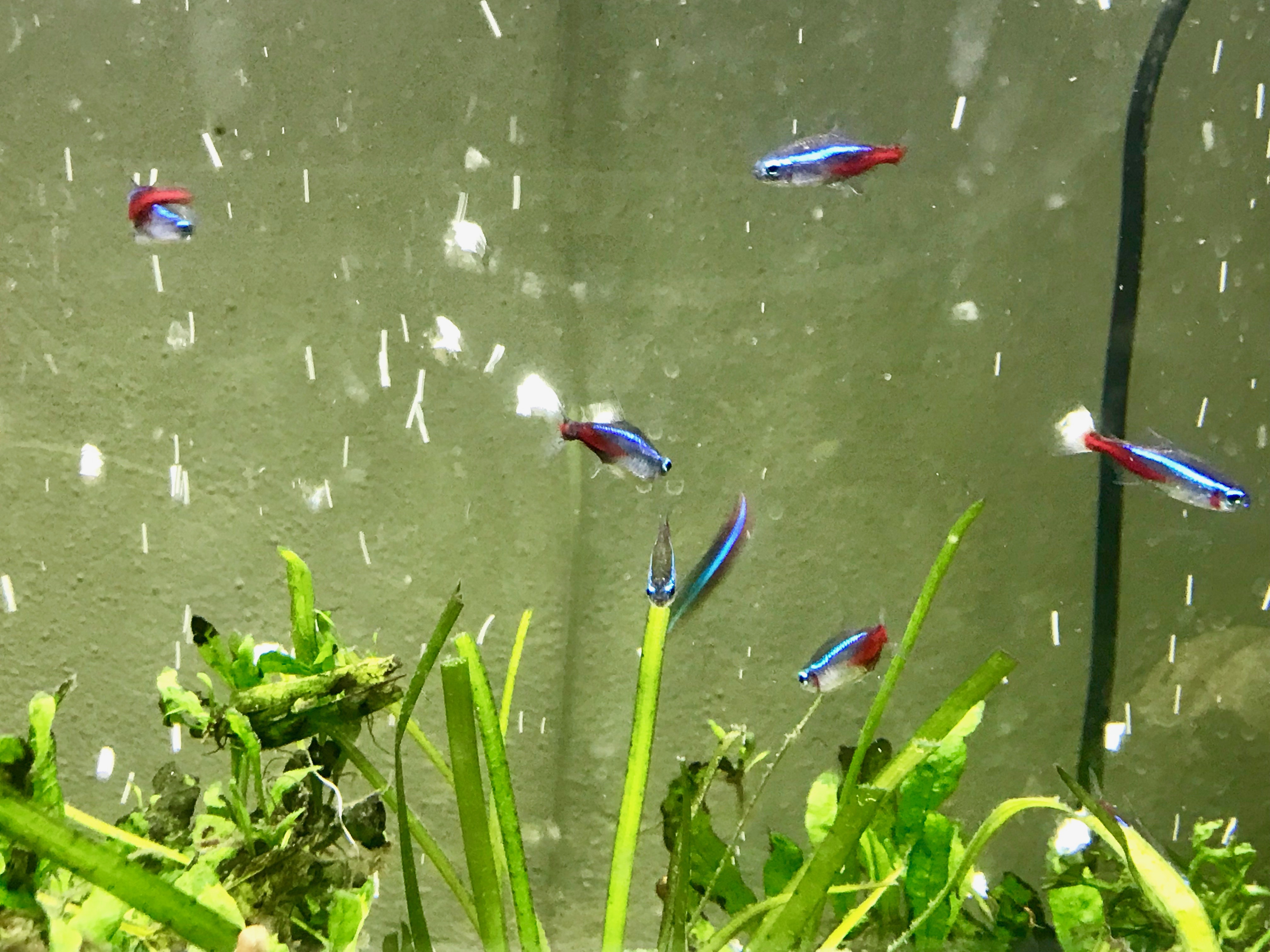
Today the blog was written on my Chromebook in front of the family aquarium, These Neon Tetras were very interested in reading about Abba Nilus. Maybe they’re kindred spirits?
Today’s blog post is two days in the making. I have been pondering what it means to be a Christian in an age where political differences in the United States are resulting in violence. Bombs are being mailed to opponents of the president and Republicans have been threatened at one particular early voting site in North Carolina. The world seems to be more and more violent the closer we get to November’s election.
I am wondering how we should reply to these situations. Scripture tells us to pray for the lands where we find ourselves. Even if some Christians do not appreciate the idea of Christians being a people living in exile, the thrust of Jeremiah 29 still points us to ponder how we relate to the “city where we are sent.”
Of course, none of this is easy. To be honest, in some circles, asking people to take Romans 13 seriously is a dangerous proposition. Calls by Paul to the Romans to be subject to governmental authorities are seen as less than applicable in some contexts, especially when we disagree with those authorities. A person who might quote Paul as sharing the gospel truth in one letter might chafe at considering his words in another. It is natural that we rejoice when governmental powers agree with us. Unfortunately, it seems increasingly common to call for their damnation when they disagree. Calls to respect people of different opinions in Romans 14 and 15 are seen as equally ludicrous at times.
It is difficult to live in such times. Whether you are a democrat, republican, or neither, these days are difficult days. As election day draws closer, there is a real sense of dread building in some circles. Will there be violence if one party loses favor or if another gains favor? Will there be violence if something changes or will there be violence if nothing changes? Heaven knows how many families are dreading Thanksgiving and those often turbulent conversations around the dinner table.
To be honest, I half expect to hear more stories about threats and potential bombings to increase as election day draws nearer. I am not seeking to be a pessimist. I find myself watching a pattern and pondering the outcome. In truth, my own days of believing in the myth of American exceptionalism in terms of believing in a political process that might be free of intimidation and gerrymandering are pretty much at an end. Perhaps I am simply choosing to save my idealism for my life of faith or perhaps I am simply worn thin by the matters of this world.
You may be asking what any of this has to do with being a pastor or spirituality. My simple answer is to say that it relates because these are the days where we need to have courage. Yes, the news is full of stories of challenges and those stories will increase. Yes, the President has warned there will be violence if his party loses the election next month, although it is strange he warns that the violence he seems to fear would be from the party that might gain political power. An honest appraisal might say that violence might occur regardless of who wins. Yes, the world might become a dark place after this election. Yes, these are days that require courage regardless of political party.
Then again, maybe these days are not as dire as it seems. Things might go poorly, but they also might go well. In a sense, these days are like every single day of our lives. Even in the best of times, all of us live with only one day. We all live in today. Yesterday has gone by. Tomorrow is a dream. Today is the only day that any of us has to live within. Since you cannot control the future and cannot change the past, today is like every day of your life. To borrow from the ancient philosopher Heraclitus, you can only step in the same river once.
The world is always changing and the natural uncertainty requires courage. It takes courage to live in a world which might change in a moment due to a blood clot, a missed stop sign, or an unexpected illness. It takes courage to live in a world where someone might leave tomorrow, where you might lose your job at the end of your shift, and where a loose dog might catch you while you wait for the school bus. It takes courage to live in this life and while the future might seem stressful, today is really the only day that any of us have ever had to live within.
I hate to bring in ancient monastics again, but I do enjoy them. There is an applicable gem in my often quoted copy of Benedicta Ward’s “The Sayings of the Desert Fathers: The Alphabetical Collection.” That gem is a quote from Abba Serinus. The quote goes: “Abba Serinus said, ‘I have spent my time in harvesting, sewing, and weaving, and in all these employments if the hand of God has not sustained me, I should not have been fed.’”
If you would prefer a biblical approach to the concept that life is a bit more transitory than some of us expect, Luke 12:13-21 contains a parable where Jesus warns people about the folly of building up riches on earth. A rich man has a bumper crop, plans to tear down his barns, and intends to build bigger barns to hold his massive crop. He plans to live out his days with wealth! Jesus shares that his folly is to plan to live out long days with his massive wealth. The rich man will die that very night. All of the crops from his wonderful harvest will not keep him from his own mortality.
Whether you approach the subject from the Abba’s viewpoint that all of life has led to this moment because God has provided or whether you hear Jesus’ warning about the uncertainty of tomorrow, in my opinion one thing is clear. We all have this one moment. We can respond with gratitude, make assumptions about the future, or even follow the advice of Ecclesiastes 5:18 (“This is what I have seen to be good: it is fitting to eat and drink and find enjoyment in all the toil with which one toils under the sun the few days of the life God gives us; for this is our lot.”). Regardless of how we spend our days, these days are the days we have.
So, how will we spend them? If today is the day you have to live, what will you do? Will you live in fear? Will you decide to ponder what comes in every package, worry about every group of people near every polling place, or will you step forward to take your place in history? If God has brought you to this time and place, is it not your responsibility to live in this moment?
I’m currently fighting a sore throat. I say this because the only medicine we had in the house was a “night-time” variety and my cough medicine is making things a bit hazy this morning. My office door is closed, I have disinfectant wipes at the ready, and I am here at my desk trying to sort through my thoughts.
The strange companions on my desk today. “Ugh drops” indeed… Clearly, the local store does not sponsor this blog. Actually, I’m the only one who sponsors this blog…
As a people, we live in challenging times. When I was a child, when we needed to learn something we had to talk to a teacher, go the library, or devise a way to find out on our own. My brother ran a dial up BBS (Bulletin Board System) in our home, but to be entirely honest, the BBS was more useful for playing video games than learning massive amounts of information. The internet may not have been in infancy, but it was certainly a toddler.
These days, we are flooded with information. This blog will reach places that my brother’s BBS would never have reached without a great deal of effort. We have more access to information and misinformation than ever. Facebook, my social media of choice, is filled with information which goes from completely factitious to unfortunately real in the space of a few swipes of a finger.
The world of information has expanded exponentially in my lifetime and I am only in my thirties. There is so much to see, so much to grasp, and only so much emotional energy with which to process it all. My brain may still be the most powerful computer I own, but it runs off of a reserve of energy that is tied to things like my mood, my mental health, my stomach, my body, and all other parts of me. A sore throat might not lessen the amazing processing power of my mind, but my focus is certainly not on the mysteries of the universe when it hurts when I swallow.
“[Abba James] also said, ‘We do not need words only, for at the present time, there are many words among men, but we need works for this is what is required, not words which do not bear fruit.”
These words are reminiscent of the words from the Letter of James. In the New Revised Standard Version (NRSV), James 1:22-24 says:
“But be doers of the word, and not merely hearers who deceive themselves. For if any are hearers of the word and not doers, they are like those who look at themselves in a mirror; for they look at themselves and, on going away, immediately forget what they were like. But those who look into the perfect law, the law of liberty, and persevere, being not hearers who forget but doers who act—they will be blessed in their doing.”
For me, these words from the Letter of James relate directly to the words from Abba James which were shared centuries later. The letter calls out at people to become doers of the words. Hearing is wonderful, but there is something powerful about moving beyond hearing to acting. As Abba James points out, there are many who hear, many who speak, but not enough who act. This sentiment is forcefully and famously restated in James 2, where its says:
“What good is it, my brothers and sisters, if you say you have faith but do not have works? Can faith save you? If a brother or sister is naked and lacks daily food, and one of you says to them, ‘Go in peace; keep warm and eat your fill,’ and yet you do not supply their bodily needs, what is the good of that? So faith by itself, if it has no works, is dead.”
We must connect our words and our deeds. How does that look when you are sitting in an office with a sore throat and trying not to give anything to a church full of preschoolers, teachers, and paid/volunteer church staff? Well, that is my question to answer for today. How will you respond to a world which needs you to do more than simply speak?




 Distracted Pastor Ramblings