Creation Narratives and Domestic Violence

Okay, so this one is going to require a stretch of one’s imagination. This morning I was working through Genesis 1:1-2:3 out of the Common English Bible as a part of today’s reading with our church’s DISCIPLE Bible Study group. In my reading of this passage from the Common English Bible today I found the text to be replete with words of plenty. We noted in our study this week that the mindset of the reader, the context where the text is read, and other variables affect the way we approach scripture. Today I must be feeling very open hearted and expansive as the words that I read were filled with expansive imagery.

As an example I would point out how in Genesis 1:14-15 God speaks expansively of the lights in the dome of the sky. These lights are signals and signposts of the passage of time, the coming of seasons, and invite creation into sacred times. Keeping in mind that I take these portions of the scriptures as sharing truth born of wisdom rather than concrete facts born of the scientific method, I was the heavens brimming with lights pouring forth after the divine word. Letters from divine words arcing out from the divine mouth before shifting into stars, moons, and the special star known as our sun. In such ways, God speaks and the world and universe are transformed from chaos into creation.

When God speaks of humanity, even the Common English Bible uses words of mastery, but I did not read words of domination into the creation account today. Humanity masters the world not for domineering or destructive purposes but for the cause of caretaking. Humanity takes charge of the fish, the birds, the animals, the plants, and all of the wandering and stationary lifeforms that cover the globe for the purpose of creative caretaking. God spoke into the world words of life and humanity is invested with the divine image in order to continue to work in the divine image as caretakers and agents of blessing to help keep the world from slipping back into chaos.

The story is quite beautiful when read with an expansive and generous mindset. What does any of this have to do with Domestic Violence or Domestic Violence Awareness? In the end, the connection I made in my mind is a very delicate one.

If we are called to treat creation with such care and respect, how can we live lives where we exert our will violently on each other? If we are called to be caretakers and agents of blessing, how can we decide to turn our backs on this divine call to love in order to strike out at the people in our homes? If the very core of our creation narrative revolves around humanity existing for the purpose of blessing, how can we curse the people we live with day by day in such abominable ways?

To be certain, if I were to read this text as a text inviting domination, a case could be made, but the whole of scripture is wildly biased against such views. While there are certainly stories of domination in our scripture, the whole of the Bible is thrown from such ways of thought by the person of Jesus.

In John 8, Jesus was offered an opportunity to dominate another person and to stone to death a woman who committed adultery (in the context of a society where that was legal, which was a different context than our society where such punitive behavior is illegal, immoral, and labeled as absolutely wrong by both church and state). Even though it was permissible, legal, and in accordance with the religious rules of Jesus’ day, Jesus refused to engage in such brutal acts. This is just one example of many where Christ taught love in situations that invited brutality.

I cannot see Jesus approving of domestic violence taking place in our homes. Even if we could read words of domination into scriptures  like those found in Genesis 1:28, I cannot see Jesus approving of such behavior. Passages like those in Genesis can be read with different eyes than those of a person seeking to dominate or subjugate others. If we can read such words with grace and plenty in our minds, then we can consider the idea that we were never meant to dominate, demean, or subjugate the people who share our slice of the garden in this life.


October has been Domestic Violence Awareness month since it was first introduced by the National Coalition Against Domestic Violence in 1981. Regardless of the month, domestic violence is never okay, no matter the circumstances. If you or someone you know is in desperate need of help, contact the National Domestic Violence Hotline at 1−800−799−7233 or TTY 1−800−787−3224.
The Small Sacrifices

Sacrifice daily.
Ask where today’s food comes from
Once or twice a week.

The role of a pastor is partially the role of a teacher. Many people think of preaching as a separate activity from other activities like Bible study, but a lot of the role can be combined into the overall category of teaching. I teach on Sunday morning through both preaching and my leadership of worship. Often I believe I teach more on Sunday morning through sharing the words around communion and in prayers than I do in the sermon. Indeed, one of the challenges pastors face is when people believe that the sermon is the focus of worship.

There is absolutely no way that one can effectively make disciples of Jesus Christ for the transformation of the world in just a few minutes a week. We teach beyond our sermons through the rest of worship, through Bible study, but also through things like conversations, social media, and blogging. One of the reasons I believe that the early church had such strident rules about what it took to be a leader in the church was that they understood the church leaders would be teaching and sharing with the community far more than just Sunday morning.

Today, I would like to try and teach a little bit about creation. Creation is where we all are in this moment. The air we breathe, the food we eat, and the land we live upon is all considered theologically to be a part of creation. Some of the earliest scriptures in the Bible (canonically) deal with the care of creation. Genesis 2:15 states that when humanity is placed into the world it is with the charge to care for where they are placed. Gardens are not self-tending and theologically humanity was made to garden. Indeed, in the earliest sections of Genesis humanity depended on plants for sustenance. Foraging is wonderful but civilization was built on gardens.

Let’s look at what it means if we are given the instruction to care for creation. How do we choose to care for the world? Do we do all that we can to damage it? Sometimes it does seem like that is our way of being, but is that destructive way theologically ethical?

What if there were ways to care for the world on a regular basis that did not ruin either your bank account or your way of life? What if the foods you choose could help the world to be a better place for everyone around? What if you invited the world to join you in that adventure?

A few months ago I was listening to a podcast called “The Splendid Table.” The episode I was listening to talked about eating anchovies. To be entirely honest, I was a bit horrified. My father invited us eat to a “blind robin” at midnight for good luck growing up and I wasn’t quite as big a fan of pickled foods at that time. I was very skeptical, but I looked into the idea of eating more seafood as a way to help make the world a better place.

Strangely, I did not begin my research at the library or on the internet. I had a grocery trip to run and looked at the canned fish. Several of the cans said “certified wild caught and sustainable.” Some digging led me to a United States Government Agency called “FishWatch.” There I was able to learn about how the Northern Anchovy is caught, how it has a low bycatch rate, and how it can be healthy (in moderation due to cholesterol levels).

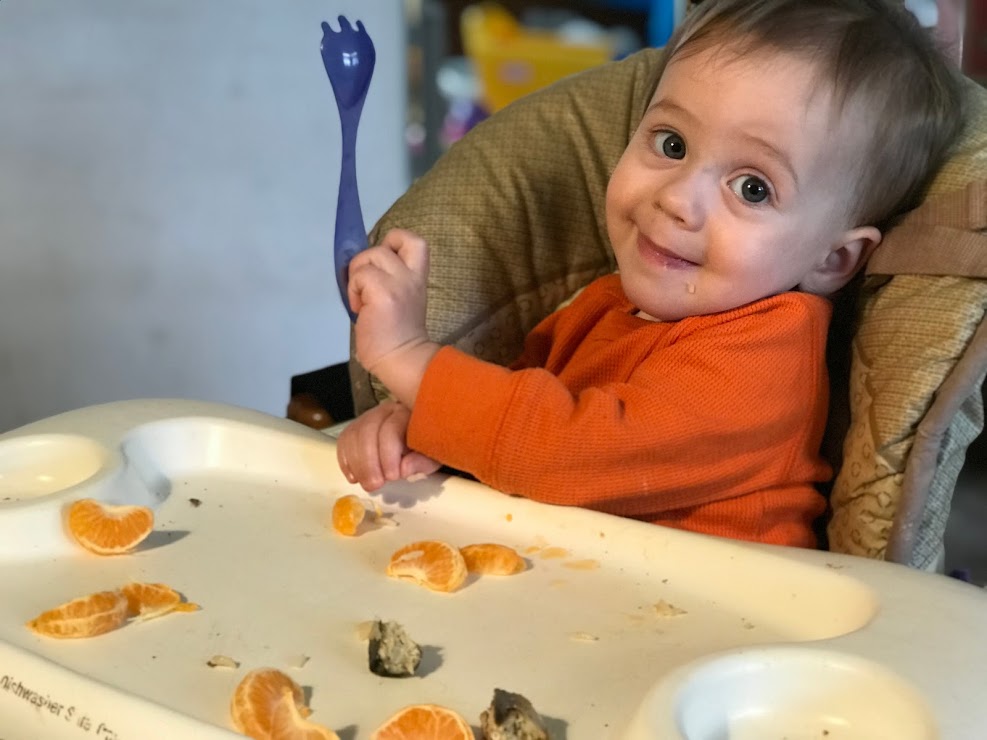
I began to experiment with anchovies and sardines. I learned that sardines can be ground into meatballs to add a flavor that my family loves while replacing some of the meat with a more sustainable protein. As I used the seafood more regularly, it became more and more normal to my palate. Look at the picture of my daughter and you’ll see that it is no burden at all when you get used to eating something new.

What am I suggesting? Well This Lent my family and I are experimenting (on the adult end) with preparing meals with fish and tofu instead of chicken, pork, or beef on Wednesdays and Fridays. If it works well, we’ll likely continue the practice after Lent ends. It might not change the world immediately, but helping to create a world where people eat sustainably might be one of the best things we can do this season.

I invite you to pray about how you and your family might be called to care for our environment this season. If we are to tend this “garden,” it will likely take intentionality. I invite you to consider if this might be something which you might be called to do with your life.

A Canzone for those eyes

My daughter’s eyes. She was too young to understand my words Sunday…
Hopefully a seed will take root!

“Can you see deep down?”
The Distracted Pastor, 2019


Holy One, do You know me?
Deep down can You see?
All of the places in me?
They just look at me
And they simply laugh away.
Sometimes it breaks me
To wake up and see just me.
I walk lonely ways.
There are many simple ways
That You might help me.
My wounded, lonely spirit
Cries sadly, Spirit.

Can you see my heart Spirit?
You knit all of me
knowing my bones and spirit?
My sad cracked spirit?
What could you possibly see
You love me Spirit?
The world needed me Spirit?
Not hiding away?
Not shunned or thrown far away
From this life Spirit?
I am confused by Your ways.
Help me see Your ways.

I can see some of the ways
With happy Spirit.
When I walk down pleasant ways
I trace Your ways–
Fingerprints of You in Me.
Marks of Your deep ways
Show in the subtlest of ways
When I slow to see
The goodness that You must see
In Your ancient ways.
You draw me from far away.
I can't stay away.

Things that I would toss away
You bless through Your ways.
You toss ideal away.
Discard it away
As You stitch up my Spirit.
Weave, subtle Spirit.
Bless my imperfect spirit
As You work in me,
As You work to renew me.
Do not stay away.
Open my eyes–help me see
The perfect You see.

I can't always clearly see
How You work away
To form what You hope to see.
Pain distracts, You see?
Work in me Your calming ways.
Bless my eyes to see
The vision that You did see
When You put spirit
In my flesh by Your Spirit.
Bless my soul to see
The loveliness within me,
the best part of me.

Holy One, you do know me.
Though it's hard to see
You are never far away.
Teach me Your deep ways
Until spirit knows Spirit.

Sunday mornings I lead worship at the Maine Federated Church. This past Sunday I spoke with our younger disciples about Psalm 139. Psalm 139 is a tricky psalm in places, so we focused on the first 18 verses. There are words about God surrounding someone on every side, words about God crafting someone with care, and words about God’s deep love.

As I shared with the kids, I saw reflections in their eyes. My eyesight isn’t the best, but there was hope and pain in those young eyes. Perhaps one or two had already been told they were not the wonderful kids I believe that they happen to be. I wrote this canzone to work into the struggle I have shared with them over the years. Can these words really apply to us? Can we move from doubt to belief?

For the record, this is the first truly complicated form of poetry I have attempted. I am not adept with the canzone or sestina, so I would adore kind feedback or recommendations of other poems in these forms I should check out.

Let us be Ramble: Poetry in a Jumble

Hello from the land between one space and another. Last week I finished up the last of the Annual Meetings for the two halves of my church charge. Next week we are welcoming a new Administrative Assistant into our church office. I have been without an assistant (during the day) for four months and things have been a little chaotic around the office.

This is the land between one moment and another. Exacerbating this time between moments is the fact that our preschool program is off on a field trip this morning. This church is a very quiet place today. I am taking advantage of the quiet to sit in our future assistant’s office to work and pray today. I am trying to imbue the room with prayer in an attempt to be a blessing to our new assistant.

A few minutes ago I was sitting in the quiet and reading through my next book for the Academy for Spiritual Formation. I began to enter into the next book on my list which is “Abide: Keeping Vigil with the Word of God” by Macrina Wiederkehr. In many ways, this book is very different than the last book that I read for the academy. This book is focused on entering into the text and helping readers to grow deeper in their own time in scripture. There is less exposition and more reflection. Regardless, here is what Sister Wiederkehr writes on the very nature of entering into a quest for the word of God: (pg. 8)

“It is not easy to find the Word of God in the midst of a jumble of words. The secret is connection. A community of words connects with each other and somehow in that connection we discern God’s Word for us. Praying with the white space between the words, sentences, and paragraphs is also important. The artist in us needs white space—our place of waiting, listening, and being. White space is the womb and the tomb in which we abide. We will experience birth, life, and death there, as we keep vigil with the Word of God”

As I reflected on these words in this empty space a few things stuck out to me revolving around the white space and the connections between words through spaces. This paragraph was incredibly effective at drawing things out of my depths.

The first place this paragraph took me was into the present. I am sitting in a church office which is unoccupied by an assistant at the moment. My wife has been assisting before and after her work, but in general, this office has been empty. It is a white space. Melissa sat in this place and blessed this community. Bonnie sat in this place and blessed this community. My wife has sat in this place in a different way in an attempt to make space for the person who would follow her.

Soon our new assistant will begin her own ministry of blessing from this place. She will do things differently. She’ll connect to some traditions out of Bonnie’s methods and some tradition’s out of Melissa’s methods. She’ll create her own traditions and methods. Soon this place will begin to be reshaped by her presence in our midst. In the meantime, this sacred space is empty, quiet, and waiting in stillness. This is a holy moment—this is “the womb and the tomb” where a new ministry will be born, live, and someday conclude. Hopefully that conclusion will be many years and many blessings from now. This is a sacred white space.

The second place this paragraph took me to in my reflection was to Annual Conference. The entire idea behind Annual Conference is supposed to be “holy conferencing.” Somewhere in the midst of all of the debate, motions, and rules of order there is supposed to be a place where the Holy Spirit works, moves, and expresses itself through the people gathered together in prayer and discernment.

This paragraph reminded me of Annual Conference because of the sacred white spaces. I recall Cathy Hall Stengel standing up in conference this year asking the bishop where there was space for people not on two sides of a particular issue to express their voices. She called for white space. I recall JJ Warren standing up and expressing his call to ordained ministry when the doors had been closed on him due to his sexuality and requesting room to respond to God’s inevitable and unavoidable call on his soul. He was requesting that creative white space be made for the Holy Spirit to call the people God was calling into ministry.

I recall many moments where there was a need for creativity, grace, and kindness. Places were required for life to be born, live, and conclude through the power of the Holy Spirit. There needed to be white spaces before all became an unending cacophony of noise without rest, meter, or even tonal structure.

These thoughts came out as I pondered this selection, but I also found myself drawn to the concept of the connection of words. If everyone carries a bit of God’s image within them, then there is a bit of God’s creative word in all of the people we see. Sister Wiederkehr wrote (pg. 9) that “Every person you encounter during the hours of your day is a word that God has spoken into the world. You too are one of God’s spoken words. And now God speaks through you.” We are connected to each other through the very fact that we are part of the poetry God is writing in this moment.

My brother in Christ Kevin Nelson from Schenectady First United Methodist Church shared the African concept of “ubuntu” on the floor of Conference last week. He translated it roughly as “I am who I am because of who we are.” In my mind, his view of connectedness draws from this idea from Sister Wiederkehr nicely. We are who we are because of the voice of God spoken into each person at the table.

Why do we seek justice? The people we seek to help each carry a bit of God’s poetic word in our midst. Why do we seek love, mercy, and grace? The people who need these things (including ourselves) are all bearers of God’s creative word. Why do we comb through the scriptures listening, abiding, and trusting in God’s encompassing love? We do these things because who we are as a people has called us into a poetic dialogue with scripture. The words on the page, the words in our lives, and the white spaces between connect to create something beautiful.

Is this easy? No! In retrospect, the very first sentence of the quote I referenced above has proven foundational in all of the places where Sister Wiederkehr’s words led me to reflect today. It is definitely not easy to find the word of God in the midst of the jumble of words we come across in life. Even discounting the carriers of God’s words who like to honk car horns, cut people off, and act less than kindly, the words in the Bible itself can be jumbled, confused, and distracting.

As I do enter into the word myself this day, I will do so realizing the challenge within me. Following Sister Wiederkehr’s advice, I will wait for God, read God’s word, spend time listening to what was written with an obedient heart, pray through where God is leading me, and finally abide in the midst of the jumble. With God’s blessing the word of God expressed in my life will join in the dance of poetry found within the scriptures. Together it is my prayer that I will join in the great proclamation of God’s love and compassion.