Querido Jesús: 2 Corintios 5:6-10, 14-17

«Por lo tanto, si alguno está en Cristo, es una nueva creación. ¡Lo viejo ha pasado, ha llegado ya lo nuevo!» 2 Corintios 5:17, NVI

Padre Celestial, mi vida vieja ha pasado y estoy trabajando para saber cómo ya será vida nueva. Yo Quiero tener tu Palabra adentro de mi vida. Yo puedo a sostener tu verdad y promesas cerca de mi porque tú ayudame y amame.

Todo lo que es viejo y roto en mi cuerpo celestial ya quedó recreado con tu amor, pero mi vida en este mundo aún necesito trabajo. Mi Salvador, cuando tropiezo, estoy embarazoso con mis faltas y mis problemas. Por favor, ayudame.

Ayudame a saber esta verdad: vivimos en fe y esperanza, no por vista o por miedo. Estoy segura tu escúchame cuando estoy asustado. Tu comprendes las cosas de que mi pienso en esos momentos y ya siempre amame. Gracias Jesucristo. Te amo y tu amame. Amén


“Therefore, if anyone is in Christ, they are a new creation. The old has gone: it has become new!” 2 Corinthians 5:17, Translated from NVI

Heavenly Father, my old life has passed and I am working to know what the new life will be like. I want to have your Word inside my life. I can hold your truth and promises close to me because you help me and love me.

Everything that is old and broken in my heavenly body has already been recreated with your love, but my life in this world still needs work. My Savior, when I stumble, I am embarrassed with my faults and my problems. Please, help me.

Help me know this truth: we live in faith and hope, not by sight or fear. I’m sure you listen to me when I’m scared. You understand the things that I think about in those moments and you always love me. Thank you Jesus Christ. I love you and you love me. Amen.

Boat Potatoes

“We often knock Peter because, as we’ll see in a moment, he’s going to take his eyes off of Jesus and begin to sink. But notice the other eleven disciples never even thought about getting out of the boat. Ortberg calls them ‘boat potatoes.’ They stayed where they were. They remained in the boat because they were afraid of what could happen if they moved beyond it.”

Rev. Adam Hamilton, “Simon Peter: Flawed but Faithful Disciple”

It is impossible for me to overstate how much I appreciate the fact that the term “boat potatoes” exists. This is single-handedly one of the funniest descriptions of something that happens all the time that I have read in a very long time.

Am I guilty of being a “boat potato?” Probably! There have definitely been points where I have just shrugged and gone along with life because that’s simply how a person is supposed to live their life. Can I think of a moment where I have been a boat potato recently?

I don’t know if I have or not. The thing about the other eleven disciples is that we learn that they are, in fact, boat potatoes, because Simon Peter steps out of the boat. If Simon Peter wasn’t there, then we might perhaps just think of them as ordinary people who would never step out of a boat. As already covered this week in an earlier post, sitting in the boat is the sensible thing to do. It would be weird to try and walk on the water in the first place. It would be absolutely bonkers to consider getting out of the boat onto the surface of the lake in the middle of a storm.

They are revealed as being boat potatoes because one of them decided to put himself into a potato cannon of faith and light the ignitor by asking Jesus if he could come out on the water. Without the revelatory presence of SImon Peter, there’s no way to know.

So, am I another boat potato? I guess the only way to know is to look around me and see whether or not I am just sitting in the boat. Alternatively, if I look around and notice nobody is out on the water with me, am I just unhinged or am I proving, definitively, that I am not a boat potato?


Our church is offering a short-term Bible study for the season of Lent. While many studies for the season traditionally focus on spiritual practices or on the stories of holy week, this year we are reading “Simon Peter: Flawed but Faithful Disciple” by Rev. Adam Hamilton. The idea of the study is that we might consider how we follow Christ in our lives while considering the life of this flawed follower. These blog posts are designed with a principle I have learned from recovery work: “We identify with the stories of others and try not to contrast.” We grow more and live with greater serenity when we look for what we share in common with someone with whom we might otherwise disagree.

Courage and Voting

Today’s blog post is two days in the making. I have been pondering what it means to be a Christian in an age where political differences in the United States are resulting in violence. Bombs are being mailed to opponents of the president and Republicans have been threatened at one particular early voting site in North Carolina. The world seems to be more and more violent the closer we get to November’s election.

I am wondering how we should reply to these situations. Scripture tells us to pray for the lands where we find ourselves. Even if some Christians do not appreciate the idea of Christians being a people living in exile, the thrust of Jeremiah 29 still points us to ponder how we relate to the “city where we are sent.”

Of course, none of this is easy. To be honest, in some circles, asking people to take Romans 13 seriously is a dangerous proposition. Calls by Paul to the Romans to be subject to governmental authorities are seen as less than applicable in some contexts, especially when we disagree with those authorities. A person who might quote Paul as sharing the gospel truth in one letter might chafe at considering his words in another. It is natural that we rejoice when governmental powers agree with us. Unfortunately, it seems increasingly common to call for their damnation when they disagree. Calls to respect people of different opinions in Romans 14 and 15 are seen as equally ludicrous at times.

It is difficult to live in such times. Whether you are a democrat, republican, or neither, these days are difficult days. As election day draws closer, there is a real sense of dread building in some circles. Will there be violence if one party loses favor or if another gains favor? Will there be violence if something changes or will there be violence if nothing changes? Heaven knows how many families are dreading Thanksgiving and those often turbulent conversations around the dinner table.

To be honest, I half expect to hear more stories about threats and potential bombings to increase as election day draws nearer. I am not seeking to be a pessimist. I find myself watching a pattern and pondering the outcome. In truth, my own days of believing in the myth of American exceptionalism in terms of believing in a political process that might be free of intimidation and gerrymandering are pretty much at an end. Perhaps I am simply choosing to save my idealism for my life of faith or perhaps I am simply worn thin by the matters of this world.

You may be asking what any of this has to do with being a pastor or spirituality. My simple answer is to say that it relates because these are the days where we need to have courage. Yes, the news is full of stories of challenges and those stories will increase. Yes, the President has warned there will be violence if his party loses the election next month, although it is strange he warns that the violence he seems to fear would be from the party that might gain political power. An honest appraisal might say that violence might occur regardless of who wins. Yes, the world might become a dark place after this election. Yes, these are days that require courage regardless of political party.

Then again, maybe these days are not as dire as it seems. Things might go poorly, but they also might go well. In a sense, these days are like every single day of our lives. Even in the best of times, all of us live with only one day. We all live in today. Yesterday has gone by. Tomorrow is a dream. Today is the only day that any of us has to live within. Since you cannot control the future and cannot change the past, today is like every day of your life. To borrow from the ancient philosopher Heraclitus, you can only step in the same river once.

The world is always changing and the natural uncertainty requires courage. It takes courage to live in a world which might change in a moment due to a blood clot, a missed stop sign, or an unexpected illness. It takes courage to live in a world where someone might leave tomorrow, where you might lose your job at the end of your shift, and where a loose dog might catch you while you wait for the school bus. It takes courage to live in this life and while the future might seem stressful, today is really the only day that any of us have ever had to live within.

I hate to bring in ancient monastics again, but I do enjoy them. There is an applicable gem in my often quoted copy of Benedicta Ward’s “The Sayings of the Desert Fathers: The Alphabetical Collection.” That gem is a quote from Abba Serinus. The quote goes: “Abba Serinus said, ‘I have spent my time in harvesting, sewing, and weaving, and in all these employments if the hand of God has not sustained me, I should not have been fed.’”

If you would prefer a biblical approach to the concept that life is a bit more transitory than some of us expect, Luke 12:13-21 contains a parable where Jesus warns people about the folly of building up riches on earth. A rich man has a bumper crop, plans to tear down his barns, and intends to build bigger barns to hold his massive crop. He plans to live out his days with wealth! Jesus shares that his folly is to plan to live out long days with his massive wealth. The rich man will die that very night. All of the crops from his wonderful harvest will not keep him from his own mortality.

Whether you approach the subject from the Abba’s viewpoint that all of life has led to this moment because God has provided or whether you hear Jesus’ warning about the uncertainty of tomorrow, in my opinion one thing is clear. We all have this one moment. We can respond with gratitude, make assumptions about the future, or even follow the advice of Ecclesiastes 5:18 (“This is what I have seen to be good: it is fitting to eat and drink and find enjoyment in all the toil with which one toils under the sun the few days of the life God gives us; for this is our lot.”). Regardless of how we spend our days, these days are the days we have.

So, how will we spend them? If today is the day you have to live, what will you do? Will you live in fear? Will you decide to ponder what comes in every package, worry about every group of people near every polling place, or will you step forward to take your place in history? If God has brought you to this time and place, is it not your responsibility to live in this moment?


IMG_3222

I invite you to participate…

Let us Ramble: On being willing to fail

It has not happened often, but I have been asked a few times over my career as a minister for the best advice I have for people entering the ministry. I credit the scarcity of the question on the fact that I am completing my first decade of pastoral ministry on July 1st of this year. I have been asked a variant of this question a lot more often. How do you keep going in ministry?

I think this second question is prevalent as a result of a number of challenges faced by people entering into the ministry during this time. Our churches are tending to skew towards the higher age brackets, anxiety is rising, and often pastors are held accountable for the overall health of a congregation, even if they’ve been in an appointment for such a short period of time that there has been an inability for trust to be built, for change to occur, or for grief over the loss of a previous pastor to fully develop and be expressed within the hearts of congregants. Pastors are being placed in difficult situations which lead to poor health, poor moods, and unhealthy dynamics in personal and professional lives.

How do you keep going when a new church needs your attention but your daughter is grieving over the loss of her previous community? How do you decide between going to your daughter’s sports practice which you’ve missed two weeks in a row and helping set tables for a church fundraiser, especially when you know church meetings will make you miss her first three games in the upcoming weeks? How do you keep going through the thick and thin of a challenging time in ministry, especially if you don’t have a decade of relationships and trust to work with in your setting?

I give the same answer to both questions. You have to be willing to fail. I often hear the words of advice “Do you really want to die on that hill?” To survive on ministry, you have to be willing to die on some hills. I know that sounds crazy, but to survive over the long haul I believe that you have to be willing to sacrifice the easy path to seek after the life-giving death that comes with seeking after your ideals. I also do not believe this advice is for ministers alone. I think we all need to be willing to live out who we actually are in a very challenging world.

Let me give you a great example. I believe the best food is homemade. I know that there are great restaurants out there with wonderful food that I’ll never be able to make, but in reality, on a regular basis, the most consistent good food you can share with a family can come from your own kitchen.

Why? You know how your ingredients have been treated, you know how they were cooked, and if something goes wrong, you can adjust until you learn how to avoid that problem. You don’t need to rely on a cook that is paid an unfair wage, you don’t need to rely on a server that might be in a bad mood, and you don’t need to worry about the conditions of the kitchen. You can adjust the cooking to allergy needs or personal preferences. You know what is good and what is bad, and frankly, at least in our area, good ingredients like a nice roast and trimmings cost far less than a dinner for four at a restaurant.

How do you get to the point where that can be a reality? To bring the best to the table, you have to be willing to fail. You have to be willing to set an achievable goal and then seek after it heart and soul. You have to find a purpose that is worth your time and go after it, even if you’ll likely fail, because people cannot live on fast food alone. People need depth. People need macaroni and cheese made with carrots snuck in to get veggies into picky kids. People need a good marinated chicken breast that hasn’t sat in a refrigerator for weeks past when it should have been cooked. People need good food in their bodies.
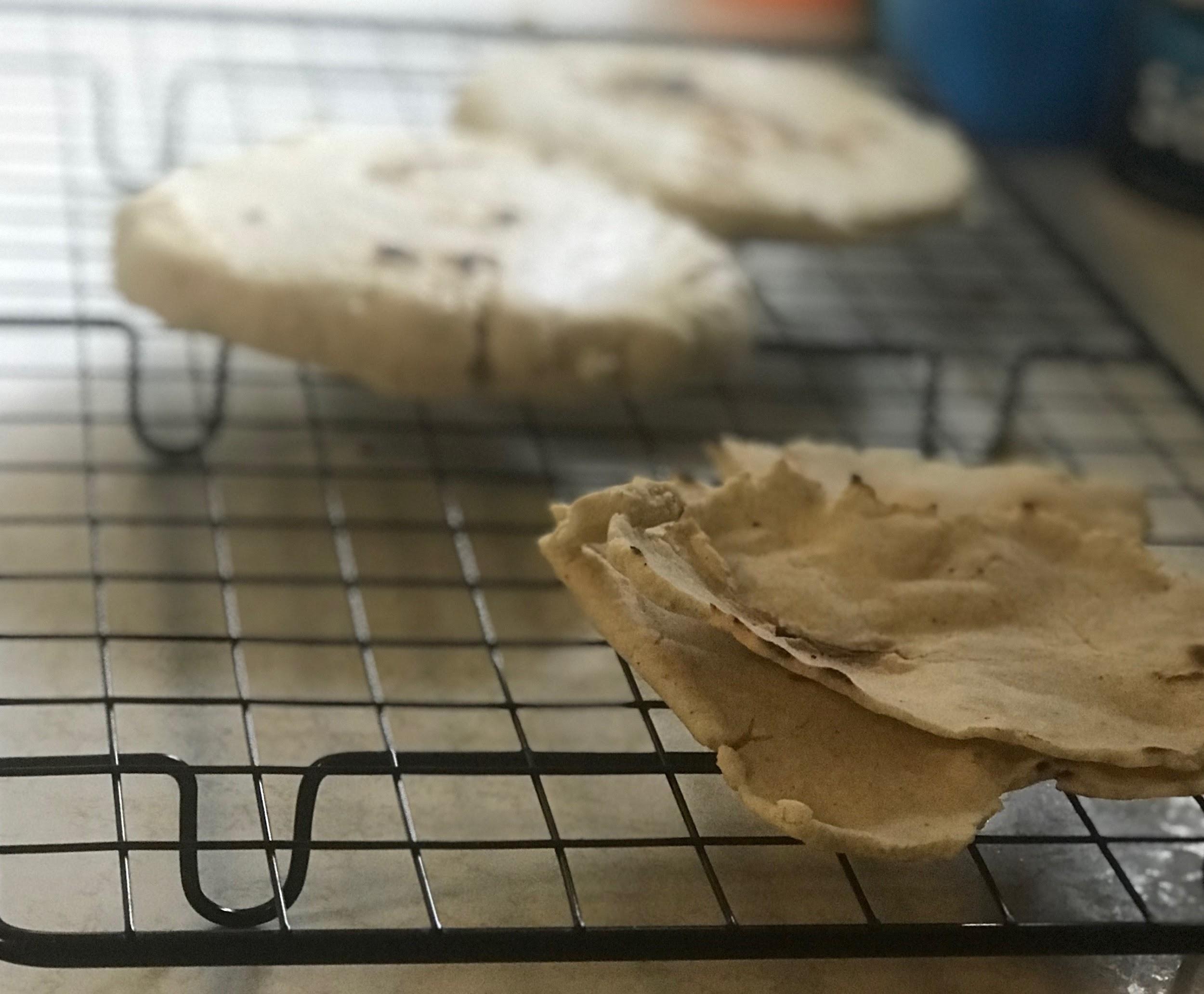
My first attempt at gluten-free communion bread rolled to different thicknesses…

Let’s take this example as a good start. On Friday, my Sabbath (or as I like to refer to it my ”bread day”) I made my first attempt at making flatbread with gluten-free flour. To be fair, it is actually based on a recipe for Indian flatbread called roti. I substituted some Gluten-Free flour, tried to make the recipe as indicated, realized the dough was wrong, and began to adjust through the addition of things like binding agents and additional moisture.

The first attempt is gone. I rolled it too thin, decided to see how it tasted without eating breakfast, and then had a breakfast of far too thin roti which was both piping hot and delicious. I noted my problems, tried to roll it thicker, realized there was still a problem, added moisture to the edges, and tried again. All it all, I made six “loaves” of gluten-free bread, all of which probably won’t cut the mustard for use in church. It tastes great and a great tasting mistake is okay in my book, but it won’t do what it needs to do for my purposes.

Now, let’s say it will take three more attempts before I get this right. Maybe I’ll need to try something different a time or two. Perhaps chia seeds won’t be gelatinous enough to bind the bread together without eggwhite. Perhaps adding more xantham gum will make it taste awful. Let’s say I get to communion Sunday, bring something that is made to the best of my ability, and receive nothing but criticism. What will I do?

I can tell you what I will do. I will hold my head up high, take the criticism, and go back to the kitchen to keep working. Why? Why not take the easy path? Why not try another loaf of gluten-free bread that has been sitting on the shelf in the store? Why not buy the dough frozen? Why not quit while I am ahead?

The plain and simple reason why is that I do not want to quit. I keep going in ministry because I decide there are times when I am willing to die on a hill for the sake of that person who won’t come to communion because they’re embarrassed. Who am I to walk away when I know there is a concrete need in front of me? I am willing to die on a hill for the sake of making sure the means of grace is available to those person while we are all sharing from one loaf as one body of Christ. I am willing to die on that hill because it is better to die with integrity to my spirit than to live with a broken heart.

If you are going to be in ministry you are going to face difficult times. Ministers are many things. We stand up front talking about God and so people will take out their anger with God on us. We talk about inclusion in the body of Christ, so we will bear the brunt of criticism when a member of our church does something exclusive to hurt others. We are the person up front helping put together worship in a way that honors God and that might mean leaving out a favorite hymn of someone for a period that they feel is too long. We will face criticism for that as well. Doing your job as a shepherd means not everyone will be happy.

Spoiler alert: Those words apply to more than just ministers. Teachers, parents will complain. Nurses, patients will continue to buck the advice of the doctor despite your best efforts. Bus drivers, “the wheels on the bus” sung fifty times in a row might be a far better way to spend a given day than to hear cranky kids, wet from the rain, bicker all the way to school. All of us will be challenged and all of us will face situations that demand we make a choice of how we want to live our lives. Sometimes that will lead to us facing hardship, challenge, and occasionally persecution.

We will all face difficult times. The question as you face your difficult times is whether or not you can find things you are passionate about and be happy to die on the hill for that passion and for the sake of your own soul. To be fair, I have found that most people will understand why you are doing what you are doing if you explain it to them. Is gluten-free communion important to you? Explain it with passion, explain your willingness to keep trying, and express that this is one of those places where you have to maintain integrity with your own spirit and most mature people will try to work with you.

Actually, sometimes following your passion frees others to follow their passions. You might die on that hill, but when that resurrection love of God brings life back into your broken bones, you may just open your eyes to see people living into their own personhood all the more powerfully as a result of your example. People can be inspired by sacrifice as much as by success, and that’s important to remember as well.

In the meantime, if you are going through a hard time, whether in ministry or not, I want to encourage you to find a hill that you’re willing to die upon. Stand up for your heart and soul and sacrifice. Jesus taught us that “Anyone who loves their life will lose it, while anyone who hates their life in this world will keep it for eternal life.” Sometimes we need to stand up against that which we hate and be willing to find ourselves on the other side of our resurrection with life everlasting.