Let us Ramble: Contemplating Charcoal

Unsurprisingly, my family and I have spent a lot of time outside this week. In the rural areas around Binghamton this week has been one of the first truly nice weeks of the year. We’ve spent time grilling dinner out on the porch almost every night this week.

A few years ago I was converted to charcoal grilling after a few years flirting with propane grills. Are charcoal grills somewhat inconvenient? They require a little bit of extra work but I adore the smokey taste they impart to the food I grill.

A few weeks ago (in this particular blogpost) I noted that a particular passage stuck out to me from a book I was reading for the upcoming session of the Academy for Spiritual Formation. The excerpt was from the book Spiritual Disciplines Handbook by Adele Calhoun. In particular, this was the passage that attracted my attention from the section entitled “Practicing the Presence” (pg. 72):

“Practicing the presence is a way of living into a deeper awareness of God’s activity in our lives. Through many small pauses we begin a habit of turning our heart toward God.”

I was sitting on my porch while waiting for the charcoal to warm up when I was drawn into a spirit of contemplation. I use a chimney charcoal starter to ignite my charcoal before grilling. I was drawn into a spirit of contemplation as I watched the charcoal begin to burn (with the help of a little lighter fluid–I was cheating when I took this picture).
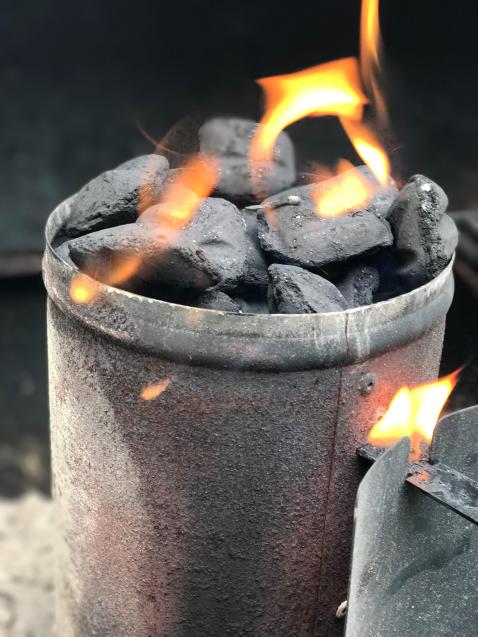
My rusty but trusty chimney charcoal starter!

The idea of the charcoal chimney is a simple concept. You light paper underneath the charcoal and that begins to heat up the bottom layer of charcoal. As that layer begins to burn, it sets the charcoal above on fire. In time, the whole of the charcoal catches on fire and it is time to spread the coals and grill.

As I watched the excessive and unnecessary flames pour out the top, I stopped to think about how the charcoal chimney is supposed to work. All it takes to function properly is patience, a little bit of newspaper, and a match. The chimney starter is simple and effective when the charcoal is in good condition, the breeze is low, and the match actually lights the paper on fire.

I have spent a lot of time working with churches that desire to grow. Some churches are always looking for a great new idea which will bring young families into the church. Some churches are seeking to figure out why certain families or individuals have stopped attending church regularly. A lot of churches are always trying to find that silver bullet which will get them where they want to go as a church.

I have also spent a lot of time working with individuals who are facing struggles in their lives. Families have struggles, coworkers are aggressive, and sometimes the neighbor just will not act neighborly. People seek help and look for a silver bullet to fix their problems. I know this is true because I have been also guilty of seeking silver bullets for my own problems.

As I stared at the excessive and unnecessary flames pour out of the charcoal starter I came to a realization. Just like the flames were unnecessary on the charcoal starter, we often unnecessarily look for big solutions to problems. One of my favorite passages is Micah 6:8. In that passage the Lord tells Micah what is required of people like you and me. People need to seek justice, love kindness, and walk humbly with God.

How many times would a culture of kindness defuse the huge problems which seem to require silver bullets in the church? My experience tells me that kindness can often defuse situations very quickly.

How many times would a little humility fix problems in the lives of individuals? Well, I can tell you that my life would have fewer problems if I decided to have a bit more humility and followed through with that decision.

How much better would our charcoal start if we were to stop pouring excessive amounts of solution into challenges that just require patient faithfulness? When we set ourselves about the tasks of life, would things taste more like the grill and less like lighter fluid if we were to focus on real solutions instead of quick solutions?

I really have to hand it to this idea of intentionally focusing on God in quiet moments. I am grateful that I have begun to find more quiet moments to turn towards God. I also need to get more newspaper. There is going to be a lot more grilling to do this summer and I am going to try to cut down on the lighter fluid.

Let us Seek: Shipwreck ahoy!

For today’s blog I thought we could spend some time with one of the readings from the Revised Common Lectionary. Today’s readings include a beautiful passage from the Book of Acts. I believe that this passage has a good word for all of us. The passage I am referring to reads: (Acts 27:7-12, NRSV)

“We sailed slowly for a number of days and arrived with difficulty off Cnidus, and as the wind was against us, we sailed under the lee of Crete off Salmone. Sailing past it with difficulty, we came to a place called Fair Havens, near the city of Lasea.

Since much time had been lost and sailing was now dangerous, because even the Fast had already gone by, Paul advised them, saying, “Sirs, I can see that the voyage will be with danger and much heavy loss, not only of the cargo and the ship, but also of our lives.” But the centurion paid more attention to the pilot and to the owner of the ship than to what Paul said. Since the harbor was not suitable for spending the winter, the majority was in favor of putting to sea from there, on the chance that somehow they could reach Phoenix, where they could spend the winter. It was a harbor of Crete, facing southwest and northwest.”

The Apostle Paul has been a leader in the church for several years. Paul had also been a leader within the religious elite of the Jewish people before converting to Christianity. Paul was a leader who knew how to convince others to his point of view.

Paul still manages to end up on a boat that is headed into a shipwreck. Paul may be spirit-filled, wise, and a leader of others, but Paul is still on a boat that is going on a very perilous journey that will end in disaster.

"Shipwreck off a Rocky Coast" by Thomas Butterworth

“Shipwreck off a Rocky Coast” by Thomas Butterworth, ~1810 CE. Located in the “Yale Center for British Art”

Have you ever felt as if you are on a boat headed for disaster which you cannot control? We all have moments in our lives where things seem out of control. We all have moments where we could tear out whatever hair we have in frustration. Interestingly enough, most of us know that on occasion everyone faces these moments in our heads but we still refuse to believe it with our hearts.

When you read the Bible it becomes absolutely clear on many things, but let’s focus on one point in particular today. Bad things happen to good people. Whether you are Job, Abraham, Paul, or even Jesus Christ, life involves moments that are neither avoidable nor pleasant. Job was considered a peerless person by Christ (Job 1:8) but still loses almost everything. Abraham is called into a new life and a new covenant multiple times by God, but still needs to rescue his nephew from captivity (Genesis 14). Paul (as previously stated) was shipwrecked despite knowing that the journey ahead of him would lead to disaster. Jesus Christ was crucified–the cup of suffering was not taken away.

Jesus Christ also stated (Matthew 5:44-45) that we should “love your enemies and pray for those who persecute you, so that you may be children of your Father in heaven; for he makes his sun rise on the evil and on the good, and sends rain on the righteous and on the unrighteous.” While he was speaking of love, Jesus taught the same truth that I am trying to express in the midst of his lesson. The sun rises and the rain falls on both the good people of the world and on those with a propensity towards evil.

Being a follower of Jesus Christ does not mean that everything will be perfect. In fact, being a follower of Jesus Christ often means that you will face difficulties. The promise made to believers is not a promise that they will be free from challenge. The promise God makes through Jesus Christ is that we will not be alone in our challenge.

We who follow Christ are given hope through the love of God. We who follow Christ are given presence through not only the Holy Spirit but through the powerful presence of Jesus in our lives. Consider the words of John 17: (NRSV)

“Righteous Father, the world does not know you, but I know you; and these know that you have sent me. I made your name known to them, and I will make it known, so that the love with which you have loved me may be in them, and I in them.”

If Christ is the messenger, then we are the recipients of the love he carried into the world for us. That love is deep, powerful, and meaningful. The thunderstorms of life will strike, crash, and thunder around us, but we have the love Christ has planted in our hearts. Paul the Shipwrecked wrote this in Romans 8: (NRSV)

“I consider that the sufferings of this present time are not worth comparing with the glory about to be revealed to us. For the creation waits with eager longing for the revealing of the children of God; for the creation was subjected to futility, not of its own will but by the will of the one who subjected it, in hope that the creation itself will be set free from its bondage to decay and will obtain the freedom of the glory of the children of God. We know that the whole creation has been groaning in labor pains until now; and not only the creation, but we ourselves, who have the first fruits of the Spirit, groan inwardly while we wait for adoption, the redemption of our bodies. For in hope we were saved. Now hope that is seen is not hope. For who hopes for what is seen? But if we hope for what we do not see, we wait for it with patience.

Likewise the Spirit helps us in our weakness; for we do not know how to pray as we ought, but that very Spirit intercedes with sighs too deep for words. And God, who searches the heart, knows what is the mind of the Spirit, because the Spirit intercedes for the saints according to the will of God.

We know that all things work together for good for those who love God, who are called according to his purpose. For those whom he foreknew he also predestined to be conformed to the image of his Son, in order that he might be the firstborn within a large family. And those whom he predestined he also called; and those whom he called he also justified; and those whom he justified he also glorified.

What then are we to say about these things? If God is for us, who is against us? He who did not withhold his own Son, but gave him up for all of us, will he not with him also give us everything else? Who will bring any charge against God’s elect? It is God who justifies. Who is to condemn? It is Christ Jesus, who died, yes, who was raised, who is at the right hand of God, who indeed intercedes for us. Who will separate us from the love of Christ? Will hardship, or distress, or persecution, or famine, or nakedness, or peril, or sword? As it is written,

‘For your sake we are being killed all day long;
we are accounted as sheep to be slaughtered.’

No, in all these things we are more than conquerors through him who loved us. For I am convinced that neither death, nor life, nor angels, nor rulers, nor things present, nor things to come, nor powers, nor height, nor depth, nor anything else in all creation, will be able to separate us from the love of God in Christ Jesus our Lord.”

My friends, Paul’s words speak for themselves. May you have faith and trust even as the boats of life carry you into the storms. May God help you, comfort you, and give you peace. May the peace of God that surpasses all understanding guard your hearts and minds in Christ Jesus (Philippians 4:7).

Let us Seek: The Cabbage Crisis

Our church’s food pantry had a problem last summer. We had a MASSIVE donation of cabbage. We received hundreds of pounds of cabbage. We had lots of cabbage. The cabbage was beyond the capacities of our refrigerators and we literally could not get rid of it fast enough. The overabundance of cabbage was a bigger problem than you might think. We needed space for other donations of things people need regularly. We could not accept donations of milk or eggs because there was too much cabbage. We could not accept donations of deli meat or cheese because there was too much cabbage. We had so much cabbage that the stuff we could not refrigerate was going bad. We donated as much as we could to a church member’s family who raises pigs, but apparently even pigs get tired of cabbage.

We came right up to the point where the volunteers at the food pantry were going to simply toss it away when I decided to do something about the situation. I did my research, I went on a small shopping spree, and I got to work. I made five gallons of sauerkraut.

Pastor Rob with five gallons of cabbage, salt, and water in July of 2016. Yes, it was incredibly hot that day.

Yes, I made gallons and gallons of sauerkraut. Now, New York State law does not allow for processed food to be distributed to folks unless it has been processed by an approved professional company. So, this meant that I had five gallons of sauerkraut on my shelves. Five gallons of sauerkraut meant that we learned a lot of recipes over the past year that use sauerkraut. Sweet and sour meatballs are my personal favorite.

Yesterday was a beautiful day and we needed to decide what to put on our hot dogs. I hemmed and hawed for a few minutes over just having ketchup or relish when I remembered what was in the garage. A few minutes later I was enjoying a hot dog with sauerkraut and ketchup. The hot dog was delicious.

The most delicious hot dog I ate yesterday!

So, why do I share all of this with you on my blog? I share it because there was a moment last year when everything was coming apart at the seams. The cabbage was literally becoming a thorn in my side and in the side of all of our volunteers. Just the smell of cabbage was beginning to get bother people in a real and powerful sense. The situation was becoming a miniature crisis.

All it took to turn the situation around was for someone to do a little research, put in a bunch of hard work, and to transform a negative situation into a positive blessing. My family had healthy meals this past winter because of the cabbage that was driving people nuts. My hot dog went from good to great because of the cabbage that even pigs were getting tired of eating. Opportunity was hiding in plain sight.

I do not know what situations you may be facing in life today. I do know that not every situation has a silver lining. I cannot promise that there is an outcome as positive as the situation with the cabbage, but I can tell you one thing that is absolutely true. If you do not open your eyes and look around then you may never know what possibilities you are missing.

Consider the following words from Jeremiah 29:10-14: (NRSV)

“For thus says the Lord: Only when Babylon’s seventy years are completed will I visit you, and I will fulfill to you my promise and bring you back to this place. For surely I know the plans I have for you, says the Lord, plans for your welfare and not for harm, to give you a future with hope. Then when you call upon me and come and pray to me, I will hear you. When you search for me, you will find me; if you seek me with all your heart, I will let you find me, says the Lord, and I will restore your fortunes and gather you from all the nations and all the places where I have driven you, says the Lord, and I will bring you back to the place from which I sent you into exile.”

Jeremiah’s words are set in the scriptures during a challenging moment in history. Trouble is on the horizon and Lamentations will show exactly deep a sorrow will fall on the people of God. Jeremiah’s prophecies are set in a time of doubt about the future. There was likely a real and powerful doubt at play in the hearts of all those people who heard Jeremiah’s prophecies and believed his words.

Despite these doubts and troubles, Jeremiah leaves the people with a word of hope. There was a place for redemption and hope when all of the trouble had come and gone. Will the seventy years ahead be a very difficult time? Of course the situation ahead of the people will be grim. Even Jeremiah will be filled with lament when everything comes to pass, but even that darkness will not last forever. God cares about the welfare of the people. God will make a way and allow the people to find both God and hope. God will hear their prayers again. God will gather the people in with open arms.

I do not want to belittle whatever situations you face today. Everyone has their own challenges and sometimes there are no silver linings. I do want to invite you to open your eyes in the midst of your challenges. Sometimes there are blessings in the stinky cabbages of life. Not always, but sometimes there are possibilities. I invite you to have courage and to have faith.

Let us Ramble: Christian koan?

Yesterday I was working through the same book that I have been reading through for The Academy for Spiritual Formation over the past few weeks. It seems like every Monday begins with a cup of coffee and the same book. Inevitably, my brain melts before the coffee cools. The book’s title is “God’s Unconditional Love: Healing Our Shame” and was written by Wilkie Au and Noreen Cannon Au. This is a dense book with a lot of good concepts and ideas.

One of the brain-melting ideas that took a hold of me this week revolved around the idea of a Christian “koan.”The authors say this on page 63:

“Many years ago, when Wilkie was in Kyoto studying Zen meditation, this practice of gazing on the crucifix was endorsed by an unlikely source, a Japanese Zen master. Yamada Roshi told him and his fellow Jesuits that the cross is the Christian koan and that contemplating it was a path to enlightenment. A Zen koan is a riddle or surd (e.g. ‘What is the sound of one hand clapping?’) that baffles and stills the busy mind, so that an intuitive flash of truth can seize one’s awareness.”

This idea struck me as being very interesting given my background as a United Methodist. In his sermon “Spiritual Idolatry” John Wesley (one of the founders of the Methodist movement) clearly stated that he believed the Roman Catholic practice of using icons was a form of idolatry. John Wesley was not a fan of this “Romish” practice.

Now, let’s be clear. I do not believe that John Wesley only spoke and preached words that were beyond reproof. In some cases (like in “The Cause and Cure of Earthquakes”) I believe John Wesley was dead wrong, Despite all of my troubles with his works, I do believe that John Wesley wrote and spoke with all of the integrity he could muster. In short, I tend to give John Wesley the benefit of the doubt.

I do not believe that John Wesley would approve of the idea of a Christian koan, which I honestly believe is sad. I believe that there is some validity to what Yamada Roshi taught Wilkie Au. The authors go on to state that Yamada Roshi taught the Jesuits studying in Japan that excessive rationality often stood between people and God. The crucifix as a koan does an excellent job of being simple enough to help a Christian go beyond rationality into a place of contemplation where inspiration can take root.

After my brain stopped sparking I contemplated the idea on and off again. It kept setting small fires in my mind, but I had a few thoughts that I believe were helpful.

First, if the Jesuits focused on the crucifix, does it change the nature of the inspiration to contemplate the empty cross favored by Protestants? How would a focus on resurrection alter how one comes closer to God? What does it mean to us in our contemplation that the means of death inflicted by the world stands empty and defeated? Does pondering the very differences lead to the excessive rationalism Yamada Roshi was warning about? Would it be helpful to break through a barrier for a Protestant to contemplate a crucifix or for a Roman Catholic to ponder the empty cross?

Second, what koans have I experienced in my life? When I regularly went to the same Young Life camp first as a student and then as a leader I remember watching the same tree growing out on an island in the lake. Contemplating the tree led me to places where I found inspiration to get through some of the most difficult spiritual struggles that I faced as a college student. I know that I have stared at a campfire many times while praying through challenges as an adult. Were these koans or just convenient places where my focus rested until I saw Christ?

Finally, what’s wrong with an icon? John Wesley’s idiosyncrasies aside, is there anything wrong with using an icon? As a young Christian I enjoyed reading both John Bunyan’s Pilgrim’s Progress and C.S. Lewis’ Pilgrim’s Regress. In reading stories filled with allegorical characters I found a way of contemplating deep things about my own spiritual life. Is using an icon to go deeper in one’s faith different than using a work of fiction? Is using an icon to focus in and grow deeper in the faith different than using a sermon like a lens to focus on a truth in the scriptures?

As I said earlier, this book causes my brain to smoke. On the positive side, if my brain is overheating then I have an excuse to always be letting hot air out of my mouth.

Let us Seek: Diving into the pool

Yesterday was a terrifying day for me. I went swimming and I was scared.

Allow me to give all of you some context to my terror. At the end of March I underwent a cornea transplant in my left eye. When my patch was removed I was told several things that I should immediately cease doing in my day-to-day life. First, no lifting of heavy objects. Second, nothing that would raise my pulse too much. Third, absolutely no swimming or getting chemicals in my eye.

Over the past few months I have done my best to avoid lifting heavy objects. A few weeks ago I was told that I could exercise again. Last week I was told that I could go swimming again.

Now, I love to swim. Swimming is one of my favorite things to do in the world. I love being in water and swimming long distances. I may not be able to run due to my back and my ankle, but I can consistently swim farther than most people can run. I’m not kidding or bragging when I say that I like to swim long distances. I often swim at the YMCA until my skin begins to react to the chemicals, which happens to me after about 2 hours. I really do love to swim…

My love of swimming is great, but it took me a week to build up the courage to go to the YMCA after receiving permission. I was certain that my eye would immediately have problems the moment that a single drop of chlorinated water made it into my goggles. I was also convinced that tightening them to the point where water would not be able to get into the goggles would lead to a tight seal that would create a pressure that would cause damage to my cornea. I was terrified that something would go wrong for the entirety of the last week.

I was scared. I did what I try to do whenever I get scared about something irrational. I faced my fear and I went swimming. My eye didn’t pop out from over exertion. My cornea did not dissolve when some water made it into my goggles. Nothing went wrong in the slightest… Well, technically I did chicken out in the name of being reasonable and only swam for 45 minutes. I am told that there is nothing wrong with a sensible amount of caution.

I am reminded of a story from the Bible as I think back to the moment that I entered the pool. The whole of nation of Israel was standing next to the Jordan in the third chapter of Joshua. The people of God were finally ready to enter the promised land, but one last thing needed to take place. The people needed to cross the Jordan. Here’s what it says in Joshua 3:14-16: (NRSV)

“When the people set out from their tents to cross over the Jordan, the priests bearing the ark of the covenant were in front of the people. Now the Jordan overflows all its banks throughout the time of harvest. So when those who bore the ark had come to the Jordan, and the feet of the priests bearing the ark were dipped in the edge of the water, the waters flowing from above stood still, rising up in a single heap far off…”

I love that the people of God are waiting to cross the river, but first twelve priests have to carry the ark into the midst of the river. They are told that the river will stand still, but the water only stands still after the twelve enter into the water. Can you imagine being the person who steps in first? Can you imagine the movement of the ark continuing forward and moving you closer and closer to the swollen river? Can you imagine the feeling of the current tugging at your toes while you carry the ark of God into the water?

It had to be a tense moment when the priests first stepped into the water. The priests still stepped forward into the river. They had to have had courage to take those first few steps in faith.

We all sometimes need to be reminded that courage is often a necessity in life. We all have moments where we wonder if the river will stop, if an eye will survive a dip in the pool, or if everything will be okay. Sometimes we all need to step into the river with courage.

Let us Ramble: Peter and Grace

I’m sitting and pondering as dinner settles itself down in my children’s tummies. One child is putting away laundry while another gets clean before putting on pajamas. The lawn has been mowed, the laundry is moved along, and I have a list of the things I need for my wife’s Mother’s Day Dinner tomorrow night. This is a good time for reflection.

I keep bringing myself back to Peter’s words in today’s scripture reading at church. I’ve spent a lot of time lately thinking about the whole passage, but continue to find myself drawn to Peter’s words. Peter says in Acts 15:8-11: (NRSV)

“…God, who knows the human heart, testified to them by giving them the Holy Spirit, just as he did to us; and in cleansing their hearts by faith he has made no distinction between them and us. Now therefore why are you putting God to the test by placing on the neck of the disciples a yoke that neither our ancestors nor we have been able to bear? On the contrary, we believe that we will be saved through the grace of the Lord Jesus, just as they will.”

I keep thinking about how remarkable well Peter expresses that saving work of Jesus. When I was younger I kept hearing a theological concept that fits well here. The concept was that “the ground is level at the foot of the cross.”

The ground is level because we all are equally blessed by Jesus Christ. Conceptually if nobody is righteous outside the grace of Jesus, then we are all equally blessed. There are neither super Christians nor subpar Christians. Instead, we are all equally blessed to be sisters and brothers of Christ through our adoption into God’s family.

This concept is a powerfully gracious concept, especially when so many people seem intent on pushing others out of the door of the community of God’s children. There are still many people who will happily share the rules and regulations of the yokes that they believe make people righteous centuries after the time of the Council in Acts 15. Christians have practically made an art form out of the practice of setting rules for ourselves and especially other people.

What would it look like if we all lived out of this perspective? What if we spent more time focusing on how the grace of Jesus Christ spreads into the lives of others than on whether or not they follow the rules our culture has placed upon us? What if we became a people who were as transformed by this grace as the man who spoke these words in Acts 15? What a world that would create…

Let us Seek: Sarai’s Exclusion

Today’s lectionary readings contains one of my favorite passages in the Hebrew Scriptures. The lectionary reading contains the call of God on the life of Abram which includes his wife Sarai. Here is what Genesis 12:1-3 says: (NRSV)

“Now the Lord said to Abram, ‘Go from your country and your kindred and your father’s house to the land that I will show you. I will make of you a great nation, and I will bless you, and make your name great, so that you will be a blessing. I will bless those who bless you, and the one who curses you I will curse; and in you all the families of the earth shall be blessed.’”

I adore this story for several reasons. Allow me to list a few:

  1. I’m an itinerant preacher. I am drawn to stories where God says “Go to the place I will show you.” It is my hope that God would lead me in the same way.
  2. I adore the fact that the blessings Abram will receive will be from many people and the curse will hopefully only fall on one entity. I love the optimism of that promise. Unfortunately, verse 3 has been translated many different ways. I remain optimistic and still find hope in these words, especially as my preferred translation (NRSV) has lines that fall in “pleasant places for me.”
  3. Abram’s life will become symbiotic to the world around him. As a result, his life causes “all of the families of the earth” to be blessed. This is about as far from an exclusivistic promise as one can get in the scriptures. All families means all families.

I love this story, but not everything is “sunshine and rainbows” between me and this verse. I struggle with this story for several reasons.

  1. Sarai is an important part of Abram’s story. She’s his partner. Her child will be a beloved part of the promise. It seems as if Adonai makes an assumption that Sarai and Abram will understand her role. What happens when you assume? A woman named Hagar is abused. Ishmael comes into being, which is wonderful for Ishmael’s descendants, but there are less abusive ways to bring life into the world.
  2. Abram’s call divides both Sarai and Abram from their families. I would like to say that the call of God does not require sacrifice, but that would be a lie. I am saddened that these sacrifices are required, but sometimes they are necessary.

While there is nothing that I can do about the second challenge, I will say that an awareness of the first challenge can easily bear fruit. What if we use Sarai’s exclusion from the call as a spur to ponder our own words, our own thoughts, and our own prayers? What if we take this as a reminder to focus on something beyond ourselves and beyond our own perspective?

"Abram's Counsel to Sarai" by James Jacque Joseph Tissot

Abram’s Counsel to Sarai, c. 1896-1902, by James Jacques Joseph Tissot (French, 1836-1902), gouache on board, 6 x 8 1/8 in. (15.2 x 20.7 cm), at the Jewish Museum, New York

I was recently invited by a friend to the Friends of the Tompkins County Public Library Book Sale in Ithaca, NY. While perusing the shelves I found a book called “Prayers for an Inclusive Church” by Steven Shakespeare. In that book, on this Sunday the following collect can be informative. I’d like to share a prayer in order to analyze the form, structure, and word choice. It is based on John 14:1-14:

“Generous God,

whose way is love,

whose truth is searching,

whose life is freely given

in Jesus Christ our Lord:

As you have opened for us

your house of many rooms,

so may we make a place

for the rejected and unloved,

and share the work of peace;

Through Jesus Christ, the image of God

Amen”

It is a very solid prayer and well written. I would recommend most of my clergy colleagues think of this as a good resource. Regardless, in taking Reverend Mr. Steven Shakespeare’s prayer as an archetype of a prayer with inclusive tendencies, we can note several things about the prayer construction: (Please note I’m using the etiquette recommended by the Church of England who ordained Mr. Shakespeare. Their etiquette is different than standard American etiquette)

  1. Mr. Shakespeare’s prayer refers to God with a gendered designation, but one which refers to a being in the Christian tradition which includes the image of humanity in all forms of gender. It isn’t perfect, but English is also not a perfect language.
  2. In Mr. Shakespeare’s prayer Jesus Christ is referred to as Lord, but this makes sense as Jesus Christ is generally considered male. The Lordship of Jesus is less of a challenge than the Lordship of God as Jesus is strongly identified with a particular gender, but not always. There are various books available about trans-theology including “Omnigender: A Trans-Religious Approach” by Virginia Mollenkott which explores other interpretations of Jesus’ gender and how that affects our view of gender.
  3. Mr. Shakespeare clearly makes an attempt to open the borders of the blessing. If Abram and Sarai are called to create a blessing to all of the families of the world, then this prayer sees that blessing as being inclusive. God’s way is love, God’s truth searches, and God’s life is given freely. Jesus’ blessing causes people to make space for the rejected and the unloved. There’s room for Ishmael and Hagar in God’s blessing. This blessing extends that grace.
  4. Mr. Shakespeare extends God’s welcome to us into the act of working towards peace. In a world which is filled with lives that often become insular to outsiders, Mr. Shakespeare’s prayer invites the blessing to become manifold in the work of our hands.

With these ideas in mind, I believe we can use Sarai’s exclusion as a spur to inclusion. Here are a few first steps:

  1. Be careful of gendered words. Be careful even if you think these concerns are hogwash. If you pray in public, think through your word choices. There is generally no need to stir up unnecessary trouble between sisters and brothers in the faith. Complications complicate things and life is complicated enough without doubling down on trivial matters.
  2. Consider the scope of your prayer. If you are praying with or for a small group, work an expansive vision into that prayer. If you are praying with a large group, include the vastness of their impact into your prayer. Why pray that an individual would be a blessing in their family when they could be a blessing in their family and neighborhood? Why pray for a church group to get along when you can pray that they get along and expand their love into the community? Prayer changes things including what we ourselves deem possible.
  3. Be wary of the barriers that you might unintentionally erect in your prayers. Does God see things your way? Does God see that town-line, those railroad tracks, or that border as a barrier to blessing? If not, why do you? Sometimes your prayers and thoughts may be the very thing blocking your ability to see the leading of God. Sarai couldn’t see that her disbelief was a barrier. She laughed when God’s inclusion stretched out to include her. Be wary.

All of this being said, if you are involved in worship planning, I believe you should get a hold of Mr. Shakespeare’s book. It is quite lovely and a good resource.

Let us Seek: Flowers in the cold

The last few nights have been very cold in the town of Maine, NY. I have gone to sleep with a prayer on my lips as I curled up into my bed. Each morning I have gone outside to check on the tomato plants and marigolds that have been hiding under burlap covers. I have pulled aside the cover and I have expected the worst case scenario to have taken place. This is what I saw as I pulled aside the burlap this morning…

Oh! The horror of it! A bright orange flower greeted me in the midst of happy tomato and carrot plants…

This beauty of a red and orange blossom also had been clearly struggling with the weather.

I had assumed that the very worst case scenario had occurred. Nothing had gone wrong with the plants. I had the same fear the night before, but nothing had gone wrong with the plants. I have assumed that something terrible would happen every night of this weekend. Nothing went wrong with the plants. They are all perfectly fine.

I occasionally have to remind myself of something very basic. I don’t need to go looking for trouble. Theodore Roosevelt was once quoted as saying “If you could kick the person in the pants responsible for most of your trouble, you wouldn’t sit for a month.” George Washington is quoted as saying “Worry is the interest paid by those who borrow trouble.” Jesus clearly taught that we should not worry about tomorrow. Consider this passage from Matthew 6:28b-33: (NRSV)

“Consider the lilies of the field, how they grow; they neither toil nor spin, yet I tell you, even Solomon in all his glory was not clothed like one of these. But if God so clothes the grass of the field, which is alive today and tomorrow is thrown into the oven, will he not much more clothe you—you of little faith? Therefore do not worry, saying, ‘What will we eat?’ or ‘What will we drink?’ or ‘What will we wear?’ For it is the Gentiles who strive for all these things; and indeed your heavenly Father knows that you need all these things. But strive first for the kingdom of God and his righteousness, and all these things will be given to you as well.”

I know these statements hold a lot of wisdom. I still catch myself being needlessly worried. Am I really so worried about tomato plants? Why do I choose to live in fear of a summer without tomato sandwiches? Why am I concerned that there won’t be enough tomatoes to sauce and preserve for quick meals when we’re all tired after the baby is born? Why do I choose to live this way? What does that say about my own relationship with God?

I’m clearly not in the same league as those flower blossoms. May God bless me with wisdom as I slow down to enjoy them before their season in the sunshine comes and goes.

Let us Ramble: Apple Blossoms

Today I would like to go back to a book that I have been using as a reference guide while doing my reading for the upcoming session of the Academy for Spiritual Formation. The following excerpt is from the book Spiritual Disciplines Handbook by Adele Calhoun. In particular, this passage is from the section “Practicing the Presence” (pg. 72):

“Practicing the presence is a way of living into a deeper awareness of God’s activity in our lives. Through many small pauses we begin a habit of turning our heart toward God.”

I was “practicing the presence” this afternoon as I was waiting for my kids to get home on the school bus. It has been very cold the last few nights and I have been concerned for the plants that I have planted and tended around the parsonage. In particular, I have been concerned for the apple tree that was so prodigious our first year but suffered from frost damage on the apple blossoms last year. I do not have the resources to properly protect the tree. I pray for the tree. We use what we have…

Anyway, I went up to the tree while waiting and tried to slow down. I had been preparing dinner as a surprise for my wife and had been busy mincing, shaving, and slicing vegetables for dinner. I needed to get to work shortly after the kids got off the bus to have dinner ready in time. I was feeling a false sense of time pressure, so that particular moment was a good moment to slow down.

I stopped and stared at the apple blossoms. The blossoms were absolutely gorgeous. Don’t take my word for it–look at these beautiful blossoms!

As I looked at the blossoms I came to realize something. There were no pollinators at work. The weather was a bit breezy and a bit cold. The blossoms were in bloom, the pollen was ready to be spread, but there were no bees! All of these beautiful blossoms would be out and ready, but no bees were taking advantage of the treasure trove of pollen.

As I looked, slowed down, and sought to find the presence of God I realized something. Our lives are full of opportunities to go deeper in our relationship with God. There are opportunities to explore our faith all around us. We can get to know God better by taking fifteen minutes to pray before starting our day. We can grow in our knowledge of the scriptures by spending time reading through the Psalms before we dig into our lunch each day. We can spend time with a spiritual director or an accountability partner going deeper in our faith. There are so many opportunities to go deeper in our lives.

As I stopped and went into God’s presence I realized those opportunities are like the flowers on an apple tree on a cold day. They are all over the place. A moment or two is all it takes to cover ourselves in God’s presence like pollen covers a bee. As we drink in God’s presence like a bee drinks nectar we spread the blessing of one part of our faith to another. As we come across others that blessing can spread from our lives into theirs. There are so many opportunities if we spread our wings and leave the nests of our own comfort.

I am very glad I took a moment to slow down and seek God’s presence. Hopefully I will be wise enough to continue finding moments where God is present in the midst of the busyness of my days.

Let Us Seek: Holy Moses!

Today’s readings from the Revised Common Lectionary draw something a bit personal out of me. In particular, I am drawn to ponder the reading from Exodus. I’ve had many images in my mind of Moses over the past few decades of my faith journey. It has been twenty years since I gave my life and my heart over to Jesus. I have spent a significant amount of time since then reading and pondering the scriptures.

Yesterday, while reading through “God’s Unconditional Love: Healing Our Shame” by Wilkie Au and Noreen Cannon Au for the upcoming session of the Academy for Spiritual Formation, I read about the practice of visualizing what you read in order to reveal your own internal image of God. When I apply this practice to the idea of seeing Moses after twenty years of study, I will admit that it is hard to describe what I see at first glance.

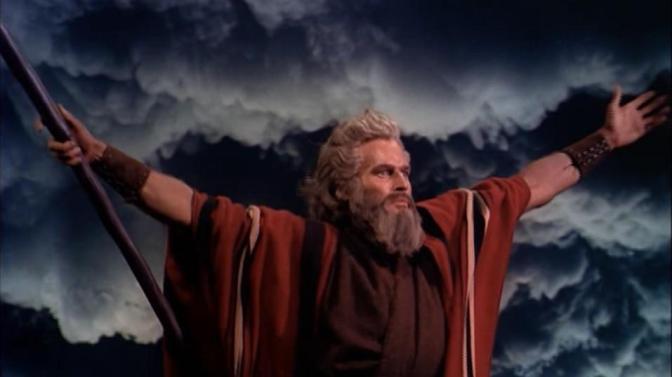
To be clear it isn’t the following image…

Charlton_Heston_in_The_Ten_Commandments_film_trailer.jpg

I’ve never watched Heston’s portrayal… Sorry film buffs–it has not happened by this point in my life.

To be honest, my vision of Moses has been deeply affected by my sense of humor. I don’t have permission to copy the image, but this is my work computer’s background (We miss your cartoons ReverendFun.com). My honest impression of Moses when I stop to pray is somewhere between these two images. Moses was serious, intense, and challenged continually. I imagine I’d tear my hair out with the stuff he had to deal with, but I also think that Moses had to reach a point of frustration where he’d have to either laugh or cry. I prefer to think of him as laughing.

All of that being said, I honestly believe that I have never stopped to dwell on the idea of Moses as a father. Was he married? Yeah. His Father-in-Law gave him some really great advice, right? I can easily remember that story. He had two sons. Exodus 18 names them as Gershom and Eliezer.

Gershom’s legacy is that his children become priests for the Danites until they are carried off into exile (according to Judges 18). 1 Chronicles 23 says that Eliezer has one son, but that son had a lot of children. The legacy of both children is tied to the tribe of Levi, but what challenges me is not the legacy of Moses’ children, but the very act Moses is called to engage in shortly after today’s reading.

Moses is called at a burning bush and must go to confront Pharaoh. The people are crying out in anguish and Moses is called to go out to do the right thing. Moses has children and following God will mean that Moses will leave his wife and children with his Father-in-Law Jethro. Listening to God’s call will require Moses to walk away, if even for a short while.

I have two children. My two daughters are shining jewels that challenge me to be a better father and provoke me to occasional fits of face-palming. I have another child on the way, which is pretty exciting. Walking away from one’s children is a hard idea for me to swallow, but isn’t that exactly what Jesus confronts several people about when they resist his call? In Matthew 10:37-40, Jesus says: (NRSV)

“Whoever loves father or mother more than me is not worthy of me; and whoever loves son or daughter more than me is not worthy of me; and whoever does not take up the cross and follow me is not worthy of me. Those who find their life will lose it, and those who lose their life for my sake will find it.”

While I am challenged by Moses’ call and his ability to walk away from his children, I must admit that there is something common in the call on Moses’ life and the call on our lives. We are not called to simply live lives that fall in pleasant places. We are not called to lives where we can always call the shots while remaining faithful. There are times when the call of God supercedes our desires and that can be incredibly painful, but pain is not always a bad thing.

I am grateful that this passage reminds me that God is calling us to a lifestyle where things are not always easy. I am grateful that the scriptures do show that Moses is eventually reunited with his children and with his wife. I am grateful that Moses was not left alone in the wilderness but was brought into a place of safety and refuge by Jethro. I am grateful Moses created a family with Zipporah.

My image of Moses may always remain the man pulling out his hair or the young man from the cartoon, but I am glad there was more to Moses than what I see in my image. Maybe as my hair turns silver I can remember Moses’ story and have an explanation as to why Heston’s hair was graying in that old movie.

Let Us Seek: Tastes good, less malicious!

In considering the Revised Common Lectionary readings for May 2nd, I am immediately drawn to the reading from 1 Peter. Indeed, these verses seem almost magnetic after a long week that has devolved (or evolved) into prayer more times than I can count. Whether it is reading an article on Facebook or having newspaper clippings handed to me out of today’s local paper, I have been regularly driven to a place where I have felt a need to lower my head into my hands and pray. As a result, I find this scripture magnetic. 1 Peter 2:1-3 says: (NRSV)

“Rid yourselves, therefore, of all malice, and all guile, insincerity, envy, and all slander. Like newborn infants, long for the pure, spiritual milk, so that by it you may grow into salvation–if indeed you have tasted that the Lord is good.”

I find these words have a certain magnetism because they are both incriminating and freeing to me. I find them incriminating in the sense that there is a part of me that wants to be angry and malicious. When friends, neighbors, and colleagues are hurting due to the actions of other individuals and special interest groups, I want to make that pain stop, but my professional avenues to address these issues are limited. This situation is extremely frustrating to me and to many others.

In the midst of these frustrating situations, I hear a voice in these scriptures. Is God good? Yes. Have I experienced the goodness of God? Yes. Which do I long for more–the pure, spiritual milk or vengeance? I long for something better than maliciousness. I hear the voice of God calling and the invitation is to both faith and relinquishment. I am called to have faith in the God I know is good and to let go of my desire for vengeance. It is time to let go of anger, hatred, and frustration. I know there is a part of me which feels frustrated and allows that anger to fester into malice, but with God’s help I can move this place from one of incrimination to one with freedom from my own anger.

Let me try and explain it another way. In our church this past Sunday we read the story of Stephen in Acts 6-7. One of the details that has always slipped my attention is the last thing Stephen does before dying. Stephen asks God to forgive the people who have caused his death. Like Jesus, Stephen decides that it is more important to forgive than to have vengeance. The sense of forgiveness that Stephen exudes and that Jesus modeled reminds me of the promise Paul makes about how the protective peace of God (which surpasses all understanding) when we make our requests known to God with joy (Philippians 4:4-7).

Forgiveness, peace, and trust all seem to dwell in a symbiotic relationship in a life of faith. For me this smorgasbord of faith is at the heart of what Peter is referring to in this passage. God is good and forgiveness, peace, trust, and friends all seem to flow from God’s goodness in a very consistent manner. These gifts are freeing and I feel freed when they take the place of anger in my heart and mind.

Does any of this mean I will advocate for righteousness any less? No. I will continue to advocate but I will also remember to do so without malice. I have tasted and seen that God is good. I will serve God with that truth in my mind partially because of the blessing of today’s scripture. I am thankful for the gift of this scripture.

Let Us Ramble: Differing Loyalties

Today I am working through a book I am reading for The Academy for Spiritual Formation. The book’s title is “God’s Unconditional Love: Healing Our Shame” and was written by Wilkie Au and Noreen Cannon Au. I reached the end of a chapter and a difficult question is raised in the “Spiritual Exercises and Reflection” section. The statement which is tripping me up this morning reads: (pg. 32)

“God asked Adam and Eve, ‘Who told you that you were naked?’ In a similar way, imagine God asking you, ‘And who told you that who you are is not enough?’ What comes to mind as possible sources of shame in your life?”

This blog is not where I openly reflect on the personal aspects of my journey. My personal thoughts on shame belong in my prayers and in my journal, but there is also a professional side to this question which is echoing through my mind.

I was approached yesterday and asked indirectly if I’d be preaching on Memorial Day or the Fourth of July. I tend to go on vacation on those weekends for several reasons. First, they are low attendance weekends and I like to celebrate with my extended family. For the last few years I’ve been invited to go on trips with my father and his wife during the Fourth of July weekend in particular. As a consequence of the 24/7 nature of my position and the busyness of my father those weekends were the only weekends I saw my father over the past few years, so I definitely took advantage of a chance to spend time with my father while he is still around and we’re both in good health. I believe that it is better to spend time now than to regret spending too little time later in life.

Second I struggle with the very nature of balancing my dual-citizenship. On earth, I am a resident of the United States who enjoys citizenship. In heaven, I am a citizen of God’s kingdom through the love of Jesus. The one citizenship is temporal and fleeting and the other is permanent and eternal. Meaning no disrespect to the country of my birth, I have made vows to serve my permanent nation and thus sometimes find the disconnection between the two disconcerting.

A great example of what I mean falls today. Today has been proclaimed Loyalty Day by the President of the United States. One sentence of the proclamation reads “The loyalty of our citizenry sends a clear signal to our allies and enemies that the United States will never yield from our way of life.” Why does this bother me? Jesus taught that we should live with a humility that requires an ability to be able to follow the Spirit even when it leads to strange places.

What would the church be like if Peter had said “I understand you want me to eat these things you have called unclean, but I am loyal to my Jewish heritage. I will never yield from my way of life.” What would the church be like if the lack of yielding led to the exclusion of the Gentiles? Even laying that aside, what would our nation look like if our loyalty led to an inability to look squarely at issues like slavery or Women’s Suffrage? The church sometimes helped, sometimes hindered, but was definitely involved in those conversations. Loyalty is admirable, but where do our loyalties truly rest as Christians? Do we never change our way of life even as that way of life hurts our neighbors and destroys the land our neighbors called home before my ancestors even left Europe? Where does my loyalty lie?

Consider for a moment that this is also International Workers’ Day. This celebration was placed on this date to honor both the old tradition of May Day and due to the proximity to a bombing which took place in Chicago called the Haymarket Massacre in 1886. The workers had been striking for an 8 hour work day so that they would have time to do simple things like care for families, participate in society, and not simply exist as a work force. Today this day is generally downplayed in the United States, but as a minister of the Gospel I am aware of how much blood, sweat, and tears were shed by my sisters and brothers over the centuries to help care for folks who were orphaned, widowed, or disabled by poor work conditions. Clergy have advocated, provided care, and reached out to people in need on this day.

So, which do I celebrate today? Do I celebrate how I should be loyal to a temporal nation or focus on a movement my sisters and brothers fought to bring into the light? Would you want that choice?

I’ll always celebrate Memorial Day as I recognize that many sisters and brothers paid the ultimate sacrifice in an attempt to live out their faith. I understand they weren’t perfect, but I can happily celebrate Memorial Day. I simply wish people would understand why ministers struggle with their dual-citizenship. Most of us in denominational settings have vows to keep and we must always tread gently.

Let us Ramble: The Cannon

I was gardening a few minutes before it happened. I spent the majority of the day getting the tomato patch ready for a good season. I pulled weeds, I measured space, I marked holes, I prepped the area, and finally planted the tomatoes. We planted 3 cherry tomato plants, 2 slicing tomato plants, and 3 paste tomato varieties for sauces. It had been a really productive day. I even planted flowers. I came inside and this is who I was…

File_000

I was this guy from the circus. I was climbing on life’s cannon. I avoided the news all day, avoided Facebook most of the day, and was ready to climb into the cannon of life. I was totally ready for what life had for me, because if life gave me lemons, I could use them to add a certain amount of acidity to my tomato sauces.

Then I read the Judicial Council’s decision on the election of Bishop Oliveto. I immediately felt like the man from the circus in the following picture…

File_001

Do you see that blur? That’s a person being fired out of a cannon. I know this because my phone took a continuous stream of photos and that’s the guy! You’d better hope that pad is in place when this happens, because that is really fast.

I felt like this man being shot across an arena when I read that article not because I am a member of the LGBTQI community–I am pretty much as heterosexual as people come. I did not feel like a man being shot across an arena because I have any relatives that are out of the closet–they’re all heterosexual as far as I can tell. I have no familial investment in the LGBTQI community as far as I know.

I felt like a person being shot out of a cannon because these actions come across to me as neither right nor righteous. We live in a world where there are children being driven from homes by war, greed, and hatred. We live in a world where children are forced into exploitive circumstances where they are taken advantage of in the most criminal of fashions. We live in a world where we are regularly discussing the possibility of nuclear war between North Korea and the United States on a nearly daily basis. We live in a messed up world and THIS is where we are spending our time and energy. If you’re reading frustration into my words, congratulations. You are correct. I am totally and completely frustrated by what has happened.

We act as if God is losing sleep over what two consenting adults do in a loving relationship but is okay with the effects that our personal investments and privileges have on people around the globe. Continuing to waste time and resources on the oppression of a community that has individuals who exemplify and exhibit the gifts of the Holy Spirit is simply and completely confounding to me.

Let me put this another way. If I call the pizzeria down the street and ask for them to send me the best pizza they have, the pizzeria might make any of a number of pizzas. They might send a black olive pizza, a cheeseburger pizza, a pepperoni pizza… The possibilities are endless, but I know this: if I ask them to make me a great pizza I’ll probably get a great pizza.

We ask God to send us leaders and then we get upset when God sends us leaders who don’t fit our conceptions of what is acceptable. We ask for God to help lead us forward into this new millennia and new century and then we get frustrated that God continually asks us to accept who we are sent instead of who we would prefer. We’re given talented leaders like Bishop Oliveto and we respond by threatening any group of clergy with punishment that would even consider electing another person like her.

Is it any wonder that someone who was ordained to help care for the body of Christ feels like he has been shot out of a cannon? I just wanted to worry about my tomatoes and now I’m worried about my church bleeding out over the massive wounding we just gave ourselves. I think we’ve all just been launched into the sky. I pray we have a soft landing.

Let us Ramble: Images of the Police and God

The other day I read a sourceless (but probably not apocryphal) story about a police officer sitting at lunch with her partner when a conversation between a mother and her son was overheard. The child had been acting up and the mother was losing her patience. The mother pointed at the two police officers and said “You see those police officers over there? They take bad kids like you to jail if they misbehave.” The officer stood up, walked over, and said to the child “Don’t worry. We don’t take children to jail. We take bad parents there instead.”

The story was meant to inspire people to not tell their children that the police are the bad guys. If a child gets in trouble it becomes harder to help them if they truly believe that the police are going to hurt them. The fear children learn about police officers from others causes the children to be less safe in the long run.

The story re-entered my brain as I was reading through the first few chapters of “God’s Unconditional Love: Healing Our Shame” by Wilkie Au and Noreen Cannon Au for the upcoming session of the Academy for Spiritual Formation. In the introduction to the book the authors note that a lot of people carry two images of God with them. They carry the image that they are taught and verbally profess, but they also carry the image that is formed by their interactions with others, especially caretakers and parents. The authors call these images of God the professed image and the operative image (pg.2-3).

Looking at the story of the police officer’s interaction we see a great example of this kind of learned behavior. The child is likely taught through school programs, teachers, and neighbors that the police are there to be helpful. This image is reinforced every time they see an officer in a car with the words “To serve and protect” written on the bumper. If pressed the child might say that the police exist to help. This would be the professed image of the police.

At the same time, the child is being taught by his mother that bad boys are taken away by the police. The child is being taught that the police effectively exist to lock him up when he misbehaves. The child is being taught that they should avoid the police and this image may last for years in such a deep place that the child may not even remember. The child is going forward with two ideas in his head. He says the police are there for his benefit and yet believes (at some level) that the police exist to hurt him when he misbehaves.

I wonder how much this duality truly exists when it comes to divine education. I serve in a role as a pastor. I teach people about God on a regular basis. I tell people about the love of Jesus, the kindness of Jesus, the graciousness of Jesus, and that God deeply and truly cares for them. I try to teach this idea at a deep level.

At the same time, there are people who constantly and consistently undermine this idea. Yes, sometimes it is a parent saying that God will take them as a bad kid and throw them into a fire where they will spend all of eternity, but I honestly don’t believe many of the parents that I meet work out of that theological place. This idea is reinforced while flipping through television stations past an angry televangelist, while walking past the angry man with a sign screaming through a bullhorn, while talking with friends and relatives who have had bad experiences with hellfire/damnation preachers. All of these influences add up and in a world where there are a million and one places to get information it shouldn’t be a surprise to any of us that God sometimes ends up with a reputation as being someone who cannot and must not be trusted.

This whole concept begs a question or two for me. How does the church survive when there are so many people teaching the exact opposite viewpoint that we share of a loving and caring God? How do we help people connect the image of God they profess to the image of God that is acting on a level that might even exist below their conscious thought? How do we help people peel back the layers and find the God of love and grace below their misconceptions?

I know I have done my best to help my kids understand that police officers are good people by making sure they know how much we respect their Uncle Stefano (who is a police officer). We treat officers with respect and do our best not to speak poorly of the police (even when we don’t agree with everything that has ever been done by police officers). We do our best to connect our children with a positive image of the police.

I wonder if we might do the same thing by connecting our children to people who carry the love of God around with them in their everyday lives. I think that means making certain our children are involved in a Christian community and supporting that community as best we are able. I also believe that means doing our best to embody the faith we profess as opposed to the poor parts of the faith we may have inherited from others. I think it’ll take a lot of work.

Here are three things I think need to become a reality for this work to succeed:

  1. Caregivers and parents need to be aware that their viewpoints often help to educate a child about the role and nature of God. A lesson is taught when a child is dropped off for Sunday school by a parent who leaves to have “me time.” Awareness is necessary.
  2. Pastors, Sunday School teachers, and even parishioners need to be aware that their vocal-voice is not the only voice children hear. Our voices need to be compelling and backed up by our actions. We cannot sing “Jesus’ hands were kind hands” before saying terrible things around the table over a cup of coffee while expecting kids to remember only the first message. Our kids will hear both messages.
  3. Sometimes we need to state the obvious in worship so that the obvious is heard more than once or twice. Why do some churches have constant communion? Yes, there’s a theology of grace, but there’s also a richness to hearing words of grace and forgiveness regularly. Why do some churches repeat a creed or affirmation of faith every week? Perhaps a child needs the consistency of hearing the same message in order to combat the messages they see every day in the world.

What other things do you think the church can do to connect the professed beliefs of the church about God with their operative images of God? What have you seen work in your lives?