Recovery and Struggles

“Before his conversion, St. Paul gained notoriety for harassing, arresting, and even stoning the followers of Jesus. He believed he was doing God’s work. Later the tables would be turned, and Paul himself would be harassed and ultimately put to death at the insistence of religious leaders. It was worshipers of the old Roman gods that cheered as the Christians were fed to the lions. But soon, Christian bishops were using the ‘keys to the Kingdom’ to anathematize and excommunicate those who didn’t conform to their understanding of the faith. Over the centuries it was religious leaders, or secular leaders appealing to the religiosity of their people, that led the Crusades, the Inquisition, the pogroms, the religious wars, burnings at the stake—all in the name of a crucified Messiah who called people to love their enemies.”

Rev. Adam Hamilton,“Simon Peter: Flawed but Faithful Disciple

I often struggle with one reality of life as a believer in recovery. I don’t speak on behalf of any twelve-step group, including the one I self-identify as belonging to as a member. I even hesitate to identify the group, but I will state that I am far from the only alcoholic in recovery.

As a member of that group, I tend to regularly come across individuals who claim to have been harmed by the church. Listening to their stories, I can even identify with how the church could have very well harmed those people in those situations over the years. I might occasionally have come to another conclusion in their shoes, but those aren’t my shoes. I listen and think about their words carefully.

In those settings, I am not a defender of the church or the behavior of Christians, which makes me grateful as there are very few things more difficult than making an alcoholic see their side of things even after they enter into recovery. Allow me to take a moment to thank God for the fact that my sponsor still tries to help me see the light. One might say it is almost impossible to convince another person to look in the mirror when they are certain they have been done wrong by anyone or any institution.

It is with that perspective in mind that I have to acknowledge that the church has certainly done harm even as I also acknowledge that the church itself has faced harm from others. At this point in history, most of the Christians I personally know have always lived in either a Christian or post-Christian culture where they have been relatively safe. I have lived most of my life and ministry in a post-Christian culture while working with those who spent most of their lives in a fairly homogenous culture with a decidedly Christian flavor.

In public conversation, it rarely ends well to point out the fact that Christianity was once the underdog and that in some ways it is becoming more of an underdog. Christians still engage in crucifying others even as they claim victimhood. Are they victims? I am sure I am not qualified to be the judge of that situation.

Still, I can see the disconnect in perspective from my daily reality. Even as certain groups on the outside look at Christianity and see the big buildings and assume that they are full of militant and angry people like someone they met forty years, twenty years, five years, or even a week ago, it probably is an impossible task to convince them to see what I see. They see their pain and don’t see inside the sometimes empty buildings behind those doors. Few people realize how many churches are full of well-intentioned people who often want little more than to live life in peace, share their faith, and to get a call from their grandkids now and again. Few angry people realize that’s what is occasionally the situation behind those shiny doors and a few people who do are cheering that reality.

I know that it is often challenging to live as a person of faith in these days. Many of us who follow the crucified Messiah see the damage of the past even as we acknowledge that our own past has a history of struggle and pain. We acknowledge it even as we remember the promise made to us: we can follow if we take up our cross. If we have a certain mindset, which I do not generally own or like, we would point out that a mindset of a world in “total depravity” means that most, if not all of us, will suffer from the brokenness of humanity. Still, I don’t find that either theologically appealing or even helpful. It is easy to point out that that group did the harm instead of acknowledging the fact that we each, in recovery terms, have to mind our own side of the street.

This is a lengthy blog entry. In the end, I hope you find that it begins with an echo of the initial sentiment which I wrote very carefully.

We each come across places where we have seen other people hurt by and hurting others. In those moments, I find it best to listen and take note of where I might play a similar role in the lives of another person. If I am blessed, I can move on with a conscious decision to avoid perpetuating the cycle of harm. In the end, I can’t fix the pain caused by another person. I can work to be a different person who is seeking to be more and more like the Christ who refused to cast the first stone.


Our church is offering a short-term Bible study for the season of Lent. While many studies for the season traditionally focus on spiritual practices or on the stories of holy week, this year we are reading “Simon Peter: Flawed but Faithful Disciple” by Rev. Adam Hamilton. The idea of the study is that we might consider how we follow Christ in our lives while considering the life of this flawed follower. These blog posts are designed with a principle I have learned from recovery work: “We identify with the stories of others and try not to contrast.” We grow more and live with greater serenity when we look for what we share in common with someone with whom we might otherwise disagree.

Incandescent Arcs

“All the elements in the Master’s goodness which we have studied, his joy, his fearlessness, his fortitude, his magnanimity, are separate as incandescent arcs are, but they all burn with the same fire. This explains why it is often possible to find bravery or sacrificial devotion in other lives than his, that seem to equal the same virtues in him; but it is never possible to find the same quality which suffuses his courage and makes his sacrificial devotion a symbol of the love of God. No virtue in him was the whole of itself; his spirit
was the rest of it.

Harry Emerson Fosdick as quoted on page 53 of “A Guide to Prayer for Ministers and Other Servants” (their italics)

Today was an interesting day. I have been working alongside someone for the past few months in what the church might call a mentoring role and we have come to a splitting point. There are differences between us in terms of philosophies and at some point there are times when even the best intentions are stymied by practical differences. The situation makes me sad but is also a bit of a relief.

One of the things that relationship has helped me to clarify is my own understanding of God. I’m a big proponent of Christianity: that much is probably obvious. I believe in my heart that Jesus Christ is the Son of God who was incarnated, died, resurrected, and ascended. I believe Christ will come again. I say that I believe these things because I am honest in the fact that these positions are propositions of faith and not sight. I believe them, but I cannot say 100% that they are true because I am a being of limited understanding of life, the universe, and everything within it. This is doubly true when I consider the Divine which is just infinitely more complex and mysterious than the universe I already do not understand.

It seems to me to be a huge assertion to say things like “All religions are manifestations of the same divine light with equal value and truth.” They very well may be one light that is refracted into the various faiths, but it is a big statement for me to say that things absolutely are this one way. I am convinced of Christianity to the extent that I can be convinced, but I don’t have the time, energy, or even intellectual capacity to do the same deep-dive into other faiths to make the same assertion about their belief system. It is intrinsically difficult for me to even pretend that I know all faiths are equal because I don’t have the heart in me to even pretend to have the audacity to make such a broad claim about other systems of belief, practice, and connections. Frankly, when it comes to other religions, there are places where I am just plain ignorant and I don’t want to put the stamp of approval on something I cannot begin to understand.

Instead of being broad in my understanding of world religions, I do have a very curious and interesting relationship with Christianity. I see truth in statements like those written by Fosdick in the pericope quoted above because I see Jesus in the light of being internationally Divine. Are there others who are sacrificial, loving, just, and kind outside of Christianity? Absolutely. Are there people in other faith traditions I deeply admire and even wish to emulate? Yes. Do I see those beautiful people as carriers of what might be called the Imago Dei? Yeah. Do I think they are on par with Jesus in terms of their place within the hierarchy of divinity and godliness in our universe? Not really.

My understanding of Jesus is fundamentally different than the way I see other people because my faith has taught me that Jesus is fully human like the rest of us but Jesus is also fully divine. Comparing Christ to other people is comparing apples and oranges. Both may be fruit, but one is fully manzana in every language, while the other will forever be naranja. No matter what language is spoken or what idiom is chosen, the two are distinctly different at a fundamental level.

Does my position on Jesus’ uniqueness intrinsically mean that I am right and they are wrong? To be honest, I don’t have the data to give an honest and forthright response to that question. A lot of world religions do have places where there is friction between their beliefs and practices and Christian orthodoxy and orthopraxy. I’m not going to say they are right because I am humble enough to say I don’t have all of the information to be definitive, Even so, at this point in my life I have long since cast my lot with Jesus of Nazareth. Is that right or wrong? A great question, but from where I look upon creation, I see the Incandescence of the Divine in Jesus Christ as being fundamentally unique. That viewpoint is my perspective and it does not need to match the perspective of everyone else. One thing I do believe for certain is this: we each have the opportunity to be either right or wrong even if we cannot say with 100% certainty that one is right and one is wrong until the Divine itself is fully revealed and fully known.

Does this position always make me friends? No, not at all. Honestly, this position costs me friends both outside of my faith and within my faith: I’m either judgmental of others or not judgmental enough depending on a person’s perspective. For what it is worth, most people of other religions that I am friends with have the capacity to disagree without animosity, to hold a friendship alongside a disagreement, and honestly accept the fact that my personal viewpoint is about what I see as right and not about telling them that they’re wrong. I do my best to return the favor of offering to disagree without animosity, to be friends despite disagreeing, and to share my perspective without damning theirs. A lot of those faithful heterodox friends think I’m wrong but are kind enough to love me anyway, which is awesome because I love them too.

On Properly Balanced Regret

“Sin with despair is certain death. Let no one therefore say, If already any evil
thing I have done, already I am to be condemned: God pardoneth not such evil things, why
add I not sins to sins? I will enjoy this word in pleasure, in wantonness, in wicked cupidity:
now hope of amendment having been lost, let me have even what I see, if I cannot have what I believe.”

St. Augustine, Commentary on Psalm 51 from “Exposition on the Psalms”

I was doing some preparatory work for the upcoming Advent study by tracing down the quotes used in the book we will be using during the upcoming season when I came across this passage in St. Augustine’s exposition on Psalm 51. The book references Augustine’s work but doesn’t actually share what Augustine wrote, which is a pet peeve of mine as “Text without a context is a pretext for misinterpretation.” When a person does not have the text itself to misinterpret or even a semi-accurate paraphrase, I feel as if the appeal to authority (in this case Augustine’s authority as one of the patristic fathers, which is weird in a book focused on the Methodists centuries later) is weakened.

Literary critique aside, despite the assertion of the author that Augustine wants us to look at God’s grace and work instead of our own sinfulness, Augustine does at certain points explicitly state that there is a definite need to personally identify with and deal with one’s own struggles and even sinful choices. Augustine is quite clear that even those who are pardoned from sin must still bear the weight of their deeds:

“ ‘For, behold, truth Thou hast loved: uncertain and hidden things of Thy wisdom,
Thou hast manifested to me’ (ver. 6). That is, Thou hast not left unpunished even the sins
of those whom Thou dost pardon. ‘Truth Thou hast loved:’ so mercy Thou hast granted
first, as that Thou shouldest also preserve truth. Thou pardonest one confessing,
pardonest, but only if he punisheth himself: so there are preserved mercy and truth: mercy
because man is set free; truth, because sin is punished.”

St. Augustine, Commentary on Psalm 51 from “Exposition on the Psalms”

It is an interesting thing to consider: the relationship between pardon, mercy, and punishment. To a certain extent, Augustine certainly had a point. He points to Nineveh in the Book of Jonah as an example. Pardon is received by the people of that city, but only after they themselves have accepted their need for humility and chastisement. Pardon occurs in the story of Jonah after the acceptance of guilt and after the choice to adopt a position of humility.

As a person in recovery, there is certainly something to be said about the fact that I truly and fully rely on the mercy of a God who forgives and accepts me. I also understand that there’s a weight to the things I have done in the past and have to put in the time to make amends for the things I have done. I understand there is a relationship between pardon, mercy, and punishment.

I don’t think focusing on the grace of God to the complete exclusion of personal responsibility is something we want to do on a regular basis. Did Augustine believe in the power of Christ to bring about change in the lives of individuals? Absolutely, but Augustine did not present the Good News of pardon and mercy at the exclusion of personal responsibility. As Augustine warns us in the quote at the top of this entry, there’s certainly a point at which the weight of sin can dishearten people to the point of giving in to sorrow and grief instead of believing in grace. At the same time, that grace does not draw away from the need to honestly reflect and work on the sin in our lives.

Perhaps all of this is overly complicating what was a point meant to be looked over in passing by an author who is not hinging their thesis on this point, but it does help at times to double-check the sources being quoted and whether or not those sources say what the author in the middle is trying to say.

On Balance with the Fruit

In two hours I will be leading worship and sharing a message as the capstone of a series on the Fruit of the Spirit. We have been going individually through each of the Fruit for the past nine weeks. This week we will be looking at the context of the Fruit by considering how they stand in contrast to the works of the flesh.

It is difficult to express just how delicate it can be to balance the hard truth of scripture against the attitudes, personalities, and sub-cultures within the church. I am reminded of Rufus Jones’ words as I prepare this morning. In case you’re wondering, I am reading Rufus Jones to help grow my understanding of Howard Thurman, whose works I continue to adore.

The following passage stood out in Jones’ writings this week.

“Most persons are strangely prone to use the ‘principle of parsimony.’ They appear to have a kind of fascination for the dilemma of either-or alternatives. ‘Faith’ or ‘works’ is one of these great historic alternatives. But this cleavage is too artificial for full-rounded reality. Each of these ‘halves’ cries for its other, and there cannot be any great salvation until we rise from the poverty of either half to the richness of the united whole which includes both ‘ways.’ ”

Rufus Jones, The Inner Life (1916)

Jones goes on to lay out the challenge that he faced in his day, which we continue to face today:

“Over against the mystic who glories in the infinite depths of his own soul, the evangelical, with excessive humility, allows not even a spark of native grandeur to the soul and denies that the inner way leads to anything but will-o’-the-wisps. This is a very inept and unnecessary halving of what should be a whole. It spoils religious life, somewhat as the execution of Solomon’s proposal would have spoiled for both mothers the living child that was to be divided. Twenty-five hundred years ago Heraclitus of Ephesus declared that there is ‘a way up and a way down and both are one.; So, too, there is an outer way and an inner way and both are one. It takes both diverse aspects to express the rich and complete reality, which we mar and mangle when we dichotomize it and glorify our amputated half.”

Rufus Jones, The Inner Life (1916)

There’s something beautiful about the way that Jones effectively humbles both the self-absorbed mystic and the dogmatic evangelical which still stands the test of time. What a great turn of phrase: we ineptly and unnecessarily halve something that should have remained whole. To live with only half of what should be a whole is, by nature, a form of spiritual poverty.

Why does this rest foremost in my thoughts as I prepare today? The Fruit of the Spirit should show themselves with a certain level of evidence in our lives both in mystical and evangelical ways. Paul describes the works of the flesh as being an expression of selfish desire.

A purely mystic Christianity that is only interested in navel-gazing while ignoring the needs of others to both have social necessities and spiritual necessities is dangerously at risk of living out of a place of spiritual bankruptcy. Similarly, an Evangelical Christianity that is so concerned with either converting others or providing for the needs of others without ever considering the spiritual aspects of others and of one’s own need for humility is also at risk. The two halves of a Christianity that embraces both should never have been cleaved in two and to the extent that we pursue the Fruit of the Spirit while holding a meat cleaver, we are dangerously at risk.

Poem on one of Isaiah’s Visions

The other day I posted a blessing from the Book of Worship “for those who “For a Victim of Crime or Oppression.” Within that blessing were several recommended scriptures, which I am now using in the task of writing poetry based on the imagery and promises found in those verses. Today I am posting on Isaiah 59:6b-8, 15b-18, which can be found here in the Common English Bible. I hope these poems are helpful both to people who have gone through Domestic Abuse or Violence and for people who might not understand how such verses affect and strike a person who has gone through that experience.

Today’s poem leans a bit into the spookiness of Halloween if you read the poem from the outside. I really do not believe that the author of this passage was writing from the outside of pain and suffering. Spider-like (in the most stereotypical sense) is great imagery to use for the wicked in this passage, and I say that as someone with passing bouts of arachnophobia.

Poison dripping fangs, a macabre sight
as wicked ones weave ill within deep gloom.
Eldritch clothing from fevered, frightful night
covers little malice born of the tomb.

Desolate pain drenched cries reach out to plea
Dark bruises, broken bones, sharp tongues and lies
echo the words of lives full of debris
from lonely places where hope often dies.

Would You rise to wrap knuckles and square up
for those they rendered voiceless and oppressed?
Many have had to drink the bitter cup
forced to the lips of those who live distressed.

Ringside, black-eyed, we look to You with hope
and dream of when we will do more than cope.

October has been Domestic Violence Awareness month since it was first introduced by the National Coalition Against Domestic Violence in 1981. Regardless of the month, domestic violence is never okay, no matter the circumstances. If you or someone you know is in desperate need of help, contact the National Domestic Violence Hotline at 1−800−799−7233 or TTY 1−800−787−3224.

“Sacrifice” and the Bridge

The #RethinkChurch Lenten Photo-A-Day word of the day is “sacrifice.” It is a somewhat difficult thing to balance the idea of sacrifice with this week’s theme of hunger and fullness. The challenge does not rest in making a connection between these two ideas, but in making a connection that is not overly personal.

In the fairly Christian culture of my teenage years, there was a common description of what Christ does through the events of holy week. Christ makes a bridge between our lives and eternity. The idea behind the analogy is that there is a massive gap between our lives in this world and the life we were created to live. We can jump as far as we want, be as righteous as possible, and we still won’t be able to leap the distance.

What happens without Christ? We fall into the gap which can be described as torment, hell, or death. Instead of leaving us in this position, Jesus came for us, died for us, and created a way for us to reach the other side. Christ is our bridge.

The photo I selected for today is of a rickety bridge over a tributary to the Cayuta Creek. I found the bridge on a walk last fall while trying to think through some personal struggles. I found the bridge and to be honest, I really wanted to see what was on the other side of the bridge; however, at least in my head, there was not even the slightest possibility that the bridge would have supported my weight. The bridge appeared rickety, broken, and frightening.

One of the things I have come to understand in my own walk with Christ is the fact that my relationship with Jesus is a relationship that is founded on love and respect. God doesn’t force me to walk over the bridge to life. There are places in my relationship with Christ where I am offered life, but even as Jesus builds a bridge to life, I must choose to step out in faith.

Jesus’ sacrifice brings life and light into my darkness, but I must choose to step out in faith. It can be really frightening to trust Christ. Occasionally the bridge looks really frightening. Sometimes, we need to face our fears and step out onto the bridge even when it is scary. Christ sacrifices for us and sometimes we must choose to sacrifice our fears in order to choose life.

“Good” and the mystical faith

Our devotional reading for today begins with the line “Christianity is a mystical faith, but not a magical faith.” Depending on the version you are reading, there is unfortunately a typo in that line which makes it read “Christianity is mystical faith…” .Even now, my editing program is having a conniption over that phrasing and it makes me wonder how I missed it when reading the devotional through multiple times while searching for errors and typos.

Christianity is a mystical faith that connects the practical physical reality with something beyond normal understanding. In the scripture reading we read of thousands of people eating a shared meal after one child came forward with five loaves of bread and two fish. The story is amazing, but it is not the only story of how people have seen the wondrous happen without the blessing of incredible wealth.

Soldiers from two different nations stopped during the first World War for a day of shared peace on Christmas. The peace could not have been bought or sold, but it was shared freely with people who shared the same faith on different sides of a war as they remembered the words “Peace on earth, and good will to all.” Victims have forgiven people who have committed atrocities against them simply because God asked them to forgive others. A sailor engaged in human trafficking came to a point of conversion and decided to stand against the very practices he once engaged in for a living. As an abolitionist, he both advocated for the dignity of the people he once harmed and sang about the amazing grace that changed his life.

Often without a world of riches at their command and often against the expectations and desires of the wealthy and powerful, people have dug into empty pockets and found that they were far richer than it looked on the outside. God has a way of showing up in a miraculous way to provide for those in need, whether it be through a changed heart, a call to forgiveness, the same hymns sung in different languages, or even the willingness to share found in a boy with five loaves of bread and two fish.

The #RethinkChurch Lenten Photo-A-Day prompt for today is “good.” I am blessed in many ways, but being a parent has often stretched me beyond the ends of what I thought were my limits. I have cried for my children, held them while they are sick, prayed over them at a distance, and now regularly wake up in the middle of the night to wonder where they are and how they are doing at that moment.

I have not always been the perfect parent, but that is not the fault of my children. I often feel like a poor father and I cannot give them everything they want in this world. Somehow, I have still been considered worthy enough by God to be their dad. I love them deeply. They are good, even when I pray for a way to be a better father. On some days, I even allow myself to believe that I must be good if I have been entrusted with such amazing kids.

My eldest during a time when life was challenging. I have always believed with all of my life that my eldest is good and I am so grateful to be his father.

“Awake” and seeing around us

On a spring day of last year, I was out and about with my camera when I noticed something in the nearby woods. It was May and the weather was beginning to warm up. Life was blossoming everywhere and it seemed like everyone (including the animals) had places to go and things to do.

Cars drove by, birds flew overhead, and this deer ran down the side of the road. As I contemplate the #RethinkChurch Lenten Photo-A-Day prompt of the word “Awake,” I wonder if this is the only image of this deer in existence. Does anyone think of this particular deer today? If I hadn’t opened my eyes to see the world around me, would there even be a trace of this one deer in the world?

If still wandering the roads, I hope this deer is doing well. If not, then I pray what was good and holy in this deer is kept safe and well in the hands of the One who brought it into being. As I cannot know, I am simply grateful that I was awake enough to see when this momentary blessing came to pass when our two paths through this world crossed.

In our devotional today, while reading Luke 21:1-4, we see that Jesus was also a fan of being awake enough to notice the world around. As Jesus sat in the temple, a widow with two small coins gave all of the coins that she had to live on to the temple treasury. She had only two coins to live upon and she had the audacity to give both of them for God’s work.

Jesus noticed this moment when a woman with very little put everything into the offering plate. When we read this story in church, I often think about those words from the Beatitudes. Blessed are the poor, for they will have the kingdom of heaven. I pray that those words are true because of faithful people like this widow that offer everything to God out of a place of poverty.

As a clergy person, I have to say that it humbles me to think that some people give their last coins to God and I live off of a salary drawn from those offerings. It is humbling and challenging to think that I have food because of someone’s offering. Such offerings made to God certainly cause me to think twice about how I spend my paycheck. If Christ was awake enough to notice the two coins offered by this widow, I cannot imagine ever being comfortable abusing or misusing my paycheck.

I think clergy, especially clergy with any amount of affluence, should see such stories and understand the phrase “The fear of the Lord is the beginning of wisdom.”

“Glory” and Sacrifices

We were directed to Matthew 9:9-13 in our devotional today. In the New Revised Standard Version, Matthew 9:13 has Jesus telling a crowd of religious leaders that they need to “Go and learn what this means, ‘I desire mercy, not sacrifice.’ For I have come to call not the righteous but sinners.”

What a powerful thing for the visible incarnation of the invisible God to say about people! For years the temple in Jerusalem had been filled with both those who appeared righteous and those who appeared “broken.” Sacrifices were brought in thanksgiving by those who were right with God and brought in repentance by those who had broken the covenant laws. The faithful and the sinners worshiped in the same space with two very different purposes.

When God did come to fulfill ancient promises of blessing, you might assume that God would have come to bless the people who looked righteous on the outside. If you believed that God had been willing to bless the faithful with abundant crops, fruitful families, and wealth, then it makes sense that God would come to bless the righteous. God might help those who had asked forgiveness, but it seems like common sense that God would first bless those who had been faithful and apparently blessed by God.

For Jesus to say that he came to call sinners and not the righteous was quite shocking to many people. The smoke that rose from the temple day after day in an attempt for people to honor God and gain divine favor might be lovely, but in the end, Christ was more interested in sharing mercy with those who were hurting instead of increasing the number of sacrifices.

Smoke on a BBQ Saturday at Trumansburg UMC

In choosing an image for today’s #RethinkChurch Lenten Photo-A-Day challenge, I chose an image of the sun pouring down the closest thing we get to a burnt offering at our church. It did take place outside the church, but the meat was neither burnt nor offered as a sacrifice. The sun was pouring down through the smoke of a chicken barbecue.

The prompt was the word “glory.” I chose the image because it was a pretty amazing and glorious sight to see the sun pouring through the smoke. It is also glorious that God no longer requires us to keep bringing fowl, cattle, sheep, and goats for burnt sacrifices. Jesus came out of a love for mercy and God’s mercy covers us through the love of Christ shown through Christ’s incarnation, death, resurrection, and exaltation. I believe that Christ’s merciful love will be seen again when Christ returns in what will likely be a different type of cloud than the smoke that comes from a bbq.

Come, Lord Jesus. Come.

“Dazzling” and the Beatitudes

The #RethinkChurch Lenten Photo-A-Day Challenge for today revolves around the word “dazzling.” When thinking about the word dazzling, a lot of images come to mind. My thoughts are filled with vibrant, bright, and amazing concepts. A starry night can be dazzling as can the sunshine pouring through stained glass windows.

At first glance, the idea of something being dazzling stands a bit at odds with the devotional reading for the yesterday. We read through the beatitudes in Luke 6 yesterday (which will happen often during this Lenten season with the beatitudes). We are asked by our devotional this week to consider how Jesus views both poverty and wealth.

What does it mean when Jesus says that the poor shall have the kingdom of God? What does it mean when Jesus says that the rich have already received their consolation? How does this reversal of how wealth is commonly seen affect our understanding of Christ? How does it relate to what is truly dazzling?

At Trumansburg through this season we are nailing words to our cross on Sundays. Yesterday we nailed both wisdom and foolishness to the cross. After the service someone came up to me and asked why we nailed both to the cross. Why would surrender wisdom to God on the cross? It was a great question and the simplest answer is that we are nailing our understanding to the cross.

To put it simply, we tend to have an upside down understanding. We think someone is doing well when we see someone with an expensive car, nice clothes, and money to buy anything they want. When someone walks through the door of the church with dirty clothes, an unwashed face, and a gurgle in their stomach, we sometimes wonder what is going on with them. We assume one is blessed and the other is struggling.

Jesus states that the poor will one day have the kingdom of God and that the rich have already received their blessings. In light of eternity, we can understand why Jesus says that we should be wary of becoming and even be sympathetic for the rich who seem to have everything but one day may have nothing compared to those who are suffering now. Even if you do not like this interpretation of the scriptures and wish to shift to language like “poor in Spirit” to shift away from a glorification of poverty, it is hard to get around Jesus’ warning about being rich in Luke.

Sunrise during the first week of 2022

So, what photo did I pick when I wanted to think of something dazzling that had nothing to do with having riches? I wanted to share a photo of something that not only was available to everyone and was likely to be seen only by the people who woke up early to put their nose to the grindstone, woke up early due to restlessness, and generally only seen by those who were either up late working or at least not sleeping in late. It is imperfect as some people work odd hours, but I have faith people can understand why a sunrise is something that is both dazzling and available to the rich and poor alike.

“Pray” and True Wealth

Throughout the readings from our devotional for this week there is an exploration of wealth. What does it mean to be truly wealthy? For Jesus there was a difference between having things and being truly wealthy. One could reasonably argue that a woman who has two coins that she can afford to give to God should be seen as being richer than a person with a wallet bursting at the seams while struggling to let go of the tiniest sliver of their fortune.

The #RethinkChurch Lenten Photo-A-Day prompt is the word “Pray.” In selecting a photo for today, I pondered through a great number of photos. In the end, I selected a beautiful flower standing out from the green leaves.

The flower blossom is quite beautiful. The stamen of the flower are outstanding in beauty and quite literally standing out like yellow hands that are waiting to shake an insect’s hand. The purple petals are an inviting shade that contrasts nicely with the green leaves and stems that surround them. If I had to choose what part of this plant to be, it seems like it would be lovely to be this blossom. You could say it seems like it would be a rich experience to be so bold, beautiful, and vibrant.

At the same time, true wealth might rest in being grateful to be whatever part of the flower you might be in this life. You might not wish to be a green leaf or a tough stem, but what an amazing gift it might be to experience the joy of being green or woody.

Many people spend their lives wishing that they were someone else, own something else, or have more of what they already have in this life. People scrabble, hoard, and envy the people around them in lives marked with competition, jealousy, and striving.

What would it look like if we prayed less about having more and prayed more about being grateful? What would it look like if we prayed to have what we need and were grateful for those blessings? What would it look like if we prayed less about having riches and prayed more from a place of gratitude for what we have in this life?

I may never be a vibrant purple flower, but I might be an amazing woody stem. If I can find the richness of having a gruff exterior with a tough hide, then I will be truly wealthy even without the yellow highlights.

“Celebrate” and Quiet Prayers

There is a question repeated several times with several different phrasings throughout the reading from our devotional for today: “What is in the closet of your heart today?”

The phrase itself refers back to the reading from Matthew 6:5-6. In that passage, Jesus teaches that when people pray they should seek to pray in secret. In the NRSV, Jesus says. “go into your room and shut the door and pray to your Father who is in secret; and your Father who sees in secret will reward you.”

As we pray, what is waiting in the closet of our hearts? When we go to pray, what are we sharing with God inside of our hearts and souls? As it is Sunday and a day of celebration, it is fitting that the #RethinkChurch Lenten Photo-A-Day prompt is the word “celebrate.”

Buckwheat Chocolate Chip Scones

Like many people, I find that it is great to celebrate with a treat. A few months ago, my kids and I were celebrating time together when we decided to make scones for breakfast. We wanted something sweet, but money has been tight.

We dug through the freezer and cupboards and found the ingredients for scones. My middle child found the chocolate chips in the back of the freezer, I found the right type of flour, and my youngest happily knew where we store the butter in the fridge. We put everything together, rolled out the dough, and baked the scones.

What is in the closet of my heart when I think of the word “celebrate?” My closet is filled with hopes and dreams. What does my prayer look like as I think about celebrating? It is full of joy for the celebrations of the past and pleading for celebrations in the future.

Does the prayer mean less because I do not lift it up in church during the prayers of the people? Does the church have a magical microphone that enables God to hear those prayers better? On both counts, the answer is “no.” If anything, the prayers I pray in my heart are likely all the more sacred as they dwell between God and me alone.

Whatever your prayer life is like today, I pray that you know that God hears our prayers. We do not need to stand on a street corner or have a microphone to be heard by God. To be sure, it is a powerful thing to pray together. It is great to be encouraged by praying with others, comforted by sharing prayers with others, and blessed by being invited into prayer for others. Still, the prayers of our quiet spaces are just as sacred to the God that calls us to come and pray in secret.

“Protect” and the Withered Hand

The #RethinkChurch Lenten Photo-A-Day prompt for today is “Protect.” The scripture reading in our devotional today is a story (found in Luke 6:6-11) of Jesus healing a man on the Sabbath. The individual had a hand that is described in the New Revised Standard Version of the Bible as being “withered.”

While the daily prompts have generally fit nicely with our devotional, today’s prompt is a bit challenging. I do not always do yoga, but I have been known to stretch ideas when necessary. Hopefully I will not stretch the idea of protecting too far.

What an interesting thing it is to see Jesus love someone and have compassion despite the fact that other people did not see his actions as being holy or righteous. The healing Christ performed on the Sabbath may have been fine on another day, but to violate the Sabbath commandments to avoid work seemingly struck them as a violation of the law.

At one level, I have to admit that I find the reaction of the religious leaders to be an understandable reaction. Their reaction might even be seen as admirable if you consider the extent of their commitment to their faith. While their heart was clearly in a different place than Jesus’ heart, it is understandable that there might be a push towards a very strict faith. The people in our story were living in a world that seemingly had turned against the people of God through the powerful forces of foreign empires and armies. They believed fiercely in their faith because they were likely concerned about losing their way if they loosened their grasp.

Still, as admirable as their tenacity was in such circumstances, they still missed the point. Jesus saw an individual who was hurt and who needed compassion. The people were so focused on the rules that they lost their perspective. I wish I could say that this was a problem that has disappeared over the centuries, but the modern church has often struggled with compassion and love when confronted with hurt people who are easily labeled as “sinners.”

Lily the Dog watching over us

In choosing a photo to portray this point, I went through my old photos and found a picture of my dog Lily standing underneath the trees in one of our favorite spots on the Interloken trail in the Finger Lakes National Forest. Lily looked so noble while looking around to make certain that everything was safe and that we were alone in the fields.

I still do not know how to tell a dog that we are sitting in the middle of a pasture that is fenced in on every side. There are no predators in the field. On that particular day, there weren’t even any cattle in sight. We were in an empty field and there was no reason to be anxious.

I have noticed over the years that we often get our hackles up and prepare to defend ourselves and our faith from threats that really aren’t threats. At the best of those times, we look like Lily being overprotective in an empty field. At the worst of times, we end up causing or threatening real harm to people who have done nothing more than have a withered hand on the Sabbath.

Personally, I plan to spend some time today thinking about the fact that there may be places in my life where I am dead set on protecting something and possibly missing the forest for the trees. I know that my dog isn’t the only silly creature in my home.

A Lunch Reflection

“Self-made people, and all heroic spiritualities, will try to manufacture an even stronger self by willpower and determination–to put them back in charge and seeming control. Usually, most people admire this, not realizing the unbending, sometimes proud, and eventually rigid personality that will be the long term result. They will then need to continue in this pattern of self-created successes and defenses. This pushy response does not normally create loving people, just people in control and in ever-deeper need for control. Eventually, the game is unsustainable, unless they make others, even their whole family, pay the price for their own aggression and self-assertion-which is the common pattern.”

BREATHING UNDER WATER: SPIRITUALITY AND THE TWELVE STEPS, RICHARD ROHR

I’m reading through Richard Rohr’s “Breathing Under Water.” I was just sitting down to a grain bowl for lunch after church and read this passage.

I would love to point out where I’ve seen this be true, but I’m not trying to be the kind of person who enjoys such efforts. Instead, I was more struck by the fact that the heroic spirituality pointed to in this paragraph is the very personality the church has tried to groom in me as a minister for years.

Be beyond reproach, be an attractive leader, dress handsomely, lose weight to attract more people, bring your kids to church, start a youth group, have lunch with the other ministers, do this, do that, and above all do everything while being humble yet confident.

I’ve bent over backwards thinking that I should be one way so many times. Maybe my back hurts from all of the spiritual contortions that I have put myself through time and time again.

“More than a Building”

If you stop to look
more than a mere glance
It is more than a building.

It hides itself well
with the bricks so fine
but this is not just a church.

Real lives change here
when people listen
and find a kind place with hope.

We may not fix things
when the world breaks stuff
but we listen with our hearts.

We share words of home
We offer safe space
for people who are adrift

Not just a building
we are a free pier
for all who sail on life's waves.

Building, dock, or church
This sanctuary
is offered freely to all

I am so grateful
and laugh here with joy
for this is not just a church

In this place we feed
those with a hunger
both in body and/or soul

It is a garden
for all of the "bees"
who need some nectar or rest

It is a warm inn
on a wintry road
when people need safe shelter

It is a rare place
where death comes quite near
but nobody runs in fear.

It is where goodbye
is shared with a hope
that goodbye is "just for now."

It is where we wash
the soul with water
and ask the Spirit to come.

Full of miracles
stories with wonder
defy explanation here

It is made of brick
but is more solid
than just a sacred building

It is a place to find grace
It is a place to belong
It is more than a building
Video, photography, accompianment, and poetry all composed/captured/performed/written by me

A Sad Realization about a word…

I was listening to the news this morning when the NPR podcast that helps me get ready for the day shared a frightening statistic: nearly 40% of Republicans seemingly approved of the use of violence to defend what I will call the “American way of life.” I was a bit upset, so I did some digging. The actual source of the survey reported, “Nearly three in 10 (29 percent) Americans completely or somewhat agree with the statement: “If elected leaders will not protect America, the people must do it themselves even if it requires taking violent actions.”

All of this was upsetting, but it bothered me on another level that this was listed under the religion section of NPR. 0https://www.npr.org/2021/02/11/966498544/a-scary-survey-finding-4-in-10-republicans-say-political-violence-may-be-necessaR and the included snippets of an interview with the head of the agency (American Enterprise Institute) that performed the survey, the director Daniel Cox connected what was labeled as the White Evangelical church and really questionable beliefs. Cox shared with NPR: ” ‘As with a lot of questions in the survey, white evangelicals stand out in terms of their belief in conspiracy theories and the idea that violence can be necessary,’ Cox says. ‘They’re far more likely to embrace all these different conspiracies.’ ”

Now, I’m white and I believe in the Good News (the “Evangel”), but I do not agree that there is any necessary use of violence in this nation’s politics. I believe in being evangelistic and in the act of evangelism, but the word “Evangelical…” I think that word has been dragged through the mud so often that I cannot connect myself with it in good conscience.

I am thankful for this snippet from the actual survey’s release: “However, although a significant number of Americans—and Republicans in particular—express support for the idea that violent actions may be necessary, there is a notable lack of enthusiastic support for it. For instance, only 9 percent of Americans overall and only 13 percent of Republicans say they “completely” agree in the necessity of taking violent actions if political leaders fail.”

I believe 9% is too high. The church has a lot of work to do, especially when such a large swath of the church has what I see as a troubling relationship with the very political violence I believe we should oppose. Blessed are the peacemakers…

Preparing for a “Love Feast”

I finally have internet at the house again! We have been settling into our new community slowly. Boxes are slowly thinning as we settle a bit more each day. Today is a technology heavy day as we had internet installed and i have an afternoon of finding various wires and devices ahead of me!

July is practically here and this Sunday is my first Sunday at the Trumansburg United Methodist Church. We are celebrating a new appointment and I am planning on celebrating with a digital “Love Feast.”

There’s a lot of information out there on Love Feasts. This tradition is tied to United Methodism through John Wesley’s exposure to the Moravian Church. This tradition is one of my favorite traditions because of the simplicity, the beauty, and the communal nature of the Love Feast. I also enjoy the Moravian tradition of sharing a hot beverage or chocolate milk with holy conversation.

A written reflection on the history of the Love Feast can be found through the United Methodist Church’s Discipleship Ministries website, but I enjoy this video from the General Commission on Archives and HIstory due to the emphasis on the relational nature of the Love Feast.

The relational nature of the Love Feast is why I am excited to connect this ancient practice with worship this weekend. We may not be gathered in person, but sharing testimony and blessing with bread and hot cocoa seems like a wonderful plan!

Enthusiasm for today…

Empty streets below skies
blotted by ashen hued puffs.
No voices carry on cold wind
As footsteps seem noisy intrusions...
This is a still place...

Listen within. 
My soul breathes,
heart beats:
life.
This is a still place...

Yesterday it rained a lot here. From morning until evening, the skies were filled with rain and the temperature was just a few degrees above freezing. The few walks that I took with my dogs and children were taken on streets drenched in rain. The streets were mainly empty, which is pretty normal in quarantine. The cold rain only made the walks chillier, the yards emptier, and the entire area’s mood more somber.

For the last few weeks of quarantine, I’ve been slowly reading through Richard Rohr’s “Everything Belongs: The Gift of Contemplative Prayer.” I say that I’m reading it slowly because the price of Kindle books has taught me the wisdom of rationing books during this time of stillness. My personal budget for books has not grown even as the time to read them has increased…

The book is interesting. I do not always agree with Fr. Rohr’s writing, but thankfully my beliefs do not require me to agree with someone’s entire belief structure to glean wisdom where I find it. Let’s take this idea from Fr. Rohr which strikes me as particularly interesting on page 96:

If contemplation teaches us to see an enchanted world, cynicism is afraid there is nothing there. As a people, we have become cynical about ourselves, our world, our future. Some rightly said, “The problem is no longer to believe in God; it’s to believe in humanity.” We’re tremendously under-confident about what it means to be human. For many secular people today we live in a disenchanted universe without meaning, purpose, or direction. We are aware only of what it is not. Seldom do we enjoy what it is. Probably it is only healthy religion that is prepared to answer that question. Healthy religion is an enthusiasm about what is, not an anger about what isn’t.

Richard Rohr, page 96 of “Everything Belongs”

Yesterday, the world was empty, wet, cold, and windy. The weather outside was fairly to quite miserable. The news on the radio was not very warm and cuddly. I could have easily chosen to be angry about the world. I could choose to embrace anger, anxiety, fear, or despair.

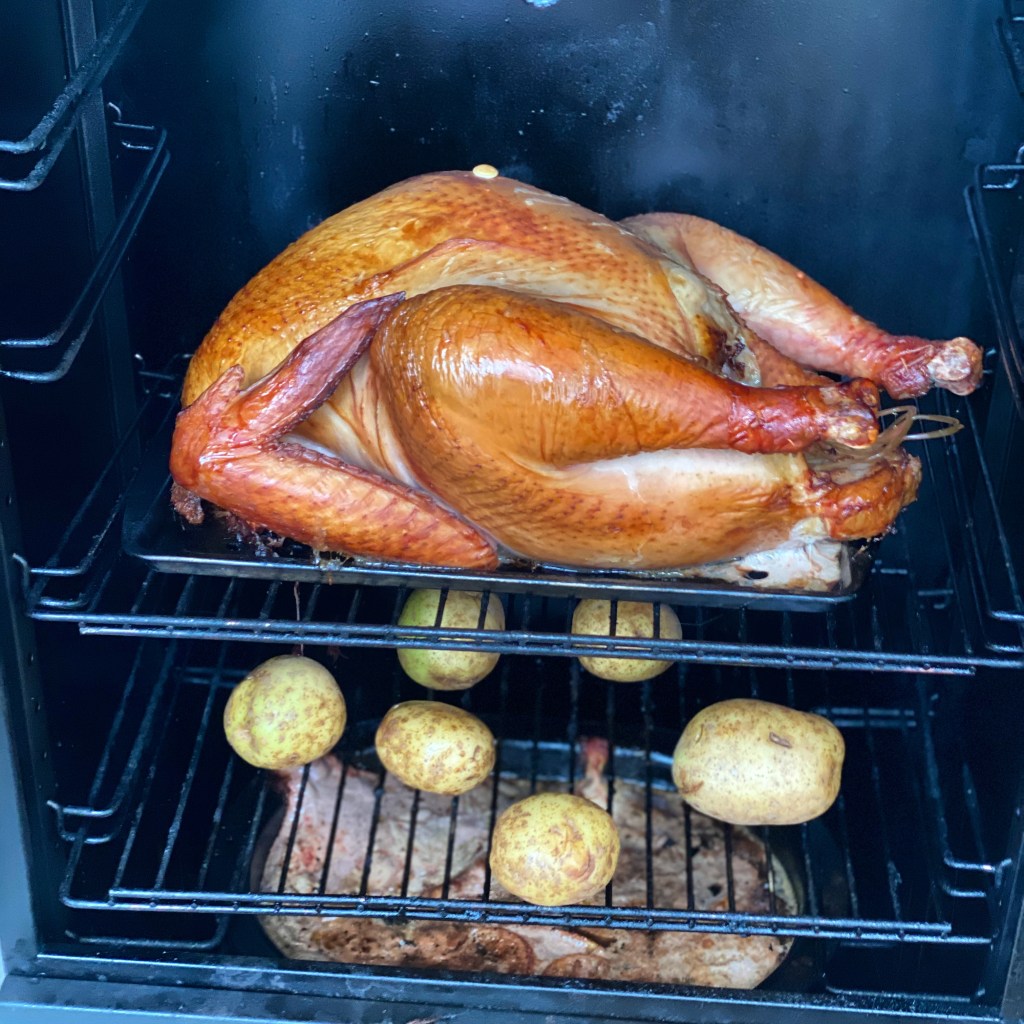
Instead, I smoked a turkey that we froze in our freezer last fall. Earlier in the week I brined the turkey with a homemade brine. We thawed the turkey in a brine for five days. We brought the brine to a boil before cooling to room temperature prior to submerging the turkey. We smoked the turkey with cherry wood chips with brine in the water pan. With three hours left, we put potatoes underneath the turkey to smoke and to be flavored by any drippings falling from the turkey.

The turkey three hours before dinner. Confession: I forgot to take a picture when finished due to the busyness of the moment.

The day could have been thoroughly miserable, but there was opportunity to find joy even in the midst of a dark world. We cannot choose the world in which we live. We can choose how we try to approach the difficulties. Sometimes there are neurochemical challenges which require medical help, patterns of habits which are detrimental, or a propensity towards anxiety, depression, or fear; however, we still can make a choice.

Last night, we had smoked turkey with smashed smoked potatoes. The turkey was moist and flavorful, the potatoes were tasty, and the inevitable cranberry sauce was devoured. We have enough leftovers for the next few days today and turkey broth cooking in the slow cooker. Even these moments can be beautiful if we choose to find a reason for hope and joy. Perhaps you’re not a cook or have nobody to cook with, but this day is still the day we have for today. We can choose to be enthusiastic about what is rather than angry about what is not.

Brine Recipe: For every five pounds of turkey: 1 clementine sliced into wedges, 1 tsp prague powder #1, 1 tsp peppercorns, ¼ c brown sugar mixed into a brine made with enough water to submerge the turkey)

“People who are in good health don’t need a doctor; sick people do.”

As a church we’re working through a devotional that I personally prepared called “The Path of the Beatitudes: A Lenten Journey.” The devotional is available off Amazon as both a Kindle book and in large print on paper.

Today we’re reading through Matthew 9:9-13 as a people. In Matthew 9:12 of The Inclusive Bible, the words which comprise the title of this post are spoken by Jesus. Jesus states freely that people who are in good health don’t need a doctor, which leads to a question: If Jesus is in the process of bringing life into the lives of poor, then why is the “Doctor Jesus” spending time with people who could objectively be seen as rich?

In my opinion, there’s a common misconception about church. People believe that church is a place for people who have everything together. It is common to find people who find church people to be self-righteous, judgmental, and hypocritical. Interestingly, Jesus did not seen to spend his time with the people who had everything together.

People could objectively look at the scriptures Jesus and see a hypocritical teacher who says a blessing will fall on the poor while spending time with the rich., but is that truly the message we should take away from the story? Jesus does not say the rich are healthy. In fact, Jesus implies the people who he is sharing a table with are not healthy. Wealth does not equal spiritual health in Jesus’ eyes. The tax collectors and notorious sinners are ill: the doctor has come to make a “house call.”

Throughout this week, Jesus will stretch our understanding of what it means to be wealthy and who is in need of blessing. May God give us wisdom in a world that glorifies riches and sometimes isolates on a pedestal the very folks who need loving and healing community the most.

The “Jesus problem” is noticed…

As a church we’re working through a devotional that I personally prepared called “The Path of the Beatitudes: A Lenten Journey.” The devotional is available off Amazon as both a Kindle book and in large print on paper.

Today we are looking at Luke 6:6-11, which contains the story of Jesus healing a person with a withered hand. The story is an interesting one and certainly lends into the story of Lent. The last verse of our reading indicates that the religious scholars and Pharisees left the synagogue on that day looking for ways to do something about their “Jesus problem.”

The Lenten journey is one which ends in the events of Holy Week. There is no Lent where Jesus ends the season without suffering on the behalf of the people God loves. The desire of individuals to take care of this Jesus problem increases as the season progresses.

What’s interesting to me about this approach to Lent with the Beatitudes is that we see how a portion of Jesus’ teaching affects both Jesus’ life and potential the lives of the people who hear his teachings. Jesus offers healing to a person with a withered hand and the people walk away with sinister thoughts in their hearts.

I wonder how the person felt whose hand was healed upon that day. If it were me, I am doubtful I would have walked away grumbling about what Jesus had done. I would likely celebrate the unexpected blessing that came into my life.

This Lent, God may have something for us. God may give a blessing into our lives which we may not be expecting. God may give a blessing to us that we do not believe we deserve. God may bring a piece of radical healing into our lives, especially if we find ourselves struggling to find our place in this world.

I pray that God is with us all tonight and into tomorrow as we prepare to enter into worship. May God add blessing to our lives and may we celebrate it together in worship tomorrow.

“What have you to do with us?”

Today is the first Friday of Lent. As a church we’re working through a devotional that I personally prepared called “The Path of the Beatitudes: A Lenten Journey.” The devotional is available off Amazon as both a Kindle book and in large print on paper.

Our reading today focused on Luke 4:31-37. The passage immediately follows our passage from yesterday. In the passage Jesus of Nazareth is approached by a person who is “possessed” while in nearby Capernaum.

Jesus is asked two questions: What does Jesus have to do with them and has he come to destroy them? Jesus frees the person of their condition, but the questions remain. What has Jesus come to do?

This Lent, that’s really the question we all must ask before we dive into the matters found in the beatitudes. What has Jesus come to do? Jesus’ teachings can radically affect the way we interact with the world. What has Jesus come to do in our lives?

One of the things I am appreciating about both using this devotional and writing this devotional is that it approaches Lent from a completely different angle than most Lenten studies. It is my hope and prayer that spending time in less traditional scriptures might help us to see things differently this season. What has Jesus to do with us? What might Jesus want to do in our lives?

Only time will tell how things will look, but I believe Christ has come to bring grace into my life. Things I have done may need to be discarded, patterns in my life may need to be destroyed, but I believe that at the end of this journey and Lent I will find myself alive in Christ.

Nazarene Privilege

Today is the first Thursday of Lent. As a church we’re working through a devotional that I personally prepared called “The Path of the Beatitudes: A Lenten Journey.” Today is the last day that the devotional is free on a Kindle, on the Kindle Cloud Reader, or both.

Our reading today focused on Luke 4:14-30. The passage speaks about the proclamation of Jesus in his hometown of Nazareth. Jesus reads from Isaiah. Jesus proclaims that the words of Isaiah have been fulfilled:

“The Spirit of the Lord is upon me,
    because he has anointed me
        to bring good news to the poor.
He has sent me to proclaim release to the captives
    and recovery of sight to the blind,
        to let the oppressed go free,
 to proclaim the year of the Lord’s favor.”

Luke 4:18-19, NRSV, where Jesus references a portion of Isaiah 61:1-2

The reason we are looking at this in our devotional is a perceived connection between the proclamation from Isaiah and the radical words of the Beatitudes. The poor are blessed and here Jesus proclaims that the blessing is good news. In the original reference which Jesus is references, Isaiah also points out that the mourning will be comforted.

What’s interesting to me is the way that the Nazarenes are frustrated that the blessing will not begin in their midst. Their community has sheltered Jesus’ family, despite Jesus’ colorful birth narrative. In this gospel in particular, Jesus is effectively born under taboo circumstances. Jesus is not conceived in a culturally acceptable time-frame. They are pleasantly shocked the carpenter’s son is able to surpass the traditional role of a carpenter’s son until Jesus proclaims that they will not receive preferential treatment.

Interestingly, there’s a very common word in modern circles that describes what the people are experiencing. The people of Nazareth feel entitled to be blessed first for having a role in Jesus’ life. They are expressing a sense of privilege. Surely, Jesus must bless them first, right?

I have three daughters and one of them is still getting used to the idea of clothes. In particular, she wants to dress herself or wear nothing at all. The other day I captured the perfect image of her point in life.

This is not how pants work…

Yes, that’s my child trying to put pants on over her head. I am aware that there’s a pants trick going around the internet where you put your legs in one side of the pants and your body through the other side, but that isn’t in her wheelhouse right now. She was genuinely confused about why the pants weren’t working.

The people of Nazareth are genuinely upset about what is happening. Jesus is not supposed to act this way as a child of the community. What Jesus is doing in saying he will not go out of the way to bless his hometown is beyond the pale of proper behavior for the people of Nazareth. They feel a sense of privilege which does not find this acceptable.

Yesterday, we talked about how the call of Lent is to “Repent, and believe the gospel.” Many individuals find themselves in the midst of a slog of a pit in their lives. As a minister and as a Christian who has engaged in evangelism on regular basis before entering into ministry as a professional, I came across many people who effectively said that their regular attendance at church, their being a good person, or even their family’s devotion meant that God should immediately bail them out of the tough parts of life.

To be brutally honest, there are times in life when that kind of belief is simply not consistent with how the spiritual life works. There are situations we face where we have to do more than notice we’re in the bog of life. We are called to repent of what led us to this place, turn towards God, and believe the gospel. Occasionally that belief is best manifested in honest attempts to step forward with faith despite the difficulty.

There’s truthfully moments where God will walk with us, but we must let go of that privilege. If you’re addicted to some substance or behavior, you may need to believe while you choose to not engage in that behavior or entering into dangerous places. If you’re struggling with mental health concerns, you may need to believe while regularly taking medicine to help your body function. If you’re grieving, you may need to believe while understanding there are stages of grief you may have to experience.

Sometimes, we each need to understand that the pants go on our legs despite our belief that they’ll work the way we want them to work. The humility that comes with a lot of Lenten practices can be an excellent place to practice what may become necessary on your journey.

May God bless us today as we ponder what we each might take for granted in our spiritual journey. May God help this to be a fruitful day.

Ash Wednesday

Our church is beginning a journey along with many in the greater Christian Church today. Several of our members are gathering with our neighboring churches to begin the Lenten journey with an ecumenical service in a few hours. We will sing, pray, and reflect on our lives as Christians.

As a church we’re working through a devotional that I personally prepared called “The Path of the Beatitudes: A Lenten Journey.” Through tomorrow the devotional is free on a Kindle, on the Kindle Cloud Reader, or both. Writing a devotional for a season is a new experience for me, but I found the practice of putting in the work to be fruitful for my own spirituality.

Today’s entry focuses on the passage which lies behind the majority of the devotional. The passage we read together today is Luke 6:17-26 and the focus of the devotional is a phrase out of the United Methodist Book of Worship. The liturgy for the Ash Wednesday service uses two distinct phrases during the imposition of the ashes.

The first is very traditional: “Remember that you are dust, and to dust you shall return.” This phrase has a lot of depth, especially as it is echoed in the traditional words during many memorial services. There is a direct correlation with the phrase “Ashes to ashes, dust to dust.”

The second phrase is also traditional. Our devotional is focused on the words of this phrase. “Repent, and believe the gospel.” When using this phrase, the Lenten journey begins with two instructions. We are called to repent. We are called to believe the gospel.

Photo from Chenango Valley State Park in Chenango Forks, NY

Often, the call to repentance is a major part of Lent. Repentance is not simply a matter of feeling guilt. The call is not to live in shame. Repentance is the process of recognizing your failings/shortcomings and turning towards God onto a better path.

In truth, there are many places in my own life where I feel as if I were walking through a field like the one in my picture. I walk along while looking at the sky until I find myself tumbling into the freezing cold waters below. Sometimes I know there’s a pit nearby, but sometimes I wander into the murky freezing water without any warning.

Repentance is about more than simply acknowledging that there’s a problem. Repentance is often about realizing that the only way out of the pit that we find ourselves standing in is with the help of God. Many people who have found themselves dealing with anything from an addiction, grief, depression, or chronic anxiety might tell you the ONLY way out of that pit is often with God’s help.

The reason I love this particular phrase on Ash Wednesday is the idea that we are called to believe. The photo I showed you is a desolate one, but did you notice the birds? There’s life down in that pit of freezing water. The water is cold, the situation would be miserable if you were trying to climb out the opposite side, but there’s still life.

The call on us today is not only to repent on this journey, but to believe in the gospel. Jesus Christ can work in our lives this Lent. The Holy Spirit can guide us through the darkest of our days throughout the years. Our Creator can create life in the midst of our lives. Let’s repent, and believe in the gospel.

Lenten Devotional!

Hello friends, I have not fallen off the face of the earth. I have been focusing on working on longer works lately. One of those products has finally come to fruition.

I recently created a Lenten Devotional based around the teachings of Christ on the Beatitudes. It isn’t perfect, but my first attempt at publishing can be found on Amazon as both a Large-Print Book and as a Kindle ebook. The book is called: “In the Path of the Beatitudes: A Lenten Devotional.”

I hope that it can be a blessing to folks who want to spend some time reflecting on the teachings of Christ during the season of Lent. The devotional has daily scripture readings, a reflection, and journaling/discussion questions for personal growth.

Blessings!