Let us Ramble: Brief Reflections on Opening Sermon

Brief reflections on the Bishop’s opening sermon…

First, I agree that the why of ministry should not change often. What we do in the church must always be in flux. How we do ministry must always be in flux. The why should be stable, but I sincerly doubt it will never change. The first century Christians altered the world because a prophet came claiming to be Son of God. The why of ministry changed in that time. The words of the Great Mystery tells us that “Christ has died. Christ has risen. Christ will come again.” The why is guaranteed to change and if we say this is the only why God will ever supply then we may miss out on the truth and movement of the Spirit. If Jesus’ mission was the end of the story, the Gentiles would still be on the outside. The Spirit may still move!

Second, James would probably have issues with focusing only on prayer. What good is it to say “Go, be warm, and eat!” when that person laxks a place to go, no warm coat, and no food? James invited the early church to always hold prayer and blessing in a partnership with action.

Let us be Honest: This is long enough to be a treatise

Welcome to the longest blogpost that I have ever written… Also, I am going to go ahead and state that I’m writing this as a well-educated, white, Protestant male who has a lot of privilege. I use a lot of “we language” to talk about the overwhelmingly white church. I own it and am trying to learn new ways of being.

Yesterday I share a quote from Walter Brueggemann on Facebook. I adore Walter Brueggemann and I really loved the quote. Here’s what it said: (original quote is from Walter Brueggemann’s Lenten devotional “A Way Other than Our Own”, pgs. 2-3)

“I believe the crisis in the U.S. church has almost nothing to do with being liberal or conservative; it has everything to do with giving up on the faith and discipline of our Christian baptism and settling for a common, generic U.S. identity that is part patriotism, part consumerism, part violence, and part affluence.”

I received a bit of pushback for sharing this concept by a few people that come from a different place in life than I am. In particular, a colleague and friend of mine said that there was no context for the quote. I normally wouldn’t mind letting Walter Brueggemann stand up for himself as he’s a world famous theologian who has more street credit with people in almost every corner of the church. I normally would leave it alone, but my colleague was just the most openly vocal person. I respect him for his openness and boldness. Such boldness is a gift in this profession.

I have private messages questioning my patriotism, my theology, and in one case my integrity for daring to share such divisive words. I decided to respond on my blog so that I could create lots of links to sources.

I do not mind people questioning my patriotism. I stood in the rain for over an hour waiting to pray for God to bring comfort into the lives of people mourning soldiers who passed in the service of this nation. I stood glumly and thought of my friends in the armed forces who have lost friends. I listened to people complain about the rain. To be fair, it was really cold and wet. I have learned to have thick skin due to the circumstances of my ministry.

I do not mind people questioning my theology. Theology is necessarily limited by the person who is approaching the divine. I stood in the rain and prayed at the beginning of the service. The Baptist minister who believes different things than me about God prayed at the end of the service. We don’t need to agree to show love and respect to each other. Theology is always a matter of perspective unless you know all things, in which case you’re navel gazing because only God knows everything.

I do get a little irked when people question my integrity. I stood in the rain to pray for others so that they might have comfort today. While standing there I realized that I have no place to rest my bones. Following Jesus has meant that I no longer have a home like many of the people that I serve. I find home in my loved ones, my community, and even in my relationship with God, but there is no grave for me to rest within at the end of my days. My responding to God has led me to forego that blessing. That takes commitment and is more than a little disconcerting.

I am a servant of the Most High and I do my best to live out my service well. My quest is to live out that service with integrity. I have decided that I am going to respond to these criticisms in the best way that I can. I am going to respond with a defense of this statement and encourage others to engage in the conversation. I mean no disrespect to those who disagree with me, but there comes a point where one must be clear, concise, and accurate when talking about challenging issues. I might not be concise, but I pray this is both clear and accurate.

So, what does Brueggemann say:

  1. There’s a crisis in the US church that has nothing to do with the theology wars that people love to engage in between liberal and conservative camps.
  2. The crisis has to do with an abandonment of the identity found in our Christian identity which is best expressed in the faith and discipline connected with our baptism into Christ.
  3. We settle for an identity that is partially patriotic, consumeristic, violent, and affluent. I think it is safe to say that Brueggemann has a negative view of this approach.

So, let’s get into this. Is there a crisis in the US church? Well, the Pew Research Center might be indicating that there is a problem. Attendance is dropping and the mission of the church according to Matthew 28:18-20 the purpose of the church is to: “Go therefore and make disciples of all nations, baptizing them in the name of the Father and of the Son and of the Holy Spirit, and teaching them to obey everything that I have commanded you.”

There’s a numerical issue that might show a problem, but why is that issue taking place? Is this the problem or a symptom? Are we the victims of a cultural shift or is it more insidious? Matthew 28:20 says that Jesus will be with us when we do what we’re supposed to be doing. So, what is going on?

Do you remember that point where Walter Brueggemann talks about violence? We were called to make disciples of all nations. We were called to teach them, love them like Jesus loved them, and to embody what Jesus commanded. Jesus taught that we should treat others like we would like to be treated. Jesus taught that whatever we do to the least of God’s children we do to Jesus.

When I was a teenager I read Dee Brown’s “Bury My Heart at Wounded Knee.” We were called to embody and teach love. We broke promises. We killed women and children. We believed in a manifest destiny that destroyed cultures, families, and bordered at times on cultural and physical genocide. If it makes you feel sick to your stomach you aren’t alone. The General Conference of the UMC engaged in a sincere attempt to draw the church into repentance in 2012 and voices in our church have been asking us to continue that work ever since, but we continue to bring violence to our sisters, brothers, and neighbors over subjects like pipelines and corporate rights. We should be sick to our stomachs. This isn’t the way that Jesus taught us to live. We were called to teach people to live as Jesus’ commanded us. If we have trouble seeing where Jesus is at work it may be our own fault.

In seminary trusted friends invited me to consider reading further. I was invited to read books like “A People’s History of the United States” by Howard Zinn. I was invited go on trips to places like Window Rock, Arizona where I stood by the graves of soldiers who died for our nation. I talked with widows whose loved ones made it home safely and could only find work in uranium mines. I stood in the middle of a tribe of proud people and saw how the culture that I had been taught to love and honored had crippled a noble community, tribe, and nation. I shook my head when I realized there were no trees in the town of Sawmill because they’d been shipped away to build the impressive towns populated by people who looked like me. I wept openly by the statue erected in honor of the Windtalkers who served so proudly. My heart broke in pieces because the Jesus I know would not have done these things.

It goes further. I’ve married a woman who has stood in the towns where my nation dropped nuclear weapons on women and children. I’ve read about the 200,000 people who died in the name of expediency. Most of them died from burns, but some of them died when the pieces of the place they called home flew through the air and killed them. I have stood by sights where Confederate soldiers stood up for their rights to own other people and thought about how their blood was shed into the very water which once carried people as property from one nation to another.

As a lay person I have served food to hungry people on the streets of Rochester and done my best to give dignity to folks who are in need of food in the communities I have served as a pastor. I have seen people die when basic needs like health-care have not been met. For the want of an antibiotic I have seen people sicken and rest on their deathbeds. I have seen that our nation is not perfect. I have seen it with my own eyes and my eyes have wept with pain for what they have seen.

On January 27, 1838, Abraham Lincoln gave a speech to the Young Men’s Lyceum of Springfield, Illinois. It was a challenging time and the beginnings of division were starting to tear apart the connections of the young nation. Lincoln said the following:

“At what point then is the approach of danger to be expected? I answer, if it ever reach us, it must spring up amongst us. It cannot come from abroad. If destruction be our lot, we must ourselves be its author and finisher. As a nation of freemen, we must live through all time, or die by suicide.”

I truly believe Lincoln’s fear is our reality. We have become a people who believes that we have a manifest destiny which can and should control the lives of people around us. Some people feared the other. Mob violence was tearing apart our nation as people oppressed and fought against people that they saw as property. Their fear was that the other would ruin the future, much like we are afraid of the terror that others can bring into our lives. Lincoln pointed out to the people that the true danger was coming from within. His fears would prove true. The way of being the early American nation was headed was leading to soldiers, neighbors, and families slaughtering each other all across this nation.

We are a people who it seems honestly believes that we have a right to control the lives of people around us. Jesus taught that we should treat others like we would like to be treated. We preach our doctrines on television and demand that we bring prayer back into schools because we honestly believe that the people praying in the school will pray in ways that will agree with our beliefs! We would cry bloody murder if someone called for Islamic prayer every morning before school, but we are okay with it if we are the ones leading the prayers. We do the very things that Jesus told us not to do and it is killing us. This idolatry is killing us very quickly. We need to repent.

Brueggemann questions the connections between patriotism and our baptismal identity, but he isn’t the first. Consider the works of the prophets who came to the people of God cajoling, pleading, begging, and trying to convince them to remember whose they were. Consider the judges who asked the people not to seek an earthly king and how their decision caused grief, destruction, death, and exile. Consider Jesus who refused to be an earthly ruler and was crucified for His trouble.

How many books of the Bible are filled with these stories? How many times does God call on the people to repent of their earthly addictions to power and greed? How many times does God call on people to live lives marked my love, kindness, and humility? How often can we read these words and not understand the most basic of messages? Do we need to live out Lamentations in addition to Jeremiah?

I am a child of this nation. I have to live a life which honestly reflects on who we have become as a people. We were a nation of immigrants and we murdered the people who lived here before us. We were a nation of refugees from the struggles of an old world and we imported people as slaves from another part of the world. We were a nation that stood up to Hitler’s terrible acts. I do not doubt the importance of those actions and honor those who died to put an end to the Holocaust. That bravery does not change the fact that we are also the nation who nuked civilians (including women and children). Knowledge, history, and experience have taught me that my identity cannot rest in my place in this nation. If my identity as an American is all that defines me, then history teaches me that a prophet is needed, because this is not good.

Violence like the violence that we have brought into the world is like the violence that is described before the flood in Genesis. Arrogance like the arrogance we have shown through depopulating a nation, enslaving others, and mistreating our own neighbors is absolutely horrendous. This arrogance is like the arrogance that led to the Tower of Babel. This is not good.

I truly believe that Walter Brueggemann is right. If there is any hope for the church in the United States then we need to remember the red letter words of the New Testament brought through Jesus. If there is any hope for the church in the United States then we need to remember the call of the prophets. If there is any hope for the church in the United States then we need to define ourselves less by where we happened to be born and more by who we have chosen to become in the life.

I am a Christian who happens to be a United Methodist. When I share in the body and blood of Christ at the Lord’s table it is with the understanding that you cannot share in the body and blood of Christ if you’re not ready to partner with Christ in the ministry of undergoing suffering. I am a minister in the United Methodist church. When I baptize a child it is with the honest expectation that the child must come to a place where they believe in their own faith and identify with their own baptism into the life and death of a man who suffered.

In my own personal theology these beliefs are not optional. I have already said that I do not need people to agree with me, but on my end they are a part of our identity as Christians. If we cannot find our identity in Christ then we have lost our way and need to pray for forgiveness. As the foundational documents of the Methodist movement say all that is truly required to enter into the society of believers is ““a desire to flee from the wrath to come, and to be saved from their sins.”

If it makes people feel better, the New York Conference of the United Church of Christ just affirmed their belief that God’s vision for the church is to be “United in Christ’s love, a just world for all.” They connect this to their mission which is to be “United in Spirit and inspired by God’s grace, we move forward boldly to welcome all, love all, and seek justice for all.” Seeking justice requires repenting of the things we do that cause pain.

For that matter, during the benediction at the American Legion’s service in the rain this morning, the Baptist minister around the corner lifted up Jesus Christ as the soldier who laid down his life so that people of every nation would enter the Kingdom of God and find salvation. By the way, Pastor Jim prayed a really powerful prayer. I’m looking forward to hearing more as time goes on.

For that matter, here’s a pretty good work of theology by a Roman Catholic scholar written on the subject of patriotism and our Christian duty is a pretty good bit of research too. By the way, it was written only a few months after 9/11. I still find it to be very relevant 15 years later. Too old for you? Here’s Pope Francis calling people to move towards justice and mercy earlier this year.

Baptists, Roman Catholics, members of the United Church of Christ, and even United Methodists like me. If you’re keeping track, that’s every denomination that has a congregation in the hamlet of Maine. We may worship different, but we all seem to be united in understanding that salvation rests in Jesus and that Jesus calls us to repent of our sins. We might not agree with what that looks like, but we all seem united in understanding that God is calling us.

As for Brueggemann’s words on affluence and consumerism, I realize that I have probably annoyed enough people already. I can go into that another day if people desire. The long and short of it is that I personally believe that John Wesley got it right. He did earn all he could and save all he could. He also gave all he could and died with less than 30 pounds to give away despite having an annual income of 1,400 pounds. It is said that he never had more than 100 pounds on him, which is pretty impressive given how easy it must have been to hoard his wealth instead of using it to bless others.

Let us Seek: Broken Images

Yesterday afternoon at the Annual Meeting of the New York Conference of the United Church of Christ we had a break between our afternoon session and our evening meal. I spent the time preparing for the upcoming session of the Academy for Spiritual Formation. I was distracted from my inevitable comparisons between the Annual Meetings of the two denominations I serve. I was distracted by reading through my favorite (and technically only) book on shame, orthodoxy, and orthopraxy called “God’s Unconditional Love: Healing Our Shame.” Here’s what authors Wilkie Au and Noreen Cannon Au write on internalized images of God and perfectionism: (pg. 85)

“As in Jesus’ time, much of the inner suffering that people struggle with today is abetted by an impoverished religious imagination that is unable to envision a God of unfailing love-a love that embraces all of us unconditionally just as we are. Instead, our projections of a harsh and demanding God leave us with feelings of shame and a sense that we have disappointed God. Many of us are burdened by a strict conscience that demands perfection, thinking this what God wants. We have an image of holiness that is out of reach for the simple reason that perfection is beyond our grasp. When we inevitably fail, we feel guilty and ashamed and are confirmed in our belief that we are unworthy of God’s love.”

The honest truth is that I could spend this blogpost talking about the idea of a frustrating and badly-considered image of God from a personal perspective, but I believe this may be a case where personal ministry experience might be helpful. I have walked with many folks who have struggled with understanding a God that accepts them unconditionally with their “warts and all.” A lot of people have difficulty seeing God lovingly walking with them during challenging moments of life. The situation is like trying to see clearly through a broken window.

"Abandoned Church - view through broken window" by Nicholas Mutton

“Abandoned Church – view through broken window” by Nicholas Mutton

I remember walking with a brother in Christ who did not understand how God could love him. The man was lonely, sad, and isolated. He wanted to be in a relationship badly, but every relationship ended up in disaster. While he would love to believe God loved him unconditionally, it was hard to believe. God loved him and understood that he was lonely. God loved him even as he felt lonely. I believe God was compassionately and completely in love with this man. That man could neither see nor believe in that love easily.

I remember walking with many people over the years that were absolutely furious over the death of a loved one. Some people were angry with God because their loved one had passed away. Other people were resolutely angry that their loved one had done the things that led to their death. How could God love them when they still feel anger towards someone that they love? How could God love them when they are angry with God? Faith in God’s unconditional love can be difficult to obtain when anger is involved. It can become very difficult to understand that God loves a person despite the anger that they harbor in their souls.

Perhaps the most heartbreaking situations are those that involve abuse. While God is neither male nor female, it can be difficult to trust in the love of God when someone is abused by another person. It can be difficult to believe that God is like a loving and caring mother hen when a woman in your life has engaged in abuse. It can be difficult to believe that God is like a loving and protective father when a man in your life has engaged in abuse. Moving beyond parental images, trust can be difficult to carry into new life with Christ as your brother when a brother has been abusive.

Walking through the challenges of life can make it very difficult to trust in God’s love and grace. The images of God that a lot of people carry around in their lives are often powerful and unjustly harsh. These images do reinforce a lot of challenges that people normally face in their lives. Praying with sincerity after a heartbreaking crisis can be almost impossible if God seems to be stern and foreboding. Seeking forgiveness for situations where everything has gone downhill can become impossible when God seems hard, cruel, and unrelenting. The weight of shame can be overwhelming when you believe that God could never forgive you for what you have done in your life.

So, what do we do with this? Well, I do not want to hamstring a future blogpost, but I will say that my family and I listened to the new NPR podcast “Wow in the World” this afternoon. The very first episode spoke about an article that was recently published by researchers from the University of Montana on the benefits of gratitude. A quick synopsis of the research is that there is a strong correlation between expressing gratitude and a person’s well being.

If a person can make their life better through regular expressions of gratitude then I believe a similar theory can be proposed. I would suggest that there may be a correlation between the health of a person’s image of God and what opportunities that person engages in to experience a loving God. Regular spiritual practices like prayer, Bible reading, and worship might help to reinforce a loving experience of God. The authors of the “God’s Unconditional Love” argue persuasively about the use of imagination to go deeper into the scripture and consequently into God’s love.

I would also suggest that engaging in compassionate acts alongside God might assist in retraining one’s heart to see a loving God more clearly. Volunteering with the hungry, assisting with rehabilitation programs, working to build and repair homes after disasters, and thousands of other opportunities exist to engage in ministry alongside a God who is neither hard nor callous to people’s pain. Partnering in ministry with others to seek God through compassionate acts might allow someone to understand God’s compassion for their own lives and souls more clearly.

In the meantime, my hope and prayer is that God might be gracious to you. May you see the love of God in your life.

Let us Ramble: Contemplating Charcoal

Unsurprisingly, my family and I have spent a lot of time outside this week. In the rural areas around Binghamton this week has been one of the first truly nice weeks of the year. We’ve spent time grilling dinner out on the porch almost every night this week.

A few years ago I was converted to charcoal grilling after a few years flirting with propane grills. Are charcoal grills somewhat inconvenient? They require a little bit of extra work but I adore the smokey taste they impart to the food I grill.

A few weeks ago (in this particular blogpost) I noted that a particular passage stuck out to me from a book I was reading for the upcoming session of the Academy for Spiritual Formation. The excerpt was from the book Spiritual Disciplines Handbook by Adele Calhoun. In particular, this was the passage that attracted my attention from the section entitled “Practicing the Presence” (pg. 72):

“Practicing the presence is a way of living into a deeper awareness of God’s activity in our lives. Through many small pauses we begin a habit of turning our heart toward God.”

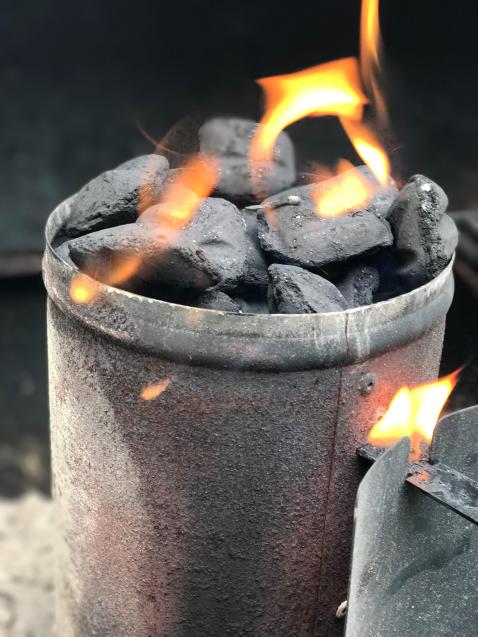
I was sitting on my porch while waiting for the charcoal to warm up when I was drawn into a spirit of contemplation. I use a chimney charcoal starter to ignite my charcoal before grilling. I was drawn into a spirit of contemplation as I watched the charcoal begin to burn (with the help of a little lighter fluid–I was cheating when I took this picture).

My rusty but trusty chimney charcoal starter!

The idea of the charcoal chimney is a simple concept. You light paper underneath the charcoal and that begins to heat up the bottom layer of charcoal. As that layer begins to burn, it sets the charcoal above on fire. In time, the whole of the charcoal catches on fire and it is time to spread the coals and grill.

As I watched the excessive and unnecessary flames pour out the top, I stopped to think about how the charcoal chimney is supposed to work. All it takes to function properly is patience, a little bit of newspaper, and a match. The chimney starter is simple and effective when the charcoal is in good condition, the breeze is low, and the match actually lights the paper on fire.

I have spent a lot of time working with churches that desire to grow. Some churches are always looking for a great new idea which will bring young families into the church. Some churches are seeking to figure out why certain families or individuals have stopped attending church regularly. A lot of churches are always trying to find that silver bullet which will get them where they want to go as a church.

I have also spent a lot of time working with individuals who are facing struggles in their lives. Families have struggles, coworkers are aggressive, and sometimes the neighbor just will not act neighborly. People seek help and look for a silver bullet to fix their problems. I know this is true because I have been also guilty of seeking silver bullets for my own problems.

As I stared at the excessive and unnecessary flames pour out of the charcoal starter I came to a realization. Just like the flames were unnecessary on the charcoal starter, we often unnecessarily look for big solutions to problems. One of my favorite passages is Micah 6:8. In that passage the Lord tells Micah what is required of people like you and me. People need to seek justice, love kindness, and walk humbly with God.

How many times would a culture of kindness defuse the huge problems which seem to require silver bullets in the church? My experience tells me that kindness can often defuse situations very quickly.

How many times would a little humility fix problems in the lives of individuals? Well, I can tell you that my life would have fewer problems if I decided to have a bit more humility and followed through with that decision.

How much better would our charcoal start if we were to stop pouring excessive amounts of solution into challenges that just require patient faithfulness? When we set ourselves about the tasks of life, would things taste more like the grill and less like lighter fluid if we were to focus on real solutions instead of quick solutions?

I really have to hand it to this idea of intentionally focusing on God in quiet moments. I am grateful that I have begun to find more quiet moments to turn towards God. I also need to get more newspaper. There is going to be a lot more grilling to do this summer and I am going to try to cut down on the lighter fluid.

Let us Ramble: Christian koan?

Yesterday I was working through the same book that I have been reading through for The Academy for Spiritual Formation over the past few weeks. It seems like every Monday begins with a cup of coffee and the same book. Inevitably, my brain melts before the coffee cools. The book’s title is “God’s Unconditional Love: Healing Our Shame” and was written by Wilkie Au and Noreen Cannon Au. This is a dense book with a lot of good concepts and ideas.

One of the brain-melting ideas that took a hold of me this week revolved around the idea of a Christian “koan.”The authors say this on page 63:

“Many years ago, when Wilkie was in Kyoto studying Zen meditation, this practice of gazing on the crucifix was endorsed by an unlikely source, a Japanese Zen master. Yamada Roshi told him and his fellow Jesuits that the cross is the Christian koan and that contemplating it was a path to enlightenment. A Zen koan is a riddle or surd (e.g. ‘What is the sound of one hand clapping?’) that baffles and stills the busy mind, so that an intuitive flash of truth can seize one’s awareness.”

This idea struck me as being very interesting given my background as a United Methodist. In his sermon “Spiritual Idolatry” John Wesley (one of the founders of the Methodist movement) clearly stated that he believed the Roman Catholic practice of using icons was a form of idolatry. John Wesley was not a fan of this “Romish” practice.

Now, let’s be clear. I do not believe that John Wesley only spoke and preached words that were beyond reproof. In some cases (like in “The Cause and Cure of Earthquakes”) I believe John Wesley was dead wrong, Despite all of my troubles with his works, I do believe that John Wesley wrote and spoke with all of the integrity he could muster. In short, I tend to give John Wesley the benefit of the doubt.

I do not believe that John Wesley would approve of the idea of a Christian koan, which I honestly believe is sad. I believe that there is some validity to what Yamada Roshi taught Wilkie Au. The authors go on to state that Yamada Roshi taught the Jesuits studying in Japan that excessive rationality often stood between people and God. The crucifix as a koan does an excellent job of being simple enough to help a Christian go beyond rationality into a place of contemplation where inspiration can take root.

After my brain stopped sparking I contemplated the idea on and off again. It kept setting small fires in my mind, but I had a few thoughts that I believe were helpful.

First, if the Jesuits focused on the crucifix, does it change the nature of the inspiration to contemplate the empty cross favored by Protestants? How would a focus on resurrection alter how one comes closer to God? What does it mean to us in our contemplation that the means of death inflicted by the world stands empty and defeated? Does pondering the very differences lead to the excessive rationalism Yamada Roshi was warning about? Would it be helpful to break through a barrier for a Protestant to contemplate a crucifix or for a Roman Catholic to ponder the empty cross?

Second, what koans have I experienced in my life? When I regularly went to the same Young Life camp first as a student and then as a leader I remember watching the same tree growing out on an island in the lake. Contemplating the tree led me to places where I found inspiration to get through some of the most difficult spiritual struggles that I faced as a college student. I know that I have stared at a campfire many times while praying through challenges as an adult. Were these koans or just convenient places where my focus rested until I saw Christ?

Finally, what’s wrong with an icon? John Wesley’s idiosyncrasies aside, is there anything wrong with using an icon? As a young Christian I enjoyed reading both John Bunyan’s Pilgrim’s Progress and C.S. Lewis’ Pilgrim’s Regress. In reading stories filled with allegorical characters I found a way of contemplating deep things about my own spiritual life. Is using an icon to go deeper in one’s faith different than using a work of fiction? Is using an icon to focus in and grow deeper in the faith different than using a sermon like a lens to focus on a truth in the scriptures?

As I said earlier, this book causes my brain to smoke. On the positive side, if my brain is overheating then I have an excuse to always be letting hot air out of my mouth.

Let us Seek: Flowers in the cold

The last few nights have been very cold in the town of Maine, NY. I have gone to sleep with a prayer on my lips as I curled up into my bed. Each morning I have gone outside to check on the tomato plants and marigolds that have been hiding under burlap covers. I have pulled aside the cover and I have expected the worst case scenario to have taken place. This is what I saw as I pulled aside the burlap this morning…

Oh! The horror of it! A bright orange flower greeted me in the midst of happy tomato and carrot plants…

This beauty of a red and orange blossom also had been clearly struggling with the weather.

I had assumed that the very worst case scenario had occurred. Nothing had gone wrong with the plants. I had the same fear the night before, but nothing had gone wrong with the plants. I have assumed that something terrible would happen every night of this weekend. Nothing went wrong with the plants. They are all perfectly fine.

I occasionally have to remind myself of something very basic. I don’t need to go looking for trouble. Theodore Roosevelt was once quoted as saying “If you could kick the person in the pants responsible for most of your trouble, you wouldn’t sit for a month.” George Washington is quoted as saying “Worry is the interest paid by those who borrow trouble.” Jesus clearly taught that we should not worry about tomorrow. Consider this passage from Matthew 6:28b-33: (NRSV)

“Consider the lilies of the field, how they grow; they neither toil nor spin, yet I tell you, even Solomon in all his glory was not clothed like one of these. But if God so clothes the grass of the field, which is alive today and tomorrow is thrown into the oven, will he not much more clothe you—you of little faith? Therefore do not worry, saying, ‘What will we eat?’ or ‘What will we drink?’ or ‘What will we wear?’ For it is the Gentiles who strive for all these things; and indeed your heavenly Father knows that you need all these things. But strive first for the kingdom of God and his righteousness, and all these things will be given to you as well.”

I know these statements hold a lot of wisdom. I still catch myself being needlessly worried. Am I really so worried about tomato plants? Why do I choose to live in fear of a summer without tomato sandwiches? Why am I concerned that there won’t be enough tomatoes to sauce and preserve for quick meals when we’re all tired after the baby is born? Why do I choose to live this way? What does that say about my own relationship with God?

I’m clearly not in the same league as those flower blossoms. May God bless me with wisdom as I slow down to enjoy them before their season in the sunshine comes and goes.

Let Us Ramble: Differing Loyalties

Today I am working through a book I am reading for The Academy for Spiritual Formation. The book’s title is “God’s Unconditional Love: Healing Our Shame” and was written by Wilkie Au and Noreen Cannon Au. I reached the end of a chapter and a difficult question is raised in the “Spiritual Exercises and Reflection” section. The statement which is tripping me up this morning reads: (pg. 32)

“God asked Adam and Eve, ‘Who told you that you were naked?’ In a similar way, imagine God asking you, ‘And who told you that who you are is not enough?’ What comes to mind as possible sources of shame in your life?”

This blog is not where I openly reflect on the personal aspects of my journey. My personal thoughts on shame belong in my prayers and in my journal, but there is also a professional side to this question which is echoing through my mind.

I was approached yesterday and asked indirectly if I’d be preaching on Memorial Day or the Fourth of July. I tend to go on vacation on those weekends for several reasons. First, they are low attendance weekends and I like to celebrate with my extended family. For the last few years I’ve been invited to go on trips with my father and his wife during the Fourth of July weekend in particular. As a consequence of the 24/7 nature of my position and the busyness of my father those weekends were the only weekends I saw my father over the past few years, so I definitely took advantage of a chance to spend time with my father while he is still around and we’re both in good health. I believe that it is better to spend time now than to regret spending too little time later in life.

Second I struggle with the very nature of balancing my dual-citizenship. On earth, I am a resident of the United States who enjoys citizenship. In heaven, I am a citizen of God’s kingdom through the love of Jesus. The one citizenship is temporal and fleeting and the other is permanent and eternal. Meaning no disrespect to the country of my birth, I have made vows to serve my permanent nation and thus sometimes find the disconnection between the two disconcerting.

A great example of what I mean falls today. Today has been proclaimed Loyalty Day by the President of the United States. One sentence of the proclamation reads “The loyalty of our citizenry sends a clear signal to our allies and enemies that the United States will never yield from our way of life.” Why does this bother me? Jesus taught that we should live with a humility that requires an ability to be able to follow the Spirit even when it leads to strange places.

What would the church be like if Peter had said “I understand you want me to eat these things you have called unclean, but I am loyal to my Jewish heritage. I will never yield from my way of life.” What would the church be like if the lack of yielding led to the exclusion of the Gentiles? Even laying that aside, what would our nation look like if our loyalty led to an inability to look squarely at issues like slavery or Women’s Suffrage? The church sometimes helped, sometimes hindered, but was definitely involved in those conversations. Loyalty is admirable, but where do our loyalties truly rest as Christians? Do we never change our way of life even as that way of life hurts our neighbors and destroys the land our neighbors called home before my ancestors even left Europe? Where does my loyalty lie?

Consider for a moment that this is also International Workers’ Day. This celebration was placed on this date to honor both the old tradition of May Day and due to the proximity to a bombing which took place in Chicago called the Haymarket Massacre in 1886. The workers had been striking for an 8 hour work day so that they would have time to do simple things like care for families, participate in society, and not simply exist as a work force. Today this day is generally downplayed in the United States, but as a minister of the Gospel I am aware of how much blood, sweat, and tears were shed by my sisters and brothers over the centuries to help care for folks who were orphaned, widowed, or disabled by poor work conditions. Clergy have advocated, provided care, and reached out to people in need on this day.

So, which do I celebrate today? Do I celebrate how I should be loyal to a temporal nation or focus on a movement my sisters and brothers fought to bring into the light? Would you want that choice?

I’ll always celebrate Memorial Day as I recognize that many sisters and brothers paid the ultimate sacrifice in an attempt to live out their faith. I understand they weren’t perfect, but I can happily celebrate Memorial Day. I simply wish people would understand why ministers struggle with their dual-citizenship. Most of us in denominational settings have vows to keep and we must always tread gently.

Let us Ramble: The Cannon

I was gardening a few minutes before it happened. I spent the majority of the day getting the tomato patch ready for a good season. I pulled weeds, I measured space, I marked holes, I prepped the area, and finally planted the tomatoes. We planted 3 cherry tomato plants, 2 slicing tomato plants, and 3 paste tomato varieties for sauces. It had been a really productive day. I even planted flowers. I came inside and this is who I was…

File_000

I was this guy from the circus. I was climbing on life’s cannon. I avoided the news all day, avoided Facebook most of the day, and was ready to climb into the cannon of life. I was totally ready for what life had for me, because if life gave me lemons, I could use them to add a certain amount of acidity to my tomato sauces.

Then I read the Judicial Council’s decision on the election of Bishop Oliveto. I immediately felt like the man from the circus in the following picture…

File_001

Do you see that blur? That’s a person being fired out of a cannon. I know this because my phone took a continuous stream of photos and that’s the guy! You’d better hope that pad is in place when this happens, because that is really fast.

I felt like this man being shot across an arena when I read that article not because I am a member of the LGBTQI community–I am pretty much as heterosexual as people come. I did not feel like a man being shot across an arena because I have any relatives that are out of the closet–they’re all heterosexual as far as I can tell. I have no familial investment in the LGBTQI community as far as I know.

I felt like a person being shot out of a cannon because these actions come across to me as neither right nor righteous. We live in a world where there are children being driven from homes by war, greed, and hatred. We live in a world where children are forced into exploitive circumstances where they are taken advantage of in the most criminal of fashions. We live in a world where we are regularly discussing the possibility of nuclear war between North Korea and the United States on a nearly daily basis. We live in a messed up world and THIS is where we are spending our time and energy. If you’re reading frustration into my words, congratulations. You are correct. I am totally and completely frustrated by what has happened.

We act as if God is losing sleep over what two consenting adults do in a loving relationship but is okay with the effects that our personal investments and privileges have on people around the globe. Continuing to waste time and resources on the oppression of a community that has individuals who exemplify and exhibit the gifts of the Holy Spirit is simply and completely confounding to me.

Let me put this another way. If I call the pizzeria down the street and ask for them to send me the best pizza they have, the pizzeria might make any of a number of pizzas. They might send a black olive pizza, a cheeseburger pizza, a pepperoni pizza… The possibilities are endless, but I know this: if I ask them to make me a great pizza I’ll probably get a great pizza.

We ask God to send us leaders and then we get upset when God sends us leaders who don’t fit our conceptions of what is acceptable. We ask for God to help lead us forward into this new millennia and new century and then we get frustrated that God continually asks us to accept who we are sent instead of who we would prefer. We’re given talented leaders like Bishop Oliveto and we respond by threatening any group of clergy with punishment that would even consider electing another person like her.

Is it any wonder that someone who was ordained to help care for the body of Christ feels like he has been shot out of a cannon? I just wanted to worry about my tomatoes and now I’m worried about my church bleeding out over the massive wounding we just gave ourselves. I think we’ve all just been launched into the sky. I pray we have a soft landing.

Let us Ramble: Images of the Police and God

The other day I read a sourceless (but probably not apocryphal) story about a police officer sitting at lunch with her partner when a conversation between a mother and her son was overheard. The child had been acting up and the mother was losing her patience. The mother pointed at the two police officers and said “You see those police officers over there? They take bad kids like you to jail if they misbehave.” The officer stood up, walked over, and said to the child “Don’t worry. We don’t take children to jail. We take bad parents there instead.”

The story was meant to inspire people to not tell their children that the police are the bad guys. If a child gets in trouble it becomes harder to help them if they truly believe that the police are going to hurt them. The fear children learn about police officers from others causes the children to be less safe in the long run.

The story re-entered my brain as I was reading through the first few chapters of “God’s Unconditional Love: Healing Our Shame” by Wilkie Au and Noreen Cannon Au for the upcoming session of the Academy for Spiritual Formation. In the introduction to the book the authors note that a lot of people carry two images of God with them. They carry the image that they are taught and verbally profess, but they also carry the image that is formed by their interactions with others, especially caretakers and parents. The authors call these images of God the professed image and the operative image (pg.2-3).

Looking at the story of the police officer’s interaction we see a great example of this kind of learned behavior. The child is likely taught through school programs, teachers, and neighbors that the police are there to be helpful. This image is reinforced every time they see an officer in a car with the words “To serve and protect” written on the bumper. If pressed the child might say that the police exist to help. This would be the professed image of the police.

At the same time, the child is being taught by his mother that bad boys are taken away by the police. The child is being taught that the police effectively exist to lock him up when he misbehaves. The child is being taught that they should avoid the police and this image may last for years in such a deep place that the child may not even remember. The child is going forward with two ideas in his head. He says the police are there for his benefit and yet believes (at some level) that the police exist to hurt him when he misbehaves.

I wonder how much this duality truly exists when it comes to divine education. I serve in a role as a pastor. I teach people about God on a regular basis. I tell people about the love of Jesus, the kindness of Jesus, the graciousness of Jesus, and that God deeply and truly cares for them. I try to teach this idea at a deep level.

At the same time, there are people who constantly and consistently undermine this idea. Yes, sometimes it is a parent saying that God will take them as a bad kid and throw them into a fire where they will spend all of eternity, but I honestly don’t believe many of the parents that I meet work out of that theological place. This idea is reinforced while flipping through television stations past an angry televangelist, while walking past the angry man with a sign screaming through a bullhorn, while talking with friends and relatives who have had bad experiences with hellfire/damnation preachers. All of these influences add up and in a world where there are a million and one places to get information it shouldn’t be a surprise to any of us that God sometimes ends up with a reputation as being someone who cannot and must not be trusted.

This whole concept begs a question or two for me. How does the church survive when there are so many people teaching the exact opposite viewpoint that we share of a loving and caring God? How do we help people connect the image of God they profess to the image of God that is acting on a level that might even exist below their conscious thought? How do we help people peel back the layers and find the God of love and grace below their misconceptions?

I know I have done my best to help my kids understand that police officers are good people by making sure they know how much we respect their Uncle Stefano (who is a police officer). We treat officers with respect and do our best not to speak poorly of the police (even when we don’t agree with everything that has ever been done by police officers). We do our best to connect our children with a positive image of the police.

I wonder if we might do the same thing by connecting our children to people who carry the love of God around with them in their everyday lives. I think that means making certain our children are involved in a Christian community and supporting that community as best we are able. I also believe that means doing our best to embody the faith we profess as opposed to the poor parts of the faith we may have inherited from others. I think it’ll take a lot of work.

Here are three things I think need to become a reality for this work to succeed:

  1. Caregivers and parents need to be aware that their viewpoints often help to educate a child about the role and nature of God. A lesson is taught when a child is dropped off for Sunday school by a parent who leaves to have “me time.” Awareness is necessary.
  2. Pastors, Sunday School teachers, and even parishioners need to be aware that their vocal-voice is not the only voice children hear. Our voices need to be compelling and backed up by our actions. We cannot sing “Jesus’ hands were kind hands” before saying terrible things around the table over a cup of coffee while expecting kids to remember only the first message. Our kids will hear both messages.
  3. Sometimes we need to state the obvious in worship so that the obvious is heard more than once or twice. Why do some churches have constant communion? Yes, there’s a theology of grace, but there’s also a richness to hearing words of grace and forgiveness regularly. Why do some churches repeat a creed or affirmation of faith every week? Perhaps a child needs the consistency of hearing the same message in order to combat the messages they see every day in the world.

What other things do you think the church can do to connect the professed beliefs of the church about God with their operative images of God? What have you seen work in your lives?

Let us Pray: United Methodists and Magic Fish

Today I am in prayer for the United Methodist Church and I am reminded of a story referenced in last weekend’s Doctor Who episode. In that episode, the Doctor speaks with his companion Bill about a cautionary tale called “The Magic Haddock.”

In the story of the Magic Haddock, a fisherman catches a fish which offers the fisherman three wishes in exchange for freedom. The fisherman wishes for his son to be home from war and for 100 pieces of gold. The Magic Haddock grants his wishes, but not as expected. The man’s son is slain in battle and returns home in a coffin. The man is offered 100 pieces of gold in gratitude for his son’s service. Heartbroken, the third wish the man makes is that his first two wishes would be undone.

It is a story that reminds me of the Tale of the Monkey’s Paw that was a part of one of the Simpsons Treehouses of Horror when I was a child. The moral of the two stories is the same: You never know what you will get when you make a wish, so you’d better be careful of what wishes you make in your life. It is a common tale that relates back to many tales of genies, d’jinn, devils, and other mythical figures.

A lot of people are making “wishes” about what will come out of this Judicial Council meeting or out of the special meeting of General Conference in 2019. I am someone who is sitting on the sidelines and wondering if the wishes we are making might have disastrous consequences, especially as we have folks praying in extreme opposite directions. We need the Holy Spirit to be at work in these events for the future to have hope. We need the Holy Spirit to be at work in us for the future to have hope. We need the Holy Spirit for our wishes are often to our own detriment.

May God bless us and give us wisdom. May the peace of God which surpasses all understanding guard our hearts and minds in Christ Jesus. May God help us to be the church.

Let Us Ramble: Fishing and Shame

This morning I made a terrible mistake. This morning I picked up the first book of many that I will be reading as a result of my time engaging in the Academy for Spiritual Formation. The book is entitled “God’s Unconditional Love: Healing Our Shame” and is written by Wilkie Au and Noreen Cannon Au out of Loyola Marymount University and the CH Jung Institute of Los Angeles respectively.

I say it was a mistake to dive into this book because I was unprepared for the depths to which this book would delve so quickly. I started keeping a list of potential blog-entries and had to stop after a few pages. This is a book that will require chewing, digesting, and redigesting later. I wish I had a brain as effective at digging through ideas as a cow’s stomach can be at munching through grass. I need a good four brains right about now.

Let me explain what I mean through an example. A question was raised in the book on the effect of shame in our spiritual lives. Shame can affect the way we relate to other people in our lives, but do we stop to think about how shame can affect the way that we see God? My first reaction is that shame definitely affects the way that we see God. The authors are right when they say that shame affects all of our relationships.

Let me give an example. When I was first married I decided that I wanted to be a fly-fisherman. I may or may not have watched “A River Runs Through It” a few too many times. I bought a pole, broke a pole, bought another pole, built a pole traveling case to protect the pole, learned to cast, and I spent hours sending a piece of yarn back and forth over the yard. I cast, cast, and cast again. I was pretty happy with my casting.

Unfortunately, I had two problems. First, my vision was beginning to deteriorate due to keratoconus and I couldn’t see very well into the water to find fish. I needed help learning where to cast as I couldn’t see what I needed to see below the surface. I had to learn to read the surface. Second, I didn’t know all that much about how to reel in a fish once I caught it. I knew I needed to strip the line, but I wasn’t quite sure how that worked. I kept casting and casting.

On our anniversary my wife and I went camping. I went fishing at the lake shore by the campsite. I caught a little fish and it went flying behind me. I didn’t even realize I caught it. My wife found it hilarious. She mounted a little plastic fish as a playful reminder of my encounter with a wild fish. It was funny, but I stopped fly fishing. I was so embarrassed by my fishing that I couldn’t bring myself to ask anyone for advice. I was ashamed of my ability. I stopped because it was easier than admitting my failure to any one of a number of friends who would have gladly helped me.

Shame stopped me in my tracks. The question becomes whether or not there are things in my life that stop me spiritually just as hard as my fear of being “found out” as a bad fly-fisherman. Yes, there certainly are things that weigh me down through spiritual shame.

When I was a kid I had a nightmare at a summer camp that the devil was going to steal my soul after a particularly rough Bible study told us about sin. The camp counselor was loving, kind, and helpful, but let’s be honest, I still carried around the image of a God who would abandon me to such a fate if I didn’t do things just right. I still carry that idea around. When people talk in church about shortcomings of an institution that is far larger than me, I sometimes see that divine head shaking at me. When people talk about younger folks who don’t come to church, I sometimes see that divine head looking at me and challenging me to do something worthwhile and amazing. I live with a lot of shame that more than likely doesn’t belong on my shoulders alone. I do live in a community, so why does everything that happens feel like it is my fault alone?

Jesus said that His yoke was easy. Why does my shame add such weight to the things I carry through my life? Why does the church (or at least church folk) sometimes seem to have an addiction to that sense of shame? Why does shame put a weight on all of us? Is shame what is killing the church rather than people who sometimes act cruelly and (ironically) shamelessly? Interesting questions to ponder…

Meanwhile, I both recommend this book and invite you to be careful. There’s a lot to chew on in these pages.

Let us Ramble: Dryness

Lately I have been thinking about dry bones. I have been feeling a bit dry myself. Perhaps it is the number of things that have been rapidly changing in my life, the busyness of the Lenten season, the stresses of being a pastor of a smaller church in a small town, or simply the constant headache from not wearing my glasses while my new cornea heals… Regardless I have been feeling like a bunch of dried out bones.

One of the books I have been reading lately has been “A Guide to Retreat for All God’s Shepherds” by Reuben P. Job. In that book, a poem by Joyce Rupp is quoted named “Dry Bones.” In that poem, the following stanzas are recorded:

tiredness grounds me

into a quiet stupor

of the spirit.

I yearn to be inspired,

to be lifted up, set free

beyond the place of deadness.

the struggle goes on,

however,

and you and I, God,

we exist together

with seemingly

little communion

Joyce Rupp goes on to state her belief in God feels stronger than ever despite the challenges she is facing. It is quite beautiful. I recommend both Joyce Rupp’s works and Reuben Job’s book because they each have their own beauty. I think that beauty is quite apparent in the words above…

I share these words because I know what it feels like to have tiredness wear me into a quiet stupor of the soul. I feel the dryness of my bones in a place of deadness. I yearn, I call, I seek, and yet here God and I exist together. The dryness is overwhelming sometimes.

Surely, the biblical quote you might lift up to me is the offer to the woman at the well. Doesn’t Jesus offer a living water that quenches this thirst? As a pastor, shouldn’t you (of all people!) know that these dry patches aren’t necessary when the living water dwells with us? Shouldn’t I know why these patches take place and be able to just walk through them into a bright future without a bit of dryness?

No. I do not know why there are dry places in life. Paul (in Romans 5:3-5) might tell us that suffering leads to endurance, character, and ultimately a hope that does not disappoint, but even with those words strike me as not explaining why there are dry places. The dry places may lead to this blessing, but I cannot tell you perfectly why any of us face dryness. Couldn’t there be an easier way?

Ultimately, all I can tell you is that almost everyone faces dry places in life. Almost every person sooner or later finds themselves in a place where they have moved away from the mountain top experiences, entered the valleys, and started wondering what happened and why. It is something that has happened to everyone from Mother Theresa to Rev. Dr. Martin Luther King, Jr.

So, how do we live through these moments? I think Joyce Rupp hits it right on the head. We exist together with God in the dryness. We call out in prayer, we yearn, and when words fail us, we exist together with God.

One story I did not personally touch on during Holy Week was that one moment where Jesus says some simple words. Jesus says “I am thirsty” (John 19:28). John says that it is to fulfill the scriptures, but even so, it is a simple statement. Jesus is thirsty. The source of the living water feels thirst.

I can co-exist with Jesus in my dryness because I believe Jesus has been dried out too. Jesus knew thirst. Am I being too literal? Possibly, but I imagine the prayer in Gethsemane was a moment of dry thirst. Jesus prayed “Father, if you are willing, remove this cup from me; yet, not my will but yours be done” (Luke 22:42). Go further back to the story of the temptation. If Jesus wasn’t actually hungry and thirsty when the devil offered rocks like loaves of bread, then was he truly tempted? In my dryness, I see the image of the invisible God. The image of God shown in Jesus is an image that knows difficulty.

I am pretty dry these days. I’ll still stay here with Jesus. I invite all of you who struggle with dryness to spend time with the One who knows dryness. Christ came, Christ rose, and Christ will come again. Even if we have to wait in the desert, Christ will come again.

Let us Seek: Holy Thursday Reflection

As we progress through Holy Week, we reach Maundy Thursday. In some Christian traditions, today marks the begin of a remembrance that begins after the Maundy Thursday and lasts until Easter. The three-day remembrance is seen as a special season of the year known as the Holy, Easter, or Paschal Triduum.

For me the Paschal Triduum has always had a strange place in my own devotional life. At various points in my ministry I have celebrated Good Friday with a Cross Walk (think stations of the cross marked by readings and often shared by various churches in an ecumenical fashion), celebrated a special service on Good Friday, and have opened the church for prayer and reflection. Holy Saturday has often been a time when I’ve spent the day in silence or doing acts of kindness for others.

Even in the midst of the celebration of the Triduum, Maundy Thursday has always had a special place in my heart. John Wesley taught that the act of communion is a gift of grace that extends a real and powerful benefit to the people of Christ. I have always found the act of communion to be a deep and meaningful expression of God’s love and grace. As such, I find the celebration of the remembrance of that first communion to be incredibly meaningful.

Today’s lectionary reading covers a great deal of that celebration, but beautifully it tells the story through the eyes of the Gospel of John. I usually default to Luke’s Gospel in a lot of my own theology, but the beauty of John’s remembrance of that night is powerful and life altering.

In John’s lectionary reading (13:1-17, 31-35) the story told does not revolve around communion but instead around the washing of feet. Jesus knows that the end of His journey towards Calvary is near, so John tells us that Jesus takes on the role of a servant. Removing his outer garment, Jesus wraps himself in a towel and washes the feet of His disciples.

The Lord of the Universe, the One we crown with many crowns, the Lamb upon the throne spends some of the last moments of His time alone with His disciples washing their feet like a servant. The King who was, and is, and is to come wraps Himself in a towel and washes feet with humility before inviting His disciples to remember what He has done and to do likewise in their own lives.

I truly believe this passage is one of the most challenging passages of Jesus’ ministry because it reminds us of the true order of things. No servant is greater than their master. Our Master humbled Himself. Our Master did not assume the place He deserved, but He took the place that He knew that He must. This is the revealed Image of the Invisible God.

Verily, the place of a disciple is to follow in the footsteps of Jesus. The next day will be challenging. Let us continue this journey and understand that we go further on the journey towards resurrection having first had a lesson in humility. Easter may be triumphant but triumph comes through first submitting to God’s will and doing so with humility mixed with grace. May God’s grace guide us down the challenging paths as the Triduum begins…

Let us Ramble: Humility and Writing

As I’ve been composing blog posts for Holy Week I have found myself continually challenged by entering into the conversation. I realize that I preach every Sunday and that I practically live in the middle of the conversations people have around the spiritual matters in their lives. Often the words I say on Sunday morning or at a Bible study have a major impact in the lives of a few individuals, but those words are transitory and momentary. The words that I say are often sacred but they live in one sacred moment.

The words that I type are far different. These words that I am typing right now will likely be accessible for the rest of my lifetime. There is a possibility that these words may exist in some form or another for the rest of human existence in this mortal coil on either backup drives or backup clouds. As some have said, nothing on the internet is truly ever deleted.

This concept gives me pause. Who am I to enter into these conversations? What place do I have at the table? Do I really believe these words will have an effect on the future? What’s more, shouldn’t the work of a preacher by necessity be something that is transitory, personal, and passing? Where is my humility?

It gives me pause, but I am not going to stop writing and I am not going to stop sharing. I will admit that I clearly am a person that occasionally needs a dose of humble pie. Okay, occasionally I need two doses. I do not assume that I am going to say something profound and life-changing, but I do know that I will say things that are honest and true to the best of my ability. What am I bringing to the conversation? I am bringing my heart and my soul–two of the most sacred things that I possess.

It is not humility to assume that you are worthless as a person. One beautiful thing about Holy Week is that it is a story about Jesus going towards the cross, death, and resurrection because Jesus cares about people like you and me. To assume you are worthless is effectively to say that Jesus paid too much for you out of love. I do not believe Jesus thinks that for a moment. I think Jesus loves you.

Humility might be better described as having perspective. You might make mistakes and it is a humble act to admit to them in an attempt to change. You might struggle with your identity as a person and struggle with depression. Humility might mean owning your struggle and going to a doctor.

Humility might also be seeing that through all of the struggles you go through, God still has a love for you. If we hold these treasures in jars of clay (2 Corinthians 4:7), there is something sacred about taking that treasure and offering it back to God. God desires to take you in both heart and soul (Luke 13:34), offers to wash you from being red as scarlet to being as clean and fresh as newly fallen snow (Isaiah 1:18), and has this desire for all of humanity (John 3:16-17).

In the end, that is what I am trying to do through this blog. I am trying to offer my heart and my soul. I may not be able to stand with the giants like Wesley, Luther, Calvin, Tillich, Bonhoeffer, Thurman, King, Jr., Nouwen, or Rauschenbusch, but I can offer what I have been given back to God and my community. I hope that it is a blessing.

Let us Ramble: Quote in context

Let’s play a game. I’ll give you a quote and you tell me when it was written… The attribution comes after:

“The adjustment of the Christian message to the regeneration of the social order is plainly one of the most difficult tasks ever laid on the intellect of religious leaders. The pioneers of the social gospel have had a hard time trying to consolidate their old faith and their new aim. Some have lost faith; others have come out of the struggle with crippled formations of faith… If our theology is silent on social salvation, we compel college men and women, workingmen, and theological students, to choose between an unsocial system of theology and an irreligious system of social salvation. It is not hard to predict the outcome. If we seek Christian doctrine unchanged, we shall ensure its abandonment.”

All of this talk about the challenge of the church to engage in a life of faith without abandoning the culture around us… It seems so very contemporary! If we don’t change the way we engage with the world around us, surely the church will collapse! If we change without care, what will become of our faith? Surely this was written by someone yesterday as they pondered the role of religious people in the politics of our divided nation. Surely it was a quote from someplace like that article on Reuters about the rise of the religious left.

No, the quote was from “A Theology for the Social Gospel” written and published by Walter Rauschenbusch in 1917. Yup, that quote is literally a century old. The church has been struggling to adapt to the world around it for at least a century.

The church does have a struggle. Let’s be clear about that fact right off the back. Attendance is lower than it used to be even ten years ago. Church checkbooks are struggling and plates are emptier. People have other priorities and sometimes soccer really does seem more important than church. Watch any standard movie about a struggling young mom. Is it more likely to show her dragging them to church or running late to soccer practice? You said soccer, right? The struggle of the church against the pressures of the world is quite real.

Let me drop an opinion on you. I believe that the struggle has been a real struggle for the entire history of the church. Why did the desert mothers and fathers retreat into the wilderness in places like Egypt? In part because they were called. In part because they couldn’t see how they could pursue God in the midst of their social context and felt called into a monastic existence in the wilds. The church and culture collided in those early centuries.

Why did the Orthodox and Roman churches split? Where did the Protestant Reformations and Catholic Counter Reformations come from in later history? Why did the Methodists start a church in the Americas after a revolution split the kingdom of Britain? Why did the Anabaptists reject pretty much everyone around them? How did the Mennonites and Amish end up disagreeing? The world and the church have always had challenges. Those challenges have led people in different directions.

There’s one constant through all of these stories. The church continued, albeit altered, when the monastics left for the wilds and challenged the church to change. The church continued, albeit altered, when the Orthodox and the Romans split courses. The church continued, albeit altered, when the Protestants went a million different directions while the Roman Church went in her own directions. Through all of our history, Christianity has continued to survive through all of her challenges.

One hundred years ago people were questioning whether the church could survive and thrive in a different world. I know that these days are somewhat challenging to many folks as a result of all the strange things going on with church attendance, church trends, and seeming crisis after crisis. Can I suggest that the church will survive even if it does not look the same in one hundred years?

Also, I’ve been late taking my kids to soccer practice more than once in the past few years. I have also missed at least one art show because a meeting ran late. It isn’t just moms movie people. Just saying…