Let us Seek: Diving into the pool

Yesterday was a terrifying day for me. I went swimming and I was scared.

Allow me to give all of you some context to my terror. At the end of March I underwent a cornea transplant in my left eye. When my patch was removed I was told several things that I should immediately cease doing in my day-to-day life. First, no lifting of heavy objects. Second, nothing that would raise my pulse too much. Third, absolutely no swimming or getting chemicals in my eye.

Over the past few months I have done my best to avoid lifting heavy objects. A few weeks ago I was told that I could exercise again. Last week I was told that I could go swimming again.

Now, I love to swim. Swimming is one of my favorite things to do in the world. I love being in water and swimming long distances. I may not be able to run due to my back and my ankle, but I can consistently swim farther than most people can run. I’m not kidding or bragging when I say that I like to swim long distances. I often swim at the YMCA until my skin begins to react to the chemicals, which happens to me after about 2 hours. I really do love to swim…

My love of swimming is great, but it took me a week to build up the courage to go to the YMCA after receiving permission. I was certain that my eye would immediately have problems the moment that a single drop of chlorinated water made it into my goggles. I was also convinced that tightening them to the point where water would not be able to get into the goggles would lead to a tight seal that would create a pressure that would cause damage to my cornea. I was terrified that something would go wrong for the entirety of the last week.

I was scared. I did what I try to do whenever I get scared about something irrational. I faced my fear and I went swimming. My eye didn’t pop out from over exertion. My cornea did not dissolve when some water made it into my goggles. Nothing went wrong in the slightest… Well, technically I did chicken out in the name of being reasonable and only swam for 45 minutes. I am told that there is nothing wrong with a sensible amount of caution.

I am reminded of a story from the Bible as I think back to the moment that I entered the pool. The whole of nation of Israel was standing next to the Jordan in the third chapter of Joshua. The people of God were finally ready to enter the promised land, but one last thing needed to take place. The people needed to cross the Jordan. Here’s what it says in Joshua 3:14-16: (NRSV)

“When the people set out from their tents to cross over the Jordan, the priests bearing the ark of the covenant were in front of the people. Now the Jordan overflows all its banks throughout the time of harvest. So when those who bore the ark had come to the Jordan, and the feet of the priests bearing the ark were dipped in the edge of the water, the waters flowing from above stood still, rising up in a single heap far off…”

I love that the people of God are waiting to cross the river, but first twelve priests have to carry the ark into the midst of the river. They are told that the river will stand still, but the water only stands still after the twelve enter into the water. Can you imagine being the person who steps in first? Can you imagine the movement of the ark continuing forward and moving you closer and closer to the swollen river? Can you imagine the feeling of the current tugging at your toes while you carry the ark of God into the water?

It had to be a tense moment when the priests first stepped into the water. The priests still stepped forward into the river. They had to have had courage to take those first few steps in faith.

We all sometimes need to be reminded that courage is often a necessity in life. We all have moments where we wonder if the river will stop, if an eye will survive a dip in the pool, or if everything will be okay. Sometimes we all need to step into the river with courage.

Let us Ramble: Peter and Grace

I’m sitting and pondering as dinner settles itself down in my children’s tummies. One child is putting away laundry while another gets clean before putting on pajamas. The lawn has been mowed, the laundry is moved along, and I have a list of the things I need for my wife’s Mother’s Day Dinner tomorrow night. This is a good time for reflection.

I keep bringing myself back to Peter’s words in today’s scripture reading at church. I’ve spent a lot of time lately thinking about the whole passage, but continue to find myself drawn to Peter’s words. Peter says in Acts 15:8-11: (NRSV)

“…God, who knows the human heart, testified to them by giving them the Holy Spirit, just as he did to us; and in cleansing their hearts by faith he has made no distinction between them and us. Now therefore why are you putting God to the test by placing on the neck of the disciples a yoke that neither our ancestors nor we have been able to bear? On the contrary, we believe that we will be saved through the grace of the Lord Jesus, just as they will.”

I keep thinking about how remarkable well Peter expresses that saving work of Jesus. When I was younger I kept hearing a theological concept that fits well here. The concept was that “the ground is level at the foot of the cross.”

The ground is level because we all are equally blessed by Jesus Christ. Conceptually if nobody is righteous outside the grace of Jesus, then we are all equally blessed. There are neither super Christians nor subpar Christians. Instead, we are all equally blessed to be sisters and brothers of Christ through our adoption into God’s family.

This concept is a powerfully gracious concept, especially when so many people seem intent on pushing others out of the door of the community of God’s children. There are still many people who will happily share the rules and regulations of the yokes that they believe make people righteous centuries after the time of the Council in Acts 15. Christians have practically made an art form out of the practice of setting rules for ourselves and especially other people.

What would it look like if we all lived out of this perspective? What if we spent more time focusing on how the grace of Jesus Christ spreads into the lives of others than on whether or not they follow the rules our culture has placed upon us? What if we became a people who were as transformed by this grace as the man who spoke these words in Acts 15? What a world that would create…

Let us Seek: Sarai’s Exclusion

Today’s lectionary readings contains one of my favorite passages in the Hebrew Scriptures. The lectionary reading contains the call of God on the life of Abram which includes his wife Sarai. Here is what Genesis 12:1-3 says: (NRSV)

“Now the Lord said to Abram, ‘Go from your country and your kindred and your father’s house to the land that I will show you. I will make of you a great nation, and I will bless you, and make your name great, so that you will be a blessing. I will bless those who bless you, and the one who curses you I will curse; and in you all the families of the earth shall be blessed.’”

I adore this story for several reasons. Allow me to list a few:

  1. I’m an itinerant preacher. I am drawn to stories where God says “Go to the place I will show you.” It is my hope that God would lead me in the same way.
  2. I adore the fact that the blessings Abram will receive will be from many people and the curse will hopefully only fall on one entity. I love the optimism of that promise. Unfortunately, verse 3 has been translated many different ways. I remain optimistic and still find hope in these words, especially as my preferred translation (NRSV) has lines that fall in “pleasant places for me.”
  3. Abram’s life will become symbiotic to the world around him. As a result, his life causes “all of the families of the earth” to be blessed. This is about as far from an exclusivistic promise as one can get in the scriptures. All families means all families.

I love this story, but not everything is “sunshine and rainbows” between me and this verse. I struggle with this story for several reasons.

  1. Sarai is an important part of Abram’s story. She’s his partner. Her child will be a beloved part of the promise. It seems as if Adonai makes an assumption that Sarai and Abram will understand her role. What happens when you assume? A woman named Hagar is abused. Ishmael comes into being, which is wonderful for Ishmael’s descendants, but there are less abusive ways to bring life into the world.
  2. Abram’s call divides both Sarai and Abram from their families. I would like to say that the call of God does not require sacrifice, but that would be a lie. I am saddened that these sacrifices are required, but sometimes they are necessary.

While there is nothing that I can do about the second challenge, I will say that an awareness of the first challenge can easily bear fruit. What if we use Sarai’s exclusion from the call as a spur to ponder our own words, our own thoughts, and our own prayers? What if we take this as a reminder to focus on something beyond ourselves and beyond our own perspective?

"Abram's Counsel to Sarai" by James Jacque Joseph Tissot

Abram’s Counsel to Sarai, c. 1896-1902, by James Jacques Joseph Tissot (French, 1836-1902), gouache on board, 6 x 8 1/8 in. (15.2 x 20.7 cm), at the Jewish Museum, New York

I was recently invited by a friend to the Friends of the Tompkins County Public Library Book Sale in Ithaca, NY. While perusing the shelves I found a book called “Prayers for an Inclusive Church” by Steven Shakespeare. In that book, on this Sunday the following collect can be informative. I’d like to share a prayer in order to analyze the form, structure, and word choice. It is based on John 14:1-14:

“Generous God,

whose way is love,

whose truth is searching,

whose life is freely given

in Jesus Christ our Lord:

As you have opened for us

your house of many rooms,

so may we make a place

for the rejected and unloved,

and share the work of peace;

Through Jesus Christ, the image of God

Amen”

It is a very solid prayer and well written. I would recommend most of my clergy colleagues think of this as a good resource. Regardless, in taking Reverend Mr. Steven Shakespeare’s prayer as an archetype of a prayer with inclusive tendencies, we can note several things about the prayer construction: (Please note I’m using the etiquette recommended by the Church of England who ordained Mr. Shakespeare. Their etiquette is different than standard American etiquette)

  1. Mr. Shakespeare’s prayer refers to God with a gendered designation, but one which refers to a being in the Christian tradition which includes the image of humanity in all forms of gender. It isn’t perfect, but English is also not a perfect language.
  2. In Mr. Shakespeare’s prayer Jesus Christ is referred to as Lord, but this makes sense as Jesus Christ is generally considered male. The Lordship of Jesus is less of a challenge than the Lordship of God as Jesus is strongly identified with a particular gender, but not always. There are various books available about trans-theology including “Omnigender: A Trans-Religious Approach” by Virginia Mollenkott which explores other interpretations of Jesus’ gender and how that affects our view of gender.
  3. Mr. Shakespeare clearly makes an attempt to open the borders of the blessing. If Abram and Sarai are called to create a blessing to all of the families of the world, then this prayer sees that blessing as being inclusive. God’s way is love, God’s truth searches, and God’s life is given freely. Jesus’ blessing causes people to make space for the rejected and the unloved. There’s room for Ishmael and Hagar in God’s blessing. This blessing extends that grace.
  4. Mr. Shakespeare extends God’s welcome to us into the act of working towards peace. In a world which is filled with lives that often become insular to outsiders, Mr. Shakespeare’s prayer invites the blessing to become manifold in the work of our hands.

With these ideas in mind, I believe we can use Sarai’s exclusion as a spur to inclusion. Here are a few first steps:

  1. Be careful of gendered words. Be careful even if you think these concerns are hogwash. If you pray in public, think through your word choices. There is generally no need to stir up unnecessary trouble between sisters and brothers in the faith. Complications complicate things and life is complicated enough without doubling down on trivial matters.
  2. Consider the scope of your prayer. If you are praying with or for a small group, work an expansive vision into that prayer. If you are praying with a large group, include the vastness of their impact into your prayer. Why pray that an individual would be a blessing in their family when they could be a blessing in their family and neighborhood? Why pray for a church group to get along when you can pray that they get along and expand their love into the community? Prayer changes things including what we ourselves deem possible.
  3. Be wary of the barriers that you might unintentionally erect in your prayers. Does God see things your way? Does God see that town-line, those railroad tracks, or that border as a barrier to blessing? If not, why do you? Sometimes your prayers and thoughts may be the very thing blocking your ability to see the leading of God. Sarai couldn’t see that her disbelief was a barrier. She laughed when God’s inclusion stretched out to include her. Be wary.

All of this being said, if you are involved in worship planning, I believe you should get a hold of Mr. Shakespeare’s book. It is quite lovely and a good resource.

Let us Seek: Flowers in the cold

The last few nights have been very cold in the town of Maine, NY. I have gone to sleep with a prayer on my lips as I curled up into my bed. Each morning I have gone outside to check on the tomato plants and marigolds that have been hiding under burlap covers. I have pulled aside the cover and I have expected the worst case scenario to have taken place. This is what I saw as I pulled aside the burlap this morning…

Oh! The horror of it! A bright orange flower greeted me in the midst of happy tomato and carrot plants…

This beauty of a red and orange blossom also had been clearly struggling with the weather.

I had assumed that the very worst case scenario had occurred. Nothing had gone wrong with the plants. I had the same fear the night before, but nothing had gone wrong with the plants. I have assumed that something terrible would happen every night of this weekend. Nothing went wrong with the plants. They are all perfectly fine.

I occasionally have to remind myself of something very basic. I don’t need to go looking for trouble. Theodore Roosevelt was once quoted as saying “If you could kick the person in the pants responsible for most of your trouble, you wouldn’t sit for a month.” George Washington is quoted as saying “Worry is the interest paid by those who borrow trouble.” Jesus clearly taught that we should not worry about tomorrow. Consider this passage from Matthew 6:28b-33: (NRSV)

“Consider the lilies of the field, how they grow; they neither toil nor spin, yet I tell you, even Solomon in all his glory was not clothed like one of these. But if God so clothes the grass of the field, which is alive today and tomorrow is thrown into the oven, will he not much more clothe you—you of little faith? Therefore do not worry, saying, ‘What will we eat?’ or ‘What will we drink?’ or ‘What will we wear?’ For it is the Gentiles who strive for all these things; and indeed your heavenly Father knows that you need all these things. But strive first for the kingdom of God and his righteousness, and all these things will be given to you as well.”

I know these statements hold a lot of wisdom. I still catch myself being needlessly worried. Am I really so worried about tomato plants? Why do I choose to live in fear of a summer without tomato sandwiches? Why am I concerned that there won’t be enough tomatoes to sauce and preserve for quick meals when we’re all tired after the baby is born? Why do I choose to live this way? What does that say about my own relationship with God?

I’m clearly not in the same league as those flower blossoms. May God bless me with wisdom as I slow down to enjoy them before their season in the sunshine comes and goes.

Let Us Seek: Holy Moses!

Today’s readings from the Revised Common Lectionary draw something a bit personal out of me. In particular, I am drawn to ponder the reading from Exodus. I’ve had many images in my mind of Moses over the past few decades of my faith journey. It has been twenty years since I gave my life and my heart over to Jesus. I have spent a significant amount of time since then reading and pondering the scriptures.

Yesterday, while reading through “God’s Unconditional Love: Healing Our Shame” by Wilkie Au and Noreen Cannon Au for the upcoming session of the Academy for Spiritual Formation, I read about the practice of visualizing what you read in order to reveal your own internal image of God. When I apply this practice to the idea of seeing Moses after twenty years of study, I will admit that it is hard to describe what I see at first glance.

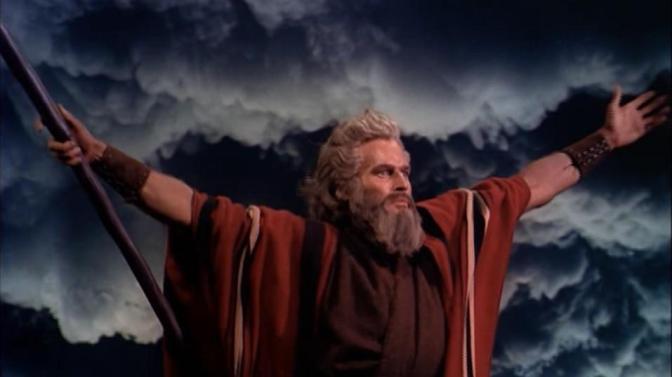
To be clear it isn’t the following image…

Charlton_Heston_in_The_Ten_Commandments_film_trailer.jpg

I’ve never watched Heston’s portrayal… Sorry film buffs–it has not happened by this point in my life.

To be honest, my vision of Moses has been deeply affected by my sense of humor. I don’t have permission to copy the image, but this is my work computer’s background (We miss your cartoons ReverendFun.com). My honest impression of Moses when I stop to pray is somewhere between these two images. Moses was serious, intense, and challenged continually. I imagine I’d tear my hair out with the stuff he had to deal with, but I also think that Moses had to reach a point of frustration where he’d have to either laugh or cry. I prefer to think of him as laughing.

All of that being said, I honestly believe that I have never stopped to dwell on the idea of Moses as a father. Was he married? Yeah. His Father-in-Law gave him some really great advice, right? I can easily remember that story. He had two sons. Exodus 18 names them as Gershom and Eliezer.

Gershom’s legacy is that his children become priests for the Danites until they are carried off into exile (according to Judges 18). 1 Chronicles 23 says that Eliezer has one son, but that son had a lot of children. The legacy of both children is tied to the tribe of Levi, but what challenges me is not the legacy of Moses’ children, but the very act Moses is called to engage in shortly after today’s reading.

Moses is called at a burning bush and must go to confront Pharaoh. The people are crying out in anguish and Moses is called to go out to do the right thing. Moses has children and following God will mean that Moses will leave his wife and children with his Father-in-Law Jethro. Listening to God’s call will require Moses to walk away, if even for a short while.

I have two children. My two daughters are shining jewels that challenge me to be a better father and provoke me to occasional fits of face-palming. I have another child on the way, which is pretty exciting. Walking away from one’s children is a hard idea for me to swallow, but isn’t that exactly what Jesus confronts several people about when they resist his call? In Matthew 10:37-40, Jesus says: (NRSV)

“Whoever loves father or mother more than me is not worthy of me; and whoever loves son or daughter more than me is not worthy of me; and whoever does not take up the cross and follow me is not worthy of me. Those who find their life will lose it, and those who lose their life for my sake will find it.”

While I am challenged by Moses’ call and his ability to walk away from his children, I must admit that there is something common in the call on Moses’ life and the call on our lives. We are not called to simply live lives that fall in pleasant places. We are not called to lives where we can always call the shots while remaining faithful. There are times when the call of God supercedes our desires and that can be incredibly painful, but pain is not always a bad thing.

I am grateful that this passage reminds me that God is calling us to a lifestyle where things are not always easy. I am grateful that the scriptures do show that Moses is eventually reunited with his children and with his wife. I am grateful that Moses was not left alone in the wilderness but was brought into a place of safety and refuge by Jethro. I am grateful Moses created a family with Zipporah.

My image of Moses may always remain the man pulling out his hair or the young man from the cartoon, but I am glad there was more to Moses than what I see in my image. Maybe as my hair turns silver I can remember Moses’ story and have an explanation as to why Heston’s hair was graying in that old movie.

Let Us Seek: Tastes good, less malicious!

In considering the Revised Common Lectionary readings for May 2nd, I am immediately drawn to the reading from 1 Peter. Indeed, these verses seem almost magnetic after a long week that has devolved (or evolved) into prayer more times than I can count. Whether it is reading an article on Facebook or having newspaper clippings handed to me out of today’s local paper, I have been regularly driven to a place where I have felt a need to lower my head into my hands and pray. As a result, I find this scripture magnetic. 1 Peter 2:1-3 says: (NRSV)

“Rid yourselves, therefore, of all malice, and all guile, insincerity, envy, and all slander. Like newborn infants, long for the pure, spiritual milk, so that by it you may grow into salvation–if indeed you have tasted that the Lord is good.”

I find these words have a certain magnetism because they are both incriminating and freeing to me. I find them incriminating in the sense that there is a part of me that wants to be angry and malicious. When friends, neighbors, and colleagues are hurting due to the actions of other individuals and special interest groups, I want to make that pain stop, but my professional avenues to address these issues are limited. This situation is extremely frustrating to me and to many others.

In the midst of these frustrating situations, I hear a voice in these scriptures. Is God good? Yes. Have I experienced the goodness of God? Yes. Which do I long for more–the pure, spiritual milk or vengeance? I long for something better than maliciousness. I hear the voice of God calling and the invitation is to both faith and relinquishment. I am called to have faith in the God I know is good and to let go of my desire for vengeance. It is time to let go of anger, hatred, and frustration. I know there is a part of me which feels frustrated and allows that anger to fester into malice, but with God’s help I can move this place from one of incrimination to one with freedom from my own anger.

Let me try and explain it another way. In our church this past Sunday we read the story of Stephen in Acts 6-7. One of the details that has always slipped my attention is the last thing Stephen does before dying. Stephen asks God to forgive the people who have caused his death. Like Jesus, Stephen decides that it is more important to forgive than to have vengeance. The sense of forgiveness that Stephen exudes and that Jesus modeled reminds me of the promise Paul makes about how the protective peace of God (which surpasses all understanding) when we make our requests known to God with joy (Philippians 4:4-7).

Forgiveness, peace, and trust all seem to dwell in a symbiotic relationship in a life of faith. For me this smorgasbord of faith is at the heart of what Peter is referring to in this passage. God is good and forgiveness, peace, trust, and friends all seem to flow from God’s goodness in a very consistent manner. These gifts are freeing and I feel freed when they take the place of anger in my heart and mind.

Does any of this mean I will advocate for righteousness any less? No. I will continue to advocate but I will also remember to do so without malice. I have tasted and seen that God is good. I will serve God with that truth in my mind partially because of the blessing of today’s scripture. I am thankful for the gift of this scripture.

Let us Seek: Jonah and Judgment

In today’s readings from the Revised Common Lectionary we find that there is a good deal to chew upon… Well, I assume too much. I figure a famous prophet like Jonah would have been well fed enough to require a good chewing. No, my wife doesn’t laugh at my jokes anymore. I think she’s afraid to encourage me. She doesn’t realize or at least admit to me that it is too late. That ship has sailed and I do my best not to be swallowed by whales.

Anyway, obviously today’s readings include a section from the story of Jonah. The section of Jonah includes the speech which Jonah makes from within the whale before being spit ashore. His voice comes to the Lord (in the temple (of course…that reading clearly points to a very solid temple-centric theology)). Jonah owns his place in the depths and offers a promise of sacrifice to God. Others turn to idols, but Jonah will come with thanksgiving to the temple. Jonah is effectively owning his place at the edge of death, is operating out of a place of desperation but hopefully also honesty, and is claiming that deliverance belongs to God alone. Jonah is spit out by the fish and reaches a place of safety.

A reading of Jonah will show that Jonah still doesn’t really care about the people of Nineveh. He waits for their destruction before the end. He waits for the Lord to destroy people who call on God to relent. Yes, he waits for God to do to others what he does not want God to do to him. Really, for being such an effective prophet Jonah does not understand mercy.

To be fair, it appears as if understanding is contagious as the reading from Matthew contains the statement made by Jesus to the Pharisees that no sign will be given but the sign of Jonah. Jesus rises from the grave after three days and Jesus seems to state quite clearly that the people of Nineveh will stand in judgment because they repented after Jonah came. Their ability to stand in judgment comes from their willingness to repent when the word comes from Jonah.

I wonder what this could mean for us as a people. It is likely that early readers saw this as a condemnation of Jewish people and it has been used many times to foment anti-semitism, but I’d like to push past that point. The world doesn’t need any more anti-semitism.

I wonder if there aren’t communities out there who have at one point or another found themselves surrounded by enemies with weapons that were more than willing to slaughter. I wonder if they called out to God, God relented, and a word was spoken to “the fish” willing to swallow them whole. Could such a community stand in judgment over other communities that are more than willing to use violence to get their way? Could such a community stand in judgment over communities that enter into the pond of life to eat other fish and consequently risk being eaten? It is a bit off the original point, but is this a possibility as we read texts like these?

How many places have we been forgiven only to hold that same place in judgment over another? How many places have we found grace only to turn around and deny it to others? How many times do we effectively act blindly towards our neighbors while ignoring our own shortcomings?

When will Jonah learn? When will we learn? The God who scares the sea walks in our midst with hills skipping away. We should learn well. We should do so in a timely fashion. Whale teeth aren’t small and I bet they hurt.

Let Us Seek: Lakes and Canoes

In today’s Revised Common Lectionary readings, I find a bit of a disconnect between the Psalm and the reading from Judges.The Psalm describes the coming of the Lord in fantastic ways. Psalm 114 asks questions of the sea and the mountains. Why would the sea flee from before the Lord? Why would mountains and hills skip away like wild animals?

A better question might be what kind of person could cause such a reaction to take place? I don’t know much about the seas or hills around the holy land beyond what I have read, but I can certainly tell you that North American lakes and mountains really don’t care what humans want of them (although we’re certainly doing our best to have a powerful impact on them).

When I was really young I was a Boy Scout. Yes, I was a Boy Scout and my troop loved to go camping. One year we went on an epic trip into the wilderness of Canada. We piled into canoes and went out into the wilds of Canada. We got into our canoes, paddled for miles, got out of our canoes, carried our canoes, climbed into our canoes again, paddled again, go out again… until we were in the middle of nowhere. It was beautiful and wild.

At one point a member of my group and I were canoeing when the boat capsized. I tried to stand up and my leg was stuck in the mud. I pulled and pulled until something gave…painfully. My scouting friend went to get help and I laid on a rock in the middle of the wilderness in insane amounts of pain. I could barely walk when I got back to camp and twisted my ankle further portaging the canoe on the way back. It was painful, it was traumatic, and the lakes did not care. The mud that I begged to let go of my foot did not care. The hill I tripped on while portaging the canoe did not care.

The Psalm describes seas and mountains as caring about what this God does. The implication for me is that this God is so far beyond me that I cannot imagine how powerful this God might be. It defies explanation. It defies science. This defies everything I experience about reality.

So, why is this silly Judge questioning God with something as simple as wool and dew? Does Gideon just needs a bit of reassurance or is he trying not to push his luck? Does Gideon not know what the seas and mountains would do? The whole Judge based system seems like it led to a lot of problems, but putting these two readings side by side really emphasizes how strange the perspectives of individuals can be at times.

Of course, I sometimes question whether it is reasonable or not to ask God for a good crop of apples this fall. God can make mountains skip, but it sometimes seems too much to ask God to keep the frost away from the blossoms for a few weeks. Perhaps this is why I was not called to be a farmer. Most faithful farmers I know have a deep faith that doesn’t seem afraid to ask for help with crops. Most of them are also bold enough that they’d likely continue to believe regardless of what the wool did the next morning.

In the meantime, I am thankful that I love a God who is so powerful yet lives out of a place of love and grace. I am thankful that I do not have the power of God as I would likely not use it very well. I will give thanks that I am beloved as a goofball who prays for apples and worries about the faith of people with wool. At least I am pondering and I know that is a good start.

Let us Seek: Beloved Partner

So, when I consider today’s readings in the Revised Common Lectionary I see an unintentional correlation between two texts that are clearly unrelated. One of the readings is from the fifth chapter of the Song of Solomon and another is from the fifteenth chapter of 1 Corinthians.

Do you know what stands out to me in this portion of the Song of Solomon? No? Well, I’ll tell you! It is one of the final descriptions of the beloved man. He is described as having legs like alabaster columns and smelly cheeks. His lips are like lilies dripping with a liquid that smells like burial spices. He has a body made of ivory encrusted with sapphires. He is described in ways that are altogether flowing and altogether over the top. He’s clearly well liked, but I want to draw attention to that one final description. The final thing she says in that chapter is “This is my beloved and this is my friend, O daughters of Jerusalem.”

What is the final compliment that can be made of this wonderful man? He’s not only beloved. He is her friend. The relationship between these two is not simply about physical attraction. The relationship includes friendship and I believe that is truly important.

Now, I love my wife with all of my heart, but she’s changed over the years from the beautiful bride that I married after college. She’s grown wiser in her eyes and she’s grown more lovely in her ways. She’s gained intelligence, character, and tenacity. Over time I have come to love her deeply and that love grows deeper each time I am reminded of one fact. She’s not just my beloved. My wife is my friend and her friendship is the fragrance that makes her more and more lovely…

As our marriage has gone on I have come to realize that her friendship is deeply important to me. As such, ten years into marriage I am as interested (if not more interested) in being a better friend to my wife as I am in being a handsome husband. I heard somewhere that: “Charm is deceitful and beauty is vain, but a person who fears the Lord is to be praised.” (Proverbs 31:30, alt.)

Here’s where I see the connection to 1 Corinthians. Paul has been writing chapter after chapter of advice to a community that is divided on multiple fronts. Paul has been trying to draw them out of their challenging behavior in an attempt to draw them back into life a loving community. Paul is working very hard to convince them of this reality when he writes the words from our reading: (1 Cor. 15:1-4)

Now I would remind you, brothers and sisters, of the good news that I proclaimed to you, which you in turn received, in which also you stand, through which also you are being saved, if you hold firmly to the message that I proclaimed to you—unless you have come to believe in vain.

For I handed on to you as of first importance what I in turn had received: that Christ died for our sins in accordance with the scriptures, and that he was buried, and that he was raised on the third day in accordance with the scriptures…

These words are an attempt to reiterate a major truth of the epistle. Jesus Christ is the one who is ultimately at the core of the Corinthian community. Paul believed that Jesus’ life, death, and resurrection were integral to the community of faith. Jesus’ work molded and transformed the ways in which the community lived, fought, and struggled together. To forget this integral truth would be to forget the very thing that made them into a community.

Ultimately, Paul’s call on the Corinthian church is also a call on us as a community. I personally hear it as a call that applies to my own marriage. Jesus’ life was marked by love, sacrifice, and servanthood. My relationship with my wife should follow Jesus’ example. I may appreciate how her teeth look like shorn sheep, but ultimately, her looks aren’t what is first and foremost important. She’s the woman I love, the woman I honor, and the woman who I am called to be a friend to for all of my days.

I normally would offer advice on how to be a better friend to your partner or spouse, but the best advice I have is to love them like you like to be loved in their shoes. Please note, I don’t mean that your partner wants what you would want–love them as if you were them and had their interests…

My father-in-law also once said don’t buy gifts that come with electrical plugs. Apparently he was into solar power before it was cool…

Let us Ramble: Dryness

Lately I have been thinking about dry bones. I have been feeling a bit dry myself. Perhaps it is the number of things that have been rapidly changing in my life, the busyness of the Lenten season, the stresses of being a pastor of a smaller church in a small town, or simply the constant headache from not wearing my glasses while my new cornea heals… Regardless I have been feeling like a bunch of dried out bones.

One of the books I have been reading lately has been “A Guide to Retreat for All God’s Shepherds” by Reuben P. Job. In that book, a poem by Joyce Rupp is quoted named “Dry Bones.” In that poem, the following stanzas are recorded:

tiredness grounds me

into a quiet stupor

of the spirit.

I yearn to be inspired,

to be lifted up, set free

beyond the place of deadness.

the struggle goes on,

however,

and you and I, God,

we exist together

with seemingly

little communion

Joyce Rupp goes on to state her belief in God feels stronger than ever despite the challenges she is facing. It is quite beautiful. I recommend both Joyce Rupp’s works and Reuben Job’s book because they each have their own beauty. I think that beauty is quite apparent in the words above…

I share these words because I know what it feels like to have tiredness wear me into a quiet stupor of the soul. I feel the dryness of my bones in a place of deadness. I yearn, I call, I seek, and yet here God and I exist together. The dryness is overwhelming sometimes.

Surely, the biblical quote you might lift up to me is the offer to the woman at the well. Doesn’t Jesus offer a living water that quenches this thirst? As a pastor, shouldn’t you (of all people!) know that these dry patches aren’t necessary when the living water dwells with us? Shouldn’t I know why these patches take place and be able to just walk through them into a bright future without a bit of dryness?

No. I do not know why there are dry places in life. Paul (in Romans 5:3-5) might tell us that suffering leads to endurance, character, and ultimately a hope that does not disappoint, but even with those words strike me as not explaining why there are dry places. The dry places may lead to this blessing, but I cannot tell you perfectly why any of us face dryness. Couldn’t there be an easier way?

Ultimately, all I can tell you is that almost everyone faces dry places in life. Almost every person sooner or later finds themselves in a place where they have moved away from the mountain top experiences, entered the valleys, and started wondering what happened and why. It is something that has happened to everyone from Mother Theresa to Rev. Dr. Martin Luther King, Jr.

So, how do we live through these moments? I think Joyce Rupp hits it right on the head. We exist together with God in the dryness. We call out in prayer, we yearn, and when words fail us, we exist together with God.

One story I did not personally touch on during Holy Week was that one moment where Jesus says some simple words. Jesus says “I am thirsty” (John 19:28). John says that it is to fulfill the scriptures, but even so, it is a simple statement. Jesus is thirsty. The source of the living water feels thirst.

I can co-exist with Jesus in my dryness because I believe Jesus has been dried out too. Jesus knew thirst. Am I being too literal? Possibly, but I imagine the prayer in Gethsemane was a moment of dry thirst. Jesus prayed “Father, if you are willing, remove this cup from me; yet, not my will but yours be done” (Luke 22:42). Go further back to the story of the temptation. If Jesus wasn’t actually hungry and thirsty when the devil offered rocks like loaves of bread, then was he truly tempted? In my dryness, I see the image of the invisible God. The image of God shown in Jesus is an image that knows difficulty.

I am pretty dry these days. I’ll still stay here with Jesus. I invite all of you who struggle with dryness to spend time with the One who knows dryness. Christ came, Christ rose, and Christ will come again. Even if we have to wait in the desert, Christ will come again.

Let us Seek: Might and Superheroes

Today’s readings in the Revised Common Lectionary are a bit challenging in a modern context. In the NRSV, Psalm 118:14 says that: “The Lord is my strength and my might; he has become my salvation.” The reading from Joshua recounts the crossing of the Jordan into a Promised Land. Joshua’s campaign will be a bloody campaign. Mary’s experience in Matthew’s Gospel is far more shocking and frightening than the gospel reading we shared on Sunday from John. Jesus is described as being as having an appearance like lightning. The Mary of Matthew does not confuse Jesus with a keeper of the garden. This telling leads modern folks like me to ask which Gospel tells the truth of Easter morning, even when we’re wise enough to realize that gospels written decades apart would likely vary significantly.

In choosing a selection from these readings to ponder in our daily blog, I am drawn to ask a question. What does it mean that the Lord is our strength and might? Sure, Jesus appears as lightning in Matthew, but Jesus is also the man who willingly went to the cross. Jesus does exemplify strength, but this is not the strength you see very often in our culture.

Consider for a moment the representations of strength shown in modern cinema. In a few short weeks my daughter (who loves superhero films) will likely be asking me to take her to see the newest Thor movie. In that movie, Christopher Hemsworth will show strength in the person of Thor. He will face the Hulk in a battle and it will be powerful, but powerful in a way I doubt we’d connect with Jesus. A few weeks later, it is likely I will be asked to go see Gal Gadot portray Wonder Woman, because she is powerful and my kids are growing up in a house where we can accept the existence of both DC and Marvel comics. She’ll probably enter into a world of war while defending the person played by Chris Pine. James Tiberius Kirk would likely be shocked to know the actor portraying him in modern films will be defended by a woman far tougher than either him or Mr. Spock (it is true, sorry…), but he’s a fictional character without real emotions. Neither Kirk nor Wonder Woman would likely be accused of carrying the strength lived out in the person of Jesus.

Indeed, I’m a red-blooded American male, but even I understand that any of these characters would likely be a better pick in a game of dodgeball than someone like me. They’re strong, they’re tough, and none of them express the same kind of strength as Jesus. The question is whether real life requires Jesus’ strength or the strength of superbeings…

As a Christian reading this selection from the Psalms, I am reminded first and foremost that the Lord is my strength. My reading is affected by my very real and personal understanding that the strength which I rely on is found in the person of Jesus. When I read other words from this selection (vs. 22) around the idea that the rejected stone has become the chief cornerstone of a building founded on God’s work, I am led to ponder the crucifixion and the resurrection of Jesus.

None of the fictional characters of the movies that my daughter might want to see will bear the strength required to become the chief cornerstone. Are they kind of cool? Well, yeah. Do they bear the strength required to bear a Christian forward in an uncertain world? No. In fact, my knowledge of superheroes has taught me that the power and might of superheroes often leads to the loss of the people they love. Jesus makes a promise in John 17 about the people in His care and I believe that this promise holds true even as Gwen Stacy, Carol Ferris, and Colossus are left behind by the heroines and heroes that love them.

Here are three suggestions that might help a child to understand the difference between the strength of superbeings and strength of Jesus:

  1. Invite your children to participate in ministry with people who have real and present needs. Work on a Habitat for Humanity home, volunteer at a soup kitchen, or invite them to go on a trip (with a trusted group like UMCOR) to a mission field in another nation. When they see the need of the world it will help them to understand that most problems that people face require a strength that goes beyond the will and power of a superbeing. They need the loving hands of God as expressed through the body of Christ.
  2. Introduce your children to great literature. This may seem counterintuitive if you are not naturally a lover of books, but there is something about reading through the events of great figures of history and also great moments in fiction that may inspire your child to think about the world around them.

    Why is Star Trek so egalitarian in approach to different life forms? Why do the Jedi see the force in all living beings? Why does Doctor Who care so much about doing the right thing? Why did the Greeks stand so firm against the invading forces of Persia? You can find people dealing with deep issues if you look deeply enough into works of fiction and works of history. Most of those issues require an answer deeper than the average superbeing can provide. If you’re a part of that conversation you can invite your children to look deeper. Also, if your kids love books they can’t afford to get into too much trouble. Books cost too much and libraries have had their funding slashed in most places.

  3. Listen to the news with your kids and do your best to answer their questions. My kids regularly listen to WBNG on NPR One as we drive to do our errands. We do this together since my dad used to listen to WBFO with me in the garage when I was a kid.

    My eldest asks questions about the world and I am sometimes forced to learn new things to answer her with integrity. To be entirely honest, she sometimes asks questions that go far above what I understand about the world. When we discuss things like economic disparity (“Why can’t they just move somewhere other than Syria?”), violence (“Why would someone kill someone on Facebook? Why didn’t God stop them?”), or even school issues (“Why are kids hungry and why wouldn’t people give them the same lunch?”), I am forced to go deeper into the issues myself. When we seek answers together we both grow. This is a good thing and as you both grow, you’ll hopefully both come to understand the nature of true might a bit more clearly.

I hope these suggestions are helpful. As always, experiment and find out what works for both you and your family. Blessings!

Featured Image Comment: You go Lidia Valentin. You’re tougher than me by a long shot! Thanks Wikimedia Commons for sharing an image of such a strong and respectable weightlifter!

Let us Seek: Holy Clothes

Even though Holy Week is over I want to continue reflecting on the daily scripture readings found through the Revised Common Lectionary at least a few times a week. Today’s readings include the following passage from Colossians. This is Colossians 3:12-17:

“As God’s chosen ones, holy and beloved, clothe yourselves with compassion, kindness, humility, meekness, and patience. Bear with one another and, if anyone has a complaint against another, forgive each other; just as the Lord has forgiven you, so you also must forgive. Above all, clothe yourselves with love, which binds everything together in perfect harmony. And let the peace of Christ rule in your hearts, to which indeed you were called in the one body. And be thankful. Let the word of Christ dwell in you richly; teach and admonish one another in all wisdom; and with gratitude in your hearts sing psalms, hymns, and spiritual songs to God. And whatever you do, in word or deed, do everything in the name of the Lord Jesus, giving thanks to God the Father through him.”

I love the idea of clothing your body with love. Every morning I get out of bed and I choose the clothes I wear. If it is a day where I’m just with my family, it is usually just a pair of jeans and a goofy t-shirt. If It is a day where I’m going to be in the office or going on visits, I put on a clergy shirt and literally clothe my body with a collar–a symbol of my office, my calling, and a reminder to my own heart that I am a servant. If I am going to be leading worship, I might clothe myself in an alb, robe, and usually a stole. I wear a wedding ring except when I’m playing my hand drums (as the metal would ruin the drumhead). I clothe myself in many ways.

The idea of wearing love and letting it bind everything together is both heartwarming and powerful. It is the cloak that covers against a winter chill. It is the garment that wraps you and keeps you dry like a rain slicker. It is the undershirt that touches you and keeps you comfortable and safe even as you wear a scratchy but warm wool sweater.

It is love that comforts and connects all of you as you let Christ dwell in you. It is love that surrounds you as God’s love fills you with wisdom, leads you into song, teaches you gratitude, and is with you in the midst of every challenge you face. It is love that ties together the compassion, kindness, humility, meekness, patience, and forgiveness that marks the life of a Christian. It is love that covers all–even the goofiness of Christians like me!

Love is an important thing. For my family, it is increasingly important. Love can help us through all matters and my family could definitely use love along with the compassion, kindness, humility, meekness, patience, and forgiveness that are part of the wardrobe. As the months go on, you’ll learn why if you keep reading this blog.

Meanwhile, may you find the key to your wardrobe! May you find that there is adventure the likes of which C.S. Lewis would dream of as you try on the clothes of faith from the back of the rack. May you live in peace and may the God of peace clothe you in love!

Let us Seek: Holy Thursday Reflection

As we progress through Holy Week, we reach Maundy Thursday. In some Christian traditions, today marks the begin of a remembrance that begins after the Maundy Thursday and lasts until Easter. The three-day remembrance is seen as a special season of the year known as the Holy, Easter, or Paschal Triduum.

For me the Paschal Triduum has always had a strange place in my own devotional life. At various points in my ministry I have celebrated Good Friday with a Cross Walk (think stations of the cross marked by readings and often shared by various churches in an ecumenical fashion), celebrated a special service on Good Friday, and have opened the church for prayer and reflection. Holy Saturday has often been a time when I’ve spent the day in silence or doing acts of kindness for others.

Even in the midst of the celebration of the Triduum, Maundy Thursday has always had a special place in my heart. John Wesley taught that the act of communion is a gift of grace that extends a real and powerful benefit to the people of Christ. I have always found the act of communion to be a deep and meaningful expression of God’s love and grace. As such, I find the celebration of the remembrance of that first communion to be incredibly meaningful.

Today’s lectionary reading covers a great deal of that celebration, but beautifully it tells the story through the eyes of the Gospel of John. I usually default to Luke’s Gospel in a lot of my own theology, but the beauty of John’s remembrance of that night is powerful and life altering.

In John’s lectionary reading (13:1-17, 31-35) the story told does not revolve around communion but instead around the washing of feet. Jesus knows that the end of His journey towards Calvary is near, so John tells us that Jesus takes on the role of a servant. Removing his outer garment, Jesus wraps himself in a towel and washes the feet of His disciples.

The Lord of the Universe, the One we crown with many crowns, the Lamb upon the throne spends some of the last moments of His time alone with His disciples washing their feet like a servant. The King who was, and is, and is to come wraps Himself in a towel and washes feet with humility before inviting His disciples to remember what He has done and to do likewise in their own lives.

I truly believe this passage is one of the most challenging passages of Jesus’ ministry because it reminds us of the true order of things. No servant is greater than their master. Our Master humbled Himself. Our Master did not assume the place He deserved, but He took the place that He knew that He must. This is the revealed Image of the Invisible God.

Verily, the place of a disciple is to follow in the footsteps of Jesus. The next day will be challenging. Let us continue this journey and understand that we go further on the journey towards resurrection having first had a lesson in humility. Easter may be triumphant but triumph comes through first submitting to God’s will and doing so with humility mixed with grace. May God’s grace guide us down the challenging paths as the Triduum begins…

Let us Seek: Holy Wednesday Reflection

Today is Holy Wednesday and for me Holy Wednesday has always been the last deep breath before the plunge. This afternoon I’ll be headed out to do the last (planned) visits before we begin the craziness of Maundy Thursday (at least it is a bit crazy around here), the solemnity of Good Friday, the silence of Holy Saturday, and the riotous celebration of Easter. Today is that moment where it seems all clergy take that last deep breath.

With that being said, today’s lectionary reading does not leave a ton of room for that deep breath. It is emotional, deep, and troubling. To be entirely honest, I feel strange writing a blog post about it in my bright clergy shirt. It feels very dark. In choosing an image to match this feeling, I chose a painting of Jesus’ giving His Farewell Discourse to the 11 remaining disciples as painted by Duccio di Buoninsegna in the 14th century because of the person who is missing from the painting.

The lectionary reading is found in John 13:21-32 and technically took place on Thursday of Holy Week. In the reading, Jesus reveals that someone at the table will betray Him. There is a moment of confusion and John is approached by Peter to ask who will betray Christ. A piece of bread is dipped in wine and given to Judas. The scripture says that after Judas receives this bread that Satan enters into Judas. Judas is sent to do what he must do and the actions of the evening are set into motion.

I must be honest, I do not like this reading. One reason I am not a huge fan of this passage is that I know this reading has been used to disparage the act of sharing communion by intinction along with Mark 14. I honestly do not like people who use scripture to disparage a meaningful act of communion with God, especially when it is not really an airtight argument.

Another reason that I struggle with this passage is simply the wording. Judas has been traveling with Jesus. Judas has the very best teacher, the very best friend, the very best guide, and the very best leader. Judas has the ideal situation to learn about the heart of God and Judas still just falls away. Judas is taken by the tempter and that is very discouraging to me, especially as his journey ends in suicide.

I have to be entirely honest. I wish that Judas’ story ended differently. Don’t you? Judas does betray Jesus, but the scriptures seem to imply that this is simply what must be. Judas has journeyed with Christ, shared a few loaves and fish with thousands, been sent out to preach with other disciples, and been a leader. In Acts, Judas’ place is filled by another disciple because Judas’ role had been very important in their life together. I wish Judas’ story ended differently. I wish it with all of my heart.

This reading hurts me down to my soul. Perhaps it is a good thing that we remember that Judas was a person on the day before his betrayal of Jesus. Judas’ story is a tragedy that leads to one of the greatest gifts of history. Even so, it is still a tragedy.

May God bless all those folks who are tempted to head in the way of Judas. May God help lead them into the path of folks who can invite and guide them back onto the path of life.

Let us Seek: Holy Tuesday Reflection

Today is Holy Tuesday. The gospel reading today reflects on conversations Jesus had around His purposes and around God’s glory. It also goes deeply into life issues. The Revised Common Lectionary reading for today is John 12:20-35. This is what verses 23-26 say in the New Revised Standard Version:

“Jesus answered them, ‘The hour has come for the Son of Man to be glorified. Very truly, I tell you, unless a grain of wheat falls into the earth and dies, it remains just a single grain; but if it dies, it bears much fruit. Those who love their life lose it, and those who hate their life in this world will keep it for eternal life. Whoever serves me must follow me, and where I am, there will my servant be also. Whoever serves me, the Father will honor.’”

We’ve followed Jesus through all of Lent. We came down that mountain into the valley where there were sick folks, hurting folks, and upset folks. We followed Jesus as He continually reminded people to turn away from their understanding of how a Messiah was meant to be and to act. We followed Jesus as He kept reaching out to the poor, kept reaching out to folks in need, and kept upsetting the religious leaders.

Now we’re invited to follow Jesus as He approaches Gethsemane. We’re invited to follow as Judas betrays with a kiss. We’re invited to follow as the world stands by as Jesus is tried and convicted. We’re invited to follow Jesus up Calvary. We’re invited to watch the sky darken.

Sometimes I don’t want to follow Jesus on this path. Let’s be honest–Holy Week grows gruesome. Holy Week would be the nastiest and worst of events if it weren’t for Easter. Some years I’d like to just say “Look at the time!” before running off to make a cup of coffee until Sunday. It is beautiful, it is deep, and sometimes I would rather have a simple broth than dig into the theological beauty of Holy Week.

Still, we must follow. We must because this is Jesus we’re following. Whenever we gather around the table to share in the Lord’s Supper it is this story that we speak to each other. Whenever we see suffering in the world around us, it is this story that reminds us that God entered into human suffering. Whenever we see people claim earthly power, authority, and greatness, it is this story that enters and can inoculate us from the disease that can easily carry us away into realms where we connect earthly power with divine right. This story is foundational–we must follow.

What’s more, we must walk the same path. This story effectively changes the way that we look at the world around us and how we relate to the world around us.

Let’s say we’re rich and we’re powerful. Perhaps we’re as powerful as the President of the United States. We have wealth, riches, and an army sworn to do what we decide. How do we act? Well, let’s be honest. If we’re going to walk like Jesus, it is going to change the way we look at the world around us and change the way we act. Jesus was arrested, tried, and convicted. Jesus was executed and his words weren’t threats or screams of anger. There was painful moans, I’m certain, but the words shared were words of forgiveness and words of grace. Jesus didn’t cajole or argue. He invited criminals to paradise despite what they did. If one is to follow Jesus it changes the way you live your life, perhaps especially if you had power, riches, and followers. To follow Jesus might mean you lose your privilege only to gain eternal life.

Let’s say we’re a public school teacher. Perhaps we’re the best teacher in the world and not one parent comes to your classroom to explain your job to you. Perhaps the parents who try leave your classroom apologizing and planning to write a nice letter. Perhaps you have offers to go and lead in the most prestigious private school in nation whenever you’d like. If you’re going to walk like Jesus, it very might well change your way of life. How? Jesus willingly cared for the very people who came to “take care” of Him in the Garden. Even in the midst of being taken to suffering, Jesus stopped to heal one of the very people who came to persecute Him. The kid screaming at you in your class might be a royal pain, but what would Jesus do with this child? Would Jesus show love and kindness? Would Jesus have grace in the midst of the suffering this kid will likely inflict upon you? To follow Jesus might mean healing that kid’s ear and that act might change your life.

I think we honestly each need to follow Jesus on this journey. It isn’t a pleasant journey, but let’s be clear. Few of us live perfectly pleasant lives. If we want to learn to live out our lives well, we might need to learn to lose in order to follow Jesus. If we want to learn to live out our lives well, we might need to learn from someone who can change us. In the way of Paul, we may need to live out our own ministries in life resolving to know nothing but Christ and Him crucified (1 Corinthians 2:2).

In the meantime, it is my prayer that this journey would be a blessing to you. May we all learn to follow and to let the Grain that died multiply within us.

Let us Seek: Holy Monday Reflection

Throughout Holy Week I have the goal of reflecting on one of the lectionary scriptures from the Revised Common Lectionary each day. For today’s gospel reading we see Jesus at the house of Lazarus in Bethany. It is revealed in the text that Lazarus is being plotted against by the chief priests in Jerusalem as Lazarus’ resurrection was causing a stir in conjunction with the ministry of Jesus, but that isn’t what immediately catches my eye when I consider this story. Consider verses 1-8 of chapter 12 of John’s gospel.

“Six days before the Passover Jesus came to Bethany, the home of Lazarus, whom he had raised from the dead. There they gave a dinner for him. Martha served and Lazarus was one of those at the table with him. Mary took a pound of costly perfume made of pure nard, anointed Jesus’ feet, and wiped them with her hair. The house was filled with the fragrance of the perfume. But Judea Iscariot, one of his disciples (the one who was about to betray him), said, ’Why was this perfume not sold for three hundred denarii and the money given to the poor?’ (He said this not because he cared about the poor, but because he was a thief; he kept the common purse and used to steal what was put into it.) Jesus said, ‘Leave her alone. She bought it so that she might keep it for the day of my burial. You always have the poor with you, but you do not always have me.’”

I find this story to be interesting for several reasons. As a person who studies the nature of the scriptures and how they were transmitted through time, I often wonder if the comments for the reader were written by the author or by one of the helpful folks copying the words throughout the centuries. Judas is at least acknowledged as a disciple by this account although his discipleship is clearly cast into question by not only his betrayal but his apparent greed in the eyes of the author.

I also find it interesting because this is the story of a family that still seems to be coming to grips with a majorly traumatic event. The previous chapter (11) recounts not only the story of Lazarus’ resurrection but tells us that Jesus was forced to go to Ephraim as a result of plots to take his life. As far as we know, this is the first real opportunity after some time had passed for Mary, Martha, and Lazarus to see Jesus. One of the reasons the chief priests seem frustrated with Lazarus is that Lazarus’ proximity to Jesus raises issues that now require his removal from the equation. This could be a sign that Lazarus hadn’t been near Jesus and raised these issues until this moment.

If this is the case and this is one of the first opportunities for response after the events of Lazarus’ resurrection, then this story becomes powerful. Martha is serving, Lazarus is sitting, and then Mary enters with the perfume. She anoints and uses something as precious and personal as her hair to wipe Jesus’ feet. This kind of act is not something that one does for just anybody. It is deeply intimate, deeply personal, and deeply emotional.

Into this moment we find Judas Iscariot stepping in and scolding. He is concerned about the waste of money. He sees the price of the perfume as the issue, but he’s missed the point. We all know that Judas has missed the point. How? Mary and Martha had lost their brother Lazarus. He was gone and he was restored. History is filled with people who would give anything for a few more moments with the person they have loved and lost. I am a pastor who believes in the resurrection and even I have people in my life I would give almost anything to see again for just a few more minutes. Mary and Martha are given the opportunity to do something incredible.

In the face of such a blessing, who wouldn’t care about money to say thank you? Perfume can cost a lot, but think about the gift that they have just received. Who cares about the money? Who cares about the cost?

I think we can all take a couple of things away from this story.

  • Some things are important most of the time, but are utterly worthless when seen in the big picture. An old phrase states “You can’t take it with you.” In the long run, would you rather have more money in your bank account or more time with people you love? If you knew tomorrow was your last moment, what would you do with your time?
  • There’s a time and place for stewardship and there is also a time and place for gratitude. I cannot say enough that sometimes we place stewardship on such a high pedestal that we forget to be grateful for the non-monetary blessings we have in life. I’m not advocating for wastefulness, but Judas clearly missed the point about what was most important. Sometimes we do the same thing (but hopefully without betraying people to their deaths).
  • We don’t need to be aloof with our emotions. Mary is clearly someone who was in touch with how she felt about Jesus. There is nothing wrong with Mary for feeling deeply about Jesus’ place in her life. Sometimes we need permission to feel and Mary gives us an example of how we can fee deeply, passionately, and still clearly have the love of God in and around our lives.

As Holy Week continues, I hope you find a place of blessing in these scriptures. May you feel deeply and thoroughly connected to Jesus.

Let Us Ramble: Light and Darkness

So, last Thursday I had a cornea transplanted onto my eye. At first I thought that the eye-shield was going to be the most annoying part of the recovery process. I learned the truth when the covering was removed. Light hurts and it hurts a lot.

Yesterday was Sunday morning and a parishioner was on the phone with a gentleman I was praying for in the church parking lot. She waved me over to talk with the gentleman on the phone. The only problem was that the sun was out and she was parked in the light. I reached the edge of the shade from the church, stepped out, and recoiled. I covered myself with my arm and suddenly realized that I had just pulled a move straight out of a vampire movie.

Over the course of a couple of hours I went from a denizen of the day to a creature of the night. The following verses have been altered from Psalm 130 to fit my recent circumstances: (NRSV, morning changed to sunset)

“I wait for the Lord, my soul waits, and in his word I hope: my soul waits for the Lord more than those who watch for the sunset, more than those who watch for the sunset.”

Last night I literally caught myself getting excited about sunset. When the sun went down I literally grabbed my keys, hopped up and down, and then went out to Wegmans where I walked around with sunglasses getting the things my wife asked me to grab if I was going to go out of the house anyway.

It made me think as I went to lay down to sleep. When was the last time I was that excited for the dawn? For that matter, when was the last time I was that hopeful and expectant on God to show up in a set of circumstances?

I was waiting for this surgery for three months. You would think that waiting for surgery would be a moment where I waited with anticipation, but to be entirely honest, I felt myself surrounded by prayer and felt a sense of peace. I was relieved when they found a cornea and I was excited when I saw one blurry and distorted sight, especially as the phantom extras of keratoconus were gone–it was just a blurriness, which was a vast improvement. I felt relief, excitement, a titch of concern, and a million and one other things, but was it more than the excitement which a watchman has for the dawn or even a transplant patient waits for the darkness?

Perhaps this is privilege at work. I have lots to pray for and lots to care for, but let’s be honest. My life is surrounded by an illusion of safety. The police are a phone call away, the fire department is around the corner, and the ambulance squad is literally a couple of hundred yards away. There are no invaders on my borders and frankly the biggest nuisance animal in my life is a squirrel who keeps driving me nuts. I live a sheltered life and I generally don’t need to wait for the dawn.

The question I have in this moment is whether or not I can learn to appreciate and live with those who do not have the same certainty and sense of security. Can I truly appreciate what it feels like to be unsafe? Can I truly understand what it might be like to not have trust in the institutions around me? Can I live into those places where others are not as privileged as me? Can I work to either share that security or reject it when it comes at the cost of others?

Jesus taught that we should treat others like we would like to be treated. Perhaps this is a moment where I can sit in the dark and think about what it means to want flee from the things that make others feel so safe.

By the way, I don’t say “Blah, blah, blah…”

Let us Ramble: Stones in the Garden

I was walking by the edge of my garden when I saw the little rocks that came up when we were tilling the garden last spring. We tried to lay them up as a pretty edge, but as winter went along the shoveling and snowblowing just made them look like a muddy mess in the midst of where the vegetables will grow. I don’t mean a little mess. Just take a look at that mess!

IMG_8348.JPG

Mud, stones, needles, leaves, and other crud. Yuck! What a mess! It made me immediately want to borrow a tiller and get to work on the garden. It may seem warm out, but there’s still snow from that giant storm a few feet away.

This messiness gets under my skin at some level, but to be honest, I’m not sure it has anything to do with the actual mess. It is just a garden. Meanwhile, the world around us is filled with bigger messes. Think for a moment about the broken places of the world. Violence in places like Cincinnati, London, and Mosul. Hungry folks going without while restaurants fill dumpsters with good food that they won’t share for fear of a lawsuit. I even saw a picture online of a guy waiting underneath a breaking Wal-Mart sign hoping the letter would fall, injure him, and give him a chance to make a fortune through a lawsuit. I really hope that one was photoshopped.

The world around us is filled with injustice and people who seek their own welfare at the direct expense of others. It is a dirty and rotten world sometimes. The mud, rocks, and muck seem to pile up everywhere and it can be hard to find beauty in the midst of all the frustrating wickedness we see in the world.

I find hope in passages like Psalm 37: (NRSV)

“Do not fret because of the wicked; do not be envious of wrongdoers, for they will soon fade like the grass, and wither like the green herb.

Trust in the Lord, and do good; so you will live in the land, and enjoy security. Take delight in the Lord, and he will give you the desires of your heart.

Commit your way to the Lord; trust in him, and he will act. He will make your vindication shine like the light, and the justice of your cause like the noonday.

Be still before the Lord, and wait patiently for him; do not fret over those who prosper in their way, over those who carry out evil devices.

Refrain from anger, and forsake wrath. Do not fret–it only leads to evil. For the wicked shall be cut off, but those who wait for the Lord shall inherit the land.”

I find hope in these words. I could get all worked up about the garden, but there’s a wisdom to patience. Instead of pointing out the very obvious meaning of these words, let’s look at what is happening in another part of the garden. Here’s what the garlic patch looks like after a long winter…

IMG_7444.JPG

Yes, the strawberries are invading, but they’ll be fine with the garlic. Yes, the stones might be sinking in a bit, but they’re still there. Underneath the snow they waited for spring to come. Now that it is here, they can do their job of reminding me not to mow over the strawberries and garlic. Even when all seems yucky in one part of the garden, in another there is still order and goodness at play.

May I invite you to keep your eyes open for the places in the world where God is at work in our midst? May I invite you to take a deep breath and be still before God when the world seeks to overwhelm you with wickedness? May I remind you that the grass may be green and the herb may grow quickly, but they are only here for a season.

Someday the plowshares will be forged from sources of pain and sorrow. One glorious day there will be no need for the things we grasp so tightly for our defense. May God hasten that day and give us patience in the meantime. May God teach us to share and to fight for justice. May we help bring food to the hungry and wisdom to the people waiting below signs. May God bless us as we seek to make the world a more lovely garden.

Let us Ramble: Bone broth

Okay, so this one is clearly a ramble… Last week my wife had what looked like the beginnings of a cold. I jumped into action–Super Husband away! I ran to the store, thought through my rambling brain for something that would make my wife feel better, and got stuck somewhere around the idea that chicken soup always made me feel better.

The problem was that I didn’t have any chicken bones or carcasses to make broth. I decided to grab some beef bones and make some broth. A quick internet search showed me that the only other thing I didn’t have in my pantry for a healthy bone broth was parsley, Neck bones, marrow bones, and parsley in hand, I went back home to work on this recipe from WellnessMama.

I didn’t read the directions. Two days of simmering in a stock pot. Our house smelled amazing for the morning of the first day. By dinnertime I was beginning to get a little tired of the smell, especially since Kayti was feeling better already… On the morning of the second day I thought I’d never get the smell out of my nose again. I let it cool a bit, refrigerated some, and froze the rest.

On the third day after I had resigned myself to smelling it again I made my wife French-Onion Soup using the bone broth. It was light and delicious. Last night I made some jasmine rice with the bone broth. It was so delicious and flavorful. I seriously cannot begin to express how amazing the broth turned out and how very glad I was that made the bone broth. It seemed like it took forever, but when it was done it was fantastic.

I’ve looked at those bones in the supermarket so many times and thought “Who buys these things?” I often look for boneless meat because I don’t want the hassle of pulling out the bones and getting rid of them. I cannot begin to describe how moist, fragrant, and delicious the jasmine rice was that I made in that broth.

My revelation about the bone broth reminds me of a story from scripture. This is from Jeremiah 18:1-6: (NRSV)

“The word that came to Jeremiah from the Lord: ‘Come, go down to the potter’s house, and there I will let you hear my words.’ So I went down to the potter’s house, and there he was working at his wheel. The vessel he was making of clay was spoiled in the potter’s hand, and he reworked it into another vessel, as seemed good to him.

Then the word of the Lord came to me: Can I not do with you, O house of Israel, just as this potter has done? says the Lord. Just as the clay in the potter’s hand, so are you in my hand, O house of Israel.”

My experience of this passage is very much like my experience with beef bones. When I was in middle school we moved to Grand Island, NY. Our backyard was lush and green…for about 4 inches. Below the 4 inches of topsoil was clay. Heavy, heavy, impossible to dig-through clay. Whenever my dad wanted to work on an outdoor project below the surface the clay became the bane of my existence. Planting trees was nightmarish. Putting in stone landscaping was abominable. I hated clay with a passion I had for no other mineral except for that sand that got in my swim trunks at summer camp.

Shortly after marriage my wife and I had a child. We didn’t get out much, but one of the things we did to spend time together was going on a date to a pottery painting place in Rochester. The hated clay was there, but it was pre-shaped into wonderful shapes. We painted, we doodled, we played with brushes and shapes… The hated clay became a beautiful cross that hangs with a place of pride in my house. Here it is!

IMG_7497.JPG

I know it doesn’t seem like the most beautiful thing in the world to many of you, but to me this bit of once miserable clay is beautiful. The three colors represent not only the trinity, but also my family. I love orange, so I saw myself on the bottom. My wife loved darker red, so I saw her up on the right. Green was a beautiful living color and represented our child to me. In the middle the colors mingled making one funky shape filled family. The hated clay of my childhood was transformed into something that still touches my heart in a special place.

Israel was being judged in this section of scripture. There is no question in my mind that Israel was not being built up by this imagery. The clay of the nation of Israel was going to be reshaped regardless of their opinion. All of that being said, as someone who reads in the midst of a different kind of exile (as a Christian in the midst of a chaotic world), I find comfort in the idea that God can work in the midst of my odd, sometimes dry clay. It might not be easy, but God can do beautiful things even in the midst of a world of ruined pots, wildly whipping wheels, and flying clay.

My prayer is that God might use my weird clay to make something beautiful in this world. My prayer is that God might take the bones I can offer and use them to make something glorious, light, beautiful, and life-giving to the world. My prayer is that I might not just see the broken nature of the world but might also see where the divine is at work in the clay.

May God work in the clay that you see in the mirror and help you to be rebuilt into something amazing. May God take your bones (even the broken ones) and make something life-giving out of your journey on earth.

Let us Ramble: Seeking Wisdom

So, it is no secret that I have been working on preparing for the beginning of my journey with the Academy for Spiritual Formation this summer. I have been buying books, listening to audiobooks through Audible (I’m not paid to endorse them, but they’re pretty cool) while walking at my treadmill desk, and searching the scriptures for wisdom.

I have been carrying around a little yellow composition book that I have been filling with quotes and scriptures that have been inspiring me to ponder the depths of my own spirituality. Writing things with my hands helps me to remember them. I recently added this set of verses that have long been favorites of mine. This is Psalm 2:1-11 in the NRSV:

“My child, if you accept my words and treasure up my commandments within you, making your ear attentive to wisdom and inclining your heart to understanding; if you indeed cry out for insight and raise your voice for understanding; if you seek it like silver, and search for it as for hidden treasures then you will understand the fear of the Lord and find knowledge of God. For the Lord gives wisdom; from his mouth come knowledge and understanding; he stores up sound wisdom for the upright; he is a shield to those who walk blamelessly, guarding the paths of justice and preserving the way of his faithful ones. Then you will understand righteousness and justice and equity, every good path; for wisdom will come into your heart, and knowledge will be pleasant to your soul; prudence will watch over you; and understanding will guard you.”

I find that passage beautiful and it has ended up in the yellow composition book because it rings deeply in my soul. Part of my own journey lately has been one of crying out for insight into the challenging parts of life and indeed raising my voice to ask for understanding.

The very fact that I have a yellow composition book for this purpose speaks to the very depth of my desire. I have many notepads, but only one is labeled at the moment. I have many legal pads of paper, but only one composition pad is clipped shut so that the pages don’t flap around. I have many pads of paper, but only one has the internal nickname of the “Composition Book of Doom.” Don’t you think “doom” is a nice synonym for “fate”?

I want to go deeper in my own relationship with God. Yes, the Academy will likely help me to be a better pastor, but I have a thirst to go deeper in the practices that I will learn there for the sake of my own soul. Yes, by the way, your pastor has a soul and it is just as human as the average lay person’s soul.

In 1 Corinthians 9:26-27 Paul says “So I do not run aimlessly, nor do I box as though beating the air; but I punish my body and enslave it, so that after proclaiming to others I myself should not be disqualified.” I do not want to run up and down hills like a student in a high school sport team. I do not want to box the empty air even if it would make my form appear phenomenal. I want to make it through this journey and reach the end with God’s blessing.

I am a pastor. I have two (2) degrees that revolve around religion and religious practice. I am approaching 10 years of experience as a pastor. I have served in country churches and suburban churches. I have been friends, colleagues, and hopefully allies to Baptists, Presbyterians, Anglicans, Roman Catholics, Christian-Missionary Alliance, Free Methodist, Wesleyan, and non-denominational sisters and brothers in Christ. I have been around the block and have begun to develop the thick-skin that a pastor needs to survive the day-to-day life in the church. I have been and done all these things that I can now point to as positives in my life, but let’s be entirely honest. I still have days when I wake up, reflect on what happened the day before, and wonder how I will get through the day ahead of me.

I cry out, I raise my voice, I seek, I ask, and I plead with God that I might survive this hair-raising experience called ministry. I pray daily that my wife will speak to me at the end of this journey, that my kids won’t be spiritually scarred, and that I will one day hear the voice of God say “Well done.”

I want to invite you to consider the ways you seek God’s wisdom for your life. Is there a better Monday blog invitation than to invite you to think about how you’ll seek God’s strength for the week ahead? How will you seek God? Will the week ahead be a blessing?