Let us Ramble: Humility and Writing

As I’ve been composing blog posts for Holy Week I have found myself continually challenged by entering into the conversation. I realize that I preach every Sunday and that I practically live in the middle of the conversations people have around the spiritual matters in their lives. Often the words I say on Sunday morning or at a Bible study have a major impact in the lives of a few individuals, but those words are transitory and momentary. The words that I say are often sacred but they live in one sacred moment.

The words that I type are far different. These words that I am typing right now will likely be accessible for the rest of my lifetime. There is a possibility that these words may exist in some form or another for the rest of human existence in this mortal coil on either backup drives or backup clouds. As some have said, nothing on the internet is truly ever deleted.

This concept gives me pause. Who am I to enter into these conversations? What place do I have at the table? Do I really believe these words will have an effect on the future? What’s more, shouldn’t the work of a preacher by necessity be something that is transitory, personal, and passing? Where is my humility?

It gives me pause, but I am not going to stop writing and I am not going to stop sharing. I will admit that I clearly am a person that occasionally needs a dose of humble pie. Okay, occasionally I need two doses. I do not assume that I am going to say something profound and life-changing, but I do know that I will say things that are honest and true to the best of my ability. What am I bringing to the conversation? I am bringing my heart and my soul–two of the most sacred things that I possess.

It is not humility to assume that you are worthless as a person. One beautiful thing about Holy Week is that it is a story about Jesus going towards the cross, death, and resurrection because Jesus cares about people like you and me. To assume you are worthless is effectively to say that Jesus paid too much for you out of love. I do not believe Jesus thinks that for a moment. I think Jesus loves you.

Humility might be better described as having perspective. You might make mistakes and it is a humble act to admit to them in an attempt to change. You might struggle with your identity as a person and struggle with depression. Humility might mean owning your struggle and going to a doctor.

Humility might also be seeing that through all of the struggles you go through, God still has a love for you. If we hold these treasures in jars of clay (2 Corinthians 4:7), there is something sacred about taking that treasure and offering it back to God. God desires to take you in both heart and soul (Luke 13:34), offers to wash you from being red as scarlet to being as clean and fresh as newly fallen snow (Isaiah 1:18), and has this desire for all of humanity (John 3:16-17).

In the end, that is what I am trying to do through this blog. I am trying to offer my heart and my soul. I may not be able to stand with the giants like Wesley, Luther, Calvin, Tillich, Bonhoeffer, Thurman, King, Jr., Nouwen, or Rauschenbusch, but I can offer what I have been given back to God and my community. I hope that it is a blessing.
Let us Seek: Holy Tuesday Reflection

Today is Holy Tuesday. The gospel reading today reflects on conversations Jesus had around His purposes and around God’s glory. It also goes deeply into life issues. The Revised Common Lectionary reading for today is John 12:20-35. This is what verses 23-26 say in the New Revised Standard Version:

“Jesus answered them, ‘The hour has come for the Son of Man to be glorified. Very truly, I tell you, unless a grain of wheat falls into the earth and dies, it remains just a single grain; but if it dies, it bears much fruit. Those who love their life lose it, and those who hate their life in this world will keep it for eternal life. Whoever serves me must follow me, and where I am, there will my servant be also. Whoever serves me, the Father will honor.’”

We’ve followed Jesus through all of Lent. We came down that mountain into the valley where there were sick folks, hurting folks, and upset folks. We followed Jesus as He continually reminded people to turn away from their understanding of how a Messiah was meant to be and to act. We followed Jesus as He kept reaching out to the poor, kept reaching out to folks in need, and kept upsetting the religious leaders.

Now we’re invited to follow Jesus as He approaches Gethsemane. We’re invited to follow as Judas betrays with a kiss. We’re invited to follow as the world stands by as Jesus is tried and convicted. We’re invited to follow Jesus up Calvary. We’re invited to watch the sky darken.

Sometimes I don’t want to follow Jesus on this path. Let’s be honest–Holy Week grows gruesome. Holy Week would be the nastiest and worst of events if it weren’t for Easter. Some years I’d like to just say “Look at the time!” before running off to make a cup of coffee until Sunday. It is beautiful, it is deep, and sometimes I would rather have a simple broth than dig into the theological beauty of Holy Week.

Still, we must follow. We must because this is Jesus we’re following. Whenever we gather around the table to share in the Lord’s Supper it is this story that we speak to each other. Whenever we see suffering in the world around us, it is this story that reminds us that God entered into human suffering. Whenever we see people claim earthly power, authority, and greatness, it is this story that enters and can inoculate us from the disease that can easily carry us away into realms where we connect earthly power with divine right. This story is foundational–we must follow.

What’s more, we must walk the same path. This story effectively changes the way that we look at the world around us and how we relate to the world around us.

Let’s say we’re rich and we’re powerful. Perhaps we’re as powerful as the President of the United States. We have wealth, riches, and an army sworn to do what we decide. How do we act? Well, let’s be honest. If we’re going to walk like Jesus, it is going to change the way we look at the world around us and change the way we act. Jesus was arrested, tried, and convicted. Jesus was executed and his words weren’t threats or screams of anger. There was painful moans, I’m certain, but the words shared were words of forgiveness and words of grace. Jesus didn’t cajole or argue. He invited criminals to paradise despite what they did. If one is to follow Jesus it changes the way you live your life, perhaps especially if you had power, riches, and followers. To follow Jesus might mean you lose your privilege only to gain eternal life.

Let’s say we’re a public school teacher. Perhaps we’re the best teacher in the world and not one parent comes to your classroom to explain your job to you. Perhaps the parents who try leave your classroom apologizing and planning to write a nice letter. Perhaps you have offers to go and lead in the most prestigious private school in nation whenever you’d like. If you’re going to walk like Jesus, it very might well change your way of life. How? Jesus willingly cared for the very people who came to “take care” of Him in the Garden. Even in the midst of being taken to suffering, Jesus stopped to heal one of the very people who came to persecute Him. The kid screaming at you in your class might be a royal pain, but what would Jesus do with this child? Would Jesus show love and kindness? Would Jesus have grace in the midst of the suffering this kid will likely inflict upon you? To follow Jesus might mean healing that kid’s ear and that act might change your life.

I think we honestly each need to follow Jesus on this journey. It isn’t a pleasant journey, but let’s be clear. Few of us live perfectly pleasant lives. If we want to learn to live out our lives well, we might need to learn to lose in order to follow Jesus. If we want to learn to live out our lives well, we might need to learn from someone who can change us. In the way of Paul, we may need to live out our own ministries in life resolving to know nothing but Christ and Him crucified (1 Corinthians 2:2).

In the meantime, it is my prayer that this journey would be a blessing to you. May we all learn to follow and to let the Grain that died multiply within us.

Let us Seek: Holy Monday Reflection

Throughout Holy Week I have the goal of reflecting on one of the lectionary scriptures from the Revised Common Lectionary each day. For today’s gospel reading we see Jesus at the house of Lazarus in Bethany. It is revealed in the text that Lazarus is being plotted against by the chief priests in Jerusalem as Lazarus’ resurrection was causing a stir in conjunction with the ministry of Jesus, but that isn’t what immediately catches my eye when I consider this story. Consider verses 1-8 of chapter 12 of John’s gospel.

“Six days before the Passover Jesus came to Bethany, the home of Lazarus, whom he had raised from the dead. There they gave a dinner for him. Martha served and Lazarus was one of those at the table with him. Mary took a pound of costly perfume made of pure nard, anointed Jesus’ feet, and wiped them with her hair. The house was filled with the fragrance of the perfume. But Judea Iscariot, one of his disciples (the one who was about to betray him), said, ’Why was this perfume not sold for three hundred denarii and the money given to the poor?’ (He said this not because he cared about the poor, but because he was a thief; he kept the common purse and used to steal what was put into it.) Jesus said, ‘Leave her alone. She bought it so that she might keep it for the day of my burial. You always have the poor with you, but you do not always have me.’”

I find this story to be interesting for several reasons. As a person who studies the nature of the scriptures and how they were transmitted through time, I often wonder if the comments for the reader were written by the author or by one of the helpful folks copying the words throughout the centuries. Judas is at least acknowledged as a disciple by this account although his discipleship is clearly cast into question by not only his betrayal but his apparent greed in the eyes of the author.

I also find it interesting because this is the story of a family that still seems to be coming to grips with a majorly traumatic event. The previous chapter (11) recounts not only the story of Lazarus’ resurrection but tells us that Jesus was forced to go to Ephraim as a result of plots to take his life. As far as we know, this is the first real opportunity after some time had passed for Mary, Martha, and Lazarus to see Jesus. One of the reasons the chief priests seem frustrated with Lazarus is that Lazarus’ proximity to Jesus raises issues that now require his removal from the equation. This could be a sign that Lazarus hadn’t been near Jesus and raised these issues until this moment.

If this is the case and this is one of the first opportunities for response after the events of Lazarus’ resurrection, then this story becomes powerful. Martha is serving, Lazarus is sitting, and then Mary enters with the perfume. She anoints and uses something as precious and personal as her hair to wipe Jesus’ feet. This kind of act is not something that one does for just anybody. It is deeply intimate, deeply personal, and deeply emotional.

Into this moment we find Judas Iscariot stepping in and scolding. He is concerned about the waste of money. He sees the price of the perfume as the issue, but he’s missed the point. We all know that Judas has missed the point. How? Mary and Martha had lost their brother Lazarus. He was gone and he was restored. History is filled with people who would give anything for a few more moments with the person they have loved and lost. I am a pastor who believes in the resurrection and even I have people in my life I would give almost anything to see again for just a few more minutes. Mary and Martha are given the opportunity to do something incredible.

In the face of such a blessing, who wouldn’t care about money to say thank you? Perfume can cost a lot, but think about the gift that they have just received. Who cares about the money? Who cares about the cost?

I think we can all take a couple of things away from this story.

  • Some things are important most of the time, but are utterly worthless when seen in the big picture. An old phrase states “You can’t take it with you.” In the long run, would you rather have more money in your bank account or more time with people you love? If you knew tomorrow was your last moment, what would you do with your time?
  • There’s a time and place for stewardship and there is also a time and place for gratitude. I cannot say enough that sometimes we place stewardship on such a high pedestal that we forget to be grateful for the non-monetary blessings we have in life. I’m not advocating for wastefulness, but Judas clearly missed the point about what was most important. Sometimes we do the same thing (but hopefully without betraying people to their deaths).
  • We don’t need to be aloof with our emotions. Mary is clearly someone who was in touch with how she felt about Jesus. There is nothing wrong with Mary for feeling deeply about Jesus’ place in her life. Sometimes we need permission to feel and Mary gives us an example of how we can fee deeply, passionately, and still clearly have the love of God in and around our lives.

As Holy Week continues, I hope you find a place of blessing in these scriptures. May you feel deeply and thoroughly connected to Jesus.

Let us Ramble: Stillness and Listening

One of the many tools in my toolbox is the book “A Guide to Prayer for Ministers and Other Servants” which was edited by Reuben Job and Norman Shawchuck. The following quote was a part of this week’s readings and it is from “Spirituality for Ministry” by Urban T. Holmes III.

“Many persons, ordained or not, live in a fairly constant state of noise, with their unresolved past and the uncertain present breaking in on them. They lack a still center and it is only for such a quiet point that we can listen attentively. When I was in my first parish, which was located in the middle of the city, a constant stream of indigents came through. One came into my office and wanted to tell me his story. I sat as if to listen but was deeply troubled inside over some issue now long forgotten. I remember I was fiddling with a pencil. The man stopped his story, looked at me and said, ‘Young Father, the least you can do is listen.’ He was right. There was no still center in me.”

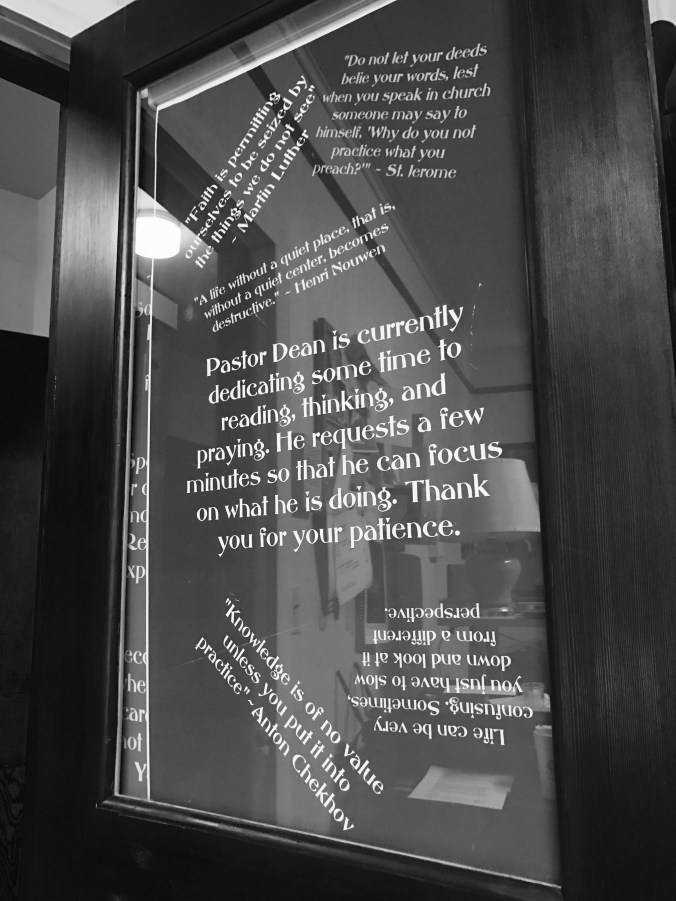
I find this quote to be inspiring. If you come by my door on any given day you might catch me at prayer. When I’m praying in my office I hang up a blue poster I had made over my office door’s window. It looks like this…

FullSizeRender 4

The quotes I put on that door-hanger are there with great intention. The Henri Nouwen quote always catches me in much the way that the quote from the Guide catches me. Nouwen was right–a life without that quiet center can easily become very destructive.

I don’t know Father Holmes myself, but I would wager to bet that he would tell you that his inability to focus himself into stillness did damage that day. I know that there have been moments when my inability to find that silent and still place led to great destructiveness. Sometimes that destructiveness came out of a place of violent response without care and sometimes that destructiveness came out of a place where I was unable to respond with intentionality instead of reactivity. The fact of the matter is that a lack of stillness made me unable to be the person I needed to be in those moments.

Of course it isn’t easy to enter into that stillness. In the book Spiritual Disciplines Handbook by Adele Calhoun, the following quote on silence always strikes me as true:

“In quietness we often notice things we would rather not notice or feel. Pockets of sadness or anger or loneliness or impatience begin to surface. Our own outer agenda looms larger than our desire to be with God in silence. And as the silence settles in and nothing seems to be happening, we often struggle with the feeling that we are wasting time. Everything we notice in this struggle can become an invitation to prayer. Like a can opener, the silence opens up the contents of our heart, allowing us deeper access to God than we experience at other times. As we remain in the silence, the inner noise and chaos will begin to settle. Our capacity to open up wider and wider to God grows. The Holy One has access to places we don’t even know exist in the midst of the hubbub.”

I am betting that Father Holmes found a bit of himself on that day when he was unable to find stillness, but I wonder what depths could be achieved if he had the presence of mind to enter into stillness before listening.

I often find myself in a completely different place if I slow myself before I enter into deep conversation. The stillness I find in silence can enable me to listen to others while being aware of what is in my own silence.

When talking to a pregnant mother I might easily be distracted into talking about what it would feel like to become a father again. Thankfully my own periods of stillness have revealed a desire in me to want to change that particular subject to revolve around my family. As a result I can actively resist my own temptation. The same is often true when I enter into conversations around rough childhoods, difficult relationships, and forgiveness. It is in learning to be still and silent that I have become a better person when it comes to having conversation with others about their lives.

In truth, silence is never especially easy, but it has many benefits. What challenges do you see to silence in your life? Does the inability to find that still center affect the way that you go about life?

Let us Ramble: Distractions

Martin Luther is translated as saying “I have so much to do that I shall spend the first three hours in prayer.” I often laugh at this saying because there are so many distractions in life. There are entire days where the only consistent thing in my life is that there is something or someone hollering for my attention. The first three hours in prayer? I am sometimes lucky to carve out the first three minutes before the knocking and ringing begins.

With that being said, I want to make a case for allowing ourselves to be distracted. I do not mean when driving or doing something incredibly dangerous. I think we need to allow ourselves to be distracted from lives that can often be overly scheduled, overly planned, and overly busy.

Last fall I was driving to and from the Veteran’s Home in Oxford, NY. It was a quiet fall day and I had been incredibly busy running from visitation to visitation when it happened. I was driving over a hill when the light of the sunset caught the leaves as they were blowing out of the trees. There was riot of reds, yellows, and browns caught up in the golden glow of the sun. It was breathtaking. I was moved to tears.

I had been so focused on what I was doing that day. There were places to go and people to see. I had run into Wegmans and barely slowed down to talk to a church member and her husband because I was focused on getting Swiss Cake Rolls for a homebound gentleman who can’t get out. I ate lunch in the car while parked in a parking lot texting. I had started the day in prayer but had not taken a moment to breathe since the day had begun. I was rushing until God effectively painted a picture of majesty and I rushed straight into the midst of God’s glory on stage.

The exact term for the spiritual discipline of focusing on the glory of God revealed in creation is VIsio Divina. A quick Google search will reveal there are books and resources in spades on this concept. For me Visio Divina is summarized as praying with one’s eyes.

I think it is very hard to engage in that type of prayer if we don’t allow ourselves to be distracted from life. Sometimes, we plan things so tightly that we don’t have time to notice, time to see, time to perceive, or even time to pray. Holy distractions are necessary sometimes.

So how do we make ourselves available to holy distraction? I have some thoughts.

  • Start every day with three hours of prayer like Martin Luther. If you cannot find three hours to pray, then at least begin the day with a prayer that your eyes would be open to see and perceive what is around you. You might be surprised how a quick prayer to open your eyes can help you to see far more than you expect.
  • Set aside time for Sabbath rest. Do not spend all of your time working, playing, driving, and doing the things of life. Take a half-hour for a walk with a friend to see how the world around you looks. Sit with your thoughts for a bit while looking over a valley. Go to the library and find a book with pictures of the plains of the Serengeti or the Rocky Mountains. Sit with that book for a while and see God’s fingers in creation.
  • Take a moment at the next red light to look at the sky. Just don’t forget to keep an eye out to see when the light turns green.
  • Tie a string on your finger first thing in the morning and only take it off after you’ve seen something God has created to be beautiful.

There are a million and one ways to be distracted by God’s creation. May your distractions be good distractions and may they be welcome when they come.

Let Us Ramble: Light and Darkness

So, last Thursday I had a cornea transplanted onto my eye. At first I thought that the eye-shield was going to be the most annoying part of the recovery process. I learned the truth when the covering was removed. Light hurts and it hurts a lot.

Yesterday was Sunday morning and a parishioner was on the phone with a gentleman I was praying for in the church parking lot. She waved me over to talk with the gentleman on the phone. The only problem was that the sun was out and she was parked in the light. I reached the edge of the shade from the church, stepped out, and recoiled. I covered myself with my arm and suddenly realized that I had just pulled a move straight out of a vampire movie.

Over the course of a couple of hours I went from a denizen of the day to a creature of the night. The following verses have been altered from Psalm 130 to fit my recent circumstances: (NRSV, morning changed to sunset)

“I wait for the Lord, my soul waits, and in his word I hope: my soul waits for the Lord more than those who watch for the sunset, more than those who watch for the sunset.”

Last night I literally caught myself getting excited about sunset. When the sun went down I literally grabbed my keys, hopped up and down, and then went out to Wegmans where I walked around with sunglasses getting the things my wife asked me to grab if I was going to go out of the house anyway.

It made me think as I went to lay down to sleep. When was the last time I was that excited for the dawn? For that matter, when was the last time I was that hopeful and expectant on God to show up in a set of circumstances?

I was waiting for this surgery for three months. You would think that waiting for surgery would be a moment where I waited with anticipation, but to be entirely honest, I felt myself surrounded by prayer and felt a sense of peace. I was relieved when they found a cornea and I was excited when I saw one blurry and distorted sight, especially as the phantom extras of keratoconus were gone–it was just a blurriness, which was a vast improvement. I felt relief, excitement, a titch of concern, and a million and one other things, but was it more than the excitement which a watchman has for the dawn or even a transplant patient waits for the darkness?

Perhaps this is privilege at work. I have lots to pray for and lots to care for, but let’s be honest. My life is surrounded by an illusion of safety. The police are a phone call away, the fire department is around the corner, and the ambulance squad is literally a couple of hundred yards away. There are no invaders on my borders and frankly the biggest nuisance animal in my life is a squirrel who keeps driving me nuts. I live a sheltered life and I generally don’t need to wait for the dawn.

The question I have in this moment is whether or not I can learn to appreciate and live with those who do not have the same certainty and sense of security. Can I truly appreciate what it feels like to be unsafe? Can I truly understand what it might be like to not have trust in the institutions around me? Can I live into those places where others are not as privileged as me? Can I work to either share that security or reject it when it comes at the cost of others?

Jesus taught that we should treat others like we would like to be treated. Perhaps this is a moment where I can sit in the dark and think about what it means to want flee from the things that make others feel so safe.

By the way, I don’t say “Blah, blah, blah…”

Let us Ramble: Stones in the Garden

I was walking by the edge of my garden when I saw the little rocks that came up when we were tilling the garden last spring. We tried to lay them up as a pretty edge, but as winter went along the shoveling and snowblowing just made them look like a muddy mess in the midst of where the vegetables will grow. I don’t mean a little mess. Just take a look at that mess!

IMG_8348.JPG

Mud, stones, needles, leaves, and other crud. Yuck! What a mess! It made me immediately want to borrow a tiller and get to work on the garden. It may seem warm out, but there’s still snow from that giant storm a few feet away.

This messiness gets under my skin at some level, but to be honest, I’m not sure it has anything to do with the actual mess. It is just a garden. Meanwhile, the world around us is filled with bigger messes. Think for a moment about the broken places of the world. Violence in places like Cincinnati, London, and Mosul. Hungry folks going without while restaurants fill dumpsters with good food that they won’t share for fear of a lawsuit. I even saw a picture online of a guy waiting underneath a breaking Wal-Mart sign hoping the letter would fall, injure him, and give him a chance to make a fortune through a lawsuit. I really hope that one was photoshopped.

The world around us is filled with injustice and people who seek their own welfare at the direct expense of others. It is a dirty and rotten world sometimes. The mud, rocks, and muck seem to pile up everywhere and it can be hard to find beauty in the midst of all the frustrating wickedness we see in the world.

I find hope in passages like Psalm 37: (NRSV)

“Do not fret because of the wicked; do not be envious of wrongdoers, for they will soon fade like the grass, and wither like the green herb.

Trust in the Lord, and do good; so you will live in the land, and enjoy security. Take delight in the Lord, and he will give you the desires of your heart.

Commit your way to the Lord; trust in him, and he will act. He will make your vindication shine like the light, and the justice of your cause like the noonday.

Be still before the Lord, and wait patiently for him; do not fret over those who prosper in their way, over those who carry out evil devices.

Refrain from anger, and forsake wrath. Do not fret–it only leads to evil. For the wicked shall be cut off, but those who wait for the Lord shall inherit the land.”

I find hope in these words. I could get all worked up about the garden, but there’s a wisdom to patience. Instead of pointing out the very obvious meaning of these words, let’s look at what is happening in another part of the garden. Here’s what the garlic patch looks like after a long winter…

IMG_7444.JPG

Yes, the strawberries are invading, but they’ll be fine with the garlic. Yes, the stones might be sinking in a bit, but they’re still there. Underneath the snow they waited for spring to come. Now that it is here, they can do their job of reminding me not to mow over the strawberries and garlic. Even when all seems yucky in one part of the garden, in another there is still order and goodness at play.

May I invite you to keep your eyes open for the places in the world where God is at work in our midst? May I invite you to take a deep breath and be still before God when the world seeks to overwhelm you with wickedness? May I remind you that the grass may be green and the herb may grow quickly, but they are only here for a season.

Someday the plowshares will be forged from sources of pain and sorrow. One glorious day there will be no need for the things we grasp so tightly for our defense. May God hasten that day and give us patience in the meantime. May God teach us to share and to fight for justice. May we help bring food to the hungry and wisdom to the people waiting below signs. May God bless us as we seek to make the world a more lovely garden.

Let us Ramble: Quote in context

Let’s play a game. I’ll give you a quote and you tell me when it was written… The attribution comes after:

“The adjustment of the Christian message to the regeneration of the social order is plainly one of the most difficult tasks ever laid on the intellect of religious leaders. The pioneers of the social gospel have had a hard time trying to consolidate their old faith and their new aim. Some have lost faith; others have come out of the struggle with crippled formations of faith… If our theology is silent on social salvation, we compel college men and women, workingmen, and theological students, to choose between an unsocial system of theology and an irreligious system of social salvation. It is not hard to predict the outcome. If we seek Christian doctrine unchanged, we shall ensure its abandonment.”

All of this talk about the challenge of the church to engage in a life of faith without abandoning the culture around us… It seems so very contemporary! If we don’t change the way we engage with the world around us, surely the church will collapse! If we change without care, what will become of our faith? Surely this was written by someone yesterday as they pondered the role of religious people in the politics of our divided nation. Surely it was a quote from someplace like that article on Reuters about the rise of the religious left.

No, the quote was from “A Theology for the Social Gospel” written and published by Walter Rauschenbusch in 1917. Yup, that quote is literally a century old. The church has been struggling to adapt to the world around it for at least a century.

The church does have a struggle. Let’s be clear about that fact right off the back. Attendance is lower than it used to be even ten years ago. Church checkbooks are struggling and plates are emptier. People have other priorities and sometimes soccer really does seem more important than church. Watch any standard movie about a struggling young mom. Is it more likely to show her dragging them to church or running late to soccer practice? You said soccer, right? The struggle of the church against the pressures of the world is quite real.

Let me drop an opinion on you. I believe that the struggle has been a real struggle for the entire history of the church. Why did the desert mothers and fathers retreat into the wilderness in places like Egypt? In part because they were called. In part because they couldn’t see how they could pursue God in the midst of their social context and felt called into a monastic existence in the wilds. The church and culture collided in those early centuries.

Why did the Orthodox and Roman churches split? Where did the Protestant Reformations and Catholic Counter Reformations come from in later history? Why did the Methodists start a church in the Americas after a revolution split the kingdom of Britain? Why did the Anabaptists reject pretty much everyone around them? How did the Mennonites and Amish end up disagreeing? The world and the church have always had challenges. Those challenges have led people in different directions.

There’s one constant through all of these stories. The church continued, albeit altered, when the monastics left for the wilds and challenged the church to change. The church continued, albeit altered, when the Orthodox and the Romans split courses. The church continued, albeit altered, when the Protestants went a million different directions while the Roman Church went in her own directions. Through all of our history, Christianity has continued to survive through all of her challenges.

One hundred years ago people were questioning whether the church could survive and thrive in a different world. I know that these days are somewhat challenging to many folks as a result of all the strange things going on with church attendance, church trends, and seeming crisis after crisis. Can I suggest that the church will survive even if it does not look the same in one hundred years?

Also, I’ve been late taking my kids to soccer practice more than once in the past few years. I have also missed at least one art show because a meeting ran late. It isn’t just moms movie people. Just saying…

Let us Ramble: Bone broth

Okay, so this one is clearly a ramble… Last week my wife had what looked like the beginnings of a cold. I jumped into action–Super Husband away! I ran to the store, thought through my rambling brain for something that would make my wife feel better, and got stuck somewhere around the idea that chicken soup always made me feel better.

The problem was that I didn’t have any chicken bones or carcasses to make broth. I decided to grab some beef bones and make some broth. A quick internet search showed me that the only other thing I didn’t have in my pantry for a healthy bone broth was parsley, Neck bones, marrow bones, and parsley in hand, I went back home to work on this recipe from WellnessMama.

I didn’t read the directions. Two days of simmering in a stock pot. Our house smelled amazing for the morning of the first day. By dinnertime I was beginning to get a little tired of the smell, especially since Kayti was feeling better already… On the morning of the second day I thought I’d never get the smell out of my nose again. I let it cool a bit, refrigerated some, and froze the rest.

On the third day after I had resigned myself to smelling it again I made my wife French-Onion Soup using the bone broth. It was light and delicious. Last night I made some jasmine rice with the bone broth. It was so delicious and flavorful. I seriously cannot begin to express how amazing the broth turned out and how very glad I was that made the bone broth. It seemed like it took forever, but when it was done it was fantastic.

I’ve looked at those bones in the supermarket so many times and thought “Who buys these things?” I often look for boneless meat because I don’t want the hassle of pulling out the bones and getting rid of them. I cannot begin to describe how moist, fragrant, and delicious the jasmine rice was that I made in that broth.

My revelation about the bone broth reminds me of a story from scripture. This is from Jeremiah 18:1-6: (NRSV)

“The word that came to Jeremiah from the Lord: ‘Come, go down to the potter’s house, and there I will let you hear my words.’ So I went down to the potter’s house, and there he was working at his wheel. The vessel he was making of clay was spoiled in the potter’s hand, and he reworked it into another vessel, as seemed good to him.

Then the word of the Lord came to me: Can I not do with you, O house of Israel, just as this potter has done? says the Lord. Just as the clay in the potter’s hand, so are you in my hand, O house of Israel.”

My experience of this passage is very much like my experience with beef bones. When I was in middle school we moved to Grand Island, NY. Our backyard was lush and green…for about 4 inches. Below the 4 inches of topsoil was clay. Heavy, heavy, impossible to dig-through clay. Whenever my dad wanted to work on an outdoor project below the surface the clay became the bane of my existence. Planting trees was nightmarish. Putting in stone landscaping was abominable. I hated clay with a passion I had for no other mineral except for that sand that got in my swim trunks at summer camp.

Shortly after marriage my wife and I had a child. We didn’t get out much, but one of the things we did to spend time together was going on a date to a pottery painting place in Rochester. The hated clay was there, but it was pre-shaped into wonderful shapes. We painted, we doodled, we played with brushes and shapes… The hated clay became a beautiful cross that hangs with a place of pride in my house. Here it is!

IMG_7497.JPG

I know it doesn’t seem like the most beautiful thing in the world to many of you, but to me this bit of once miserable clay is beautiful. The three colors represent not only the trinity, but also my family. I love orange, so I saw myself on the bottom. My wife loved darker red, so I saw her up on the right. Green was a beautiful living color and represented our child to me. In the middle the colors mingled making one funky shape filled family. The hated clay of my childhood was transformed into something that still touches my heart in a special place.

Israel was being judged in this section of scripture. There is no question in my mind that Israel was not being built up by this imagery. The clay of the nation of Israel was going to be reshaped regardless of their opinion. All of that being said, as someone who reads in the midst of a different kind of exile (as a Christian in the midst of a chaotic world), I find comfort in the idea that God can work in the midst of my odd, sometimes dry clay. It might not be easy, but God can do beautiful things even in the midst of a world of ruined pots, wildly whipping wheels, and flying clay.

My prayer is that God might use my weird clay to make something beautiful in this world. My prayer is that God might take the bones I can offer and use them to make something glorious, light, beautiful, and life-giving to the world. My prayer is that I might not just see the broken nature of the world but might also see where the divine is at work in the clay.

May God work in the clay that you see in the mirror and help you to be rebuilt into something amazing. May God take your bones (even the broken ones) and make something life-giving out of your journey on earth.

Let us Ramble: The Cloud

So, as previously mentioned, I’m working through “Spiritual Disciplines Handbook: Practices That Transform Us” by Adele Ahlberg Calhoun. For the last few days I’ve been pondering my way through one particular quote. I promise you that I’m not just hanging around in the first chapter (as it isn’t that kind of book), but that chapter has a lot of good thought-nuggets. The quote comes from page 21:

“Becoming aware of what is true and false about us is essential for spiritual growth, and it is not always comfortable. So when we find ourselves in the space between desire and demand, when we are waiting on God and nothing seems to be happening, we must remember this space is an opportunity. In the unfixables of our lives we are invited to keep company with Jesus and take a risk that God’s intentions toward us are good.”

This quote has been running through my mind almost constantly for the past few days. I will hopefully be undergoing a minor surgical procedure in a few days and I have been waiting for news on whether or not a transplant will be available. It has been an anxious moment in time for me. It has also been quite revealing.

As a pastor, I sit with folks and I often invite them to trust in God in similar moments. I tell them that nervousness is natural but that worrying will do little good in their lives. I invite them to find faith through their trials, yet as I approach the same trials I find myself in a place where I can clearly see my own anxiousness. The veil that I put over these parts of my life has been worn pretty thin in the past few weeks–I can see that there is room for personal growth in faith.

It isn’t easy to grow into that faith, especially when the comfortable cloak of the false-self is peeled back. As Pastor Calhoun writes, when we’re in that space of waiting on God it can be uncomfortable, but it also an opportunity. I was speaking to a parishioner the other day about a similar place of anxious waiting. I drew her a doodle similar to this one…

IMG_0105

On the left we have all of the stuff we know is within our control. On the right we have the place where we need to go. In the middle we have a greatly distorting and disguising cloud. Anything can be in there. It could be a giant gap of nothingness filled with cloud or it could be the world’s most sturdy platform. One thing is true regardless of whatever is in there. Whatever sits in that mysterious fog is unknown.

I explained what I had been processing from Pastor Calhoun’s writing. In the midst of what I can control and what I can not control there is an opportunity to trust that whatever rests in that cloud is something good. Occasionally in life we have to trust that God does intend good things for us. Occasionally in life we are called to take the proverbial leap of faith.

My own necessity for a leap of faith has been half of the reason why this quote has been in my mind lately. The other reason it has been in my mind has been the other concept lifted up in this passage. We have the opportunity to trust but we’re also invited to keep company with Jesus through these moments of stress.

What does it mean to keep company with Jesus? It has meant many things to many different people. Perhaps it means…

  • Caring for the least around you.
  • Reading through Jesus’ story on a regular basis and letting the stories sink into our heart, being, and soul. Maybe it goes deeper into certain portions of Jesus’ story during certain seasons. Maybe it is simply taking a parable or story and pondering it each morning.
  • Entering into the holy sacraments with regularity. While my church does not engage in weekly communion, many churches keep the tradition of sharing the Lord’s Supper as often as they meet. John Wesley, one of the founders of the Methodist movement, had a lot to say about that in his sermon “The Duty of Constant Communion.” My experiences in places where I have had regular communion have been a blessing.
  • Caring for the least around you…
  • Spending time on a regular basis going into one of the many spiritual disciplines that have helped people to go deeper in their faith through the centuries. A lot of people fixate on the disciplines like silence and fasting, but there are many different ways people have gone deeper in their faith. Maybe you are drawn to the Examen (to overly simplify, a practice of seeking to find God in your daily life) or to prayer walks.
  • Letting God interrupt your busyness with prayer. Perhaps you set a new rule that you take a moment to pray before you get out of your car when running errands or perhaps you stop to take a moment to give thanks in prayer for your baptism when you wash your hands. Perhaps, if it is feasible, you find a simple ring and wear it for a season so that each time you notice it rubbing against a pen, pencil, or steering wheel you remember to pray. Yes, that is a very similar idea to tying a string to your finger to remember something. Yes, a string would work too.
  • Perhaps you need to spend some time in confession so that you feel comfortable both with God’s forgiveness and with a growing proximity to Jesus. I know it seems strange to list that as a way to keep company with Jesus, but the old saying is true. Confession is good for the soul.
  • Caring for the least around you… Why yes, Jesus did tell a story where the King said “whatever you do to the least of these, you do to me” (Mt. 25). Perhaps one of the best ways we can keep company with Jesus is to be with folks who need love and compassion.

Keeping company with Jesus can come about in many different ways. For me half of the journey has been finding the courage to take the leap and the other half has been focusing my heart and mind on keeping company with Jesus in my anxiety.

If you find yourself in a similar place of anxiety today, I hope you know that I am praying with you. May God bless us all as we seek to walk with Jesus through all of the strange and unknown parts of life.

Let us Ramble: Seeking Wisdom

So, it is no secret that I have been working on preparing for the beginning of my journey with the Academy for Spiritual Formation this summer. I have been buying books, listening to audiobooks through Audible (I’m not paid to endorse them, but they’re pretty cool) while walking at my treadmill desk, and searching the scriptures for wisdom.

I have been carrying around a little yellow composition book that I have been filling with quotes and scriptures that have been inspiring me to ponder the depths of my own spirituality. Writing things with my hands helps me to remember them. I recently added this set of verses that have long been favorites of mine. This is Psalm 2:1-11 in the NRSV:

“My child, if you accept my words and treasure up my commandments within you, making your ear attentive to wisdom and inclining your heart to understanding; if you indeed cry out for insight and raise your voice for understanding; if you seek it like silver, and search for it as for hidden treasures then you will understand the fear of the Lord and find knowledge of God. For the Lord gives wisdom; from his mouth come knowledge and understanding; he stores up sound wisdom for the upright; he is a shield to those who walk blamelessly, guarding the paths of justice and preserving the way of his faithful ones. Then you will understand righteousness and justice and equity, every good path; for wisdom will come into your heart, and knowledge will be pleasant to your soul; prudence will watch over you; and understanding will guard you.”

I find that passage beautiful and it has ended up in the yellow composition book because it rings deeply in my soul. Part of my own journey lately has been one of crying out for insight into the challenging parts of life and indeed raising my voice to ask for understanding.

The very fact that I have a yellow composition book for this purpose speaks to the very depth of my desire. I have many notepads, but only one is labeled at the moment. I have many legal pads of paper, but only one composition pad is clipped shut so that the pages don’t flap around. I have many pads of paper, but only one has the internal nickname of the “Composition Book of Doom.” Don’t you think “doom” is a nice synonym for “fate”?

I want to go deeper in my own relationship with God. Yes, the Academy will likely help me to be a better pastor, but I have a thirst to go deeper in the practices that I will learn there for the sake of my own soul. Yes, by the way, your pastor has a soul and it is just as human as the average lay person’s soul.

In 1 Corinthians 9:26-27 Paul says “So I do not run aimlessly, nor do I box as though beating the air; but I punish my body and enslave it, so that after proclaiming to others I myself should not be disqualified.” I do not want to run up and down hills like a student in a high school sport team. I do not want to box the empty air even if it would make my form appear phenomenal. I want to make it through this journey and reach the end with God’s blessing.

I am a pastor. I have two (2) degrees that revolve around religion and religious practice. I am approaching 10 years of experience as a pastor. I have served in country churches and suburban churches. I have been friends, colleagues, and hopefully allies to Baptists, Presbyterians, Anglicans, Roman Catholics, Christian-Missionary Alliance, Free Methodist, Wesleyan, and non-denominational sisters and brothers in Christ. I have been around the block and have begun to develop the thick-skin that a pastor needs to survive the day-to-day life in the church. I have been and done all these things that I can now point to as positives in my life, but let’s be entirely honest. I still have days when I wake up, reflect on what happened the day before, and wonder how I will get through the day ahead of me.

I cry out, I raise my voice, I seek, I ask, and I plead with God that I might survive this hair-raising experience called ministry. I pray daily that my wife will speak to me at the end of this journey, that my kids won’t be spiritually scarred, and that I will one day hear the voice of God say “Well done.”

I want to invite you to consider the ways you seek God’s wisdom for your life. Is there a better Monday blog invitation than to invite you to think about how you’ll seek God’s strength for the week ahead? How will you seek God? Will the week ahead be a blessing?

Let us ramble: Jesus and personal responsibility

So, I’m currently beginning to read through “Spiritual Disciplines Handbook: Practices That Transform Us” by Adele Ahlberg Calhoun. I’m preparing to participate in an upcoming session of The Academy for Spiritual Formation for the next two years, so one of the things that I am reading through is this handbook. It is not required reading, but I am starting to wade into some deeper waters.

A phrase stuck out to me today while reading. On page 18, Pastor Calhoun states:

“Jesus doesn’t grant requests like a genie in a bottle. He works with people, allowing their desires to draw him into the core conversations of life. For Jesus, requests for water, healing, rest, vindication, approval, status and so on all engage soul hungers. Misguided, self-destructive, true or addictive desperations and desires opened doors to relationship”

Pastor Calhoun goes on (I’m paraphrasing) to state that as we watch Jesus in ministry with people who make such deep requests requests we see Jesus delve into God-sized issues. These issues are generally resolved with Jesus leading people either to see the true nature of their desires or to a spiritual-practice that might help get at the core of requests. Speaking directly to the reader earlier on the same page Pastor Calhoun writes “Jesus knew you wouldn’t get well if you didn’t want the responsibility that came with wellness.”

I find all of this to be incredibly fascinating because I deal with people’s requests to God on a regular basis. Nearly every week of the year we lift up the “Prayers of the People” during our church service. Sometimes, especially on major holidays when things are a bit busy, we might use a Bidding Prayer to lift up all concerns at once through a communal prayer (which is usually the Lord’s Prayer), but generally we have an opportunity to lift up to God a word or two about a prayer request. Sometimes it is just a name and sometimes people lift up a situation, but there are often a lot of requests that cover everything from lifting up families in grief, to people fighting cancer, to life-victories like a loved one’s graduation from high school, to…well, pretty much anything! People lift up a lot of things in prayer and I am often happy to lift them up.

One of the reasons I am happy to lift up the prayers is that I generally am not placed in a place where I have to pass judgment on any of the requests. If Mrs. Doe wants to lift up her unmarried daughter Jane, it really is neither may place to tell her if her request is right or wrong nor is it generally my place to answer her prayer. Such matters often fall to God. These prayer requests often fall on Divine Shoulders, but not always.

Let me explain what I mean. When I was just out of college I came home to my town and the church I attended as a teenager. I loved attending Trinity United Methodist Church on Grand Island. Sitting in the pew every Sunday a plate was passed where we were invited to write down our prayer concerns. Almost every Sunday I put a slip of paper in the plate. The slip almost always said the exact same thing. It requested prayers for God to help the unemployed.

I lifted up that prayer request to God weekly and the pastor faithfully prayed for the under-employed and unemployed (kudos for expanding the prayer request into multiple areas of need). I walked out of church feeling God’s blessing on my shoulders, but do you know who had to place each of my job applications into the hands of the potential employers? I was the only one who could begin the process of having my prayer answered. To be certain, there were moments when I felt divine grace helping me to get out of my bed and try again, but there were also moments where the answer to my prayer required my participation.

Some part of me is led to thought when I read Pastor Calhoun’s words “Jesus knew you wouldn’t get well if you didn’t want the responsibility that came with wellness.” If I wanted to get well after college, if I wanted to pay my own bills, if I wanted to buy my own food, or if I simply wanted to be able to sit tall in church knowing that I wasn’t just using up heat and space (which I thought at the time and now thoroughly shake my head at now–that’s why the church is a public building and not a private chapel!), then I needed to take the responsibility that came with my wellness.

I think back through the scriptures and ponder a lot of the places where Jesus brings wellness into the lives of people. Jesus heals a Gerasene in Mark 5 and the man begs to go with Jesus, but the Gerasene is not called to go with Jesus. The Gerasene is given wellness, but that wellness seemingly comes with a cost. The Gerasene is sent to Decapolis where he tells people about Jesus. His blessing comes with the responsibility of wellness. He is called into his own ministry–no more tombstones and graves for the Gerasene.

In John 9, Jesus heals a blind man and being able to see immediately complicates the life of this formerly blind man and seemingly his whole family. Jesus heals and there comes a cost with that wellness. Was the formerly blind man willing to live up to the responsibility of wellness? When they interact later, the man worships Jesus, so it seems that the man was indeed willing to accept the challenges that came along with wellness.

I pursued my own wellness even as I lifted up my prayers and I was fortunate and blessed enough to find a place to work, but so often the prayers I hear lifted up both in church and in private come with a high responsibility if there is to be wellness. A few areas I see this to be true are listed below…

  • Right-relationship: People often want others to repent of their actions and ask me to pray that their friend, spouse, neighbor, family member, etc., will change in a powerful way. Right-relationship often requires that both parties be willing to flex, bend, be humble, forgive, etc. It is common to pray for others to change. It is not wrong to ask God to be in a relationship, but it often requires personal commitment to the process of making the relationship right before healing can take place.
  • Finances: People want the world to be a place of sunshine and roses. I know this is true because I am just as guilty as the next person. I would love to have a car without rust, without creaky noises, and without the high number of miles that my car currently holds. The terrible van still runs as of this blog post. In fact, in honesty, the fact that it still runs relatively-reliably may make it a bit self-absorbed and ungrateful to nickname it the terrible van.People would love to see a world where they have lots of money and they often ask why God cannot just give them a fortune. I truly believe the answer is often that people cannot have a fortune because they honestly do not need it. I also believe a lot of us have fortunes that we do not recognize because we do not see all that we have in our lives.I also believe that there are times when some of us would have fortunes if we were wise with the money we received. There’s a responsibility to look, to see, and to recognize when we are blessed. This may seem strange, but Netflix is not a spiritual gift. Christians are called to seek after the gifts of the Spirit and sometimes the nice things of the world do have a temporal cost that we have to accept if we desire them. I am not casting judgment on Netflix, but I do believe the actual value of the service compared to other temporal needs is worth thought.
  • Forgiveness: This one hurts… People pray that someone else will forgive them. Sometimes forgiveness does not mean forgetting. Sometimes forgiveness can only be offered responsibly if precautions are first put in place. If someone were to hurt my daughter I might bring myself to forgive them, but you had better believe that my forgiveness does not mean that I will automatically leave them alone with my daughter.In all honesty, there have been times in my own ministry where people have hurt me deeply simply because they are angry at God. I forgive them as I understand that they are not always capable of understanding their actions or even capable of asking for forgiveness, but that does not always mean that I want to spend time extra time around them waiting for another round of abuse.Can I always avoid such individuals? Of course not. Will I treat them poorly? I hope not. Will I go out of my way to spend more time with them so they can keep hurting me? Not unless I am led by the Spirit–Jesus is their Savior, not me. Sometimes they need to work out their anger with God before they can come to a place of resolution and restitution. I have heard it said before “We are called to love our neighbors. Loving someone does not always mean that we have to like them.”

    The same concept (having to work through the reason why pain was caused before forgiveness can be truly and completely extended) often holds true when we want others to forgive us. We may pray that others will forgive us, but occasionally that forgiveness does not come with an automatic pass back into the life of the person we have hurt. In extreme cases, this might even lead to a divorce in a marriage or estrangement with a loved one or family member.

    If this is the first time you have considered this idea, feel free to talk with me or (even better) to a profesionally trained counselor about it in private. I may even be able to recommend a counselor to help you work through this if you live locally. It is not weakness or failure to seek help when you are struggling. If anything, admitting your limitations is a sign of strength.

  • Wellness: I’m typing this blog-post while walking at my treadmill desk in my church office. Why? I prayed to God to help me to live a healthier life so that I could help my daughters grow up. My wife and I scraped through half a year without mileage reimbursement checks while going through multiple car repairs (see the terrible van comments above) and paying down a child’s surgery bills so that I might be able to get a piece of equipment that could help me to live a healthier life. The responsibility for my wellness rests partially and often heavily on my own shoulders.

Pastor Calhoun is right–God does not act like a genie every time we pray. I know passages like these challenge me to not only teach more deeply on prayer in my own ministry, but also to go deeper in how I support both my own prayer requests and the prayer requests of others. I hope you think more deeply about your own prayers as a result of these reflections. May your own requests draw you deeper into your relationship with Jesus.