Malvern’s Retreat House has a fifteenth Station of the Cross! It is a station celebrating the resurrection! Happy Easter!


Malvern’s Retreat House has a fifteenth Station of the Cross! It is a station celebrating the resurrection! Happy Easter!


Note: A friend of mine once called this statue “Jesus with a six pack.” Artistic license is alive and well, even in statuary.


Today’s Photo-A-Day prompt from Rethink Church is “Silent.”


Today’s prompt for the Rethink Church Photo-A-Day is “Needs.” I decided I would write a Haiga, but wanted to give some background. A lot of folks over the years have joked that ministers work “an hour a week.”
We work far more than that amount. I run to hospitals, go to Nursing Homes, write sermons, read books, counsel the troubled, plan outreach, visit the sick in their homes, and try to be peacekeeper in everything from committees to marriages. I have spent sleepless nights thinking about the needs of my church.
There really are nights that I have trouble even going to sleep because my church has needs that I cannot fulfill, but must rely on God to meet: such trust does not come easily even for clergy. There are nights I wake up with bad dreams as a result. Despite all the rumors, ministers often do not see God face to face. We, too, have to rely on faith.
An honest response to this prompt for me is to show an “empty” church. I do not show it because the seats are empty. I show it because the seats are full for me.
I see the folks looking for a word of life during a funeral, a word of acceptance during communion, and a word of joy during a wedding. I see folks in tears, folks with smiles, and folks laughing. I see folks in doubt on Christmas Eve who have been dragged in by their family and folks with a smirk on Easter morning who have been brought by their loved ones. I see those folks next to the hopeful. This space is a sacred space that encompasses all of those emotions, relationships, and more.


Friends, I am preparing for the fourteen days before Good Friday. Starting Friday, April 5th, at noon, a post will automatically come up every day until Good Friday.

The pictures were taken on the walking stations of the cross outside the Family Life Center at the Malvern Retreat House in Malvern, Pennsylvania. The artist was Timothy Schmaltz, although my understanding is that Mr. Schmaltz did not have his name listed on the monuments. His work was to honor God and not his own talents (which are considerable).

The pictures were taken throughout a year in all four seasons. I find that contemplating the images throughout the year led me to different places in different seasons. The cold of snow in winter affected the way I saw the scenes as much as the heat (and vibrant) greens of summer.

I’m posting the pictures for those of us who find depth in contemplation. I appreciate that all of the statuary was done in black metal, which allows people of all sorts to contemplate the imagery. I do not believe it is cast-iron, but there is something relatable about seeing an image cast in something you can find in my kitchen (like a dutch oven) instead of something I only see in places of power and influence like marble.

I hope the posting of these images help lead you to a place of contemplation as we approach the cross. Blessings to you.
All people have rough days. Ministers are no exception. Today has been a difficult morning for me. I have wept, I have prayed, and I have reached out to friends. One friend recommended I read two psalms, so I did the natural thing: I turned to a completely different psalm. I am, if nothing else, predictable.
I spent time in Psalm 127 trying to get my head back on straight. The following poem is inspired by the first two verses. It is a rondelet, which is my favorite syllabic poetry form outside of the various forms of Japanese Haikai.
Find rest with God.
“Find rest with God” Rondelet (inspired by Psalm 127:1-2) by the Distracted Pastor, 2019
Anxious thoughts do not give life birth.
Find rest with God.
There will come no bread from poor sod:
Unless the Creator brings forth
There will come nothing of true worth.
Find rest with God.

Recently I was reading an article in the April 2019 edition of Sojourners magazine called “Kill the Chicken to Scare the Monkeys” by theologian and anthropologist Michel Chambon. I found the article fascinating as it reflected on the ongoing relationship between Chinese Protestant Christianity and the government under which they live. I found it fascinating because it had a greater level of reflection on the relationship between the church and state in a land I know little about in general.
I read various things about Christian practice I did not even realize where are part of the practice of my beloved family in another nation. Did you know that Christians lead large calisthenic groups in places like Nanping? Did you know that the Chinese are also facing the crisis of an aging population? I did not know that was happening. Most of the news I have seen over the years has focused on trade issues, pollution issues, or religious-freedom issues. In particular, they taught me growing up that the Chinese church was consistently and constantly under pressure. In fact, the church that the sources I read taught me about growing up could never exist openly–a public gathering of Christians to exercise was beyond my comprehension.
What makes this interesting is how Mr. Chambon presents the information. Mr. Chambon states:
“The Chinese state–like every other state–operates under its own political tradition and in relation to its own national culture. Chinese religious police is not only defined by a supposedly coherent national law but also through the agency of local officials who play a key role in its implementation. In practice, state control is heterogenous and varies from district to district. It relies on the balance of power between local officials, religious actors, social needs, and regional history.
Michel Chambon in “Kill the Chicken to Scare the Monkeys” (Sojourners, April 2019, pg. 8)
In some places, local officials have imposed stricter regulation and monitoring on Christians and other social actors. In other places, they have destroyed Christian churches and jailed a few leaders. But in my view, this does not represent a general crackdown on Christianity. It reflects instead the Chinese policy of ‘killing a chicken to scare the monkeys’–applying a heavy hand on one group is publicized to push others toward self-limitation and censorship.”
At some level, this should have not needed to be spelled out to make sense. Part of the struggle of the United Methodist Church is the belief we can set an international policy on human-sexuality without understanding that there needs to be a reliance “on the balance of power between local officials, religious actors, social needs, and regional history.”
At some level, the attempt to apply one set of laws across the board internationally is to engage in the same idealistic hubris which I felt must apply to Chinese culture of my imagination for decades of my life. The attempt to enforce such legislation without balancing the needs of the local area is at least naïve. I am certain there are folks who believe the “coherency” of church law requires uniformity, but that may be misguided. Yes, there are those moments of persecution which are regrettable and terrible, but what if that is a part of the policy of applying a heavy hand to push others towards “self-limitation and censorship?”
What really struck me and threw me for a loop was that I recognized this policy of “killing a chicken to scare the monkeys” in my culture. I have seen this policy my entire life. In my context as an European American Protestant Christian, I have not seen this policy enacted from the top down. Our government says there is freedom in this land. I have seen this policy enacted at the grassroots and in the middle of society. I have seen it applied in the way we treat indigenous tribes, immigrants, and the descendants of our own hunger for slavery.
In June 2015 when Dylann Roof entered Emanuel African Methodist Episcopal Church in Charleston, South Carolina, was it to put an end to every group of African American Christians? Clearly, Dylann Roof did not end the African American church when he murdered nine of the Christian family. In my experience, the church surrounded the people of Emanuel African Methodist Episcopal Church regardless of denomination or race. That is my perception. Did Dylann Roof’s violence lead folks to self-limitation and censorship?
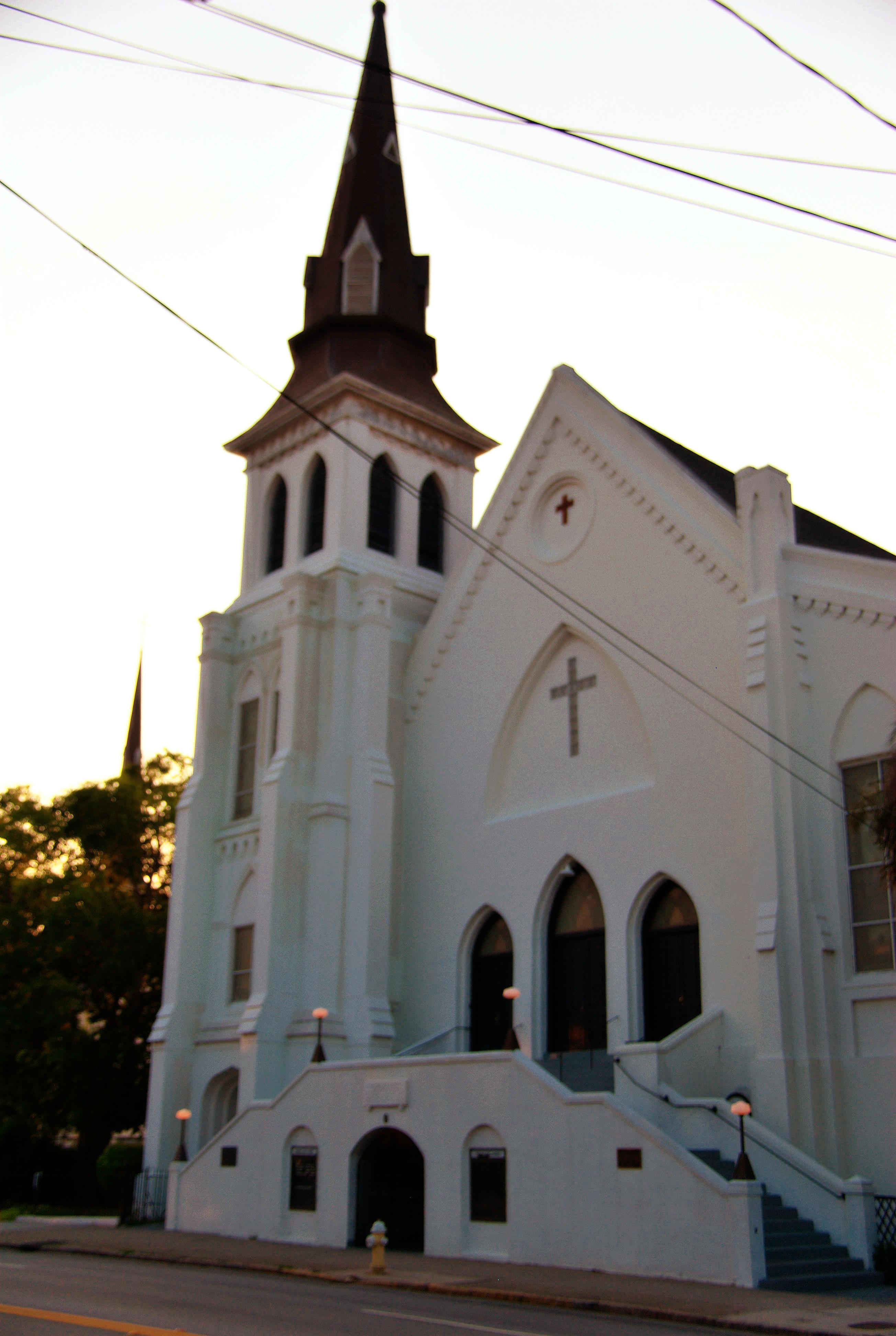
Here’s the thing: as a part of the dominating culture of American Imperialism, I am uncertain I can say that Dylann Roof accomplished the same goal as the Chinese policy. I can say I refuse to use an honorific to refer to him, but how did his actions affect those in churches like Emanuel African Methodist Episcopal Church? Did the people like those gathered in other communities similar to Emanuel African Methodist Episcopal Church walk away with a message? Did people who worshipped in synagogues or mosques hear the shots of a member of the dominant culture towards a group of African American Christians and hear a message? Did they see violence against a subset of the dominant religion (Christianity) and fear for their own future when they do not share the same experience of God?
Thinking back to those moments, I realize that I took part in an ecumenical memorial for those family members in faith down south, but I did not reach out to people who might have received just as violent a message. I did not stand alongside those who might also have been intimidated. The African American Christians were the chickens who were slaughtered, I rushed to the hen house to soothe the flock, but ignored the rest of the surrounding people.
When I reflect on Mr. Chambon’s article, what really strikes me is that I have been blind. I was not only blind in my understanding of Chinese culture. I have been blind in the way I have treated my own neighbors. I was blind as a teenager every time I was silent when a friend would drive to the nearby Native American reservation to act like hooligans. I was blind as a college student when I stood by ignoring the Muslim community after September 11, 2001. I was blind to injustice when people grabbed anyone who was not pale (like me) out of the line in airport security lines.
The challenge Mr. Chambon’s article leads me towards is a difficult challenge. When I know that African American males are disproportionately jailed, who else is hearing that message? How do be in ministry with those folks who are disproportionately jailed and those who are also given those messages? When I hear that folks are labeled as coming from s%#thole countries, how do I not only build up the people I meet from those places but also the others who hear words of disparagement? How do I open my eyes further? How do I honor my own principles and ethics? How do I stop letting blinders fetter my sight?
Message: “Clearing the Brambles and Dead Wood”
Date: March 24, 2019
Scripture: Luke 13:1-9
Preacher: Rev. Robert Dean
At that very time there were some present who told him about the Galileans whose blood Pilate had mingled with their sacrifices. He asked them, “Do you think that because these Galileans suffered in this way they were worse sinners than all other Galileans? No, I tell you; but unless you repent, you will all perish as they did. Or those eighteen who were killed when the tower of Siloam fell on them—do you think that they were worse offenders than all the others living in Jerusalem? No, I tell you; but unless you repent, you will all perish just as they did.”
Luke 13:1-9, NRSV
Then he told this parable: “A man had a fig tree planted in his vineyard; and he came looking for fruit on it and found none. So he said to the gardener, ‘See here! For three years I have come looking for fruit on this fig tree, and still I find none. Cut it down! Why should it be wasting the soil?’ He replied, ‘Sir, let it alone for one more year, until I dig around it and put manure on it. If it bears fruit next year, well and good; but if not, you can cut it down.’”
Friends, we are in the midst of the season of Lent. This entire season we have been comparing our own spiritual journey to a journey into the wild. In this Lenten season we have faced some difficult passages and today’s scripture is no exception. Difficult passages can lead to messages that difficult to both preach and hear. Let’s enter these moments prayerfully.
Holy God, one of the early Desert Monastics named Abba Pambo said “If you have a heart you can be saved.” Give to us your saving grace this morning. As we follow Jesus towards Jerusalem, give us the wisdom to hear what you are saying to the saints. We ask this blessing in Jesus’ Name. Amen.
What have you found during this Lenten journey? Have you found wild things in your hearts? Did those things frighten or exhilarate you? This morning we continue looking at Luke’s account of Jesus’ journey towards Jerusalem. There’s tough words here and some difficult theology.
Jesus challenges the people to think about the world and their own lives. In our text Jesus hears words of great tragedy. The ruler Pilate has executed some of Jesus’ people and then treats them barbarically. The story has a sense of being older than time as a hated public figure has done something terrible and it upsets the people. I am certain we can all think of figures who have done awful things in our day and age.

Jesus questions one of the oldest theological misconceptions. Jesus attacks a theology which says that bad things happen to bad people, so if something bad happened to these Galileans it is because they are bad people. Just like the people who died when a tower collapsed in Siloam, the people are looking at these Galileans and asking why God let this happen. If they are good, wouldn’t God have spared them?
Jesus starts off essentially teaches the same lesson as the Book of Job. Bad things can happen to good people. Jesus takes it a step further and points out that all of the people have sin in their lives. WHen Jesus says “Unless you repent, you will all perish just as they did” we find ourselves reading uncomfortable words. The words are very uncomfortable.
Jesus is teaching a truth though. Any journey into the heart like Lent will reveal a lot about our hearts and souls. There are wild parts of us we may encounter, there are dangerous things within us, and there’s also something else in there. Like every wooden wilderness, there are places where the trees are dead, the branches are broken, and the ground is covered with brambles. It is uncomfortable to say it, but there are places in all of our lives where we need to repent.

For me, there are places in my heart where there are broken bits. I grew up in a house where I experienced physical abuse as a child. When I wander through my woods, I occasionally come across parts of my heart that are deeply troubled and angry. There are parts of my soul where I need to repent because I can grow furious when those parts are touched, poked, and prodded. There are places in my life where these words are true. I need to clear out those brambles, get rid of the deadwood, and tear through the thorns.
Do you understand what I am saying? When I hear these words I don’t hear words of condemnation. I hear Jesus saying that all have brokenness. I hear Jesus seeing a group of people trying to say these Galileans must have been sinners while turning a blind eye to their own problems. To use another part of Jesus’ teachings, I see Jesus looking at a people with logs in their own eyes judging other people for having what may have been splinters.
I am glad the parable follows this passage because I think it elucidates what Jesus is trying to say. The people are like a fig tree without fruit. The owner of the garden keeps coming to get figs and finds nothing. The owner wants to tear the tree down, but the gardener asks for more time. The gardener will fertilize it with manure, break up the ground so the roots can spread, and watch over the tree for another year. The gardener is doing everything possible to save the tree.
It bears saying that we are reading this in Lent and the Lenten journey ends at the cross every year. The people are broken in deep ways and on Good Friday Jesus will do everything possible to bring life to the very people who will stand around jeering and taunting him. It is important to remember that Jesus is acting like this gardener and will do everything for these people.
When Jesus says unless we repent, we will perish the words are very hard to hear. In honesty though, there are parts in all of us we know should not be there. There are broken places in our lives and they need to go. Our hope is in the fact that Jesus tends the garden in our hearts, and with Jesus’ help we can tend to our broken places. When we pull down the thorn bushes, it is with Christ’s hands and our hands. When we chop down the broken branches, we do not swing an axe alone.

Also, sometimes there are places in us which we cannot deal with ourselves. In those moments, we have one we can turn to hoping God will bless us with all we need. Yes, we have to repent, but if we turn to God with honesty, we can find our way through even the most challenging of circumstances.
Will you have the courage to repent this Lent? Will you find your broken places and turn them over to the gardener? Will you let God break the soil of your heart, fertilize what is good, tend to what is hurting, and remove what needs to be taken away?
The role of a pastor is partially the role of a teacher. Many people think of preaching as a separate activity from other activities like Bible study, but a lot of the role can be combined into the overall category of teaching. I teach on Sunday morning through both preaching and my leadership of worship. Often I believe I teach more on Sunday morning through sharing the words around communion and in prayers than I do in the sermon. Indeed, one of the challenges pastors face is when people believe that the sermon is the focus of worship.
There is absolutely no way that one can effectively make disciples of Jesus Christ for the transformation of the world in just a few minutes a week. We teach beyond our sermons through the rest of worship, through Bible study, but also through things like conversations, social media, and blogging. One of the reasons I believe that the early church had such strident rules about what it took to be a leader in the church was that they understood the church leaders would be teaching and sharing with the community far more than just Sunday morning.
Today, I would like to try and teach a little bit about creation. Creation is where we all are in this moment. The air we breathe, the food we eat, and the land we live upon is all considered theologically to be a part of creation. Some of the earliest scriptures in the Bible (canonically) deal with the care of creation. Genesis 2:15 states that when humanity is placed into the world it is with the charge to care for where they are placed. Gardens are not self-tending and theologically humanity was made to garden. Indeed, in the earliest sections of Genesis humanity depended on plants for sustenance. Foraging is wonderful but civilization was built on gardens.
Let’s look at what it means if we are given the instruction to care for creation. How do we choose to care for the world? Do we do all that we can to damage it? Sometimes it does seem like that is our way of being, but is that destructive way theologically ethical?
What if there were ways to care for the world on a regular basis that did not ruin either your bank account or your way of life? What if the foods you choose could help the world to be a better place for everyone around? What if you invited the world to join you in that adventure?
A few months ago I was listening to a podcast called “The Splendid Table.” The episode I was listening to talked about eating anchovies. To be entirely honest, I was a bit horrified. My father invited us eat to a “blind robin” at midnight for good luck growing up and I wasn’t quite as big a fan of pickled foods at that time. I was very skeptical, but I looked into the idea of eating more seafood as a way to help make the world a better place.
Strangely, I did not begin my research at the library or on the internet. I had a grocery trip to run and looked at the canned fish. Several of the cans said “certified wild caught and sustainable.” Some digging led me to a United States Government Agency called “FishWatch.” There I was able to learn about how the Northern Anchovy is caught, how it has a low bycatch rate, and how it can be healthy (in moderation due to cholesterol levels).
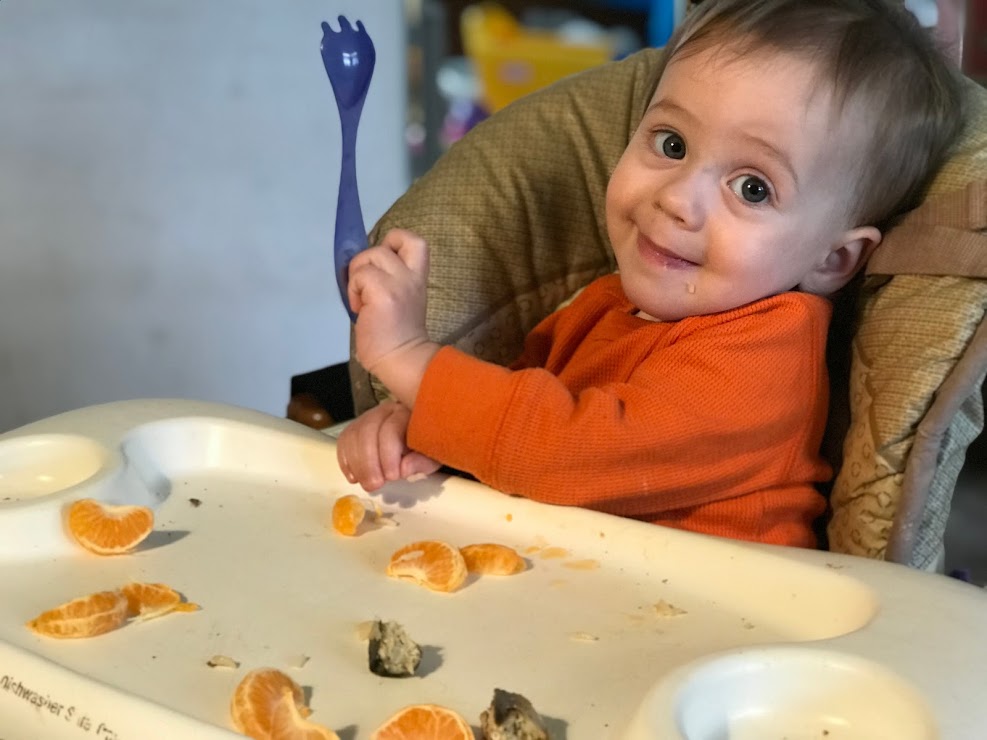
I began to experiment with anchovies and sardines. I learned that sardines can be ground into meatballs to add a flavor that my family loves while replacing some of the meat with a more sustainable protein. As I used the seafood more regularly, it became more and more normal to my palate. Look at the picture of my daughter and you’ll see that it is no burden at all when you get used to eating something new.
What am I suggesting? Well This Lent my family and I are experimenting (on the adult end) with preparing meals with fish and tofu instead of chicken, pork, or beef on Wednesdays and Fridays. If it works well, we’ll likely continue the practice after Lent ends. It might not change the world immediately, but helping to create a world where people eat sustainably might be one of the best things we can do this season.
I invite you to pray about how you and your family might be called to care for our environment this season. If we are to tend this “garden,” it will likely take intentionality. I invite you to consider if this might be something which you might be called to do with your life.
Two weeks ago I had the privilege to learn from Professor Carlos Cardoza-Orlandi from Baylor University at the recent session of the Academy for Spiritual Formation. Learning from Professor Cardoza-Orlandi was a challenging experience. We were challenged on multiple levels about our understanding of Christianity in the global south. The lesson was very timely the week before General Conference.
One lesson has rung through my mind the last few days. The good professor taught us that the world’s Christians do not have the same privilege that I had in my community as a child. When you’re not the dominant religion in an area, some assumptions of both the world around you and your own traditions can shift. I keep hearing the question “Who is your Jesus?” It has been running through my mind.
I want to be clear. I appreciate the Professor Carlos Cardoza-Orlandi enough to note that his opinions are not my opinion. I also want to be clear that my opinions do not need to be shared by everyone else in the body of Christ and this is alright with me. There’s enough room in the Kin-dom of God for there to be diversity.
So, who is my Jesus? My Jesus is radically loving, radically inclusive, and adept at turning the world upside down without people realizing what has happened.

My Jesus is the Jesus whom Paul comes to know and eventually says “for I am convinced that neither death, nor life, nor angels, nor rulers, nor things present, nor things to come, nor powers, nor height, nor depth, nor anything else in all creation, will be able to separate us from the love of God in Christ Jesus our Lord.” (Romans 8:38-39).
My Jesus is the Jesus who throws the door open to a larger kin-dom (kindom) than imagined. My Jesus used the Apostles to share the gospel beyond traditional bounds. In Acts 8:26–40 the family is stretched to include a eunuch, which lest we forget is absolutely forbidden in Deuteronomy 23:1. Why shouldn’t you be baptized, Eunuch of Ethiopia? Well, because: “No one whose testicles are crushed or whose penis is cut off shall be admitted to the assembly of the Lord.” I guess that rule did not apply anymore.
My Jesus reached out to Romans and other Gentiles through Peter who is unequivocally told in Acts 10: “What God has made clean, you must not call profane.” My Jesus was there in the Holy Conferencing that took place in Acts 15:6-29 which opened the doors further. By the way, the Holy Spirit continued to pour itself out on those who engaged in fornication, hence we still have children’s moments where children born of believers come to be blessed. Thankfully, the United Methodist Church has not attempted to remove folks who are married and have children from leadership like several other major Christian denominations.
What’s more and what keeps ringing through my head is the story of the woman accused of adultery. In John 8:1-11 we read the story of a woman who is accused of an extramarital affair. Jesus tells her accusers that the one who is without sin should cast the first stone.
Nobody stones her. Nobody there is apparently without sin. Jesus says “I do not condemn you, either. Go. From now on sin no more.” Now, first of all, yes Jesus says do not sin again. To be entirely fair, she is very fortunate Jesus is there to offer this moment of protective grace. I may prevent a child from being beaten up in a parking lot on an afternoon, but if the child keeps walking through the parking lot when I am not there… There is more than one way of looking at that second sentence.
What is amazing is that in all the readings of this scripture, one thing was never pointed out to me. Jesus says “I do not condemn you.” Who is the one who has the ability to condemn sins? Who has the authority to forgive sins? If it is Christ, Jesus’ words “I do not condemn you” hold divine authority. She is forgiven.
What’s further, in a crowd full of people who have sin (including the woman accused of adultery), it is this woman alone who leaves forgiven of her sins. Hebrews 10:4 says “For it is impossible for the blood of bulls and goats to take away sins.” The folks may leave to go and make an offering for their own sinful behavior, but it is Christ alone who forgives.
Now, I cannot say that God’s love does not extend to these folks. Judgment is God’s alone, but I can say that in this moment there is only one person in the crowd we can claim is absolutely forgiven by Christ’s own words. The woman accused of adultery is the only one explicitly told “I do not condemn you…” We can even go further to point out Jesus did not stop the crowd from leaving by saying “Wait! Hold on! God understands and your sins will be forgiven. Throw those stones!”
My Jesus is the Jesus who forgives. My Jesus is the one through whom I baptize children into the Kindom of God in the name of the Father, Son, and Holy Spirit. My Jesus is the one who accepts those children even before they grow up into whatever person they may become in their adult days.
My Jesus is the Jesus who ate with sinners and tax collectors. My Jesus hangs out at Alcoholics Anonymous and in rehab centers. My Jesus sits with the homeless in the cold. My Jesus does a ton of caring through the children of the Kindom who bring food for community suppers, supply food pantries, donate towards medical supplies, walk alongside LGBTQIA+ folks as they struggle with depression and expulsion, cry with those imprisoned falsely in jails, mourn with those who are imprisoned fairly, and do every sort of thing they can in order to be with God’s children. Yes, all children are God’s children.
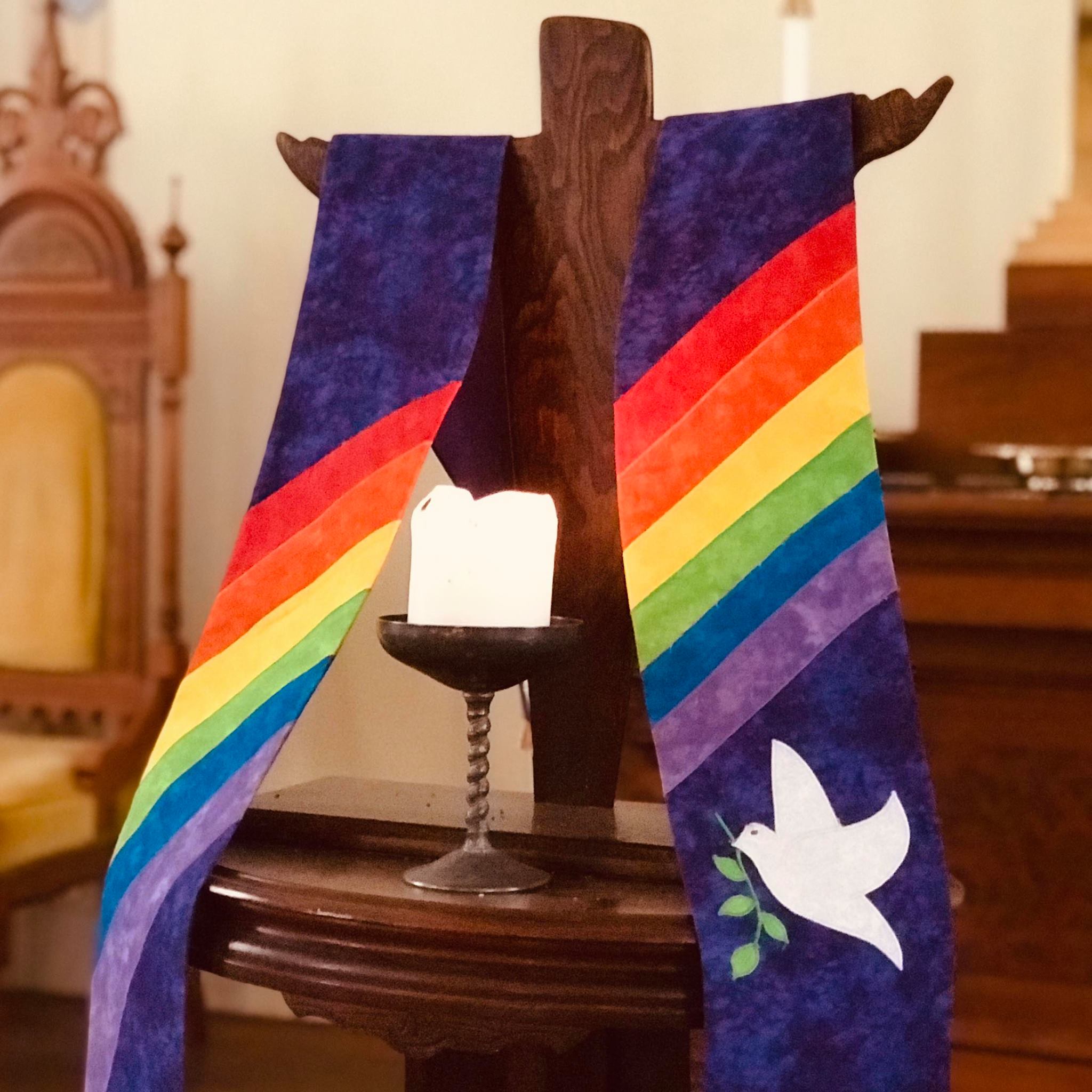
My Jesus is a pretty awesome Jesus. My Jesus is the reason I did not give up my faith after I grew up into adulthood. Some behavior that I have seen recently does not square up with that Jesus, but I need to be clear: My Jesus is worth following down the narrow path of life. I most certainly will follow that Jesus and will not be one of those who trample “under foot the Son of God, and has regarded as unclean the blood of the covenant by which he was sanctified, and has insulted the Spirit of grace?… It is a terrifying thing to fall into the hands of the living God.” (Hebrews 10:29-31, NASB)
For it is impossible for the blood of bulls and goats to take away sins. Therefore, when He comes into the world, He says,
Hebrews 10:4-31, NASB
“Sacrifice and offering You have not desired,
But a body You have prepared for Me;
In whole burnt offerings and sacrifices for sin You have taken no pleasure.
“Then I said, ‘Behold, I have come
(In the scroll of the book it is written of Me)
To do Your will, O God.’”
After saying above, “Sacrifices and offerings and whole burnt offerings and sacrifices for sin You have not desired, nor have You taken pleasure in them” (which are offered according to the Law), then He said, “Behold, I have come to do Your will.” He takes away the first in order to establish the second. By this will we have been sanctified through the offering of the body of Jesus Christ once for all.
Every priest stands daily ministering and offering time after time the same sacrifices, which can never take away sins; but He, having offered one sacrifice for sins for all time, sat down at the right hand of God, waiting from that time onward until His enemies be made a footstool for His feet. For by one offering He has perfected for all time those who are sanctified. And the Holy Spirit also testifies to us; for after saying,
“This is the covenant that I will make with them
After those days, says the Lord:
I will put My laws upon their heart,
And on their mind I will write them,”
He then says,
“And their sins and their lawless deeds
I will remember no more.”
Now where there is forgiveness of these things, there is no longer any offering for sin.
Therefore, brethren, since we have confidence to enter the holy place by the blood of Jesus, by a new and living way which He inaugurated for us through the veil, that is, His flesh, and since we have a great priest over the house of God, let us draw near with a sincere heart in full assurance of faith, having our hearts sprinkled clean from an evil conscience and our bodies washed with pure water. Let us hold fast the confession of our hope without wavering, for He who promised is faithful; and let us consider how to stimulate one another to love and good deeds, not forsaking our own assembling together, as is the habit of some, but encouraging one another; and all the more as you see the day drawing near.
For if we go on sinning willfully after receiving the knowledge of the truth, there no longer remains a sacrifice for sins, but a terrifying expectation of judgment and the fury of a fire which will consume the adversaries. Anyone who has set aside the Law of Moses dies without mercy on the testimony of two or three witnesses. How much severer punishment do you think he will deserve who has trampled under foot the Son of God, and has regarded as unclean the blood of the covenant by which he was sanctified, and has insulted the Spirit of grace? For we know Him who said, “Vengeance is Mine, I will repay.” And again, “The Lord will judge His people.” It is a terrifying thing to fall into the hands of the living God.
I am currently entering into the final steps of preparing my second year project for the Academy for Spiritual Formation. I am thinking that I will have most of the project revolve around the usage of poetry and prayer. I was recently reading through a book I borrowed from the library called “The Art and Craft of Poetry” by Michael Bugeja. On the seventy third page of that tome, Mr. Bugeja quotes the poet Kevin Bezner as saying “All true poetry is religious poetry–all poems are prayers–but not in the sense of a belief in or worship of a god or a supernatural power.”
Given my particular approach to poetry, I found that statement to be intriguing. Mr. Bugeja paraphrases Mr. Bezner, saying “true or sincere poems, by their very nature, always reflect a poet’s faith, commitment, desire to commune, conscientiousness and devotion…”
If poetry does reflect and express the poet’s faith and commitment, then perhaps there is a sense at which heartfelt poetry is prayer. One of my greatest challenges with liturgy is the struggle to include the word “Amen” after every prayer. For a long time, hymns concluded with an amen. Nowadays, it seems as if almost every prayer needs and “Amen” in order to conclude.
Amen has a rich history and depth of meaning. The usage of the word for the congregation to enter into the depth of the prayer is helpful. When we say amen after someone prays, we become a part of that prayer orally. It is a wonderful act of inclusion in an act of worship, but often folks seem to believe that any prayer must have an amen. This is not true.
I thought I’d share a poem I recently wrote in an attitude of prayer after a saint invited me over to lunch. I wrote it for a thank you note, but I thought it was a perfect way of expressing how a prayer can be found in poetry.
Scents waft up from a warm bowl of chili rich yet faint.
“Full” by The Distracted Pastor, 2019
As I sit to share a meal with an elder saint.
She has made special biscuits for us to share
And we break bread together with prayer.
With cheese and conversation our meal
Is filled with a depth you can feel.
I listen with quiet peace
As my inner cares cease.
I try to be here
With one so dear.
I’m thankful,
Grateful,
Full…
The form itself was fairly simple. I started with thirteen syllables a line and decreased a syllable each consecutive line. The rhyming pattern is a set of 5 couplets with a rhyming envoi creating one tercet at the end. It is clearly a poem.
It is also clearly a prayer. I intended to express care, gratitude, and thankfulness for the opportunity. Although God is not addressed by name, there is homage paid to communion in the mentioning of the breaking of the bread. The person I shared a meal with is a saint, there’s a stillness while listening that ties back to the idea of silence in contemplation and prayer. Even the mentioning of saints can draw our thoughts to God.
Psalm 19:14 says “Let the words of my mouth and the meditation of my heart be acceptable to you, O Lord, my rock and my redeemer.” It is my belief that poetry that seeks to live into this verse really is prayer.
Tomorrow we are looking at Isaiah 45:9-13,15-19 at our church service. We will be focusing on the call of the community to live with a purpose, but as usual, church is only so long and there is more in the passage that is worthy of our time.
In particular, I wanted to take a moment to look at the last two verses. In the NRSV, the Isaiah 45:18-19 calls out for attention given our world’s modern challenges.
For thus says the Lord,
Isaiah 45:18-19, NRSV
who created the heavens
(he is God!),
who formed the earth and made it
(he established it;
he did not create it a chaos,
he formed it to be inhabited!):
I am the Lord, and there is no other.
I did not speak in secret,
in a land of darkness;
I did not say to the offspring of Jacob,
“Seek me in chaos.”
I the Lord speak the truth,
I declare what is right.
God does not create the world to be a jumble of chaos in the scriptures. God created a world that was meant and is meant to be inhabited. The world is very carefully crafted. Indeed, we live in a beautiful world filled with majestic creatures.
To be blunt, a lot of those beautiful creatures are going extinct and huge swaths of the earth are struggling to cope with human induced climate change. For the entirety of our existence, humans have had an impact on the world. We systematically hunted certain animals to extinction over the course of our existence. Now our behaviors are bringing extinction to creatures not through the use of a bullet or arrow but by changing the chemicals in streams, filling oceans with plastic, and removing habitats through intentional deforestation.
To me, this is an outrage and an offense to both the gift we have been granted and the world which we received. This world was meant to be inhabited just as the hotel has rooms that are meant to be rented. We are invited to this world like someone invited to stay at a friend’s house for a season. If we were to treat a hotel room like we have treated our world, we would be charged to repair the damage. If we were to destroy our friend’s house, we would likely lose that friendship. Why is the way we treat this world seen differently?
I would invite you to consider whether we are called to treat our world better. More information about climate challenges can be found here.
Poems
“Poems” by The Distracted Pastor, 2019
Contemplation
Seeing with open eyes
Expressing reasons for wonder
Poems
I have recently been contemplating the idea of teaching. I am three quarters through the Academy for Spiritual Formation. I have been asking an interesting question. How do I share what I have been learning with others?
The very first session of the Academy we were invited to consider how God was being revealed around us by Wilkie Au. Since that lesson I have spent a lot of time walking through the various outdoor “Stations of the Cross” walking paths at the Malvern Retreat House.
It has been incredible noticing how I saw different things in different seasons. In the midst of winter, I took a picture of Christ crushed under the weight of the cross under a layer of newly fallen snow. I contemplated how cold the world must have been for Jesus in those moments. Blood loss was likely only one source of his suffering.

In the height of autumn, I saw Pilate standing in judgment as leaves fell from the sky. I contemplated how the world itself was growing colder and the days shorter as Pilate held his perpetual place of judgment over the solitary Christ. Leaves fell as judgment waited further down the path.
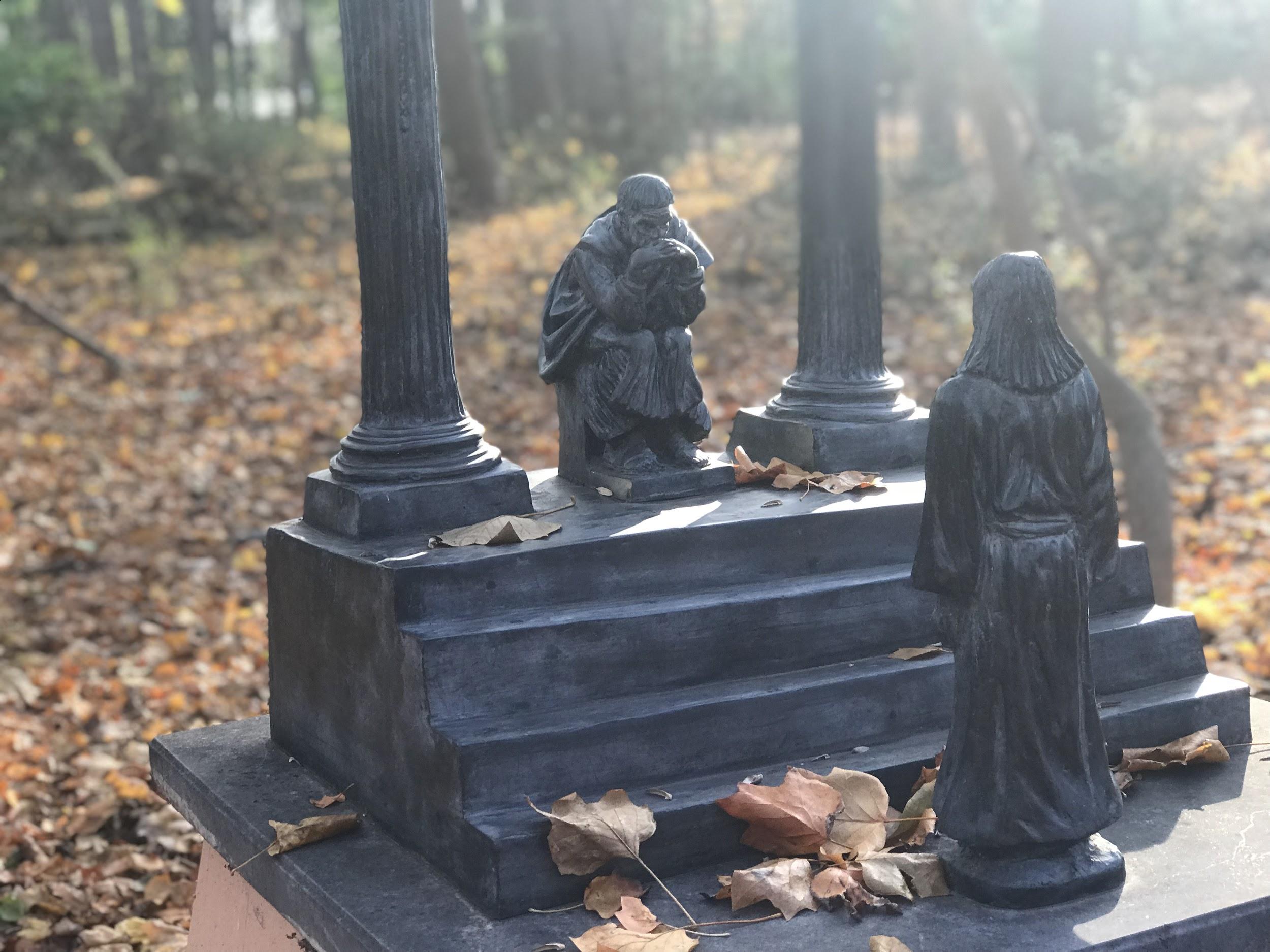
I have found those moments of contemplation to be life giving to my prayers. The very nature of the surrounding changed my contemplation, my prayer, and my focus in holy moments.
Walking through a path in the woods while praying is a valuable and wonderful experience. In this cold season, walking outside can be treacherous on frozen, freezing, and dangerously windy days. How can we enrich our prayers in a season which is dismally gray without continually focusing on the bleak, the dark, and the promise of spring that seems so very distant?
What if poetry is a window we can use for contemplation? Consider the poem “In a Vale.” The poem was written and published by Robert Frost in 1915. Let’s take a look as the poem is now in public domain.
When I was young, we dwelt in a vale
“In the Vale” by Robert Frost, 1915
By a misty fen that rang all night,
And thus it was the maidens pale
I knew so well, whose garments trail
Across the reeds to a window light.
The fen had every kind of bloom,
And for every kind there was face,
And a voice that has sounded in my room
Across the sill from the outer gloom.
Each came singly unto her place,
But all came every night with the mist,
And often they brought so much to say
Of things of moment to which, they wist,
One so lonely was fain to list,
That the stars were almost faded away
Before the last went, heavy with dew,
Back to the place from which she came –
Where the bird was before it flew,
Where the flower was before it grew,
Where bird and flower were one and the same.
And thus it is I know so well
Why the flower has odor, the bird has song.
You have only to ask me, and I can tell.
No, not vainly there did I dwell,
Nor vainly listen all night long.
First, Robert Frost was an incredible poet. When I was younger, I would have said that “He’s the kind of poet I want to be if I grow up.” Now it would be more accurate to say that he’s the kind of poet I would like to be if I ever grow up.
Second, consider the words Frost uses in his poem. If you have an overactive imagination like me, you might be blessed to leave the poem with the smell of earth in your nostrils, or the feeling of dew soaking into your sneakers as you see yourself walking out to greet the day.
Consider that a poem can be a window into a new place. What a gift this is to those who live underneath gloomy and gray skies! A poem can do more than inspire thoughts. Literature and stories were the original way people communicated visions of worlds beyond sight. Prose and poetry inspired religious belief, transported people to places of romance and ecstasy (e.g., consider the Song of Solomon in Judaism or the poems of Rumi in Sufi tradition), and opened the scope of people’s understanding of the world (e.g., Plato in Greece, Prince Shōtoku in Japan).
Like stories, poems can transport us to new places. What use is poetry? Poetry can be a way to see a world that can affect your prayer, change your viewpoint, and allow you to see a different existence than you might otherwise imagine. Poetry can be a way into memories from your own past, even when you did not write the poem. Poetry can be a blessing beyond belief.
I would like to encourage you to look into some poetry today. Consider that our world is an amazing place with amazing people. Explore their view through the power of their poems and see if you do not see the world a little differently. Perhaps the experience will change the way you pray today.
 Distracted Pastor Ramblings