Una Canción Nueva: Not Making it Worse

In October we remember Domestic Violence Awareness Month. I am reading and reflecting on both my experiences and the thoughts of others about domestic violence during this month. This action is important to me as a survivor of domestic violence.

Yesterday and two days ago I wrote about asking for help when demons from the past are haunting us. Yesterday I wrote and encouraged people who need help to ask for it. People of God, I encourage you not to make things worse by shaming people who need help.

I know that the Bible has a lot of things that revolve around community issues. Often, the things that the Bible addresses regarding community issues are beneficial to many people. The words of the gospel of Matthew, chapter 18, are amazing to many people. Sometimes the words can help with domestic violence issues, but when you don’t know the situation, the advice in that chapter can be dangerous.

It is possible that people who experience domestic violence may suffer or die when the abusers cannot hide in the shadows. Abusers may be kind to others and horrible to their victims. Although people may attend church, it is possible for those people to live in evil when in the shadows of ignorance.

When you don’t know what’s going on in a domestic violence survivor’s life, don’t shame people who ask for help. All people, regardless of gender identity, deserve to seek help and be believed. Some people may be liars, but when you don’t know, you don’t know and you don’t need to judge without understanding.


En Octubre recordamos el mes de concientización sobre la violencia doméstica. Estoy leyendo y reflexionando sobre ambas mis experiencias y los pensamientos de otra sobre violencia doméstica durante este mes. Esta acción es importante para mi como un sobreviviente de violencia doméstica.

Ayer y hace dos días escribí acerca de pedir ayuda cuando los demonios del pasado nos están acosando. Ayer escribí y animé a las personas que necesitan ayuda a pedirla. Pueblo de Dios, los animo a no empeorar las cosas avergonzando a las personas que necesitan ayuda.

Sé que la Biblia tiene muchas cosas que giran en torno a problemas de la comunidad. A menudo, las cosas que la Biblia trata sobre problemas de la comunidad son beneficiosas para muchas personas. Las palabras del evangelio de Mateo, capítulo 18, son increíbles para muchas personas. A veces, las palabras pueden ayudar con los problemas de violencia doméstica, pero cuando no se conoce la situación, el consejo de ese capítulo puede ser peligroso.

Es posible que las personas que experiencia violencia doméstica puede dolor o morir cuando los abusadores no puede esconder en los sombras. Las personas que abusan puede ser genial a otras y horible a su victimas. Aunque las personas puede attender la iglesia, es posible esos personas vivir malveda cuando adentro los sombras de ignorencia.

Cuando no sabes qué está pasando en la vida de una sobreviviente de violencia doméstica, no avergüenzas a las personas que piden ayuda. Todas las personas, independientemente de su identidad de género, merecen buscar ayuda y que se les crea. Es posible que algunas personas sean mentirosas, pero cuando no sabes, no sabes y no necesitas juzgar sin comprender.

Una Canción Nueva: Letting Go (part two)

In October we remember Domestic Violence Awareness Month. I am reading and reflecting on both my experiences and the thoughts of others about domestic violence during this month. This action is important to me as a survivor of domestic violence.

Yesterday I wrote on my blog about trusting Jesus when demons from the past are knocking at the door of your heart. Today, I need to tell the truth about the reality of domestic violence. Sometimes, the Lord wants to help you seek freedom from domestic violence. Today, the Lord loves you and wants you to seek help with your problems. Even if you are scared and worried, the Lord loves you and wants you to ask for help.

It is terrible to suffer from domestic violence. Why do we believe the Lord does not want us to call 800-799-SAFE or visit thehotline.org when we need help? It is unbelievable that we believe the Lord does not love us and want us to seek help!

Yes, it is good for us to call upon the Lord when demons from the past are bothering us, especially when the demons from the past are in the past. When demons from the past are in the present, we call upon the Lord and we also call upon others to help us. Today, our Lord loves us and hears us. When we call upon others we may find new freedom. When we do not call upon others, we may find that the very demons we hate are here until we seek help.


En Octubre recordamos el mes de concientización sobre la violencia doméstica. Estoy leyendo y reflexionando sobre ambas mis experiencias y los pensamientos de otra sobre violencia doméstica durante este mes. Esta acción es importante para mi como un sobreviviente de violencia doméstica.

Ayer escribí en mi blog acerca de confiar en Jesús cuando los demonios del pasado están llamando a la puerta de tu corazón. Hoy, necesito decir la verdad sobre la realidad de la violencia doméstica. A veces, el Señor quiere ayudarte a buscar la libertad de la violencia doméstica. Hoy, el Señor te ama y quiere que busques ayuda con tus problemas. Incluso si tiene miedo y está preocupado, el Señor se ama y desea que usted preguntar para ayudar.

Es terrible que sufrir de violencia doméstica. ¿Por qué creeimos el Señor no desea que llamar 800-799-SAFE o visitamos el sitio thehotline.org cuando neceisitamos ayudar? ¡Es incredible que creeimos el Señor no se ama y desea que buscar a ayudar!

Sí, es bueno que invoquemos al Señor cuando los demonios del pasado nos están molestando, especialmente cuando los demonios del pasado están en el pasado. Cuando los demonios del pasado están en el presente, invocamos al Señor y también invocamos a otros para que nos ayuden. Hoy, nuestro Señor nos ama y nos escucha. Cuando invocamos a otros podemos encontrar una nueva libertad. Cuando no invocamos a otros, podemos encontrar que los mismos demonios que odiamos están aquí hasta que buscamos ayudar.

Una Canción Nueva: Letting Go

In October we remember Domestic Violence Awareness Month. I am reading and reflecting on both my experiences and the thoughts of others about domestic violence during this month. This action is important to me as a survivor of domestic violence.

One day last week, I was having a conversation about the past. A person and I were talking about our fears and worries from the past. We wanted to live without our fears and worries, but the demons from the past wouldn’t let go. How frustrating!

It’s hard to let go of the past. Often, demons from the past come knocking at the door when it’s not good for our mental health. It’s like they have our mobile phone number and it’s not possible to turn it off. The phone sings and makes a disturbing noise when we just want to live in the present. It’s horrible!

In my recovery program we learn that we have to admit that we were powerless over our problems. We have to admit that our lives had become unmanageable. We didn’t believe that every problem needed God’s help, but there were some problems that we were powerless over. Sometimes our demons from the past are problems that we are powerless over. I see the same power in the demons of the past as I do in the horrible problems that I am powerless over.

In my past life, I had to decide to put my life in the Lord’s hands before seeking freedom and happiness. When I went to seek the Lord instead of struggling with my problems, I found new freedom and happiness. Today, why don’t I seek the Lord instead of struggling with the demons of the past? Jesus Christ descended into hell to save me. Why don’t I believe that Jesus can defeat my demons of the past even though I am powerless against them? Can I entrust these demons of the past to Jesus and walk away without becoming stuck?


En Octubre recordamos el mes de concientización sobre la violencia doméstica. Estoy leyendo y reflexionando sobre ambas mis experiencias y los pensamientos de otra sobre violencia doméstica durante este mes. Esta acción es importante para mi como un sobreviviente de violencia doméstica.

Un día de la semana pasada, estaba teniendo una conversación sobre el pasado. Una persona y yo hablamos sobre nuestros miedos y preocupaciones del pasado. Queríamos vivir sin nuestros miedos y preocupaciones, pero los demonios del pasado no lo salirnos. ¡Que frustrante!

Es difícil desprenderse del pasado. A menudo, los demonios del pasado llaman a la puerta cuando no es bueno para nuestra salud mental. Es como si tuvieran nuestro número de teléfono móvil y no fuera posible apagarlo. El teléfono canta y hace un ruido inquietante cuando solo queremos vivir el presente. ¡Es horrible!

En mi programa de recuperación aprendemos que tenemos que admitir que éramos impotentes ante nuestros problemas. Tenemos que admitir que nuestras vidas se habían vuelto ingobernables. No creíamos que todos los problemas necesitaban la ayuda de Dios, pero había algunos problemas ante los cuales éramos impotentes. A veces, nuestros demonios del pasado son problemas ante los cuales somos impotentes. Veo el mismo poder en los demonios del pasado que en los problemas horribles ante los cuales soy impotente.

En mi vida pasada, tuve que decidir poner mi vida en las manos del Señor antes de buscar la libertad y la felicidad. Cuando fui a buscar al Señor en lugar de luchar con mis problemas, encontré una nueva libertad y felicidad. Este dia, ¿por qué no busco al Señor en lugar de luchar con los demonios del pasado? Jesucristo descendió a los infiernos para salvarme. ¿Por qué no creo que Jesús puede vencer a mis demonios del pasado aunque yo sea impotente contra ellos? ¿Puedo confiarle a Jesús estos demonios del pasado y alejarme sin quedarme estancado?

Una Canción Nueva: Psalm 90:15

“Make us happy for the same amount of time that you afflicted us–for the same number of years that we saw only trouble.”

Psalm 90:15, Common English Bible

In October we remember Domestic Violence Awareness Month. I am reading and reflecting on both my experiences and the thoughts of others about domestic violence during this month. This action is important to me as a survivor of domestic violence.

The other day I spoke with two friends from my seminary who knew me for many years. We talked about the days when we first met. My friends told me the story of how they met my past wife. I heard their voices and felt compassion, love, and sorrow for the past and anger at the injustice they saw in the past and now.

My friends studied the Bible for many years and live with integrity. They had compassion for me when I didn’t know what happened when I wasn’t in the conversation with my ex-wife. My friends understand the words of Psalm 95. The above scripture is from the Revised Common Lectionary for next Sunday.

The past happened. Moments of the past sometimes cannot be repaired. We cannot possibly go back to those moments when terrible actions occurred. When we understand ourselves and the past, we may lose hope for the future.

My friends have compassion for me because they wish a future full of justice and hope. They want to see the good days we find in the Psalm for people who are afflicted with injustice and evil.

I need the same hope because the past is the past. I wish the same hope for you.

“Alégranos conforme a los días que nos has afligido y a los años que nos has hecho sufrir.”

Salmo 90:15, Nueva Versión Internacional

En Octubre recordamos el mes de concientización sobre la violencia doméstica. Estoy leyendo y reflexionando sobre ambas mis experiencias y los pensamientos de otra sobre violencia doméstica durante este mes. Esta acción es importante para mi como un sobreviviente de violencia doméstica.

El otro día hablé con dos amigos de mi seminario que me conocieron por muchos anos. Hablamos de los dias en que nos conocimos. Mis amigos me dieron el cuento de cómo conocieron a mi esposa pasada. Escuché su voces y sentí compasión, amar, y pena para el pasado y foriosa por la ijusticia vieron en el pasado y ahora.

Mis amigos estudiaron la biblia durante muchos años y viven con integridad. Tuvieron compasión por mi cuando no sabía que ocurrió cuando no estaba en la conversación con mi esposa pasada. Mis amigos comprenden la palabras de Salmo 95. La escritura de arriba es del Leccionario Común Revisado para el próximo domingo.

El pasado ocurrió. Los momentos del pasado a veces no pueden a reparar. No es posible que caminemos a esos momentos cuando las acciones malisimas courrieron. Cuando nos comprendemos y comprendemos el pasado, es posible que perdeamos la esperanza por la futura.

Mis amigos me tienen buena compasión porque les desean a futuro con justicia y esperanza. Ellos desean ver los buenismios dias que eoncontramos en el Salmo por las paersonas que tienen afligida con injusticia y mal.

Necesito la misma esperanza porque el pasado es en el pasasdo. Deseo la misma esperanza para ti.

Querido Jesús: Salmo 9:9-20

«Al Señor se le conoce porque imparte justicia; el malvado cae en la trampa que él mismo tendió» Salmo 9:16, NVI

Querido Jesús, ¿Cuál es tu discernimiento de mi? Cuando tú caminas en este mundo, tu traes justicia contigo. ¿Te traes justicia para mi o contra mi? Estoy haciendo lo mejor que puedo con mi vida pero soy un humano normal. ¿Que traes para mi?

Estoy esperanzando que tú traes cosas mejor de que merezco. No me conozco adónde obtengo esta esperanza, pero tengo esperanza de que me amas y quieres mejores cosas para mi acá en esta vida. Merezco nada en mis ojos, pero te escucho tus canciones de amor y gracia. ¿Quién puede decir alguna cosa contra tus palabras de amor y gracia?

Si, que verdad. San Pablo escribi: «Pues estoy convencido de que no la muerte no la vida, no los ángeles ni los demonios, no lo presente no lo por venir, no los poderes, no lo alto ni lo profundo, no cosa alguna en toda la creación podrá apartarnos del amor que Dios nos ha manifestado en Cristo Jesús nuestro Señor».

Si, es verdad y estoy en esta Creación. No puedo apartarme del poder del Espíritu Santo. No merezco que me amas pero es verdad. Gloria a Dios. Hallelujah. Amén.


“The Lord is known because he dispenses justice; the evil one falls into the trap that he himself set.” Psalm 9:16, translated from NVI

Dear Jesus, what is your discernment of me? When you walk in this world, you bring justice with you. Do you bring justice for me or against me? I’m doing the best I can with my life, but I’m a normal human. What do you bring for me?

I’m hoping that you bring better things than I deserve. I don’t know where I get this hope, but I have hope that you love me and want better things for me here in this life. I deserve nothing in my eyes, but I hear your songs of love and grace. Who can say anything against your words of love and grace?

Yes, how true. As Saint Paul wrote: “For I am convinced that neither death nor life, neither angels nor demons, neither things present nor things to come, nor powers, nor height nor depth, nor anything in all creation will be able to separate us from the love that God has shown us in Christ Jesus our Lord.”

Yes, it is true and I am in this Creation. I cannot depart from the power of the Holy Spirit. I don’t deserve that you love me but its true. Glory to God. Hallelujah. Amen

Querido Jesús: 1 Samuel 17:32-49

《Dios guardará tus entradas y salidas desde ahora y para siempre.》 Salmo 125:8 en El Libro de Oración Común (Protestant, Episcopal Church, 2022)

Querido Jesús, las batallas en mi vida no son mis batallas. Mis manos pueden golpear las personas que me atacan, pero  no necesito responder con violencia. Las batallas en mi vida son para el Señor.

Yo recuerdo tus palabras para nuestras vidas en mi biblia:《esos confían en sus carros de guerra, aquellos confían en sus corceles, pero nosotros confiamos en el nombre del Señor nuestro dios.》

Yo recuerdo la verdad en mi vida que no neceisto responderle a personas rotas con violencia o furiosa. Las batallas en mi vida son del Señor y para el Señor. Puedo responderle a las personas y problemas con fuerte confío en el Nombre del Señor nuestro dios. Jesuscristo, no  necesariamente me necesito a responder cuando te puedes.

Jesucristo, tus palabras son basta para las situaciones en mi vida. Tu proteges mis entradas y salidas desde las batallas espantosas ahora y mañana y siempre. Amén


God will guard your comings and goings from now on and forever.” Psalm 125:8, Translated from “El Libro de Oración Común”

Dear Jesus, the battles in my life are not my battles. My hands can hit people who attack me, but I don’t need to respond with violence. The battles in my life are for the Lord.

I remember your words for our lives in my Bible: “Some trust in their chariots, some others trust in their warhorses, but we trust in the name of the Lord our God.”

I remember the truth in my life that I do not need to respond to broken people with violence or fury. The battles in my life are from the Lord and for the Lord. I can respond to people and problems with strong trust in the name of the Lord God. Jesus Christ, I don’t necessarily need to respond when you can.

Jesus Christ, your words are enough for the situations in my life. You protect my comings and goings from the dreadful battles now, tomorrow, and forever. Amen.

Querido Jesús: Marcos 4:26-29

«Sin que éste sepa cómo, y ya sea que duerma o esté despierto, día y noche brota y crece la semilla.» Marcos 4:27, NVI

Quérido Jesús, sin que sabo, mi vida ya brota y crece. No sé cómo o porque mi vida es importante, pero es importante para ti, Yo no comprendo tu amor para mi. Tu me planta en tu jardín y deséame a crecer.

No todos del mundo me amas. Algunos dicen: «Él es el peor del mundo. Quisiéramos tomar la Agua Vida desde él.» No quiero tener sed. Por favor, no escuchas a las personas per amame con mis faltas. Tienes amor por aquellas personas que dicen aquellas cosas. Enseñame a amar aquellas personas también.

Tenemos que vivir juntos en tu mundo. Enseñarnos a vivir con amor por nuestros vecinos. Plantanos, brotanos, y crecenos hasta que estamos maduro. En tu nombre magnifico. Amén.


“Without knowing how it happens, as they sleep and as they rise, day and night, the seed buds and grows.” Mark 4:27, translated from NVI

Dear Jesus, without me knowing, my life is already sprouting and growing. I don’t know how or why my life is important to you, but it is important to you. I don’t understand your love for me. You plant me in your garden and wish me to grow.

Not everyone in the world loves me. Some say: “He is the worst in the world. We would like to take the Water of Life from him.” I don’t want to be thirsty. Please don’t listen to those people, but love me with my faults. You have love for those people who say those things. Teach me to love those people too.

We have to live together in your world. Teach us to live with love for our neighbors. Plant us, sprout us, and grow us until we are ripe. In your magnificent name. Amen.

Incandescent Arcs

“All the elements in the Master’s goodness which we have studied, his joy, his fearlessness, his fortitude, his magnanimity, are separate as incandescent arcs are, but they all burn with the same fire. This explains why it is often possible to find bravery or sacrificial devotion in other lives than his, that seem to equal the same virtues in him; but it is never possible to find the same quality which suffuses his courage and makes his sacrificial devotion a symbol of the love of God. No virtue in him was the whole of itself; his spirit
was the rest of it.

Harry Emerson Fosdick as quoted on page 53 of “A Guide to Prayer for Ministers and Other Servants” (their italics)

Today was an interesting day. I have been working alongside someone for the past few months in what the church might call a mentoring role and we have come to a splitting point. There are differences between us in terms of philosophies and at some point there are times when even the best intentions are stymied by practical differences. The situation makes me sad but is also a bit of a relief.

One of the things that relationship has helped me to clarify is my own understanding of God. I’m a big proponent of Christianity: that much is probably obvious. I believe in my heart that Jesus Christ is the Son of God who was incarnated, died, resurrected, and ascended. I believe Christ will come again. I say that I believe these things because I am honest in the fact that these positions are propositions of faith and not sight. I believe them, but I cannot say 100% that they are true because I am a being of limited understanding of life, the universe, and everything within it. This is doubly true when I consider the Divine which is just infinitely more complex and mysterious than the universe I already do not understand.

It seems to me to be a huge assertion to say things like “All religions are manifestations of the same divine light with equal value and truth.” They very well may be one light that is refracted into the various faiths, but it is a big statement for me to say that things absolutely are this one way. I am convinced of Christianity to the extent that I can be convinced, but I don’t have the time, energy, or even intellectual capacity to do the same deep-dive into other faiths to make the same assertion about their belief system. It is intrinsically difficult for me to even pretend that I know all faiths are equal because I don’t have the heart in me to even pretend to have the audacity to make such a broad claim about other systems of belief, practice, and connections. Frankly, when it comes to other religions, there are places where I am just plain ignorant and I don’t want to put the stamp of approval on something I cannot begin to understand.

Instead of being broad in my understanding of world religions, I do have a very curious and interesting relationship with Christianity. I see truth in statements like those written by Fosdick in the pericope quoted above because I see Jesus in the light of being internationally Divine. Are there others who are sacrificial, loving, just, and kind outside of Christianity? Absolutely. Are there people in other faith traditions I deeply admire and even wish to emulate? Yes. Do I see those beautiful people as carriers of what might be called the Imago Dei? Yeah. Do I think they are on par with Jesus in terms of their place within the hierarchy of divinity and godliness in our universe? Not really.

My understanding of Jesus is fundamentally different than the way I see other people because my faith has taught me that Jesus is fully human like the rest of us but Jesus is also fully divine. Comparing Christ to other people is comparing apples and oranges. Both may be fruit, but one is fully manzana in every language, while the other will forever be naranja. No matter what language is spoken or what idiom is chosen, the two are distinctly different at a fundamental level.

Does my position on Jesus’ uniqueness intrinsically mean that I am right and they are wrong? To be honest, I don’t have the data to give an honest and forthright response to that question. A lot of world religions do have places where there is friction between their beliefs and practices and Christian orthodoxy and orthopraxy. I’m not going to say they are right because I am humble enough to say I don’t have all of the information to be definitive, Even so, at this point in my life I have long since cast my lot with Jesus of Nazareth. Is that right or wrong? A great question, but from where I look upon creation, I see the Incandescence of the Divine in Jesus Christ as being fundamentally unique. That viewpoint is my perspective and it does not need to match the perspective of everyone else. One thing I do believe for certain is this: we each have the opportunity to be either right or wrong even if we cannot say with 100% certainty that one is right and one is wrong until the Divine itself is fully revealed and fully known.

Does this position always make me friends? No, not at all. Honestly, this position costs me friends both outside of my faith and within my faith: I’m either judgmental of others or not judgmental enough depending on a person’s perspective. For what it is worth, most people of other religions that I am friends with have the capacity to disagree without animosity, to hold a friendship alongside a disagreement, and honestly accept the fact that my personal viewpoint is about what I see as right and not about telling them that they’re wrong. I do my best to return the favor of offering to disagree without animosity, to be friends despite disagreeing, and to share my perspective without damning theirs. A lot of those faithful heterodox friends think I’m wrong but are kind enough to love me anyway, which is awesome because I love them too.

Joy as a Subterranean Spring

“True joy is not a thing of moods, not a capricious emotion, tied to fluctuating experiences It is a state and condition of the soul. It survives through pain and sorrow and, like a subterranean spring, waters the whole life. It is intimately allied and bound up with love and goodness, and so is deeply rooted in the life of God. Joy is the most perfect and complete mark and sign of immortal wealth, because it indicates that the soul is living by love and by goodness, and is very rich in God.”

Quaker theologian Rufus Jones, “The Inner Life”, 1916

Today I returned two of my three kids to their mother after too short a visit. My ride home was marked by tears and a blessing as it was the first time in years I had not ridden alone. Upon reaching our destination I still had to wash off saline streaks from my face, but it was an improvement.

Jones wrote about joy filling our lives like a subterranean stream. Such watering keeps the soil moist even through moments where everything is dried out under the harsh light of sadness. I want to feel such joy in my life. I do feel such joy even if it feels fleeting at times.

God, grant me your joy.
Even as the harsh winds howl,
soak arid taproots
and keep green in me the hope
by which my core first sprouted.

Grief and Pain

A couple of hours ago I made a mistake through my own stupid arrogance. Okay, it wasn’t that bad, I said something stupid to the neighboring minister when stopping by her office. I said, “I feel like the end of Advent is going to be quiet. I feel like I have paid my dues with Advent drama.” I didn’t knock on wood.

Two hours later I am on the phone with the doctor’s office for my children. One child is sick and the other has a head injury. I have been trying to get information through a phone call for days. I was told repeatedly that their mother wouldn’t tell me the information because I could get it from the doctor, The doctor let me know that they’ve never been given permission to share anything with me. Shared custody or not, there’s no medical information for Dad. All I know is that my eldest has a head injury and that my middle child needs medication to breathe more fully.

Why would I need to know more than that? Isn’t that enough for me to make medical decisions? When will there be medical decisions where I actually get to make a choice or even remain informed if even head trauma isn’t enough to qualify? I should have knocked on wood. More accurately, I should have assumed the worst earlier. You would think I would have learned by now.

I have been thinking about the pain this afternoon. Even as I prepare for the Longest Night Service on Thursday, I find myself coming back to the pain within. I was ready for a drama-free Christmas. I was neither wishing ill nor inviting the Krampus to visit my former partner. I was accepting of the fact that life simply means neither seeing my eldest this season nor seeing my kids on Christmas morning. I was even accepting of the fact that buying Christmas presents for them feels more and more like buying gifts for strangers. It hurt, but it was numb. Suddenly it is as if the bandages are torn away and my soul is bleeding again. I thought about it and turned back to a book I have been reading on and off again for a few years now.

“Following the initial numbing shock of disbelief in the immediate experience of loss, pain presses itself into our souls and bodies. It is sometimes more than we think we can bear. We seek ways to anesthetize ourselves. It hurts too much to allow that gaping hole in our gut to bleed unstaunched. We want to feel anything other than that pain. We want to fill the empty hole within with something—alcohol, drugs, sex, sleep, work, easy love, TV. We are vulnerable to anyone who will offer us a moment’s respite from that unspeakable gap within our soul…

Eventually though, we begin to feel again and the pain sets in. The pain reminds us we are still alive and in need of healing. It will come and go, visiting us when we least expect it. When you can feel the pain of sadness and loneliness, know that this signals that you are growing stronger. When we are not strong, the body numbs us and we don’t feel. If we feel the pain, we are gaining strength. Pain reminds us that something significant has happened. It reminds us that to be human is to feel. Only when we can feel the deep sadness of the loss can we ever hope to feel the deep joy of new life. Feeling is central to the ability to experience the fullness of life as it is being lived.”

Dan Moseley, “Lose, Love, Live: The Spiritual GIfts of Loss and Change,” pg 41

I am really hurting today and I understand, in part, what Moseley is saying here. If I couldn’t handle the pain, then my body, soul, and spirit would surely know enough to anesthetize the wound. Even if it couldn’t heal from the wounds in the past, my soul has become very good at cauterizing internal pain through things like exercise, poetry, eating, music, and even focusing my thoughts on the pain of occasional hunger. When you have no other way to advocate for yourself and when even your attorney has gone on vacation, what choice can there be here?

I get that it hurts and I wish that it wouldn’t hurt. I wish there was something I could do to make the pain go away, but there’s no really good answer other than to embrace the pain. If there’s one thing my former partner has given me, it is the gift of pain. I can hide away from it, or I can accept the simple things it teaches me.

  • I’m alive to feel this pain
  • I’m strong enough to experience this without going into shock
  • I’m alive enough to make choices to reach out to people who care about me
  • I’m alive enough to think about things like the meaning of pain, the lack of justice, and even anticipate the Advent of Christ to stand as the only just and righteous judge who can unfailingly stand in final judgment over situations like this one.
  • I’m alive enough to pray and seek after the Spirit even as the world denies hypothetical rights and shatters the hope of people who have already been broken by injustice

I’m reading Lamentations 5 in worship this Thursday. Lord, I feel it…

“15Joy has left our heart; our dancing has changed into lamentation. 16The crown has fallen off our head. We are doomed because we have sinned. 17Because of all this our heart is sick; because of these things our glance is dark. 18Mount Zion, now deserted– only jackals walk on it now! 19But you, LORD, will rule forever; your throne lasts from one generation to the next. 20Why do you forget us continually; why do you abandon us for such a long time? 21Return us, LORD, to yourself. Please let us return! Give us new days, like those long ago– 22unless you have completely rejected us, or have become too angry with us.”

Lamentations 5:15-22, Common English Bible (CEB)

Aiming at dissolving

“Persons of the blessed life, Christ says, are the saving salt of the earth. They carry their wholesome savor into everything they touch. They do not try to save themselves. They are ready like salt to dissolve and disappear, but, the more they give themselves away, the more antiseptic and preservative they become to the society in which they live. They keep the old world from spoiling and corrupting not by attack and restraint, not by excision and amputation, but by pouring the preservative savor of their lives of goodness into all the channels of the world. This preservative and saving influence on society depends, however, entirely on the continuance of the inner quality of life and it will be certain to cease if ever the salt lose its savor, i.e. if the soul of religion wanes or dies away and only the outer form of it remains.”

Quaker theologian Rufus Jones, “The Inner Life” (1916)

I have an apparently unpopular opinion about the very nature of Christianity. Christianity was never supposed to be a legalistic religion that helps others to “grow” by controlling their actions. The scriptures speak about grafting and pruning branches. John 15 begins by sharing how Jesus is the true vine while we are the branches. There is precedence for grafting and pruning, but the action taken in John 15 is the action of Jesus’ Abba. Authority is not given to the church to make those decisions in John 15.

Are there places where authority is given to the disciples to bind and unbind with authority? Yes, but let’s be clear: that authority is tied intrinsically to remaining in the branches. John 15:7 says in the Common English Bible, “If you remain in me and my words remain in you, ask for whatever you want and it will be done for you.” Speaking a chapter later, John 16:8-11 says: “When he comes, he will show the world it was wrong about sin, righteousness, and judgment. He will show the world it was wrong about sin because they don’t believe in me. He will show the world it was wrong about righteousness because I’m going to the Father and you won’t see me anymore. He will show the world it was wrong about judgment because this world’s ruler stands condemned.”

Again, please note that the Holy Spirit is given the task of conviction, correction, and revelation. The church may testify to the work of the Spirit and seek to share the wisdom first shared through the word of God, but the work ultimately rests with the Holy Spirit. Even if the church is given authority to bind things in heaven and on earth, the primary work of conviction, correction, and revelation lies first and foremost with the Holy Spirit.

If that work is truly reliant upon the work of the Holy Spirit, why do people act on behalf of the church to set about converting the world through legalistic methods? Is it merely a case of audacious people taking too much power into their hands? Is it a natural result of being raised in a world where we have conflated personal opinion with democratic or representative power?

Way back in 1916, Rufus Jones entered into the ongoing conversation with the quote above. Jones spends the paragraphs prior to this section discussing the difference between the church using organization to spread the faith and spreading the faith by becoming spiritually contagious. To be entirely honest, I find Jones’ description of the church to be both amusing and a source of personal melancholy:

“The way of organization, which is as old as human history, is too familiar to need any description. Our age has almost unlimited faith in it. If we wish to carry a live idea into action, we organize. We select officials. We make ‘motions.’ We pass resolutions. We appoint committees or boards or commissions. We hold endless conferences. We issue propaganda material. We have street processions. We use placards and billboards. We found institutions, and devise machinery. We have collisions between ‘pros’ and ‘antis’ and stir up enthusiasm and passion for our ’cause.’ The Christian Church is probably the most impressive instance of organization in the entire history of man’s undertakings.”

Rufus Jones, 1916

I say it makes me a bit sad because I have seen how the church as an organization often seeks to guide others through legislation. I once served on my Conference’s Social Holiness team and worked with the Peace with Justice program because I had yet to come to my current understanding that legislation does little to nothing to change things. Even now, I only submit resolutions for consideration that are about considering and promoting ideals and conversation. I do not seek specific legalistic changes or purposes but instead, seek opportunities for conversation and growth.

The church is great at organizing in this way and it can be helpful to organize this way when we are in conversation about how we live together in the community, but I don’t see this as an effective strategy when interacting with the world outside of the church community. Partially I hold this viewpoint because I have seen the church organize to exercise shears in pruning the world around it. Partially I hold this viewpoint because I agree with Jones when he talks about how the church was meant to work in a different way.

Rufus Jones uses the simile of comparing the church to salt within a world that needs a preservative. On one level, this isn’t my favorite simile as there are things that need alteration instead of preservation. The church should not, for example, act as a preservative for institutions that are inherently antithetical to the gospel. For example, people aren’t property or disposable assets, so all people must have the same rights if we truly believe that those rights are given to all people by God.

If one parent has a right to see their child and be a part of their life, then, when all things are equal before a God who created both parents, both must have the same rights. If a white defendant is given the right to proper advocacy because they grew up in one community, then a bipoc defendant must have the right to the same advocacy if we are to argue that both matter equally before the throne of God. If a religious person is given the right to exercise their faith freely before everyone because that is their right as discerned by our nation, then as a people we must give the same right to a person without the same beliefs as those freely exercising their faith.

So, the salt analogy is not a perfect analogy, but it is a pretty good one. Sometimes our call is to understand that we may not be able to force our way and definitively should not force our ways upon other people. There are times when our call is to suffer so that others may one day live without the same struggles. There are times when we suffer, our families suffer, and even people with mental illness are supported in their dysfunction by a system that is blind to its own brokenness. It is only through suffering publicly that change can come. Sometimes we need to stand up and get in the way with the understanding that we will likely be crushed before the institutions speeding towards us.

So, how do we live that out? We do not necessarily organize a legalistic campaign, Sometimes our strongest advocacy comes from growing in strength, light, and power without using marketing tools, focus groups, or even laws. We seek to let our goodness fill us and pour into the world around us. It is easy to run over a traffic cone in the lane of life, but it is another matter when that obstacle has a face, has a space, and is an inherently good part of the world around it. Sometimes the way of the martyr only works because we let it happen while living to the best of our ability.

So, is the way that Jones suggests living necessarily easy? No, it certainly is not easy. It is especially difficult when we consider the fact that some of us live in situations that are unjust and that suffering for the sake of the gospel compounds into the suffering we already experience on a regular basis. It might even be worth saying that those who can choose to suffer alongside others perhaps have an imperative to act like salt when it means that those who are already dissolving need not dissolve alone.

On Properly Balanced Regret

“Sin with despair is certain death. Let no one therefore say, If already any evil
thing I have done, already I am to be condemned: God pardoneth not such evil things, why
add I not sins to sins? I will enjoy this word in pleasure, in wantonness, in wicked cupidity:
now hope of amendment having been lost, let me have even what I see, if I cannot have what I believe.”

St. Augustine, Commentary on Psalm 51 from “Exposition on the Psalms”

I was doing some preparatory work for the upcoming Advent study by tracing down the quotes used in the book we will be using during the upcoming season when I came across this passage in St. Augustine’s exposition on Psalm 51. The book references Augustine’s work but doesn’t actually share what Augustine wrote, which is a pet peeve of mine as “Text without a context is a pretext for misinterpretation.” When a person does not have the text itself to misinterpret or even a semi-accurate paraphrase, I feel as if the appeal to authority (in this case Augustine’s authority as one of the patristic fathers, which is weird in a book focused on the Methodists centuries later) is weakened.

Literary critique aside, despite the assertion of the author that Augustine wants us to look at God’s grace and work instead of our own sinfulness, Augustine does at certain points explicitly state that there is a definite need to personally identify with and deal with one’s own struggles and even sinful choices. Augustine is quite clear that even those who are pardoned from sin must still bear the weight of their deeds:

“ ‘For, behold, truth Thou hast loved: uncertain and hidden things of Thy wisdom,
Thou hast manifested to me’ (ver. 6). That is, Thou hast not left unpunished even the sins
of those whom Thou dost pardon. ‘Truth Thou hast loved:’ so mercy Thou hast granted
first, as that Thou shouldest also preserve truth. Thou pardonest one confessing,
pardonest, but only if he punisheth himself: so there are preserved mercy and truth: mercy
because man is set free; truth, because sin is punished.”

St. Augustine, Commentary on Psalm 51 from “Exposition on the Psalms”

It is an interesting thing to consider: the relationship between pardon, mercy, and punishment. To a certain extent, Augustine certainly had a point. He points to Nineveh in the Book of Jonah as an example. Pardon is received by the people of that city, but only after they themselves have accepted their need for humility and chastisement. Pardon occurs in the story of Jonah after the acceptance of guilt and after the choice to adopt a position of humility.

As a person in recovery, there is certainly something to be said about the fact that I truly and fully rely on the mercy of a God who forgives and accepts me. I also understand that there’s a weight to the things I have done in the past and have to put in the time to make amends for the things I have done. I understand there is a relationship between pardon, mercy, and punishment.

I don’t think focusing on the grace of God to the complete exclusion of personal responsibility is something we want to do on a regular basis. Did Augustine believe in the power of Christ to bring about change in the lives of individuals? Absolutely, but Augustine did not present the Good News of pardon and mercy at the exclusion of personal responsibility. As Augustine warns us in the quote at the top of this entry, there’s certainly a point at which the weight of sin can dishearten people to the point of giving in to sorrow and grief instead of believing in grace. At the same time, that grace does not draw away from the need to honestly reflect and work on the sin in our lives.

Perhaps all of this is overly complicating what was a point meant to be looked over in passing by an author who is not hinging their thesis on this point, but it does help at times to double-check the sources being quoted and whether or not those sources say what the author in the middle is trying to say.

On Balance with the Fruit

In two hours I will be leading worship and sharing a message as the capstone of a series on the Fruit of the Spirit. We have been going individually through each of the Fruit for the past nine weeks. This week we will be looking at the context of the Fruit by considering how they stand in contrast to the works of the flesh.

It is difficult to express just how delicate it can be to balance the hard truth of scripture against the attitudes, personalities, and sub-cultures within the church. I am reminded of Rufus Jones’ words as I prepare this morning. In case you’re wondering, I am reading Rufus Jones to help grow my understanding of Howard Thurman, whose works I continue to adore.

The following passage stood out in Jones’ writings this week.

“Most persons are strangely prone to use the ‘principle of parsimony.’ They appear to have a kind of fascination for the dilemma of either-or alternatives. ‘Faith’ or ‘works’ is one of these great historic alternatives. But this cleavage is too artificial for full-rounded reality. Each of these ‘halves’ cries for its other, and there cannot be any great salvation until we rise from the poverty of either half to the richness of the united whole which includes both ‘ways.’ ”

Rufus Jones, The Inner Life (1916)

Jones goes on to lay out the challenge that he faced in his day, which we continue to face today:

“Over against the mystic who glories in the infinite depths of his own soul, the evangelical, with excessive humility, allows not even a spark of native grandeur to the soul and denies that the inner way leads to anything but will-o’-the-wisps. This is a very inept and unnecessary halving of what should be a whole. It spoils religious life, somewhat as the execution of Solomon’s proposal would have spoiled for both mothers the living child that was to be divided. Twenty-five hundred years ago Heraclitus of Ephesus declared that there is ‘a way up and a way down and both are one.; So, too, there is an outer way and an inner way and both are one. It takes both diverse aspects to express the rich and complete reality, which we mar and mangle when we dichotomize it and glorify our amputated half.”

Rufus Jones, The Inner Life (1916)

There’s something beautiful about the way that Jones effectively humbles both the self-absorbed mystic and the dogmatic evangelical which still stands the test of time. What a great turn of phrase: we ineptly and unnecessarily halve something that should have remained whole. To live with only half of what should be a whole is, by nature, a form of spiritual poverty.

Why does this rest foremost in my thoughts as I prepare today? The Fruit of the Spirit should show themselves with a certain level of evidence in our lives both in mystical and evangelical ways. Paul describes the works of the flesh as being an expression of selfish desire.

A purely mystic Christianity that is only interested in navel-gazing while ignoring the needs of others to both have social necessities and spiritual necessities is dangerously at risk of living out of a place of spiritual bankruptcy. Similarly, an Evangelical Christianity that is so concerned with either converting others or providing for the needs of others without ever considering the spiritual aspects of others and of one’s own need for humility is also at risk. The two halves of a Christianity that embraces both should never have been cleaved in two and to the extent that we pursue the Fruit of the Spirit while holding a meat cleaver, we are dangerously at risk.

“Tumbling Rocks”

Some friends recently blessed me with a rock tumbler. Although it seems strange, it was quite thoughtful. I wander around in the wilderness often these days. You do not need a full wallet to enjoy the forest. You do not need a credit card to walk on stone covered beaches. Living in a space with gorges and wilderness means there are plenty of places to search for rocks.

Today the first stage of tumbling came to an end: rocks gathered on New Year’s have spent a week tumbling together through the new possibilities. I have checked on them as they tumbled through the days: rotating over and over, first visible but then swallowed in the slurry of grit and water. In time, even bits of themselves joined in the chaotic tumbling. Washed, dried, and looked over, each rock is the same yet different. With reluctance, they are tumbling again with finer grit. There is a lot of tumbling in their future.

I sympathize with a rock for the first time in my life. I journey in shoes that have walked down long roads. My feet have grown calloused only through painful blisters and my legs have known spasming muscles waking me from the deepest slumber. My heart and soul have wounds to match as the days have not been nearly as beautiful as I once imagined. There are pieces of me that I will never have back and there are edges rounded off of my heart through night after night of tumbling through life’s grit-filled wasteland. Aye, there is beauty, but that beauty has come at a great cost.

Tumbled and jostled
through the dark days and cold nights
as life grinds it all

Meeting Poetry

These haiku/tanka-formatted poems have come out of long meetings with difficult conversations around the church community. I write poetry to express feelings and thoughts that might disrupt or aggravate during meetings. I share them later, without context, for they continue to inspire me to consider what words I use, what notions I carry, and that I, too, might have blind spots.

Problematic words:
dividing with our notions
and cutting our ties
"We" "Ours" "I" "My" "Mine"
There is a space between us
that is shown in words
The apple and tree:
growing in their own spaces
but sharing some roots.
Hubris, pride, self-righteousness:
can't you see the path ahead?

Different Holidays

One of the strangest things about the holidays is dealing with the expectations of other people. I say that it is a strange thing, because it can be quite surreal and odd at times. People have expectations about what it means to celebrate holidays that are often reinforced by the culture at large. Holidays are meant to be “happy.” There are expectations that people will be spending time with loved ones and friends.

Everyone has an image of what the holidays are meant to be, but on occasion they come across someone like me: a person-shaped stumbling block between them and their ideal vision of the world. People are meant to be with people they love at the holidays, but that person over there has no great plans. People are supposed to see their loved ones and families, but my only close family in state is traveling to see the rest of my family while I remain behind to work. People are going out of the way to see kids and grandkids while I am waiting for a court order to take effect that hasn’t even been filed at this point. If everything works out, I just may see some of my kids for the New Year weekend, but I’m not even bothering to assume that will happen at this point.

Some people try to fix the problem by inviting me to come and join their holidays, which is lovely, but I want to see my family for the holidays. Some people try to fix the problem by suggesting a new legal strategy or by urging me to somehow force other people to do things they are not willing to do. Some people get quite frenetic about fixing things.

They can’t fix things though. To use recovery language, there are things I can change and things I cannot change. For the people trying to help, there are things they can change and things they cannot change. I would love it if they had a solution based on the things that they can do, but the reality is that there is no solution that falls under the category of “feasible.”

As my attorney put it, there is a system of order in our country, not a system of justice. The system is biased and unfortunately it would take a truly criminal act on behalf of my former partner for me to even be heard. It doesn’t matter if my former partner is, in the words of my attorney, the least cooperative and least Christian person he has seen while working in the family court system. The system does not care and that’s not going to change today. As one person put it quite clearly: “Family courts don’t separate children from their mothers. Period. Hard stop.”

In truth, without going into the religious aspects of things, there’s only one person who could truly change any of this: my former partner. If she had some kind of Christmas Carol experience things might change, but dreams of vengeance seem to be the only dreams she has carried for most of a decade. I’m no stumbling block on the path to her happy holiday, for I am the refuse tossed by the side of the road to be discarded and forgotten by her, her children, and everyone she knows.

So, yeah, there’s no amount of turkey and stuffing that will make this a happy holiday. There’s no party or gift that will suddenly make things better. There isn’t even the possibility of cupid coming on the scene with hope for the future, for even the idea of trusting someone in those ways is beyond my grasp. Every time that idea even comes to the surface it is shot down with extreme prejudice. I simply am a stumbling block between others and their ideal vision of the world.

My holidays are different and they’re not suddenly going to get better regardless of what you do. In a few weeks I’ll get another year older, another year wiser, and thanks to circumstances, I will probably be a little more of a miser who needs to pinch every penny so he can pay for his kids to have another happy year without him as he remains out of sight and out of mind. These holidays are going to be hard and there’s no getting around that reality.

I wish you could fix my holiday too, friend. Unfortunately, the only thing I want for Christmas is something nobody can provide.

Ramen Reflections

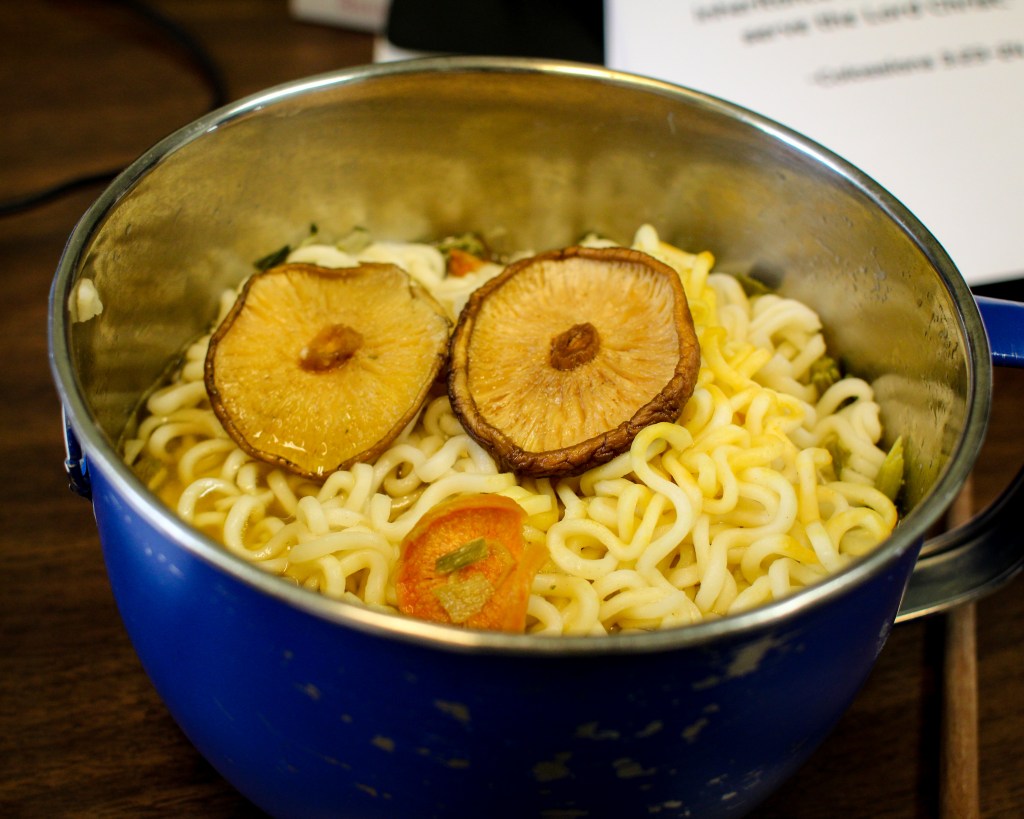
Ramen noodles soak
Mushrooms and veggies draw in
more than flavored broth:
they draw in hope for today
and give strength for tomorrow.

This morning started off well: a peanut butter and jelly sandwich with a tall glass of water before biking down to the church. The wonderful thing about biking to work is that you get to save gas money and help to care for the planet. Hours later, the crew leaves the church from the spring cleanup day. I head into my office and begin to work on cards thanking people for their service to the church today and for their service in helping to cleanup at Casowasco last Saturday.

After everyone has come and gone, the time for lunch draws near. I put a package of ramen, four dehydrated mushrooms, and a quarter cup of dehydrated veggies underneath the coffee maker’s spout. Twenty minutes later, I have Keurig Ramen, a common meal these days.

It isn’t the church’s fault that I’m not eating steak today. While I’d love to blame my former partner, it is not completely her fault either. It certainly is not the fault of the three blessings that I love with all of my heart and soul. We live in a broken world and after I am done voluntarily supporting my children who live across the state against my desires, I honestly have less in my bank account than I had when I served a church in seminary. I definitely did not see this place on my journey coming: I would have spent more time learning to cook better foods for fewer people for less.

For lunch today, my ramen looks back at me. I wrote a tanka about the ramen as I contemplated my lunch. I still wonder, what does the ramen see?

I hope it sees someone who is grateful for a good meal. I hope it sees someone who is grateful for what he has been given instead of someone who spends all of his time lamenting what is not right here. Actually, let me reword that: “I hope it sees someone who is working to be more grateful for what he has been given and to be less focused on what is lacking.” The intention is important, for I know I have a role in choosing how I react to these moments.

We don’t always get to choose what comes our way in this life. When we slow down and listen to the Spirit, we can be given a choice about how we react. I choose to react to these moments with hope.

“Here” and Life

The #RethinkChurch Lenten Photo-A-Day Prompt for today is “here.”

This has been a really rough week for me. I have had more than one wise individual in my life point out that it was likely always going to end this way. One friend with a long history in the legal profession said “If you were the mother, things would probably be very different. Nobody wants to be the judge who gets a reputation for separating kids from their mothers.”

So, I have fewer rights and will see my kids less. The system is broken and there’s nothing I can do about it but pray. What’s my consolation today?

I weep, Jesus weeps, but we’ll laugh.
I feel impoverished, Jesus is sacrificing, but we’ll be rich.
I am empty, Jesus is emptying himself, and we’ll be full again.
I had to choose my religious profession or more visitation, Jesus faced persecution, but there’ll be blessing.

Also, those who laugh will mourn.
Those who feel rich will be impoverished.
Those who are full will be emptied.
Those who have everyone speak well of them will go the same way as the false prophets.

In the end, it is going to be okay. Justice is in the hands of a just God who sees what has happened. My attorney tried to lighten the mood by asking if lightning bolts or karma would strike first, but that’s far above my paygrade. Another friend later chimed in that karma may make me spend the rest of my days wondering if God answers prayers, but it isn’t really about that kind of thinking for me either.

Maybe they’ll repent someday? Maybe they’ll seek forgiveness and make amends for their sins? I have no idea, but their sins are in the hands of God, not mine. I don’t need to be vengeful as God is still God. I don’t need to threaten anyone with wrath, because the wrath of the New Testament falls on people who choose to bring it into their lives. What comes out of the lips comes from the heart, regardless of whether those are words of blessings or empty accusations. In the meantime, I’ve texted my kids that I love them and now am choosing a picture.

When everything was in the hole Tuesday after a sleepless Monday night, I knew where I could go to find solace, peace, and safety. I went to church. Sometimes I go and meet with my lawyer on Grand Island, and I pull into my home church’s parking lot to just be near the place where so many holy things took place over the years. On Tuesday, I went to the church to work. As I worked, I was drawn into a world bigger than myself. By the time we had Council, we were having discussions about how the church was a blessing to us and how we can share that blessing with others. Being at the church transformed my day, my attitude, and my hope. The church truly is a a place where we can just be “here.”

“Silent,”Peace, and Holy Week

The #rethinkchurch Lenten Photo-A-Day prompt for today is “silent.”

In our devotional today we are reading through a section of Matthew 10. Matthew 10:24-25 says:in the NRSV “A disciple is not above the teacher, nor a slave above the master; it is enough for the disciple to be like the teacher, and the slave like the master

Throughout the gospels, the story of Christ is one where Jesus seeks out time alone with God. Jesus spends time with God in prayer. In my own experience, I have always equated those times to moments of silence. Although it does not say so, I cannot imagine the disciples falling asleep if their prayer was some form of prayer in motion.

There are times when we are called to intensive prayer. For me, that often means being in a place where I can still my mind and my thoughts. To be clearly honest, there are times that my mind has been absolutely still and clear in the midst of a tumultuous location like in a crowd. There have also been times when I have been in peaceful spaces without an ounce of peace in my soul. Silence and stillness are not always the same as being in a place of peace and stillness.

What is important to me as we approach Holy Week is finding a place where I can find peace and stillness. Forget what the world says stillness and peace should look like as we approach holy week and the cross; we need the peace that enables us to follow. Whether that peace is found in a loud crowd or a silent setting, the peace we need is far more important than the appearance of peace. The silence inside is far more important than the sound levels outside..

“Needs” and a Happy Sight

The #rethinkchurch Lenten Photo-A-Day prompt for today is “Needs.” To be honest, there is absolutely no appropriate way that I can find to connect the word needs with both any photo in my collection and the theme of the devotional today.

In the devotional, the story we read today about Jesus’ life comes from John 9:1-40. In that story, Jesus brings sight into the life of a man who was born blind. To be entirely honest with you, I’ve never taken a photo of a blind person. The closest thing I have come to taking a photo of a blind person are the self-portraits I took when I had a corneal transplant a few years ago. My sight had grown so poor due to keratoconus that I was seeing quadruple at times in m one eye.

Nobody asked me the insanely pointed questions which were raised about the blind man in John 9. Nobody asked if I had keratoconus because my father or mother sinned. Nobody asked if my vision was hurt because of some great transgression. We don’t know everything about keratoconus, but it is likely that the latest medical journals do not point to divine punishment as a reason for a wacky cornea.

Instead, I chose a different picture for today. I chose a picture of a coffee pot brewing coffee on a camping trip two years ago. Why? Is it because I need coffee? Actually no, I was drinking tea at the time. Yes, there have been points in my life when I had foregone coffee for tea. Was it because everyone sometimes feels like they “need” a cup of something hot to start the day?

No, I shared this picture because it beautifully caught the flames, showed a moment of joy, and reminded me of a really happy sight in my past. Why was it a happy sight? It was a happy sight because someone donated a cornea and I can now see far better than seeing four images in one eye, and one image in the other.

Perhaps that’s the closest I will get to connecting this photo with the story of a blind person in need of compassion. While my story is not nearly as beautiful as the one in John 9, I have been in a place where I have been truly grateful to see. Sometimes the coffee pot is the most beautiful thing in front of us for a reason besides what it promises us. Sometimes it is just beautiful to see and have gratitude for sight.

“Compassion” and the Eagle

The #RethinkChurch Lenten Photo-A-Day prompt for today is the word “compassion.” We are reading the scripture that is at the heart of tomorrow’s sermon, so I will avoid diving into the devotional today.

What does it mean to be compassionate, especially in light of Jesus’ teachings on weeping? Blessed are those who weep, for they will laugh! Laughter? I rarely think of laughter and compassion in the same sentence. As we have touched on a few times this week, laughter can often be at someone rather than with some. Such laughter is not very compassionate.

Compassion may have a lot to do with the comfort found in Matthew’s presentation of the beatitudes. It can be compassionate to show loving comfort to someone who you might consider your enemy if it were not for the fact that they are down on their luck. I think it is fair to say that it is compassionate to comfort people who are simply down on their luck or in a place of tears rather than living in a place of laughter.

I chose a picture of an eagle that I took at the Buffalo zoo last year. The eagle really does have a beautiful visage, but this eagle will likely never fly free. The eagle lives behind a fence where it can see tasty morsels flit by on smaller wings. Given the eyesight of the eagle, it probably sees the squirrels in the nearby park or the mice that might feast near the trash cans despite the best efforts of the staff.

Many people might think I am trying to make a point about zoos here. I’m actually not, although you can draw your own conclusions. Most of us have someplace in our lives where we feel trapped by life circumstances or life challenges. The fence is right there and it is okay to wish for something more. I know that I wish for something more on a regular basis.

I believe that God sees our sorrow and that’s one reason why Jesus went beyond offering comfort in Luke’s version of the beatitudes. Jesus makes a promise that laughter is on the way, because God sees our tears, knows our fears, and God is on the way.

“Enough” and the Lonely Leaf

The #RethinkChurch Lenten Photo-A-Day prompt for today is the word “enough.” In our devotional, I once wrote the words “Perhaps one might think of the cliche that it is better to laugh than cry.” In the story we read, grieving parents laugh as Jesus tells them that their dead child is merely sleeping. To be very clear, they laugh at Jesus instead of with Jesus.

My photo for today is a picture of a single leaf that I found fluttering besides a walkway in the Sapsucker Woods north of Ithaca. I walked through the woods last fall and saw this life. As I contemplated how the leaf sat on the end of the branch alone, I found a kinship with the leaf as it fluttered alone.

Is it better to laugh than to cry? Not always. It is certainly better to come to a place where you can laugh with Jesus rather than laugh at Jesus. Grief is a powerful thing and can cause a great amount of pain and disorientation. Would the parents laugh in the same way if Jesus had arrived before their child passed away? Often grief blinds us to the possibilities in front of us. The parents in the story with Christ were clearly in a place where they could not see beyond their grief.

I chose the picture of the leaf for “enough” for several reasons. First, the leaf was a beautiful leaf. As lonely as it seemed, it was still lovely. I am also enough even when I am alone. You are enough even when you feel lost or alone.

Second, I chose the leaf as an affirmation of the fact that last fall while I was on an afternoon walk there was enough goodness in the world that I was shaken out of my thoughts. I lay on the ground to get this photo from this angle. Would I rather have been somewhere else? Yes, but even when I was disoriented and somewhere I did not want to be, there was enough beauty in the world that goodness shone through my own sorrow.

Third, I chose the leaf as an affirmation of the fall. What I think is permanent today will one day fade away. My life is that of a leaf. One day it will be done. God willing, one day another leaf will fill my place in the world. I hope you have such a hope as well.

“Planted” and Aquaponic Fish

The #RethinkChurch Lenten Photo-A-Day prompt for today is the word “planted.” Of course, I couldn’t just be normal, so I decided to use one of my favorite pictures from my “aquaponic” fish tank. Who wouldn’t want to be planted in water?

Nibbling fish

To be entirely honest, the picture is quite fitting for the theme of the week. We have been pondering “hunger” and “fullness” and these fish are almost the living embodiment of the idea taught by Jesus.

When I bought these fish, I bought them with a pair of clown loaches in order to help take care of some very expansive plant growth in the tank. I had bought some plants from my favorite fish place and had been warned that they tended to grow quickly. Between the plants and the snails that came with them, it was not long before the aquarium was very green and very infested by snails.

Woe to you fish who are full, for you shall be empty. They devastated every single plant in the aquarium in a matter of weeks. When they arrived I couldn’t see the back of the tank. After they were happily established, every single plant in the aquarium was doomed. The snails had just as rough a time. Indeed, the fish made short work of the basil roots shown in this picture. They were so full for a while, but then they were more than empty.

The plants actually have grown to the point that their roots are managing to reach into the tank now. Their roots grow quickly and there’s enough space within the plastic enclosure, planting medium, and clay pellets that their roots are thriving despite the nibbling. I am almost certain that all of the plants would be rootless if I had let the fish “be full” of plants, but blessed are these fish for their “emptiness” means that there will be enough for tomorrow’s nibbling.

“Sacrifice” and the Bridge

The #RethinkChurch Lenten Photo-A-Day word of the day is “sacrifice.” It is a somewhat difficult thing to balance the idea of sacrifice with this week’s theme of hunger and fullness. The challenge does not rest in making a connection between these two ideas, but in making a connection that is not overly personal.

In the fairly Christian culture of my teenage years, there was a common description of what Christ does through the events of holy week. Christ makes a bridge between our lives and eternity. The idea behind the analogy is that there is a massive gap between our lives in this world and the life we were created to live. We can jump as far as we want, be as righteous as possible, and we still won’t be able to leap the distance.

What happens without Christ? We fall into the gap which can be described as torment, hell, or death. Instead of leaving us in this position, Jesus came for us, died for us, and created a way for us to reach the other side. Christ is our bridge.

The photo I selected for today is of a rickety bridge over a tributary to the Cayuta Creek. I found the bridge on a walk last fall while trying to think through some personal struggles. I found the bridge and to be honest, I really wanted to see what was on the other side of the bridge; however, at least in my head, there was not even the slightest possibility that the bridge would have supported my weight. The bridge appeared rickety, broken, and frightening.

One of the things I have come to understand in my own walk with Christ is the fact that my relationship with Jesus is a relationship that is founded on love and respect. God doesn’t force me to walk over the bridge to life. There are places in my relationship with Christ where I am offered life, but even as Jesus builds a bridge to life, I must choose to step out in faith.

Jesus’ sacrifice brings life and light into my darkness, but I must choose to step out in faith. It can be really frightening to trust Christ. Occasionally the bridge looks really frightening. Sometimes, we need to face our fears and step out onto the bridge even when it is scary. Christ sacrifices for us and sometimes we must choose to sacrifice our fears in order to choose life.