Sermon: “A Letter to God”

Sermon: “A Letter to God”
Preached; October 10, 2022
Scriptures: Luke 17:11-19; Psalm 111
Preacher: Rev. Robert Dean

Holy Christ, I wanted to write you an open letter this morning for a few reasons, all of which you already know. The fact that you know the contents of this letter is one of the fun parts about writing a letter to you, but I am fairly certain you do not mind my sharing this letter with your congregation.

One reason I chose to write you a letter this morning is the very real tiredness which comes from attending Annual Conference for several days in a row. Preaching a sermon while looking people in the eye and focusing on body language is a bit much after several days of long meetings. Such a presentation might be beyond me this morning, but presenting a letter is within my capacity. 

Another reason is the very real challenge that comes with the subject matter. You know the subject we are speaking around is very near and dear to my heart as a person. I wanted to choose my words carefully around this touchy subject, so I chose each word in advance this week. 

So, dear Lord, let me get to the heart of why I wanted to write to you today. The scripture reading that we just read included a psalm from the Hebrew Scriptures around the work of God and a story from Christ’s life. The psalm shared how your goodness and majesty are embodied within the earth. You are described in words with words like majestic, glorious, righteous, and honest. In covenant, you are revealed as faithful, trustworthy, merciful, and compassionate.

Now, you know what I do for a living. As an Elder in the United Methodist Church I am called to a ministry where I share the Word, offer the Sacraments, invite others alongside the community into a life of Christian Service, and Order the church life through acts of administration with ordained authority. While I live out my ordained role within the community I perform wedding rites, counsel and encourage individuals and couples in relationships, and help to advocate and work towards ensuring that the churches I serve are safe places for children and vulnerable adults. I am in ministry with elder saints, married adults, single adults, adults in relationships, with teenagers, and with children. To put it in Methodist terms, since “the world is my parish,” I am called to minister to all parts of the community and not simply the people who walk through the doors of my church or who officially enter church membership..

I enjoy what I do for a living. I derive comfort from helping others. I enjoy sharing in deep conversations about you (God) and about what life can be like while living with you. If it were not for paperwork, there are very few days where going to work feels like drudgery, but that does not mean that it is always easy or painless.

In those moments of both joy and pain, I rely on you both as the One who walks with us and sets an example for us. You, Lord, are all the things described in our psalm. When I marry people, I share with them about the way that Christ models a healthy way to live in love with a spouse. When I confirm students into church membership, I ask those students point blank about their relationship with you, their divine parent and Savior. All of these conversations use relationships as a simile for our relationship with you. God, you are like our Parent. God, you are like our spouse.

So, what am I supposed to do when I come across places where spouses hit spouses? Didn’t I just say that a loving relationship with a partner is like a loving relationship with you? Do such analogies work after a spouse bruises a spouse? Do they do more harm than good after such moments? In a similar vein, what do I say when a teenager tells me that their parent or parents tear them down? What do I say when a child tells me that their parent does not love them? What do I say when a child mentions one parent hitting another?

The other day you know that I had Chinese for lunch on the first day of the Annual Conference. You know what that fortune cookie told me. The cookie stated in bold fashion that “Fate loves the fearless.” You know that I read that fortune and thought of this moment in this letter to you. You know the questions I wanted to ask after reading that short little proverb. 

It is nice to think that people who are unafraid have a place to live in this world. What of the others? Who favors the fearful? Who favors the frightened? Who favors those who have felt pigeonholed into places of darkness and doom? 

We know as a people that domestic violence is not okay. The Book of Resolutions of the United Methodist Church affirms that belief when it shares on behalf of the church the words: “We recognize that family violence and abuse in all its forms—verbal, psychological, physical, sexual—is detrimental to the covenant of the human community.” 

We understand that domestic violence is not acceptable and harms the covenants within our community. We understand that God cares for us deeply and does not want us to suffer in such ways, but these actions happen in spite of our best intentions and desires.

So what do we do, Lord? Where do I point as a proclaimer of the Word? If people see you as their divine parent and their example of a parent is violent, then how do I share that there’s a difference between what the worst of humanity shows us and the way you want to care for us? Where can I point? Where can I tell a hurt person to look?

Of course, you know the answer to that question. I already know the answer to that question. A lot of people who have spent time in church know where I should invite people to look. Where do I point people who have such questions, concerns, and fears? 

I point them to Jesus. When they need to see a person whose life is marked by compassionate love rather than impassioned hatred, I point them to Jesus. When they need to see a person who does more than say pretty words, I point them to Jesus. Jesus not only spoke about love and nonviolence, but went so far as to heal the ear of a soldier who was hurt by Jesus’ disciple when that soldier came to arrest Jesus on the night before his crucifixion. 

Look at our story! Jesus is confronted on the road by ten people with skin diseases which were identified by translators for many years as leprosy. There are ten lepers on the road who need help. They are unclean and by both religious law and cultural tradition they had to keep their distance from Jesus and his disciples. From a distance they cry out for help. 

Does Jesus berate them? Does Jesus throw things at them? Does Jesus mock them? Does Jesus ignore them? Does Jesus tell them to go somewhere else? Jesus does none of these things.Jesus heals them. All ten of them. Nine of them are healed, but apparently have their own plans about what to do next. The nine walk away, but one returns.

Was this person a rich person? We don’t see that in the text. Was this cleansed person a person of importance? We don’t see that in the text. What we do see is that this person was that there was more going on with this person than just a skin disease. This person was a foreigner from outside the Jewish people. Beyond unclean, this person’s entire being was outside of the people God called and sanctified in the desert. 

So, Jesus was nice to this leper when there was just a disease and the leper was one of many. Perhaps now Jesus will reject this person as a distraction, a nuisance, or an outsider? Perhaps now Jesus will strike the foreigner, mock the foreigner, or just ignore the fact that they have returned. 

Jesus doesn’t do any of those terrible things. Jesus does not strike out at this person physically, verbally, or even culturally. Jesus invites this person to go forth as a person who has been healed. Even though the praise of God comes from someone other than a child of Abraham, Jesus welcomes the praise, accepts the thanks, and sends this person out with a blessing. There isn’t even a touch of cruelty shown to this person. All that remains is love and kindness for a person who needed help.

This is the kind of example that I point to when I tell people to love their partner like Jesus. This is the kind of behavior a loving parent should show their child, should model in their home, and should ideally invite their child to share with someone else one day. Do I expect that anyone can live this kind of a loving life 24/7 without divine help? No, but this is the ideal. 

The love shown by Christ when shared between two people is holy and good. It does not harm or hate. It does not mock or denigrate. It does not tear down or destroy. It is good, holy, and kind. This is the love I want people to share with God. This is the kind of love that I pray will fill the lives of the people who stand before me when I perform a marriage. This is the kind of love I pray will anoint every child and every adult that I baptize. This is love incarnate.

Of course, I know that trust is hard, especially after the wounding that can take place when people face domestic violence. Here’s what I propose. God, if we do our best to trust that you are kind, loving, and graceful, will you help us to believe? Will you meet us in the moment we are tempted to see you in the same light as the broken parts of humanity we may have seen? Will you help us to believe in you when the worst criticisms of all come from within?

Truthfully, although this letter addresses domestic violence as a major issue, I hope that you will meet people who struggle to believe in a loving God in other situations. Some people live life with happy parents, loving children, and without a cloud in the sky of their home life while still struggling to believe. Will you meet them too? Right here and right now, will you meet them if you ask for help? 

I trust you will meet everyone who turns to you in these moments. I trust you will help people to come to know love deeply, to understand hope intimately, and to cultivate faith in the internal garden they share with you. 

Likewise, I trust that the people who hear me read this letter to you or who read it later on their own will understand the message that should not need to be said. The Book of Resolutions teaches after the passage we read before that: 

“We encourage the Church to provide a safe environment, counsel, and support for the victim and to work with the abuser to understand the root causes and forms of abuse and to overcome such behaviors. Regardless of the cause or the abuse, both the victim and the abuser need the love of the Church. While we deplore the actions of the abuser, we affirm that person to be in need of God’s redeeming love.”

 ¶161.ii.h. “The Nurturing Community, Family violence and abuse” in the Book Of Resolutions of the United Methodist Church, 2016

If someone who reads these words needs help, we are called to be a place where help can be found, whether they are the victims or perpetrators of domestic violence. All people are called to the redeeming and redemptive God of love and we will do our best to walk with each person who comes in need of help. Taking it a step further theologically and philosophically, as a church we will work with you through the Spirit so that we can do better than our best in such moments.

In the end God, for me the journey towards healing begins in trusting in You. Whether we are recovering from abuse, facing abuse, living out destructive patterns of abuse, or walking with others who face such terrors, we are called to trust in Christ. Like the foreigner long ago, we can choose to walk away even after Christ works in our lives. We can also choose to come back in faith.

It is only in returning to Christ that the cleansed person found welcome. It is only by stepping towards God in faith that the foreigner was sent forth with a blessing. In stepping towards Christ an example was set where blessing came from drawing near even after all was made right in that person’s life. 

I would end this letter with a straightforward prayer: Holy God, help us to draw near to you. As someone who has faced such circumstances, help me to offer words of hope to others as a minister, an advocate, and as a Christian. Help each Christian to stand for a world where abuse fades in the light of love. Teach us to advocate for redemption in the lives of the least of these as well as healing in the lives of those they have abused. Help us to treat them like we would treat Jesus. Let that light of love shine in dark corners and help to bring hope into the darkest of places. We ask for your help in Jesus’ name. Amen.


October has been Domestic Violence Awareness month since it was first introduced by the National Coalition Against Domestic Violence in 1981. Regardless of the month, domestic violence is never okay, no matter the circumstances. If you or someone you know is in desperate need of help, contact the National Domestic Violence Hotline at 1−800−799−7233 or TTY 1−800−787−3224.

Healing and Sharing

How do we begin to heal after the pain of the past? How do we start to find our way forward after trust is broken, hearts are shattered, and faith falls flat? 

For me, one tool in my toolbox of healing is to care for other people. Often the things that I need on my path to a healthier place are the very things needed by people who have walked a similar path. While I need them, I don’t always recognize my needs. Being around and caring for people who have walked similar roads often helps me to see in others the things I need in my own life.

Do you know what I mean? I may need to hear a loving voice, but I don’t recognize that need until I see how much a friend needs to hear my loving voice. I may need to go easier on myself, but I will be harsh until I walk alongside someone who is just as harsh to themselves as me. 

To put this in Biblical terms, I might relate it to what is said in the Common English Bible in Luke 6:38: “Give, and it will be given to you. A good portion—packed down, firmly shaken, and overflowing—will fall into your lap. The portion you give will determine the portion you receive in return.”

There have been places in my life where I have felt completely broken, but I have found the process of healing begins when I reach out loving hands to another person suffering. Selfishly, one reason I am being so open about my woundedness this month is to help others find a compassionate voice because I understand that compassion acts like a boomerang. When I send it out and away it comes back to me. 

I hope that these posts bring encouragement to others and help them to understand that they are not alone. I hope that others find my voice to be loving, sympathetic, and inviting. I hope that others take encouragement from what I write this month and pour that love out to others. I hope that divine cycle of giving love and receiving love will keep spreading, but even if it never goes beyond the words on this page, I will reach out and invite others to reach with me.

Just as I think I am just done,
Everything switches as I hear
How another person has walked
Over roads I once might have tread.
Very slowly my closed heart creaks
As deep compassion stirs within:
Healing pours in as love flows out.

October has been Domestic Violence Awareness month since it was first introduced by the National Coalition Against Domestic Violence in 1981. Regardless of the month, domestic violence is never okay, no matter the circumstances. If you or someone you know is in desperate need of help, contact the National Domestic Violence Hotline at 1−800−799−7233 or TTY 1−800−787−3224.

Judgment and Domestic Violence

“Grateful for God’s forgiving love, in which we live and by which we are judged, and affirming our belief in the inestimable worth of each individual, we renew our commitment to become faithful witnesses to the gospel, not alone to the ends of earth, but also to the depths of our common life and work.”

“Preamble to the Social Principles,” The Book of Resolutions of The United Methodist Church 2016.

What are the Social Principles of the United Methodist Church? Earlier in the preamble to the Social Principles within the Book of Resolutions, the Social Principles self-identify themselves as existing outside of church law. The principles “are a prayerful and thoughtful effort on the part of the General Conference to speak to the human issues in the contemporary world from a sound biblical and theological foundation as historically demonstrated in United Methodist traditions.”

The Social Principles are neither binding by church law nor restrictive of church member behavior. They are a work born of prophetic zeal and idealism which in the end hopefully points us towards a more holistic understanding of the world around us.

Why am I bringing this up during Domestic Violence Awareness month? I would point out at least two things about the paragraph that I originally quoted. 

First, the Social Principles point towards the value of each individual. Yesterday my post pointed out that there should be a place for redemption in the church. Today I wanted to point out that even when redemption takes place, the redemption of another person’s life does not diminish the importance of wholeness and healing in the life of the victims of domestic violence.

Each person has inestimable worth and part of our common work is to affirm that value in the lives of people who have been demeaned, denigrated, or diminished through the sinful actions of others. Victims of Domestic Violence can feel broken, worthless, or even worth less than others. The lives of people who have gone through this experience are valuable and they are worthy of both God’s love and a loving place in God’s community.

Second, I want to point out that this paragraph points out that we both live within the forgiving love of God and are subject to judgment through and by that love. I’m generally not a hellfire and damnation preacher, but I do not deny that judgment will one day come for us all. I believe that God is far more gracious and kind than us, and I also believe wholeheartedly that God’s loving kindness sees and counts every tear and wound inflicted through our broken behavior and actions. 

As a survivor of Domestic Violence myself, there are times when I honestly do not want to be forgiving. In those moments, there are times when I can only move forward by handing my pain over to my loving God. I can let go of a deathgrip on my anger, pain, and hurt because I understand that in time God will take care of things. 

I don’t need to be vengeful for any vengeance necessary is in the hands of a God who is both kinder and better equipped to bring judgment without cruelty. I don’t need to carry anger around in my heart, for the pain which would fuel my anger doesn’t need to rest within me. I can let God care for the situation and move forward with life. 

Judgment may come, but I don’t need to be the judge. Retribution may come, but I don’t need to be dealing it out. I don’t have to do a thing to harm the people who harmed me, for God will care for those who have done wrong. I am a person of inestimable value and I don’t need to cheapen my value by carrying around worthless and harmful things like rage, anger, and hatred. God has those things, so I can move forward with life without worrying about them every day.

If you have been through such pain, I invite you to consider that God both loves you and will one day deal with the sinfulness of the world. There can be  healing and there can be wholeness even after everything that both you and I have gone through. It is not easy to hand over such things to God, but I invite you to consider what life might be like without carrying the baggage of pain, anger, and hatred with you everywhere you go. 


October has been Domestic Violence Awareness month since it was first introduced by the National Coalition Against Domestic Violence in 1981. Regardless of the month, domestic violence is never okay, no matter the circumstances. If you or someone you know is in desperate need of help, contact the National Domestic Violence Hotline at 1−800−799−7233 or TTY 1−800−787−3224.
A Place for Both

“We recognize that family violence and abuse in all its forms—verbal, psychological, physical, sexual—is detrimental to the covenant of the human community. We encourage the Church to provide a safe environment, counsel, and support for the victim and to work with the abuser to understand the root causes and forms of abuse and to overcome such behaviors. Regardless of the cause or the abuse, both the victim and the abuser need the love of the Church. While we deplore the actions of the abuser, we affirm that person to be in need of God’s redeeming love.”

¶161.II.H. “The Nurturing Community, Family Violence and Abuse” in The Book of Resolutions of The United Methodist Church, 2016

What does it mean that the church is a place for both the abuser and the abused? This question resonates deeply with me as a survivor of Domestic Violence. Can there be space in the church for both me and the person who tore me to shreds?

Yes. The short answer is that the church absolutely must be broad enough for both the abused and the abusers. Although I have my issues with the imperfect nature of the Book of Resolutions, to the best of my ability I understand that the church must make room both for those who need redemption and for those who lives need to be redeemed from the places of desolation, sorrow, and shattering.

Why? Wouldn’t it be easier to lean into the more judgmental parts of scripture? Although I generally refer to the larger section of the scriptures as the Hebrew Scriptures, can’t God “go Old Testament” once in a while with the fire, flames, and what not? Won’t God bring damnation to those who have hurt people deeply to the point where it feels imprinted on the soul? Aren’t there places where the wicked find out that they can’t have their cake and eat it too?

Absolutely those places exist in scripture. Honestly, my soul rests better at night knowing that such places exist in the theological life of the church. That being said, we can do better as a people than rely on damnation as our first recourse to sin in the world. Who among us is without sin in their lives?

Once upon a time, most of us crawled on the earth as toddlers. Each of us grew up in the same world that was filled with imperfection and brokenness. Some of those who abuse were once the innocent ones being abused. Some of those who abuse walked down dark roads none of us would choose to walk.

Would we want to be left to our own sorrow and judgment after we went on such a journey? If there truly is a chance for redemption, would any of us truly ask for redemption to pass us by? Would we want to suffer when grace might lead us back to life and lifegiving ways? Is that what we would want if we walked down such roads in those shoes?

We are called to love one another. We are called to treat each other like we would want to be treated. We are called to live lives filled with the unmerited favor known as grace. Judgment belongs to the Lord and there may come a day when judgment falls, but between now and then we are called to lives of faith, hope, and love.

Yes, that means that my abuser may one day shelter under the wings of the God that shelters me. Yes, that means that the Holy Spirit may need to sit us both down one day or keep us under opposite wings of the divine Mothering Hen (Mt. 23:37).

Should such a day come, I will ask God to help me to make room, even if I still have moments where the tears flow and I ask for God to “go Old Testament” every now and again. I will stretch for God as I believe and ask God to help me in my unbelief.

Even after such a moment, I do have to state clearly that forgiving and making room for an abuser does not justify abusive behavior, ever. Also, let’s be absolutely clear that I don’t need to be the person to bring my abuser back into the community of life. While I may give my blessing for their restoration, I do not feel the need to do it myself. If you have been abused, it might not be your responsibility either.


October has been Domestic Violence Awareness month since it was first introduced by the National Coalition Against Domestic Violence in 1981. Regardless of the month, domestic violence is never okay, no matter the circumstances. If you or someone you know is in desperate need of help, contact the National Domestic Violence Hotline at 1−800−799−7233 or TTY 1−800−787−3224.

Doctor Appointments

The doctor’s appointment is over an hour away from where I live. I need to care for my eyes, especially as I have two potential eye conditions that can go awry quickly if left without care. For the past month it has felt like I have a loose stitch on the cornea I once had replaced and it is almost constantly in discomfort.

If I go to the appointment, will I still have money to buy my kids Christmas presents? If I go to the appointment, will they accept it if we end up eating peanut butter and jelly the next time I see them? Will they still love me if I spend the money I will need to spend on my eyes instead of spending that money on them?

On one level, this post has nothing to do with Domestic Violence. There’s a whole fleet of unrelated issues that I face as a person going through divorce at a distance from his children. On another level, this way of thinking is directly related to living with someone who taught me that caring for my needs was problematic and caused my family to suffer. Domestic Violence is not just about people hitting other people. Domestic Violence includes systematically tearing down others verbally until they forget how to care for their own needs.

As I look at the map, I hear those words telling me that I’m wasting money that my kids could use. At the same time, I need to take care of myself if my kids want to have a father who can see well enough to drive to see them. Sometimes I do not need to get another cup of coffee, but this particular need is not a question of whether or not I deserve a cup of coffee. There are legitimate needs in my life that need to be cared for despite being taught repeatedly that I needed to dismiss my own needs for the sake of my kids or the person who was once my wife.

It is okay to care for yourself. I have heard words that may be like those you might have heard or are hearing. Friend, it is okay to have legitimate needs and to fulfill those needs. There are times in life when it is absolutely valid to spend money to care for your needs, because those things are needs and not wants. You don’t need to be ashamed.


October has been Domestic Violence Awareness month since it was first introduced by the National Coalition Against Domestic Violence in 1981. Regardless of the month, domestic violence is never okay, no matter the circumstances. If you or someone you know is in desperate need of help, contact the National Domestic Violence Hotline at 1−800−799−7233 or TTY 1−800−787−3224.

Log Filled Eyes and Surviving

“Don’t judge, so that you won’t be judged. You’ll receive the same judgment you give. Whatever you deal out will be dealt out to you. Why do you see the splinter that’s in your brother’s or sister’s eye, but don’t notice the log in your own eye? How can you say to your brother or sister, ‘Let me take the splinter out of your eye,’ when there’s a log in your eye? You deceive yourself! First take the log out of your eye, and then you’ll see clearly to take the splinter out of your brother’s or sister’s eye. Don’t give holy things to dogs, and don’t throw your pearls in front of pigs. They will stomp on the pearls, then turn around and attack you.

Matthew 7:1-6, CEB

One of the hardest things for me to accept along the path I have walked was my own need to have perspective. Along life’s journey I had come to believe that it was judgmental to look critically at someone else’s actions, especially if I knew that I was imperfect. I have had to learn to have perspective.

I am a trained Biblical scholar who has spent over a decade teaching other people to take the scriptures seriously. One of the largest tools in my toolbox is to model a response to scripture by considering deeply how the scriptures affect my every day life and living in light of those considerations. In particular, I have felt compelled by both belief and position to move past being judgmental to a place of loving acceptance of other people.

As a result when things happened that were unacceptable, I did my best to look for the log in my own eye. When I was yelled at for fulfilling a basic need, the assumption I immediately made was that the thing I thought I needed was the issue. Many times over the years I had wanted things that were less than necessary, so I thought that the needs I had in the those moments must now must also be unnecessary.

Over the years I spent a lot of time looking for the log in my own eye. I thought that all of the problems my family faced were my fault. I listened to the words over and over until I agreed with my partner when she stated that everything wrong in our life together was my fault. If I wasn’t so broken, things would be great. If I wasn’t so needy, she wouldn’t yell. If I could do a little better, she wouldn’t need to laugh at me.

In hindsight, the relationship was toxic to the point that I really did start having a problem that needed fixing. The primary problem was not that I fell short in many ways, although I still had shortcomings and still have shortcomings. The problem was that I took the good life that God had given to me and kept handing it over to someone who would stomp on what was good in me, turn, and attack me.

To be absolutely clear, the problem was not that I was too judgmental and should immediately stop to find out what was wrong with me. The problem was that I valued myself so little that I forgot one of the most holy tenets of my faith: that God loved me and cared about me deeply. While this was happening, I taught others that God was not okay with such behavior out in the world. The things I taught did not line up with the life I lived.

In practice, I forgot that God was not okay with the mocking laughter or the verbal abuse inside my marriage. Even as I taught that others should never hit their spouses or partners, I continued to forgive the pain of what I considered brief but forgivable moments throughout the years. I had all the grace I could muster for others but accepted no part of that grace in my own life.

I didn’t deserve such behavior and I should have asked for help. If you are going through something similar, you don’t deserve such treatment either. Years later, I am working hard to get to a point where I can look in a mirror without hearing the words that I should never have accepted in the first place. It hurts to admit it, but I can’t look at the good person in the mirror without hearing how I’m “pathetic.”

Being forgiving is a wonderful and noble thing. Humility is an important and powerful gift of the Spirit. Neither forgiveness nor humility make Domestic Violence acceptable. From my perspective as a Christian, I believe that each one of us have been given gifts that are holy and good. We should never throw them before the swine of the world that will trample them and attack us for sharing our lives.


October has been Domestic Violence Awareness month since it was first introduced by the National Coalition Against Domestic Violence in 1981. Regardless of the month, domestic violence is never okay, no matter the circumstances. If you or someone you know is in desperate need of help, contact the National Domestic Violence Hotline at 1−800−799−7233 or TTY 1−800−787−3224.

Complete Personhood

It can be easy to overlook the underlying issues that exist when considering the effects of Domestic Violence within the family. One issue that can be easily overlooked is how acts of Domestic Violence can affect the wellbeing of others. It may seem overly simplistic, but the simple things are often those most often overlooked.

As stated in other posts this month, the folks over at DomesticViolence.org wisely share that “Domestic violence shows itself in a number of different forms, whether it’s punching, slapping, choking, or threatening, manipulating, yelling and many others.” They are absolutely correct when they state that such acts are never okay, but why?

I like to rely on the wisdom of others as a United Methodist minister and as a person. One document of living wisdom from the ecclesial world is the Book of Resolutions, which is a collection of non-binding statements which often express the ideals and sentiments of the church as gathered every quadrennium (except for 2020) since 1792. The process of holy conferencing has not always been perfect, but the theory behind acts of holy conferencing remains sound (in my opinion).

The 2016 Book of Resolutions is an imperfect document created by a people who believe in striving towards perfection. The principles of Holy Conferencing helped to create this imperfect document. Even imperfect, the imperfections of this work do not preclude it from holding wisdom. The 2016 Book of Resolutions states in the section on the family within “The Nurturing Community” in ¶161.II.B. :

“We believe the family to be the basic human community through which persons are nurtured and sustained in mutual love, responsibility, respect, and fidelity. We affirm the importance of loving parents for all children. We also understand the family as encompassing a wider range of options than that of the two-generational unit of parents and children (the nuclear family). We affirm shared responsibility for parenting where there are two parents and encourage social, economic, and religious efforts to maintain and strengthen relationships within families in order that every member may be assisted toward complete personhood.”

¶161.II.B. “The Nurturing Community, The Family” in The Book of Resolutions of The United Methodist Church, 2016

The final statement of that section speaks to a family that ideally helps each person to become whole in each part of their personhood. Although the facets of human life are philosophically debatable, the aim for families to help each person become whole in body, spirit, and soul is an admirable aim.

What happens when we take the people in that system and shatter the dynamics between the members? Can a person be whole in spirit and soul as their body is covered in bruises? Can a person have a truly healthy body when their spirit is domineered and diminished by another person who should be nurturing them?

It is very easy to stand in judgment over situations where there is domestic violence: Are people being too sensitive? Couldn’t that person just say something? Shouldn’t they just stand up for themselves? Isn’t that person just asking for it?

It is easy to dismiss domestic violence from the outside, but from the inside things may not be so easily dismissed. Why doesn’t the person with thirty pounds of muscle just walk away from the person hitting them? Maybe they are frightened, threatened, or intimidated. Even if we never know why such a situation exists, it is still important to stand up for the ideal that every person should be provided a chance to be a whole and complete person.

Wholeness looks different from person from person, but each person should have a chance to live into their own personhood. Just like with the Book of Resolutions, things may not be perfect yet, but today is a good day to begin to work towards a more perfect tomorrow.


October has been Domestic Violence Awareness month since it was first introduced by the National Coalition Against Domestic Violence in 1981. Regardless of the month, domestic violence is never okay, no matter the circumstances. If you or someone you know is in desperate need of help, contact the National Domestic Violence Hotline at 1−800−799−7233 or TTY 1−800−787−3224.

Silenced by Fear

A while back I had a deep conversation with someone I trust deeply. She asked me why I haven’t shared my poetry lately. I told her that isn’t that I have stopped writing poetry: I have one that I’ve been working on for over a month, which is unheard of on my end. Instead, my blog has remained empty due to a sense of fear, frustration, and worry.

How do you share poetry that is deeply personal when you feel as if your abuser will turn it against you in court? How do you express the depth of sorrow that fills every inch of your being when such an acknowledgment might lead to people saying that such expressions are marks of weakness? How can you be expected to care for children if you write these things that make you appear weak before others?

The poem I am writing is about the pain in and wounds on my knuckles after long sessions with my punching bag. As I burn calories striking the punching bag, my hands often end up aching deeply. At times, the skin has broken. Once, it took weeks for the tear over my knuckle to heal. More than once I have sat in my car, in my chair, at my desk, and even stood in the pulpit while feeling my fingers and knuckles throb from exercising the night before.

If I share a poem about hitting a boxing bag, will that be seen as a sign that I am violent? If I share how it has been a long time since I have felt safe, will that be enough to overcome the presumption that I must be a violent person just because I am a cisgender white male?

Do people know how my weight has made me feel unable to flee for decades? Do people know that my professional role and personal beliefs have often conspired to make me feel as if I have had to take the abuse time and time again? Do people know about the memories from being struck, the pain from hearing the derisive laughter, or even the sorrow of having children taken away because on the outside I may look like a bad guy at first glance? Do people know how I felt as if I would lose my job if I ever said anything and how it felt when my abuser acted as if nobody would ever believe me?

So, can I share that poem? Can I share poetry about how the bag welcomes my feelings when the world might not? Can I share a verse or two about how the pain of bloody knuckles sometimes makes me feel real and grounded during a troubling time in my life? Can I share that my knuckles ache but I am okay with that pain? Can I share that it means more to me when I choose to turn the other cheek when I actually know that I have an option? Can I share that the bloody knuckles come with the knowledge that I need not be afraid?

I can, but even in a month where the veil is pulled back on this issue in my life, I probably will not share that poem. It isn’t ready and I don’t know that I’m ready to trust others with my wounded soul when they read those words. Instead I will simply ask others whether or not they understand that people are not always the way they look on the surface.


October has been Domestic Violence Awareness month since it was first introduced by the National Coalition Against Domestic Violence in 1981. Regardless of the month, domestic violence is never okay, no matter the circumstances. If you or someone you know is in desperate need of help, contact the National Domestic Violence Hotline at 1−800−799−7233 or TTY 1−800−787−3224.

Domestic Violence Awareness Month

October is Domestic Violence Awareness month. For the month of October I am using the platform I have as an individual and as a clergyperson to raise awareness of this issue and to work towards a better future for all people. I am raising these issues both as a person with a moral obligation and as a person who has experienced domestic violence. As the Companion Litany to the Social Creed of the United Methodist Church states:

“Today is the day God deplores violence in our homes and streets,
rebukes the world’s warring madness,
humbles the powerful and lifts up the lowly.
And so shall we.”

United Methodist Book of Resolutions, 2016, ¶ 166. “OUR SOCIAL CREED”

Domestic Violence knows no boundaries. People of every persuasion can be affected by domestic violence regardless of their gender identity, cultural norms, religious persuasion, and any every other form of distinction. As it says over at DomesticViolence.org, domestic violence “affects not only women, but men and children, of all different races, status, religions, and culture. No one is immune to it.”

Throughout this month I will likely share a bit of my experience, share how I have begun to heal, and hopefully highlight parts of the conversation in and around these topics, but my voice is not the only voice. Read widely, read wisely, and be prepared for both the joy of successes and the sorrow of struggles. 

A word of unasked for advice: Like most moments in life, this is a wonderful month to consider the old phrase “Be kind, for everyone you meet is fighting a hard battle” before diving into the comment sections of people you do not know.


October has been Domestic Violence Awareness month since it was first introduced by the National Coalition Against Domestic Violence in 1981. Regardless of the month, domestic violence is never okay, no matter the circumstances. If you or someone you know is in desperate need of help, contact the National Domestic Violence Hotline at 1−800−799−7233 or TTY 1−800−787−3224.

“Silent,”Peace, and Holy Week

The #rethinkchurch Lenten Photo-A-Day prompt for today is “silent.”

In our devotional today we are reading through a section of Matthew 10. Matthew 10:24-25 says:in the NRSV “A disciple is not above the teacher, nor a slave above the master; it is enough for the disciple to be like the teacher, and the slave like the master

Throughout the gospels, the story of Christ is one where Jesus seeks out time alone with God. Jesus spends time with God in prayer. In my own experience, I have always equated those times to moments of silence. Although it does not say so, I cannot imagine the disciples falling asleep if their prayer was some form of prayer in motion.

There are times when we are called to intensive prayer. For me, that often means being in a place where I can still my mind and my thoughts. To be clearly honest, there are times that my mind has been absolutely still and clear in the midst of a tumultuous location like in a crowd. There have also been times when I have been in peaceful spaces without an ounce of peace in my soul. Silence and stillness are not always the same as being in a place of peace and stillness.

What is important to me as we approach Holy Week is finding a place where I can find peace and stillness. Forget what the world says stillness and peace should look like as we approach holy week and the cross; we need the peace that enables us to follow. Whether that peace is found in a loud crowd or a silent setting, the peace we need is far more important than the appearance of peace. The silence inside is far more important than the sound levels outside..

“Peace” and the Lake

The #rethinkchurch Lenten Photo-A-Day prompt for today is “Peace.” In our devotional we encounter the moment where Jesus comes across a man who has been inundated with a swarm of demons that self-identifies as “Legion.” What a contrast we have with the idea of peace on one side and the idea of a forceful and tumultuous bunch on the other side.

I connect these two ideas in my mind with this picture of one of my favorite places on the nearby Interloken trail. Last fall, as sunset approached, I found myself walking home past this lake just as the sun began to go down over the lake. The view of the trees was absolutely gorgeous.

There were no hills filled with swine, but there was cattle mooing in the distance. There were neither graves nor frustrated demoniacs to break the silence. It was peaceful beyond belief.

One reason the man purportedly possessed by Legion was found in a cemetery was the belief that the devil and demons tended to frequent such places. The edge of settled lands, graveyards, and other places were considered havens for the demonic and the disgruntled. A lonely lake, miles from the nearest city and in a place that would be frankly far less accessible without modern roads and even manicured trails would be the exact kind of wilderness space where something as questionable might have been found in Jesus’ day. The wooded wilderness is where the wild things were thought to live.

Thankfully, I do not live back in Jesus’ day. I do not need to live in fear of what lives in the wilderness near that lake. I normally have a walking stick and a dog which likely scares away anything that is in the slightest bit frightening, mostly because they see a relative of a wolf and not the relative of a couch potato that I sometimes see.

I also know that the scarier things that once would fall squarely under the realm of demonic forces have begun to be understood and blessed through the God given giftedness of biologists, physicians, and doctors across the years from Jesus’ day through today. There can be hope in the wild spaces within because of both God’s blessing and the rigorous efforts of scholars over the years with wisdom, intelligence, and insight.

I look forward to getting to my favorite place again soon. It is not as wild as it once was, but still has a peace that echoes within my soul. May God bless us all with such places.

“Blessed” and Spending Time

The #rethinkchurch Lenten Photo-A-Day prompt for today is “Blessed.” We read about the story of Mary and Martha’s confrontation during a visit with Jesus during our devotional reading for today. In reading John 12:1-8, we read the story of a pair of sisters. One of the sisters is busy caring for the needs of the visitors in a culturally appropriate way. The other sister is learning from Jesus instead of helping, which might not have fit many of that culture’s norms.

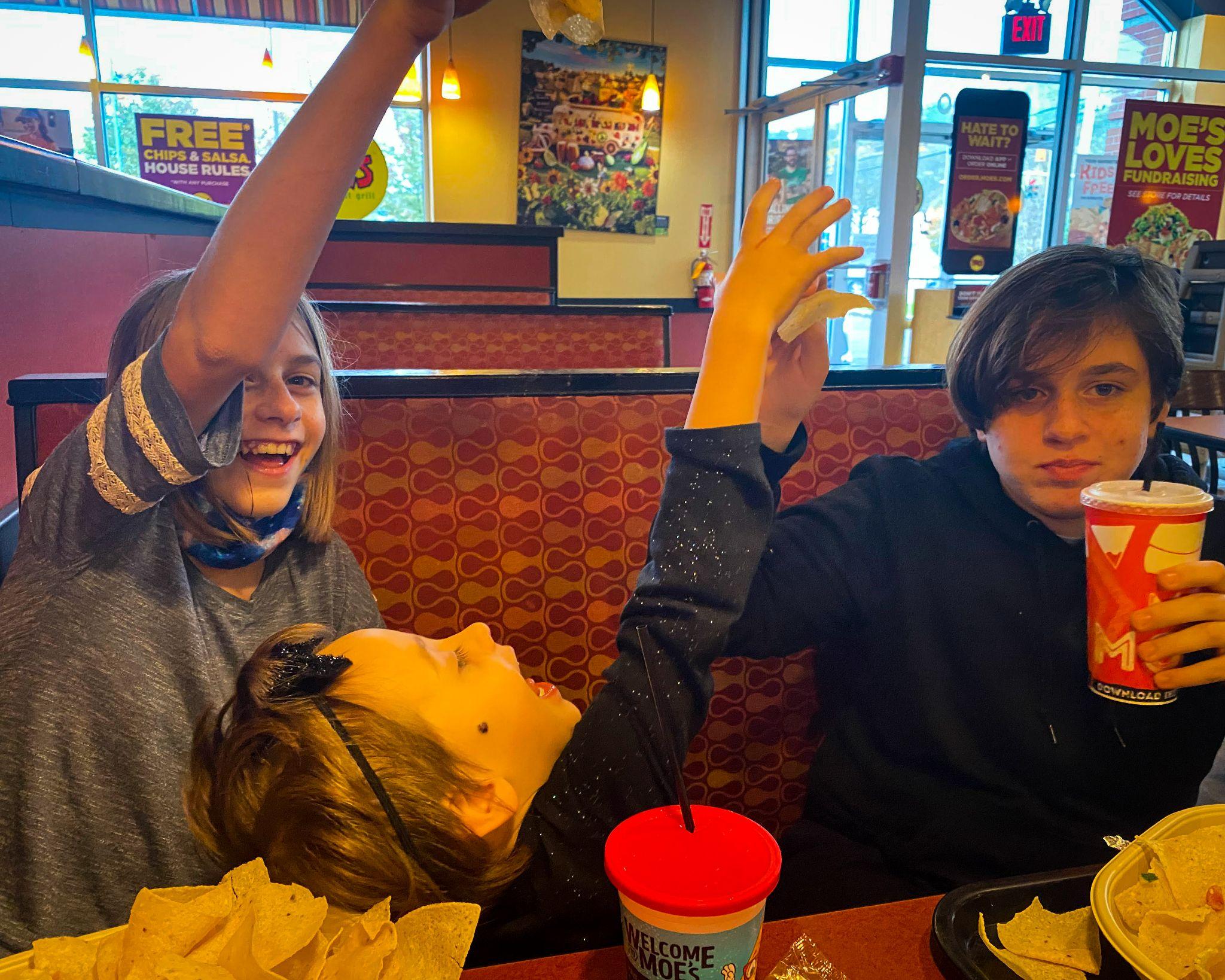
Today I picked a photo taken at a nearby restaurant during a recent visit with my kids. They were eating tortilla chips, playing, and having a great time together. Even my eldest seems pretty happy behind that hidden smirk.

I really cannot afford to eat out much with my kids when they visit. Eating out is expensive, especially when you can cook better food for less at home. Often, I find myself thinking a few days in advance of their visits about what we are going to eat, what I will prepare, and what snacks we can take on the road so that we won’t stop somewhere that will cost me an arm and a leg.

It may seem like eating out that day was an extravagance I cannot afford. My wallet agrees with that opinion, but for one afternoon a few visits back, there was time for laughter, joking around, and sitting with my kids instead of cooking a meal, serving a meal, and cleaning up the meal. It was such a blessing to just be with them and to be in their company.

I don’t know if the joy of being in someone’s company is why Mary stepped outside of cultural norms, but if it was, I completely understand. It is sometimes good to just be with someone as they go about life. Could Mary have listened while helping Martha? Maybe she could have done both, but I completely agree with Jesus. Mary was doing a pretty great thing by choosing to spend those moments the way that she did.

“Needs” and a Happy Sight

The #rethinkchurch Lenten Photo-A-Day prompt for today is “Needs.” To be honest, there is absolutely no appropriate way that I can find to connect the word needs with both any photo in my collection and the theme of the devotional today.

In the devotional, the story we read today about Jesus’ life comes from John 9:1-40. In that story, Jesus brings sight into the life of a man who was born blind. To be entirely honest with you, I’ve never taken a photo of a blind person. The closest thing I have come to taking a photo of a blind person are the self-portraits I took when I had a corneal transplant a few years ago. My sight had grown so poor due to keratoconus that I was seeing quadruple at times in m one eye.

Nobody asked me the insanely pointed questions which were raised about the blind man in John 9. Nobody asked if I had keratoconus because my father or mother sinned. Nobody asked if my vision was hurt because of some great transgression. We don’t know everything about keratoconus, but it is likely that the latest medical journals do not point to divine punishment as a reason for a wacky cornea.

Instead, I chose a different picture for today. I chose a picture of a coffee pot brewing coffee on a camping trip two years ago. Why? Is it because I need coffee? Actually no, I was drinking tea at the time. Yes, there have been points in my life when I had foregone coffee for tea. Was it because everyone sometimes feels like they “need” a cup of something hot to start the day?

No, I shared this picture because it beautifully caught the flames, showed a moment of joy, and reminded me of a really happy sight in my past. Why was it a happy sight? It was a happy sight because someone donated a cornea and I can now see far better than seeing four images in one eye, and one image in the other.

Perhaps that’s the closest I will get to connecting this photo with the story of a blind person in need of compassion. While my story is not nearly as beautiful as the one in John 9, I have been in a place where I have been truly grateful to see. Sometimes the coffee pot is the most beautiful thing in front of us for a reason besides what it promises us. Sometimes it is just beautiful to see and have gratitude for sight.

“Bring” and Blessing Bags

The #rethinkchurch Lenten Photo-A-Day prompt for today is “bring.” As someone who spends a lot of time taking pictures in nature or pictures of family, the idea of connecting one of my photos to the word “bring” was a bit of a challenge. Eventually, after a great search a long way into my photos, I found a picture of the blessing bags we have been handing out as a congregation to people in need. Each blessing bag has a small amount of food, water, and often simple necessaries like a comb, hand sanitizer, or a new toothbrush.

The idea of the blessing bag is simple. We may not hand out money to people on a street corner, but we will do our best to give them something concrete. How do we have these on hand when we come across someone in need? The answer is that we bring them in our cars, carry them in a backpack, or have them on hand when we are somewhere that they may bless someone in need.

In our devotional today, we read the story of Jesus’ interactions with a Canaanite woman who came to him in need. The story is in Matthew 15:21-28. Jesus’ dealt with the Canaanite woman with compassion.

At the end of the day, the purpose of the blessing bags is to be able to share compassion with others in a concrete way. Does everyone take them? No. Do some people really get frustrated that we are not handing them money? Yes. Why do we do it anyway?

We do it because we want to share with compassion. I know that when I hand out blessing bags it is often for the simple reason that I want to be compassionate but I don’t carry money with me. The closest branch of the bank where I have my account is in Corning, so I tend to do most of my transactions digitally. I cannot give people cash because I don’t have any cash on me, which is good because cash tends to burn a hole in my pocket.

I know that others hand them out for a very different reason. They hand out the bags because they want to do something more than hand someone money. Clean socks may not mean much to me, but to someone who never gets clean socks, they are a gift. Socks, water, and even hand sanitizer offered during a pandemic: each of these are kindnesses offered by one human being who sees the humanity in someone else. I see compassion in that loving act.

So, what do I connect with compassion and “bring?” Blessing bags! May God bless them, the hands that share them, and the hands that receive them.

“Sent” and Barbed Wire

The #RethinkChurch Lenten Photo-A-Day prompt for today is “sent.” As we go through the week during the last week before Holy Week, our theme is to go Christ’s way instead of our ways. Jesus taught many things during his life and during Holy Week we will see how far Christ’s way is from our way.

On May 7th, 2014 I was standing in Northern Ireland and looking at a barbed wire fence. If you have never looked at a barbed wire fence up close, it is truly horrifying. I have spent a lot of time in my adult life trying to “kid proof” houses, churches, and even cars. I have gone out of my way to make certain that my child or another person’s child is not hurt when in a place where I have had a chance to make the space safer.

A barbed wire fence is designed with the opposite sentiment in mind. I don’t like walking through brambles because thorns hurt. The razor wire on these fences could easily hurt anyone who is reckless enough to get close. They look deadly, are deadly, and are not something you put up lightly. Seeing barbed wire on a church fence is seemingly antithetical to the gospel, but by local law the Methodist church I stood outside of in 2014 had a barbed wire fence cutting itself off from the community. What’s almost worse is that we were there on a trip to help repair the church that had been damaged by hurt people living in a hurt world where the barbed wire constantly reminded them of how they were the “enemy” of their neighbors.

I wanted to share the image of the murals below the barbed wire at the church. Why? Well, the people of that community had been sent by God to build a church in that space. The barbed wire came and it cut off the Methodist church from the protestant community and the parsonage which were on the other side of the barbed wire. Why? The church refused to have barbed wire between them and their catholic neighbors. What’s more, after the church was closed, the church building became a community center with the goal of building peace and the church rented the parsonage on the protestant side of the wall to Catholic nuns. They couldn’t help where they were sent, but they weren’t going to let it get in the way of following where Christ led them. That Methodist Church on the Springfield Road chose Christ’s way. I salute them for their bravery and hope to be half as faithful in my life.

“Celebrate” and Sandwiches

The #RethinkChurch Lenten Photo-A-Day prompt for today is “celebrate!” If you have been paying attention throughout the season, then you remember that Sunday is a day for celebration. In theological terms, we celebrate what Christ has done on Easter every Sunday throughout the year, including during Lent. Sundays are a day of celebration, which is why many Christian churches set aside Sunday as a day of worship.

It is sometimes strange to think that for most of the history of the Abrahamic religions, Saturday was the day when the Sabbath was celebrated. Blue laws, community events, and even a five day work week have collaborated to create the cultural phenomenon where the affluent take off both Saturday and Sunday for the weekend, but for much of history, it was a good life if you had the time and wealth to set aside for one day of rest a week.

One of the very few silver linings to going through separation from my spouse has been a new understanding of the importance of Sabbath. When my kids are in town, I do my very best to handle every obstacle and requirement on my time in the days leading up to my time with them so that I can truly spend time with them. As they always visit on a workday, it is not easy, but I often work through one of my days of rest in order to have the spare time to spend with my kids. I am fortunate enough to have enough flexibility to generally be able to reschedule things.

So, what do I do when they are here? What am I saving up my time to do? During the last visit, we had an amazing lunch with hand breaded and made airfryer crispy chicken sandwiches with homemade fries, carrot slaw, and apples. For the first time in months I took a picture of my kids where I caught them chewing? Why? So I could remember how much they enjoyed the food I spent days planning out while making phone calls, refining sermons early, and getting ready for the invasion.

What would it look like if we approached worship with such enthusiasm? I’m not a “church hat” person and I am likely downplaying the social aspect and competitiveness of it, but there’s something we may have lost over the years. Can you imagine taking the time to get your hat right for worship? Can you imagine taking the time to get ready to see friends and family in church again?

There’s only one thing worse than all the hubbub that goes with cleaning dishes, sweeping floors, and putting away the stuff after a celebration. What? Not having anyone to celebrate with in the first place.

“Always” and the Sunshine

The #RethinkChurch Lenten Photo-A-Day prompt for today is “always.” Today’s scripture reference in our devotional contains one of the typos I missed in the proofreading process. The chapter is Luke 6, not Luke 7.That reading in our devotional includes some painful words from Luke 6:27-28 “Love your enemies, do good to those who hate you, bless those who curse you, pray for those who abuse you.”

Always? Really? When someone cuts me off in traffic I can bless them once I cool off, but do I have to bless the people who are continually cursing me? I can let go of someone being abusive once, but do I really have to pray for someone who was systematically abusive?

If you read these words straightforwardly, the answer is “yes.” If you squint at them and look at them carefully, you could probably find a loophole, but I have to be honest: I don’t want to be a part of that kind of Biblical scholarship. These words are straightforward and meaningful as written. Yes, I do believe we are called to prayer even when the person in front of us is truly wicked and cruel.

For an image today, I decided to share a picture of the sun through the clouds. In the depths of winter, it was freezing cold and cloudy. The sun still shined through the clouds. The wind was bitter and the temperatures were low, but the sun still shined. The sun is always rising, whether it is an easy day or a hard day.

It is not easy to pray for people that are mean, cruel, or abusive. It is still possible. I will note that Jesus says that we should pray for these people, do good to them, and bless them. Jesus does not invite us to subjugate ourselves to the will of the cruel. I believe that you cannot truly do good to someone if you always have your neck on the floor. You cannot pray for people if your voice is always silenced. It isn’t in the text here, but I truly believe that there’s a difference between turning the other cheek and consistently walking into a slap.

“Keep” and the Toy Blocks

The #RethinkChurch Lenten Photo-A-Day prompt for today is “gullible.” Actually, on the first of April the word for today is “keep.”

In my house there is a set of wooden blocks that all of my children have played with over the years. During a recent visit, the blocks were pulled out and I had a chance to play with my youngest. At one point she asked if her castle was beautiful. I told her that it was an amazing castle.

The bricks are not fancy bricks. As you can see, they’ve been written on, worn down, and in some places have started to chip and splinter away. While we have always made sure they are safe, they’re simple blocks. They don’t make sounds, they don’t scream out in bright colors, and they are extremely simple. They also have been the favorite toys of all of my children at one point or another, probably because I can’t help but play alongside them.

In the devotional today, we read the story of a man with a withered hand being healed by Jesus in Luke 6:6-11. Here was a man whose hand was wounded, whose wellbeing was considered less important than the Sabbath rules, and who was used as bait to trap Jesus. In other words, he was only useful in this moment as a tool rather than as a person.

Jesus loved the man and brought healing into his life. Where other people might see woundedness and assume it was a punishment from God, Jesus saw a person in pain. Where others were happily using the opportunity to find dirt on Jesus, Jesus saw a chance to do something wonderful for a man in pain. If this man was a toy, it would have been a pretty sad toy. Jesus restored rather than rejected. Jesus loved the man despite the consequences.

Jesus loved this man and healed him. In my life, I sometimes feel like the old bricks that might be ready for retirement. It is easy to dismiss your needs and value as unimportant or insignificant. We really should think twice before we try to throw our own self-worth out with the bath water. Jesus loves us even if we only see the worn edges or the lack of bells and whistles. Jesus loves us dearly as the people we are right now.

“Cared” and Tiny Flowers

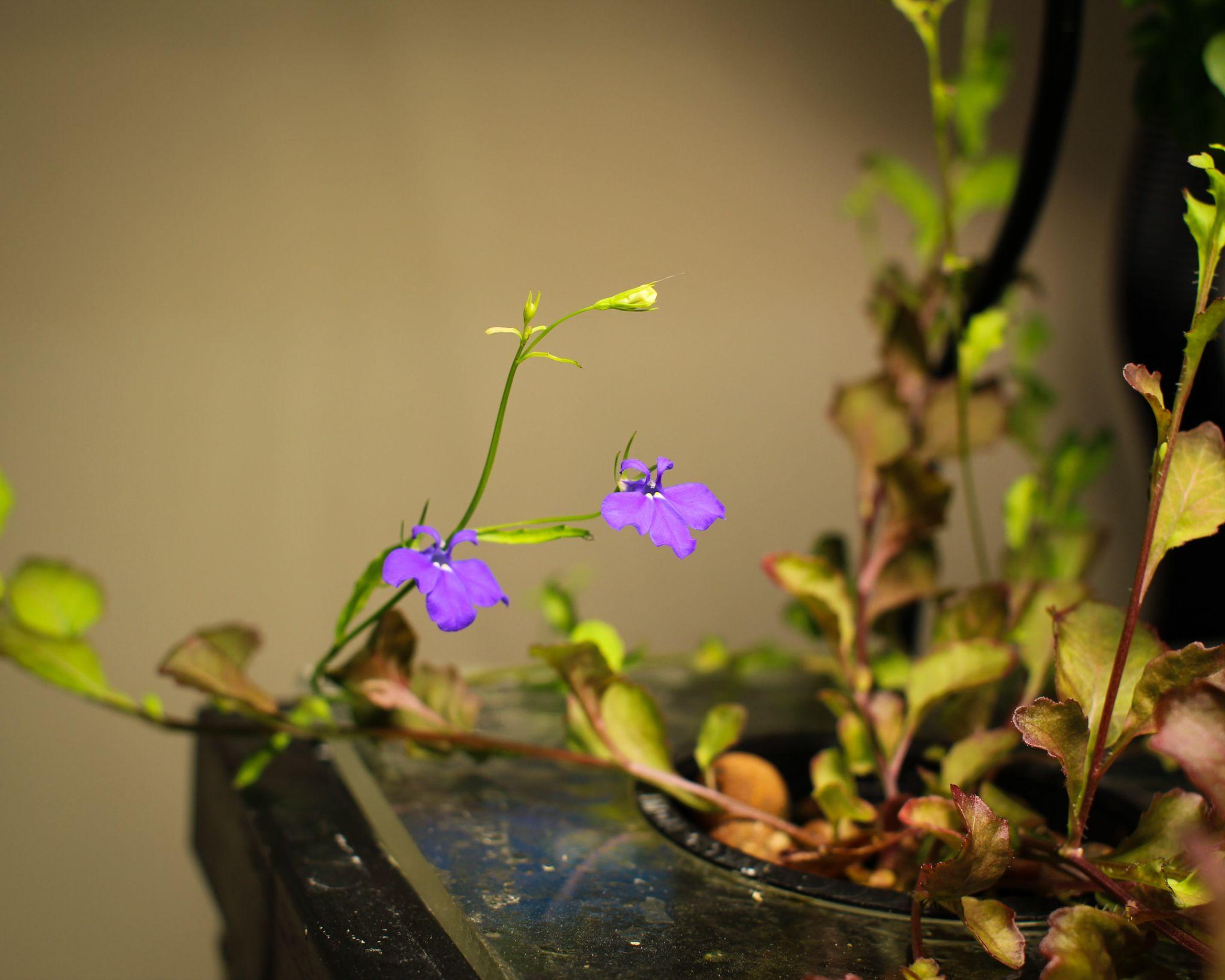
The #RethinkChurch Lenten Photo-A-Day prompt for today is “cared.” In thinking about an image that showed care, I immediately thought of the lovely little flowers growing on top of my aquaponic fish tank.

Perhaps you are thinking that this is a strange choice with the prompt “cared.” Well, there’s a story here that has to do with the fact that there have been few flowers in my life over the years.

One of my shortcomings as a husband over the years was my inability to remember to bring home flowers for my wife. I did my best to remember, promised to get better, and worked diligently at trying to wrap my head around the fact that it mattered to my spouse. A few months into separation I was setting up the top of my fish tank to grow herbs and was trying to decide what I should grow.

I had talked with a few people over the previous months about how I felt abandoned, lonely, and really hurt by the ways that everything has happened. It took a lot to move past sitting in sorrow when not working and losing myself in my work as often as possible. My first move was to start walking, taking pictures, and forcing myself to look through a camera lens to look at something outside of myself. There was a ton of guilt, grief, self-accusation, and woundedness that had to be acknowledged and grown through before I got to the point where I was not only willing to think of doing anything joyful beyond the bare necessities of living, much less doing something new like growing plants with my fish.

As strange as it sounds, I had to accept that I had worth before I could do more than work, engage in spiritual practices that I had previously learned, and do the minimum to survive. In time, around January after the healing story of Christmas began to take root in my soul, I had begun to move beyond looking at everything I had done wrong to acknowledging a simple fact: I had wanted flowers too. I like flowers. I enjoy the look of them, taking pictures of them, trying to grow them, celebrating their little successes, and generally being around them which makes my allergies a real pain sometimes.

While looking at the seeds at the local Agway for seeds in the middle of winter, I acknowledged that nobody had bought me flowers and nobody would buy me flowers. I acknowledged the pain of being criticized for not bringing home enough flowers when the last flower I had received from my spouse was a flower to match my wife’s bouquet on our wedding day: one flower for me, a whole bouquet for her.

I wanted flowers, so I bought flower seeds, and now there are little purple flowers bringing joy to my home. Nobody has to buy me flowers and I never asked my spouse for flowers, but now that I am on my own, there is nothing wrong with growing flowers to bring joy into my life and into my home. I now not only have those flowers, I have the joy of seeing my children enjoy the flowers whenever they visit home to be with their father. Cue the cute four year old saying, “Look Dad! There’s another flower!”

In the section of the beatitudes that we are focusing on this week, there’s a lot of weight behind the words. Luke 6 does an excellent job of saying that we should neither expect praise for following Christ nor expect that everything is going right when we receive all of the praise and accolades. In the end, my flowers have little to do with my journey with Christ other than to acknowledge that God created a good creation in me.

Will I receive blessings from God if someone thinks a man shouldn’t grow flowers or want someone to give him flowers? I somehow doubt it. I do know that my value and my worth as a person does not depend on whether I fit the typical norms of my childhood. I have lavender aftershave and deodorant; God loves me despite the fact that some might question the scent that wafts about me. I like taking pictures of flowers and enjoying the beauty of these lovely plants that I cannot grow for the life of me; God loves me despite the fact that I take pictures of other people’s flowers because I need a hydroponic/aquaponic system to grow anything more complicated than a spider plant.

I don’t believe I will receive special blessings from God after being persecuted if someone picks on me for my liking flowers. I do believe that God cares about me and will bless me through the situation anyway because of God. I don’t believe every criticism I ever receive falls under this beatitude, but I do believe that God cares about me deeply and will bless me with love (at the very least) when I accept and honor the good things God has placed in my heart.

In other words, when I actually do manage to grow flowers, I see them as a gift from God. I may never receive flowers from a spouse, but I happily receive them from God.

Thank you God! They’re lovely. I really appreciate it.

“Anointed” and Hyssop

The #RethinkChurch Lenten Photo-A-Day prompt for today is “anointed.” In considering a photo to share, I will admit to having to dig into my photos for a while until I found something fitting.

Last summer I took this picture of a hyssop plant at the Cutler Botanical Garden outside of Binghamton. Hyssop was used for a lot of religious purposes and Psalm 51:7 says in the NRSV: “Purge me with hyssop, and I shall be clean; wash me, and I shall be whiter than snow.” I personally would have preferred the verse be translated “cleaner” than snow, but generations of faithful people have connected the hyssop plant with religious cleansing

The hyssop plant was connected to the story of Exodus as hyssop branches were used to anoint the doorways of the children of Israel before the first passover. In Exodus 12, the hyssop plant was forever tied to at least one act of anointing.

Still, how do I tie this to our theme for the week? The hyssop plant has become connected with religious life for a long time. The role of hyssop in both religious and herbal realms led to the propagation and widespread popularity of this herb. To be hyssop is to be connected with both medicinal and religious purposes.

As believers in Christ, we are tied to the life of Christ. We are no less tied to the story of Christ than hyssop was tied to the story of God’s people. Why should we be surprised when we face challenges as a result of our faith? If they treated Christ poorly, why do we expect less?

I still don’t know about leaping for joy, but when I consider my life as a Christian, I understand that it will include challenges as well as blessings. Like cat grass draws felines and maple trees draw people who like syrup, being a hyssop means having a place in the hierarchy of life. Being a Christian comes with various challenges and difficulties. I don’t know if I am being clear, but I think we should at least understand that difficulties come with being followers of a Jesus who faced challenges.

“Celebrate” and the BBQ Flower

The #RethinkChurch Lenten Photo-A-Day prompt for today is the word “celebrate.” Every Sunday throughout Lent is a “mini-Easter” where we celebrate the fact that the journey ends in celebration. As I think about my Lenten practices, one practice that I have been following throughout this Lenten season has been avoiding meat on Wednesdays and Fridays.

My photo about celebration this Sunday is a photo that I took at one of the church BBQ sales last year. If you are around town on the Saturday after Mother’s Day, we will be having our Spring BBQ. My mouth is watering while thinking about it.

There is something ludicrous and celebratory about this image. It clearly is staged. No flowers grew on the edge of the bbq pit. If they had, the wonderful way our trustees light the pit would have quickly turned the flower into a more charred version of itself. The photo was completely staged, but it was absolutely amusing to take. I still laugh whenever I see it in my pictures.

Why? Sometimes life is just funny. The flower came from the nearby garden outside the church and was going to go to waste. The people who were weeding the garden during the BBQ brought the flower over and I had my fun with the flower. I’m fairly certain that the flower has graced a church bulletin cover, definitely went out on our eNews, and this flower likely received more attention due to the ten seconds when I took this picture than it did for weeks while sitting out in the sun.

I know the flower is a flower, but I hope that the flower felt some form of flowery happiness both in life and in being remembered as a source of life, laughter, and joy. I am so grateful that there will be a flower garden again this spring. I hope that the flowers are just as lovely. I also cannot wait to celebrate with the community over a great spring BBQ.

“Compassion” and the Eagle

The #RethinkChurch Lenten Photo-A-Day prompt for today is the word “compassion.” We are reading the scripture that is at the heart of tomorrow’s sermon, so I will avoid diving into the devotional today.

What does it mean to be compassionate, especially in light of Jesus’ teachings on weeping? Blessed are those who weep, for they will laugh! Laughter? I rarely think of laughter and compassion in the same sentence. As we have touched on a few times this week, laughter can often be at someone rather than with some. Such laughter is not very compassionate.

Compassion may have a lot to do with the comfort found in Matthew’s presentation of the beatitudes. It can be compassionate to show loving comfort to someone who you might consider your enemy if it were not for the fact that they are down on their luck. I think it is fair to say that it is compassionate to comfort people who are simply down on their luck or in a place of tears rather than living in a place of laughter.

I chose a picture of an eagle that I took at the Buffalo zoo last year. The eagle really does have a beautiful visage, but this eagle will likely never fly free. The eagle lives behind a fence where it can see tasty morsels flit by on smaller wings. Given the eyesight of the eagle, it probably sees the squirrels in the nearby park or the mice that might feast near the trash cans despite the best efforts of the staff.

Many people might think I am trying to make a point about zoos here. I’m actually not, although you can draw your own conclusions. Most of us have someplace in our lives where we feel trapped by life circumstances or life challenges. The fence is right there and it is okay to wish for something more. I know that I wish for something more on a regular basis.

I believe that God sees our sorrow and that’s one reason why Jesus went beyond offering comfort in Luke’s version of the beatitudes. Jesus makes a promise that laughter is on the way, because God sees our tears, knows our fears, and God is on the way.

“Enough” and the Lonely Leaf

The #RethinkChurch Lenten Photo-A-Day prompt for today is the word “enough.” In our devotional, I once wrote the words “Perhaps one might think of the cliche that it is better to laugh than cry.” In the story we read, grieving parents laugh as Jesus tells them that their dead child is merely sleeping. To be very clear, they laugh at Jesus instead of with Jesus.

My photo for today is a picture of a single leaf that I found fluttering besides a walkway in the Sapsucker Woods north of Ithaca. I walked through the woods last fall and saw this life. As I contemplated how the leaf sat on the end of the branch alone, I found a kinship with the leaf as it fluttered alone.

Is it better to laugh than to cry? Not always. It is certainly better to come to a place where you can laugh with Jesus rather than laugh at Jesus. Grief is a powerful thing and can cause a great amount of pain and disorientation. Would the parents laugh in the same way if Jesus had arrived before their child passed away? Often grief blinds us to the possibilities in front of us. The parents in the story with Christ were clearly in a place where they could not see beyond their grief.

I chose the picture of the leaf for “enough” for several reasons. First, the leaf was a beautiful leaf. As lonely as it seemed, it was still lovely. I am also enough even when I am alone. You are enough even when you feel lost or alone.

Second, I chose the leaf as an affirmation of the fact that last fall while I was on an afternoon walk there was enough goodness in the world that I was shaken out of my thoughts. I lay on the ground to get this photo from this angle. Would I rather have been somewhere else? Yes, but even when I was disoriented and somewhere I did not want to be, there was enough beauty in the world that goodness shone through my own sorrow.

Third, I chose the leaf as an affirmation of the fall. What I think is permanent today will one day fade away. My life is that of a leaf. One day it will be done. God willing, one day another leaf will fill my place in the world. I hope you have such a hope as well.

“Filled” and Lonely Mugs

The #RethinkChurch Lenten Photo-A-Day prompt for today is the word “filled.” When I consider all of the things that I might choose for the word filled, I lean towards my coffee cup.

In contrast to this image, the theme for today in our devotional revolves around grief. Jesus was the son of God, but also was the son of Joseph, Mary’s husband. As the devotional notes, Joseph has likely passed away by the time of the events of holy week.

There is an interesting question that connects the image of a coffee cup with questions of grief. What will happen to my coffee cup after I am gone? I have three cups in my church office. I rotate between an orange mug and a black mug, but I also have a mug covered in gnomes for when my children visit. What will happen to those mugs when I go?

I have served in many churches over the years and almost every church has a cupboard full of mugs. Some of the mugs are from church events, others are from various homes, and others have just shown up over the years. Will my mugs end up in a cupboard somewhere? Will someone else enjoy the joy of coffee from an orange mug or feel as serious when they drink from my black mug?

In the end, I do not know where my mug will end up. This is a simple reality at this point in my life. I neither grieve the fact that I will one day be gone nor mourn the fact that I do not know where my mugs will end up when everything is said and done. What I do know is that I should take today seriously because there are things far more important that I shall leave behind. Even more important than those things are the people that I will leave behind.

It doesn’t matter to me where the mug will end up, but it does matter whether or not I have a loving relationship with my children, my family, and the people I care about. I hope that Joseph left no relationship broken and no words unsaid. I hope that I might leave no words unsaid.