Let us Ramble: Stilling hunger

I was not hungry as I began my devotions this morning. A parishioner had a bumper crop of hot peppers which she recently shared with me. I was not hungry for food at all as my stomach was filled with an omelette that was stuffed with spicy goodness.

I was not thirsty as I began my devotions this morning. I had an ethically-sourced cup of coffee which sated my thirst quite nicely. The cup of coffee was a good cup of coffee with strong flavor.

I was neither hungry nor thirsty as I began my devotions this morning, but that state of being changed as I spent time in reflection. I came across a quote from Henri Nouwen as I was working through my favorite devotional book “A Guide to Prayer for Ministers and Other Servants.” This quote from Henri Nouwen is sourced by the Guide as coming from “Reaching Out”:

“The Gospel doesn’t just contain ideas worth remembering. It is a message responding to our individual human condition. The Church is not an institution forcing us to follow its rules. It is a community of people inviting us to still our hunger and thirst at its tables.”

As I came out of the reverie, contemplation, and depths of my devotions, I found myself wanting to share this quote with others. There were deeper matters in my devotion this morning, but this was a word I felt needed to be shared for a simple reason. I am not certain the world sees the church in this light.

A Powerful Pair

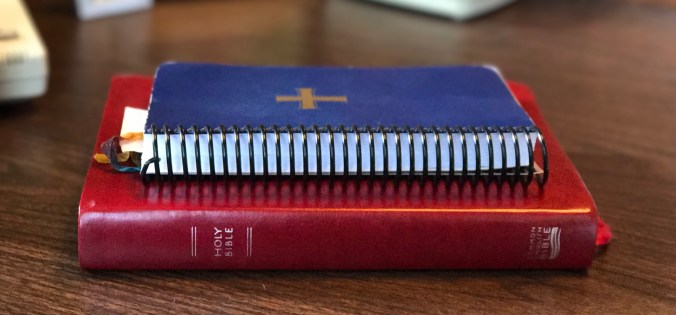
My devotional and one of my Bibles


I grew up in a northern home in a house that was very Protestant. My mother had been Roman Catholic but had become United Methodist when she married my father. We went to a United Methodist Church every Sunday and were taught things like “God loves all people.” There were moments when my family struggled with racism, but I do not believe that is a unique situation. On the whole, we were taught that the church was open to people of all races and ethnicities. My general thought process was that if God welcomed people of every variety into the family, shouldn’t we? Even in the extremely European communities where my family lived, seeing someone of another race was not the kind of thing that made one exclude and hate, so much as just being the kind of thing that made you say “Oh, hey. That’s different. Whatever.” I was not the most enlightened of kids, but at least I was not malicious. I was more ignorant than anything else.

When the time came to be educated about the past of our nation I remember reading stories of the activities of the KKK with horror. I was not just horrified about the way that people treated the “other” in these stories. I was offended by someone burning a cross as a symbol of hatred. I was furious that they would try and use a symbol of love and inclusion to threaten people! The behavior I was learning about was simply unacceptable.

I saw the church as a place where God’s love leveled the playing field of life. I saw the church as the place where we could look beyond our differences and find community. I saw the church as a place where even ignorant kids like me could find a home as we grew. I was absolutely horrified by what I learned. I began to ask questions of youth leaders and my good friend Jim Patterson who was an elder in an urban Presbyterian Church invited me to think deeply about what united us with different people.

In college I studied with Dr. Middleton who brought a global perspective to my theology, although it was still very much a western perspective. When I went to seminary I studied African religious history and African American religious theology. I was enthralled because the words I was reading were far different than those in my own heart. I literally read “Stony the Road We Trod” to my daughter as an infant on the day she was born because I did not want to fall behind and because she liked the sound of my voice as she napped against my chest. I read, I pondered, I made friends, and I tried to know more and more about how the Bible looked to people who were not like me.

For me, the church had become a place where I could safely challenge my own assumptions, grow deeper in my faith, and help the world to become a better place. When I hungered for knowledge, there was almost always a wise colleague or friend who could help me go deeper. When I thirsted for righteousness, there was almost always some place I could go to work towards a better world. When I had a need to belong, to grow, to work, to live, and to be a part of something greater than myself, the church was there to push me forward.

I do not think the world sees the church in the same way, especially when sometimes the first exposure people have to Christianity is images of burning crosses, abortion protestors with horrifying pictures, or bullhorn wielding “prophets” telling everyone they are going to burn in hell. Not everyone is lucky enough to have been nudged into the path of knowledge, faith, and blessing which I was blessed enough to find in my own life.

I am hungry and thirsty. The coffee still takes care of my natural thirst and that omelette is doing remarkably well at holding off my hunger, but I am hungry and thirsty for other things. The world does not see what a blessing the church can be in the midst of life. I want people to see a world where the church can be a place more concerned with community than regulations. I want people to see a world where the church is more concerned with bringing good food to the table than in meeting the budget so we can have fancier napkins. I want people to know that the church exists to be a blessing. All of our lives are made better each time someone joins in at the table. I wish people understood the power of the church fully active and empowered. Indeed, Irenaeus, the glory of God is humanity fully alive in Christ.

Let us Ramble: Contemplations on being Contagious

Once again, I have been drawn into deep thought by my children’s favorite podcast. My kids adore the NPR Podcast Wow in the World with Guy Raz and Mindy Thomas. Last week my kids asked to listen to the podcast while we were running an errand to the grocery store in Johnson City. The podcast was entitled “A Case FOR the Giggles” and revolved around a study out of Georgia State University. The study was on the health benefits of laughter.

The podcast was very amusing. The podcast was full of laughter which spread throughout our van as we drove through the hills outside Binghamton. The podcast also caught my attention when it began to speak about the idea of contagious laughter. Laughter, much like yawning, is contagious. Simply being around another person who is laughing can cause a person to smile if not laugh,

As I contemplated contagious behavior, I began to think about other behaviors which are contagious. The creators of the podcast suggested a social experiment where we look at how other behaviors might be contagious. The study suggestion was to see if people would engage in mimicking your behavior. I thought back through past situations in my life and here is what I came up with:

  • Stress is contagious. If you enter a room and you are filled with stress that stress is extremely contagious.
  • Body language is contagious. If you are in a deep conversation and lean towards someone, they will lean in like you. If you cross your arms and sit back, they may do the same thing.
  • Panic is contagious. If one person begins to panic in a crowded place, things can go downhill quickly.
  • Anger is contagious. I do not go out on Black Friday as a result of this contagion.
  • Greed is contagious. If there are a limited amount of resources and you hoard as much as you can, others will likely follow suit.

I noticed that a lot of the examples I could come up with for contagious behavior revolved around pretty negative things. Yawning, body language, and laughing may be neutral activities, but anger, panic, greed, and stress can be pretty negative. I was contemplating this idea when I thought back to my time at the Academy this last session.

I remembered that when people smiled, grinned, and even made space for each other, the space was transformed, even in the midst of absolute silence. There were a number of periods of silence each day and what I discovered was that silence was not the end of communication. The sense of peace, welcome, and grace filled the room.

So, is peace contagious? Yesterday in my private devotions I was reading through Luke 10:1-12. In that chapter Jesus says the following to the seventy disciples that he is sending ahead of him: (Luke 10:4-7, NRSV)

“Carry no purse, no bag, no sandals, and greet no one on the road. Whatever house you enter, first say ‘Peace to this house!’ And if anyone is there that shares in peace, your peace will rest on that person; but if not, it will return to you. Remain in the same house, eating and drinking whatever they provide, for the laborer deserves to be paid. Do not move from house to house.”

What if what Jesus is telling the seventy disciples is to be contagious with their peace? He tells the seventy disciples to share their peace widely as they go. Each home they enter should be offered peace. As they preach in these towns, Jesus tells them to proclaim the kingdom of God and to heal those who are ill, but only if they are welcome. If they are not welcomed, they are invited to knock the contagious dust off their feet and move on.

What if the invitation to the seventy disciples applies to us? What if we are to offer our peace to people when we enter into their lives? What if we are to begin our relationships with others through the gift of peace? We live in a world that suggests fear and carefulness is the correct response to strange folks. What if the very first thing we are called to do is to offer peace? What if we have been going about things all wrong?

Can you imagine a world where the peace of God spreads like a contagion? Can you imagine a world where it inoculates us from things like fear, hatred, and angst? Can you imagine a place where grace and kindness spread like the joy of laughter? While I do not like being contagious when it comes to a cold or sickness, there is something powerful about the idea of being contagious with God’s grace.

What if all of the fruits of the Spirit were such contagious things? Perhaps the very contagious nature of love, joy, peace, patience, kindness, generosity, gentleness, faithfulness, and self-control that is why they are described as fruit filled with seeds. I hope they are contagious, because I know the people I know and the whole world could use more of these gifts. May they spread like wildfire among the saints and those people that they love.

Let us Ramble: Transients

I struggled to finish my sermon this weekend at the Maine Federated Church. The subject was challenging, but I was prepared. I struggled to finish my sermon because the cold of the previous week had beaten my voice to a pulp. We were preaching on baptism and how baptism was opened to people of all races. We shared that God loved all people. I publicly declared that God does not think of one race as superior to another. We spoke of deep things even as my voice started to crack.

Sunday night, I watched my Facebook feed explode with statements from pastors and committed Christians from across the spectrum. The vast majority of them were incredibly clear. “Racism is bad.” “God loves all people.” A few of the statements were provocative. A few statements seemed more concerned with politics than with what was actually happening. My public statement on Facebook was to reblog a “Litany against White Supremacy.” I will admit, I was still exhausted by my cold, so I was willing to let that stand for a day or two until I could get a good night’s rest.

Well, I am rested now. I have a cup of hot coffee to sooth my throat muscles, I have spent some time centering myself in my daily devotions, and I am prepared to enter into my pastoral role as one of the resident theologians in my community. So, let’s lay out the theological argument I wish to make. I will not be pulling punches today.

  1. It is a Christian’s duty to live with a sense of humility
  2. It is a Christian’s duty to love people like Jesus
  3. White Supremacy should be considered an abomination

I believe that it is a Christian’s duty to live with a sense of humility. I believe that is a belief that long predates Christianity, has been passed down from our Hebrew forebearers, and should be passed along from generation to generation. I believe that pride has been an issue for the church for nearly the entirety of our history and must be fought with all sincerity.

In my own studies I have been reading through “Penguin Classics: Early Christian Writings,” which is a translation by Maxwell Staniforth (revised by Andrew Louth) of some early letters of church leaders. One letter translated was from the church in Rome to the church in Corinth. It was written by one of the early church leaders in Rome named Clement and is generally considered to have been written during the last decade of the first century with a high probability of having been written around 96 CE. A passage from this letter from one church to another strikes me as fitting and applicable: (¶30)

“Since then we are the Holy One’s own special portion, let us omit no possible means of sanctification. We must bid farewell to all slandering, lewd and unclean coupling, drinking and rioting, vile lusting, odious fornicating, and the pride which is an abomination. God, it says, opposes the proud, but he gives grace to the humble; so let us attach ourselves firmly to men who have received this grace. Let us clothe ourselves in a mutual tolerance of one another’s views, cultivating humility and self-restraint, avoiding all gossiping and backbiting, and earning our justification by deeds and not by words… Self-assertion, self-assurance, and a bold manner are the marks of men accursed of God; it is those who show consideration for others, and are unassuming and quiet, who win His blessing.”

So, Clement was very opinionated. Clement uses several words and makes several claims that I am unwilling to make throughout his letter, especially on the role of women in their homes. I am very glad that this letter is not a part of our scriptures for several reasons, but there are some gems to be found in this old letter.

First, there seems to be a strong opposition to pride in Clement’s worldview. In some places, such as Clement’s insistence on quiet obedience of women, the adoption of humility as a driving force of church life is less than ideal in a modern context, In other places, such as the passage above, there’s a real sense of force behind Clement’s words. Looking through the list of sins Clement lists, the one which is singled out for being especially onerous is pride. Pride is the thing which Clement nails over and over again throughout his letter.

  • ¶16 “Christ belongs to the lowly of heart, and not to those who would exalt themselves over His flock. The coming of our Lord Jesus Christ, the Sceptre of God’s Majesty, was in no pomp of pride and haughtiness—as it could so well have been—but in self-abasement…
  • ¶35 “Wickedness and wrongdoing of every kind must be utterly renounced; all greed, quarreling, malice and fraud, scandal-mongering and back-biting, enmity towards God, glorification of self, presumption, conceit, and want of hospitality; for men who do these things—and not only men who do them, but men who consent to them—are held in detestation by God”
  • ¶39 “Men who have no intelligence or understanding, men who are without sense or instruction, make a mock of us and ridicule us, in their wish to raise themselves in their own esteem. But what is there that anyone who is mortal can really effect? What force is there in anyone born on this earth?”

Clement was very clear in his letter that pride was a serious issue. It can be inferred that Clement speaks out of the worldview of the early church. The conception of pride being an issue and the value of humility was nothing new to Clement or the church in which he lived. We can head back to the end of 1 Chronicles to see King David share similar sentiments. David says in 1 Chronicles 29:10-18: (NRSV)

“Blessed are you, O Lord, the God of our ancestor Israel, forever and ever. Yours, O Lord, are the greatness, the power, the glory, the victory, and the majesty; for all that is in the heavens and on the earth is yours’ yours is the kingdom, O Lord, and you are exalted as head above all. Riches and honor come from you, and you rule over all. In your hand are power and might; and it is in your hand to make great and to give strength to all. And now, our God, we give thanks to you and praise your glorious name.

But who am I, and what is my people, that we should be able to make this freewill offering? For all things come from you, and of your own have we given you. For we are aliens and transients before you, as were all our ancestors; our days on earth are like a shadow, and there is no hope. O Lord our God, all this abundance that we have provided for building you a house for your holy name comes from your hand and is all your own. I know, my God, that you search the heart, and take pleasure in uprightness; in the uprightness of my heart I have freely offered all these things, and now I have seen your people, who are present here, offering freely and joyously to you. O Lord, the God of Abraham, Isaac, and Israel, our ancestors, keep forever such purposes and thoughts in the hearts of your people, and direct their hearts towards you.”

At this moment in the story of scripture, David has prepared the way for his son Solomon to build a temple in Jerusalem. David has accomplished a great deal in his life and is approaching the end of his reign. David has led imperfectly but is completing his reign in peace, which is a blessing few of his descendents would know as the generations would pass. Here at the end David gives thanks to God through an honest lens that gives thanks to God and puts his life in perspective.

David sees himself as a transient in these words. He does not claim the right and power over all that he had done and all that he has gained. He seeks humility. He states that all of God’s blessings are from and ultimately are for God’s purposes. He lives out the humility that Clement claims we must seek. Clement is echoing David’s statement on human transience in this life when he asks what real effect the proud can have in this world. The people of God are here in this world for a moment. The people are being invited to live in humility by both Clement and David.

Going back further we see a real sense of a call to humility from the earlier tales of faith. When Abram was called in Genesis 12:2-3, the following words are shared (in the New Revised Standard Version) with the one who would become Abraham: “I will make of you a great nation, and I will bless you, and make your name great, so that you will be a blessing. I will bless those who bless you, and the one who curses you I will curse; and in you all the families of the earth shall be blessed”

From the very beginning, the call of God comes with an understanding that the blessing that will come to Abraham is for the very purpose of Abraham becoming a blessing to all the families of the earth. His call is to head out into the world as a transigent. His call, the call to create a nation, will begin with him being an immigrant in a strange land. The call of Abraham is not into a castle or highly advantaged place in society, but to live as a stranger in a strange land.

Throughout the scriptures, God calls the humble time and time again. Even figures like Jacob, who was not humble, had to go through humbling circumstances before they were fully ready to take their place in the story of God’s life-bringing and grace. Being a Christian is a call into a tradition which has been marked by a strong need for humility. Jesus told a parable in Matthew 26 about an employer who hired servants throughout the day and paid each the same amount to each. The ones who began earliest in the day believed they deserved more, but it was the employer’s choice to be generous. All who follow Christ are called to understand that by God’s choice the first may become last just as the last may become first.

I also believe it is a Christian’s duty to love people like Jesus. When Jesus came across the other, Jesus acted with compassion. It is true that Jesus called people to repentance and expressed extreme disappointment and occasionally foretold woe for cities that refused to repent like those in Matthew 11:30-34 and the Samaritan village in Luke 9:51-56. Jesus also expressed hope for those of other races than those of Jewish descent when we shared the parable of the Good Samaritan in Luke 10:25-37, shared a story of a faith-filled Roman Centurion in Matthew 8:5-12, and told the story of the Samaritan woman in John 4:1-42. Jesus seems less concerned with where people are from than how they react.

Jesus’ love was not bound to one race or one people. The very call of Acts 1:8 is to make disciples by witnessing to the ends of the earth. The very call of the Great Commission in Matthew 28:18-20 is to go out and make disciples of all nations. The call of God is to reach out to all people because God called for all people. Jesus’ compassion was for every people of earth—that is why are were sent out to share the good news in the first place.

This should go without saying, but this love informs us. If we want to live a life with Jesus, we will be remade through and like Jesus. Paul wrote to the church of Romans in 8:9-12:

“But you are not in the flesh; you are in the Spirit, since the Spirit of God dwells in you. Anyone who does not have the Spirit of Christ does not belong to him. But if Christ is in you, though the body is dead because of sin, the Spirit is life because of righteousness. If the Spirit of him who raised Jesus Christ from the dead will give life to your mortal bodies also through his Spirit that dwells in you.”

Later on the effect of God’s Spirit and Christ’s love is further laid out by Paul in Romans 10:10-13:

“For one believes with the heart and so is justified, and one confesses with the mouth and so is saved. The scripture says. ‘No one who believes in him will be put to shame.’ For there is no distinction between Jew and Greek—the same Lord is Lord of all and is generous to all who call on him, For, ‘Everyone who calls on the name of the Lord shall be saved.’”

So, let’s be clear on these points. Our life, our eternal life, comes from God. Jesus’ Spirit comes into us and gives us life. The Spirit of Christ who loved faithful people of different backgrounds has opened salvation to all who call on the name of the Lord. The God of the Jewish people is the same God as those who are Greek, Roman, African, Asian, or any other form of human.

With all these things in mind, I have to say that I firmly believe that white supremacy is an abomination which must be resisted with all of our strength, all of our willpower, and all of our heart. White supremacy claims that one race is superior to other races, but God has called us to humility. To claim an inherent greatness for people of one skin color is to walk in the exact opposite direction of where Jesus walked. To claim an inherent inferiority for people of other ethnicities is abominable for many reasons, but especially because it stands in direct contradiction to the teachings of Jesus.

In Luke 14:7-14, the following is shared by Jesus Christ, the author and perfecter of our faith:

“When he noticed how the guests chose the places of honor, he told them a parable. ‘When you are invited by someone to a wedding banquet, do not sit down at the place of honor, in case someone more distinguished than you has been invited by your host, and the host who invited both of you may come and say to you, ‘Give this person your place,’ and then in disgrace you would start to take the lowest place. But when you are invited, go and sit down at the lowest place, so that when your host comes, he may say to you, ‘Friend, move up higher’; then you will be honored in the presence of all who sit at the table with you. For all who exalt themselves will be humbled, and those who humble themselves will be exalted.’

He said also to the one who had invited him, ‘When you give a luncheon or dinner, do not invite your friends or your brothers or your relatives or rich neighbors, in case they may invite you in return, and you would be repaid. But when you give a banquet, invite the poor, the crippled, the lame, and the blind. And you will be blessed, because they cannot repay you; for you will be repaid at the resurrection of the righteous.’”

When teaching on humility, Jesus first told people to choose the worst places at the table. To be certain, there is a chance that this is a story about practically putting oneself in a place where someone could be honored by the host when they are asked to move up, but there’s also a real sense of Jesus noticing what is happening around him and inviting people to a place of honest humility. Jesus states that a person or people will be humbled when they seek to their own exaltation.

Is there any more clear description of self-exaltation than to say that your race is inherently superior to all of the others? Is there any more clear way of looking at this situation than as an invitation to being humbled for your actions? Is there really something so special about being white that leads people to believe that they alone are exempt from the call to humility? As a white male, I have to say that whites are no more exempt from this rule than men—any attempt, whether based on gender or race, to say that my people are superior to other people (either as men or as people of European descent) is foolhardy and an abomination.

Who should come to the banquet of celebration? The other is to be invited. We are called to humility and hospitality in life, Events like those in Charlottesville this past weekend are incompatible with Christian teaching. People who live out their faith through terrorism and violence do not exemplify the Christian life and they are certainly not acting on behalf of Christians who hear our call as a people to humility, repentance, and community.
A Litany Against White Supremacy

A beautiful creation for a day of challenges. I lift prayers for folks down south today.

revchrien's avatarPastor Jennifer Preaching

http://www.latimes.com/nation/la-na-white-virginia-rally-20170811-story.html

As Charlottesville, VA becomes the focal point of white supremacy and those who stand against it, this litany was prepared by myself and Pastor Elizabeth Rawlings for use in worship.

Litany against white supremacy

Gracious and loving God,

In the beginning, you created humanity and declared us very good

We were made in Africa, came out of Egypt.

Our beginnings, all of our beginnings, are rooted in dark skin.

We are all siblings. We are all related.

We are all your children.

We are all siblings, we are all related, we are all your children.

Violence entered creation through Cain and Abel.

Born of jealousy, rooted in fear of scarcity,

Brother turned against brother

The soil soaked with blood, Cain asked, “Am I my brother’s keeper?

We are all siblings, we are all related, we are our brothers keeper.

When your people cried out in slavery,

You heard them…

View original post 475 more words

Let us Ramble: “The Natural World”

Okay, so today I wanted to put out a blog post that addressed something I hinted at in yesterday’s post. This is more educational than pastoral. Teaching is a part of the role of a pastor in the United Methodist Church, especially in times of crisis. Yesterday I wrote about fear. Today I write about applying faith to action.

Our world stands at a precipice. We have rushed up to the edge of a cliff and are looking off the edge. There is a need for wisdom and discernment in the world. A voice needs to cry out with wisdom! In a world with a thousand and one opinions for every person, there should be some place we can turn when things are out of sorts to find a consensus of wise minds. Yes, the Bible is one such place to find guidance, but nuclear weapons are not mentioned by name in the scripture.

Thankfully, the United Methodist Church meets for holy conferencing every four years. While I am not always a fan of everything that comes out of General Conference, there is one resource that I believe best expresses the heart of what good holy conferencing can create. Unfortunately, not many United Methodists read the words of our Book of Resolutions. The Book of Resolutions are non-binding on people within the church and as such are free to express our most passionate ideals while not forcing churches in wildly different circumstances to engage in the same behaviors.

Here’s what the 2016 Book of Resolutions of the United Methodist Church (¶160.1) says about “The Natural World:” (my underlines)

All creation is the Lord’s, and we are responsible for the ways in which we use and abuse it. Water, air, soil, minerals, energy resources, plants, animal life, and space are to be valued and conserved because they are God’s creation and not solely because they are useful to human beings. God has granted us stewardship of creation. We should meet these stewardship duties through acts of loving care and respect. Economic, political, social, and technological developments have increased our human numbers, and lengthened and enriched our lives. However, these developments have led to regional defoliation, dramatic extinction of species, massive human suffering, overpopulation, and misuse and overconsumption of nature and nonrenewable resources, particularly by industrialized societies. This continued course of action jeopardizes the natural heritage that God has entrusted to all generations. Therefore, let us recognize the responsibility of the church and its members to place a high priority on changes in economic, political, social, and technological lifestyles to support a more ecologically equitable and sustainable world leading to a higher quality of life for all of God’s creation.

As United Methodists have gathered in Holy Conferencing, we have come to the conclusion as a global body that there are some things we believe about the world around us. We believe that this world is a world that is entrusted to us but does not exist entirely for us. Our planet has a natural heritage this planet possesses that abuses have caused us to damage and debilitate in some cases. Plants, creatures, and the earth itself all consist parts of God’s creation. We are called to care for this earth as caretakers and stewards.

While there are people who still argue about and around climate change, the vast majority of people understand that the deployment of nuclear weapons would be a damaging act that would do a massive amount of harm to the earth, the plants, the biosphere, and the creatures including humans. United Methodists believe that the way we treat the world can jeopardize the natural heritage entrusted to all people and all who live upon and in the world itself. As a people, we cannot abide the concept of nuclear war and the ramifications it has on human and natural life. We have the technology and we have the ability to develop non-technological responses (e.g. diplomacy, sanctions, isolation) to deal with tyranny without resorting to nuclear exchanges.

The suffering which would take place as the result of a nuclear exchange would be massive. As people of faith, there are many things we can do. We can pray for our leaders and for other world leaders. We can study peace-making and begin to create a culture of peace-making that can influence challenges like these in the future. We can also write or call our representatives in this earthly nation and ask them to express displeasure (and abject horror) to other leaders in the world about the possibility of a nuclear exchange.

Regardless of feelings of helplessness, questions of efficacy, or doubts about our own abilities, it is the obligation of stewards to care for creation. We are stewards of creation and we have an obligation to seek a way forward which will care for creation in the face of nuclear annihilation. To do anything less would be an abdication of our responsibility as caretakers of a planet that has given us all of the great elements that provide us life.

A Collect for these days: “Holy God, You are the One who stitched this world together. Knit together Your caretakers in action, deed, and love through your Holy Spirit so that we may work together to keep this world from being torn asunder through the most brutal and violent of forces. We pray these things through the power of the Holy Spirit. Amen.”

Let us Seek: Do not be alarmed!

I was out in the world this morning. Cold or no cold, there are some appointments that cannot be put off. I had an appointment with a specialist that I had scheduled weeks in advance. I went to my appointment on cold medicine, advised everyone I was in contact with to wash their hands, and we made the best of things.

My appointment today was for a simple non-invasive type of treatment which took a few minutes. The doctor and I sat alone talking while she was going about her work. We began to talk and things went to deep matters in a few moments. I was not surprised. People often open up to me–I do not advertise that I am a minister, but I always seek to be polite and courteous. It can be amazing how quickly people come to trust you when you always say “please,” “thank you,” and tell them that you are grateful for what they are doing for you. I also believe that most people just want someone to listen.

She started talking about what she had heard in the news. She was afraid of what was happening in the world. She talked about intercontinental ballistic missiles, nuclear warheads, and the idea that someplace as nearby as Washington could be struck, although she did not rule out New York City. As medicated as I was at the time, I wondered aloud about the fact that people feared nuclear attacks on the Hoover Dam and the dam at Niagara Falls during the Cold War. We talked about how frightening things are, how strange everything seemed, and she wondered what she would do if a war broke out. She was frightened. I commiserated, listened, spoke very little, and prayed for her fears in my heart.

The conversation reminded me of a passage in Matthew about the end times. Discussions of nuclear winter, nuclear fallout, and global conflict often remind me of the passage found in the twenty fourth chapter. Matthew’s gospel reads in verses three through fourteen: (Common English Bible)

“Now while Jesus was sitting on the Mount of Olives, the disciples came to him privately and said, ‘Tell us, when will these things happen? What will be the sign of your coming and the end of the age.’


Jesus replied, ‘Watch out that no one deceives you. Many will come in my name, saying, ‘I’m the Christ.’ They will deceive many people. You will hear about wars and reports of wars. Don’t be alarmed. These things must happen, but this isn’t the end yet. Nations and kingdoms will fight against each other, and there will be famines and earthquakes in all sorts of places. But all these things are just the beginning of the sufferings associated with the end. They will arrest you, abuse you, and they will kill you. All nations will hate you on account of my name. At that time many will fall away. They will betray each other and hate each other. Many false prophets will appear and deceive many people. Because disobedience will expand, the love of many will grow cold. But the one who endures to the end will be delivered. This gospel will be proclaimed throughout the world as a testimony to all nations. Then the end will come.’”

I first came to know this passage well through the New Revised Standard Version of the Bible. In that translation verse six says “…you will hear of wars and rumors of wars; see that you are not alarmed…” These verses have all taken a vital place in my lived theology within this world of global information and easily spread global panic, but verse six has always rung out the loudest in my mind. As I lay on the table, I could almost hear a palpable voice repeating in my heart “you will hear wars and rumors of wars…” alternating with “Peace I leave with you; my peace I give you… Do not let your hearts be troubled and do not be afraid.” 

My doctor was afraid this morning. I chose not to be fearful, but to be compassionate. What is the good news? In this context, I believe it can be best expressed earlier in the Gospel of Matthew. In verses twelve through fourteen in chapter eighteen, Jesus tells a parable: (CEB)

“What do you think? If someone had one hundred sheep and one of them wandered off, wouldn’t he leave the ninety-nine on the hillsides and go in search for the one who wandered off? If he finds it, I assure you that he is happier about having that one sheep than about the ninety-nine who didn’t wander off. In the same way, my Father who is in heaven doesn’t want to lose one of these little ones.”

I invite you to think about the promise which inherently sits within this parable. My doctor, like many individuals, has an uncertainty about the future. The world seems to be less than the ideal many of us were taught as children. Most of us lose a sense of the innocence of childhood as we grow into the world, and I personally believe that there’s a correlation between this loss of innocence and the traditional drop in church attendance that tends to happen at around the same time. Losing our innocence hurts.and events like those depicted in the news can send us back into our grief over our loss even if it has been decades since we first realized the world is broken. The world can seem to be a confusing place and our fear can isolate us.

Into those moments of fear, there is an ancient promise embodied in the person of Jesus. God does not want to lose one of those little ones. God cares about the lost sheep of the world. Even when it seems that the world does not care one bit for our fears, God does care and will walk through the valley of darkness to lead us all home. There is space for us at the table, there is space in the flock, and there is deep grace despite our fears for all people. God has come near, God has shown compassion, and eternal life will come to those who follow the Shepherd. As Matthew records in the twenty ninth verse of chapter nineteen, “…all who have left houses, brothers, sisters, father, mother, children, or farms because of my name will receive one hundred times more and will inherit eternal life.

Friends, be at peace. God does not give as the world gives. Know that the path of a Christian is not an easy path, but there is a place of peace that awaits the end of our journey. Go! Be a blessing in a world of fear! Fight for justice and grace! Share the Good News! Walk with the lost sheep! Please, be compassionate

Let us Ramble: On Commitment

There is something foul afoot in the Dean household. My family was in the Olean and Buffalo areas this past weekend visiting with relatives. Every single one of them had a cold yesterday. Yesterday was a foul day full of a lot of phlegmy sounds.

When everyone had settled into bed for the night I drove into town to pick up supplies. Liquids, liquids, and more liquids. We also had begun to run low on that most effective of medicines. We were low on chicken broth. With three folks fighting colds and a father who has to keep his body healthy to resist the plague, chicken broth is a powerful thing to have around.

As I drove into town I thought about the evening that had almost taken place. I was supposed to go into town to play a tabletop game with a colleague and his friends. There were invitations for my family to enjoy a nice lasagna with my colleague’s family. As a very isolated introvert, it is the kind of event that is really healthy for me. When my family became ill, those plans had to be put aside. My family needed me. I drove and thought over the night’s events that could have been while remembering what had taken place in our kitchen while a chorus of coughs serenaded me from the next room.

Earlier in the day I set to work to make kluski noodles. When I was young, a hot bowl of wonton soup was my favorite cold remedy. Often, I wouldn’t even eat the wontons. I would just drink down the hot broth with gusto. As I grew older, I went to college where I learned that the Chinese restaurants in the vicinity were not up to par. Their broth was way too watery and the wontons were generally nothing to write home about. I was frustrated, looked for alternatives, and found kluski noodle soup at the store. The soup was really fragrant, the noodles were small enough to enjoy without scratching things up on the way down, and this was a great alternative to the wonton soup of my childhood.

I brought forward my love of this soup into my marriage. It was quite a sight when my wife and I would get sick My wife felt better when wrapped in her grandfather’s old robe. I only felt better when I had plenty of broth to drink. She’d wrap up and watch me sip cup after cup of broth. We both felt better, which was the goal. As the parent of two daughters, my plan has continued to work while the three of them fight over one bathrobe. You can always make more soup for more bowls.

So, I set about the task of making kluski noodles for soup. I asked for recommendations, received a wonderful recipe from my mother-in-law which her mother used to cook, and set to work. I measured, I sifted, I mixed, I realized I made a mistake, I corrected, mixed some more, and rolled them out before attacking with a pizza cutter. Here’s what they looked like when all rolled and cut.

Kluski noodles!

Not exactly uniform, but uniform isn’t the rule of the day when you’re making homemade soup. I set about making the broth. I was out of bone broth, so I used some dried chicken soup base and set out into the garden with a pair or scissors to attack the lemon thyme, sage, and parsley plants. Along with some ground peppercorns, a dash of garlic powder, and a leaf off of my bay tree, the soup base was ready to simmer for a few hours to mix flavors and fill the house with the smell of health.

I did not always know how to cook. While I am almost certain most people who have eaten in my kitchen would find it odd to believe, especially when I am feeling particularly miserable and tell people my fantasy of running away to become a cook in an isolated diner in someplace quiet like Maine or North Dakota. I actually was a horrible cook when my wife married me.

I learned to cook in seminary while my wife was working to make sure we had those niceties which do not come easily when you are getting an education on student loans. Due to my wife’s working with the developmentally disabled we had things like food, soap, and deodorant. I still believe that my classmates adored my wife for that last blessing alone.

I started simple with things like grilled cheese, which I had already learned to cook in home economics in school. I flipped the sandwiches way too often, didn’t use my nose to smell, had little experience, and burned the living daylights out of a lot of them at first. I practiced and I learned. Highlights of my first year of cooking:

  • I learned it is harder to burn things in a crockpot. Harder does not mean impossible.
  • I somehow made split pea and ham soup with neither split peas or ham!
  • I learned that Campbell’s soup is good in a pinch, but not sufficient alone to help a hungry Kayti make it through a shift at work.
  • I learned that I had an affinity for cooking eggs. We understood each other and my wife started calling me her “King of Eggs.” I still find that to be one of the nicest things anyone has ever called me.

I practiced, practiced, and practiced. When my wife became pregnant I began to practice cooking with the things she was craving, usually with mixed results. When my child came along, I began to look into soft foods like porridge. I began to steam things, sauté, and “unfortunately” finally left the seminary and became appointed to a place where cable was a part of our housing package. In other words, I was finally exposed to the Food Network where I became obsessed with people like Alton Brown. We still get the Food Network magazine years after telling our beloved parsonage committees that they do not need to pay for cable as it is neither helpful nor desirable in a house with small kids. I like my advertisements like I like my clickbait–easily ignorable in a sidebar, not blasting in my face decibels louder than a television program every three minutes.

In time I began to see cooking as more than a hobby. Cooking was a way I could bless the people around me, including my family. If you’re looking for me around 3:30 PM on an afternoon, the place to look for me is generally at the parsonage. If you come around 4:00 PM, you may even get an invitation to dinner if it is stretchable. I cook dinner almost every night because it is one way I live out my commitment to my wife “for better or worse.” The same love and commitment fuels me as a parent as I continue to push back against my youngest daughter’s whims against “weird” vegetables like pepper and strange food like “fish.” I have been given a gift, but that gift is not for me alone. In a paraphrase of the words of the Abrahamic blessing, God has said “I will bless you so that you may be a blessing to others.”

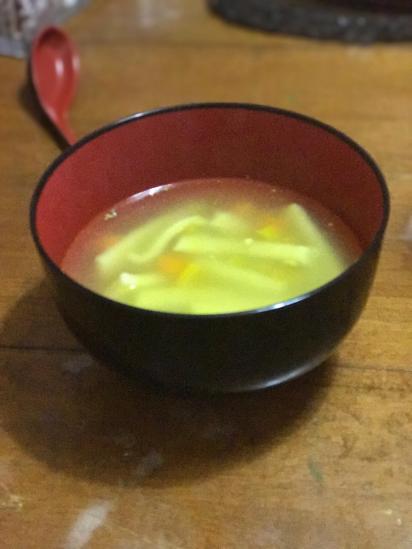
In continuing the story of the soup, I added some frozen turkey bits from a previously roasted turkey, some carrots, and yellow pepper to the broth about half an hour before my wife was going to be home. Normally I wouldn’t have added them so early, but let’s be clear here–sick people do not love crunchy vegetables. Softer carrots and softer peppers are good for the throat, especially as the pepper oils spread into the broth and slowly condition my youngest child to like the taste of peppers–I will win the pepper-war eventually. When my wife walked in the door, the slightly dried noodles were tossed in the pot. In a few minutes (far less time required than when cooking dried noodles), the soup was ladled out to salivating kids. A prayer, a blessing, and sore throats began to enjoy.

Yummy soup

My kids claimed it was the most delicious soup they’d ever eaten. My wife said it was really good. To be honest, it was pretty good. I drank a couple extra ladles of broth to make sure my body would stay nice and healthy.

As I collected my groceries and returned home, I thought about all of these things. I thought about the game that I had missed and the fellowship over lasagna that could have been mine that evening. I reflected and gave thanks that a perfect day had not occurred, but that my commitment to learning, practicing, and caring had allowed me to bring blessing into my sick family. Commitment is not always about the large things in life. Commitment is often lived out in the little things, like learning to plant herbs and use them to make a good cup of soup.

Rob’s “Kluski” Noodle Soup (makes… a lot of brothy soup that is easy on bellies and throats)

  • 1 gallon Chicken Soup Base (or skimmed poultry bone broth)
  • 2 cups of previously roasted turkey (small bits–I imagine any poultry would do, but I would recommend something chunky, not sliced. My wife would say to buy a rotisserie chicken at the grocery store and chop it up. I would tell you to reserve the bones and skin to make bone broth later, especially if people might be sick for a couple of days. Yes, I know that’s a beef bone broth recipe, but just substitute chicken. It works, I promise.)
  • 1 cup of sliced carrots
  • 1 yellow pepper, diced
  • 1 dash garlic powder
  • 1 teaspoon ground pepper
  • Noodles!
    • 2 cups flour, sifted
    • ½ teaspoon salt (shh–I used the “No-Salt” my dad left behind to cut down on the sodium)
    • 2 Eggs
    • 2 half-eggshells of water (old recipe indeed)
  • 1 Bouquet Garni (tie together with enough string to tie it to the handle of pot so that you can remove it easily)
    • 5 sprigs (3 inches) of Lemon Thyme
    • 2 sprigs parsley with stems (3 inches)
    • 1 sprig sage (3 inches)
    • 1 bay leaf

First, make the noodles. On a clean surface, like a large rolling board or a silicone rolling mat, sift the flour and salt together. Make a well in the flour. Crack the eggs into the well. Work the eggs through the flour, which is surprisingly easier if you do it before you add the water. When thoroughly mixed, form another well and add the water. At this point, I use a spatula to make sure the water doesn’t escape until the dough is formed. Roll the dough as flat as possible and cut into the desired shape. Kluskis are usually about 2 inches long and maybe a half centimeter wide. I didn’t do a very good job at this part, but they still tasted good.

Bring broth to a boil. Reduce to simmer. Add spices and the bouquet garni after tying it to the handle. Leave it to summer for at least an hour. The soup will smell very lemony, but that’s okay. The thyme will not overpower the soup. With half an hour to go, put in the veggies and turkey. If the turkey is frozen, add the turkey a few minutes earlier and bring the broth up to a boil. I personally remove the bouquet at this point so the tumbling vegetables don’t break too many leaves off. The thyme lost several leaves, but after this long a boil, they’ll just slip down the throat with the broth without causing even a hiccup to the most sensitive of throats.

When you’re almost ready to eat (seriously, only a few minutes), set the table and add the noodles. They will float when nearly done. Taste one noodle (I use chopsticks to pull it out–kluskis are dense but should taste cooked through) and adjust broth if necessary, although I didn’t need to do anything. Serve with lots of broth to make unhealthy throats happy.

Let us Seek: Sovereign God, part deux

Sometimes, I argue with myself. My habit to write the next day’s blog post and schedule it for 9:00 AM the following morning. On occasion, I find inspiration to continue with a previous line of thought. Occasionally, I find myself arguing with both myself and my blog entry for the day.

This morning I posted about a reflection on the sovereignty of God. My post came about after reflection on scripture as seen through the light of a book I am reading for the Academy for Spiritual Formation. That book is “Psalms of the Jewish LIturgy: A Guide to Their Beauty, Power & Meaning” by Rabbi Miriyam Glazer. In the book, the argument is made that the sovereignty of God is a sacrosanct concept. Adonai reigns so our world is seen in a different light.

I made the “mistake” of spending time in my devotions this morning, which is always a risky affair. I was working through one of my favorite resources, which is Upper Room’s “A Guide to Prayer for Ministers and Other Servants” (henceforth, “Guide”) This resource is the very resource which led me to consider applying for the Academy in the first place. Before finding the Guide I had always seen Upper Room as that tiny little book which I took to individuals when I visited or handed out to folks when they wanted something to read to go deeper. The Guide was deep, methodical, and practical for me as someone who likes structure in their prayer life to balance out my lack of attention span–there is a reason my blog uses the phrase “Distracted Pastor.”

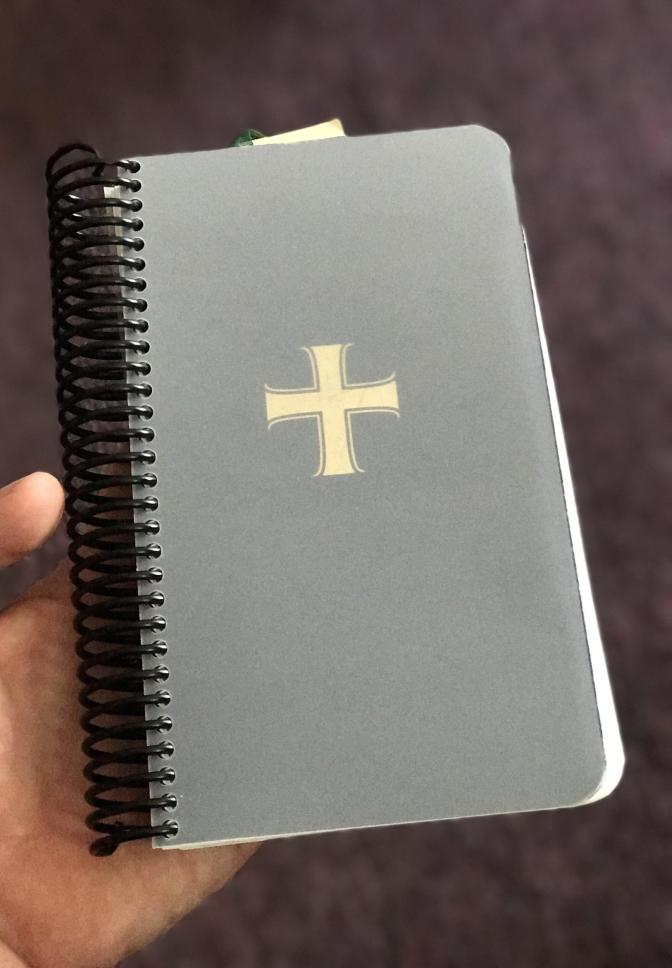
Quick aside, one of my colleagues at the Academy recommended that I take my new Worship Book to the artist formerly known as Kinkos to get it bound with a spiraling ring to make it easier to use. I took my Guide there and for less than nine dollars it is now far easier to use and has nice protective covers to keep it safe. Getting my devotional book bound with a ring was a great idea as I now don’t have to weigh the pages down while taking notes in my journal.

Look how easily it sits flat!

The plastic cover is a nice protective touch…

Anyway, back on subject, I made the mistake of working through the Guide and found myself reflecting on a passage that was the exact opposite of what our good Rabbi Miriyam Glazer stated. Mind you, the author whom the guide quoted is a Christian, so that is somewhat to be expected. Still, the cognitive dissonance has been bothering me as I attempt to stay with both readings.

The following excerpt is stated to be from “Prayer” by Simon Tugwell, a Dominican historian and author. The excerpt is found in the readings for reflection for this week.

“[God in Jesus] does not come in strength but in weakness, and he chooses the foolish and weak and unimportant things of the world, things that are nothing at all, to overthrow the strength and impressiveness of the world. As we saw earlier, he is like the judo expert who uses the strength of his opponent to bring him to the ground; it is the art of self-defense proper to the weak.

This is why, if we keep clamoring for things we want from God, we may often find ourselves disappointed, because we have forgotten the weakness of God and what we may call the poverty of God. We had thought of God as the dispense or all the good things we would possibly desire; but in a very real sense, God has nothing to give at all except himself.”

I imagine most people can see the dissonance between these two sets of conceptions. On the Rabbi’s side we have a God who reigns. Adonai reigns; therefore, we have hope that the future can be a place of blessing. On the Dominican’s side we have a God who has entered the form of Jesus. There is a sense of a self-imposed weakness. God has nothing to give except himself in the form of Jesus. God has nothing to give except himself; therefore, we should not see God as the dispenser of all the good things we would possibly desire.

I have to say that my knee-jerk reaction is to immediately side with Rabbi Glazer. My fear is that my reaction is very human. How could God do something so very foolish? Well, God does what God does. In the most ancient of addresses, God claims the name “I am who I am.”

The challenging part in the midst of all of this chaos is the reality that the Reading for Reflection in the Guide does not stand alone. The psalm of the week is Psalm 105. Psalm 105 is not a psalm of passivity. God acts deeply, thoroughly, and completely in the psalm to assert the placement of the people of God. A few examples:

  • The psalm invokes the actions of God in a time of famine through the servant Joseph. (Ps 105:16-23)
  • The psalm invokes the action of God in establishing a covenant with the immigrants Abraham, Isaac, and Jacob which will never be forgotten. God protects those immigrants with might (Ps 105:7-14, 42-45)
  • The Psalm invokes the powerful and sometimes brutal story of the Exodus (Ps 105:24-45)

The actions claimed in the Psalm are not the actions of a passive God of weakness. The Psalm claims the power of Adonai. Adonai reigns! All of this begs a simple question. Why did Bishop Job and Pastor Shawchuck, the compilers of the Guide, choose to include this passage for reflection? Was it merely to inspire there to be interesting thoughts in the minds of those who sought God this week? Even without Rabbi Glazer’s contribution to this conversation, Psalm 105 and this reflection seem at odds with each other.

I have been pondering these differences for several hours and I am brought to a place where I once again go back to things I learned way back in my philosophy classes at Roberts Wesleyan College. Yes, I was indeed the student who insisted with all of the depths of my heart that I believed that God could do the incredible. I believed that God could make a square circle.

The concepts was simple. Could God do something that was logically impossible? Could God create a rock so heavy that God could not lift it? That concept never stuck within me. I was obsessed with the square circle. Could God make an object that was fully a circle and fully a square? Such a logical fallacy seems impossible.

To say that I received a bit of mockery, ribbing, and even disdain at the time for the strength and consistency of my view is to put it mildly. I have since learned to live into that tension, especially as I lived into theology. Can God truly be fully human and fully divine? Can God really be the One God as expressed in trinitarian theology? Can God really care for humanity to the extent that God would come into the world in the form of weakness to engage in an act of strength that would help Jesus emerge as the victor who would break down the division of sin that had lasted for ages past? There are all sorts of paradoxes in Christianity. There are many koans to be considered.

What is the sound of one hand clapping? I have no idea. How can Jesus be fully human and fully divine? I have no idea. How can God create a square circle? I have no idea. How can God move in weakness and foolishness to save the world? I have no idea, but I believe that Jesus has done this thing quite beautifully.

What are your thoughts in regards to this contradiction? Do you have any ideas or reflections?

Let us Ponder: Sovereign God

Yesterday in the blog I was pondering the concept of knowledge. What does it mean for any religious or spiritual knowledge to go beyond being informational in nature to being transformational in nature? What does it mean for us to understand a text, a revelation, or a message from so thoroughly that it changes the ways that we authentically engage with the world and her creator? These were the sort of questions I was considering in my heart and in my soul yesterday.

As I read for the next session of the Academy for Spiritual Formation, I found myself entering into a new book from a new perspective. We were invited to read four books for the upcoming Academy and I decided to begin with “Psalms of the Jewish LIturgy: A Guide to Their Beauty, Power & Meaning” by Rabbi Miriyam Glazer.

I was considering the introduction to the book and Rabbi Glazer’s discussion of barriers that can interdict themselves between us and these works of an ancient faith when something caught my eye on the sixth page. Rabbi Glazer pointed out that “One barrier may be especially present for us Americans, who are unaccustomed to accepting, or even contemplating, images rooted in monarchy.”

The phrasing and content caught my eye as I had been considering the idea of what it might mean to be transformed by an understanding of the text. I was away last week and was disheartened by the news when I had returned. I was disturbed by the national conversations inspired by events on issues such as “How does someone speak appropriately as a leader to youth and children?” and “What does it mean to treat someone as innocent until they are proven guilty?” I read stories of foul-mouthed politicians and was disheartened. I truly regretted the state of affairs that awaited me in my news feed, but could I really see the power and possibility behind a Sovereign? I am not a fan of some of our elected officials, but surely the heart of democracy and the power of the social contract dwell deeply within my worldview. What could it mean to consider a Sovereign as a welcomed authority figure when I struggle to trust the officials we sometimes elect?

In the midst of these struggles I pondered the very Psalms being considered in the book I was beginning to read. The words that I read truly did come from a very foreign worldview. In truth, the foreign nature of the texts are sometimes what gives those text their strength. Consider the first four verses of the second Psalm: (NRSV, alt.)

“Why do the nations conspire, and the peoples plot in vain? The kings of the earth set themselves, and the rulers take counsel together, against the Sovereign and the anointed, saying ‘Let us burst their bonds asunder, and cast their cords from us.’ The Sovereign who sits in the heavens laughs; the Sovereign has them in derision.”

In a nation where it seems like every political party is conspiring and plotting, it can be invigorating to consider a Sovereign above such matters. In a world where there is earthly power and might in the hands of a relatively small number of individuals, it is comforting to think of a God who considers such earthly might and power as being worthy of laughter. The very foreign nature of the texts presents a Sovereign that can be powerful in ways that are unimaginable in the midst of the plots and conspiracies of modern politics. Consider Psalm 19:7-9: (NRSV, alt.)

“The law of the Sovereign is perfect, reviving the soul; the decrees of Adonai are sure, making wise the simple; the precepts of the Sovereign are right, rejoicing the heart; the commandment of the Sovereign is clear, enlightening the eyes; the fear of Adonai is pure, enduring forever; the ordinances of the Sovereign are true and righteous altogether…”

What if the reason the Sovereignty of God is so foreign is because it has become unimaginable to see a decree or a law that is not immediately shot down as insufficient or askew by another political party? What if the very wisdom of God is what makes God so foreign to us as a people? When was the last time any of us saw a politician and had the first word we would use to describe them be “righteous?”

I found myself moved to think about many Psalms as I thought about Rabbi Glazer’s assertion about the barrier between words of sovereignty and American principles. There are many other good examples of the foreign yet beautiful concept of God as sovereign besides those listed above. I found another passage in Rabbi Glazer’s book to be particularly moving: (pgs. 6-7)

“Despite the reality of terrible evil, despite the chaos and bloodshed that all-too-often beset human life, and despite human suffering; in the view of the psalms, it is because Adonai reigns that we can trust that justice and goodness will triumph in the end. To believe that God is ‘sovereign of the universe’ is to have the faith that, if not in our own lives then in the lives of generations to come, the blessings of peace will indeed someday spread over the face of the earth.”

This is a text written from a truly Jewish perspective, but I find comfort in the words. Evil and chaos are rather prevalent in our world. There are times when the news seems to deliver messages of injustice and resultant shock. This world and this nation are not at peace, but if Adonai reigns then there is room for hope. If Adonai reigns, then there is a possibility for a better world for our children. If Adonai reigns, perhaps we can move forward with the faith that justice will return and peace will overcome.

An understanding of God’s sovereignty that is transformational could really change the way a person reads the news, prays for the world, and seeks justice. It is interesting to ponder, but it is my prayer that such an understanding would first transform my heart and then the world.

Let us Ramble: Questions of Knowledge

When I was in college one of my favorite courses was taught by Professor Andy Koehl and it was on the very nature of knowledge. Epistemology was a wonderful course and it caused me to think deeply about how I knew the things that I thought I knew. Epistemology was a course that lent itself to navel gazing and deep contemplation about the nature of life.

Last Monday morning I sat and listened to a former Jesuit Priest and current spiritual director named Wilkie Au. He spoke to us about the nature of knowledge in a different way than Dr. Koehl had taught in college, which makes sense as philosophy and spiritual formation are two different schools of thought with very different purposes. Wilkie taught us about the nature of knowledge and challenged us to think deeply about the things we know about God.

Wilkie Au laid out the concept of knowledge having layers. Some knowledge is informational. I had a burrito for lunch on Monday and that burrito was filled with tofu. The knowledge of what I had for lunch is simply information which states facts. Information is static knowledge that does not change.

Some knowledge is formational. There are things which we learn that change the way we see the world around us—this knowledge creates a lens on reality which changes our perspective. The week before last my kids and I were listening to a podcast from NPR called Wow in the World which talked about the effects of methane from cow flatulence on climate change. The podcast challenged people to replace some of the protein they eat with insect or plant based protein. The information in that podcast changed my perspective and changed my lunch order from a beef based burrito to a tofu based burrito. It still tasted good smothered in hot sauce.

Wilkie finally challenged us to consider that some knowledge is transformational. The knowledge shapes, forms, and helps a person to live a life marked by authenticity. My listening to the podcast did not transform my life, at least not yet. If I were to live into the knowledge that my lunch choice could help make the world a better place, consistently move towards that truth, and eventually allow that information to change the way that I live my life on a daily basis that information could be said to be transformational.

Now, how does this affect a life of faith? I have lots of information about my God in my brain. I have whole reams of knowledge from my education which tell me about the themes of various books of the Bible, conceptions of the lives of figures from scriptures and history, and a lot of knowledge about the lived life of the church. A lot of that is information which is helpful, practical, and applicable. I also have a lot of knowledge which has helped to form my perspective. I know that God loves people, so I try to choose to consistently love people. I know that God cares for the hungry, so I support the local food bank and our CHOW pantry. This information forms my view of the world and even begins the beginning steps of transformation.

The question I am left with is whether I let the love of God become something that I know which begins to transform my heart and soul. Do I allow God’s love to go that deeply into my soul that it begins to draw out the deep parts of myself? Do I allow that formational knowledge to express itself in my actions so I begin the act of transforming the world around me? While Dr. Koehl might ask how I could know my neighbor is not the effect of the work of some Cartesian demon, Wilkie Au might ask me how my love of God might transform the way I treat that neighbor. How does what I know transform who I am into the image of Christ? For that matter, does what I know transform me into the image of Christ or does it drive me farther from the life of the Spirit?

As I said, we asked tough questions this past week. I continue to recommend you take the opportunity to experience an Academy if you have an opportunity.

Let us Ramble: Upon Reflection

So, this is my first blogpost since I attended the first session of the Academy for Spiritual Formation, which is a ministry that operates through Upper Room Ministries. I returned home late on Friday night and spent most of Saturday recovering from the joy that is driving through Pennsylvania and New York during construction season.

Sunday morning we prepared for worship and I was asked repeatedly about my experience. I told the truth. I was tired, emotionally exhausted, spiritually exhausted, but thoroughly aware that I had found a place where I could find depth, blessing, and community. I reflected with people about the powerful music and my unexplained need to sing the bass part in the four part harmony that emerged naturally from the voices around the table until I experienced vocal-fry. I reflected with people about the challenges of silence and about how I looked really peaceful as I sat silently up front while waiting for the service. I reflected with folks about walking into a situation with a lot of strangers and finding community.

As I reflected, I pondered what I would say for my first blogpost after the session. What I want to say is that I do not believe the Academy for Spiritual Formation is for everyone, but that I found it to be an incredibly moving and powerful experience. If entering into a community where you will learn new things, experience life together with communal silence and song, and explore the depths of spiritual formation seems exciting for you, then I might recommend you look into the Academy. If you want to spend time praying with other people as you explore your faith, share the Eucharist day after day in a refreshing experience that recalls our call to “constant communion,” and spend more time with the Psalms that most of us do in a year, then I invite you to explore the possibility.

In three months I will experience the joy of returning to Malvern where I will share communion with new friends, go deeper into the history of spirituality and spiritual formation, and probably find new areas of growth which I did not know needed to be explored. I imagine God will show up again in a powerful way. I am looking forward to heading back and invite you all to go along with me on the journey as I study, ponder, and reflect both on what has just happened and what will come in the months ahead. Blessings!

Let us Ramble: Ministry within a Culture

I was reading through my coursework for the Academy for Spiritual Formation this morning when a quote from another book caught my eye. I was reading through “Thirsty for God” by Bradley Holt when he quoted Eugene Peterson. I have never really read a lot of Eugene Peterson’s work, especially as my first reaction was a knee-jerk reaction to “The Message.” I happen to like the New Revised Standard Version of the Bible and my first impression of Peterson’s translation was a bit biassed. Nonetheless, I was caught by the quotation from “Take and Read: Spiritual Reading” by Peterson. The excerpt went as follows: (Holt, 143)

“My conviction is that the pastor must refuse to be shaped by the culture, whether secular or ecclesiastical, and insist on becoming a person of prayer in the community of worship. This is our assigned task; anything less or other is malpractice.”

Now, as someone who spent a few years working through academic settings in college and seminary, I must first admit that I do not like having the context of Peterson’s quote. I am working on remedying that situation through a copy of Peterson’s work. Regardless, the quote is striking.

What does it mean that a pastor should not be shaped by either secular or ecclesiastical culture? I can understand the request that a pastor set a special concern in their ministry for prayer, but does that call fundamentally change our approach to ministry? Should it reshape our approach to culture?

For context, consider the earlier histories which Professor Holt shared about the early church. Two groups of monastics entered into their approaches to the monastic life in roughly the same age. The Coptic Antony entered into ministry in the desert as an offensive against the devil in the devil’s own territory much like his master Jesus Christ entered into the devil’s territory during his temptation (Holt, 52). His ministry was (by nature) isolated from both ecclesiastical and secular culture. Amma Theodora, Blessed Syncletica, Athanasius, Pachomius, and other Desert Mothers and Fathers entered into ministry in a similar fashion (Holt, 52-53).

In contrast, Columba established a ministry in Iona after being influenced by his own actions in 632 CE (Holt, 68). Brigid of Kildare lived among the people of Ireland until 523 and Patrick in the early to mid 400s CE (Holt, 67). These individuals knew the work of the earlier Desert Mothers and Fathers but continued to engage their ministries in locations where they could interact with the world around them on a regular basis. Their influence on modern Celtic art is one example of a place where they certainly had interaction with the culture around them. A person could argue that they influenced the culture, but time spent reading through the Carmina Gadelica seems to imply a lot more of the interactions were mutual in nature.

The earlier Desert Mothers and Fathers withdrew in an attempt to be faithful from both culture and their former lives. The Irish monastics seemed to attempt to be faithful while withdrawing from their former lives but not necessarily from the culture where they lived and ministered. They exist down two different paths from a fork on the road of their journeys.

The current life of the church seems to be a similar crossroads. Some churches believe that the church should withdraw from the world around us into fidelity without using cultural tools of current times. I serve a church which worships to an organ with hymnals in a building without air conditioning. They seem comfortable worshiping in this way. Other churches withdraw from the world into a place of fidelity while using modern tools such as guitars, projectors, movie clips, and a host of other tools from the world. Worship in both places is affected and shaped by culture. The former churches are usually shaped by the culture of the past century and the latter churches are shaped by the tools of this age.

Worship has been clearly shaped by the culture around us. Church structure has been clearly shaped by the culture around us. What does it mean that Eugene Peterson believes that the pastor must remain in a place where the cultures of the world and the church are refused on principle? Can one become a person of prayer while allowing the world to alter one’s identity as a pastor?

Was it not righteous and just for the pastors of ages past to allow their lives to be shaped by the communities where they served? Does anyone believe that the pastors who were beaten and arrested while seeking justice during the struggle for civil rights were less faithful for allowing the culture of the world to change them and their practices? Does anyone believe that the pastors who have allowed their prayers and thoughts to be bent to the suffering of indigenous peoples are somehow being less than faithful?

More importantly, what is the context of that quote! I guess that I will have to wait until the book arrives, I find time to digest it, and can follow up upon this post. In the meantime, I hope that this post has inspired some thoughts and conversations. Blessings today.

Let us Ramble: Pursuit of Smokiness

Yesterday was Independence Day in the United States. For most folks Independence Day is marked by celebration with a barbecue of chicken, hamburgers, hot dogs, sausages, or any other number of delicious foods. Tradition usually lends itself towards children staying up late to see fireworks and to listen to patriotic music.

The day celebrates the Declaration of Independence being ratified by Congress in 1776. The day celebrates a far different time in our nation. A lot of the celebration would probably be considered obtuse, strange, and irreverent to most of the folks who lived through the events of 1776. I must admit that I am less concerned with the historical tension in this holiday than with many of the religious holidays which normally pique my interest. I happen to like Independence Day.

One of the reasons I like Independence Day is that I like to grill. I enjoy using our grill. This year I did a bit of minor surgery on my charcoal grill/smoker with a dremel to add a rotisserie component. I woke up very early, set the fire smoking, and watched a turkey spin around and around on the spit. We were invited to a wedding renewal ceremony and picnic about noon. The turkey hit the perfect temperature right on time to head out to the party with a smoked bird. Here’s the bird about an hour before she was finished. The tiny yellow bits were part of an olive oil baste with thyme, marjoram, and garlic. When finished the turkey was deeply colored and extremely fragrant.

My smoked turkey about an hour before completion

I was really proud of the turkey, but I refused to put pictures online. My wife knows that I love to share bits of my cooking adventures, so she took a picture to post on my behalf. I almost stopped her from posting the picture. What was my reasoning? What if I had made a huge mistake and the turkey was awful? What if people saw the turkey and told me I had messed it up?

The turkey was decimated at the party. The turkey was just torn to shreds by people who had spent a good half hour smelling the fragrant meat while waiting for the guests of honor to arrive. I’m glad my wife saved me a piece when carving because the turkey was just destroyed. I understood why immediately upon tasting the meat. The meat was deeply flavored, deeply delicious, and tasty in a way that only smoked meat can taste. This turkey wasn’t just store-bought turkey. The bird had been prepared carefully, slowly, and it was absolutely delicious.

It raised a question in my mind. Why am I so afraid of failure? I have good gifts, I have talent, and I practice my craft. I cook dinner regularly in my house and I have never been afraid to attempt new things. I should believe in myself, but I regularly look in the mirror and assume the worst about myself. What if my fear really is just fear that should be put aside?

The situation reminds me of FDR’s first inaugural address in 1933. President Roosevelt stated “let me assert my firm belief that the only thing we have to fear is fear itself—nameless, unreasoning, unjustified terror which paralyzes needed efforts to convert retreat into advance.” Facing a nation in a fiscal crisis with a vast imbalance of population and resources, FDR approached a dangerous situation with the belief that the nation must advance or perish. While my concerns are not nearly so dire, I will say that my own fears in life are often unreasonable and unjustified. President Roosevelt said later in that address:

“Happiness lies not in the mere possession of money; it lies in the joy of achievement, in the thrill of creative effort. The joy and moral stimulation of work no longer must be forgotten in the mad chase of evanescent profits. These dark days will be worth all they cost us if they teach us that our true destiny is not to be ministered unto but to minister to ourselves and to our fellow men.”

If true happiness lies in the joy of achieving things, then why am I so terrified of failure? Why do I fret about money, resources, and future criticism when happiness will not lie down those paths? Why do any of us live in such fear? I smoked a turkey that I filled with herbs from my own garden, basted in an oil I infused with my own instincts, and then slow roasted in a smoker that I altered with my own hands, My wife was right to be proud of me. Smoking a turkey is not rocket science, but the turkey was something that I enjoyed creating which I brought together through my own efforts in cooking, gardening, crafting, and patience. What’s more, I took that gift and shared it in a place where people could enjoy it without price or cost. I used my talents to bless others.

What would the church look like if we were to live out this love together? What if we were more concerned with our ministry to ourselves and to others than with looking at what we can take from the world around us? What if we found joy in our work as a community instead of chasing our own profits to our own doom?

Let us Ramble: Gelatin and Chopsticks

Last Thursday I took my children to lunch. The two minions had spent three days sitting fairly quietly in the church’s board room and were understandably at the end of their patience. I know this because they came into my office and began to repeatedly chant “Dad, feed us. Om-nom-nom.”

We went out for lunch at a nearby buffet. I proceeded to watch what might have been the most agonizing thing that I saw all week. I watched my daughter try to eat a gelatin cube with chopsticks.

image

At first, she would seem to be making progress. She’d place the chopsticks exactly where they should go for a nice grasp on any other type of food.

image

After she began to apply pressure things began to go sideways. The chopsticks would slip into the sides of the gelatin and the edges would begin to give way to the pressure applied by my daughter.

image

At one point she managed to pick up the gelatin. Her grip did not last for long and soon the gelatin plummeted to the plate again. She was determined to eat her lunch without using her fork, but this gelatin was trying her patience. I was lucky enough to convince her to let me grab a picture or three despite her frustration.

I share this story to express a reality of life. Many people often come across situations in life where they believe that they have everything needed to face life’s challenges. They reach out to grasp life by the horns and suddenly realize that they are grabbing the horns of an ornery bull without a backup plan.

Sometimes in life the challenge is as simple as stripping that one screw necessary to complete putting together a piece of furniture. The situation is frustrating but not a matter of life or death. At other times, the challenges we unexpectedly face can be far more serious. Sometimes the situations we are face are both serious and severe.

Watching my daughter attempt to pick up gelatin with chopsticks was agonizing to me in part because I have tried to eat slippery foods with chopsticks in the past. My daughter was frustrated, but she certainly wasn’t alone in her frustration. I sympathized with her, told her that eating slippery foods with chopsticks can be hard, and let her know that it was okay to use her fork. I gave her a form of permission to let go of her frustration and to just get on with her life.

In my opinion, the value of community shows itself in moments like those spent on Thursday with my daughters. We all face difficult situations and sometimes the thing we need most is someone to stand with us in the frustration. Community does not always provide answers, but the best communities often provide the context and compassion necessary to make it through dark times.

My hope is that the churches which I serve in my ministry will help to provide community in places where compassion and context are necessary in the lives of our community members and our neighbors. The church does not often provide the silver-bullets necessary to slay the werewolves of life, but we do point in the direction of the God who provides comfort, grace, and life. The church does not always share grace as perfectly as we should, but we do hopefully surround folks with the gentleness and kindness that comes through the Holy Spirit.

Let us Ramble: Waiting for S’mores

It had been a very busy Wednesday. The day had been long. I slumped into my camping chair and watched as a fire began to spread in my family’s fire ring.

I was tired. The children have been in the office with me this week and had joined me for Senior Lunch. My youngest daughter had an audience for her antics. The senior citizens were amused. I was very tired.

I was tired. The children had been very well behaved on Tuesday morning in the church office. By Tuesday night they were beginning to snipe at each other. On Wednesday morning the bickering began shortly after we arrived. By Wednesday afternoon… I was very tired.

I was tired. A storm knocked down a tree in the field last week. I had been dragging the logs out of the field with an old “Radio Flyer” style wagon without a comfortable pull-handle nor any form of shock-absorbers. One of our Buildings and Grounds folks was able to set the church tractor up with a trailer to help me do the job without walking a thousand miles with the wagon. Even with the tractor’s help there was still a lot of wood and a lot of work. The last big and irregularly shaped piece that I grabbed to load into the trailer slipped through my fingers and tore a gash in my wrist as I scrambled to catch it before it could strike my foot. That ornery and unwieldy piece of wood was the first piece in the fire ring. I was very tired.

I was tired. It would be at least half an hour until my kids returned home from their swim lessons at the YMCA. I was very tired, but the lemon-flavored seltzer water was pretty refreshing. The smoke rose and the very human and fairly spiteful bit of myself smiled as the wood which hurt my wrist began to burn away into nothingness.

The ornery piece of firewood burning…

I was tired, but thought back to the fact that my kids’ biggest problem that morning had been who would have the first turn being the teacher as the played school. I was tired, but thought back to the fact that the senior citizens who we sat with at lunch seemed to reconnect to a bit of their past and smile as they saw me tormented by my child. I was tired, but thought back to the fact that Paul had helped me to use the trailer so that I wouldn’t collapse of exhaustion. I was tired, but that bedraggled piece of wood was getting what it deserved and would provide enough heat to make my kids s’mores after they returned from swim lessons.

I was tired, but I decided to be grateful as I stared into the flames. I knew that tomorrow would have enough problems, but for that one moment I could decide to be content with the blessings of a cool glass of seltzer water, a warm fire, and the promise of time together alone with my wife sitting by the fire after the kids went to bed.

Let us Ramble: Silence isn’t always Silence?

Yesterday I posted on questions of silence. I was still deep in thought on the subject of silence when I began to work through my readings for the Academy for Spiritual Formation. I was reading through a meditation on Psalm 148 in “Abide: Keeping Vigil with the Word of God” by Macrina Wiederkehr. As I read a portion relating to the Psalm stuck out to me: (40)

“If the fruit trees, the cedars, and even the hail are to give praise, then it follows that there is a way of praising God in which the spoken word is unnecessary. There is a Word that differs from the spoken kind. Sometimes it flows forth in the simple silence of being as shown in the mountains and hills. There is a Word that leaps up in the crackling of the fire, it rides in on the moaning of the wind and in the roar of the wild beast. Could this too be praise? Could all of creation be drawn like a magnet to the divine?”

Could there be a deep truth here? When I think of silence I often think about not speaking, not talking, not singing, and simply keeping my mouth shut. What if there’s a voice that speaks louder than my voice? While Sister Wiederkehr is speaking of the praise found in creation, is there a place where we are called to praise God through presence? As we listen to these wise words, is there a call by God to change the subject?

The 68th Psalm establishes that God is known to be a parent to orphans and a protector of widows. God cares deeply for the desolate and the prisoners. God is the one who is present in the lives of those who are often considered voiceless. If we are to love those whom God loves, are we not called to speak with both our voice and our presence?

Consider the words of James 2:15-16: “If a brother or sister is naked and lacks daily food, and one of you says to them ‘Go in peace; keep warm and eat your fill,’ and yet you do not supply their bodily needs, what is the good of that?” What good are our words if they are not backed up by our presence? What good is our voice if we are not speaking through our deeds?

The fire crackles because the fire burns by nature. The wind moans as it blows through the trees because that is what the wind does when it passes through branches. The fruit tree grows fruit by nature. All of these things engage in their behavior by nature. If we are being called to be remade through the power of the Holy Spirit, shouldn’t our voice be raised with love for all the people Jesus’ loves? Shouldn’t our voices crackle, moan, and grow like the rest of creation that reaches out in praise?

Let us Ramble: On Keeping Silent

What does it mean to keep silent? There are opportunities to share and to overshare for practically everyone with access to the internet, so what does it mean to keep silent? Ecclesiastes teaches us that there is a time for every matter under the sun. Ecclesiastes 3:7 states outright that there are times to speak and times to keep silent.

I awoke this morning pondering silence. I say I awoke this morning, but I honestly did not sleep much last night. We couldn’t find the cat. She just went AWOL at some point and every couple of hours I would restlessly wander the house calling her. There was no sign of her anywhere.

At four AM I went outside and started circling the house calling out to her. I heard no reply. At six AM I went out to let the dogs do their numbers. Suddenly there was a meow. The cat managed to get underneath the bay window. How? I have absolutely no idea how she got out, why she chose to hide there, or why she suddenly called out to me. I was glad she called out.

We often allow ourselves to get backed into corners through our own silence. We have a great idea, wander off into the darkness, and suddenly realize that it is very cold, dark, and rainy outdoors. I am probably anthropomorphizing, but we let our pride get the best of us until we know we need to call out for help. To keep silence when it leads to our own detriment is something some of us do far too often.

At the same time, as I ponder silence, I find myself thinking about next Monday. My wife and I will be going to the doctor’s office and we are going to be learning some good news that we will not be sharing with others until the 12th of August. We have a pact to keep silent on the subject until we can share it with our friends and communities together. We will keep silence because the silence will neither hurt nor damage others. This time is our time to share in this knowledge as partners and to prepare for the hubbub that will come after the announcement is made.

So, what does it mean to keep silent? Is silence an opportunity or a risk? Is silence a choice or a privilege? Is silence enforced or is silence a blessing? Is silence all of these things at different points? There is a lot to contemplate about silence in my mind this morning.

Let us be Grateful: On Ridiculous Things

Last Sunday was Father’s Day and my family celebrated with me after church. The weather was hot, so they took me down the street to Kelli’s Deli, which is air conditioned. They ordered me a ridiculous pizza for lunch which I normally would not order. My younger child is a picky eater, so I do not generally order strange things. My wife knew that I had wanted to try the pizza for at least a year. On Sunday they bought the pizza for lunch. Yes, they ordered a cheeseburger pizza for lunch.

IMG_0413 2.JPG

Cheeseburger Pizza! Delicious!

The strange pizza was an utterly ridiculous gift to a person who appreciates simple gestures of affection. I spend a lot of time cooking for my family. I love saucy and spiced foods but we rarely eat them in our home because of our children’s tastes. I love pickles but we rarely have them as a part of our meals because of our children’s tastes. I love a lot of food that I never cook because my children have turned their noses up at foods that were too strange or too different.

My kids sitting with me and eating a weird pizza with me was a great Father’s Day gift. My youngest might have struggled to eat anything but the crust, but she still tried to make an attempt to eat a single bite with only minimal complaining. She only tried to change our order twice to something she would rather eat and that’s an improvement over most meals lately. Don’t feel too bad for her—she ate at least three pieces of our church’s Fathers’ Day cake at Fellowship Hour.

It seems strange, but it really is the little things that help a person feel appreciated. I invite you to remember that sometimes a kind word or a bit of love can turn a person’s day around. Today you may have the opportunity to make the world a better place for someone you come across in your life. I invite you to share love—be ridiculous if necessary. Sometimes it means more than you know.

Let us Ramble: Free Will

What choices are you making today?

I grew up into my own faith during an age of culture wars within the church. Some churches were beginning to adopt more charismatic contemporary worship and other churches were holding to the music of ages past. Some churches fought over drumsets and other churches restored magnificent pipe organs.

I have survived those culture wars. I now live with the view that Psalm 100:1 is ultimately what matters. Is it a joyful noise to the Lord? Well, good enough! Do I prefer certain music? Of course, but I am not the only person in worship on any given Sunday.

I am living in the midst of an ongoing cultural clash between different schools of Biblical interpretation. This is exemplified by the current struggles over LGBTQIA theology, but also rises up to the challenge on discussions of spiritual gifts, spiritual practices, and even the limits of God’s grace. I am surviving this clash by keeping my eye on my ultimate goal. I run this race with Jesus.

Interestingly, the culture clash that I believe is most important to our current situation became “yesterday’s news” before I even truly entered ministry. I believe this reality is a great tragedy because one part of the challenge we face as a culture requires the presence of a vital piece of theology.

I believe that we absolutely need an orthodoxy and orthopraxy that supports the concept of free will. We have become a culture that is complacent when we face situations that seem beyond our control. We have become a people that allows fate to decide some of the most difficult choices in our lives. To riff on the excellent work of Dylan Thomas, we go gentle into our own goodnights. There is no rage against the dying of our light, our neighbor’s light, or any light. We passively accept fate like people in Thomas’ poem accepted the end of life.

Let me explain what I mean through examples. These examples apply to many people, but certainly not everyone. In many cases they refer to very few people.

People are living within marriages where things are going to shambles. A lot of people live in marriages where things are going awry. I talk with people about marriage more than almost any other subject. People often accept that there is nothing they can do because their partner won’t change. Free will means that we can change their own behavior, but we almost always focus on the behavior of another person as the root of our problems. People give up their ability to change their circumstances and often do not realize what they are doing when they surrender their own choices.

People live life with children that have challenges. They accept they can do nothing about the situation because their children do not do exactly what they want them to do in life. People can be happy to give their children choices but are unwilling to accept that their choices have consequences. By letting go of their own free will they have set themselves up for further aggravation and hopelessness.

People are living in communities that are filled with anger and hatred. Facebook is filled with posts from angry individuals who rage at each other. People assume that nothing can be done, but we each can choose to set an example by our own behavior. We can affect our community through living out lives of grace and compassion, but we allow ourselves to be fated to frustration.

People can be frustrated by the lives we live in the United States. Politicians represent the people and ultimately power rests with the people. King George learned this lesson the hard way. If absolute power corrupts absolutely, ultimately the weight of corruption falls on the people who grant power in the first place. We tend to not accept our responsibility as citizens. One of the highlights of being a part of the Kingdom of Heaven is that we do not have to be in charge. In our secular lives in the United States, the buck ultimately stops with the American people.

We can choose to select our own identity in this world. We can choose how our behavior will affect our future. We can choose who we will become in the future by our actions today. We can make the world great tomorrow through our use of love and grace today. We must only choose to grab the helm of life and turn the ship around.

There are no shoals that we must strike. There are no hurricanes that must lie in our path. There is an ocean of possibility if we but believe that we can trim our own sails, lift our own anchors, and shift our own rudder. We can make the world a better place if we trust in God, accept God’s power to transform our lives, and live into the image of Jesus.

Let us Seek: “Confidence and Pride” or “On Lectionary Usage”

“Why do we use a lectionary?” “What use does a lectionary have for a minister in the church or for the community at large?” “Wouldn’t life be easier if you just picked out all of the scriptures?” One reason we use lectionaries as communities and as pastors is because they force us out of our own comfort-zones into scriptures we would ordinarily glaze over. I have been preaching out of the Narrative Lectionary which comes out of Luther Seminary in St. Paul, Minnesota. I post blog entries based off the Revised Common Lectionary as provided through the library of the Divinity School at Vanderbilt University. I use both resources to help round out my teaching as a preacher and teacher of the Good News. I also occasionally wander off and do a series based on a particular book or concept, because even a crazy United Methodist minister like me has freedom of the pulpit and it can be cathartic to exercise that freedom.

For today’s reading I decided to use the complimentary daily readings from the Revised Common Lectionary. In those readings I was struck by the reading from Hebrews. Hebrews 3:1-6 says: (NRSV)

“Therefore, brothers and sisters, holy partners in a heavenly calling, consider that Jesus, the apostle and high priest of our confession, was faithful to the one who appointed him, just as Moses also ‘was faithful in all God’s house.’ Yet Jesus is worthy of more glory than Moses, just as the builder of a house has more honor than the house itself. (For every house is built by someone, but the builder of all things is God.) Now Moses was faithful in all God’s house as a servant, to testify to the things that would be spoken later. Christ, however, was faithful over God’s house as a son, and we are his house if we hold firm the confidence and the pride that belong to hope.”

The first question this passage raised was the obvious question for anyone who studies some selections of scripture. What is the “therefore” referring to in the previous section? The second chapter of Hebrews refers to: (Hebrew 2:17-18 NRSV)

“Therefore [Jesus] had to become like his brothers and sisters in every respect, so that he might be a merciful and faithful high priest in the service of God, to make a sacrifice of atonement for the sins of the people. Because he himself was tested by what he suffered, he is able to help those who are being tested.”

(Sidenote: Hebrews is a logically organized book with a lot of “therefore” statements, so I will allow you to dig into the “therefore” of the previous chapter if you are inclined. Be forewarned that there are two more therefore statements with a significant amount of explanation in the second chapter before this particular “therefore.”)

In my opinion, the content of the “therefore” of the first verse of chapter three brings light into the reading, especially the sixth verse. Christ is faithful over God’s house as a son. We are a part of that house if we hold firm to the pride and confidence that come with hope.

Why would we have pride? We are part of a people for whom Jesus intentionally entered creation. We have a merciful and faithful high priest in Jesus. Jesus came in service, sacrificed to bring atonement, and was like us in every respect. We are a people who have lived in futility but Christ has come into the world. We are part of the people which were blessed by Jesus’ presence. We are a part of the household of God due to the faithfulness of our brother and high priest Jesus. While pride is often a word used with negativity in church circles, there is surely some blessing and joy to be found in the reality that Jesus chose to become a part of our human family. There is a pride that does not come with smugness, but with peace. This is the pride that comes with the fulfillment of hope and faith.

The fulfillment of hope and faith are also behind our confidence. The legacy of the Christian worldview is a legacy marked with perfection in creation shaded by sinfulness, tranquility in a garden overshadowed by ejection from utopia, calling into community tainted by broken sovereignty and nationhood, and voices crying out from the wilderness drown out by earthly concerns. Throughout the history of the Christian and Hebrew journeys towards God there has been continual frustration marked by the stubborn refusal of God to give up on the people. We have confidence because Jesus has come to be our high priest.

Ancient promises, hopes, and dreams are fulfilled in the person of Jesus Christ as our high priest. Furthermore, we are brought into the family of God through the incarnation of Jesus Christ into humanity as our brother. We have pride and confidence because Jesus has willingly done these things with us and for us as a people.

Why do we use lectionaries? I had no intention of writing a blog post on a high priest or on the legacy of hope this morning. We use lectionaries because they lead us out of ourselves into God’s realm where the unexpected can happen. Making a choice to step beyond our comfort zone can be a blessing, but let’s not pretend that taking a risk is always easy. It takes confidence to believe God can meet us out in the wilderness where we relinquish control and it takes humility to listen for a word that we do not expect.

I hope this explains in part why your minister may or may not use a lectionary. There are many other reasons to use a lectionary, but I personally believe that this logic holds well. When I bake bread, I proof the yeast to make certain the yeast is alive and will help the bread rise. The lectionary tends to be full of life in my experience and sometimes the bread we need is not the bread we have in the pantry.

Let us Seek: Enthroned Forever

This morning I stood outside the elementary school where my children go to school. Today is Flag Day in the United States. Our children sang songs, marched, paid tribute to the flag, and were very patriotic. The presentation was a stirring event for everyone involved.

I returned to my office, visited with the CHOW folks serving in the Zimmer Annex, spent some time reading from my book for the Academy, and then sat down at my computer to look up the menu for the local deli down the street. I clicked on Facebook while Kelli made me a delicious sub for lunch. I saw an article about violence in Virginia. I read an article which was updating as I read. Violence, death, and pain suddenly filled my mind.

I wanted to go back to the circle in front of the school and see my kids celebrate the flag. I wanted to go back to the moment where all of my cynicism crumbled before a child who marched proudly and another child who signed boldly with their classmates. It had been such a powerful expression of innocence and I wanted to go back to that place.

I have been asked how I handle being a citizen of earth and a citizen of heaven. I tell people that I have dual-citizenship. I am a citizen of the United States and a citizen of Heaven. I love the nation where I was born, but have accepted allegiance to the Kingdom of God. I have made vows as a minister that have further tied me to that nation as an ambassador of the “Shepherd” of us all who serves within the church.

Ultimately, as a result of my faith and may vows, my allegiance falls foremost to my citizenry in Heaven. History teaches me that nations come and go, and that life is short. The dictionary teaches me that eternity is endless. My citizenship in Heaven is established by and through Jesus Christ and will last as long as I am held with love by God. My citizenship in Heaven is eternal since nothing can separate me from the love and God. My citizenship in Heaven is eternal since Christ will not lose me.

Unfortunately, my ties to Heaven do not release me from the sorrow of events like those that took place today in Virginia. My heart is broken as more folks lay in hospitals injured by violence. My heart is broken as I know at least one person lies in a morgue.

Even reading the readings in the Revised Common Lectionary for today did not bring comfort today, and not just because Job gets told off by God in one of the readings. If anything the readings (except Job’s selection) brought longing for a better world into my heart. Consider the words of Psalm 29:10-11: (NSRV)

“The Lord sits enthroned over the flood;
the Lord sits enthroned as king forever.
May the Lord give strength to his people!
May the Lord bless his people with peace!”

I long for a world where God sits enthroned over humanity. If Jesus is the image of the invisible God, then I truly long that Jesus would be enthroned. The world needs more compassion, more grace, and more love from her leaders.

In my opinion, the world would seemingly be a million times improved if Jesus were to return. Consider the promise of John 14:27: “Peace I leave with you; my peace I give to you. I do not give to you as the world gives. Do not let your hearts be troubled, and do not let them be afraid.”

In defiance (apparently) of Jesus’ words to us, my heart is troubled by the violence that I see in the world where I was born. On this Flag Day. I wish that everything could be happy songs sung by children, but this is a dangerous and questionable world. I want the peace of God to fill the hearts of the world, because the world just doesn’t offer the peace we need on days like today. I fear we need the strength spoken of in the Psalms, because this world can shift like sand in a single moment. We need to build on the rock for when the storms come.

The reading from John 14 brings more longing than perhaps anything else. John 14:25-26 says: “I have said these things to you while I am still with you. But the Advocate, the Holy Spirit, whom the Father will send in my name, will teach you everything, and remind you of all that I have said to you.”

Teach me, Holy Spirit. Teach us all. Remind us of Jesus’ words and teach us how to live in this world of rifles, bullets, and death. Our sins stain us scarlet. Wash us clean and we shall be as fresh as newly fallen snow…

Let us Ramble: In-between Spaces

My readings for the Academy for Spiritual Formation have led to me doing a lot of contemplation. Today I was reading through “Abide: Keeping Vigil with the Word of God” by Macrina Wiederkehr. Here’s the passage that led to contemplation today: (24)

“Then suddenly you find yourself back in those in-between times. Distressing and boring as these in-between times of the season may seem; they can also be nourishing spaces for the soul. This waiting between dying and rising is like being in the tomb. It is a waiting room that is essential for spiritual growth. In this quiet tomb-place we feel, once again, that ancient tugging at the heart. We experience being drawn, like a magnet to the divine.”

Sister Wiederkehr had been speaking on the beauty she finds in the in-between times of life. She enjoys walking as the sun rises and sets. She enjoys the time between seasons. She finds these are the best times to romance the Word of God.

I’m not a morning person and I often put my children to bed around the time of sunset most of the year. I know that the dawn is beautiful, but that is not where I experience my in-between moments. The place where I have been experiencing the in-between moments like Sister Wiederkehr describes is in my garden.

A pepper plant from our garden. We need to weed again…

My garden is currently in an in-between place. Sister Wiederkehr explored the in-between nature of winter turning into spring, but I also connect more to that in-between place when spring is turning into summer. The plants have started to take root, the leaves are growing, and there are already a few blossoms on the tomato plants. There is growth and in time the pepper-plant in the image above will begin to create food for my family.

Spring is a time of hope, promise, and busyness in preparing the garden. Summer and autumn are seasons when these promises become a reality when the harvest comes in to be canned, frozen, and eaten. This is that in-between place where there is occasional weeding, occasional watering, and a lot of waiting.

I often feel like I experience these same moments in my spiritual life. I rush to make plans after reading a book, organize a wonderful event, or have a revelation that begins to change my outlook on life. I complete what needs to be done and then simply have to wait to see what will happen. This time of waiting in-between moments can be boring, but I agree with Sister Wiederkehr. These moments are essential for spiritual growth.

By my garage, at the base of a simple flower there will soon grow a tomato. The tomato will be small and green. I can watch it day in and day out. The tomato will be ripe on the day it turns ripe and not a day before then. As much as I would like to rush things, the tomato requires time, sun, and water to thrive. The tomato requires good soil, good nutrients, and time. I have provided sun, water, good soil, and nutrients to the best of my ability. Now, I need to have patience.

Spiritual lives require patience. A healthy spiritual life does not grow all at once. There may be mountain-top experiences and times when we receive revelation that shakes us to the core, but most of the time we need to have patience with God and with ourselves. One of the few times that God grew a plant overnight for a person of God in scripture it was almost immediately cut down by a worm to help teach Jonah a lesson. God can do all things and that includes asking us to be patient and wait.

In my experience Sister Wiederkehr is right about the silent, tomb-like places. The quiet-places are necessary to our growth as individuals. The silences also teach us how to hear God in the stillness and to feel that magnetic draw towards the divine. I invite all of us (including myself) to know the wisdom and longing that comes with patience in the quiet places of our spiritual lives.

Let us Ramble: Selling Silence

In his book “Silent Compassion: Finding God in Contemplation” the author Richard Rohr states:

“How do you market that which is inherently unmarketable? How do you sell silence? How do you make attractive what feels like selling air or selling emptiness or selling something that, certainly to the capitalistic mind, would not immediately be attractive at all?”

These are good questions. This quote came to mind as I considered the reading I did yesterday for Academy for Spiritual Formation. I was reading through “Thirsty for God: A Brief HIstory of Christian Spirituality” by Bradley Holt when the following quote caught my attention: (1—I’m just starting the book)

“You may be dehydrated right now but not know it. One peculiar feature of our physiology is that the signals for lack of fluid are not immediate or strong. Thus we may feel uneasy or tired when dehydrated but not recognize these symptoms as thirst. By the time we recognize thirst as such, we have already moved through the early stages of dehydration. Why does this matter? It matters because keeping our fluid levels up is vital for our bodies to function in so many important ways: for energy, for healing, for our immune systems, for electrolytes, and yes, even for sex.

So one part of the human predicament is that we do not always know what we really need or long for. Another part is that we find it difficult to act consistently on what we do know.”

How does a person sell silence? How does a person sell water? We learn to recognize thirst as thirst by necessity. I think that we have to learn to sell people silence by showing them the value, the need it quenches, and to consistently model it ourselves. Hence, this is all I’m writing today. Silence…

Let us Ramble: Tall Curbs and God

The other day I sat in a Dunkin Donuts outside Syracuse looking out the window. I was in the city for Annual Conference and was beginning the day with a cup of coffee before heading to the OnCenter for the day’s events. I noticed a table outside the window. It was a beautiful table in a very pragmatic sense. It had three benches and a fourth side open for a wheelchair for folks with accessibility needs. I was really excited to see the table!

accessible-table.jpg

The table in question…

Unfortunately, the table was in the middle of a grassy section surrounded by a mulched landscaping filled with shrubs and over an 8” curb. The only section without mulch was in the middle of a very busy driveway with very fast traffic, For anyone with a wheelchair to get to the table it would require either a very capable individual or a significant amount of help. It made me shake my head. I am assuming that the person who purchased this table had wonderful intentions, but that those intentions were blocked by poor planning. I imagined it would drive me nuts if I wanted to sit there on a nice and sunny day but could not make my way to the table.

I was reminded of this moment in the past two weeks while reading through a book for the Academy for Spiritual Formation. I was reading through “Abide: Keeping Vigil with the Word of God” by Macrina Wiederkehr when the following quote came to my attention: (pg. 12)

“On some days we struggle to feel anything—certainly not some magnetic mystery tugging us toward intimacy. The most important question is, are we accessible? Can God get in? Or, is our need for certainty so overpowering that it become a prison walling out even the divine? Whatever our inclination, God is always calling us beyond what we can see with the naked eye.”

Reading these words on the nature of approaching the scriptures reminded me of that table outside Dunkin Donuts. I want God to be active in my life. I want to hear the Word ringing throughout my heart and my soul, but let’s be honest. The Word of God is not always a safe word. As Hebrews 4:12 says “Indeed, the word of God is living and active, sharper than any two-edged sword, piercing until it divides soul from spirit, joints from marrow; it is able to judge the thoughts and intentions of the heart.” Sister Wiederkehr even points out: (11)

“The Hebrew people believed that one could not see the face of God and live…When I am confronted by God’s Word, I am sometimes able to recognize that some change is needed in my life. Ordinarily I name this piece of growth, transformation. Of Course, the other side of transformation is that until I am able to integrate the change into my life, with a certain acceptance it feels more like death.”

I want God to be in my life but the Word of God is a dangerous word that can transform my life in ways that I cannot always anticipate. As much as I love Micah 6:8, sometimes it softens the reality of the spiritual life. I can often convince myself that I can enact justice, love kindness, and walk humbly with God in ways that are comfortable for my soul. The Word of God sometimes calls me to a humility that can be difficult to bear. Enacting justice sometimes means letting go of my own privilege and that is neither easy nor comfortable.

So, am I accessible to God’s movement in my life? Have I grown beautiful shrubs that are less ornamental hedgerows around my heart and effectively more like a maze or labyrinth? Have I created places where God’s word can easily reach my core or do I have the tallest of curbs creating a subtle barrier? Am I willing to allow God into my heart and soul if God might bring discomfort, challenge, or even death to some bogarted piece of my soul or being that I would keep from God?

These are difficult questions for me to answer, but I believe that they are questions all Christians must be willing to consider. Do we love God enough to ask these kinds of tough questions? Here are a few questions I could have asked myself in years past (which I personally struggled with for many years and still have my moments of struggle—I imagine you have your own difficult questions):

  • God created both my wife and me. We were blessed into a partnership in this life together. We are compatriots and companions on this journey through life. Culturally, the world does not always agree with that viewpoint. Does my place in the family as the father mean that I have some kind of special privilege when it comes to who changes the baby when the diaper is dirty in a restaurant? Am I willing to support restaurants with changing tables in one bathroom and not another?
  • Does my view of human sexuality keep me from sharing God’s love with someone because they disagree with me? Does my comfortable place of inclusion within my culture keep me from asking tough questions about how my view affects others?
  • I tend to see God’s love in my life as a source of blessing which sometimes spills into the physical world. Is it right to get angry at a member of the Seneca Nation because they would like restitution for events of the past? Is it right to get upset because my father [owned] a piece of property within disputed territory? As a person who is a member of the most affluent ethnicity within one of the most affluent nations in the world, can I ethically believe that I know what a member of the Seneca nation believes or feels?
  • God created the earth in wonderful ways! It is full of good creatures and good people. So, where’d that meat come from in that cheeseburger I just ate? Did the hen who laid the eggs I ate for breakfast ever experience an open field? Who grew and picked the coffee beans that I used to brew my coffee? Did they have the capacity to eat as well as I did this morning?
  • God created the world and the people who live upon it. God has created and blessed the people who comprise many nations. Can I truly believe an America first view of the world when we’re just living here? If we’re theologically tenants and temporally just passing through, is that kind of viewpoint just, fair, or righteous?

The Word of God is sharp! It can lead to very difficult places when we allow it into our hearts. So, is my heart accessible or not? Do I want that kind of accessibility when it could change who I am in a heartbeat? If I say that i do, what am I willing to put before God to make that a reality? Will I look on God if it might mean personal sacrifice?

Let us be Ramble: Poetry in a Jumble

Hello from the land between one space and another. Last week I finished up the last of the Annual Meetings for the two halves of my church charge. Next week we are welcoming a new Administrative Assistant into our church office. I have been without an assistant (during the day) for four months and things have been a little chaotic around the office.

This is the land between one moment and another. Exacerbating this time between moments is the fact that our preschool program is off on a field trip this morning. This church is a very quiet place today. I am taking advantage of the quiet to sit in our future assistant’s office to work and pray today. I am trying to imbue the room with prayer in an attempt to be a blessing to our new assistant.

A few minutes ago I was sitting in the quiet and reading through my next book for the Academy for Spiritual Formation. I began to enter into the next book on my list which is “Abide: Keeping Vigil with the Word of God” by Macrina Wiederkehr. In many ways, this book is very different than the last book that I read for the academy. This book is focused on entering into the text and helping readers to grow deeper in their own time in scripture. There is less exposition and more reflection. Regardless, here is what Sister Wiederkehr writes on the very nature of entering into a quest for the word of God: (pg. 8)

“It is not easy to find the Word of God in the midst of a jumble of words. The secret is connection. A community of words connects with each other and somehow in that connection we discern God’s Word for us. Praying with the white space between the words, sentences, and paragraphs is also important. The artist in us needs white space—our place of waiting, listening, and being. White space is the womb and the tomb in which we abide. We will experience birth, life, and death there, as we keep vigil with the Word of God”

As I reflected on these words in this empty space a few things stuck out to me revolving around the white space and the connections between words through spaces. This paragraph was incredibly effective at drawing things out of my depths.

The first place this paragraph took me was into the present. I am sitting in a church office which is unoccupied by an assistant at the moment. My wife has been assisting before and after her work, but in general, this office has been empty. It is a white space. Melissa sat in this place and blessed this community. Bonnie sat in this place and blessed this community. My wife has sat in this place in a different way in an attempt to make space for the person who would follow her.

Soon our new assistant will begin her own ministry of blessing from this place. She will do things differently. She’ll connect to some traditions out of Bonnie’s methods and some tradition’s out of Melissa’s methods. She’ll create her own traditions and methods. Soon this place will begin to be reshaped by her presence in our midst. In the meantime, this sacred space is empty, quiet, and waiting in stillness. This is a holy moment—this is “the womb and the tomb” where a new ministry will be born, live, and someday conclude. Hopefully that conclusion will be many years and many blessings from now. This is a sacred white space.

The second place this paragraph took me to in my reflection was to Annual Conference. The entire idea behind Annual Conference is supposed to be “holy conferencing.” Somewhere in the midst of all of the debate, motions, and rules of order there is supposed to be a place where the Holy Spirit works, moves, and expresses itself through the people gathered together in prayer and discernment.

This paragraph reminded me of Annual Conference because of the sacred white spaces. I recall Cathy Hall Stengel standing up in conference this year asking the bishop where there was space for people not on two sides of a particular issue to express their voices. She called for white space. I recall JJ Warren standing up and expressing his call to ordained ministry when the doors had been closed on him due to his sexuality and requesting room to respond to God’s inevitable and unavoidable call on his soul. He was requesting that creative white space be made for the Holy Spirit to call the people God was calling into ministry.

I recall many moments where there was a need for creativity, grace, and kindness. Places were required for life to be born, live, and conclude through the power of the Holy Spirit. There needed to be white spaces before all became an unending cacophony of noise without rest, meter, or even tonal structure.

These thoughts came out as I pondered this selection, but I also found myself drawn to the concept of the connection of words. If everyone carries a bit of God’s image within them, then there is a bit of God’s creative word in all of the people we see. Sister Wiederkehr wrote (pg. 9) that “Every person you encounter during the hours of your day is a word that God has spoken into the world. You too are one of God’s spoken words. And now God speaks through you.” We are connected to each other through the very fact that we are part of the poetry God is writing in this moment.

My brother in Christ Kevin Nelson from Schenectady First United Methodist Church shared the African concept of “ubuntu” on the floor of Conference last week. He translated it roughly as “I am who I am because of who we are.” In my mind, his view of connectedness draws from this idea from Sister Wiederkehr nicely. We are who we are because of the voice of God spoken into each person at the table.

Why do we seek justice? The people we seek to help each carry a bit of God’s poetic word in our midst. Why do we seek love, mercy, and grace? The people who need these things (including ourselves) are all bearers of God’s creative word. Why do we comb through the scriptures listening, abiding, and trusting in God’s encompassing love? We do these things because who we are as a people has called us into a poetic dialogue with scripture. The words on the page, the words in our lives, and the white spaces between connect to create something beautiful.

Is this easy? No! In retrospect, the very first sentence of the quote I referenced above has proven foundational in all of the places where Sister Wiederkehr’s words led me to reflect today. It is definitely not easy to find the word of God in the midst of the jumble of words we come across in life. Even discounting the carriers of God’s words who like to honk car horns, cut people off, and act less than kindly, the words in the Bible itself can be jumbled, confused, and distracting.

As I do enter into the word myself this day, I will do so realizing the challenge within me. Following Sister Wiederkehr’s advice, I will wait for God, read God’s word, spend time listening to what was written with an obedient heart, pray through where God is leading me, and finally abide in the midst of the jumble. With God’s blessing the word of God expressed in my life will join in the dance of poetry found within the scriptures. Together it is my prayer that I will join in the great proclamation of God’s love and compassion.