Joy as a Subterranean Spring

“True joy is not a thing of moods, not a capricious emotion, tied to fluctuating experiences It is a state and condition of the soul. It survives through pain and sorrow and, like a subterranean spring, waters the whole life. It is intimately allied and bound up with love and goodness, and so is deeply rooted in the life of God. Joy is the most perfect and complete mark and sign of immortal wealth, because it indicates that the soul is living by love and by goodness, and is very rich in God.”

Quaker theologian Rufus Jones, “The Inner Life”, 1916

Today I returned two of my three kids to their mother after too short a visit. My ride home was marked by tears and a blessing as it was the first time in years I had not ridden alone. Upon reaching our destination I still had to wash off saline streaks from my face, but it was an improvement.

Jones wrote about joy filling our lives like a subterranean stream. Such watering keeps the soil moist even through moments where everything is dried out under the harsh light of sadness. I want to feel such joy in my life. I do feel such joy even if it feels fleeting at times.

God, grant me your joy.
Even as the harsh winds howl,
soak arid taproots
and keep green in me the hope
by which my core first sprouted.

Expectations and Disappointments

“Christ always shows a very slender appreciation of any act of religion or of ethics which does not reach beyond the stage of compulsion. What is done because it must be done; because the law requires it, or because society expects it, or because convention prescribes it, or because the doer of it is afraid of consequences if he omits it, may, of course, be rightly done and meritoriously done, but an act on that level is not yet quite in the region where for Christ the highest moral and religious acts have their spring.”

Quaker Theologian Rufus Jones, 1916

What does it mean to have an expectation of other people? Is expecting them to do their best an empty expectation doomed to failure? Is expecting them to live up to their principles and their vows an expectation based upon madness? Is expecting someone else to keep their word the very same as building a house on shifting sands? Do we actually expect it will stand when the rains come?

Sadly, experience tells me that trusting others is perhaps an act of folly. At the same time, while there are times when promises fall flat and it can be insanity to trust other people to do what they say, it is perhaps best to consider the fact that none of us are precisely and perfectly sane all of the time. The religious way of stating this has been that all have sinned and fallen short of the glory of God. If we expect others to be perfect, then we are expecting a perfection that we ourselves know we are incapable of executing. While we can do all things through Christ who strengthens us, most people in the faith I truly respect understand that they are going towards perfection and are not actually absolutely perfect at the moment.

So, how do we know whether or not we should trust others? How do we know whether or not we should place our trust in someone after our heart is broken or promises tossed aside as chaff? I think that Rufus Jones had a wise thought that applies here. Jones points out in “The Inner Life” that there are people who legalistically attempt to live up to the rules of religion. In particular, he takes umbrage with those who take the passage about going the second mile too literally. Surely any religious practice that is willing to literally go another mile without going deeply into the meaning behind the request is looking only at the wrapping paper on the present of Jesus’ words.

Is it good to go the extra mile? Probably! Still, Jones points out a grievous reality within that obedience: “But there was no spontaneity in his religion, no free initiative, no enthusiastic passion, no joyous abandon, no gratuitous and uncalculating acts. He did things enough, but he did them because he had to do them, not because some mighty love possessed him and flooded him and inspired him to go not only the expected mile, but to go on without any calculation out beyond milestones altogether.”

Doing things because they’re just enough is valuable at some level, but that’s not the goal. Similarly, keeping one’s word just because one must or because a person is commanded to do so by some sort of authority is not nearly the same thing as doing something because you are motivated by spontaneous love, free choice, and the gracious life that comes from Christ. There’s a distinct difference between doing something right because one must and doing so because one’s being is expressed through those actions.

This perspective is valuable to me as I continue to question my own ability to make commitments after a past of difficulties. For neither love nor money can I convince someone from my past to give me appropriate access to my children despite their best interests. To be entirely honest, the court system seems equally impotent at showing her any sort of accountability to a standard of behavior. It is like the wild-west to be anywhere near the person from that relationship and it is safer to be out in the desert than walking down the street with all those tumbleweeds.

At one level Jones’ words seem inapplicable. There’s what Jones suggests as Christian behavior, what Jones sees as legalistic behavior, and then there’s just that level of behavior we’re dealing with where both Jesus and the Pharisees would likely shake their heads in disgust. “Go and sin no more” seems like a bit of an understatement.

At another level, consider the fact that the person I want to trust in my life has done none of the things my former partner has done. She has acted honorably, charitably, and graciously. She does things like ask me for my consent and lets me admit that I am just broken without treating me like someone from the isle of misfit toys. She’s doing all the right things and she’s doing them because it comes from the heart and not some pharasitical set of rules. At the moment, she’s the whole package: someone who I like, adore, and who would be an awesome blessing to me and someone I want my children to know.

So, how do we learn to trust? I think the only answer is the one I learned in recovery. We choose to trust one day at a time. When things don’t add up, we remember our own past and the mistakes of our past, consider our own part in things, and, whenever possible, try again. We make consensual amends when our character defects harm others and we are willing to let others make consensual amends to us. We choose to care and to try while understanding that the person we meet today or tomorrow may not be the person that we once met in the past, especially if they are literally not the same person who broke our hearts.

Aiming at dissolving

“Persons of the blessed life, Christ says, are the saving salt of the earth. They carry their wholesome savor into everything they touch. They do not try to save themselves. They are ready like salt to dissolve and disappear, but, the more they give themselves away, the more antiseptic and preservative they become to the society in which they live. They keep the old world from spoiling and corrupting not by attack and restraint, not by excision and amputation, but by pouring the preservative savor of their lives of goodness into all the channels of the world. This preservative and saving influence on society depends, however, entirely on the continuance of the inner quality of life and it will be certain to cease if ever the salt lose its savor, i.e. if the soul of religion wanes or dies away and only the outer form of it remains.”

Quaker theologian Rufus Jones, “The Inner Life” (1916)

I have an apparently unpopular opinion about the very nature of Christianity. Christianity was never supposed to be a legalistic religion that helps others to “grow” by controlling their actions. The scriptures speak about grafting and pruning branches. John 15 begins by sharing how Jesus is the true vine while we are the branches. There is precedence for grafting and pruning, but the action taken in John 15 is the action of Jesus’ Abba. Authority is not given to the church to make those decisions in John 15.

Are there places where authority is given to the disciples to bind and unbind with authority? Yes, but let’s be clear: that authority is tied intrinsically to remaining in the branches. John 15:7 says in the Common English Bible, “If you remain in me and my words remain in you, ask for whatever you want and it will be done for you.” Speaking a chapter later, John 16:8-11 says: “When he comes, he will show the world it was wrong about sin, righteousness, and judgment. He will show the world it was wrong about sin because they don’t believe in me. He will show the world it was wrong about righteousness because I’m going to the Father and you won’t see me anymore. He will show the world it was wrong about judgment because this world’s ruler stands condemned.”

Again, please note that the Holy Spirit is given the task of conviction, correction, and revelation. The church may testify to the work of the Spirit and seek to share the wisdom first shared through the word of God, but the work ultimately rests with the Holy Spirit. Even if the church is given authority to bind things in heaven and on earth, the primary work of conviction, correction, and revelation lies first and foremost with the Holy Spirit.

If that work is truly reliant upon the work of the Holy Spirit, why do people act on behalf of the church to set about converting the world through legalistic methods? Is it merely a case of audacious people taking too much power into their hands? Is it a natural result of being raised in a world where we have conflated personal opinion with democratic or representative power?

Way back in 1916, Rufus Jones entered into the ongoing conversation with the quote above. Jones spends the paragraphs prior to this section discussing the difference between the church using organization to spread the faith and spreading the faith by becoming spiritually contagious. To be entirely honest, I find Jones’ description of the church to be both amusing and a source of personal melancholy:

“The way of organization, which is as old as human history, is too familiar to need any description. Our age has almost unlimited faith in it. If we wish to carry a live idea into action, we organize. We select officials. We make ‘motions.’ We pass resolutions. We appoint committees or boards or commissions. We hold endless conferences. We issue propaganda material. We have street processions. We use placards and billboards. We found institutions, and devise machinery. We have collisions between ‘pros’ and ‘antis’ and stir up enthusiasm and passion for our ’cause.’ The Christian Church is probably the most impressive instance of organization in the entire history of man’s undertakings.”

Rufus Jones, 1916

I say it makes me a bit sad because I have seen how the church as an organization often seeks to guide others through legislation. I once served on my Conference’s Social Holiness team and worked with the Peace with Justice program because I had yet to come to my current understanding that legislation does little to nothing to change things. Even now, I only submit resolutions for consideration that are about considering and promoting ideals and conversation. I do not seek specific legalistic changes or purposes but instead, seek opportunities for conversation and growth.

The church is great at organizing in this way and it can be helpful to organize this way when we are in conversation about how we live together in the community, but I don’t see this as an effective strategy when interacting with the world outside of the church community. Partially I hold this viewpoint because I have seen the church organize to exercise shears in pruning the world around it. Partially I hold this viewpoint because I agree with Jones when he talks about how the church was meant to work in a different way.

Rufus Jones uses the simile of comparing the church to salt within a world that needs a preservative. On one level, this isn’t my favorite simile as there are things that need alteration instead of preservation. The church should not, for example, act as a preservative for institutions that are inherently antithetical to the gospel. For example, people aren’t property or disposable assets, so all people must have the same rights if we truly believe that those rights are given to all people by God.

If one parent has a right to see their child and be a part of their life, then, when all things are equal before a God who created both parents, both must have the same rights. If a white defendant is given the right to proper advocacy because they grew up in one community, then a bipoc defendant must have the right to the same advocacy if we are to argue that both matter equally before the throne of God. If a religious person is given the right to exercise their faith freely before everyone because that is their right as discerned by our nation, then as a people we must give the same right to a person without the same beliefs as those freely exercising their faith.

So, the salt analogy is not a perfect analogy, but it is a pretty good one. Sometimes our call is to understand that we may not be able to force our way and definitively should not force our ways upon other people. There are times when our call is to suffer so that others may one day live without the same struggles. There are times when we suffer, our families suffer, and even people with mental illness are supported in their dysfunction by a system that is blind to its own brokenness. It is only through suffering publicly that change can come. Sometimes we need to stand up and get in the way with the understanding that we will likely be crushed before the institutions speeding towards us.

So, how do we live that out? We do not necessarily organize a legalistic campaign, Sometimes our strongest advocacy comes from growing in strength, light, and power without using marketing tools, focus groups, or even laws. We seek to let our goodness fill us and pour into the world around us. It is easy to run over a traffic cone in the lane of life, but it is another matter when that obstacle has a face, has a space, and is an inherently good part of the world around it. Sometimes the way of the martyr only works because we let it happen while living to the best of our ability.

So, is the way that Jones suggests living necessarily easy? No, it certainly is not easy. It is especially difficult when we consider the fact that some of us live in situations that are unjust and that suffering for the sake of the gospel compounds into the suffering we already experience on a regular basis. It might even be worth saying that those who can choose to suffer alongside others perhaps have an imperative to act like salt when it means that those who are already dissolving need not dissolve alone.
On Pondering Pelagius and Augustine

I have spent time lately thinking about the differences in perspective between Pelagius and Augustine. I have been reading a book on Celtic Christianity which is very opinionated on the matter, which has put me in a place to consider the perspectives of both authors.

I have read various works from Augustine several times over the years, but only recently read through some of the letters of Pelagius. I have to admit to having a certain amount of sympathy in my heart towards Pelagius. History is often written by those with power and it is likely that the commonly understood theology of Orthodoxy is written by the “victorious” in a situation where there perhaps should be different categories than winners and losers.

Pelagius does seem to present a world where everything comes from God and I am sympathetic to this worldview. Pelagius wrote:

“We measure the goodness of human nature in relation to its creator, whom we call God. When he created the world, God declared that everything he had made was good. So if every tree and animal, insect and plant is good, how much better is man himself! God made man in his own image; and so he intends each of us to be like him. God has made many animals stronger and faster than human beings. He has given many animals teeth and jaws that are more powerful and sharper than the finest sword. But he has given man intelligence and freedom. We alone are able to recognize God as our maker, and thence to understand the goodness of his creation. Thus we have the capacity to distinguish between good and evil, right and wrong. This capacity means that we do not act out of compulsion; nor need we be swayed by our immediate wants and desires, as animals are. Instead we make choices. Day by day, hour by hour, we have to reach decisions; and in each decision, we can choose good or evil. The freedom to choose makes us like God: if we choose evil, that freedom becomes a curse; if we choose good, it becomes our greatest blessing.”

“The Letters of Pelagius: Celtic Soul Friend” p. 4.

What do we have in this perspective? Free will as a reality when we consider our choices. We have a positive outlook on creation as something created by God with God’s good intent and unassailable power (for who is powerful enough to thwart a God who is omnipotent and desiring to create something good?). There’s a lot of good in there.

At the same time, some people have said the power of Augustine rests, in part, in his view of creation itself and how God relates to that good creation. Depending on your perspective, that’s either a positive or a negative, but views of Augustine are decidedly less clear-cut when you read across a broad spectrum of perspectives. Here’s what he writes about Psalm 145

“Of the things which He hath made, he hath made a step up to Him, not a descent from Him to them. For if thou love these more than Him, thou wilt not have Him. And what profit is it to thee to overflow with the works, if the Worker leave thee? Truly thou shouldest love them; but love Him more, and love them for His sake. For He doth not hold out promises, without holding out threats also: if He held out no promises, there would be no encouragement; if He held out no threats, there would be no correction. They that praise Thee therefore shall “speak” also “of the excellence of Thy terrible deeds;” the excellence of that work of Thy hands which punisheth and administereth discipline, they shall speak of, they shall not be silent: for they shall not proclaim Thine everlasting kingdom, and be silent about Thine everlasting fire. For the praise of God”

Augustine, “Exposition on the Psalms,” Psalm CXLV

It is good to honor creation, but ultimately it is not the Creator. At some level, there’s a very fine distinction here. Both Augustine and Pelagius see that there are choices and that there can be bad choices, but one can read that Augustine has a bit of a harder edge at times.

I love some of what Pelagius writes, but I also understand the need at times for a harder edge like that of Augustine. While some have said Augustine’s theology can be seen as a tool to encourage and empower the connection of Christianity to the more imperialistic aspects of the faith, I can appreciate the need for a firmer hand in theology.

It is great that there are choices, but what do we do when the choices of others cause great harm? Moving beyond the villains of today for a moment, can we sit in comfort while figures in history like clan members, Nazis, colonizers, and other groups leave behind a legacy of pain and sorrow? Isn’t there a place of comfort when there is the promise of paradise and a promise of fire?

Of course, that promise can be frightening. I’m the son of people who some would consider to be an invasive culture in a land that has been stripped of indigenous culture. It is frightening to consider, but sometimes it is good to have a little bit of perspective.

On Properly Balanced Regret

“Sin with despair is certain death. Let no one therefore say, If already any evil
thing I have done, already I am to be condemned: God pardoneth not such evil things, why
add I not sins to sins? I will enjoy this word in pleasure, in wantonness, in wicked cupidity:
now hope of amendment having been lost, let me have even what I see, if I cannot have what I believe.”

St. Augustine, Commentary on Psalm 51 from “Exposition on the Psalms”

I was doing some preparatory work for the upcoming Advent study by tracing down the quotes used in the book we will be using during the upcoming season when I came across this passage in St. Augustine’s exposition on Psalm 51. The book references Augustine’s work but doesn’t actually share what Augustine wrote, which is a pet peeve of mine as “Text without a context is a pretext for misinterpretation.” When a person does not have the text itself to misinterpret or even a semi-accurate paraphrase, I feel as if the appeal to authority (in this case Augustine’s authority as one of the patristic fathers, which is weird in a book focused on the Methodists centuries later) is weakened.

Literary critique aside, despite the assertion of the author that Augustine wants us to look at God’s grace and work instead of our own sinfulness, Augustine does at certain points explicitly state that there is a definite need to personally identify with and deal with one’s own struggles and even sinful choices. Augustine is quite clear that even those who are pardoned from sin must still bear the weight of their deeds:

“ ‘For, behold, truth Thou hast loved: uncertain and hidden things of Thy wisdom,
Thou hast manifested to me’ (ver. 6). That is, Thou hast not left unpunished even the sins
of those whom Thou dost pardon. ‘Truth Thou hast loved:’ so mercy Thou hast granted
first, as that Thou shouldest also preserve truth. Thou pardonest one confessing,
pardonest, but only if he punisheth himself: so there are preserved mercy and truth: mercy
because man is set free; truth, because sin is punished.”

St. Augustine, Commentary on Psalm 51 from “Exposition on the Psalms”

It is an interesting thing to consider: the relationship between pardon, mercy, and punishment. To a certain extent, Augustine certainly had a point. He points to Nineveh in the Book of Jonah as an example. Pardon is received by the people of that city, but only after they themselves have accepted their need for humility and chastisement. Pardon occurs in the story of Jonah after the acceptance of guilt and after the choice to adopt a position of humility.

As a person in recovery, there is certainly something to be said about the fact that I truly and fully rely on the mercy of a God who forgives and accepts me. I also understand that there’s a weight to the things I have done in the past and have to put in the time to make amends for the things I have done. I understand there is a relationship between pardon, mercy, and punishment.

I don’t think focusing on the grace of God to the complete exclusion of personal responsibility is something we want to do on a regular basis. Did Augustine believe in the power of Christ to bring about change in the lives of individuals? Absolutely, but Augustine did not present the Good News of pardon and mercy at the exclusion of personal responsibility. As Augustine warns us in the quote at the top of this entry, there’s certainly a point at which the weight of sin can dishearten people to the point of giving in to sorrow and grief instead of believing in grace. At the same time, that grace does not draw away from the need to honestly reflect and work on the sin in our lives.

Perhaps all of this is overly complicating what was a point meant to be looked over in passing by an author who is not hinging their thesis on this point, but it does help at times to double-check the sources being quoted and whether or not those sources say what the author in the middle is trying to say.

Different ways of walking

“There is no one exclusive ‘way’ either to the supreme realities or to the loftiest experiences of life. The ‘way’ which we individuals select and proclaim as the only highway of the soul back to its true home turns out to be a revelation of our own private selves fully as much as it is a revelation of a via sacra to the one goal of all human striving. Life is a very rich and complex affair and it forever floods over and inundates any feature which we pick out as essential or as pivotal to its consummation. God so completely overarches all that is and He is so genuinely the fulfillment of all which appears incomplete and potential that we cannot conceivably insist that there shall be only one way of approach from the multiplicity of the life which we know to the infinite Being whom we seek.”

Quaker Scholar Rufus Jones, “The Inner Life” (1916)

I took a day trip with someone very close to me yesterday to the Zoo. I shared my love of trying to eat slippery Chinese food with chopsticks on the way up to Syracuse and we enjoyed a fish fry on the way back. We had lots of time to talk, to ponder life, and to enjoy the animals. It is amazing how much fun it can be to go to the zoo even when you’re not pursuing a small child. We finished the night decorating the Christmas tree I have not put up since 2020.

Towards the end of the evening, we were talking about some of the challenges that come with trying to recover from a divorce. Both of us have had difficult circumstances in our lives and we both have things we did similarly and things we have done differently.

For me, a lot of the journey has revolved around physical ways of pursuing wellness. Recovery from the trauma that led to my divorce included a lot of physical wellness activities as I tried to respond to the stress, fears, and painful sorrows by doing the next right thing in my life. I reinforced my sobriety practices by sticking close to people who had been through difficult times in their programs, worked the twelve steps, and continued to regularly go the therapy and my doctor to make certain everything in the background was running well so I wouldn’t trip over inconsistencies within my own body and mind.

Beyond sobriety, I adopted old spiritual practices that were impractical with kids around to complicate certain activities. I’m pescatarian on Wednesdays and Fridays as a partial fast in the pattern of the Orthodox and in the pattern of early Methodists of fasting on those days. I write out my gratitudes every night and effectively do a version of the Examen blended with a tenth-step inventory. I journal every day.

Also, I walked thousands of miles and began to work my muscles by weightlifting. I dropped over 160 pounds so far! I took my sorrow and I put it in the furnace. I walked through sleet and snow burning through my anger like coal. I did everything I could to take the broken sorrowful parts and to use them as fuel for a self-improving fire to forge a new self instead of turning that anger and sorrow on anyone else, especially avoiding bringing that frustration anywhere near my former partner. There’s a reason there are giant holes in my blog and why I’m not on social media. Heck, I avoid emails in part because it is too easy to let my anger out.

I have done all of these things and I am grateful for all of them. Also, the person I spent time with yesterday did things very differently than me. They handled their sorrow for a longer time and have used their experiences to forge someone I hold dear without some of the tools I have used. Their circumstances were different but similar. As a result of some of those variations, our paths look different and honestly, there are some ways in which the other path looks great. That path looks fantastic when you see what’s beyond the surface of the cheerful things I wrote above.

My shoulders hurt constantly. My body dysmorphia makes it feel like I’m larger than I am and sometimes I reach up to my shoulders and it feels like the bones just beneath my skin shouldn’t be there. It feels like I’m more skeleton than man some days. I sometimes feel incredibly self-conscious and even my muscles aren’t enough to sometimes make me feel safe. Those great phone calls and good friendships in my life are the converse of the grief which threatened to bust down the door if I didn’t get out there and connect with others. It has not been easy.

Sitting with someone who has been through similar things yesterday I heard an invitation to not only be vulnerable but to tell the truth about the fact that my bones ache, my shoulders are sore, and my back is so tight it feels like I have two plates of armor between my shoulder blades and my hips. A lot of things hurt and sometimes it feels as if the pain will never cease.

I have worked so hard to carve my way out of my sorrows and it has been wonderful in so many ways. It also is not the only way forward. I can live a life where my bones hurt less and my shoulders ache less constantly. As a new year dawns, I can set a different goal for something gentler on my body like swimming or rowing. I am not forced to walk this one way. My friend has a different path and their way is worthy of emulating in many ways. Perhaps I need to be slow enough to see where the path diverts and runs slightly askew in the same direction.

Loving that one person

“We are being invited to call others by their true name, to view them in their deepest identity, to see and think of them not primarily for their failings, but first and foremost in their original nature, made of God. Each one of us is essentially brother of Light, sister of Light, no matter what we have done, even those in whom there appears to be only falseness and violence. At the heart of our being is the light from which we have come. We can choose to live from this place of deepest identity and, at the same time, confront the darkness that violates the light in ourselves and one another. We can call each other back to live from these true depths, not because we have somehow achieved sacredness in our lives, but because we are made of sacredness, pure grace.”

J. Philip Newell, “Sacred Earth, Sacred Soul”

I was recently leading a meeting where we were discussing making amends for our character defects in the past. I won’t acknowledge the group by name, but those who know probably know. It was a deep conversation and has been running through my mind.

How does one come to a place of forgiveness for the sins of others? How can we make amends to someone who has been a source of violence in the past? How can we even begin to make amends to people who say horrifying things like “It was consensual when I hit him”? How do we come to a place where we can even begin to clean up our side of the street when their toxicity is so great that threats and demands are their only way of communication? How do we do that when it is still a fearful thing to even acknowledge such situations are a part of our lives?

I know that I am not the only person who has these questions about people in their lives. Even if you are not in a recovery program, it is really difficult to think kindly of the people who have done real and significant harm to you and the people in your life. Thank goodness the call of Jesus is to love our neighbor and not to like our neighbor. We can sometimes force the verb of loving even if we never get near the feeling of liking someone.

It is with all this in mind while waiting for my computer to process and encode the video of the service from two weeks ago that I came across the paragraph which I have quoted above. I found it in J. Phillip Newell’s book “Sacred Earth, Sacred Soul.” In the paragraph previous Newell writes about John Scotus Eriugena (ca. 817-817 CE) and his view of Lucifer. Eriugena believed deeply that all things have their essential nature come from God. Lucifer is an Angel of Light who has lost connection with that which was meant to be: As Newell puts it, Satan is “an archetype of the false self, living in shadow and exile from his true center.”

Newell states Eriugena’s belief that Satan will one day come around. Although that is not exactly in the scriptures as I read them, I can see the thought process at work. If all things that come from God come to fruition, then creation itself must eventually come to fruition. It is a very generous outlook on creation and perhaps the kindest treatment I have ever read of the figure of Satan. Again, I don’t necessarily agree with the theology, but I can see where it is coming from and the theological and philosophical intent.

In all honesty, the fate of Lucifer is definitely something I see as a matter well above my pay grade. I know what scripture says, which is effectively that the choice of offering salvation rests in the hands of God. As a Gentile, I have been grafted into a tree of salvation through the grace of God. I neither earned salvation nor did anything that makes me worthy of demanding a place at God’s table. I was offered a gift and it is my choice to decide whether or not to accept that gift. If I don’t even have the authority to make such a demand about my own life, I’m certainly not in a place to say whether or not someone else is worthy of grace.

The understanding that I am not the decider of such things is at the very core of why this quote bothers me. There are people in this world who resemble the violently false people described by Newell. There are people who resemble the remark when Newell writes “Each one of us is essentially brother of light, sister of light, no matter what we have done, even those in whom there appears to be only falseness and violence. At the heart of our being is the light from which we have come.”

The person at the farthest on the right of the categories of “Ready to make an amends to them,” “Not quite ready yet to make an amends,” and “I will never make an amends” is a sister of light in the eyes of Newell. I will note that there are no people in that last category for me and I have an open offer to make my amends if and when it is consensual, but even as I am willing to make those amends it is hard to think of that individual as a sister of light given the violence and falseness of the past.

The situation is complicated further by the fact that I just returned from a pilgrimage where I walked through the places and sat in the spaces where people bled and suffered to stand often non-violently for the rights of people who were and are sisters of light, brothers of light, and beloved people of light. This is echoed in Newell as he writes “We can choose to live from this place of deepest identity and, at the same time, confront the darkness that violates the light in ourselves and one another. We can call each other back to live from these true depths, not because we have somehow achieved sacredness in our lives, but because we are made of sacredness, pure grace.”

There’s the rub of it, right? You can live in a place where you stand for what’s right while recognizing that something is inherently good within someone who has been a source of violence and pain. How do we do that with any level of competency? I won’t claim to be an expert, but I think it begins with a perspective like that shared by Eriugena through Newell.

Richard Rolle of Hampole

“I marvelled more than I can say when I first felt my heart grow warm and burn, truly, not in imagination but as it were with sensible fire. I was indeed amazed at that flame which burst forth within me; and at this unwonted comfort—because of my inexperience of this abundance—I have often felt my breast to see if perchance this heat was due to some outward cause. But when I knew that this fire of love had blazed forth only from within, and was not of the flesh but a gift of my Maker, I was full of joy and dissolved in a desire for yet greater love; and chiefly because of the inflowing of this most sweet delight and internal sweetness which, with this spiritual burning, bedewed my mind to the core. For I had not thought before that such sweet heat and comfort might come to pass in this exile.”

Richard Rolle of Hampole, from “A Translation of the Legenda in the Office Prepare for the Blessed Hermit Richard” in “The Fire of Love” (2015, Aeterna Press)

Richard Rolle of Hampole was a Christian mystic who died in 1349. I have been reading his work “The Fire of Love” as released by Aeterna Press in 2015. As Evelyn Underhill notes in the foreword to the volume, Richard Rolle presented a vision of God’s presence that was marked by heat, sweetness, and song. She states:

“His love was essentially dynamic; it invaded and transmuted all departments of his nature, and impelled him as well to acts of service as to songs of joy. He was no spiritual egotist, no mere seeker for transcendental satisfaction; but one of those for whom the divine goodness and beauty are coupled together in insoluble union, even as ‘the souls of the lover and the loved.’ “

As a Methodist, I have to admit that my attention immediately caught upon the description of a strangely warmed heart. John Wesley is infamous for expressing an experience of similar automatism when reading Martin Luther’s introduction to the Book of Romans on May 24, 1738. I picked up Richard Rolle’s book to trace a quote from an anthology of Christian mystics on the nature of love. I have been trying to sort out my feelings on the subject of love and relationships, so I wanted to have context for Richard Rolle’s words… Yes, I still remember the motto we were taught while studying scripture and philosophy in college: “A text without a context is a pretext for misinterpretation.”

I have yet to find the elusive quote as I think doing a search for the phrase would be rushing into the text without context. Searching on Kindle is wonderful, but some analog methods of study still have merit. What I have found is this interesting correlation between John Wesley and Richard Rolle who both had similar experiences approximately four centuries apart. Like many a Methodist, I caught on Wesley’s description as it reminded me of my own spiritual experiences while coming to faith and growing throughout the years. 

I felt an immediate spiritual kinship with Richard Rolle that I felt with John Wesley. I have spent most of my spiritual life as an adult both in service to God through the United Methodist Church where I am called as a minister and seeking to understand my own relationship to God and neighbor. I am still unpacking the act of God that literally saved my life as a teenager who was on the edge of committing an act of self-harm that could have been fatal. My life on the night of my fifteenth birthday was blanketed with love and my heart was given that sense of warming peace that I had never known. The direction of my life changed although I would continue to struggle with anxiety, depression, and eventually the hidden disease of alcoholism that would come for me as the son of someone who struggled with Johnny Barleycorn for a good portion of the life I shared with her.

All of this to say I feel drawn to Richard Rolle as I continue my life as a minister, a divorcee, and as a person in long term recovery, I am curious about where and how the experiences of Richard Rolle and John Wesley will mirror each other. 

I am also curious about what I will read and resonate with as I read through Richard Rolle’s work from centuries ago. I am curious whether I will see things in a similar perspective to Evelyn Underhill. She stated that in  “examining the passages in which Rolle speaks of that ‘Heat’ which the ‘Fire of Love’ induced in his purified and heavenward turning heart, we see that this denotes a sensual as well as a spiritual experience.” Will I find a more sensual side to this experience than that normally connected with John Wesley? Only time will tell.

“Blessed” and Spending Time

The #rethinkchurch Lenten Photo-A-Day prompt for today is “Blessed.” We read about the story of Mary and Martha’s confrontation during a visit with Jesus during our devotional reading for today. In reading John 12:1-8, we read the story of a pair of sisters. One of the sisters is busy caring for the needs of the visitors in a culturally appropriate way. The other sister is learning from Jesus instead of helping, which might not have fit many of that culture’s norms.

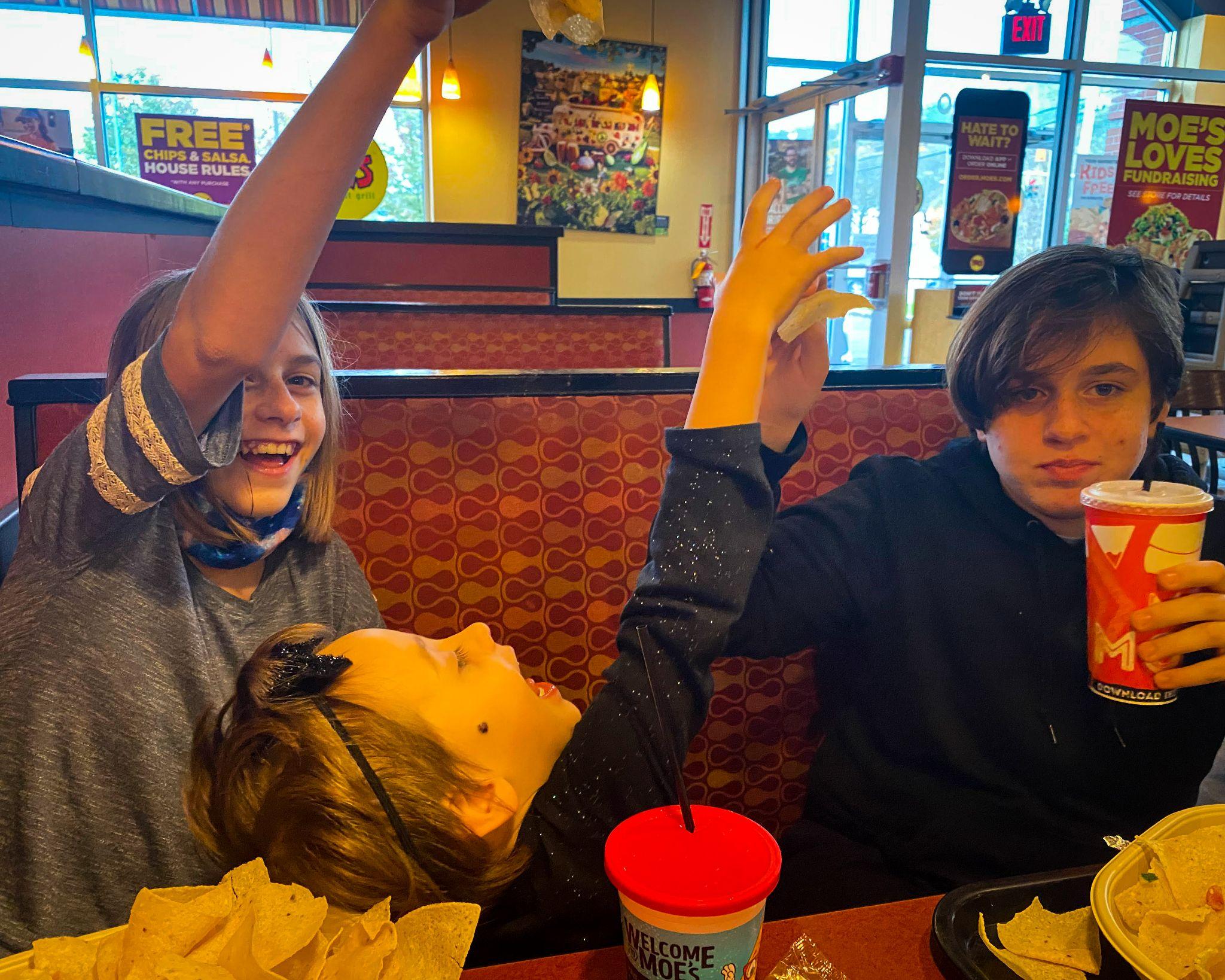
Today I picked a photo taken at a nearby restaurant during a recent visit with my kids. They were eating tortilla chips, playing, and having a great time together. Even my eldest seems pretty happy behind that hidden smirk.

I really cannot afford to eat out much with my kids when they visit. Eating out is expensive, especially when you can cook better food for less at home. Often, I find myself thinking a few days in advance of their visits about what we are going to eat, what I will prepare, and what snacks we can take on the road so that we won’t stop somewhere that will cost me an arm and a leg.

It may seem like eating out that day was an extravagance I cannot afford. My wallet agrees with that opinion, but for one afternoon a few visits back, there was time for laughter, joking around, and sitting with my kids instead of cooking a meal, serving a meal, and cleaning up the meal. It was such a blessing to just be with them and to be in their company.

I don’t know if the joy of being in someone’s company is why Mary stepped outside of cultural norms, but if it was, I completely understand. It is sometimes good to just be with someone as they go about life. Could Mary have listened while helping Martha? Maybe she could have done both, but I completely agree with Jesus. Mary was doing a pretty great thing by choosing to spend those moments the way that she did.

“Bring” and Blessing Bags

The #rethinkchurch Lenten Photo-A-Day prompt for today is “bring.” As someone who spends a lot of time taking pictures in nature or pictures of family, the idea of connecting one of my photos to the word “bring” was a bit of a challenge. Eventually, after a great search a long way into my photos, I found a picture of the blessing bags we have been handing out as a congregation to people in need. Each blessing bag has a small amount of food, water, and often simple necessaries like a comb, hand sanitizer, or a new toothbrush.

The idea of the blessing bag is simple. We may not hand out money to people on a street corner, but we will do our best to give them something concrete. How do we have these on hand when we come across someone in need? The answer is that we bring them in our cars, carry them in a backpack, or have them on hand when we are somewhere that they may bless someone in need.

In our devotional today, we read the story of Jesus’ interactions with a Canaanite woman who came to him in need. The story is in Matthew 15:21-28. Jesus’ dealt with the Canaanite woman with compassion.

At the end of the day, the purpose of the blessing bags is to be able to share compassion with others in a concrete way. Does everyone take them? No. Do some people really get frustrated that we are not handing them money? Yes. Why do we do it anyway?

We do it because we want to share with compassion. I know that when I hand out blessing bags it is often for the simple reason that I want to be compassionate but I don’t carry money with me. The closest branch of the bank where I have my account is in Corning, so I tend to do most of my transactions digitally. I cannot give people cash because I don’t have any cash on me, which is good because cash tends to burn a hole in my pocket.

I know that others hand them out for a very different reason. They hand out the bags because they want to do something more than hand someone money. Clean socks may not mean much to me, but to someone who never gets clean socks, they are a gift. Socks, water, and even hand sanitizer offered during a pandemic: each of these are kindnesses offered by one human being who sees the humanity in someone else. I see compassion in that loving act.

So, what do I connect with compassion and “bring?” Blessing bags! May God bless them, the hands that share them, and the hands that receive them.

“Enough” and the Lonely Leaf

The #RethinkChurch Lenten Photo-A-Day prompt for today is the word “enough.” In our devotional, I once wrote the words “Perhaps one might think of the cliche that it is better to laugh than cry.” In the story we read, grieving parents laugh as Jesus tells them that their dead child is merely sleeping. To be very clear, they laugh at Jesus instead of with Jesus.

My photo for today is a picture of a single leaf that I found fluttering besides a walkway in the Sapsucker Woods north of Ithaca. I walked through the woods last fall and saw this life. As I contemplated how the leaf sat on the end of the branch alone, I found a kinship with the leaf as it fluttered alone.

Is it better to laugh than to cry? Not always. It is certainly better to come to a place where you can laugh with Jesus rather than laugh at Jesus. Grief is a powerful thing and can cause a great amount of pain and disorientation. Would the parents laugh in the same way if Jesus had arrived before their child passed away? Often grief blinds us to the possibilities in front of us. The parents in the story with Christ were clearly in a place where they could not see beyond their grief.

I chose the picture of the leaf for “enough” for several reasons. First, the leaf was a beautiful leaf. As lonely as it seemed, it was still lovely. I am also enough even when I am alone. You are enough even when you feel lost or alone.

Second, I chose the leaf as an affirmation of the fact that last fall while I was on an afternoon walk there was enough goodness in the world that I was shaken out of my thoughts. I lay on the ground to get this photo from this angle. Would I rather have been somewhere else? Yes, but even when I was disoriented and somewhere I did not want to be, there was enough beauty in the world that goodness shone through my own sorrow.

Third, I chose the leaf as an affirmation of the fall. What I think is permanent today will one day fade away. My life is that of a leaf. One day it will be done. God willing, one day another leaf will fill my place in the world. I hope you have such a hope as well.

“Filled” and Lonely Mugs

The #RethinkChurch Lenten Photo-A-Day prompt for today is the word “filled.” When I consider all of the things that I might choose for the word filled, I lean towards my coffee cup.

In contrast to this image, the theme for today in our devotional revolves around grief. Jesus was the son of God, but also was the son of Joseph, Mary’s husband. As the devotional notes, Joseph has likely passed away by the time of the events of holy week.

There is an interesting question that connects the image of a coffee cup with questions of grief. What will happen to my coffee cup after I am gone? I have three cups in my church office. I rotate between an orange mug and a black mug, but I also have a mug covered in gnomes for when my children visit. What will happen to those mugs when I go?

I have served in many churches over the years and almost every church has a cupboard full of mugs. Some of the mugs are from church events, others are from various homes, and others have just shown up over the years. Will my mugs end up in a cupboard somewhere? Will someone else enjoy the joy of coffee from an orange mug or feel as serious when they drink from my black mug?

In the end, I do not know where my mug will end up. This is a simple reality at this point in my life. I neither grieve the fact that I will one day be gone nor mourn the fact that I do not know where my mugs will end up when everything is said and done. What I do know is that I should take today seriously because there are things far more important that I shall leave behind. Even more important than those things are the people that I will leave behind.

It doesn’t matter to me where the mug will end up, but it does matter whether or not I have a loving relationship with my children, my family, and the people I care about. I hope that Joseph left no relationship broken and no words unsaid. I hope that I might leave no words unsaid.

“Living” and Hunger

The #RethinkChurch Lenten Photo-A-Day prompt for today is “Living.” Throughout this week we have been looking at hunger and fullness in our devotional, but I wanted to take a moment to note that there is more than one type of hunger.

Last fall I spent a lot of time walking and praying. One place I went for an extended walk was in Chenango Valley State Park. If you spend enough time in Chenango Valley State Park, you will realize that there are definitely places where a lot of people travel and places where few people travel.

During my first few visits to the park, I spent a lot of time walking around the large loop which surrounds one of the lakes and crosses over what could be called the isthmus between the two lakes. As I continued to visit over the years, I found various walking paths down near the edges of the lakes, but there was one path that always tempted me. It just sort of went off into nowhere from behind a picnic shelter.

I wondered what might be back behind that picnic shelter visit after visit until I was so hungry to know what was back there that my dog and I went out exploring. We hiked, hiked, and hiked some more. Eventually we came out of one section of the path and found ourselves at the top of a hill looking over Chenango Valley. The view was breathtaking and there was this cute bench setup for people to rest and look down upon the valley.

An overlook in Chenango Valley State Park

This photo has little to nothing to do with actual hunger, but it does have a lot to say about how hunger for knowledge, love, or even food can affect the way we think. When we find ourselves hungry, our priorities can change, our limits can be stretched, and occasionally we realize that God is out there beyond the realm of where we are full and “happy” with the things around us.

I invite you to ask yourself if there is a place in your life where you are hungry. Is the hunger meant to teach you something or stretch you beyond the places where you are safe and comfortable?

“Repent” and the Flood

Sometimes everything aligns in a moment of serendipity. There have been several times where there have been challenges throughout this season of connecting devotional to the #RethinkChurch Lenten Photo-A-Day prompt. Today is not one of those days.

The first thing that I do in the process of writing these entries for Lent is to find photos that have potential to connect with the prompt. Today’s prompt word is “repent” and I found one photo and one photo alone that fit the prompt.

Last year, after a particularly stormy day, I decided to walk from my home to the nearby lake. It is a ten mile trip which is unfortunately only half downhill and unfortunately begins by going downhill. In other words, after I was halfway done the walk became much more difficult.

Still, I walked down to the lake and I was amazed by the amount of water. The water had risen far above the level of the ordinarily dry walkways and parkland. Looking out over the water, I was shocked by the way that features like trees, signs, and grills that I normally walked past on dry ground were being accosted by waves.

Why choose this photo for the word “repent?” It reminded me of Noah. What is Jesus discussing in our devotional? Noah! I even highlighted Luke 17:27, which says in the NRSV: “They were eating and drinking, and marrying and being given in marriage, until the day Noah entered the ark, and the flood came and destroyed them all.”

How could I pick any other image than the one good photo I have of a flood? In the days before the flood, people were walking the shore while looking for sea glass, grilling at picnics, and fishing on the pier. Suddenly the floodwaters came and there was nothing to do for it, but to give thanks to God that the storm had abated and the water would soon return to normal levels.

It seems silly to think that there might have been a person grilling or a child playing on any other day. It seems silly to compare these minor inconveniences to the “Day of the Lord,” but we all will face moments when we face things we never expected. The Day of the Lord comes to each of us even if the specific day of the Lord that Jesus was referring to in this gospel may have fallen upon Jerusalem long ago.

It is perhaps wisdom gained over the years, but I wonder if it is wiser to live a life where you have kept your life in order than to live a life where the end may come and you have not done all that needed to be done or said all that needed to be said. Perhaps it is better to live with a repentant attitude than to assume there will always be a tomorrow.

“Chosen” and generosity with wealth

The devotional asks us a question today without using a question mark. Our devotional says: “One deep question this raises is what we consider to be our wealth and what we consider to be God’s wealth.” What is our wealth? What is God’s wealth?

This past Monday morning, I had to drive down to Vestal in order to get my tooth fixed. Back in 2016 I had a golden crown put on a tooth which I have since privately called my “piratical tooth.” If my floss breaks while flossing, my tooth is likely being piratical. If a piece of food needs a good crunching, I often smile as I bare my teeth and chomp down with my golden tooth. I love my golden tooth and on Sunday night it tried to pull a runner.

I was nervous about the price of gas on the ride down to Vestal, which lasted until I was told that my dentist no longer accepts my insurance plan. I was then anxious about the cost of the tooth, but told the dental hygienist that I would have to have the work done without insurance. It hurt to breathe too hard over the tooth, I had accidentally had one splash of coffee on it which caused me to howl, and I frankly needed to eat at some point and would need my teeth.

I was worried about the cost, especially knowing that my wife would be expecting a check to help support the kids even if I had to pay for my tooth to be repaired. I was very anxious, but I decided to pray through the fear and have the work done. After a delightful hour chatting with the hygenist about everything from x-ray procedures, to being okay with new medication as we age (as long as we held out longer than our parents had before need it), to the fact that nobody likes the dentist but they aren’t nearly as scary as physical therapists, we came to the crux of the matter. I never once mentioned my fear about paying, but had decided to have a good conversation and a good attitude even though I was quaking in my boots.

The dentist didn’t charge me. They decided that this was just life with a crown, noted that I had the crown put in place nearly a decade ago, and decided that it must have been a fault in the cement. They knew I had a piece of candy and it pulled out the crown, but they decided to waive the fees for everything including the x-rays. I was so incredibly grateful.

What does it mean to be wealthy? For me, on Monday being wealthy was being in the hands of someone who could afford to be generous and guarantee their work long after I had gotten my original money’s worth. I have kids younger than that tooth but they decided that generosity was more important than profit today and I am grateful. Tonight I am wealthy, for I have a piratical tooth in working order again! I can chew without pain and that’s a gift of wealth that many people in history have not known.

The #RethinkChurch Lenten Photo-A-Day prompt for today is the word “Chosen.” In thinking of what it means to be chosen, I wanted to find a photo that fit both the prompt and the idea of extravagant wealth on God’s end. Enter the seagull…

I caught this seagull flying over the beach at Taughannock State Park last year. It was up in the wind, gliding around and looking for food. Well, I say that it was looking for food, but it honestly just seemed like it was having an awesome time surfing in the wind currents.

I have used this image to talk about the Holy Spirit before and probably will again, but let me reiterate what I have said in church. I grew up thinking that seagulls were flying rats. They would attack you with their enthusiasm if you dared to feed them, acted like vultures in the parking lot of fast food places, and there was no punishment for someone you didn’t like worse than dumping a bunch of fries on their car.

This flying rat, despicable creature, loathsome creation… My dear God in Heaven, it is absolutely stunning when the sun shines through those wings. The delicate wings, the beautiful feathers, the artistry involved in giving such beauty to something as common as a seagull. If that’s not true wealth being flaunted by the Creator, then I would be hard pressed to find another example (unless Ratatouille is based on a real story, which it better not be).

“Good” and the mystical faith

Our devotional reading for today begins with the line “Christianity is a mystical faith, but not a magical faith.” Depending on the version you are reading, there is unfortunately a typo in that line which makes it read “Christianity is mystical faith…” .Even now, my editing program is having a conniption over that phrasing and it makes me wonder how I missed it when reading the devotional through multiple times while searching for errors and typos.

Christianity is a mystical faith that connects the practical physical reality with something beyond normal understanding. In the scripture reading we read of thousands of people eating a shared meal after one child came forward with five loaves of bread and two fish. The story is amazing, but it is not the only story of how people have seen the wondrous happen without the blessing of incredible wealth.

Soldiers from two different nations stopped during the first World War for a day of shared peace on Christmas. The peace could not have been bought or sold, but it was shared freely with people who shared the same faith on different sides of a war as they remembered the words “Peace on earth, and good will to all.” Victims have forgiven people who have committed atrocities against them simply because God asked them to forgive others. A sailor engaged in human trafficking came to a point of conversion and decided to stand against the very practices he once engaged in for a living. As an abolitionist, he both advocated for the dignity of the people he once harmed and sang about the amazing grace that changed his life.

Often without a world of riches at their command and often against the expectations and desires of the wealthy and powerful, people have dug into empty pockets and found that they were far richer than it looked on the outside. God has a way of showing up in a miraculous way to provide for those in need, whether it be through a changed heart, a call to forgiveness, the same hymns sung in different languages, or even the willingness to share found in a boy with five loaves of bread and two fish.

The #RethinkChurch Lenten Photo-A-Day prompt for today is “good.” I am blessed in many ways, but being a parent has often stretched me beyond the ends of what I thought were my limits. I have cried for my children, held them while they are sick, prayed over them at a distance, and now regularly wake up in the middle of the night to wonder where they are and how they are doing at that moment.

I have not always been the perfect parent, but that is not the fault of my children. I often feel like a poor father and I cannot give them everything they want in this world. Somehow, I have still been considered worthy enough by God to be their dad. I love them deeply. They are good, even when I pray for a way to be a better father. On some days, I even allow myself to believe that I must be good if I have been entrusted with such amazing kids.

My eldest during a time when life was challenging. I have always believed with all of my life that my eldest is good and I am so grateful to be his father.

“Glory” and Sacrifices

We were directed to Matthew 9:9-13 in our devotional today. In the New Revised Standard Version, Matthew 9:13 has Jesus telling a crowd of religious leaders that they need to “Go and learn what this means, ‘I desire mercy, not sacrifice.’ For I have come to call not the righteous but sinners.”

What a powerful thing for the visible incarnation of the invisible God to say about people! For years the temple in Jerusalem had been filled with both those who appeared righteous and those who appeared “broken.” Sacrifices were brought in thanksgiving by those who were right with God and brought in repentance by those who had broken the covenant laws. The faithful and the sinners worshiped in the same space with two very different purposes.

When God did come to fulfill ancient promises of blessing, you might assume that God would have come to bless the people who looked righteous on the outside. If you believed that God had been willing to bless the faithful with abundant crops, fruitful families, and wealth, then it makes sense that God would come to bless the righteous. God might help those who had asked forgiveness, but it seems like common sense that God would first bless those who had been faithful and apparently blessed by God.

For Jesus to say that he came to call sinners and not the righteous was quite shocking to many people. The smoke that rose from the temple day after day in an attempt for people to honor God and gain divine favor might be lovely, but in the end, Christ was more interested in sharing mercy with those who were hurting instead of increasing the number of sacrifices.

Smoke on a BBQ Saturday at Trumansburg UMC

In choosing an image for today’s #RethinkChurch Lenten Photo-A-Day challenge, I chose an image of the sun pouring down the closest thing we get to a burnt offering at our church. It did take place outside the church, but the meat was neither burnt nor offered as a sacrifice. The sun was pouring down through the smoke of a chicken barbecue.

The prompt was the word “glory.” I chose the image because it was a pretty amazing and glorious sight to see the sun pouring through the smoke. It is also glorious that God no longer requires us to keep bringing fowl, cattle, sheep, and goats for burnt sacrifices. Jesus came out of a love for mercy and God’s mercy covers us through the love of Christ shown through Christ’s incarnation, death, resurrection, and exaltation. I believe that Christ’s merciful love will be seen again when Christ returns in what will likely be a different type of cloud than the smoke that comes from a bbq.

Come, Lord Jesus. Come.

“Dazzling” and the Beatitudes

The #RethinkChurch Lenten Photo-A-Day Challenge for today revolves around the word “dazzling.” When thinking about the word dazzling, a lot of images come to mind. My thoughts are filled with vibrant, bright, and amazing concepts. A starry night can be dazzling as can the sunshine pouring through stained glass windows.

At first glance, the idea of something being dazzling stands a bit at odds with the devotional reading for the yesterday. We read through the beatitudes in Luke 6 yesterday (which will happen often during this Lenten season with the beatitudes). We are asked by our devotional this week to consider how Jesus views both poverty and wealth.

What does it mean when Jesus says that the poor shall have the kingdom of God? What does it mean when Jesus says that the rich have already received their consolation? How does this reversal of how wealth is commonly seen affect our understanding of Christ? How does it relate to what is truly dazzling?

At Trumansburg through this season we are nailing words to our cross on Sundays. Yesterday we nailed both wisdom and foolishness to the cross. After the service someone came up to me and asked why we nailed both to the cross. Why would surrender wisdom to God on the cross? It was a great question and the simplest answer is that we are nailing our understanding to the cross.

To put it simply, we tend to have an upside down understanding. We think someone is doing well when we see someone with an expensive car, nice clothes, and money to buy anything they want. When someone walks through the door of the church with dirty clothes, an unwashed face, and a gurgle in their stomach, we sometimes wonder what is going on with them. We assume one is blessed and the other is struggling.

Jesus states that the poor will one day have the kingdom of God and that the rich have already received their blessings. In light of eternity, we can understand why Jesus says that we should be wary of becoming and even be sympathetic for the rich who seem to have everything but one day may have nothing compared to those who are suffering now. Even if you do not like this interpretation of the scriptures and wish to shift to language like “poor in Spirit” to shift away from a glorification of poverty, it is hard to get around Jesus’ warning about being rich in Luke.

Sunrise during the first week of 2022

So, what photo did I pick when I wanted to think of something dazzling that had nothing to do with having riches? I wanted to share a photo of something that not only was available to everyone and was likely to be seen only by the people who woke up early to put their nose to the grindstone, woke up early due to restlessness, and generally only seen by those who were either up late working or at least not sleeping in late. It is imperfect as some people work odd hours, but I have faith people can understand why a sunrise is something that is both dazzling and available to the rich and poor alike.

“Pray” and True Wealth

Throughout the readings from our devotional for this week there is an exploration of wealth. What does it mean to be truly wealthy? For Jesus there was a difference between having things and being truly wealthy. One could reasonably argue that a woman who has two coins that she can afford to give to God should be seen as being richer than a person with a wallet bursting at the seams while struggling to let go of the tiniest sliver of their fortune.

The #RethinkChurch Lenten Photo-A-Day prompt is the word “Pray.” In selecting a photo for today, I pondered through a great number of photos. In the end, I selected a beautiful flower standing out from the green leaves.

The flower blossom is quite beautiful. The stamen of the flower are outstanding in beauty and quite literally standing out like yellow hands that are waiting to shake an insect’s hand. The purple petals are an inviting shade that contrasts nicely with the green leaves and stems that surround them. If I had to choose what part of this plant to be, it seems like it would be lovely to be this blossom. You could say it seems like it would be a rich experience to be so bold, beautiful, and vibrant.

At the same time, true wealth might rest in being grateful to be whatever part of the flower you might be in this life. You might not wish to be a green leaf or a tough stem, but what an amazing gift it might be to experience the joy of being green or woody.

Many people spend their lives wishing that they were someone else, own something else, or have more of what they already have in this life. People scrabble, hoard, and envy the people around them in lives marked with competition, jealousy, and striving.

What would it look like if we prayed less about having more and prayed more about being grateful? What would it look like if we prayed to have what we need and were grateful for those blessings? What would it look like if we prayed less about having riches and prayed more from a place of gratitude for what we have in this life?

I may never be a vibrant purple flower, but I might be an amazing woody stem. If I can find the richness of having a gruff exterior with a tough hide, then I will be truly wealthy even without the yellow highlights.

“Celebrate” and Quiet Prayers

There is a question repeated several times with several different phrasings throughout the reading from our devotional for today: “What is in the closet of your heart today?”

The phrase itself refers back to the reading from Matthew 6:5-6. In that passage, Jesus teaches that when people pray they should seek to pray in secret. In the NRSV, Jesus says. “go into your room and shut the door and pray to your Father who is in secret; and your Father who sees in secret will reward you.”

As we pray, what is waiting in the closet of our hearts? When we go to pray, what are we sharing with God inside of our hearts and souls? As it is Sunday and a day of celebration, it is fitting that the #RethinkChurch Lenten Photo-A-Day prompt is the word “celebrate.”

Buckwheat Chocolate Chip Scones

Like many people, I find that it is great to celebrate with a treat. A few months ago, my kids and I were celebrating time together when we decided to make scones for breakfast. We wanted something sweet, but money has been tight.

We dug through the freezer and cupboards and found the ingredients for scones. My middle child found the chocolate chips in the back of the freezer, I found the right type of flour, and my youngest happily knew where we store the butter in the fridge. We put everything together, rolled out the dough, and baked the scones.

What is in the closet of my heart when I think of the word “celebrate?” My closet is filled with hopes and dreams. What does my prayer look like as I think about celebrating? It is full of joy for the celebrations of the past and pleading for celebrations in the future.

Does the prayer mean less because I do not lift it up in church during the prayers of the people? Does the church have a magical microphone that enables God to hear those prayers better? On both counts, the answer is “no.” If anything, the prayers I pray in my heart are likely all the more sacred as they dwell between God and me alone.

Whatever your prayer life is like today, I pray that you know that God hears our prayers. We do not need to stand on a street corner or have a microphone to be heard by God. To be sure, it is a powerful thing to pray together. It is great to be encouraged by praying with others, comforted by sharing prayers with others, and blessed by being invited into prayer for others. Still, the prayers of our quiet spaces are just as sacred to the God that calls us to come and pray in secret.

“Protect” and the Withered Hand

The #RethinkChurch Lenten Photo-A-Day prompt for today is “Protect.” The scripture reading in our devotional today is a story (found in Luke 6:6-11) of Jesus healing a man on the Sabbath. The individual had a hand that is described in the New Revised Standard Version of the Bible as being “withered.”

While the daily prompts have generally fit nicely with our devotional, today’s prompt is a bit challenging. I do not always do yoga, but I have been known to stretch ideas when necessary. Hopefully I will not stretch the idea of protecting too far.

What an interesting thing it is to see Jesus love someone and have compassion despite the fact that other people did not see his actions as being holy or righteous. The healing Christ performed on the Sabbath may have been fine on another day, but to violate the Sabbath commandments to avoid work seemingly struck them as a violation of the law.

At one level, I have to admit that I find the reaction of the religious leaders to be an understandable reaction. Their reaction might even be seen as admirable if you consider the extent of their commitment to their faith. While their heart was clearly in a different place than Jesus’ heart, it is understandable that there might be a push towards a very strict faith. The people in our story were living in a world that seemingly had turned against the people of God through the powerful forces of foreign empires and armies. They believed fiercely in their faith because they were likely concerned about losing their way if they loosened their grasp.

Still, as admirable as their tenacity was in such circumstances, they still missed the point. Jesus saw an individual who was hurt and who needed compassion. The people were so focused on the rules that they lost their perspective. I wish I could say that this was a problem that has disappeared over the centuries, but the modern church has often struggled with compassion and love when confronted with hurt people who are easily labeled as “sinners.”

Lily the Dog watching over us

In choosing a photo to portray this point, I went through my old photos and found a picture of my dog Lily standing underneath the trees in one of our favorite spots on the Interloken trail in the Finger Lakes National Forest. Lily looked so noble while looking around to make certain that everything was safe and that we were alone in the fields.

I still do not know how to tell a dog that we are sitting in the middle of a pasture that is fenced in on every side. There are no predators in the field. On that particular day, there weren’t even any cattle in sight. We were in an empty field and there was no reason to be anxious.

I have noticed over the years that we often get our hackles up and prepare to defend ourselves and our faith from threats that really aren’t threats. At the best of those times, we look like Lily being overprotective in an empty field. At the worst of times, we end up causing or threatening real harm to people who have done nothing more than have a withered hand on the Sabbath.

Personally, I plan to spend some time today thinking about the fact that there may be places in my life where I am dead set on protecting something and possibly missing the forest for the trees. I know that my dog isn’t the only silly creature in my home.

“Alone” and Compassion

The #RethinkChurch Lenten Photo-A-Day prompt for today is “alone.” What a word for contemplation, especially for a father in the midst of working his way through a separation! “Alone” is a word that I have pondered many times over the past few months.

A phrase stands out in our devotional reading for today: “Even when put in a challenging place, Jesus responds to challenge with compassion.” If we are called to become more like Jesus during this journey towards the cross, then what does it look like when we seek to respond to our challenges with compassion?

When writing this section of the devotional, my life was in a far more different place. As I work through this devotional alongside the members of my church, it is with a sense of wonder. Who was the person who wrote these words? I remember the hours working on this devotional, but now see the passages with different eyes and definitely answer the questions differently than I would have when I wrote this devotional.

In selecting a photo for today, I wanted to think about what it means to truly be alone. At the beginning of this oddly horrifying and challenging set of circumstances, I found myself filled with grief over the quiet house, the silent bedrooms, and the challenges of cooking for fewer people. Now, I find myself often coming across beautiful and wonderful things that are bitterly sweet.

Black Diamond Trail in Trumansburg, NY

I took this photo on a cold winter’s day while walking with my dog down a nearby trail. The path was empty of anyone, although there was clearly evidence that I was not the first person to enter the woods. For the entirety of the journey, I was alone with my dog. The wind blew through the branches, the dog snuffled through snow drifts and marked the snow, but it was otherwise silent.

It was beautifully still and silent. A world of icy stillness and solitude for just my dog and me. The sunlight shone through the branches and the snow sparkled underneath golden beams. It was truly amazing that I was able to see such beauty and it felt like that moment was for me and me alone. In the beauty and quiet, I felt as if God was walking right there with me.

It was sweet to know that I still matter enough that God draws near to me in such still spaces. It was sweet to know that God loves me deeply and truly despite the challenges of the past few months. It was also bitter to realize that I might have shared such a moment with my children a year ago.

How do I respond to these challenging moments with compassion? How do I love the people who have broken my heart through either their choices or simply doing their work? These are thoughts for my journal and not my blog, but I can state that this is where the journey for me begins today.

“Full” and Ash Wednesday

The word of the day for the #ReThinkChurch Photo A Day campaign is “Full.” In our devotional, Ash Wednesday revolves around the depth of old words. Our devotional journey begins with the reminder that: “Old words whisper out over many pews today.” The old words do resonate throughout this day and throughout the season ahead of us.

The traditional words that might ring through your memories may be “Remember that you are dust, and to dust you shall return.” Perhaps you remember hearing “Repent, and believe the gospel.” Perhaps the words that ring through your memories are not rooted in old and meaningful liturgies. Perhaps you hear are “The journey has begun. Let us journey together with Christ.”

In contemplating the words that ring out through my memory thanks the Photo-A-Day, I remember the words that have historically have little to do with Ash Wednesday, even if they are fitting. I remember two lines from the Wesley Covenant Prayer, which is often shared each January by Methodist congregations. The lines are “Let me be full. Let me be empty.”

“Wheat Sanctuary Window” in Trumansburg UMC

What does it mean to be full? One photo I considered using is the photo I edited of the window with sheaves of wheat from our sanctuary. The reason I would share such a photo is that I want to be filled with God’s love and light to the point where I am gathered in with the harvest. I do not desire to be set aside or blown away by the wind. I want to be gathered in as a treasure. I want my life to be so full of goodness that I would be gathered in with the wheat.

At the same time: “Let me be full. Let me be empty.” I want to be the person that God want me to be. If my life is filled with glorious goodness and obvious giftedness, so be it. If I am easily seen as a person whose life should be gathered in, so be it. Also, if I seek to be faithful but stumble throughout my days, so be it. If I seek to be easily gathered in but end up rubbing all of the other stalks of wheat the wrong way or end up being a cornstalk in the middle of the wheat, so be it.

Ultimately, the old words whisper out. This season is about the fact that God’s grace was necessary. Jesus walked down the road on a journey of redemption and we all need the love that Jesus shared long ago. I would be full, but even if I am empty, God’s grace is truly what I need on this journey.

I think this is the photo that I will end up using today: a tomato growing on a vine in the middle of winter. By all rights, the photo makes no sense. Who grows tomatoes in the middle of winter? Will it even taste the same after spending the winter under a grow lamp? Will it be delicious or weird? Will it become a vibrant healthy tomato or simply fall off the vine one day? Will the flowers nearby ever grow their own blessings or will they fall to the counter in exhausted emptiness? I don’t know. Let it be full. Let it be empty. An excellent analogy and start to a season of both wonder and solemnity.

Hydroponic tomatoes from my home

A Lunch Reflection

“Self-made people, and all heroic spiritualities, will try to manufacture an even stronger self by willpower and determination–to put them back in charge and seeming control. Usually, most people admire this, not realizing the unbending, sometimes proud, and eventually rigid personality that will be the long term result. They will then need to continue in this pattern of self-created successes and defenses. This pushy response does not normally create loving people, just people in control and in ever-deeper need for control. Eventually, the game is unsustainable, unless they make others, even their whole family, pay the price for their own aggression and self-assertion-which is the common pattern.”

BREATHING UNDER WATER: SPIRITUALITY AND THE TWELVE STEPS, RICHARD ROHR

I’m reading through Richard Rohr’s “Breathing Under Water.” I was just sitting down to a grain bowl for lunch after church and read this passage.

I would love to point out where I’ve seen this be true, but I’m not trying to be the kind of person who enjoys such efforts. Instead, I was more struck by the fact that the heroic spirituality pointed to in this paragraph is the very personality the church has tried to groom in me as a minister for years.

Be beyond reproach, be an attractive leader, dress handsomely, lose weight to attract more people, bring your kids to church, start a youth group, have lunch with the other ministers, do this, do that, and above all do everything while being humble yet confident.

I’ve bent over backwards thinking that I should be one way so many times. Maybe my back hurts from all of the spiritual contortions that I have put myself through time and time again.

Enthusiasm for today…

Empty streets below skies
blotted by ashen hued puffs.
No voices carry on cold wind
As footsteps seem noisy intrusions...
This is a still place...

Listen within. 
My soul breathes,
heart beats:
life.
This is a still place...

Yesterday it rained a lot here. From morning until evening, the skies were filled with rain and the temperature was just a few degrees above freezing. The few walks that I took with my dogs and children were taken on streets drenched in rain. The streets were mainly empty, which is pretty normal in quarantine. The cold rain only made the walks chillier, the yards emptier, and the entire area’s mood more somber.

For the last few weeks of quarantine, I’ve been slowly reading through Richard Rohr’s “Everything Belongs: The Gift of Contemplative Prayer.” I say that I’m reading it slowly because the price of Kindle books has taught me the wisdom of rationing books during this time of stillness. My personal budget for books has not grown even as the time to read them has increased…

The book is interesting. I do not always agree with Fr. Rohr’s writing, but thankfully my beliefs do not require me to agree with someone’s entire belief structure to glean wisdom where I find it. Let’s take this idea from Fr. Rohr which strikes me as particularly interesting on page 96:

If contemplation teaches us to see an enchanted world, cynicism is afraid there is nothing there. As a people, we have become cynical about ourselves, our world, our future. Some rightly said, “The problem is no longer to believe in God; it’s to believe in humanity.” We’re tremendously under-confident about what it means to be human. For many secular people today we live in a disenchanted universe without meaning, purpose, or direction. We are aware only of what it is not. Seldom do we enjoy what it is. Probably it is only healthy religion that is prepared to answer that question. Healthy religion is an enthusiasm about what is, not an anger about what isn’t.

Richard Rohr, page 96 of “Everything Belongs”

Yesterday, the world was empty, wet, cold, and windy. The weather outside was fairly to quite miserable. The news on the radio was not very warm and cuddly. I could have easily chosen to be angry about the world. I could choose to embrace anger, anxiety, fear, or despair.

Instead, I smoked a turkey that we froze in our freezer last fall. Earlier in the week I brined the turkey with a homemade brine. We thawed the turkey in a brine for five days. We brought the brine to a boil before cooling to room temperature prior to submerging the turkey. We smoked the turkey with cherry wood chips with brine in the water pan. With three hours left, we put potatoes underneath the turkey to smoke and to be flavored by any drippings falling from the turkey.

The turkey three hours before dinner. Confession: I forgot to take a picture when finished due to the busyness of the moment.

The day could have been thoroughly miserable, but there was opportunity to find joy even in the midst of a dark world. We cannot choose the world in which we live. We can choose how we try to approach the difficulties. Sometimes there are neurochemical challenges which require medical help, patterns of habits which are detrimental, or a propensity towards anxiety, depression, or fear; however, we still can make a choice.

Last night, we had smoked turkey with smashed smoked potatoes. The turkey was moist and flavorful, the potatoes were tasty, and the inevitable cranberry sauce was devoured. We have enough leftovers for the next few days today and turkey broth cooking in the slow cooker. Even these moments can be beautiful if we choose to find a reason for hope and joy. Perhaps you’re not a cook or have nobody to cook with, but this day is still the day we have for today. We can choose to be enthusiastic about what is rather than angry about what is not.

Brine Recipe: For every five pounds of turkey: 1 clementine sliced into wedges, 1 tsp prague powder #1, 1 tsp peppercorns, ¼ c brown sugar mixed into a brine made with enough water to submerge the turkey)